Economics 9708/43 — October/November 2022
Cambridge A-Level · A Level Data Response and Essays · worked solutions for every part, with the mark scheme
Topics Externalities, Social Costs and Benefits · Economic Growth and Sustainability · Government Policies to Correct Market Failure · Efficiency and Market Failure · Equity, Poverty and Redistribution · Market Structures · +14 more
The Hidden Cost of Palm Oil
Worldwide production of palm oil has been increasing for many years. Between 1995 and 2015, annual production quadrupled. The amount of land taken to produce palm oil is vast. It accounts for 10% of all global cropland.
Over 3 billion people in 150 countries now use products containing palm oil. The worldwide demand has raised incomes, especially in the rural areas of Malaysia and Indonesia that produce 85% of the output of palm oil. After the global economic crisis of 1998, the region had been suffering from a significant decline in the exports of manufactured goods. This had a detrimental effect on the balance of payments and resulted in external debt.
Nations producing palm oil view it as a means of reducing poverty, while international finance organisations regard it as an engine of growth for developing economies. The International Monetary Fund (IMF) encouraged Malaysia and Indonesia to cultivate natural resources and to produce more palm oil in spite of an awareness of high external costs. Dutch banks provided more than US$12 billion in loans to Indonesian producers. Palm oil is Indonesia’s main export earner.
Widespread adoption of palm oil began when, in 1995, one of the world’s major multinational companies decided to use it in its global food manufacturing industries instead of animal fats and other vegetable oils, which were then said to be unhealthy. It invested heavily in expanding palm oil plantations in Malaysia and achieved considerable cost savings because palm oil has a much higher yield per hectare than other vegetable oils.
Palm oil’s versatility is not limited to food. It is used in 70% of personal care products (toiletries) such as soap, shampoo and make-up. It is also increasingly used as biodiesel fuel.
As the palm oil industry expanded, conservationists began to raise the alarm about the devastating effects from carbon emissions and on wildlife habitats. Fires set to clear forests and create land for more palm plantations are the major source of greenhouse gas emissions in Indonesia. The financial incentive to produce more palm oil is helping to warm the planet, while destroying the only habitat of some rare animals.
In 2019, one supermarket promised to remove palm oil from all its own-brand foods. Norway banned imports for biodiesel production. The European Parliament proposed that public subsidies for biodiesel should be removed by 2021. If this proposal is enacted it will affect the demand for biodiesel and may force palm oil producing countries to reduce deforestation programmes, leading to improved environmental sustainability.
Fig. 1.1 illustrates the palm oil uses in Europe.
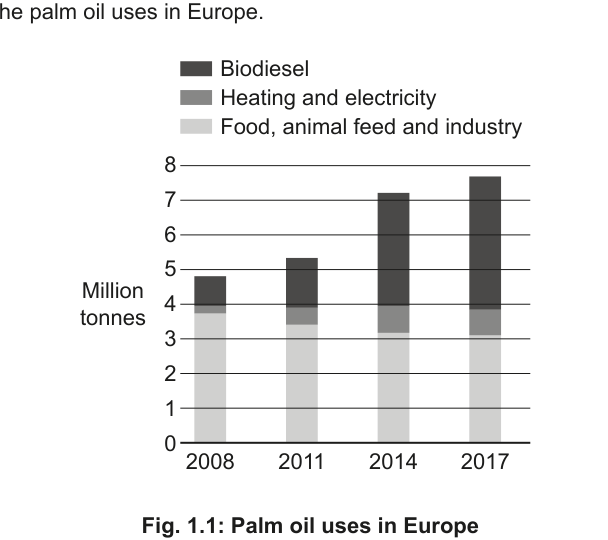
Fig. 1.1: Palm oil uses in Europe
Sources: 1. Article: The Hidden Cost of Palm Oil by Paul Tullis: The Guardian 19 Feb 2019
2. www.tranpsortenvironment.org/what-we-do/biofuels
Identify the trends in demand for different uses of palm oil as shown in Fig. 1.1.
Analyse why developing countries that produce palm oil view it as a means of poverty reduction.
Explain how a change in fiscal policy proposed by the European Parliament for 2021 regarding biodiesel could affect the economies of palm oil producing countries such as Malaysia and Indonesia.
To what extent do you agree with the advice of the IMF to encourage Indonesia to expand its production of palm oil?
The rest of this paper
6 more questions- Q2Efficiency and Market Failure · Externalities, Social Costs and Benefits · Equity, Poverty and Redistribution25M
- Q3Market Structures · Performance of Firms in Different Market Structures · Objectives and Pricing Policies of Firms · Costs of Production25M
- Q4Demand for and Supply of Labour · Wage Determination and Labour Market Intervention25M
- Q5The Multiplier and National Income Determination · Components of Aggregate Demand · Economic Growth and Sustainability · Employment and Unemployment · Short-Run and Long-Run Production25M
- Q6Economic Development and Living Standards · Characteristics of Countries at Different Levels of Development25M
- Q7Exchange Rate Systems · Effectiveness of Macroeconomic Policies · Macroeconomic Objectives and Policy Conflicts25M