Economics 9708/41 — October/November 2022
Cambridge A-Level · A Level Data Response and Essays · worked solutions for every part, with the mark scheme
Topics Economic Growth and Sustainability · Demand for and Supply of Labour · Wage Determination and Labour Market Intervention · Effectiveness of Macroeconomic Policies · Employment and Unemployment · Relationships Between Countries at Different Levels of Development · +6 more
Romania’s economy booms
Romania, like other former planned economies in eastern Europe has increased the amount of private enterprise and foreign direct investment (FDI) in its economy. Romania’s economy has boomed in recent years and compares favourably with economies in the European Union (EU) as indicated in Fig. 1.1.
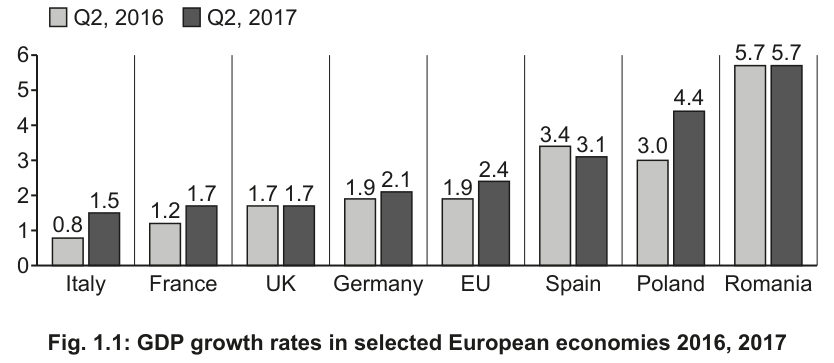
Fig. 1.1: GDP growth rates in selected European economies 2016, 2017
This economic boom has been characterised by the expansion of services and manufacturing sectors. In particular the high-tech industries have been very successful and are expected to double their contribution to GDP to 12% by 2025. The low wage rate in Romania was a benefit for foreign companies. For example, global car companies have, since 2008, invested US$1.4 billion in Romania’s car factories that has increased employment.
After Romania joined the EU in 2007, many Romanian workers took advantage of the free movement of labour the EU allows. In 2008, 600 000 out of a population of 21.2m left Romania. In spite of its economic boom, Romania has failed to attract sufficient workers back and there is now a shortage of labour. The total population is lower than in 2008 at 19.4m. Unemployment was only 5.9% in 2017 compared with an average rate of 8.6% for the EU as a whole.
Since 2015, the government has taken measures to boost the economy. It reduced sales tax from 24% to 19%, which increased consumer demand. It also doubled the national minimum wage providing a boost for both private sector and public sector employment.
But there are also serious economic challenges. The gap between government income and spending has widened causing a rising budget deficit. The transport infrastructure remains poor. In a World Economic Forum report in 2016, Romania was ranked 128th out of 138 countries for the quality of its road network and 79th for its railway system.
Sources: 1. Romania is poor man of the EU no more as economy booms, The Observer, 15 October 2017
2. Table 2.6 Private Sector Activity: ‘Transition Economics Two Decades On’, Gerard Turley and Peter J. Luke, Routledge 2011
Use the information to indicate how Romania’s economy performed in 2017 compared with the European Union as a whole.
Use the information to explain the reasons for Romania’s rapid economic growth.
Describe the changes in Romania’s workforce mentioned and consider whether they have been a benefit to Romania.
The information states that Romania had a budget deficit. Explain what is meant by a budget deficit and discuss whether the measures taken by the government in 2015 were likely to reduce this deficit.
The rest of this paper
6 more questions- Q2Externalities, Social Costs and Benefits25M
- Q3Objectives and Pricing Policies of Firms · Market Structures · Performance of Firms in Different Market Structures25M
- Q4Demand for and Supply of Labour · Wage Determination and Labour Market Intervention25M
- Q5Money and Banking25M
- Q6Economic Development and Living Standards · Economic Growth and Sustainability25M
- Q7Effectiveness of Macroeconomic Policies · Economic Growth and Sustainability25M