Economics 9708/43 — May/June 2022
Cambridge A-Level · A Level Data Response and Essays · worked solutions for every part, with the mark scheme
Topics Economic Growth and Sustainability · Efficiency and Market Failure · Market Structures · Short-Run and Long-Run Production · Performance of Firms in Different Market Structures · Objectives and Pricing Policies of Firms · +7 more
Productivity in the G7 countries
The G7 is a group of countries that have some of the world’s major advanced economies. Productivity in the G7 countries varies, as shown in Fig. 1.1 below, with United Kingdom (UK) performance as the base index of 100.
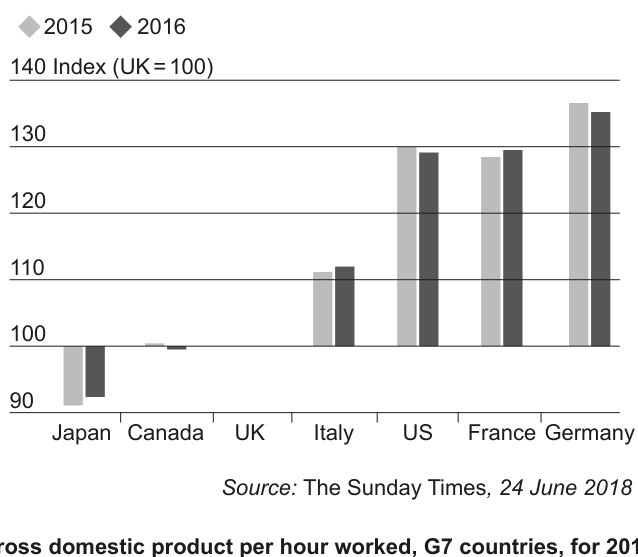
Fig. 1.1: Gross domestic product per hour worked, G7 countries, for 2015 and 2016
Source: The Sunday Times, 24 June 2018
Productivity in the UK was one of the worst in the G7. Poor management practices and lower levels of skills in the workforce were the main reasons for the UK’s position. In low wage, high employment sectors of the UK economy, the performance compared unfavourably with five of the G7 countries. In retailing, the UK was 40% lower than the performance in the United States (US). In hospitality industries the UK had a 45% lower rate than France.
Tackling poor productivity is about innovation, investment and improving infrastructure as well as labour skills.
The Federal Reserve Bank of the US suggested that innovation is one of the keys to productivity differences among the G7 countries. Innovation can occur using different factor inputs such as IT hardware and software, investment in staff training, research and development (R&D) and marketing. In 2015, the US had the most advanced software and IT services industries in the world accounting for a third of the global IT market. In 2018, the industry accounted for 12% of private sector employment and contributed 7.1% of GNP. Three of the top ten IT companies in the world were based in the US.
In 2014, in the UK, businesses spent US$26 billion on R&D, notably on digital technology and biomedical research projects that are world-renowned. However over the past 25 years R&D in the UK has only averaged between 1% and 1.3% of GNP and falls behind Japan with 3.4%, Germany 2.9%, the US 2.7% and France 2.2%.
There were concerns about the UK government reducing spending but in 2018 it made a commitment to a large investment programme in transport and communications to provide a boost to productivity. At that time one threat to the UK economy was its decision to leave the European Union’s single market. The decision created uncertainties for investors and the balance of foreign direct investment (FDI) showed that there were more investments abroad than there were foreign investments in the UK. This made some UK industries, such as car production, vulnerable. The central bank in the UK has stated that foreign owned car manufacturers in the UK invest heavily in R&D and their presence boosts the productivity of labour. It was thought this may change in the future.
Sources: The Sunday Times 24 June 2018, David Smith (Economic Outlook). ‘We don’t need a new target but we must raise our game’.
The Times 27 June 2018, David Smith. ‘Inward Investment so important to Britain is now at risk’.
Office for National Statistics, Britain, 2016
Explain what is meant by productivity.
The information suggests that innovation and R&D are important in ensuring high productivity. Is this statement consistent with the evidence in Fig. 1.1?
Use the information to comment on productivity in the US and indicate which factors contributed to its performance.
Use the information to discuss whether or not it is likely that the UK’s productivity within the G7 countries will improve.
The rest of this paper
6 more questions- Q2Efficiency and Market Failure · Market Structures25M
- Q3Market Structures · Performance of Firms in Different Market Structures · Efficiency and Market Failure · Objectives and Pricing Policies of Firms25M
- Q4Wage Determination and Labour Market Intervention25M
- Q5Economic Growth and Sustainability · Economic Development and Living Standards · The Multiplier and National Income Determination25M
- Q6Money and Banking25M
- Q7Employment and Unemployment · Effectiveness of Macroeconomic Policies · Macroeconomic Objectives and Policy Conflicts25M