Economics 9708/43 — October/November 2021
Cambridge A-Level · A Level Data Response and Essays · worked solutions for every part, with the mark scheme
Topics Demand for and Supply of Labour · Characteristics of Countries at Different Levels of Development · Wage Determination and Labour Market Intervention · Efficiency and Market Failure · Government Policies to Correct Market Failure · Utility Theory · +9 more
The effects of European Union (EU) labour migration
In 2016 in the EU labour market there was free movement of people seeking work among the EU’s 28 member countries. One country reported that an extra 252 000 workers from other EU countries came to work there during 2014–2015. This meant that the total number of EU workers was 2.1 million, or 6.8% of the country’s workforce. The eight Eastern European countries that joined the EU in 2004 supplied 987 000 of those workers by 2015.
A critic of this free movement of labour stated that “It is the workers on low pay in the receiving country – and those out of work – who feel the consequences of uncontrolled migration. They are forced to compete for jobs with thousands of people from abroad, and they suffer downward pressures on their wages.”
In contrast, other studies have shown that migration of workers has been good for both economic growth and public finances. These studies reported “There is no correlation between high migration and unemployment. Unemployment fell significantly as total migration rose to a record level of 392 000 in May 2014. Migration is acknowledged to be positive for public finances. In the EU, migrants contributed US$25 billion more in taxes in the decade to 2011 than they used in welfare and public services. Wages may have been affected for low-skilled workers but only marginally downward.”
Other economists have argued that, in theory, “the impacts of immigration on wages and employment critically depends on whether migrants’ skills are complements to, or substitutes for, the skills of existing workers. These impacts vary between the short run and long run. In the short run if the skills of migrants and existing workers are substitutes, immigration can be expected to increase competition in the labour market and drive down wages. If, on the other hand, the skills of migrants are complementary to those of existing workers, all workers experience increased productivity which can be expected to lead to a rise in wages of existing workers. In the long run the economy can adjust to the increase in labour supply.”
Some governments have introduced a minimum wage to help those workers on low pay. The wage is set to increase to match any increase in inflation.
Sources: The Times, 18 May 2016, Daily Telegraph, 18 May 2016, BBC, 19 May 2016
Use a marginal revenue product diagram to illustrate what will happen to wages as a result of the changes mentioned by the critic of the free movement of labour (in the second paragraph).
Answer
In a perfectly competitive labour market, the firm's marginal revenue product (MRP) curve is its demand for labour. The supply of labour to the firm is perfectly elastic at the market wage. The increase in labour supply from migration shifts the industry supply curve to the right, lowering the equilibrium wage from W1 to W2. Consequently, the firm's supply curve shifts down from S1 to S2. At the lower wage, the firm hires more labour (from L1 to L2) as long as MRP exceeds the wage.
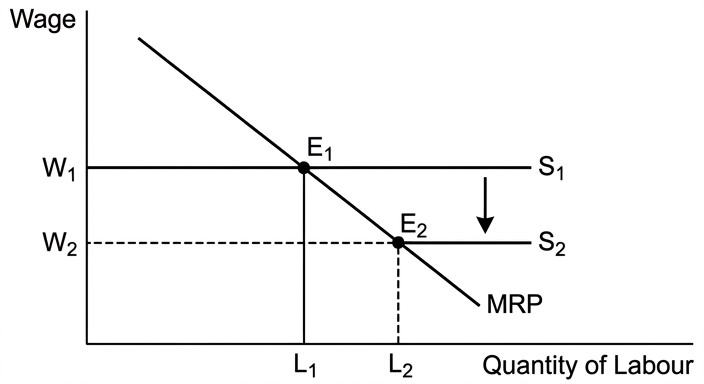
Wages fall as labour supply increases.
Background Concept
Marginal revenue product (MRP) is the additional revenue generated by employing one more unit of labour. In a perfectly competitive labour market, the firm's demand for labour is its MRP curve. The supply of labour to the firm is perfectly elastic at the market wage. The industry supply of labour determines the equilibrium wage through the interaction of industry demand and supply.
Understanding the Question
The critic claims that migration increases competition for jobs and puts downward pressure on wages. The question asks us to illustrate this using an MRP diagram. This is a 3-mark question, so we need to accurately draw and label the diagram, and explain the shift.
Approach
We will use a perfectly competitive labour market model. We need to show the initial equilibrium wage and employment, then show the effect of an increase in labour supply (from migration) shifting the industry supply curve right, which reduces the wage and shifts the firm's supply curve down.
Step-by-Step Reasoning
- Draw the firm's MRP curve (downward sloping) and the initial supply of labour (horizontal line at W1). The firm hires where MRP = W1, at L1.
- The industry has a supply curve of labour S1 and demand curve (sum of firms' MRP). The increase in labour supply shifts S1 to S2, reducing the market wage from W1 to W2.
- At the firm level, the new supply curve is horizontal at W2. The firm hires more labour L2 where MRP = W2.
- The diagram shows that wages fall, consistent with the critic's claim.
Key Takeaways
- An increase in the supply of labour, ceteris paribus, reduces the equilibrium wage in a competitive labour market.
- The MRP diagram is a standard tool to analyse labour demand and wage determination.
Common Mistakes
- Drawing a shift in the demand curve instead of supply.
- Forgetting to label the axes (wage, quantity of labour) and curves.
- Not linking the firm's supply to the industry supply.
Things to Be Careful About
- Clearly show the direction of the shift: supply right for industry, supply down for firm.
- Label all equilibrium points.
What do the high numbers of workers migrating from Eastern Europe to other countries in the EU suggest about the state of their own economies compared with the country to which they migrate?
Answer
The high numbers of workers migrating from Eastern Europe suggest that these economies have:
- Lower wages for workers with the same skills compared to the receiving country.
- Higher unemployment or fewer job opportunities, pushing workers to seek work abroad.
- Weaker infrastructure and welfare systems, leading to lower living standards.
- Possibly lower economic growth or development, making migration attractive.
These are the push factors that drive workers to leave their home countries.
The high migration suggests that Eastern European economies have lower wages, higher unemployment, fewer job opportunities, and lower living standards compared to the receiving country.
Background Concept
Labour migration is driven by differences in economic conditions between countries. Push factors are negative conditions in the home country that encourage emigration, such as low wages, unemployment, and poor living standards. Pull factors are positive conditions in the destination country, such as higher wages and better opportunities.
Understanding the Question
The article states that 987,000 workers from Eastern European countries migrated to another EU country by 2015. This suggests that the Eastern European economies are in a worse state than the receiving country, providing the push for migration.
Approach
We need to infer the economic conditions in the home countries based on the large outflow of workers. The answer should list push factors.
Step-by-Step Reasoning
- The high number of migrants indicates that wages in Eastern Europe are lower than in the destination country for similar skills, otherwise workers would not have the incentive to move.
- There must be higher unemployment or fewer job opportunities in Eastern Europe, pushing workers to seek work abroad.
- Other factors like weaker infrastructure, lower quality public services, and overall lower living standards contribute to the decision to migrate.
- The fact that the migration is from Eastern Europe to Western Europe suggests a clear development gap.
Key Takeaways
- Migration patterns reveal relative economic conditions.
- Push factors are key to understanding labour mobility.
Common Mistakes
- Only stating one reason; need to mention several factors.
- Confusing push and pull factors.
Things to Be Careful About
- Use the context of the EU free movement of labour.
- The question asks about the state of their own economies compared to the receiving country, so the comparison is essential.
Explain whether the introduction of a minimum wage will always result in a different outcome for employment from that which would occur in a free market.
Answer
The introduction of a minimum wage will not always result in a different outcome for employment. It depends on:
-
The level of the minimum wage relative to the market-clearing wage.
- If the minimum wage is set below the equilibrium wage, it is non-binding and has no effect on employment.
- If set above the equilibrium wage in a competitive labour market, it creates a surplus of labour (unemployment) as quantity supplied exceeds quantity demanded.
-
The market structure.
- In a monopsony labour market (single employer), a minimum wage can increase both wages and employment up to the competitive level, but if set too high, it may reduce employment.
- Thus, the outcome varies; it is not always a reduction in employment.
Therefore, the effect of a minimum wage on employment is conditional on its level and the structure of the labour market.
No, the introduction of a minimum wage does not always result in a different employment outcome. It depends on the level of the minimum wage relative to the market wage and the market structure.
Background Concept
A minimum wage is a price floor on labour. In a perfectly competitive labour market, a binding minimum wage (above equilibrium) causes a surplus of labour (unemployment). In a monopsony (single buyer of labour), the employer has market power, and a minimum wage can increase both wages and employment up to the competitive level.
Understanding the Question
The question asks whether a minimum wage always leads to a different employment outcome compared to a free market. The word "always" indicates we need to show conditions under which it does not change employment.
Approach
We need to explain two scenarios: (1) when the minimum wage is non-binding (below market wage), it has no effect; (2) when the market structure is monopsony, the effect on employment can be positive or negative depending on the level.
Step-by-Step Reasoning
- In a competitive market, if the minimum wage is set below the equilibrium wage, firms still pay the market wage, so employment unchanged.
- If set above equilibrium, the quantity of labour supplied exceeds quantity demanded, leading to unemployment.
- In a monopsony, the employer faces an upward-sloping supply curve. The employer hires where marginal cost of labour (MCL) equals MRP, paying a wage below the MRP. A minimum wage set between the monopsony wage and the competitive wage can increase both wages and employment (because it raises the wage and reduces the firm's marginal cost of labour up to a point). However, if set too high, it can reduce employment.
- Therefore, the outcome is not always different; it depends.
Key Takeaways
- The effect of a minimum wage is contingent on its level relative to the market wage and the market structure.
- Monopsony theory provides a counterexample to the simple competitive model.
Common Mistakes
- Assuming that a minimum wage always reduces employment.
- Ignoring the possibility of no effect when the minimum wage is below market wage.
- Forgetting to discuss monopsony.
Things to Be Careful About
- The question says "always result in a different outcome", so we need to show that it is not always the case.
- Use the term "market-clearing wage" and "binding" correctly.
With the help of information in the article assess whether the increasing numbers of migrant workers are an advantage or a disadvantage to the receiving country.
Answer
Advantages:
- Migrant workers can fill labour shortages, increasing the economy's productive capacity (AS) and reducing inflationary pressures.
- Migrants contribute more in taxes than they use in public services, improving public finances.
- The multiplier effect from migrant spending boosts aggregate demand and economic growth.
- If migrants' skills are complementary to those of domestic workers, productivity and wages for domestic workers can rise.
- Evidence in the article shows unemployment fell as migration rose, suggesting no negative correlation.
Disadvantages:
- Increased competition for jobs may reduce wages for low-skilled domestic workers, especially in the short run.
- Some domestic workers may become unemployed if their skills are substitutes for migrants' skills.
- Migrants willing to accept lower wages could cause industrial unrest and downward pressure on labour standards.
Conclusion:
On balance, the advantages appear to outweigh the disadvantages. The article's evidence shows a positive contribution to public finances and no rise in unemployment. The negative effects on low-skilled wages are marginal and can be mitigated by long-run adjustments, such as capital investment and upskilling. Therefore, increasing numbers of migrant workers are more of an advantage than a disadvantage to the receiving country.
On balance, the increasing numbers of migrant workers are an advantage to the receiving country, as the positive effects on economic growth, public finances, and filling labour shortages outweigh the marginal negative effects on low-skilled wages.
Background Concept
Immigration affects the labour market by increasing the supply of labour. The impact depends on whether immigrants' skills are substitutes or complements to existing workers. It also affects aggregate demand through spending and aggregate supply through labour force growth. Public finances are affected by tax contributions and use of public services.
Understanding the Question
The article presents both sides: the critic argues negative effects on low-paid workers; studies show positive effects on growth and public finances. We need to assess which side is stronger, using the evidence in the article. The question is worth 8 marks, so we need to develop both sides and reach a conclusion.
Approach
We will structure the answer in two parts: advantages and disadvantages, each supported by evidence from the extract. Then we will evaluate the relative importance and conclude.
Step-by-Step Reasoning
- Start with the positive effects: The article mentions that migration contributes to economic growth, public finances (US$25 billion more in taxes), and that unemployment fell as migration rose. Also, the theoretical point about complementarity can raise productivity and wages.
- Then the negative effects: The critic's point about job competition and downward pressure on wages, especially for low-skilled workers. The article acknowledges "marginally downward" effect on low-skilled wages.
- Evaluation: The evidence suggests that the positive effects are broad-based and significant, while the negative effects are marginal and concentrated. The long-run adjustments can alleviate the negative effects. Also, the article's data shows no correlation between high migration and unemployment, which weakens the critic's case.
- Conclusion: The advantages outweigh the disadvantages, making migration an advantage overall.
Key Takeaways
- Immigration analysis requires balancing microeconomic (labour market) and macroeconomic (aggregate demand, growth) effects.
- The use of empirical evidence from the extract is crucial for a high mark.
- A conclusion must be justified, not just a summary.
Common Mistakes
- One-sided answer: only discussing advantages or disadvantages.
- Not using the article's specific data.
- Giving a conclusion without justification (e.g., "it depends" without resolution).
Things to Be Careful About
- The command word is "assess", so we need to weigh up and make a judgement.
- The conclusion must be a clear verdict on whether it is an advantage or disadvantage.
- Use the extract's information: the $25 billion tax contribution, the fall in unemployment, the marginal downward wage effect.
The rest of this paper
6 more questions- Q2Efficiency and Market Failure · Government Policies to Correct Market Failure25M
- Q3Utility Theory · Indifference Curves and Budget Lines25M
- Q4Growth and Survival of Firms · Costs of Production25M
- Q5Money and Banking · Components of Aggregate Demand25M
- Q6Economic Growth and Sustainability · Employment and Unemployment · Macroeconomic Objectives and Policy Conflicts25M
- Q7Relationships Between Countries at Different Levels of Development25M