Economics 9708/42 — October/November 2021
Cambridge A-Level · A Level Data Response and Essays · worked solutions for every part, with the mark scheme
Topics Costs of Production · Market Structures · Performance of Firms in Different Market Structures · Efficiency and Market Failure · Government Policies to Correct Market Failure · Utility Theory · +8 more
Competition in the skies over Europe
In the sixteen months to April 2019 thirteen airlines ceased trading in Europe. This reflected a global trend where small airlines found it increasingly difficult to compete against large airlines, which have continued to grow.
Large airlines charge a price for a flight that includes meals and entertainment for passengers. Smaller airlines charge a price for the flight only and passengers need to pay extra for other services such as meals.
Large airlines benefit from economies of scale. Without these cost-reductions some smaller airlines have gone bankrupt.
The reduction in the number of airlines has not reduced the overcapacity in the market because the aircrew and aircraft of the bankrupt airlines were acquired by the remaining companies, which have developed into super-airlines. This has left passengers with fewer airlines to choose from and more expensive fares. It was predicted that this would lead to an increase in the market share for the top five European airlines from 50% of the European market in 2019 to match the top five United States (US) airlines, which control 77% of the US market.
The development of super-airlines took place at the same time as increasing regulation of the airline market. For example, the European Union (EU) will only grant operating licences for flights between EU countries to an EU airline. This has prevented non-EU airlines from competing on EU routes.
For the super-airlines, large scale is the easy way to avoid the stresses and strains of open competition. For passengers this will lead to higher prices and poorer service.
Sources: adapted from Financial Times, 6 October 2017 and The Economist, 27 April 2019
Using the information, explain the predicted effect of the development of super-airlines on the concentration ratio in the European airline market.
Answer
The development of super-airlines reduces the number of airlines and increases the market power of the top five airlines. The concentration ratio for the top five European airlines is predicted to rise from 50% to 77%, matching the US market. This makes the market more oligopolistic.
The concentration ratio increases from 50% to 77%, making the market more oligopolistic.
Background Concept
The concentration ratio measures the combined market share of the largest firms in an industry. A higher ratio indicates a more concentrated market, closer to monopoly or oligopoly. In this extract, the top five European airlines' share is predicted to rise from 50% to 77%.
Understanding the Question
The question asks you to use the information in the extract to explain the predicted effect of the development of super-airlines on the concentration ratio. The key data is the change in market share of the top five airlines from 50% to 77%.
Approach
Identify the relevant data: the number of airlines decreases, and the market share of the top five increases. State that the concentration ratio increases, and explain that this makes the market more oligopolistic.
Step-by-Step Reasoning
- The extract states that the top five European airlines' market share will rise from 50% to 77%.
- The number of airlines decreases because small airlines go bankrupt and are acquired by super-airlines.
- As a result, the market becomes more concentrated: the top five control a larger share.
- This is a higher concentration ratio, moving the market structure closer to oligopoly.
Key Takeaways
- Concentration ratio is a key indicator of market structure.
- Consolidation increases concentration.
- Use data from the extract to support your answer.
Common Mistakes
- Not linking the concentration ratio change to the data (50% to 77%).
- Simply stating 'the concentration ratio increases' without using the figures.
- Confusing concentration ratio with market share of a single firm.
Things to Be Careful About
- Ensure you quote the specific percentages from the extract.
- The answer should be concise and directly address the predicted effect.
‘Large airlines benefit from economies of scale.’
With the use of an example and a diagram, explain how a large airline can benefit from economies of scale.
Answer
Economies of scale occur when a firm’s long-run average cost (LRAC) falls as output increases. A large airline can benefit from technical economies of scale, for example by using larger aircraft that reduce cost per passenger, or by bulk purchasing fuel and aircraft parts. These reduce the LRAC, allowing the airline to operate at a lower unit cost than smaller airlines.
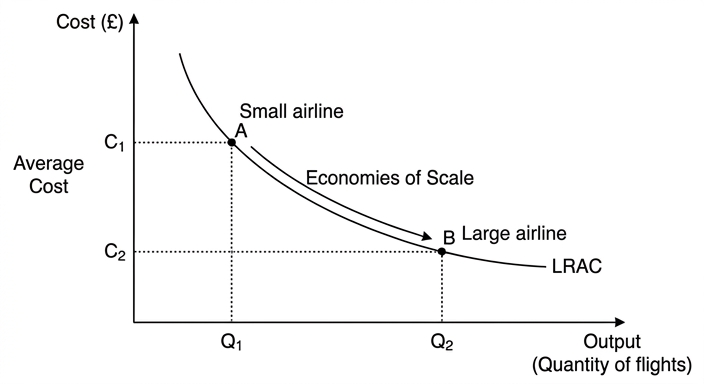
The diagram shows a downward-sloping LRAC curve, indicating that as the airline increases its output, average cost per flight decreases. This gives the large airline a cost advantage.
Economies of scale reduce long-run average cost, enabling larger airlines to operate at lower cost per unit.
Background Concept
Economies of scale refer to the reduction in long-run average cost (LRAC) as a firm increases its scale of production. This can arise from technical, managerial, financial, marketing, or other economies. The LRAC curve typically slopes downward over the range of increasing returns to scale.
Understanding the Question
The question requires you to explain how a large airline benefits from economies of scale, using an example and a diagram. The extract mentions that large airlines benefit from economies of scale, giving them a cost advantage over smaller airlines.
Approach
First, define economies of scale and state that they lead to falling LRAC. Then provide a specific example relevant to airlines (e.g., larger aircraft, bulk purchasing). Finally, draw and explain the LRAC diagram, showing how increasing output reduces average cost.
Step-by-Step Reasoning
- Define economies of scale: a fall in LRAC as output increases.
- Example: A large airline can purchase a fleet of larger aircraft, which have a lower cost per passenger-mile than smaller aircraft. Also, it can negotiate lower prices for fuel and maintenance due to bulk buying.
- These factors reduce the airline's LRAC.
- Diagram: Draw axes: Cost (vertical) and Output (horizontal). Draw a downward-sloping LRAC curve. Label it LRAC. Show that as output increases from Q1 to Q2, average cost falls from C1 to C2.
- Explain that the diagram illustrates that the large airline can produce at a lower average cost, giving it a competitive advantage.
Key Takeaways
- Economies of scale are a key reason for the growth of large firms.
- The LRAC curve is U-shaped, but the downward-sloping part shows economies of scale.
- Examples help to make the explanation concrete.
Common Mistakes
- Drawing a short-run average cost curve instead of LRAC.
- Not labeling axes or curves.
- Providing an example that is not clearly linked to economies of scale (e.g., 'more flights' does not necessarily reduce cost per unit).
- Forgetting to explain the diagram in words.
Things to Be Careful About
- The diagram must be fully explained in the text; a diagram alone is not sufficient.
- The example should be specific to airlines (e.g., larger aircraft, bulk purchasing).
- Ensure the axes are labelled correctly: cost/price on vertical axis, quantity/output on horizontal axis.
Explain what is meant by a contestable market and discuss how making the airline market more contestable could benefit passengers.
Answer
A contestable market is one with low barriers to entry and exit, so existing firms are constrained by the threat of potential competition from new entrants. Making the airline market more contestable would benefit passengers in two ways. First, lower prices: new airlines with lower cost structures would enter, forcing existing airlines to reduce fares to remain competitive. For example, budget airlines entering a route would drive down prices. Second, improved service quality: to attract passengers, airlines would offer better in-flight services, more frequent flights, and greater route choice. This increases consumer choice and satisfaction.
Making the market more contestable would lead to lower prices and improved service quality for passengers.
Background Concept
A contestable market is characterized by low barriers to entry and exit, meaning that new firms can easily enter if they see profit opportunities and exit without significant cost. The threat of potential competition forces existing firms to behave competitively, even if the market is dominated by a few firms.
Understanding the Question
The question asks you to define a contestable market and then discuss how making the airline market more contestable could benefit passengers. The extract describes the current situation with super-airlines leading to higher prices and poorer service, so the opposite would occur if the market were more contestable.
Approach
First, provide a clear definition of a contestable market. Then, identify two specific benefits for passengers: lower prices and improved service quality. For each benefit, explain the mechanism: lower barriers allow new entry, which increases competition, leading to lower prices and better service. Use the extract's context to illustrate (e.g., budget airlines charging lower fares).
Step-by-Step Reasoning
- Define contestable market: low barriers to entry and exit, threat of potential competition.
- Benefit 1 – Lower prices: New airlines can enter easily, especially if they have lower cost structures (e.g., budget airlines). To prevent losing customers, existing airlines lower their fares. This directly benefits passengers through cheaper tickets.
- Benefit 2 – Improved service quality: To differentiate themselves and attract passengers, airlines may offer better in-flight meals, more legroom, entertainment, or more frequent flights. This increases consumer choice and satisfaction.
- Conclude that making the market more contestable would reverse the negative trends described in the extract.
Key Takeaways
- Contestability is about the threat of entry, not just the number of firms.
- Benefits to consumers include lower prices, better quality, and more choice.
- Use the extract to anchor the discussion.
Common Mistakes
- Confusing contestable market with perfect competition (contestable markets can have few firms but low barriers).
- Only stating benefits without explaining the mechanism.
- Not providing two distinct benefits.
- Forgetting to define contestable market (first mark).
Things to Be Careful About
- Ensure the definition includes 'low barriers to entry and exit' and 'threat of potential competition'.
- Each benefit should be clearly explained with a causal link to contestability.
- The extract mentions that super-airlines lead to higher prices and poorer service, so the benefits are the opposite.
Identify the market structure for airlines in Europe in 2019 following the development of the super-airlines and discuss how airlines may compete in this market structure.
Answer
The market structure for airlines in Europe in 2019 is an oligopoly, dominated by a few large super-airlines. Airlines in an oligopoly may compete in several ways. First, price competition: airlines may cut fares to attract passengers, potentially leading to price wars. Second, non-price competition through product differentiation: airlines can offer different levels of service, such as meals, entertainment, and baggage allowances, to appeal to different customer segments. The extract notes that large airlines include meals in the price while smaller airlines charge extra for these services. Third, advertising and marketing: airlines use brand promotion, loyalty programmes, and advertising to build customer loyalty and increase market share. These competitive strategies can benefit passengers through lower prices and greater choice.
The market structure is oligopoly, and airlines compete through price competition, product differentiation, and advertising.
Background Concept
Oligopoly is a market structure with a few large firms dominating the market. There are high barriers to entry, and firms are interdependent. Oligopolistic firms can compete on price, product differentiation, advertising, and other non-price factors. They may also collude, but competition is common.
Understanding the Question
The question asks you to identify the market structure for airlines in Europe in 2019 following the development of super-airlines, and then discuss how airlines may compete in this market structure. The extract indicates that the top five airlines control 50% of the market (rising to 77%), and there are barriers to entry (e.g., EU licensing). This clearly points to oligopoly.
Approach
First, state that the market is an oligopoly. Then, discuss three forms of competitive behaviour typical of oligopolies: price competition, product differentiation (non-price competition), and advertising/marketing. For each, explain how it applies to the airline industry, using evidence from the extract where possible.
Step-by-Step Reasoning
- Identify market structure: The extract mentions that the top five European airlines control 50% of the market (rising to 77%), and there are barriers to entry (EU licensing). This is characteristic of an oligopoly.
- Price competition: Airlines may engage in price wars to attract passengers. For example, budget airlines offer lower fares, forcing super-airlines to reduce prices. This benefits passengers through lower fares.
- Non-price competition through product differentiation: Airlines differentiate their products by offering different levels of service. The extract notes that large airlines include meals in the price, while smaller airlines charge extra for meals. This is a form of product differentiation. Airlines may also offer different seat classes, entertainment, and loyalty points.
- Advertising and marketing: Airlines spend heavily on advertising to build brand loyalty and attract customers. Loyalty programmes (frequent flyer miles) are a key marketing tool. This increases market share and can create brand preference.
- Conclude that these competitive strategies can lead to lower prices and greater choice for passengers, but may also lead to wasteful competition or collusion.
Key Takeaways
- Oligopoly is identified by a high concentration ratio and barriers to entry.
- Firms in oligopoly can compete in various ways, not just price.
- The extract provides specific evidence of product differentiation.
Common Mistakes
- Only identifying oligopoly without discussing competitive behaviour.
- Discussing collusion as the only strategy (though it is possible, the question asks 'how airlines may compete', so focus on competition).
- Not providing three distinct forms of competitive behaviour.
- Not using the extract to support the discussion.
Things to Be Careful About
- Ensure you mention the concentration ratio from the extract to justify oligopoly.
- Each form of competition should be explained with a clear application to airlines.
- The discussion should be balanced, noting that competition can benefit passengers but also that firms might collude to raise prices.
The rest of this paper
6 more questions- Q2Efficiency and Market Failure · Government Policies to Correct Market Failure25M
- Q3Utility Theory · Indifference Curves and Budget Lines25M
- Q4Short-Run and Long-Run Production · Costs of Production · Objectives and Pricing Policies of Firms25M
- Q5Economic Development and Living Standards25M
- Q6Employment and Unemployment · Effectiveness of Macroeconomic Policies25M
- Q7Money and Banking · Equity, Poverty and Redistribution25M