Economics 9708/41 — October/November 2021
Cambridge A-Level · A Level Data Response and Essays · worked solutions for every part, with the mark scheme
Topics Economic Growth and Sustainability · Externalities, Social Costs and Benefits · Efficiency and Market Failure · Macroeconomic Objectives and Policy Conflicts · Costs of Production · Market Structures · +10 more
The economic impacts of the increasing use of all-electric cars
Some governments have agreed targets to reduce air pollution and, as part of this, are concerned about the social costs caused by the use of petrol and diesel vehicles. In response, car manufacturers are producing all-electric cars. The sales of these are increasing, especially in developed countries. The success of this switch to all-electric cars will depend on improving both battery technology as well as building an infrastructure in which, as drivers reduce their use of fossil fuels, electricity charging points will replace petrol pumps.
Fig. 1.1 shows the cumulative number of all-electric cars in the world between 2010 and 2016.
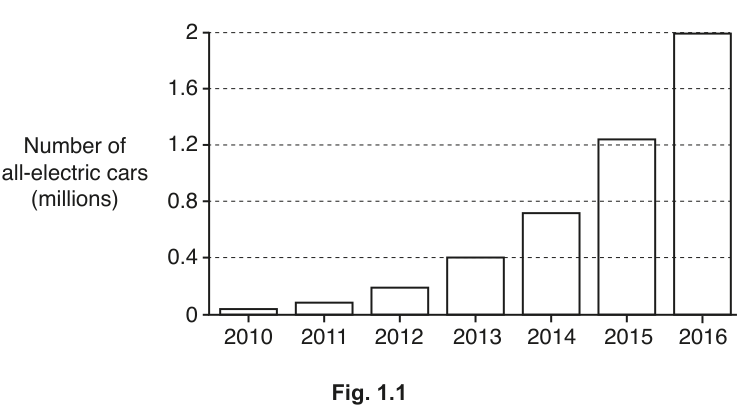
Fig. 1.1
Fig. 1.2 shows the annual sales of all cars in the world between 2010 and 2016.
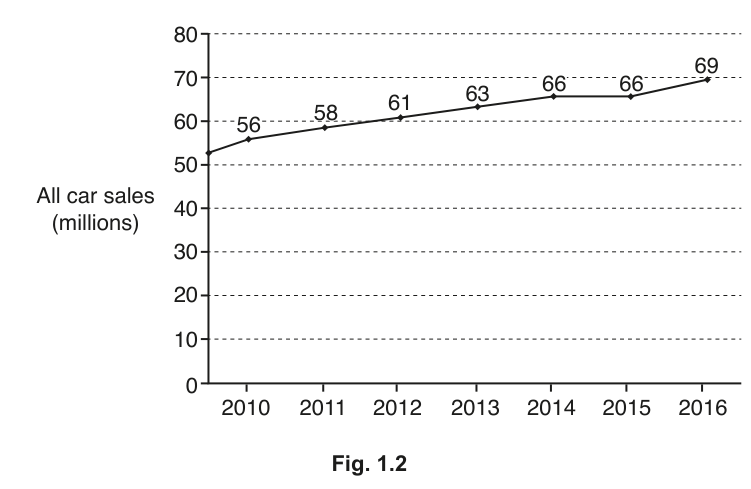
Fig. 1.2
Some forecasters predict that about one third of the world's cars will be all-electric by 2040. Their forecasts are based on the assumption that the costs of batteries to run these cars will have declined steeply from their present levels. Battery costs are dependent on supplies of various metals which are used as component parts. Supplies of these metals are finite and their prices, linked to mining costs, will be crucial in increasing the scale of all-electric car production.
In 2016, the cost of the batteries was 49% of the total cost of the car. In 2017 it was stated at a New Energy conference in Shanghai that battery prices would need to drop by more than half before all-electric cars would become competitive with cars powered by petrol and diesel engines.
Oil producers claim that growth in sales of all-electric cars will not substantially reduce world demand for oil. The world needs oil for much more than just cars. Cars account for only about a fifth of the 95 million barrels the world consumes every day. Most of the rest is used in industry or to fuel heavy goods vehicles, aircraft and ships, which do not have easy non-oil alternatives. In developing economies, petrol sales are expected to continue rising because these countries do not have the infrastructure or sufficient capital investment to enable the switch to electric vehicles.
Source: The Times, 31 July 2017; letters to the Guardian, 8 August 2017; World Motor Vehicle sales of new vehicles 2005–2016 published by OICA, accessed 8 August 2017
Comment on the relative significance of the growth in the number of all-electric cars for 2010–2016 compared with annual sales of all cars in the world.
Use the information to discuss what might happen to the long-run average cost of producing batteries for all-electric cars.
Use the information to assess whether it is likely that the switch to all-electric cars will substantially reduce world demand for oil.
Assess the effects on the social costs of transport of replacing diesel and petrol engine cars with all-electric cars.
The rest of this paper
6 more questions- Q2Efficiency and Market Failure · Externalities, Social Costs and Benefits · Market Structures · Performance of Firms in Different Market Structures25M
- Q3Demand for and Supply of Labour · Wage Determination and Labour Market Intervention · Efficiency and Market Failure25M
- Q4The Multiplier and National Income Determination · Effectiveness of Macroeconomic Policies · Components of Aggregate Demand25M
- Q5Money and Banking · Macroeconomic Objectives and Policy Conflicts25M
- Q6Economic Development and Living Standards · Relationships Between Countries at Different Levels of Development25M
- Q7Economic Growth and Sustainability · Macroeconomic Objectives and Policy Conflicts · Balance of Payments and Policies to Correct Disequilibrium25M