Economics 9708/43 — October/November 2020
Cambridge A-Level · A Level Data Response and Essays · worked solutions for every part, with the mark scheme
Topics Effectiveness of Macroeconomic Policies · Macroeconomic Objectives and Policy Conflicts · Economic Growth and Sustainability · Economic Development and Living Standards · Demand for and Supply of Labour · Relationships Between Countries at Different Levels of Development · +13 more
Economic links between developed and developing economies
In the developing world the working-age population is expected to increase. It was predicted in 2016 that in 2017 more than 1.1 million new workers would join the labour force each month. Sub-Saharan Africa was expected to experience the most rapid labour-force growth, but many developing countries in Asia and the Middle East would be close behind.
It was also forecast that by 2030, developing and emerging economies will have added 1.7 million workers a month to their labour force. China, by comparison, added an average of 1.1 million workers a month from 1978 to 2011. Therefore, to absorb these workers developing nations must create jobs at a faster rate than China experienced during one of its fastest periods of economic growth (8–10% a year).
Capital inflows to developing countries rose in 2016 after almost a decade of decline caused by the global financial crisis of 2007–8. Capital flows are needed to finance manufacturing and infrastructure. The rise in capital flows could provide not only welcome economic growth for developing economies by providing facilities for more employment but also benefit developed economies.
But there is a risk that these mutually beneficial gains will not occur.
First, despite the recent increase, capital flows to developing economies remained low, as shown in Fig. 1.1.
Secondly, some domestic policies of developed countries do not help. In the United States (US) policies to protect its manufacturing industries, such as iron and steel, and measures to halt the flow of economic migrant labour have created uncertainties in the global economy. There is a disincentive to invest in the developing world and a redirection of savings into the US economy.
Some economists argue that if the mutual benefits from the developed world to developing and emerging economies do not occur the alternative will be even greater economic migration as millions of young people from Egypt, India, Nigeria, Pakistan, Mexico and the Philippines, enter the labour force without the prospect of meaningful employment and make their way to rich countries, legally or otherwise in search of work.
Source: adapted from The Economist, The World in 2017, December 2016
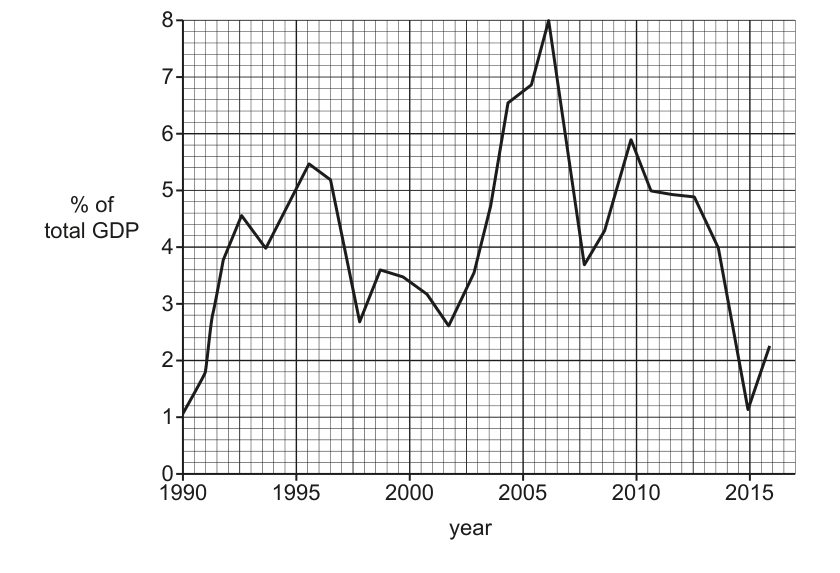
Fig. 1.1 Total private capital flows to 25 emerging economies (including China) as a % of total GDP, 1990–2016
The article mentions economic growth. What is meant by economic growth?
Explain how economic growth is linked to a country’s level of development.
Explain why economic migrants are mainly from the developing economies.
Discuss, using the information, whether links between developed economies and developing economies are necessarily ‘mutually beneficial’.
The rest of this paper
6 more questions- Q2Efficiency and Market Failure · Externalities, Social Costs and Benefits · Government Policies to Correct Market Failure25M
- Q3Utility Theory · Indifference Curves and Budget Lines · Revenue and Profit25M
- Q4Market Structures · Performance of Firms in Different Market Structures · Objectives and Pricing Policies of Firms · Costs of Production25M
- Q5Wage Determination and Labour Market Intervention25M
- Q6Employment and Unemployment · The Multiplier and National Income Determination · Effectiveness of Macroeconomic Policies · Macroeconomic Objectives and Policy Conflicts25M
- Q7Effectiveness of Macroeconomic Policies · Macroeconomic Objectives and Policy Conflicts25M