Economics 9708/42 — May/June 2020
Cambridge A-Level · A Level Data Response and Essays · worked solutions for every part, with the mark scheme
Topics Performance of Firms in Different Market Structures · Costs of Production · Effectiveness of Macroeconomic Policies · Employment and Unemployment · Externalities, Social Costs and Benefits · Indifference Curves and Budget Lines · +8 more
The impact of economic concentration
By locating closely together manufacturers can often gain economic benefits. The makers of industrial machines save on transport and communication costs when they are close to the firms that supply their raw materials and components. A group of similar manufacturers attracts a large number of workers with similar skills. Educational and training facilities in the area will develop courses and research skills that support the local industry. Similar benefits also occur in service industries, for example with the concentration of information technology in Silicon Valley and finance in New York, Hong Kong and London, where groups of accountants, merchant bankers and specialist lawyers in mergers and acquisitions all exist in close proximity.
The scope for concentration depends on the size of the market. The recent trend towards globalisation has increased the size of the available market. This has allowed some internet retailing firms to overcome competition from other countries. But the overall impact has been the delivery of a wide range of goods and services at low prices that have benefited consumers everywhere. This suggests that globalisation has not been a 'zero-sum' game.
But concentration has not always been beneficial. Silicon Valley has significant traffic congestion and many local people are priced out of the housing market. Seven of the ten most polluted cities in China are in Hebei Province, a centre for the iron and steel industry. This concentration has caused large amounts of air, water and land pollution. The competing demand for a limited number of workers has also led to wage increases.
Geographical concentration of an industry can lead to problems when demand for the product changes. This has been evident in the United States (US) where the city of Detroit has experienced unemployment rates as high as 25% (see Fig. 1.1) and a fall in its population by over 60% because of the decline in Detroit's motor industry caused by vehicle imports and the movement of production to US states where trade unions are not as strong.
Source: The Economist, 21 October 2017
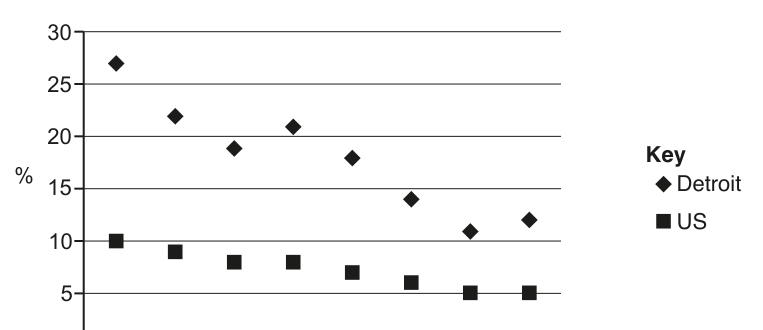
Fig. 1.1: Unemployment rates in the US and Detroit, 2010–2017
Source: US Bureau of Labor Statistics, accessed 12 May 2018
Explain the meaning of zero-sum in game theory.
Answer
In game theory, a zero-sum situation is one where the total benefit is fixed, so that one party can only gain if the other party loses (and vice versa). The gains of the winners exactly match the losses of the losers, resulting in a net change of zero.
A situation where the total benefit is fixed and one party can only gain if the other loses.
Background Concept
Game theory analyses strategic interaction where the outcome for each player depends on the actions of others. A zero-sum game is a specific type of game in which the total payoffs sum to zero for all players combined. This means that any gain by one player is exactly offset by an equivalent loss by another player. Classic examples include poker or chess, where one person's win is another's loss. In contrast, most economic interactions are positive-sum (or non-zero-sum), meaning trade can make all parties better off.
Understanding the Question
The extract describes globalisation as not being a 'zero-sum game' because it has delivered benefits to consumers everywhere. The question asks you to explain what is meant by 'zero-sum' in the context of game theory. This is a straightforward definition question worth 2 marks.
Approach
Provide a concise definition that captures the essential feature of a zero-sum game: the fixed total benefit and the mutually exclusive nature of gains and losses. A clear example may help illustrate the concept, though for 2 marks a precise definition is sufficient.
Step-by-Step Reasoning
- Start by stating that game theory studies situations where players' outcomes depend on each other's choices.
- Define zero-sum: the total benefit (or payoff) available in the game is fixed.
- Explain the consequence: because the total is fixed, one player can only improve their position if another player's position worsens by the same amount.
- Mention that the net change across all players is zero.
- Optionally, contrast with non-zero-sum situations (like trade) where all parties can gain.
Key Takeaways
- Zero-sum implies a fixed pie: one person's gain is another's loss.
- This concept is important in understanding competitive situations like oligopoly (e.g., price wars) or international trade negotiations.
- Globalisation is described as positive-sum because it can expand the total benefits available.
Common Mistakes
- Confusing zero-sum with negative-sum (where total losses exceed gains) or positive-sum (where total gains exceed losses).
- Forgetting to mention that the total benefit is fixed.
- Providing a lengthy example instead of a clear definition.
Things to Be Careful About
- Keep the definition tight and precise for 2 marks.
- Ensure you mention both the fixed total and the one-gain-one-lose relationship.
- Do not confuse game theory with general competition; zero-sum is a specific mathematical property of the game's payoffs.
Use the information to explain how external economies of scale develop. Show, with the aid of a diagram, how this would affect a firm's average costs.
Answer
External economies of scale can develop when firms in the same industry locate close to each other. First, there can be a common supply of raw materials, components, and a pool of skilled labour, which reduces input costs for all firms. Second, ancillary services such as specialist education, training, and legal services develop to support the industry. These external economies reduce the long-run average cost (LRAC) for all firms operating in the area.
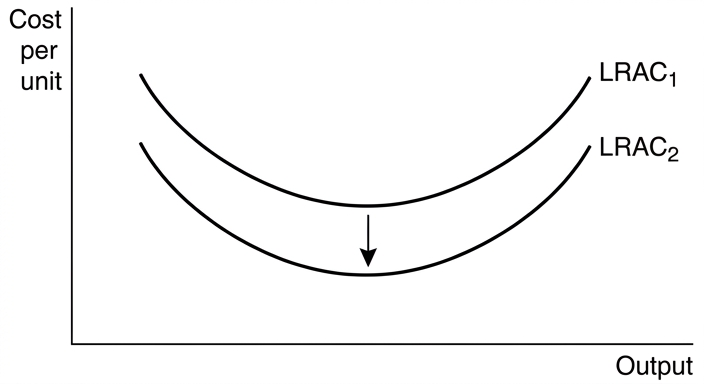
The diagram shows the long-run average cost curve shifting downwards from LRAC1 to LRAC2, indicating a reduction in average costs at all levels of output due to external economies of scale.
External economies from pooled resources/skilled labour and ancillary services shift LRAC downwards, reducing average costs for all firms in the area.
Background Concept
Economies of scale are cost advantages that firms obtain as they increase their scale of production. Internal economies arise from the growth of an individual firm (e.g., technical, managerial, financial economies). External economies of scale, however, arise from the growth of the industry as a whole, often due to geographical concentration or clustering. When firms locate near each other, they can share infrastructure, a skilled labour pool, supplier networks, and specialist services. This reduces the long-run average cost (LRAC) for all firms in the area, shifting the LRAC curve downward.
Understanding the Question
The extract describes how manufacturers locating closely together gain benefits such as savings on transport and communication costs, access to skilled workers, and the development of educational and training facilities. The question asks you to explain how these external economies of scale develop and to show, with a diagram, how they affect a firm's average costs. This is a 5-mark point-based question.
Approach
- Identify the sources of external economies mentioned in the extract: pooled skilled labour, supplier networks, and ancillary services (education, legal, finance).
- Explain how each source reduces costs for firms.
- State the effect on LRAC: a downward shift.
- Draw a diagram showing LRAC shifting down from LRAC1 to LRAC2.
- Explain the diagram in the prose.
Step-by-Step Reasoning
Development of external economies:
- Pooled resources and labour: When manufacturers cluster, they create a large pool of workers with industry-specific skills. Firms can hire skilled workers more easily and at lower cost because the labour supply is concentrated. Similarly, suppliers of raw materials and components locate nearby to serve the cluster, reducing transport costs and just-in-time inventory costs.
- Ancillary services: A concentrated industry attracts specialist services such as legal firms (for mergers and acquisitions), financial institutions, and educational/training facilities that develop courses tailored to the industry's needs. These services are more efficient and accessible when clustered.
Effect on costs:
- These external economies lower the cost per unit for all firms in the area at every level of output. This is represented by a downward shift in the long-run average cost (LRAC) curve.
Diagram:
- Draw the LRAC curve (U-shaped) for the original cost structure (LRAC1).
- Draw a second LRAC curve (LRAC2) below the first, showing that average costs are lower at each output level.
- Label the vertical axis 'Cost per unit' and the horizontal axis 'Output'.
- Explain that the shift from LRAC1 to LRAC2 represents the cost savings from external economies.
Key Takeaways
- External economies benefit all firms in a cluster, regardless of their individual size.
- They are a key reason for industrial clusters like Silicon Valley or the motor industry in Detroit (before its decline).
- The diagram must show a shift of the entire LRAC curve, not a movement along it.
Common Mistakes
- Confusing external economies with internal economies (which come from a single firm's expansion).
- Drawing a movement along the LRAC curve instead of a shift.
- Forgetting to label axes and curves.
- Listing sources without explaining how they reduce costs.
Things to Be Careful About
- The question asks how external economies 'develop' — focus on the process of clustering and the resulting shared resources.
- The diagram must clearly show LRAC1 and LRAC2 with LRAC2 below LRAC1.
- Ensure the explanation links the sources (labour, suppliers, services) directly to the reduction in average costs.
There is a fall in demand for the product of a geographically concentrated industry. Analyse the economic implications of this for the area where the industry is located.
Answer
A fall in demand for the product of a geographically concentrated industry will have several economic implications for the area:
-
Structural unemployment: Workers in the declining industry will lack the skills required for growing sectors, leading to structural unemployment. This is evident in Detroit, where the decline of the motor industry caused unemployment rates to rise to 25% (Fig. 1.1), well above the US national average of around 5-10%.
-
Local negative multiplier effect: As workers lose their jobs, their incomes fall, reducing their spending on local goods and services. This causes further rounds of income reduction in the local economy, amplifying the initial shock and leading to additional job losses in non-manufacturing sectors.
-
Falling house prices and population outflow: Rising unemployment and lower incomes will reduce demand for housing, causing house prices to fall. This, combined with a lack of job opportunities, will lead to an outflow of population as workers move to areas with better employment prospects, as seen in Detroit's population fall of over 60%.
The area will experience structural unemployment, a local negative multiplier effect, falling house prices, and population outflow as workers migrate to find employment.
Background Concept
When an industry is geographically concentrated, a region becomes specialised in that sector. A fall in demand for its product creates a regional economic shock. Unlike a diversified economy, the concentrated area cannot easily absorb the shock. Structural unemployment arises because workers' skills are specific to the declining industry and they cannot simply switch to other sectors without retraining. Geographical immobility prevents them from moving to other regions. The multiplier effect operates locally because the initial reduction in income leads to reduced consumption of locally produced goods and services, causing secondary rounds of job losses.
Understanding the Question
The question asks you to analyse the economic implications for an area when demand falls for the product of a geographically concentrated industry. The extract provides the example of Detroit, where the motor industry declined due to imports and production moving to states with weaker trade unions. Fig. 1.1 shows Detroit's unemployment rate was much higher than the US average from 2010-2017. The mark scheme requires three effects, each analysed for 2 marks.
Approach
Select three distinct implications and develop each with a clear chain of reasoning, using the extract's evidence (Detroit's 25% unemployment, 60% population fall, Fig. 1.1) where relevant:
- Structural unemployment and skill mismatch.
- Local negative multiplier effect.
- Falling house prices and demographic change (population outflow).
Step-by-Step Reasoning
Effect 1: Structural unemployment
- Fall in demand -> firms reduce output and lay off workers.
- Because the industry is concentrated, workers are heavily concentrated in this sector and possess industry-specific skills (e.g., motor vehicle manufacturing skills in Detroit).
- These skills are not easily transferable to other industries, creating structural unemployment rather than cyclical unemployment.
- Workers face geographical immobility (family ties, housing costs, lack of information about jobs elsewhere) and occupational immobility (lack of transferable skills).
- Evidence: Detroit's unemployment rate reached 25% and remained significantly above the US national average (Fig. 1.1 shows Detroit around 12-27% vs US 5-10% in 2010-2017).
Effect 2: Local negative multiplier effect
- Laid-off workers have lower disposable incomes.
- They reduce spending on local services (retail, restaurants, entertainment) and goods.
- This reduces the income of workers in those sectors, who in turn spend less, creating further rounds of income reduction.
- The initial fall in manufacturing employment is multiplied into a larger total fall in local employment and income.
Effect 3: Falling house prices and population outflow
- Higher unemployment and lower incomes reduce demand for housing in the area.
- House prices fall, reducing household wealth and confidence, which further reduces consumption.
- Workers migrate to other areas where jobs are available (e.g., to US states with growing industries or weaker unions where production moved).
- Evidence: Detroit's population fell by over 60%.
Key Takeaways
- Geographical concentration creates vulnerability to sector-specific demand shocks.
- Structural unemployment is more persistent than cyclical unemployment because it involves skill and geographical mismatches.
- The local multiplier amplifies the initial economic shock.
- Regional decline can become self-reinforcing through falling house prices and out-migration.
Common Mistakes
- Describing the trend in Fig. 1.1 without linking it to the analysis of structural unemployment.
- Confusing structural unemployment with cyclical or frictional unemployment.
- Forgetting that the multiplier effect is localised and specific to the concentrated area.
- Listing points without developing the causal chain (e.g., stating 'unemployment rises' without explaining why it is structural).
Things to Be Careful About
- Always link the fall in demand to the geographical concentration — this is why the effects are concentrated in the area.
- Use the data from the extract and Fig. 1.1 to support your points (e.g., 25% unemployment, 60% population fall).
- Ensure each effect is a distinct chain of reasoning, not just a list of outcomes.
Consider how the negative externalities from concentrated industrial production can be reduced.
Answer
Negative externalities occur when the production or consumption of a good imposes uncompensated costs on third parties who are not involved in the market transaction. In the extract, concentrated industrial production causes negative externalities of production, such as the air, water and land pollution in Hebei Province from the iron and steel industry. There are also negative externalities of consumption, such as the traffic congestion in Silicon Valley caused by the concentration of information technology firms and their employees. In both cases, marginal social cost (MSC) exceeds marginal private cost (MPC), leading to overproduction or overconsumption from society's perspective.
To reduce these negative externalities, two policies could be considered:
-
Taxation: A tax equal to the marginal external cost (a Pigouvian tax) internalises the externality by raising the firm's private cost to equal the social cost. For example, a carbon tax on steel production would reduce output towards the socially optimal level. However, this requires accurate measurement of the external cost and effective enforcement.
-
Legislation and regulation: The government could impose legal restrictions, such as emission standards, pollution permits, or zoning laws that separate industrial and residential areas. This directly limits the harmful activity. For instance, China could enforce stricter environmental regulations on factories in Hebei.
Both policies can be effective, but their success depends on enforcement and the specific context. Taxation provides a market-based incentive for firms to reduce pollution, while regulation sets clear legal boundaries. A combination of both, along with provision of information about environmental impacts, is likely to be most effective in reducing the negative externalities from concentrated industrial production.
Negative externalities can be reduced through market-based policies such as taxation to internalise costs, and through command-and-control policies such as legislation and regulation, with a mixed approach often being most effective depending on enforcement capacity.
Background Concept
Negative externalities arise when a market transaction imposes costs on third parties who are not compensated. This means the marginal social cost (MSC) of production exceeds the marginal private cost (MPC), and the marginal social benefit (MSB) may be less than marginal private benefit (MPB) for consumption externalities. The result is overproduction or overconsumption relative to the socially optimal level, creating deadweight welfare loss. Government intervention aims to internalise the externality — make the producer or consumer face the full social cost — so that market outcomes move closer to the social optimum.
Understanding the Question
The question asks you to consider how negative externalities from concentrated industrial production can be reduced. The extract provides two clear examples: pollution from Hebei's steel industry (negative externality of production) and traffic congestion in Silicon Valley (negative externality of consumption). The mark scheme requires an explanation of negative externalities with reference to the passage (3 marks) and consideration of two policies (taxation, subsidy, legislation, education) (4 marks). The command word 'Consider' implies evaluation and judgement.
Approach
- Define and explain negative externalities, explicitly referencing the extract's examples (Hebei pollution, Silicon Valley congestion).
- Select two policy instruments (e.g., taxation and legislation) and explain how each would reduce the externalities.
- Evaluate the strengths and weaknesses of each policy in the context of concentrated industry.
- Provide a justified judgement on which approach is most effective or whether a combination is preferable.
Step-by-Step Reasoning
Explanation of negative externalities:
- Negative externalities of production: Hebei's iron and steel industry produces air, water and land pollution. The firms bear private costs (raw materials, labour) but the local population bears external costs (health problems, environmental damage). MSC > MPC.
- Negative externalities of consumption: Silicon Valley's IT concentration generates traffic congestion as workers commute. The drivers bear private costs (fuel, time) but other road users and residents bear external costs (delays, pollution). MSC > MPC.
- In both cases, the market fails because producers/consumers do not face the full social cost, leading to overproduction/overconsumption.
Policy 1: Taxation (Pigouvian tax)
- The government imposes a tax equal to the marginal external cost (MEC) per unit.
- This shifts the private cost curve up to align with the social cost curve.
- Firms reduce output to the socially optimal level where MSC = MSB.
- Advantages: Market-based, efficient if MEC is known correctly, generates revenue.
- Disadvantages: Difficult to measure MEC accurately (e.g., valuing health impacts of pollution), may be politically unpopular, enforcement challenges.
Policy 2: Legislation and regulation
- The government sets legal limits on pollution emissions, requires specific technologies, or zones industrial activity away from residential areas.
- This directly restricts the harmful activity regardless of cost.
- Advantages: Certainty in outcome (e.g., emission caps), politically visible, can be designed to address specific hazards.
- Disadvantages: Inflexible (does not account for differences across firms), costly to monitor and enforce, may create compliance costs without considering cost-effectiveness.
Evaluation and judgement:
- The choice depends on the nature of the externality and institutional capacity.
- For pollution with measurable damages, taxes are economically efficient but require good data.
- For hazards where any amount is harmful (e.g., toxic waste), regulation may be preferable.
- In practice, a mixed approach (tax plus regulation plus information provision) is often most effective.
- The extract mentions both production and consumption externalities, so a combination of policies tailored to each is appropriate.
Key Takeaways
- Negative externalities cause market failure because private costs diverge from social costs.
- Government intervention can internalise externalities through taxes, subsidies, regulation, or provision of information.
- The effectiveness of policy depends on accurate measurement, enforcement, and the specific context of the externality.
- 'Consider' questions require evaluation of alternative policies and a justified conclusion.
Common Mistakes
- Explaining externalities in general without referencing the specific examples in the extract (Hebei, Silicon Valley).
- Listing policies without explaining how they work or evaluating their effectiveness.
- Providing a one-sided answer that only lists policies without weighing their pros and cons.
- Ending with a summary rather than a justified judgement.
Things to Be Careful About
- Always link the explanation to the extract's evidence.
- For 'Consider' questions, ensure you evaluate both policies and reach a clear verdict.
- Mention the importance of enforcement — a policy is only effective if implemented and monitored.
The rest of this paper
6 more questions- Q2Indifference Curves and Budget Lines25M
- Q3Costs of Production · Performance of Firms in Different Market Structures · Growth and Survival of Firms · Objectives and Pricing Policies of Firms25M
- Q4Efficiency and Market Failure · Government Policies to Correct Market Failure25M
- Q5Macroeconomic Objectives and Policy Conflicts · Effectiveness of Macroeconomic Policies25M
- Q6Characteristics of Countries at Different Levels of Development · Economic Development and Living Standards25M
- Q7Money and Banking · Effectiveness of Macroeconomic Policies25M