Economics 9708/42 — May/June 2019
Cambridge A-Level · A Level Data Response and Essays · worked solutions for every part, with the mark scheme
Topics Performance of Firms in Different Market Structures · Market Structures · Efficiency and Market Failure · Externalities, Social Costs and Benefits · Government Policies to Correct Market Failure · Objectives and Pricing Policies of Firms · +7 more
India’s grocery market
Amar Singh explained why he sells ‘exotic’ produce, such as broccoli and iceberg lettuce, at his vegetable stall in Mumbai. “I have to keep the customer in my grasp,” he said. Mr Singh has traded for 20 years, and is not worried by the supermarkets whose stores have recently opened nearby. “They are cheaper,” he said, “but they cannot match me on quality.”
In India, the 11 million small traders like Mr Singh are protected. India’s complex rules have made it difficult for supermarkets from developed countries to enter the Indian grocery market. Also, India’s domestic supermarkets account for only 2% of food and grocery sales and are struggling to make a profit. Revenues have not kept pace with rising rents. Reliance Fresh, one of India’s big supermarket companies, has recently closed some shops around Mumbai. The companies had hoped that as India became richer, its consumers would abandon kiranas (small family-owned shops) and stalls such as Mr Singh’s for modern supermarkets. This has not happened.
This may be because 70% of India’s population are rural dwellers so a localised strategy is vital to accommodate the variation in languages and cultures. India’s kiranas are often described as neighbourhood stores, embedded in their local communities. Many have been run by the same families for generations. They have a deep understanding of the local market and a good relationship with their customers, some of whom are loyal to the shop that their parents used. Today’s kirana and stall owners make product recommendations, offer credit to help shoppers balance their budgets, and can even obtain products not normally stocked. They will also deliver shopping to customers free of charge − something that the supermarkets struggle to match.
Long-established kirana retailers often also benefit from prime store locations, leaving modern supermarkets struggling to find space in existing shopping areas. Instead, supermarkets are forced to look for new places to develop larger stores.
Fig. 1.1 shows the results of a survey of customers in the largest cities in India to find their preferred place to purchase groceries and vegetables.
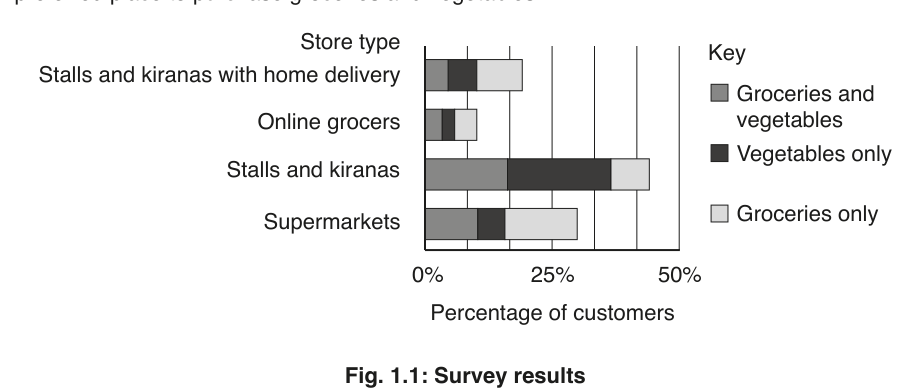
Fig. 1.1: Survey results
Sources: adapted from The Economist, October 2014, Laura May, academia.edu, April 2014 and Market Express India, September 2016
Identify two ways in which kiranas compete for customers.
What can be concluded about the groceries and vegetables trade in India from Fig. 1.1?
Use economic analysis to suggest the market structure in which kiranas operate and explain how equilibrium is reached by a firm in such a market.
Discuss how it might be possible for supermarkets in India to compete with the stalls and kiranas.
The rest of this paper
6 more questions- Q2Efficiency and Market Failure · Externalities, Social Costs and Benefits · Government Policies to Correct Market Failure25M
- Q3Objectives and Pricing Policies of Firms · Market Structures · Performance of Firms in Different Market Structures25M
- Q4Utility Theory · Indifference Curves and Budget Lines25M
- Q5Employment and Unemployment · Effectiveness of Macroeconomic Policies25M
- Q6Money and Banking25M
- Q7Economic Growth and Sustainability · Economic Development and Living Standards25M