Economics 9708/42 — October/November 2018
Cambridge A-Level · A Level Data Response and Essays · worked solutions for every part, with the mark scheme
Topics Economic Development and Living Standards · Equity, Poverty and Redistribution · Government Policies to Correct Market Failure · Efficiency and Market Failure · Market Structures · Performance of Firms in Different Market Structures · +11 more
What’s to be done about rising inequality?
There is great inequality of income and wealth in the United States (US), that many believe is not equitable. It seems, even to some of those who benefit from this inequality, that something should be done to reduce it. What are the strongest reasons for trying to bring about greater equality of income and wealth?
One obvious reason for redistributing resources from the rich to the poor is simply that this is a way of making the poor better off. Many people in the world are poor, and the improvement in their lives that richer people could bring about by giving money is enormous by comparison with the small sacrifice that this would involve. Redistributing assets increases the well-being of the poor more than it decreases that of the rich.
A justification for reducing inequality through non-voluntary means, such as taxation, needs to explain why redistribution of this kind is not just arbitrary.
The possibility of making the poor better off is not the only reason for seeking to reduce the world’s rising level of economic inequality. Many people in the US believe that high and rising levels of inequality are objectionable.
It is worth inquiring into why this might be so.
- Economic inequality can give wealthier people an unacceptable degree of control over the lives of others, for example over where and how they can work, what they can buy and in general what their lives will be like.
- Economic inequality can undermine the fairness of political institutions. If those who hold political offices depend on large private contributions for their election campaigns, they may be more responsive to the interests and demands of wealthy contributors, and those who are not rich will not be fairly represented.
- Economic inequality undermines the fairness of the economic system itself by making it difficult, if not impossible, to create equality of opportunity. For example, it means that some children will enter the workforce much better prepared than others and people with few assets find it harder to access a loan to start a business or to pay for higher education.
Source: Reasons we should fix economic inequality, TM Scanlon, accessed 19 April 2016
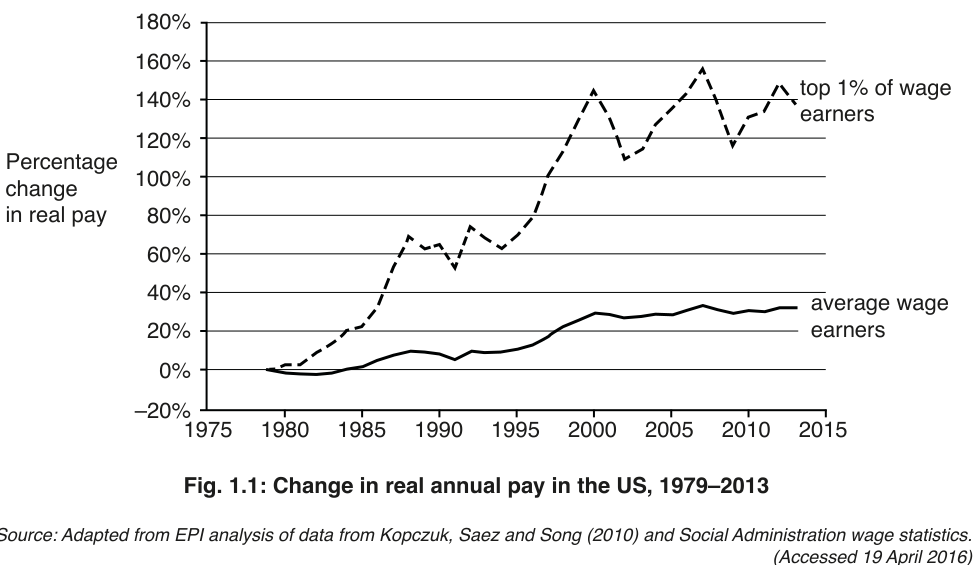
Fig. 1.1: Change in real annual pay in the US, 1979–2013
Source: Adapted from EPI analysis of data from Kopczuk, Saez and Song (2010) and Social Administration wage statistics. (Accessed 19 April 2016)
The article says that many in the US believe that inequality is not equitable.
What is the difference between equality and equity?
Explain, using the article, two ways in which inequality is considered harmful.
Consider whether the changes in real annual pay shown in Fig. 1.1 support the idea of rising inequality in the US.
The article refers to a reduction of inequality through taxation. Discuss the effectiveness of fiscal policy in redistributing income.
The rest of this paper
6 more questions- Q2Efficiency and Market Failure25M
- Q3Market Structures · Performance of Firms in Different Market Structures · Objectives and Pricing Policies of Firms · Growth and Survival of Firms25M
- Q4Demand for and Supply of Labour · Wage Determination and Labour Market Intervention25M
- Q5Employment and Unemployment · Economic Development and Living Standards25M
- Q6Components of Aggregate Demand · The Multiplier and National Income Determination · Effectiveness of Macroeconomic Policies25M
- Q7Characteristics of Countries at Different Levels of Development · Economic Development and Living Standards · Relationships Between Countries at Different Levels of Development · Economic Growth and Sustainability25M