Economics 9708/42 — February/March 2018
Cambridge A-Level · A Level Data Response and Essays · worked solutions for every part, with the mark scheme
Topics Costs of Production · Efficiency and Market Failure · Economic Growth and Sustainability · Market Structures · Government Policies to Correct Market Failure · Performance of Firms in Different Market Structures · +11 more
Problems in the steel industry
By 2016, China’s steel industry had expanded rapidly and accounted for just over half of world production but China’s economy had huge excess capacity: 30% in the case of steel which led to cheap export prices. Chinese economic growth in real terms was slowing and aggregate supply was greater than aggregate demand. Profit margins were already small but the collapse of world steel prices which fell significantly in 2015 (as shown in Fig. 1.1) worsened the situation.
The dumping of cheap Chinese imports of steel caused problems for the United Kingdom (UK) steel industry. There were thousands of job losses at three major steel factories which was devastating news for UK steel workers and the regional economies.
Some argued that despite this there was no case for the UK Government to intervene to save the steel factories.
Steel is used in the construction industry and in the production of cars, household appliances and many other goods. Companies that use steel are much more numerous than companies that produce it. If steel prices are low, the costs of companies that use steel are reduced. So there should be no complaints or pleas for government intervention about supposedly unfair competition from cut-price imports.
Industrial policy is a valid aim of government when it comes to identifying market failures. There is even a strong case for rescuing industries that face temporary external shocks, such as occurred with the United States (US) Government’s rescue of Chrysler and General Motors in 2008 as the economy fell into deep recession. For steel, however, it is a buyers’ market. The closure of unprofitable steel factories is not a market failure at all. It is a reflection of costs being too high and the industry being uncompetitive. Rescuing steel factories with public money would do nothing to alleviate the problem of overcapacity. It would divert scarce resources from more productive uses such as long term investment in infrastructure.
Steel price in US$
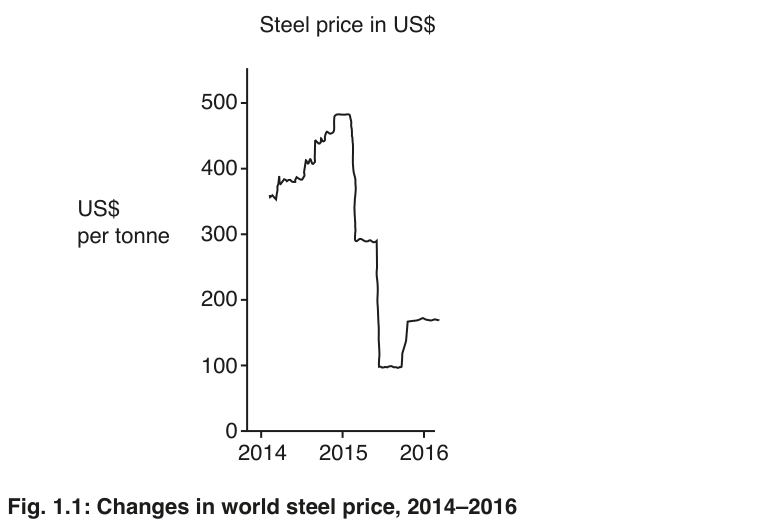
Fig. 1.1: Changes in world steel price, 2014–2016
Sources: The Times, 21 October 2015 and The Observer, 25 October 2015
What is meant by economic growth per capita in real terms?
Explain the difference between a firm’s variable costs and fixed costs. Consider which would be changed as a result of the changes in steel prices in 2015.
Why is the market for steel described in the article as “a buyers’ market”?
Explain what is meant by market failure. Discuss whether there is any evidence in the information that the government should support the steel industry because there is market failure.
The rest of this paper
6 more questions- Q2Indifference Curves and Budget Lines · Government Policies to Correct Market Failure25M
- Q3Efficiency and Market Failure · Equity, Poverty and Redistribution · Market Structures · Performance of Firms in Different Market Structures · Costs of Production25M
- Q4Demand for and Supply of Labour · Performance of Firms in Different Market Structures · Revenue and Profit · Costs of Production · Objectives and Pricing Policies of Firms25M
- Q5Money and Banking25M
- Q6Components of Aggregate Demand · The Multiplier and National Income Determination · Effectiveness of Macroeconomic Policies · Efficiency and Market Failure · Government Policies to Correct Market Failure25M
- Q7Economic Growth and Sustainability · Relationships Between Countries at Different Levels of Development · Globalisation and Economic Integration25M