Economics 9708/42 — May/June 2017
Cambridge A-Level · A Level Data Response and Essays · worked solutions for every part, with the mark scheme
Topics Money and Banking · Effectiveness of Macroeconomic Policies · Characteristics of Countries at Different Levels of Development · Exchange Rate Systems · Economic Growth and Sustainability · Indifference Curves and Budget Lines · +10 more
Monetary policy and economic growth
Between 2009 and 2014, the central bank of the United Kingdom (UK) used policy measures of quantitative easing (QE) and very low interest rates. The Finance Minister said that monetary policy was the primary tool for encouraging investment that could lead to economic growth. Private businesses, however, said that QE by itself cannot restore confidence in the economy. It needs to be supported by a range of supply-side policies, in particular policies to help small firms access credit. Pension fund companies also did not welcome the policy and said that it penalised those who rely on their savings for income.
A policy of QE was also followed by the United States (US) central bank but was criticised by other central banks and governments in the emerging markets. They argued that the extra money was depressing the value of the US dollar on the exchange markets. This may have increased US competitiveness but it did not help economic development in the rest of the world as their products became relatively more expensive.
By contrast, it was suggested that the greatest threat to global economic development was the culture of risk aversion among companies. This meant that too many were concentrating on managing costs while failing to invest sufficiently. The aim seemed to be to reduce costs rather than create new revenue. When growth is slow companies often merge and consolidate, rather than make risky investments. This happened in food and beverages, construction, pharmaceuticals and the media.
One way to find new opportunities and encourage growth would be to look to emerging markets. They account for more than half of the global economy. However, in 2014 emerging markets were suffering large capital outflows, partly caused by the stronger US dollar and partly because of demographic factors. Population structure is vital to a nation’s prosperity. A young workforce and a small proportion of retired people help the economy to grow.
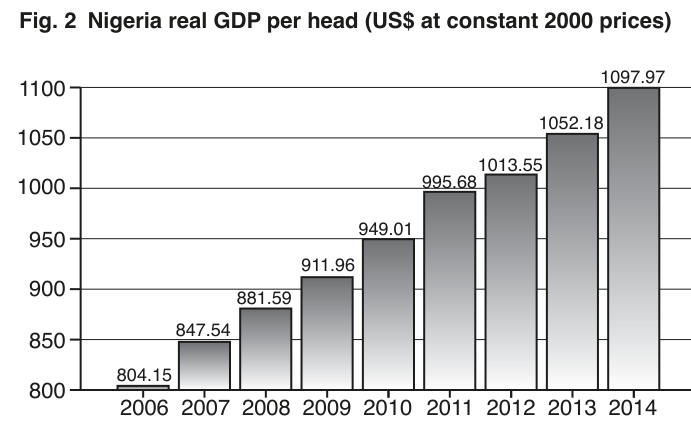
One country that offers great potential is Nigeria. About 43% of its population is under the age of 15, and only 3% are aged over 65. Demographically it looks good. The largest generator of GDP in Nigeria is the oil industry. Fig. 1 shows the changes in the price of crude oil between March and August 2014 and Fig. 2 shows changes in Nigeria’s real GDP per head between 2006–2014.
Fig. 1 Crude oil price (US$) per barrel
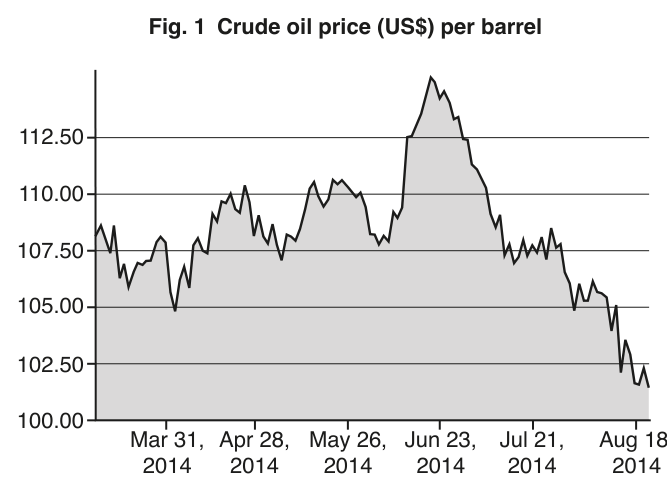
Fig. 2 Nigeria real GDP per head (US$ at constant 2000 prices)
Source: Daily Telegraph, 10 February 2012 and Sunday Telegraph, 12 April 2015.
Explain what is meant by ‘the extra money was depressing the value of the US dollar on the exchange markets’.
Explain the difference between quantitative easing and supply-side policies.
Analyse whether Nigeria is likely to be a good prospect for investors.
Discuss the evidence in the information that companies have a different opinion to the Finance Minister about the value of monetary policy.
The rest of this paper
6 more questions- Q2Indifference Curves and Budget Lines25M
- Q3Objectives and Pricing Policies of Firms25M
- Q4Money and Banking · Demand for and Supply of Labour · Wage Determination and Labour Market Intervention25M
- Q5Effectiveness of Macroeconomic Policies · Components of Aggregate Demand · The Multiplier and National Income Determination25M
- Q6Characteristics of Countries at Different Levels of Development · Economic Development and Living Standards25M
- Q7Market Structures · Performance of Firms in Different Market Structures · Efficiency and Market Failure · Externalities, Social Costs and Benefits25M