Economics 9708/42 — February/March 2017
Cambridge A-Level · A Level Data Response and Essays · worked solutions for every part, with the mark scheme
Topics Efficiency and Market Failure · Economic Development and Living Standards · Effectiveness of Macroeconomic Policies · Components of Aggregate Demand · The Multiplier and National Income Determination · Utility Theory · +9 more
Finance Ministers and Economic Power
The power of Finance Ministers to make a difference to an economy is exaggerated. Political parties would argue that Finance Ministers have the ability to form policies that lead to the creation of jobs, the building of houses, and the encouragement of economic growth. The reality is that Finance Ministers are usually at the mercy of the economy rather than in control of it.
The Finance Minister has a limited macroeconomic range of policy measures. Interest rates, bond markets, international trade markets, company investment policies and changes in consumer spending are far more important than Finance Ministers in shaping the economy and determining tax revenues.
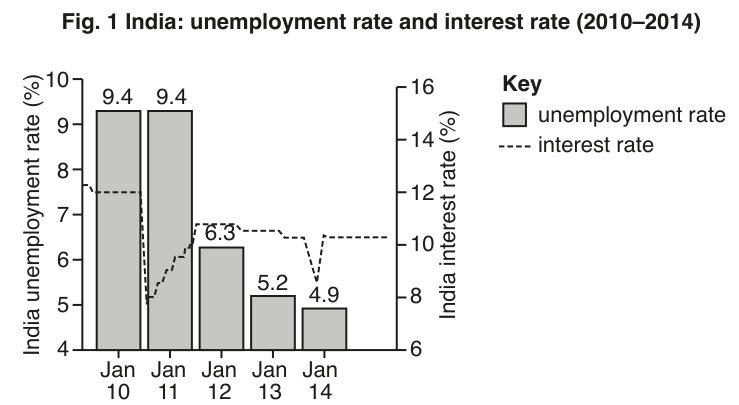
Consider monetary policy. This is often controlled by central banks. In 2015, there were low interest rates across much of the world. These lower borrowing costs could encourage firms to invest and this may result in increased employment. Statistics for unemployment and the level of interest rates for India from 2010 to 2014 are given below in Fig. 1.
Fig. 1 India: unemployment rate and interest rate (2010–2014)
In international trade markets some economies improved in 2015 because of the halving of the crude oil price – a benefit for companies and households with an effect on inflation that allowed interest rates to stay low. However, part of the benefit of such a change in the general price level would be short-term if oil prices recovered.
Another influence on the economy can be a high level of immigration which could increase the working population and possibly increase employment and production. Immigration is not controlled by the Finance Minister.
Some consider that the best hope for improving an economy is on the supply side. But supply-side policies are also often the responsibility of ministers other than the Finance Minister and take a long time to become effective.
A further economic boost could be a rise in house prices. House price rises encourage consumer confidence and stimulate retail sales. Moving house often results in re-decoration, modernisation and the purchase of household items. However, house price rises, or the corresponding rent increases, can sometimes be out of proportion to wage rates and make it impossible for many people to purchase property or to move.
Source: The Times, 18 April 2015
The information refers to supply-side policies. Explain, with two examples, what is meant by supply-side policies.
Answer
Supply-side policies are primarily microeconomic policies designed to improve the efficiency of markets and industries, increasing the economy's long-run productive capacity.
Two examples of supply-side policies are:
- Public investment in education and vocational training programmes to improve workers' skills and productivity, reducing structural unemployment.
- Reduction of bureaucratic planning regulations for new business development, lowering barriers to entry for new firms and reducing operational costs for existing businesses.
Supply-side policies are microeconomic policies aimed at improving market and industry efficiency to increase long-run productive capacity, with examples including education/training programmes and reduction of business planning regulations.
Background Concept
Supply-side policies are a core component of government macroeconomic policy, distinct from demand-side policies (fiscal and monetary policy) because they target the long-run productive capacity of the economy rather than short-run aggregate demand. Their primary aim is to shift the long-run aggregate supply (LRAS) curve to the right, increasing the economy's potential output, reducing natural unemployment and lowering long-run inflationary pressures. Supply-side policies can be categorised as market-based (e.g., tax cuts, deregulation, privatisation) which rely on market forces to improve efficiency, or interventionist (e.g., public spending on training, direct subsidies for R&D) where the government directly intervenes to improve market outcomes.
Understanding the Question
This 4-mark part asks for two things: a clear definition of supply-side policies, and two concrete examples of such policies. The mark scheme allocates 2 marks for a correct definition and 2 marks for two valid examples, so the answer must be concise and directly address both requirements without extra detail.
Approach
First, state the core definition of supply-side policies, ensuring it mentions their focus on improving market efficiency or long-run productive capacity to qualify for the 2 definition marks. Then select two distinct, standard examples of supply-side policies, briefly explaining what each policy entails to link it clearly to the definition.
Step-by-Step Reasoning
- Definition: Supply-side policies are primarily microeconomic measures implemented by governments to improve the efficiency of product, labour and capital markets, thereby increasing the economy's long-run productive capacity and shifting the LRAS curve right.
- Example 1: Investment in education and vocational training. This interventionist supply-side policy improves the skills and productivity of the workforce, reducing structural unemployment and increasing the quality of labour available to firms, which raises long-run output.
- Example 2: Reduction of planning regulations for new business construction. This market-based supply-side policy lowers barriers to entry for new firms, increases market competition, and reduces costs for businesses looking to expand their operations, improving overall market efficiency.
Key Takeaways
Supply-side policies target long-run productive capacity, not short-run aggregate demand; they can be either market-based or interventionist; valid examples must directly link to improving market efficiency or productive capacity.
Common Mistakes
Confusing supply-side policies with demand-side policies (e.g., listing increased government spending on healthcare as a supply-side policy without linking it to productivity improvements); providing only one example; giving an example that is not a supply-side policy (e.g., increasing the national minimum wage, which is a labour market intervention but not a supply-side policy unless linked to productivity).
Things to Be Careful About
Ensure the definition explicitly mentions improving market efficiency or long-run productive capacity to earn the full 2 definition marks; examples must be clearly explained to show they fit the definition of a supply-side policy.
Explain briefly the link between the rate of interest, investment and employment. Consider whether this is supported by the information in Fig. 1.
Answer
The theoretical link between interest rates, investment and employment is as follows: lower interest rates reduce the cost of borrowing for firms, making investment in new capital (e.g., machinery, premises) more profitable. Higher investment increases the demand for labour to operate new capital, raising employment; higher interest rates have the opposite effect, reducing investment and employment.
This link is not supported by the data in Fig. 1 for India 2010–2014. The interest rate rose from approximately 7.5% in January 2010 to a peak of 11.5% in January 2012, but the unemployment rate fell from 9.4% to 6.3% over the same period. Between January 2012 and January 2014, the interest rate remained stable at around 10.5–11%, yet unemployment continued to fall to 4.9%. This indicates other factors, such as economic growth or labour market reforms, drove the fall in unemployment, rather than the interest rate-investment-employment relationship.
The theoretical link between lower interest rates, higher investment and higher employment is not supported by the India 2010–2014 data, as unemployment fell while interest rates rose or remained stable.
Background Concept
Monetary policy operates through a transmission mechanism to affect macroeconomic outcomes. When the central bank changes the policy interest rate, it affects borrowing costs for households and firms. For firms, lower interest rates reduce the cost of borrowing to fund investment in new capital (e.g., machinery, factories, technology), and increase the present value of future investment returns, making more investment projects profitable. Higher investment increases the demand for labour to operate new capital, leading to higher employment and lower unemployment. The reverse applies when interest rates rise: higher borrowing costs reduce investment, leading to lower employment. This relationship is a core part of the monetary policy transmission mechanism, though it can be affected by other factors in the real world.
Understanding the Question
This 4-mark part has two distinct elements: first, explain the theoretical causal chain linking interest rates, investment and employment (worth 2 marks); second, evaluate whether the data in Fig. 1 for India 2010–2014 supports this theoretical link (worth 2 marks). The mark scheme notes that the chart is "equivocal" about the relationship, so the evaluation must identify inconsistencies between the theory and the data.
Approach
First, lay out the full causal chain clearly, ensuring each step (interest rate -> borrowing costs -> investment -> employment) is explicitly stated. Then interpret the data in Fig. 1, citing specific figures to test the relationship, and note any inconsistencies between the predicted trend and the observed data.
Step-by-Step Reasoning
- Theoretical link: A fall in the interest rate reduces the cost of borrowing for firms, and raises the expected return on investment (since future profits are discounted at a lower rate). This makes more investment projects financially viable, so firms increase investment in new capital. To operate this new capital, firms hire more workers, increasing the demand for labour and thus employment. A rise in interest rates has the opposite effect, reducing investment and employment.
- Evaluation of Fig. 1: The chart shows two inconsistent trends with the theoretical link:
a. Between January 2010 and January 2012, India's interest rate rose from ~7.5% to ~11.5%, but the unemployment rate fell from 9.4% to 6.3% over the same period. This is the opposite of the predicted relationship, where higher interest rates should reduce investment and raise unemployment.
b. Between January 2012 and January 2014, the interest rate remained broadly constant at ~10.5–11%, but unemployment continued to fall to 4.9%. This suggests that the interest rate was not the dominant factor driving unemployment in this period; other factors such as strong economic growth, structural labour market reforms, or increased government spending were likely more important.
Key Takeaways
The interest rate-investment-employment link is a core part of monetary policy theory, but real-world data may not show a perfect correlation due to the influence of other factors; when evaluating a theoretical relationship with data, always cite specific figures and note any inconsistencies.
Common Mistakes
Stating that the chart supports the theoretical link without noting the clear inconsistencies; skipping steps in the causal chain (e.g., omitting the investment step between interest rates and employment); citing figures without interpreting what they show about the relationship.
Things to Be Careful About
Note the dual axes in Fig. 1: the left axis measures unemployment rate (bars), the right axis measures interest rate (dashed line); always cite specific figures from the chart to support your evaluation; acknowledge that correlation does not equal causation, so other factors may explain the observed trends.
The information refers to rising house prices and politicians sometimes say such a rise is a sign of an improvement in the economy. Analyse how the economy is claimed to benefit from rising house prices but can also benefit from falling oil prices.
Answer
Rising house prices benefit the economy through two main channels:
- The wealth effect: Higher house prices increase the net wealth of homeowners, raising consumer confidence and willingness to spend. Households may also extend mortgages to release housing equity to fund other consumption, increasing aggregate demand, real output and employment.
- Increased housing market activity: Rising house prices encourage more home moves, leading to higher spending on estate agent fees, home renovations, decoration and household goods. This boosts demand in the construction and retail sectors, further raising output and employment.
Falling oil prices benefit the economy through two main channels: - Lower production costs: Oil is a key variable cost for many firms. Lower oil prices reduce firms' costs of production, shifting the short-run aggregate supply curve to the right, lowering the general price level and increasing real output and employment.
- Higher household disposable income: Lower oil prices reduce household spending on fuel and transport, increasing disposable income. Households can spend this extra income on other goods and services, raising consumption and aggregate demand, further boosting output and employment.
Rising house prices boost the economy via the wealth effect and increased housing-related spending, while falling oil prices boost the economy via lower production costs and higher household disposable income, both raising aggregate demand and real output.
Background Concept
This question relies on two core macroeconomic mechanisms: the wealth effect (a key determinant of autonomous consumption) and the impact of input price changes on aggregate supply and demand. The wealth effect states that changes in the market value of household assets (such as property) affect consumer spending: higher asset values increase households' perceived wealth and financial confidence, leading to higher consumption even without a rise in actual disposable income. For intermediate inputs like oil, changes in their price affect both firms' production costs (shifting the short-run aggregate supply curve) and household disposable income (shifting the consumption function and thus aggregate demand).
Understanding the Question
This 6-mark part asks for an analysis of two separate economic scenarios: the claimed benefits of rising house prices for the economy, and the benefits of falling oil prices. Each scenario is worth 3 marks, so each requires a developed causal chain linking the price change to a positive economic outcome (e.g., higher output, employment, growth). The analysis must explain the mechanisms through which each price change affects the economy, not just state that it has a positive effect.
Approach
First, break down the house price effect into its two main channels (wealth effect, housing market activity) and explain each link in the causal chain, linking to the consumption function and aggregate demand. Then break down the oil price effect into its two main channels (lower production costs, higher household disposable income) and explain each link, referencing the AD/AS model and consumption theory.
Step-by-Step Reasoning
- Benefits of rising house prices:
a. Wealth effect: Houses are the largest asset for most households. When house prices rise, the market value of these assets increases, so households feel wealthier and more financially secure. This raises consumer confidence and increases autonomous consumption (spending not dependent on current disposable income). Households may also extend their mortgages to release housing equity to fund other purchases (e.g., cars, holidays), further increasing consumption. Higher consumption is a component of aggregate demand (AD = C + I + G + (X-M)), so AD rises, leading to higher real output and employment.
b. Housing market activity: Rising house prices encourage more households to sell their existing property and move to a new home, as they can realise a profit on their current asset. Moving home requires spending on estate agent fees, legal fees, home renovations, decoration and new household items. This increases demand for construction, retail and services sectors, further boosting AD and creating jobs in these industries. - Benefits of falling oil prices:
a. Lower production costs: Oil is a key variable cost for firms in transport, manufacturing, energy and many other sectors. A fall in oil prices reduces firms' per-unit costs of production, so at every price level, firms are willing to supply more output. This shifts the short-run aggregate supply (SRAS) curve to the right, leading to a lower general price level and higher real national output, as well as higher employment as firms expand production to meet higher demand.
b. Higher household disposable income: Lower oil prices reduce household spending on petrol, heating and other oil-based energy, increasing disposable income. Households can spend this extra income on other goods and services, raising consumption and AD, which further increases output and employment. Additionally, lower oil prices reduce cost-push inflationary pressures, allowing the central bank to keep interest rates lower, which supports business investment and consumer spending on credit.
Key Takeaways
Asset price changes (like house prices) affect the economy primarily through the wealth effect on consumption, while changes in the price of key intermediate inputs (like oil) affect both aggregate supply (via production costs) and aggregate demand (via household disposable income); both channels can raise real output and employment.
Common Mistakes
Confusing the effect of rising house prices with a supply-side effect (it is a demand-side effect via consumption, unless it encourages new house building, which is a secondary effect); forgetting that falling oil prices also reduce cost-push inflation, not just increase disposable income; failing to link each effect to a concrete economic outcome (output, employment, growth).
Things to Be Careful About
Ensure each causal chain is fully developed: do not just state that "house prices rise, spending rises" — explain the wealth effect and mortgage equity withdrawal; for oil prices, distinguish between the supply-side effect (lower costs, SRAS shift) and the demand-side effect (higher disposable income, higher C); link all effects to macroeconomic outcomes (real output, employment, inflation) to earn full marks.
Summarise the main argument of the information. Discuss whether there is sufficient evidence in the information to support it.
Answer
The main argument of the text is that the power of Finance Ministers to shape economic outcomes is exaggerated. It claims Finance Ministers have a limited range of policy tools, and that other factors — including central bank-controlled interest rates, international trade conditions, immigration, supply-side policies led by other ministers, and external shocks like oil price changes — are far more important in determining economic growth, employment and tax revenues.
The evidence provided in the text is insufficient to fully support this argument. Supporting evidence includes the valid points that interest rates are set by independent central banks, immigration is controlled by other government departments, supply-side policies are often led by other ministers, and oil prices are determined by global markets. However, the text omits the core fiscal policy tools that Finance Ministers directly control: tax rates (both direct and indirect) and government spending. Tax changes affect consumer disposable income, business investment and housing market activity, while government spending on infrastructure and public services directly creates jobs and boosts aggregate demand. The text also provides no empirical evidence of the limited impact of fiscal policy to support its claim. Overall, while Finance Ministers do face significant constraints, the text overstates its case by ignoring the substantial influence of their fiscal policy powers.
The text's claim that Finance Ministers have limited economic power is partially supported by evidence of external and cross-ministerial constraints, but insufficient as it ignores the direct influence of fiscal policy tools (tax and spending) that Finance Ministers control.
Background Concept
This question tests two key skills: summarising a core argument from a text, and evaluating the sufficiency of the evidence provided to support that argument. The core debate is about the relative influence of fiscal policy (controlled by Finance Ministers) versus other factors (monetary policy, external shocks, supply-side policy led by other departments) in determining macroeconomic outcomes. Fiscal policy refers to government tax and spending decisions, which are the primary tools available to Finance Ministers to influence the economy.
Understanding the Question
This 6-mark part has two elements: first, summarise the main argument of the provided text (worth 3 marks); second, discuss whether the text provides sufficient evidence to support this argument (worth 3 marks). The mark scheme allocates 3 marks for a correct summary of the argument and 3 marks for a balanced evaluation of the evidence, including a justified conclusion. The text's argument is an absolute claim that Finance Ministers have "exaggerated" power, so the evaluation must identify both supporting evidence and gaps in the text's reasoning.
Approach
First, extract the core claim of the text clearly, without adding extra detail or examples from outside the text. Then list the evidence the text provides to support the claim, then identify key evidence that the text omits (specifically the fiscal policy tools Finance Ministers do control), then weigh the two to reach a justified judgement on whether the evidence is sufficient.
Step-by-Step Reasoning
- Summarising the main argument: The text's central claim is that the power of Finance Ministers to influence economic outcomes is exaggerated. It argues that Finance Ministers have a limited range of macroeconomic policy tools, and that other factors are far more important in shaping the economy, determining tax revenues and influencing employment and growth. These other factors include: central bank-controlled interest rates, international trade conditions (e.g., oil price changes), immigration levels, supply-side policies led by other government ministers, and changes in consumer spending and firm investment decisions that are outside direct government control.
- Evaluating the sufficiency of evidence:
a. Supporting evidence in the text: The text correctly identifies valid constraints on Finance Ministers' power. Interest rates are typically set by independent central banks, not Finance Ministers. Immigration policy is usually controlled by interior or home affairs ministries, not finance ministries. Supply-side policies such as education reform, infrastructure investment and labour market regulation are often led by other government departments. External shocks like oil price changes are driven by global supply and demand, not domestic fiscal policy. These are all legitimate factors that limit the direct influence of Finance Ministers.
b. Missing evidence: The text completely omits the core policy tools that Finance Ministers directly control: fiscal policy. Finance Ministers are responsible for setting both direct taxes (e.g., income tax, corporation tax) and indirect taxes (e.g., VAT, excise duties), as well as government spending on public services, infrastructure and welfare. Tax changes directly affect consumer disposable income, business investment incentives and housing market activity, while government spending directly creates jobs, boosts aggregate demand and improves long-run productive capacity. The text also provides no empirical evidence (e.g., case studies of successful fiscal stimulus, data on the impact of tax changes on growth) to support its claim that Finance Ministers have little power, and does not acknowledge that fiscal policy can be highly effective, particularly during recessions when monetary policy is constrained (e.g., when interest rates are near zero and cannot be cut further). - Judgement: The evidence is insufficient to fully support the text's claim. While the text correctly identifies important external and cross-ministerial constraints on Finance Ministers' power, it ignores their direct control over fiscal policy, which is a major macroeconomic tool. The text presents a one-sided view that overstates the limitations of Finance Ministers' influence.
Key Takeaways
When evaluating an argument, always look for both supporting evidence and omitted counter-evidence; fiscal policy (tax and spending) is the core tool of Finance Ministers, so any argument about their limited power must address this; a justified judgement must weigh the strengths and weaknesses of the evidence, not just list them.
Common Mistakes
Summarising the argument by listing all the examples in the text rather than stating the core claim; only listing supporting evidence without identifying gaps; reaching a vague judgement like "it depends" without explaining what it depends on; failing to mention the fiscal policy tools that Finance Ministers control, which is the key omission in the text.
Things to Be Careful About
Ensure the summary of the argument is concise and captures the core claim, not just the supporting points; when discussing evidence, explicitly link omissions to the argument (e.g., "the text omits fiscal policy, which is the primary tool of Finance Ministers, so this weakens its claim"); the judgement must be justified by reference to the evidence (or lack thereof) in the text, not just personal opinion.
The rest of this paper
6 more questions- Q2Utility Theory · Indifference Curves and Budget Lines25M
- Q3Market Structures · Performance of Firms in Different Market Structures · Objectives and Pricing Policies of Firms25M
- Q4Wage Determination and Labour Market Intervention · Efficiency and Market Failure25M
- Q5Characteristics of Countries at Different Levels of Development · Economic Development and Living Standards · Economic Growth and Sustainability25M
- Q6Money and Banking · Economic Development and Living Standards25M
- Q7Efficiency and Market Failure · Government Policies to Correct Market Failure25M