Economics 9708/41 — May/June 2016
Cambridge A-Level · A Level Data Response and Essays · worked solutions for every part, with the mark scheme
Topics Economic Growth and Sustainability · Market Structures · Economic Development and Living Standards · Characteristics of Countries at Different Levels of Development · Macroeconomic Objectives and Policy Conflicts · Relationships Between Countries at Different Levels of Development · +12 more
Changes in the Chinese economy
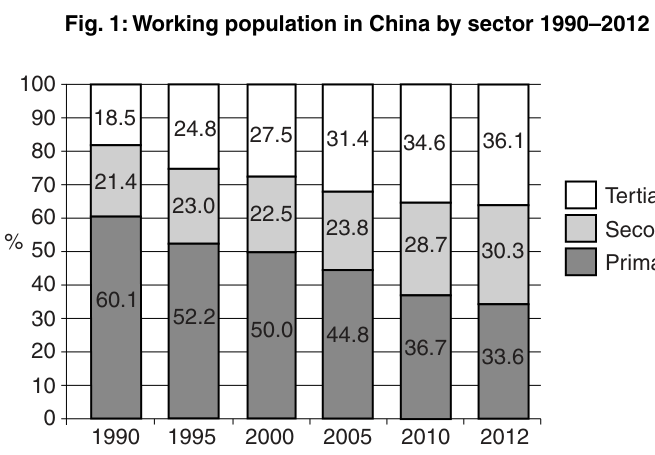
China is an emerging economy. The proportions of workers employed by sector between 1990 and 2012 are shown in Fig. 1.
Fig. 1: Working population in China by sector 1990–2012
Iron ore is used for steel making. By 2013, China was the largest iron ore importer in the world. The main suppliers were Australia, Brazil, India and South Africa. China also needed other raw materials such as aluminium and copper. As a proportion of GDP, China bought four to ten times more of these than other countries and was responsible for much of the global increase in their demand during the two decades before 2013.
The iron and steel industry in China was stimulated by strong domestic demand, particularly from the construction, manufacturing and automotive industries, all of which had expanded production.
But during 2013 the outlook for China’s economy was less bright. There was a sharper than expected fall in export growth in China, while imports actually fell. Growth in industrial output was also slower and this, together with increased output from new iron ore mines in Australia, seemed likely to cause a reduction in iron ore prices. It was thought that the potential change in industrial output in China, the world’s second-largest economy, would worsen the outlook not only for mining companies but also for other producers worldwide.
Statistics for the annual rate of inflation in China indicated that in 2013 prices of key products such as iron ore fell, causing the rate of inflation to fall and creating the prospect of price deflation. An economist said ‘falling prices are bad for the economy.’ Some economists feared that the future growth of building and urbanisation would be at a significantly slower rate. The result, it was thought, would be that any economic growth would be more likely to be caused by consumption and not by investment.
This change to consumption from investment would mean that the demand for raw material inputs would fall significantly, as previous demand was a consequence of China’s growth through an investment approach. Of course, items such as cars, washing machines and computers all require a substantial amount of raw materials, so the demand for some inputs would still increase.
Sources: China Labour Bulletin, accessed 29 April 2014, and Daily Telegraph, 10 June 2013
Identify the trends in working population in China and consider whether they are what might be expected in an emerging economy.
The article states that ‘falling prices are bad for the economy’. Analyse whether falling prices necessarily harm an economy.
Does the article give enough evidence to lead you to conclude that the changes in the Chinese economy would be bad for countries that trade with China?
Using the article and your own knowledge, discuss what difference an investment approach to growth and a consumption approach to growth might make to an emerging economy such as China.
The rest of this paper
6 more questions- Q2Market Structures · Performance of Firms in Different Market Structures25M
- Q3Utility Theory · Indifference Curves and Budget Lines25M
- Q4Wage Determination and Labour Market Intervention · Demand for and Supply of Labour · Equity, Poverty and Redistribution · Efficiency and Market Failure25M
- Q5Short-Run and Long-Run Production · Costs of Production · Market Structures · Objectives and Pricing Policies of Firms25M
- Q6The Multiplier and National Income Determination · Employment and Unemployment · Economic Growth and Sustainability · Economic Development and Living Standards25M
- Q7Economic Development and Living Standards25M