Economics 9708/42 — February/March 2016
Cambridge A-Level · A Level Data Response and Essays · worked solutions for every part, with the mark scheme
Topics Economic Growth and Sustainability · Employment and Unemployment · Efficiency and Market Failure · Market Structures · Short-Run and Long-Run Production · Costs of Production · +8 more
Global Employment Trends
A report from the International Labour Organisation (ILO) in 2014 warns that young people are likely to be hit hardest as global total unemployment continues to rise. 42.6 million people are expected to enter the labour market every year but the forecast is that only 40 million net new jobs will be created.
The ILO forecasts that millions more will be unemployed as companies choose to increase dividends to shareholders rather than invest their profits by employing new workers. They expect that the world unemployment rate (adults and youths) will be 6.1% in 2014, up from 5.5% in 2007. The report puts the youth unemployment rate at 13.1%, almost three times the adult rate of 4.6%. Young people will continue to be particularly affected by what the ILO describes as a “weak and uneven recovery” in the world economy. In many advanced economies, the average duration of unemployment has doubled compared with 2008.
The ILO warns that if countries fail to tackle the crisis of long-term youth unemployment, hopes for sustainable growth will be destroyed. There will be a risk of further and perhaps deeper social unrest, linked to widening inequalities of incomes.
For some countries the proportion of young people not in employment, education or training (NEETS) continues to rise as shown in Fig. 1. Some of the worst rates are in countries affected by the European financial crisis, as advanced economies in Europe try to find the right balance between employment and other macroeconomic goals.
The ILO said that although emerging economies would continue to enjoy the lowest combined (adults and youths) unemployment rate this year, growth in those economies has slowed down in the past two years. Notably, China’s growth rate of 10.5% per year in the last decade fell to 7.7% in 2013. Changes in such growth rates have created changes in international markets for both commodities and manufactured goods, which have also affected unemployment.
Fig. 1: Young people not in Employment, Education or Training (NEETS) as a percentage of the population aged 15–29
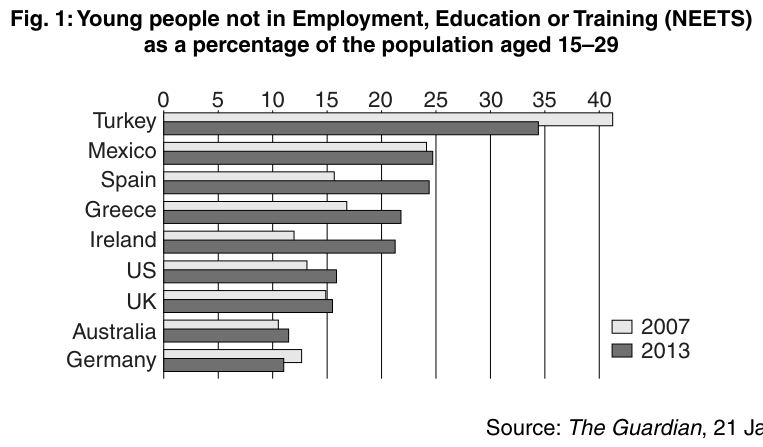
Source: The Guardian, 21 January 2014
What evidence is provided in the information for the statement that youth unemployment has been ‘hit hardest’?
Explain two reasons why, according to the information, not enough jobs are being created each year in the world.
Referring to the information and your own knowledge, explain why it is usually important to tackle the problem of increasing long-term youth unemployment.
From the information given, do you agree that within the world economy recovery was both ‘weak and uneven’?
The rest of this paper
6 more questions- Q2Efficiency and Market Failure · Market Structures25M
- Q3Short-Run and Long-Run Production · Costs of Production · Objectives and Pricing Policies of Firms25M
- Q4Wage Determination and Labour Market Intervention25M
- Q5Economic Growth and Sustainability25M
- Q6Money and Banking · Components of Aggregate Demand · Effectiveness of Macroeconomic Policies · The Multiplier and National Income Determination25M
- Q7Economic Development and Living Standards · Economic Growth and Sustainability · Equity, Poverty and Redistribution25M