Economics 9708/42 — October/November 2015
Cambridge A-Level · A Level Data Response and Essays · worked solutions for every part, with the mark scheme
Topics Economic Growth and Sustainability · Efficiency and Market Failure · Government Policies to Correct Market Failure · Utility Theory · Market Structures · Short-Run and Long-Run Production · +9 more
Economic growth in China
In less than 30 years, China has seen a huge shift from being a mainly farming economy to a thriving manufacturing economy. Since 2007, economic growth has continued despite uncertain economic conditions and the global financial crisis. Some economists doubt China’s ability to sustain such economic growth, which has been achieved at a cost to the environment.
Fig. 1: GDP growth for China since 2001
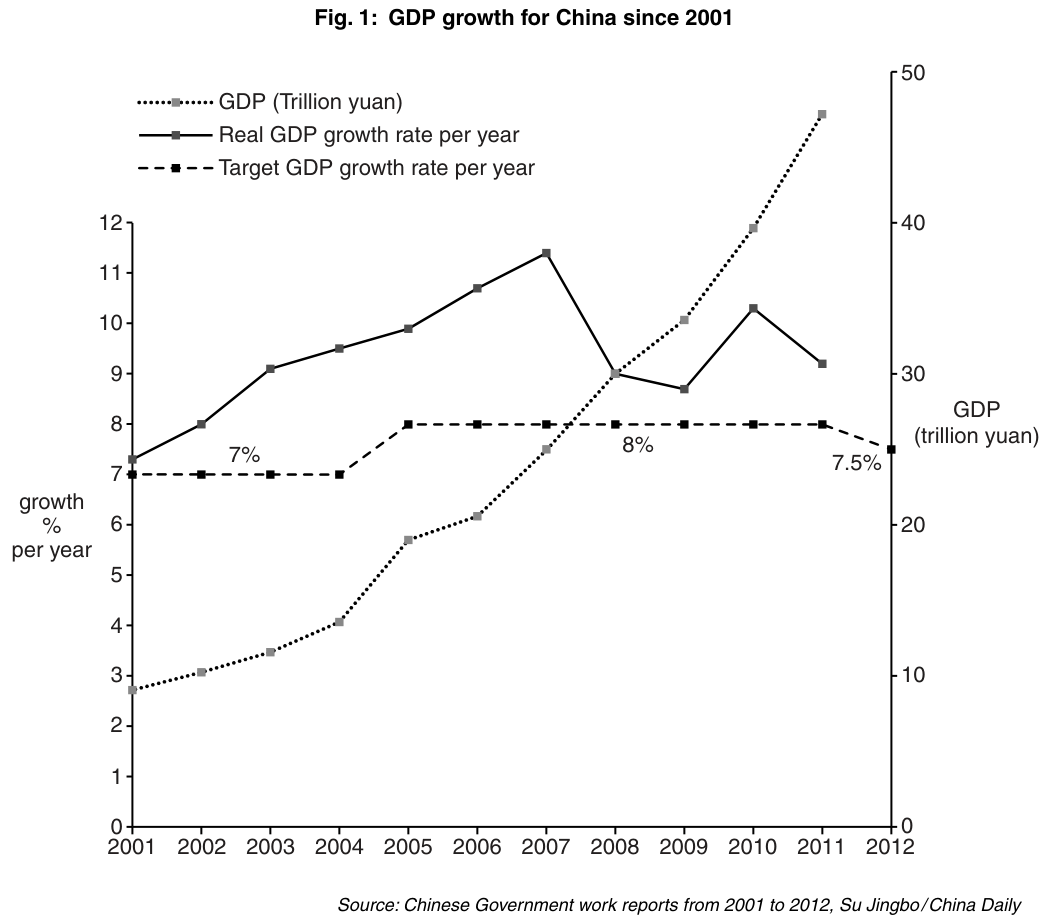
Source: Chinese Government work reports from 2001 to 2012, Su Jingbo / China Daily
As China’s economy continues to grow, it has a new challenge: how will it deal with the shift of the population from being mainly rural to being mainly urban? In 2030, it is estimated that about 220 cities in China will have at least one million residents. This will increase the pressure on natural resources. Economic inefficiencies created by urban growth include air and water pollution, traffic congestion, poor housing and overcrowding.
China’s leaders have responded by reducing the target GDP growth rate. They have also concentrated on trying to improve the quality of China’s economic growth and have focused on sustainable urban planning, low-carbon development, promoting improved public transit systems and improved water treatment.
National government policies can help correct market failures and set standards for environmental problems such as air pollution. They can establish partnerships between city authorities, businesses and the general public. Urban sustainability solutions do not just benefit the environment and people’s quality of life; they are often highly profitable. Investment in rapid transit bus systems, for example, results in lower energy consumption and lower costs.
Source: The Daily Telegraph supplement, 2012
Fig. 1 shows China’s real GDP growth rate. Explain what this means.
How far does Fig. 1 support the suggestion in the extract that China’s growth ‘has continued despite uncertain economic conditions’?
The article refers to economic inefficiencies. Explain the distinction between an economically efficient situation and one which is inefficient.
Identify two market failures mentioned in the article and consider the methods that governments might use to help overcome these market failures.
The rest of this paper
6 more questions- Q2Utility Theory · Market Structures25M
- Q3Short-Run and Long-Run Production · Costs of Production · Growth and Survival of Firms25M
- Q4Money and Banking25M
- Q5Economic Development and Living Standards · Characteristics of Countries at Different Levels of Development25M
- Q6Effectiveness of Macroeconomic Policies · Macroeconomic Objectives and Policy Conflicts25M
- Q7Revenue and Profit · Wage Determination and Labour Market Intervention25M