Economics 9708/41 — October/November 2015
Cambridge A-Level · A Level Data Response and Essays · worked solutions for every part, with the mark scheme
Topics Economic Development and Living Standards · Government Policies to Correct Market Failure · Utility Theory · Equity, Poverty and Redistribution · Macroeconomic Objectives and Policy Conflicts · Economic Growth and Sustainability · +12 more
Economic growth and happiness
Research in the United States has demonstrated that economic growth – and improved wages that usually accompany it – improves happiness and well-being. The richer we are, the happier we are. There is no maximum wealth level beyond which higher incomes cease to increase well-being.
The best way to promote happiness is, therefore, to maximise economic growth and ensure that as many as possible are able to enjoy higher incomes. Every tax change should be judged against how it will affect GDP. Increasing taxes on higher incomes will reduce disposable income and not increase well-being.
Recently, real wages have been falling. Faster growth is necessary to overcome this. Without faster growth, people will become poorer and, therefore, unhappier. Further, without growth, it will not be possible to keep spending more on essential services such as health care without cutting expenditure in other areas.
The results of the research are not good news for those who argue that what makes people happy is not what they earn in absolute terms, but what they earn compared with others. An opposing opinion suggests that it is wise to reduce differentials in earnings. For example, high earners, such as investment bankers, should be taxed more heavily.
The results are also not welcomed by those, including environmentalists, who say that it is stressful and unsustainable for economies to focus on increasing their GDP. There should be careful consideration of future economic development. The country should not develop certain resources in case they increase carbon emissions and result in allocative inefficiency.
An example of this is found in the UK. There is a proposal to build a new runway at London Airport. The new runway will enable the number of flights from the airport to be increased with an estimated net private benefit from the expansion which is said to be £5 billion over 70 years. Environmentalists say that the calculation ignores many costs, such as what will be the effect of extra road journeys to and from the airport each year; what will be the effect on house prices; and what will be the cost to the environment of increased emissions?
Increasing investment and the resulting increase in GDP do not always bring increased happiness and welfare.
Source: Adapted from London Evening Standard, 2012; Daily Telegraph, 2013
Briefly explain how, according to the article, an increase in economic growth increases happiness.
Answer
According to the article, an increase in economic growth leads to higher incomes and higher expenditure. Higher incomes increase consumer welfare, and increases in welfare increase happiness. The article states that there is no maximum wealth level beyond which higher incomes cease to increase well-being, so the effect is continuous.
Economic growth increases happiness because it raises incomes and expenditure, which increase consumer welfare, and the article claims there is no limit to this effect.
Background Concept
Economic growth is an increase in the real output of an economy, typically measured by GDP. The article assumes a direct link between growth and happiness: growth raises incomes, which allow higher consumption, and consumption increases utility. In economics, the relationship between income and happiness is debated; the article presents a view that absolute income is the main determinant.
Understanding the Question
The question asks to briefly explain how, according to the article, an increase in economic growth increases happiness. This is a comprehension question: we must extract the specific mechanism described in the extract. The article says: growth leads to higher incomes, higher incomes increase welfare, and welfare increases happiness. It also states that there is no limit to this effect.
Approach
Read the first paragraph of the extract carefully. The key phrases are: 'economic growth – and improved wages that usually accompany it – improves happiness and well-being', 'The richer we are, the happier we are', 'no maximum wealth level beyond which higher incomes cease to increase well-being'. The answer should restate these points in a logical chain.
Step-by-Step Reasoning
- Growth increases output and productivity, leading to higher wages and incomes. (Implicit in the article)
- Higher incomes enable higher consumption expenditure.
- The article states that higher incomes increase consumer welfare (happiness).
- The article explicitly denies the existence of a satiation point: 'no maximum wealth level beyond which higher incomes cease to increase well-being'.
- Therefore, growth always increases happiness, according to the article.
The answer should include the idea that there is no limit, as the mark scheme awards a mark for that.
Key Takeaways
- The article presents a simplistic view that growth automatically increases happiness.
- In exam, when asked to 'briefly explain how according to the article', you must quote or paraphrase the article's reasoning.
Common Mistakes
- Not mentioning the 'no limit' point (loses 1 mark).
- Adding external knowledge not in the article (e.g., environmental costs) – not required here.
Things to Be Careful About
- The question is about the article's claims, not the candidate's own views.
With the help of a diagram, explain how an increase in indirect tax rates might affect a consumer’s total utility.
Answer
An indirect tax increases the cost of production, shifting the supply curve to the left. This raises the equilibrium price from P1 to P2 and reduces the quantity demanded from Q1 to Q2. The consumer now consumes fewer units of the good. Since total utility is the sum of the marginal utilities of all units consumed, and due to diminishing marginal utility, each unit consumed provides positive marginal utility. The loss of Q1 – Q2 units means the consumer foregoes the marginal utility of those units, so total utility decreases.
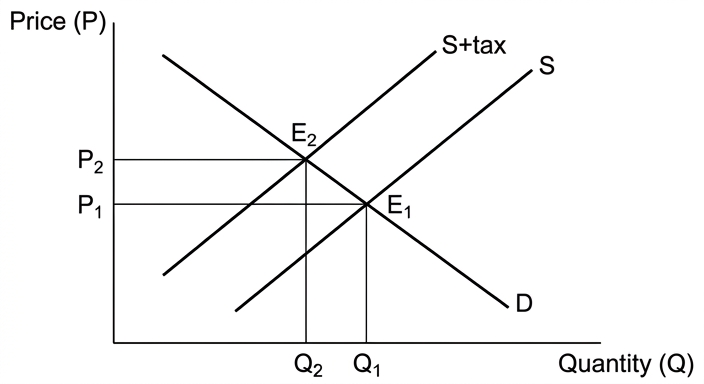
Consumer total utility decreases because the tax raises price, reduces quantity demanded, and the foregone units each had positive marginal utility.
Background Concept
Total utility is the total satisfaction a consumer gets from consuming a good. Marginal utility is the additional satisfaction from consuming one more unit. The law of diminishing marginal utility states that as a consumer consumes more units, the marginal utility from each additional unit falls, but remains positive. The consumer maximizes utility by consuming up to the point where marginal utility equals price (or where the ratio equals the price ratio, but here we consider a single good). An indirect tax, such as a specific or ad valorem tax, shifts the supply curve upward, raising the market price. At the higher price, the consumer reduces quantity demanded, leading to a loss of total utility.
Understanding the Question
The question asks to explain how an increase in indirect tax rates affects a consumer's total utility, with the help of a diagram. The diagram must be a demand and supply diagram showing the shift in supply due to the tax. The explanation must link the price increase to the reduction in quantity consumed and then to the decrease in total utility.
Approach
- Draw a standard demand and supply diagram. Label axes, curves, initial equilibrium.
- Show the shift of supply to the left (upward) due to the tax.
- Identify the new equilibrium: higher price, lower quantity.
- Explain that the consumer now buys fewer units.
- Apply the concept of diminishing marginal utility: each unit consumed gives positive marginal utility, so consuming fewer units means total utility falls.
Step-by-Step Reasoning
- Initial equilibrium: demand D and supply S intersect at E1, price P1, quantity Q1.
- The government imposes an indirect tax on the good. This adds to the cost of production, so suppliers require a higher price to supply each quantity. The supply curve shifts left to S2 (or S+tax). The vertical distance between S and S2 represents the tax per unit.
- New equilibrium at E2: price P2 (higher) and quantity Q2 (lower).
- The consumer now purchases Q2 instead of Q1. The reduction in consumption is Q1 – Q2.
- Each unit of the good consumed provides positive marginal utility (MU > 0) due to the law of diminishing marginal utility (MU is positive until satiation).
- The total utility from consuming Q1 is the sum of MUs from 1 to Q1. After the tax, the consumer only gets the sum from 1 to Q2. The difference is the total utility of the units Q2+1 to Q1, which is positive. Therefore, total utility decreases.
- Note: The consumer may also allocate spending differently, but the direct effect on this good is a decrease in total utility from that good.
Key Takeaways
- Indirect taxes reduce consumption of the taxed good, leading to a loss of consumer surplus and total utility from that good.
- The diagram must be accurately drawn and explained; curves must be labelled.
Common Mistakes
- Drawing a diagram but not explaining it (diagram only – max 2 marks).
- Confusing total utility with marginal utility.
- Not linking the price increase to the reduction in quantity.
Things to Be Careful About
- The question says 'with the help of a diagram', so the diagram is mandatory. Without it, maximum 2 marks.
- The explanation of the decrease in total utility is the key part; the diagram is a tool.
Consider whether you support the opinion in the article that it is a good idea to increase taxes on the rich.
Answer
The article suggests that reducing wage differentials may increase happiness because relative income matters. Increasing taxes on the rich could reduce inequality and potentially increase overall well-being. However, higher taxes on the rich may reduce their spending, which could reduce aggregate demand, lower incomes for everyone, and slow growth. The effect depends on how the tax revenue is used. If the government uses the revenue to increase spending on public services or to reduce taxes on the poor, the overall effect on happiness could be positive, as the poor have a higher marginal propensity to consume and possibly higher marginal utility of income. Therefore, I do not entirely support the article's opinion; it is not necessarily a good idea to increase taxes on the rich without considering the use of the revenue, but it could be beneficial if the revenue is redistributed effectively.
It depends on the use of the revenue; if redistributed to the poor, it could increase overall happiness, but if it reduces growth, it may not.
Background Concept
The article presents two opposing views: one that absolute income determines happiness, and another that relative income (comparison with others) matters more. Taxing the rich reduces income inequality, which could increase happiness if relative income is important. However, higher taxes on the rich may reduce their incentive to work and invest, potentially slowing economic growth. The use of tax revenue is crucial: if the government redistributes to the poor, the poor may have higher marginal utility of income, so overall welfare could increase. The concept of diminishing marginal utility of income suggests that taking £1 from a rich person reduces their utility less than giving £1 to a poor person increases their utility.
Understanding the Question
The question asks to consider whether you support the opinion that it is a good idea to increase taxes on the rich. The opinion is that 'it is wise to reduce differentials in earnings... high earners, such as investment bankers, should be taxed more heavily.' The article immediately questions this opinion by suggesting that reduced incomes for the rich may lead to lower spending and lower incomes for everyone. We need to evaluate both sides and give a personal supported conclusion.
Approach
- Explain the argument in favor of taxing the rich: reduces inequality, may increase happiness if relative income matters, and the revenue can be used to benefit the poor.
- Explain the argument against: higher taxes may reduce the rich's spending, lowering aggregate demand and growth, and may reduce incentives to work.
- The key is the use of the revenue: if used for redistribution or public services, the net effect could be positive.
- Conclusion: state your support conditionally.
Step-by-Step Reasoning
- The article mentions that what makes people happy is not what they earn in absolute terms, but relative to others. If this is true, reducing high incomes could increase overall happiness by reducing envy or status competition.
- Taxing the rich generates revenue. The government can use this revenue to increase spending on public goods (e.g., healthcare, education) or to reduce taxes on the poor. The poor have a high marginal propensity to consume, so spending may increase, potentially offsetting the reduction in spending by the rich. Additionally, the poor have higher marginal utility of income, so the welfare gain from redistribution may outweigh the loss.
- However, taxing the rich may reduce their incentive to work, save, and invest, which could reduce long-run growth. This could harm everyone's income. The article argues that without growth, people will become poorer and unhappier.
- The overall effect depends on the size of the tax, the responsiveness of the rich, and the efficiency of government spending. Therefore, the opinion is not universally true.
Key Takeaways
- Tax policy involves trade-offs between equity and efficiency.
- The marginal utility of income is higher for the poor, so redistribution can increase total welfare.
- The article's own argument about relative income is used to support the tax, but the potential negative effects on growth must be considered.
Common Mistakes
- One-sided answer: only arguing for or against without considering the other side.
- No conclusion: the question asks 'consider whether you support', so a conclusion is required.
- Ignoring the article's context: the answer should refer to the article's points.
Things to Be Careful About
- The marks are only 4, so the answer should be concise but include both sides and a conclusion.
- The conclusion should be a clear statement of support or not, with conditions.
Discuss whether consumer welfare is always increased if economic growth increases.
Answer
Arguments that growth increases consumer welfare:
- Higher incomes allow consumers to purchase more goods and services, increasing utility. The article claims no limit to this effect.
- Growth provides employment and higher wages, which improve living standards.
- Growth generates tax revenue to fund essential services like healthcare, which enhances welfare.
Arguments that growth does not always increase consumer welfare:
- GDP growth figures often ignore external costs, such as pollution and congestion. The example of the airport runway shows that the net private benefit of £5 billion excludes wider environmental and social costs, which could reduce overall welfare.
- Growth may lead to resource depletion and environmental degradation, harming future generations' welfare.
- If growth is accompanied by rising inequality, the welfare gains may be concentrated among the rich, while the poor may not benefit. Relative income comparisons can reduce happiness.
- Growth may increase stress and work hours, reducing leisure time and well-being.
Conclusion: Consumer welfare is not always increased by economic growth. The measure of growth (GDP) does not capture all costs, and the distribution of benefits matters. Therefore, the statement is not always true; it depends on the nature of growth and how its costs are managed.
No, consumer welfare is not always increased by economic growth, because growth may impose external costs, worsen inequality, and fail to account for non-material aspects of well-being.
Background Concept
Consumer welfare refers to the well-being or utility that individuals derive from consumption and other aspects of life. Economic growth is measured by increases in real GDP, but GDP is a narrow measure of market output. It does not account for externalities, income distribution, leisure time, or environmental quality. The article presents a debate: some argue that growth always increases happiness, while others point to external costs and the importance of relative income. The concept of externalities shows that private costs and benefits may differ from social costs and benefits, so growth may not improve welfare if it generates significant negative externalities.
Understanding the Question
The question asks to discuss whether consumer welfare is always increased if economic growth increases. The word 'always' is crucial; the statement is absolute. To answer, we must provide a balanced argument showing that growth can increase welfare but also may not, due to various factors. The article provides examples: the airport expansion shows that private calculations ignore external costs; the discussion of relative income suggests that inequality matters. The question requires a discussion (both sides) and a conclusion. The mark scheme caps one-sided answers at 5 marks.
Approach
- Present the case for growth increasing welfare: higher incomes, employment, fiscal dividends, and the article's claim of no limit.
- Present the case against: external costs (airport example), resource depletion, inequality, and non-material aspects.
- Evaluate the two sides: weigh the costs and benefits. The key point is that GDP growth is not synonymous with welfare improvement because of negative externalities and distributional issues.
- Conclude that the statement is false; growth does not always increase welfare, but it can under certain conditions.
Step-by-Step Reasoning
- For growth: The article states that research shows growth improves happiness, and there is no satiation point. Growth increases incomes, which enable more consumption. Growth also provides employment, which improves well-being. Without growth, real wages fall, and it becomes harder to fund essential services. These are valid points.
- Against growth: The airport example illustrates that the calculation of net benefit (£5 billion) ignores many costs: extra road journeys, effect on house prices, cost of increased emissions. These are external costs not captured in the private benefit. So growth projects may reduce welfare when all costs are considered. Additionally, growth can lead to resource depletion, environmental degradation, and climate change, which harm future generations. Moreover, if growth is accompanied by rising inequality, the rich gain more, but the poor may not benefit, and relative income comparisons can make the poor feel worse off. Growth may also increase stress and reduce leisure time, which are not captured in GDP.
- Evaluation: The strength of the argument against growth depends on the magnitude of external costs and the distribution of gains. Some growth may be 'green' or inclusive, leading to welfare improvements. However, the statement is 'always increased', and the evidence shows that it is not always the case. The airport example is a concrete counterexample.
Key Takeaways
- GDP is an imperfect measure of welfare.
- Externalities and income distribution matter for welfare.
- When a question contains 'always', a single counterexample is sufficient to disprove the statement.
- Use data from the extract to support arguments.
Common Mistakes
- One-sided answer: only giving advantages or disadvantages (max 5 marks).
- Not using the extract's example (airport) to illustrate external costs.
- No conclusion or a vague conclusion.
- Confusing consumer welfare with just income.
Things to Be Careful About
- The question is about 'consumer welfare', not just income. Include non-income aspects.
- The mark scheme says 'One-sided answer up to 5', so we must include both sides.
- The conclusion must be a clear judgement on whether the statement is always true or not.
- Use the extract's specific example to support the against side.
The rest of this paper
6 more questions- Q2Efficiency and Market Failure · Government Policies to Correct Market Failure25M
- Q3Performance of Firms in Different Market Structures · Costs of Production · Growth and Survival of Firms25M
- Q4Demand for and Supply of Labour · Wage Determination and Labour Market Intervention25M
- Q5Effectiveness of Macroeconomic Policies · Money and Banking25M
- Q6Components of Aggregate Demand · The Multiplier and National Income Determination25M
- Q7Economic Development and Living Standards · Characteristics of Countries at Different Levels of Development25M