Physics 9702/22 — October/November 2025
Cambridge AS Level · AS Level Structured Questions · worked solutions for every part, with the mark scheme
Topics Forces, Density and Pressure · Dynamics · Physical Quantities and Units · Kinematics · Deformation of Solids · Superposition · +5 more
Scientists are investigating the variation in air pressure at different locations on a mountain.
The scientists take measurements of several physical quantities at each location.
Complete Table 1.1 by stating the SI base unit for each quantity and identifying with a tick () whether each quantity is a scalar or a vector. Use the space for any working.
Table 1.1
| quantity measured | SI base unit | scalar | vector |
|---|---|---|---|
| air temperature | |||
| air pressure |
Answer
- Air temperature: SI unit ; scalar
- Air pressure: ; scalar
Air temperature: K, scalar. Air pressure: kg m^-1 s^-2 (Pa), scalar.
Background Concept
An SI base unit is one of the fundamental units (e.g. kilogram, metre, second, kelvin). Many quantities use derived units, built from base units using physical definitions.
A scalar has magnitude only (e.g. temperature, pressure). A vector has magnitude and direction (e.g. force, velocity).
Pressure is defined by
so its unit is force per unit area.
Understanding the Question
You must fill a table for two measured quantities:
- give the correct SI unit (and for pressure, it is safest to show it in SI base units),
- decide whether each quantity has direction (vector) or not (scalar).
Approach
- Recall the SI unit for temperature.
- For pressure, start from and convert into base units using .
- Decide scalar/vector by asking: “does this quantity need a direction to be fully described?”
Step-by-Step Reasoning
-
Temperature: SI unit is the kelvin (). Temperature does not have a direction, so it is a scalar.
-
Pressure:
- Unit of pressure is the pascal: .
- Convert to base units:
and since
then
- Pressure acts equally in all directions at a point and has no single direction itself, so it is a scalar.
Key Takeaways
- Temperature: , scalar.
- Pressure: , scalar.
- Derived units can be rewritten in SI base units using definitions.
Common Mistakes
- Saying pressure is a vector because it “pushes”: pressure is scalar; force is the vector.
- Giving without converting to base units when the question asks for base units.
- Writing Celsius () instead of kelvin.
Things to Be Careful About
- The table heading says “SI base unit”: for pressure, show the conversion to base units clearly.
- Do not confuse the unit name (pascal) with its base-unit form ().
At one location, the density of the air is . A spherical weather balloon is filled with a gas and released from rest. The balloon has radius .
Calculate the upthrust acting on the balloon when it is released.
upthrust = ______
Working
Volume displaced:
Upthrust:
Answer
33 N
Background Concept
Upthrust (buoyant force) occurs when an object is in a fluid (liquid or gas). The key result (Archimedes’ principle) is:
where:
- is the fluid density,
- is gravitational field strength,
- is the volume of fluid displaced (for a fully immersed object, this is the object’s volume).
Understanding the Question
A spherical balloon of radius is released in air of density . At the instant it is released, the upthrust depends only on the volume of air displaced (i.e. the balloon’s volume) and the air density.
You are asked to calculate the upthrust in newtons.
Approach
- Find the volume of the sphere using .
- Use .
- Quote the result to sensible significant figures (typically 2 s.f. from given data).
Step-by-Step Reasoning
- Volume of the balloon (and hence air displaced):
Compute , so
- Upthrust equals weight of displaced air:
- Rounding appropriately:
Key Takeaways
- Use for buoyancy.
- For a sphere, .
- In gases, upthrust is usually smaller than in liquids because is smaller.
Common Mistakes
- Using the density of the gas inside the balloon instead of the surrounding air density.
- Forgetting that is in (not ).
- Using diameter instead of radius.
Things to Be Careful About
- Ensure is in metres before cubing.
- Use a consistent value of (e.g. ) throughout.
Answer
Air pressure increases with depth, so the pressure (and force) on the bottom of the balloon is greater than on the top. This produces a resultant upward force (upthrust), equal to the weight of displaced air.
Pressure is greater at the bottom than the top, giving a net upward force equal to the weight of displaced air.
Background Concept
In a fluid at rest, pressure increases with depth because the fluid above has weight:
Pressure acts normally (perpendicularly) on a surface, producing a force
If pressure is larger on the lower surface than the upper surface, the upward force is larger than the downward force, giving a net upward force: upthrust.
Understanding the Question
You are not being asked to calculate anything here. You must explain the physical reason the balloon experiences an upward buoyant force when surrounded by air.
Approach
- State that pressure in a fluid increases with depth.
- Link pressure difference to different forces on top and bottom surfaces.
- Conclude there is a net upward force (upthrust), and optionally connect to Archimedes’ principle.
Step-by-Step Reasoning
- The balloon is surrounded by air, which exerts pressure on all sides.
- The bottom of the balloon is at a slightly greater depth than the top, so the air pressure at the bottom is slightly larger.
- Since force on a surface is , the upward force on the bottom surface is greater than the downward force on the top surface.
- The difference between these forces is the upthrust, acting upward.
- This net force is equal to the weight of the displaced air (Archimedes’ principle).
Key Takeaways
- Upthrust comes from a pressure gradient in the surrounding fluid.
- Pressure differences translate into force differences via .
Common Mistakes
- Saying upthrust is caused by “air pushing up” without mentioning the pressure difference between bottom and top.
- Confusing upthrust with the force from the gas inside the balloon; buoyancy depends primarily on the surrounding fluid.
Things to Be Careful About
- Make it clear it is the surrounding air pressure that causes upthrust.
- Mentioning “greater pressure at the bottom” is usually essential for full credit.
The balloon has weight .
Calculate the magnitude of the initial acceleration of the balloon.
acceleration = ______
Working
Resultant upward force:
Mass of balloon:
Newton’s second law:
Answer
7.2 m s^-2
Background Concept
Newton’s second law relates resultant force to acceleration:
Weight is a force:
For a balloon released from rest, the initial acceleration depends on the net force at that instant (upthrust upward, weight downward; other forces like drag are zero at the instant of release because speed is zero).
Understanding the Question
You are given the balloon’s weight () and you have already found the upthrust from part (i). You must find the magnitude of the initial acceleration just after release.
Approach
- Find the net upward force: .
- Convert weight to mass using .
- Use .
Step-by-Step Reasoning
- Forces:
- Upthrust acts upward.
- Weight acts downward.
- At the moment of release, air resistance is negligible because .
So the resultant force is
Using and :
- Find mass from weight:
- Apply Newton’s second law:
Key Takeaways
- Always use the resultant force to find acceleration.
- Convert correctly between weight and mass.
- At the instant of release, drag is zero because speed is zero.
Common Mistakes
- Using instead of converting from weight.
- Adding forces instead of subtracting ( instead of ).
- Including drag at release (drag depends on speed).
Things to Be Careful About
- The question asks for magnitude, so you can give a positive value even though you might choose up as positive in your working.
- Keep consistent and significant figures from earlier parts (error carried forward is usually allowed).
A quantity relating to the motion of the balloon is calculated from three measured quantities , and using the formula
The percentage uncertainties in the measured quantities are given in Table 1.2.
Table 1.2
| measured quantity | percentage uncertainty |
|---|---|
The calculated value of is .
Determine the absolute uncertainty in .
absolute uncertainty = ______
Working
Percentage uncertainty in :
Absolute uncertainty:
Answer
Absolute uncertainty in is .
0.29
Background Concept
When quantities are multiplied/divided, percentage (or fractional) uncertainties add:
- If , then .
- If , then .
- If , then .
Constants (like the factor 2) are taken as exact unless stated otherwise.
To convert percentage uncertainty to absolute uncertainty:
Understanding the Question
You are given
and percentage uncertainties: , , . The calculated value is . You must find the absolute uncertainty .
Approach
- Add the percentage uncertainties for and .
- Because is squared in the denominator, double its percentage uncertainty.
- Multiply the total percentage uncertainty by to get absolute uncertainty.
Step-by-Step Reasoning
- Combine percentage uncertainties:
- From : .
- From : .
- From : since has , then contributes .
Total percentage uncertainty:
- Convert to absolute uncertainty using :
Rounded sensibly:
Key Takeaways
- For products/quotients: add percentage uncertainties.
- For a power: multiply the percentage uncertainty by the power.
- Absolute uncertainty = (fractional uncertainty) value.
Common Mistakes
- Forgetting to double the uncertainty because of .
- Subtracting uncertainties because is in the denominator (you still add).
- Giving as the final answer instead of converting to an absolute uncertainty.
Things to Be Careful About
- Treat the constant 2 as exact (no uncertainty contribution).
- Round the absolute uncertainty to an appropriate number of significant figures (usually 1–2 s.f.), consistent with exam conventions.
A spacecraft in deep space uses jets of hot gas from its thrusters to change its velocity. Fig. 2.1 shows a side view of the spacecraft and some of its thrusters.
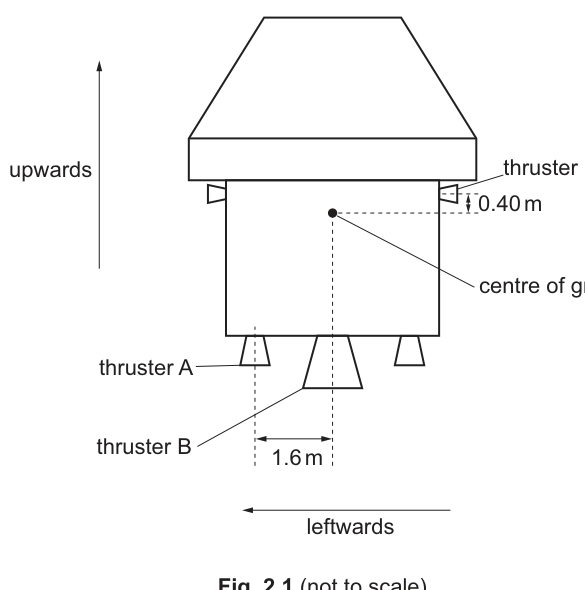
Thruster A is a distance of leftwards from the centre of gravity of the spacecraft. Thruster C is a distance of upwards from the centre of gravity of the spacecraft.
Thrusters A and B can produce forces on the spacecraft in the upwards direction only. Thruster C can produce a force on the spacecraft in the leftwards direction only. All the thrusters shown produce forces entirely in the same plane as the centre of gravity.
Thruster A is activated, producing a force of upwards on the spacecraft. Thruster C is also activated, producing a force of in the leftwards direction on the spacecraft.
Calculate the resultant moment due to these forces about the centre of gravity.
resultant moment = ______
Working
Moment from A about C.G.:
Moment from C about C.G.:
Resultant moment:
Answer
clockwise
8 N m clockwise
Background Concept
The moment (torque) of a force about a point is a measure of its turning effect:
where is the force and is the perpendicular distance from the point (pivot) to the line of action of the force.
The direction (sense) of the moment is either clockwise (CW) or anticlockwise (ACW). When more than one force acts, the resultant moment is the algebraic sum of the individual moments, taking one sense as positive.
Understanding the Question
Two thrusters produce forces in perpendicular directions:
- Thruster A: upwards, acting at a point to the left of the centre of gravity.
- Thruster C: leftwards, acting at a point above the centre of gravity.
We must find the net (resultant) moment about the centre of gravity, including the correct sense (CW/ACW).
Approach
- For each force, identify the perpendicular distance from the centre of gravity to that force’s line of action.
- Calculate each moment using .
- Decide whether each moment is clockwise or anticlockwise.
- Subtract because the moments oppose.
Step-by-Step Reasoning
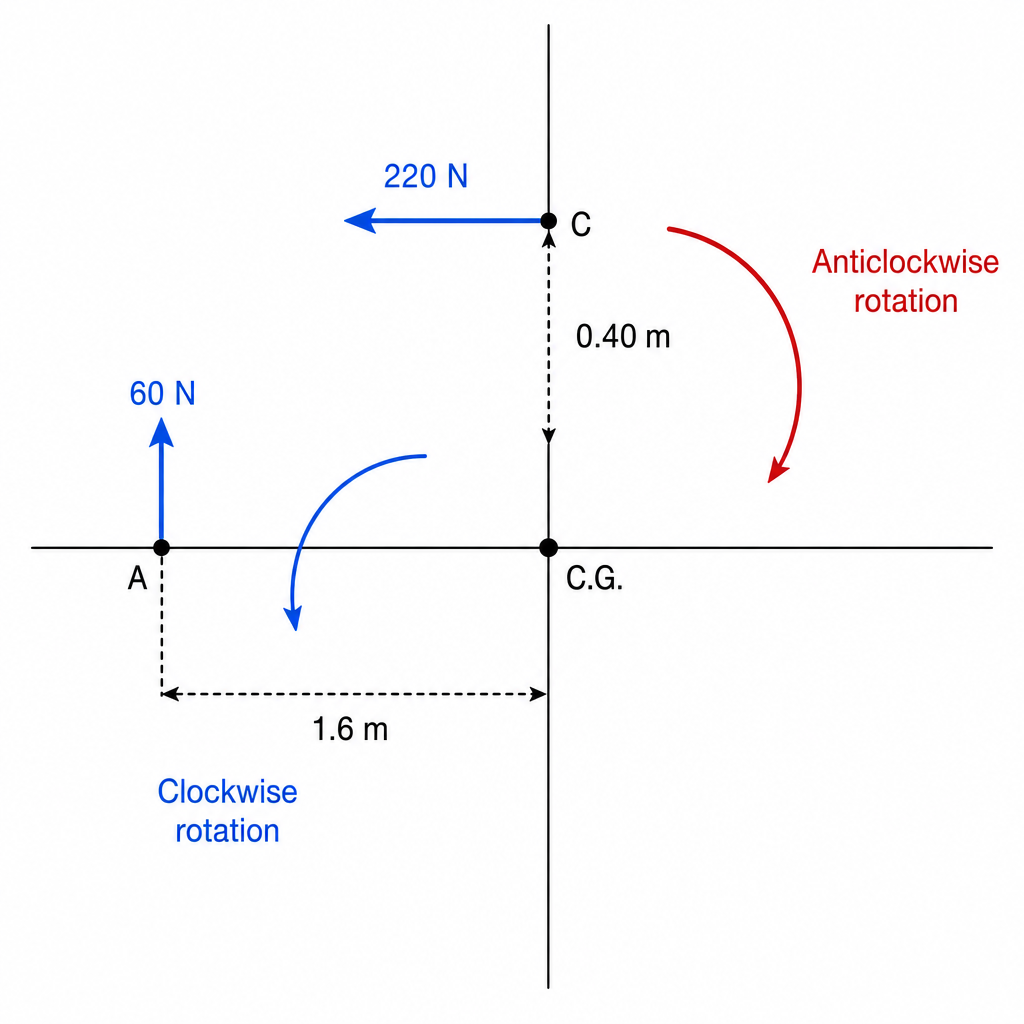
Moment from thruster A
- Line of action is vertical (upwards force).
- Perpendicular distance from C.G. is the horizontal separation .
Because the force is upward on the left of the C.G., it tends to rotate the spacecraft clockwise.
Moment from thruster C
- Line of action is horizontal (leftward force).
- Perpendicular distance from C.G. is the vertical separation .
A leftward force acting above the C.G. tends to rotate anticlockwise.
Resultant moment
The two moments oppose, so subtract:
Direction is the same as the larger moment (from A): clockwise.
Key Takeaways
- Use with the perpendicular distance to the line of action.
- Always state the sense of rotation when moments are involved.
- Resultant moment is the algebraic sum (moments can oppose).
Common Mistakes
- Using the wrong distance (e.g. using for thruster C or for thruster A).
- Forgetting that clockwise and anticlockwise moments can cancel.
- Not stating the direction (CW/ACW) when required.
Things to Be Careful About
- The perpendicular distance is measured to the line of action, not to the point of application in a straight-line sense.
- Keep units as (not or missing units).
Answer
No.
A couple is formed by two equal and opposite parallel forces with zero resultant force. Forces from A (upwards) and C (leftwards) are not parallel and do not give zero resultant force, so they are not a couple.
No; they are not a couple.
Background Concept
A couple is a pair of forces that:
- are equal in magnitude,
- opposite in direction,
- parallel (same line direction),
- act along different lines of action (separated),
so the resultant force is zero but there is a non-zero moment causing pure rotation.
Understanding the Question
Thruster A pushes upwards on the spacecraft and thruster C pushes leftwards. The question asks whether these two forces constitute a couple.
Approach
Compare the forces with the definition of a couple: check parallelism, equality/opposition, and whether the resultant force would be zero.
Step-by-Step Reasoning
- The force from A is vertical (upwards) while the force from C is horizontal (leftwards).
- Since they are at right angles, the forces are not parallel.
- They are also not opposite to each other (they are in different directions), so they cannot be “equal and opposite”.
- Therefore the resultant force is not zero; it would be a diagonal force (up and left).
Hence they do not form a couple.
Key Takeaways
- A couple requires parallel forces and zero resultant force.
- Non-zero resultant force means translation as well as possible rotation.
Common Mistakes
- Thinking “any two forces that make a turning effect” form a couple.
- Forgetting the crucial condition that the forces must be parallel.
Things to Be Careful About
- A system can have a moment about a point without being a couple; a couple is a very specific arrangement of forces.
Thrusters A and C are now switched off and the spacecraft is stationary. Thruster B is activated at time , producing a constant force on the spacecraft until the fuel runs out at time . As the fuel is used, the total mass of the spacecraft decreases.
On Fig. 2.2, sketch the variation of speed of the spacecraft with time from to .
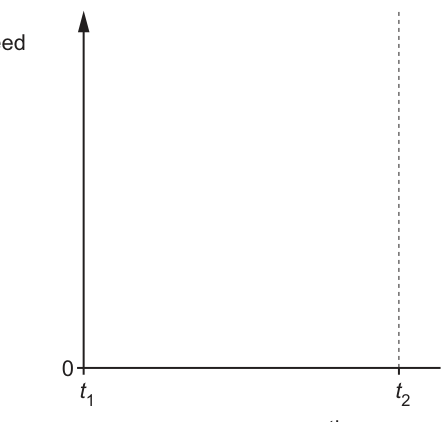
Answer
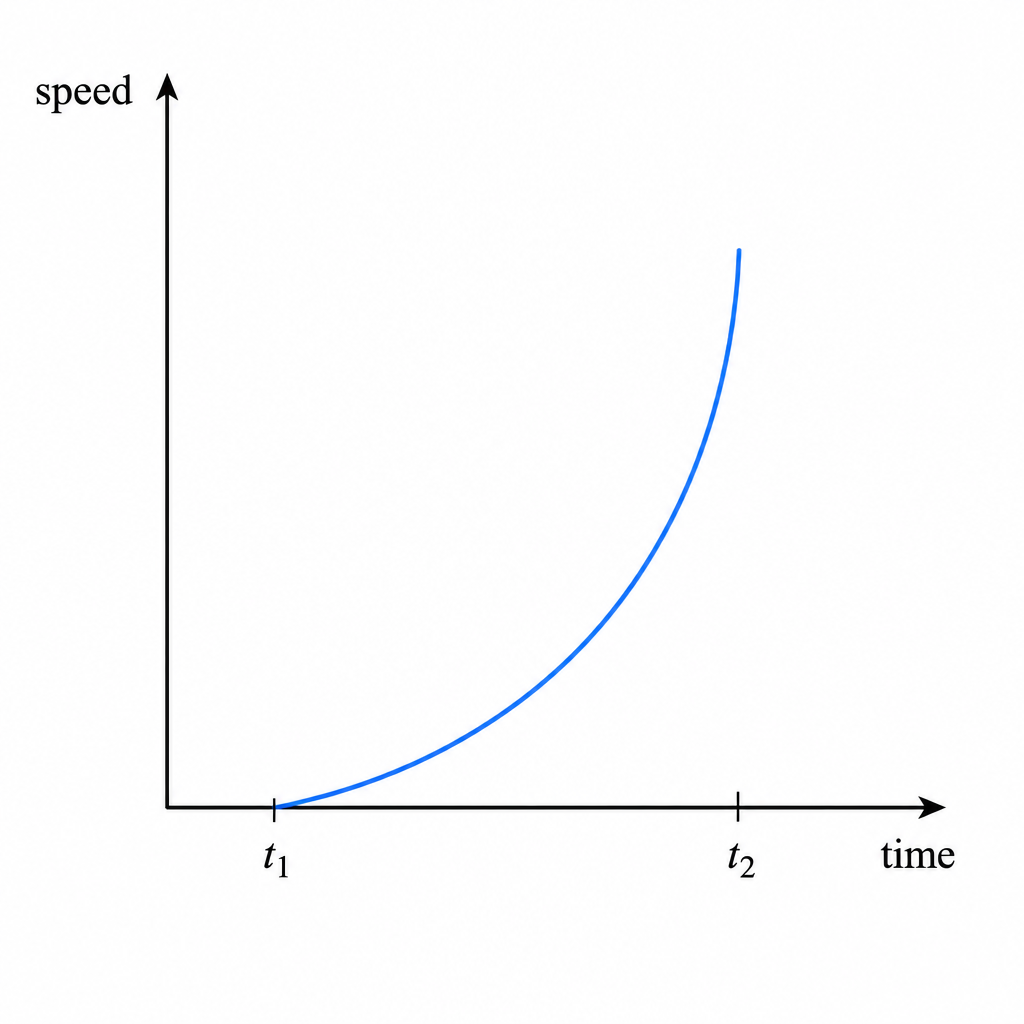
From the speed increases with time and the gradient increases (curve becomes steeper) because increases as decreases.
So sketch a rising curve from to that is concave upwards (increasing gradient).
Speed increases with increasing gradient (concave-up curve) from t1 to t2.
Background Concept
Newton’s second law states:
so the acceleration is
On a speed–time graph, the gradient at any point equals the acceleration:
Therefore, if acceleration increases with time, the speed–time graph must become progressively steeper (concave upwards).
Understanding the Question
The spacecraft starts stationary. Thruster B provides a constant force from to . As fuel is burnt, the spacecraft’s mass decreases. We must sketch how speed varies between and .
Approach
- Use .
- Since is constant and decreases, increases.
- Increasing means increasing gradient on the speed–time graph.
- Draw a curve starting at at that rises and becomes steeper towards .
Step-by-Step Reasoning
At , speed is zero (stationary). Immediately after there is a forward (upward) thrust from B, so speed begins to increase.
Because the thrust is constant:
As fuel is used, decreases, so increases. Since acceleration equals the gradient of the speed–time graph, the gradient must increase with time.
So the correct sketch is an increasing curve that is concave upwards between and .
Key Takeaways
- Constant force does not necessarily mean constant acceleration if mass changes.
- On a – graph: increasing acceleration means a curve that gets steeper.
Common Mistakes
- Drawing a straight line (constant gradient), which would imply constant acceleration and hence constant mass.
- Drawing a curve that flattens (decreasing gradient), which would imply acceleration is decreasing.
Things to Be Careful About
- The sketch asked is only from to .
- Make sure the curve starts at the correct point: the spacecraft is stationary at , so at .
The spacecraft now splits apart into a carrier and a payload as shown in Fig. 2.3.
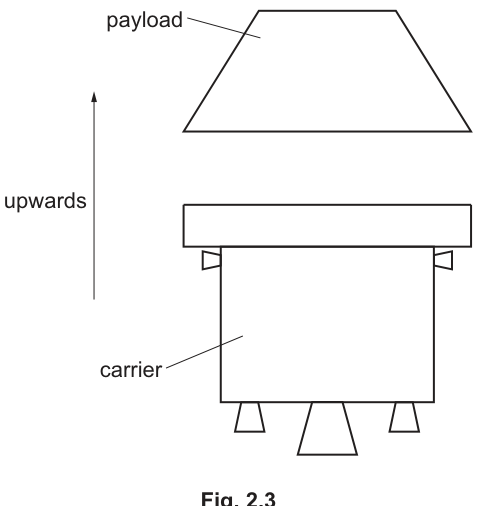
During the split, an average force of acts on the payload for a time of . The velocity of the payload increases by in the upwards direction.
The combined mass of the carrier and payload is .
Answer
In an isolated system (no resultant external force), the total momentum remains constant, i.e. total momentum before an interaction equals total momentum after.
Total momentum of an isolated system remains constant (before = after) if no resultant external force acts.
Background Concept
Linear momentum is
The principle of conservation of momentum states that if the resultant external force is zero, then the total momentum of a system does not change.
Equivalently:
This is because external force is the rate of change of momentum:
So if , then .
Understanding the Question
The spacecraft splits into carrier and payload. The forces involved in the split are internal forces between the two parts, so (in deep space) the system can be treated as having negligible external forces. The question asks you to state the principle used to relate their momenta before and after the split.
Approach
Give the standard two-part statement:
- Condition: no resultant external force / isolated system.
- Conclusion: total momentum remains constant (before = after).
Step-by-Step Reasoning
- Identify the system: carrier + payload.
- In deep space, external forces are negligible over the short split time, so it is approximately isolated.
- Therefore total momentum of carrier + payload is conserved.
Key Takeaways
- Momentum conservation is a system rule: apply it to all interacting bodies together.
- Always mention the condition: no resultant external force.
Common Mistakes
- Saying only “momentum is conserved” without stating the condition for conservation.
- Confusing momentum conservation with energy conservation.
Things to Be Careful About
- Conservation applies to the total momentum vector, including directions (signs).
Working
Impulse on payload:
Answer
230 kg
Background Concept
Impulse is the product of average force and time:
Impulse equals the change in momentum:
For a body of constant mass,
Understanding the Question
An average force of acts on the payload for , and the payload’s velocity increases by upwards. We are asked to show the payload mass is .
Approach
- Compute the impulse .
- Set .
- Rearrange for and substitute values.
Step-by-Step Reasoning
Compute impulse:
Use impulse–momentum:
So
Rounded to 2 significant figures (consistent with the given data),
Key Takeaways
- Impulse links force and time to change in momentum.
- For constant mass, is the quickest route to find .
Common Mistakes
- Using instead of .
- Forgetting that is the change in velocity already.
- Rounding too early and losing accuracy.
Things to Be Careful About
- Use the average force if the force is not constant (the question explicitly says average).
- Quote the final mass to a sensible number of significant figures (here, ).
Calculate the magnitude of the change in velocity of the carrier.
change in velocity = ______
Working
Payload mass (from (ii)) , so carrier mass
Initially total momentum , so after split
Answer
0.86 m s^-1
Background Concept
For an isolated system, total momentum is conserved:
Momentum is a vector, so direction matters. If the system starts at rest, the total momentum is zero; after separation, the two parts must have equal and opposite momenta.
Understanding the Question
The spacecraft (total mass ) splits into:
- payload of mass moving upwards with speed increase ,
- carrier of mass moving in the opposite direction.
We must find the magnitude of the carrier’s change in velocity.
Approach
- Find the carrier mass from total mass: .
- Use conservation of momentum with initial momentum zero.
- Set payload momentum upward equal to carrier momentum downward in magnitude.
- Solve for .
Step-by-Step Reasoning
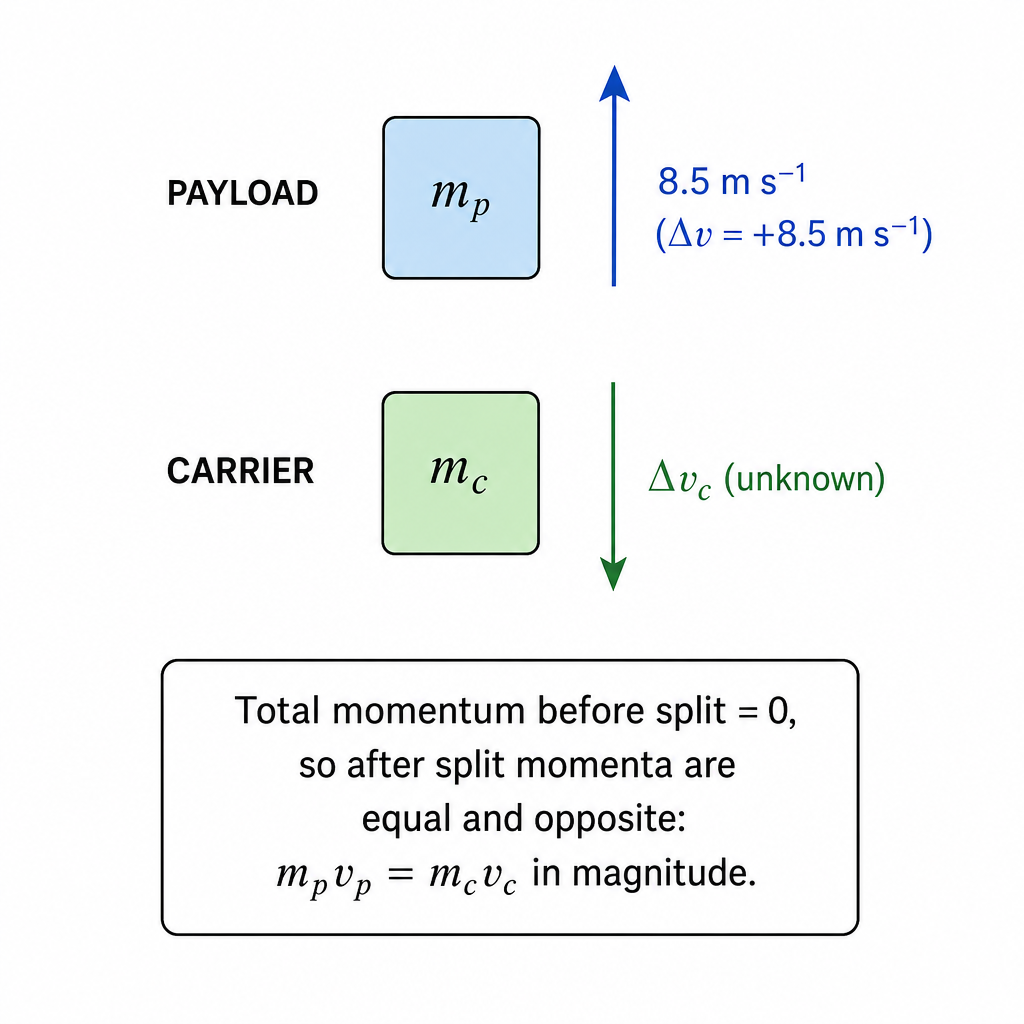
1. Mass of the carrier
Using :
2. Apply momentum conservation
Initially the spacecraft is stationary, so total momentum is zero.
After the split, take upwards as positive.
Payload momentum:
Carrier must have equal and opposite momentum:
So in magnitudes:
Solve:
This is the magnitude; the direction would be downwards.
Key Takeaways
- If the system starts from rest, momenta after separation must be equal and opposite.
- The more massive object gets the smaller change in velocity.
Common Mistakes
- Forgetting to subtract to find .
- Adding velocities instead of using momentum conservation.
- Ignoring direction and getting the sign wrong (even though this question asks for magnitude).
Things to Be Careful About
- Use consistent significant figures (2–3 s.f. is appropriate here).
- If you used a more precise payload mass from (ii), you would get a very similar final value (error carried forward is usually allowed).
A spring is fixed at one end and attached to the frame of a pulley at the other end. A cable is passed around the wheel of the pulley. The spring is stretched to a fixed length using the cable and pulley.
Fig. 3.1 shows the view from above of the spring, cable and pulley.
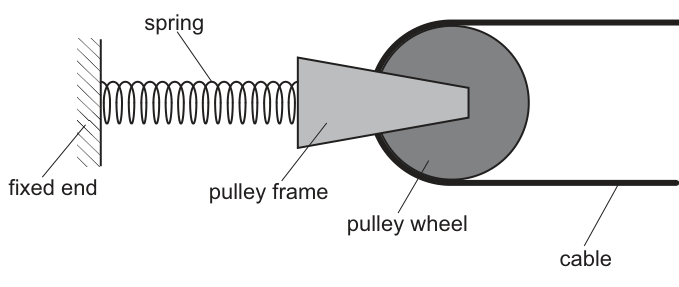
The spring obeys Hooke’s law and has a spring constant of . A force acts on the spring. The tension in the cable is . The pulley is in equilibrium.
On Fig. 3.2, draw labelled arrows to show the directions of the forces acting on the pulley.
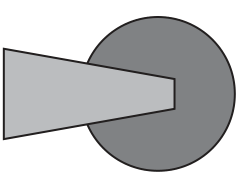
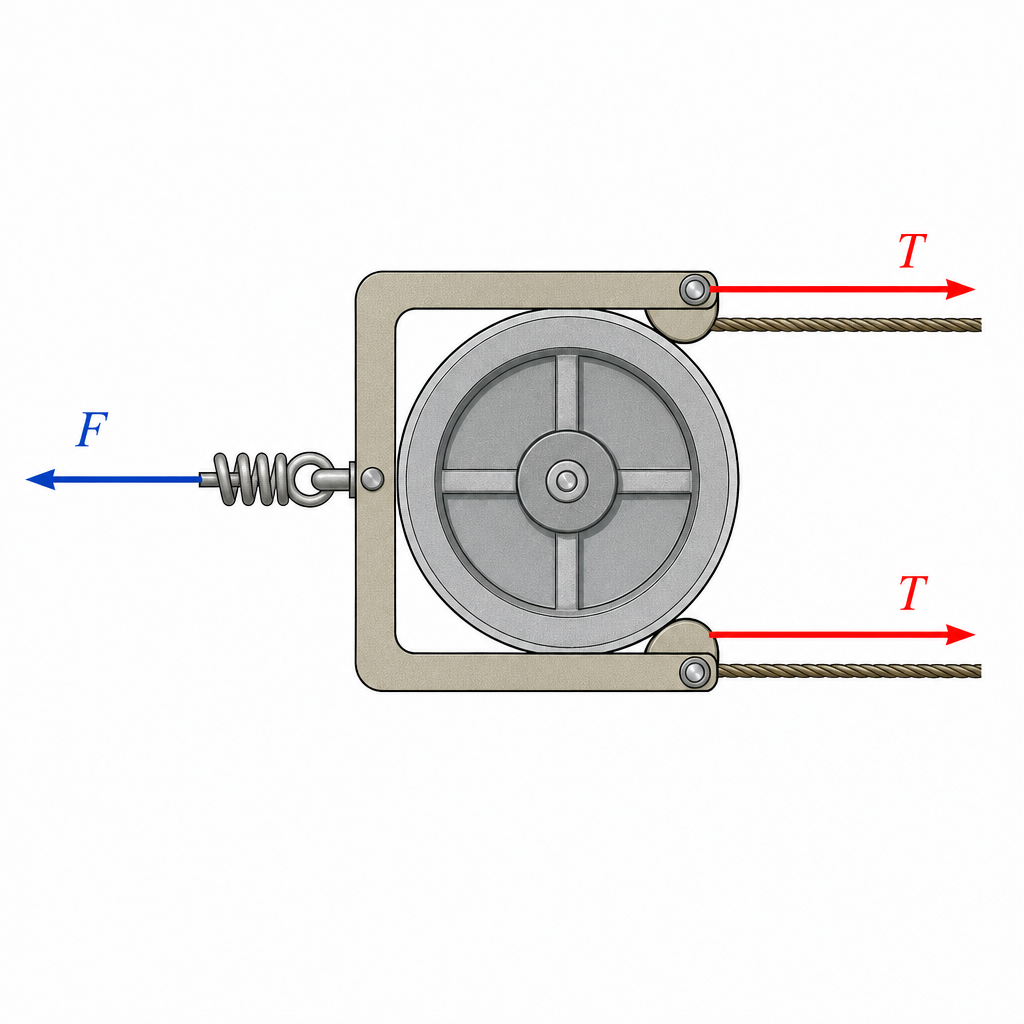
See diagram
Background Concept
For a body in equilibrium, the resultant force on it is zero. To analyse this, we draw a force diagram showing all external forces acting on the body. Each force is drawn as an arrow pointing in the direction the force acts on the chosen body.
In a light, smooth cable, the tension is the same throughout the cable. If the cable touches a pulley and leaves in two straight sections, then the pulley experiences two tension forces from the two cable sections, each acting along the direction of that section.
Understanding the Question
We are looking at the pulley (frame/wheel) as the object. The spring is attached to the pulley frame, so the spring exerts a force on the pulley. The cable passes around the pulley wheel and leaves as two parallel straight segments to the right; each segment pulls on the pulley with tension . The pulley is stated to be in equilibrium, so these forces must balance.
Approach
- Choose the pulley as the body.
- Add forces due to each interaction:
- spring on pulley (), along the spring direction;
- cable on pulley: two forces of magnitude , each along the direction of a cable segment.
- Ensure directions are consistent with the geometry (spring to the left, two cable segments to the right).
Step-by-Step Reasoning
- The spring is stretched between the fixed support (left) and the pulley frame (right), so it pulls the pulley back towards the fixed end: force on the pulley is to the left.
- The cable has two straight, parallel sections on the right-hand side of the pulley. Each section exerts a pull on the pulley along the cable direction, so there are two forces of magnitude acting to the right on the pulley (one for the upper segment and one for the lower segment).
- These three forces are the ones to show for the pulley in equilibrium.
Key Takeaways
- For a pulley with a cable leaving in two sections, the pulley experiences two tension forces, one from each section.
- In equilibrium, a correct force diagram is the essential first step.
Common Mistakes
- Drawing only one tension force instead of two.
- Drawing the spring force in the wrong direction (it acts to pull the pulley back toward the fixed end).
- Labeling cable forces as instead of .
Things to Be Careful About
- Forces must be drawn on the pulley (not on the cable or on the spring).
- Tension forces act along the cable segments (here, horizontal to the right as shown).
- If the diagram shows two separate cable strands, you must include two separate forces.
The force is .
Working
For equilibrium on the pulley:
Answer
55 N
Background Concept
For a body in equilibrium, the vector sum of forces is zero. If all forces act along one line, equilibrium reduces to “total force to the right = total force to the left”.
A pulley with a cable around it experiences a force from each straight section of cable leaving the pulley. If the tension in each section is and the two sections are parallel, then the resultant pull from the cable on the pulley is in that direction.
Understanding the Question
We are told acts on the spring and the pulley is in equilibrium. From the diagram context, the spring pulls the pulley one way with force and the cable pulls the pulley the opposite way with two equal tension forces (one from each cable segment). We must find .
Approach
Use horizontal force equilibrium for the pulley:
- spring force magnitude balances the sum of the two cable tensions .
So set and solve.
Step-by-Step Reasoning
- The cable has two segments pulling the pulley to the right, each with magnitude , so total rightward force is .
- The spring pulls the pulley to the left with magnitude .
- Equilibrium gives:
Substitute :
Key Takeaways
- A pulley pulled by two equal strands has a total pull of .
- Equilibrium often reduces to a simple force-balance equation.
Common Mistakes
- Using (forgetting there are two strands).
- Doubling the wrong force (writing ).
Things to Be Careful About
- The two tensions are separate forces acting on the pulley; only add them if they act in the same direction (they do here: both to the right).
Working
Using Hooke’s law :
Answer
extension
0.44 m
Background Concept
Hooke’s law for an ideal spring states:
where:
- is the force (tension) in the spring in newtons,
- is the spring constant in ,
- is the extension from the natural length in metres.
This applies as long as the spring remains within its limit of proportionality.
Understanding the Question
We are given the spring constant and the force on the spring . The question asks for the extension .
Approach
Rearrange Hooke’s law to make the subject:
Then substitute the given values.
Step-by-Step Reasoning
Start with:
Rearrange:
Substitute and :
Unit check: , so metres is correct.
Key Takeaways
- Extension is directly proportional to force for a Hooke’s-law spring.
- Always check units: in gives in m.
Common Mistakes
- Using .
- Giving the answer in cm without converting (or without stating units).
Things to Be Careful About
- The force used in Hooke’s law is the force in the spring itself ( here), not the tension in one cable segment ().
A second identical spring with the same spring constant of is now also connected to the pulley, as shown in Fig. 3.3.
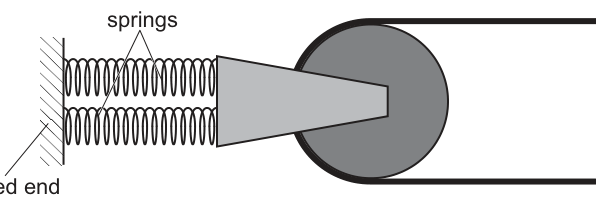
The tension in the cable is kept the same. The pulley is again in equilibrium.
Working
From (b)(i), so the pull from the cable is .
Two identical springs in parallel:
Answer
extension
0.22 m
Background Concept
When springs are connected in parallel (both attached between the same two points), they have the same extension . The forces they exert add:
So the equivalent spring constant is:
Understanding the Question
A second identical spring is added in parallel with the first between the fixed support and the pulley frame. The cable tension is kept the same as before, and the pulley remains in equilibrium. So the total force that must be balanced by the springs is unchanged, but it is now shared between two springs.
Approach
- Use the same cable effect as before: with tension in each strand, the cable pulls with .
- In equilibrium, springs must provide equal and opposite total force .
- Use the parallel-springs relation to find the extension .
Step-by-Step Reasoning
- From earlier, the tension in each cable segment is . With two segments:
- With two identical springs in parallel, both extend by the same amount , and each exerts force , so total restoring force is:
- Solve for :
This is half the original extension because the system is twice as stiff.
Key Takeaways
- Parallel springs add their spring constants: stiffer system, smaller extension for the same load.
- Always decide whether springs are in series or in parallel by checking whether they share the same extension (parallel) or the same force (series).
Common Mistakes
- Treating parallel springs as if they were in series (using ).
- Using with instead of .
Things to Be Careful About
- “Tension kept the same” means the external pull from the cable () is the same as before, so the total spring force required is unchanged.
The elastic potential energy stored in the spring in Fig. 3.1 is . The total elastic potential energy stored in the two springs in Fig. 3.3 is .
Calculate the ratio .
ratio = ______
Working
Elastic energy in a spring:
Fig. 3.1:
Fig. 3.3: for each spring
Answer
ratio
2
Background Concept
The elastic potential energy stored in a Hooke’s-law spring is the work done to stretch it:
This comes from the area under a force–extension graph (a triangle) because increases linearly from to .
When there are two springs, the total energy stored is the sum of the energies in each spring.
Understanding the Question
is the energy in the single-spring setup (Fig. 3.1). is the total energy stored when two identical springs are used in parallel (Fig. 3.3). We already found the extensions:
- single spring: ,
- each of the two parallel springs: .
We must find the ratio .
Approach
- Write energy for the one spring: .
- Write energy for the two-spring case: energy per spring is , then multiply by 2 to get .
- Form the ratio and simplify; cancels.
Step-by-Step Reasoning
Single spring:
Two parallel springs:
- energy in one spring is ,
- total energy is twice that:
Now take the ratio:
With :
So the single-spring setup stores twice as much elastic energy as the two-parallel-spring setup, even though the applied force is the same (because extension is larger in the less stiff system).
Key Takeaways
- Elastic energy scales with the square of extension: .
- For multiple springs, total energy is the sum across springs.
- Doubling stiffness (parallel springs) halves extension for the same force, so energy changes significantly.
Common Mistakes
- Forgetting to double the energy for two springs (using instead of that).
- Using (they are not equal here).
- Using or instead of .
Things to Be Careful About
- is the total energy in both springs, not the energy in one spring.
- Do the algebra first: cancelling helps avoid unnecessary arithmetic errors.
A laser emits visible light of a single frequency in a vacuum. The light is incident normally on a double slit and then forms a pattern of bright and dark fringes on a screen, as shown in Fig. 4.1.
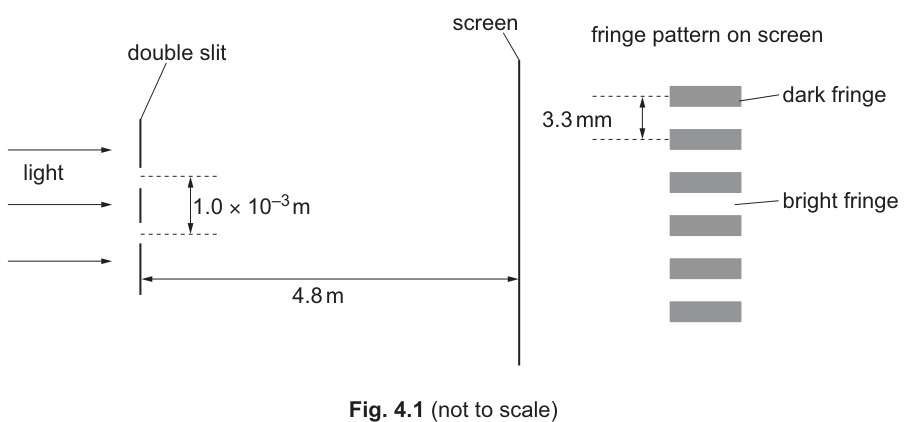
The separation of the slits is . The distance from the slits to the screen is . The distance between the centres of adjacent dark fringes on the screen is .
Answer
Light diffracts at each slit so the two slits act as two coherent sources.
At a point on the screen the waves from the two slits superpose.
Where path difference the waves arrive in phase giving constructive interference (bright fringe).
Where path difference the waves arrive in antiphase giving destructive interference (dark fringe).
Bright fringes where path difference = mλ; dark fringes where path difference = (m + 1/2)λ, due to superposition of coherent waves from the two slits.
Background Concept
Interference occurs when two (or more) waves overlap at a point and combine according to the principle of superposition: the resultant displacement is the sum of the individual displacements.
For a stable (unchanging) fringe pattern, the two sources must be coherent: they have a constant phase difference and the same frequency.
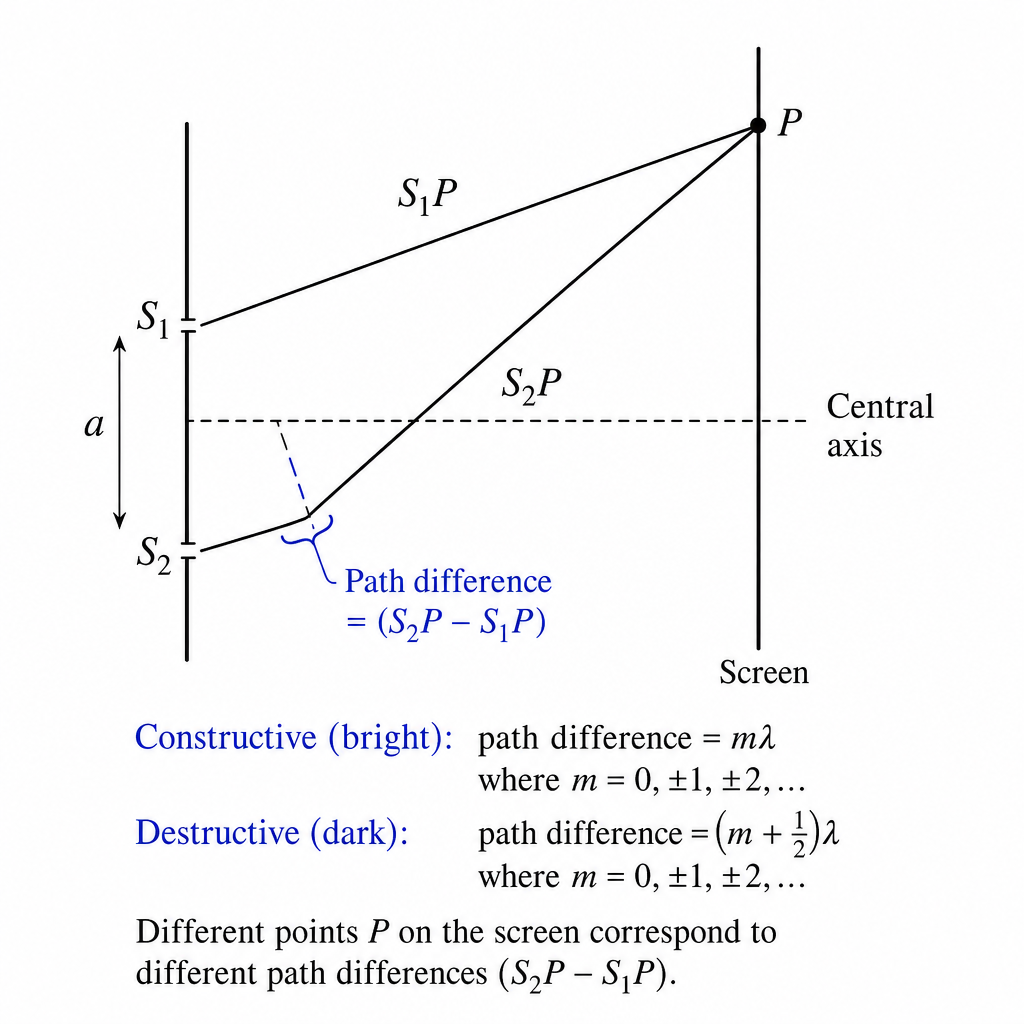
For two coherent sources, the type of interference at a point depends on the path difference (difference in distance travelled by the two waves to that point):
- Constructive interference (bright): path difference (integer ), waves arrive in phase.
- Destructive interference (dark): path difference , waves arrive radians out of phase.
Understanding the Question
A laser shines normally onto a double slit and produces alternating bright and dark fringes on a distant screen. The question asks for a physical explanation of how those fringes arise.
So we need to mention:
- each slit producing a spreading (diffracted) wave,
- coherence (both slits fed by the same laser),
- superposition at the screen,
- the path-difference conditions for bright and dark.
Approach
Explain the chain:
- Laser light reaches both slits from the same source, so the two emerging waves are coherent.
- The waves overlap on the screen.
- Different points on the screen correspond to different path differences.
- Use the path-difference conditions to identify bright (constructive) and dark (destructive) fringes.
Step-by-Step Reasoning
-
Diffraction at each slit: each slit is narrow enough to cause spreading, so light from each slit can reach many points on the screen.
-
Coherent sources: because both slits are illuminated by the same laser, the waves leaving the slits have the same frequency and a fixed phase relationship.
-
Superposition on the screen: at any chosen point on the screen, two waves arrive: one from slit and one from slit .
-
Path difference controls phase difference:
- If , the phase difference is , so the waves add to a maximum amplitude → bright fringe.
- If , the phase difference is , so the waves cancel → dark fringe.
As you move along the screen, the path difference changes smoothly, so you get alternating bright and dark fringes.
Key Takeaways
- Double-slit fringes are an interference effect requiring coherence.
- Bright: path difference ; dark: path difference .
- Diffraction at each slit allows overlap of the two waves on the screen.
Common Mistakes
- Saying “bright where waves meet” without stating the path-difference / phase condition.
- Forgetting to mention that the two slits must act as coherent sources.
- Mixing up the conditions for bright and dark fringes.
Things to Be Careful About
- “Coherent” means constant phase difference, not merely “same frequency” (though same frequency is necessary).
- The pattern is stable only if the phase relationship does not drift randomly with time.
Working
Fringe spacing (dark to adjacent dark):
Answer
4.3 × 10^14 Hz
Background Concept
For a double-slit pattern (small angles), the separation between adjacent fringes is
where:
- is the wavelength,
- is the distance from the slits to the screen,
- is the slit separation.
This spacing is the same whether you measure between adjacent bright fringes or adjacent dark fringes (each step corresponds to a path-difference change of one full wavelength).
Once is known, for light in vacuum:
Understanding the Question
Given:
- slit separation
- slit-to-screen distance
- spacing between centres of adjacent dark fringes
We must find the frequency of the laser light.
Approach
- Use the measured fringe spacing with to calculate .
- Use with .
Step-by-Step Reasoning
- Convert the fringe spacing to metres:
- Rearrange the fringe-spacing formula to get wavelength:
- Substitute values:
This is in the visible range, which is a good check.
- Use :
Key Takeaways
- Adjacent bright-to-bright or dark-to-dark spacing equals .
- Always convert mm to m before substituting.
- For EM waves in vacuum, use .
Common Mistakes
- Using instead of (inverting the formula).
- Forgetting to convert to metres.
- Using with left in mm, giving a frequency off by .
Things to Be Careful About
- The formula assumes small angles and that (true here: is much larger than ).
- Quote the final frequency to sensible significant figures (limited by given data: typically 2 s.f.).
The double slit is removed. A second laser is placed beside the first laser. The second laser produces visible light of a different frequency from that of the first laser. The beams of light from the two lasers overlap on the screen.
Explain why a steady pattern of bright and dark fringes is not formed on the screen.
Answer
The two lasers are not coherent (no constant phase relationship, and different frequencies), so the phase difference at any point changes with time and the interference pattern averages out (no steady fringes).
No steady fringes because the two lasers are not coherent (phase difference varies with time), so the pattern washes out.
Background Concept
A steady interference pattern requires coherent sources: same frequency and a constant phase difference.
If the phase difference at a point changes with time, the intensity at that point fluctuates between bright and dark. The screen (and your eye) effectively averages over time, so you observe a uniform illumination rather than fixed fringes.
Understanding the Question
The original double slit produced fringes because both waves came from the same laser and therefore had a stable phase relationship.
Now the double slit is removed and instead two separate lasers shine onto the same screen, with different frequencies. The question asks why this does not produce a steady bright/dark fringe pattern.
Approach
State the coherence requirement, then explain that two independent lasers (especially with different frequencies) cannot maintain a fixed phase difference at the screen, so the fringe pattern is not stationary.
Step-by-Step Reasoning
- With two independent lasers, the relative phase between their electric fields is not locked.
- Because their frequencies differ, the phase difference changes continually:
- Therefore, at any fixed point on the screen, the interference varies rapidly in time from constructive to destructive.
- Time averaging removes the contrast, so there is no steady pattern of bright and dark fringes.
Key Takeaways
- Interference fringes require coherence.
- Different frequencies (and independent sources) cause a varying phase difference, washing out fringes.
Common Mistakes
- Saying “different wavelengths so no fringes” without mentioning the real reason: no constant phase difference.
- Forgetting that even same-frequency independent lasers are generally not coherent unless phase-locked.
Things to Be Careful About
- It is the stability of the phase difference that matters for a steady pattern; instantaneous interference can still occur, but it will not remain fixed in position or contrast.
Fig. 5.1 shows a circuit containing a battery, two fixed resistors X and Y, and a light-dependent resistor (LDR) Z.
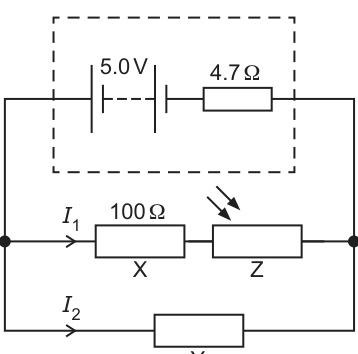
The battery has electromotive force (e.m.f.) and internal resistance . The current in X is and the current in Y is .
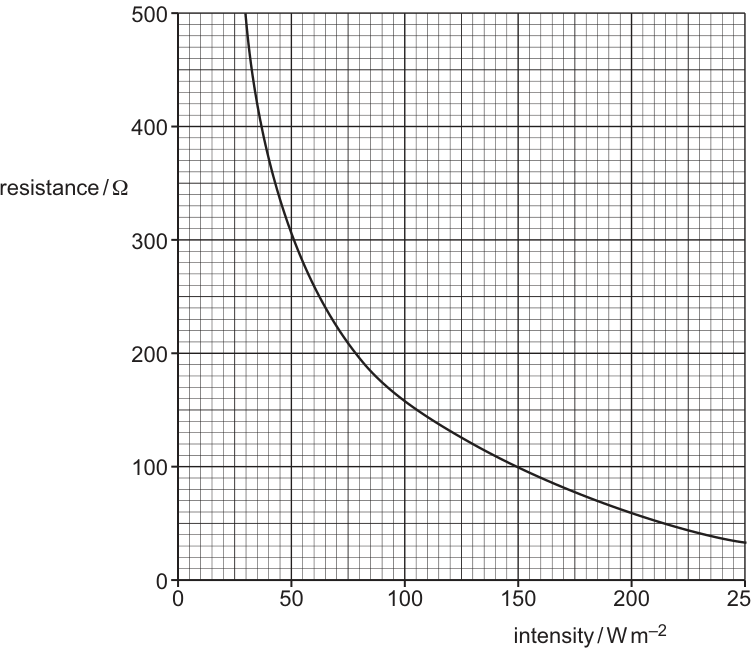
The resistance of X is . The resistance of Z varies with the intensity of light incident on it as shown in Fig. 5.2.
Answer
At any junction, the sum of currents entering equals the sum of currents leaving (algebraic sum of currents at a junction is zero).
At any junction, the sum of currents entering equals the sum of currents leaving.
Background Concept
Kirchhoff’s first law is a statement of conservation of charge in electrical circuits. Charge cannot build up at a junction in a steady circuit, so the rate at which charge flows into the junction must equal the rate at which it flows out.
Since current is the rate of flow of charge,
conservation of charge implies conservation of current at a node.
Understanding the Question
You are asked to state Kirchhoff’s first law (the junction rule). No numbers or the specific circuit in Fig. 5.1 are needed for this part.
Approach
Give a clear verbal statement involving “sum of currents into a junction equals sum of currents out”. Equivalent algebraic wording is also acceptable.
Step-by-Step Reasoning
In a steady circuit, charge does not accumulate at a junction.
- If more current entered than left, charge would build up.
- If more current left than entered, the junction would be “losing” charge.
So the only possibility is:
Key Takeaways
- Kirchhoff’s first law is current conservation at a junction.
- It comes from conservation of charge.
Common Mistakes
- Stating Kirchhoff’s second law (sum of voltages in a loop) instead.
- Writing “current is the same everywhere” (only true for a single series path, not at junctions).
Things to Be Careful About
- Use the word “junction” (or “node”).
- “Algebraic sum of currents is zero” is fine, but only if it clearly refers to a junction.
The intensity of light incident on Z is . The current in the battery is .
Working
Lost volts:
Terminal p.d.:
Answer
4.8 V
Background Concept
A real battery can be modelled as an ideal source of e.m.f. in series with an internal resistance . When a current is drawn, some energy per unit charge is dissipated inside the battery, giving a “lost volts” drop .
The terminal potential difference (p.d.) across the external circuit is then
This applies when the battery is delivering current to the circuit.
Understanding the Question
Given:
- battery current
You must show the terminal p.d. is .
Approach
Convert the current into amperes, calculate lost volts , then subtract from the e.m.f.
Step-by-Step Reasoning
- Convert current:
- Lost volts across internal resistance:
- Terminal p.d.:
To 2 s.f. (matching the data),
Key Takeaways
- Terminal p.d. is less than e.m.f. when current flows because of internal resistance.
- Use for a delivering cell.
Common Mistakes
- Using (wrong sign).
- Forgetting to convert to .
Things to Be Careful About
- Quote the terminal p.d. to appropriate significant figures; or would typically be accepted depending on marking.
- Ensure is in and in so is in volts.
Working
From Fig. 5.2 at , take .
Branch and are in series:
Terminal p.d. across each parallel branch is , so
Total battery current and :
Answer
1.6 × 10^-2 A
Background Concept
In a parallel circuit, each branch has the same potential difference across it (equal to the supply terminal p.d.). For any resistor or series combination of resistors in a branch, the branch current is found using Ohm’s law:
At the junction where the current splits, Kirchhoff’s first law applies:
where is the total current from the battery and , are the branch currents.
Understanding the Question
The external circuit consists of two parallel branches:
- Top branch: fixed resistor in series with LDR .
- Bottom branch: fixed resistor .
Given when the light intensity on is :
- battery current
- terminal p.d. (from part (i))
- must be read from the graph.
You need (current in ).
Approach
- Read at from Fig. 5.2.
- Compute the total resistance of the top branch: .
- Use because the branch p.d. is .
- Use Kirchhoff’s first law: .
Step-by-Step Reasoning
-
Reading the graph: at intensity , the LDR resistance is approximately (your exact value may differ slightly depending on how you read the curve).
-
Series in the top branch means resistances add:
- The terminal p.d. is across the whole parallel network, so it is also across the top branch. Hence
- At the junction, total current splits:
So
Key Takeaways
- Parallel branches share the same p.d.; series components share the same current.
- For a split, use Kirchhoff’s first law: total current equals the sum of branch currents.
- Reading a value from a graph is often the first step in a circuit calculation.
Common Mistakes
- Adding currents directly using with the wrong resistance (e.g. using instead of ).
- Using the e.m.f. instead of the terminal p.d. .
- Forgetting that .
Things to Be Careful About
- Your numerical answer depends on how you read from the curve; keep your reading sensible and consistent with the axes.
- Use the terminal p.d. across the external circuit, not the e.m.f., when finding branch currents.
- Round at the end to avoid unnecessary rounding error.
Working
For resistor , p.d. across it is the terminal p.d. :
Answer
7.8 × 10^-2 W
Background Concept
Electrical power is the rate of transfer of electrical energy. For a component with potential difference across it and current through it,
For a resistor you can also use
Understanding the Question
You have already found the current in resistor (called ). Resistor is connected directly across the battery terminals (as one branch of the parallel network), so the p.d. across equals the terminal p.d. of the battery (found in part (i) to be ).
You are asked for the power dissipated in .
Approach
Use with:
- = terminal p.d. across the parallel branches
- = branch current
Step-by-Step Reasoning
Since is a single component in its branch, the p.d. across it is the branch p.d., which equals the battery terminal p.d.
With ,
So to 2 s.f.,
Key Takeaways
- In parallel, each branch has the same p.d.
- Power in a component can be found quickly using .
Common Mistakes
- Using instead of the terminal p.d.
- Using the total battery current instead of the branch current .
Things to Be Careful About
- Keep units consistent: in volts, in amperes gives in watts.
- If you use or , make sure you are using the resistance of (not the whole circuit).
The intensity of the light incident on Z decreases.
State and explain the effect on the terminal potential difference of the battery.
Answer
As light intensity decreases, increases, so the resistance of the – branch increases and the total external resistance increases. Hence the battery current decreases. Since
a smaller gives a smaller , so the terminal p.d. increases (towards ).
Terminal p.d. increases (towards 5.0 V) because lower light makes R_Z larger, reducing current so lost volts Ir decreases.
Background Concept
An LDR has a resistance that increases when light intensity decreases. In circuits with an internal resistance , the terminal p.d. is
So the terminal p.d. depends on the current drawn. If the current decreases, the lost volts decreases and rises closer to the e.m.f.
Also, for a fixed e.m.f. source, changing a resistance in the external circuit changes the total external resistance and hence the current drawn.
Understanding the Question
The LDR is in series with resistor in the top branch, and this whole top branch is in parallel with resistor . You are told the intensity of light incident on decreases.
You must state what happens to the battery terminal p.d. and explain using circuit reasoning (including internal resistance).
Approach
Follow the cause-and-effect chain:
- Lower light increases.
- Top branch resistance increases.
- The parallel combination’s equivalent resistance increases (or, at least, the total current drawn decreases).
- Battery current decreases.
- Lost volts decreases.
- Terminal p.d. therefore increases.
Step-by-Step Reasoning
- From the given graph behaviour of an LDR, decreasing intensity makes the LDR resistance larger:
- Since and are in series in the top branch,
so increases.
- With a larger resistance in one of the parallel branches, that branch current decreases (because the same branch p.d. produces a smaller current ). Therefore the total current drawn from the battery decreases:
(Here through may also change because the terminal p.d. changes; the key point is that overall the circuit draws less current when the external resistance increases.)
-
The internal voltage drop is . If decreases, decreases.
-
Using
when becomes smaller, becomes larger. So the terminal p.d. increases, approaching .
Key Takeaways
- Lower light on an LDR increases its resistance.
- Increasing external resistance reduces the current drawn.
- With internal resistance, reduced current means reduced lost volts and increased terminal p.d.
Common Mistakes
- Saying the terminal p.d. decreases because “resistance increases” (that would be true for the p.d. across the internal resistance drop , not the terminal p.d.).
- Forgetting to mention internal resistance and lost volts in the explanation.
Things to Be Careful About
- Be explicit that it is the battery current (total current) that determines the lost volts .
- State the direction of change: decreases, so decreases, so terminal p.d. increases.
Answer
A fundamental particle is one that is not made of smaller constituent particles (i.e. it is not composite).
A particle that is not made of smaller constituent particles (not composite).
Background Concept
In particle physics, we classify particles as either:
- Fundamental (elementary): not composed of smaller particles (in this syllabus: quarks and leptons are treated as fundamental), or
- Composite: made from smaller constituents (e.g. hadrons such as protons, neutrons, mesons are made from quarks).
“Fundamental” therefore means “no internal structure made of smaller particles” at this level of description.
Understanding the Question
The question asks for the meaning of “fundamental particle”. It is a 1-mark definition, so a short, precise statement is enough.
Approach
State that a fundamental particle is not composed of smaller particles / has no smaller constituents.
Step-by-Step Reasoning
- A particle like a proton is not fundamental because it is made of three quarks.
- A particle like an electron is treated as fundamental because it is not made from smaller particles in this course.
- So the definition is simply: not composite / not made of smaller constituents.
Key Takeaways
- Fundamental particle = elementary, not composite.
- Composite particles (e.g. hadrons) are built from quarks.
Common Mistakes
- Saying “a particle with no charge” or “smallest particle” (not the definition).
- Giving an example only (e.g. “an electron”) without stating what makes it fundamental.
Things to Be Careful About
- Use wording like “not made of smaller constituent particles” to make the idea unambiguous.
- Do not confuse “fundamental” with “stable”; some fundamental particles are unstable.
Particle Q is a meson with a charge of 0.
Determine a possible quark composition for Q.
Working
A meson is a quark–antiquark pair.
For example:
Charge .
Answer
(or / ).
u u-bar (e.g. u\bar{u})
Background Concept
A meson is a hadron made from one quark and one antiquark.
Quark charges:
- has charge so has charge
- has charge so has charge
- has charge so has charge
The total charge of a particle is the sum of the charges of its constituents.
Understanding the Question
We are told particle :
- is a meson (so it must be quark–antiquark), and
- has charge 0.
We must give one possible quark composition that satisfies both conditions.
Approach
- Start with the rule “meson = quark + antiquark”.
- Choose a quark flavour and pair it with its own antiquark; their charges cancel to give net charge zero.
Step-by-Step Reasoning
Pick :
- has charge .
- has charge .
Add them:
So is a valid neutral meson composition.
Similarly:
- gives .
- gives .
Key Takeaways
- Meson = quark–antiquark.
- Neutral meson can be formed by a quark and its corresponding antiquark.
Common Mistakes
- Writing three quarks (that would be a baryon, not a meson).
- Forgetting that antiquark charges are the opposite sign.
- Giving a pair like (two quarks) rather than quark–antiquark.
Things to Be Careful About
- The question asks for a “possible” composition: you only need one correct example.
- Use the bar notation clearly, e.g. , .
Particle Q has a mass of and a kinetic energy of .
Calculate the speed of particle Q.
speed = ______
Working
Answer
6.2 × 10^5 m s^-1
Background Concept
For speeds much less than the speed of light, kinetic energy is given by
where:
- is kinetic energy in joules (J),
- is mass in kilograms (kg),
- is speed in .
Here the mass is given in atomic mass units, where
Understanding the Question
We are given for particle :
- mass ,
- kinetic energy .
We must calculate its speed .
Approach
- Convert the mass from to kg.
- Rearrange to get .
- Substitute values and evaluate, keeping sensible significant figures.
Step-by-Step Reasoning
1) Convert mass
2) Rearrange kinetic energy formula
Starting from
Multiply both sides by 2 and divide by :
So
3) Substitute
Compute inside the square root:
Then
Given the data are to 2 s.f., round to:
(As a quick check, , so the non-relativistic formula is reasonable.)
Key Takeaways
- Always convert to kg before using mechanics equations in SI.
- Use and rearrange carefully.
Common Mistakes
- Using as if it were already in kg.
- Forgetting the square root when solving for .
- Significant figures: giving many digits when inputs are only 2 s.f.
Things to Be Careful About
- Keep powers of ten consistent when dividing numbers in standard form.
- Ensure the final unit is .
- If came out as a large fraction of , you would need a relativistic treatment, but here it is clearly not necessary.
Radium-228 () is a radioactive nuclide.
State the number of electrons in a neutral atom of radium-228.
number of electrons = ______
Answer
For a neutral atom, number of electrons proton number .
number of electrons
88
Background Concept
Nuclide notation is written as , where:
- is the proton number (atomic number),
- is the nucleon number (total protons + neutrons).
In a neutral atom, the number of electrons equals the number of protons, because total negative charge must balance total positive charge.
Understanding the Question
Radium-228 is written as . The question asks for the number of electrons in a neutral atom of this nuclide.
Approach
Read the proton number from the notation and use electrons = protons for a neutral atom.
Step-by-Step Reasoning
- From , the proton number is .
- A neutral atom has 88 protons, so it must also have 88 electrons.
Key Takeaways
- gives the number of protons.
- Neutral atom: electrons = protons.
Common Mistakes
- Using as the electron number.
- Confusing neutrons with electrons.
Things to Be Careful About
- The word neutral is essential; ions would have different electron numbers.
A nucleus of radium-228 undergoes a series of decays to form nucleus X. During the process, 5 -particles and 4 particles are emitted.
Determine the number of protons and the number of neutrons in nucleus X.
number of protons = ______
number of neutrons = ______
Working
Start: .
After :
After (each increases by 1):
Neutrons:
Answer
number of protons
number of neutrons
Protons: 82; Neutrons: 126
Background Concept
Radioactive decays change the numbers in nuclide notation:
-decay
An particle is a helium nucleus .
So when a nucleus emits an particle:
- nucleon number decreases by 4:
- proton number decreases by 2:
-decay
In decay, a neutron turns into a proton + electron + antineutrino.
So:
- stays the same
- increases by 1:
Neutron number is then found from
Understanding the Question
We start with .
A series of decays leads to a final nucleus after emitting:
- 5 particles
- 4 particles
We must find the number of protons () and neutrons () in nucleus .
Approach
- Update and for the 5 decays.
- Update for the 4 decays (no change to ).
- Compute .
Step-by-Step Reasoning
1) Apply 5 alpha decays
Each reduces by 4 and by 2.
Total change for 5 :
So:
2) Apply 4 beta-minus decays
Each increases by 1; unchanged.
Total change:
So:
Thus nucleus is .
3) Find neutrons
Key Takeaways
- Track and separately.
- : , .
- : unchanged, .
Common Mistakes
- Changing during decay (it does not change).
- Using the wrong sign for (it increases , not decreases it).
- Forgetting to multiply the changes by 5.
Things to Be Careful About
- Do and effects systematically; many students lose marks by mixing steps.
- Final neutron number must be calculated from the final and , not from the starting values.