Physics 9702/21 — October/November 2025
Cambridge AS Level · AS Level Structured Questions · worked solutions for every part, with the mark scheme
Topics Electricity · Kinematics · Work, Energy and Power · Forces, Density and Pressure · Dynamics · Physical Quantities and Units · +5 more
Answer
Acceleration is the rate of change of velocity with time.
Rate of change of velocity with time.
Background Concept
Acceleration describes how quickly velocity changes. Since velocity is a vector, acceleration is also a vector.
Mathematically, the (average) acceleration is
and the instantaneous acceleration is the gradient of a velocity–time graph.
Understanding the Question
The question asks for the definition of acceleration (not how to calculate it from a graph). A 1-mark definition must include “rate of change of velocity” and “with time”.
Approach
Write the standard Cambridge definition in one sentence, ensuring it is velocity (not speed) and that time is mentioned.
Step-by-Step Reasoning
- Acceleration measures change in velocity.
- “Rate of change” means change per unit time.
- Therefore: rate of change of velocity with respect to time.
Key Takeaways
- Acceleration is based on velocity, so it has direction.
- The defining relationship is .
Common Mistakes
- Saying “rate of change of speed” (speed is scalar; acceleration is linked to velocity).
- Missing “with time” so the definition is incomplete.
Things to Be Careful About
- Use the word velocity, not speed.
- Keep it concise: extra words are fine, but the key phrase must be present.
A rocket is launched vertically from the surface of the Earth.
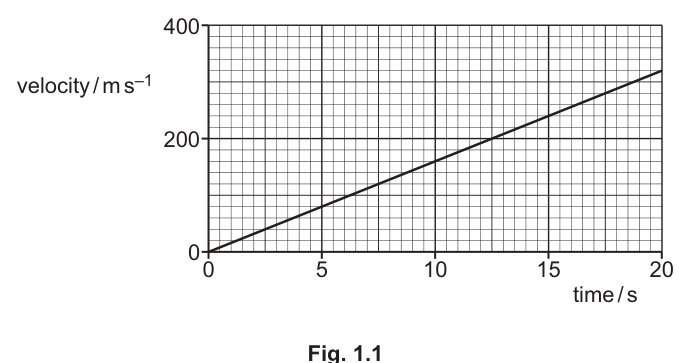
Fig. 1.1 shows the variation of the velocity of the rocket with time for the first 20s after its launch.
Working
Gradient of – graph:
Answer
16 m s^-2
Background Concept
For a velocity–time graph, the acceleration is the gradient (slope):
This works because acceleration is defined as the rate of change of velocity with time.
Understanding the Question
The rocket’s velocity increases linearly from at to at . You must find the acceleration from this graph.
Approach
Pick two clear points on the straight-line graph (the endpoints are easiest), calculate and , then divide.
Step-by-Step Reasoning
- Read two points from the line: and .
- Compute changes:
- Gradient gives acceleration:
Key Takeaways
- Acceleration equals gradient of a – graph.
- Use large separations on the graph (e.g. endpoints) to reduce reading error.
Common Mistakes
- Using instead of .
- Reading values incorrectly from the axes (mixing up 200 and 400 gridlines, etc.).
Things to Be Careful About
- Include units: gradient of against is .
- Because the line goes through the origin, using endpoints is unambiguous here.
Show that the height of the rocket above the surface of the Earth at a time of 20s after launch is 3.2km.
Working
Height = area under – graph (triangle):
Answer
3.2 km
Background Concept
For a velocity–time graph, the displacement (change in position) is the area under the graph:
For straight-line segments, this is found using basic geometry (rectangles, triangles, trapezia).
Understanding the Question
At , the rocket’s velocity is and the velocity increased linearly from zero. You are asked to show the rocket’s height above the surface is . Since the rocket moves vertically upwards, the displacement equals the height.
Approach
Treat the region under the straight-line – graph from to as a triangle. Find its area, giving displacement in metres, then convert to kilometres.
Step-by-Step Reasoning
- The graph starts at and ends at , so the area from to is a triangle.
- Triangle base and height .
- Area (displacement):
- Convert to kilometres:
Key Takeaways
- On a – graph: gradient gives acceleration; area gives displacement.
- Linear increase in velocity produces a triangular area.
Common Mistakes
- Using the gradient instead of the area (mixing up what each feature represents).
- Forgetting the factor for a triangle.
- Not converting to .
Things to Be Careful About
- Ensure the velocity stays positive; here it does, so area corresponds directly to upward displacement.
- Units: , which is correct for displacement.
The mass of the rocket in (b) is . Assume that this mass remains constant.
For this rocket, from launch to its height at a time of 20s after launch:
Working
Answer
9.1 × 10^10 J
Background Concept
Near the Earth’s surface, the change in gravitational potential energy is
where is mass, is gravitational field strength, and is the vertical height gained.
Understanding the Question
The rocket has mass (assumed constant) and rises to a height of in the first . You must calculate its gain in gravitational potential energy over that interval.
Given/inferred:
- take (unless a different value is specified)
Approach
Convert height to metres, then apply and present the answer in joules, typically in standard form.
Step-by-Step Reasoning
- Convert height:
- Substitute:
- Multiply the numbers and combine powers of ten:
So
(Any close value depending on the chosen and rounding is acceptable.)
Key Takeaways
- For vertical motion near Earth, .
- Convert km to m before substitution.
Common Mistakes
- Using instead of .
- Dropping the power of ten from the mass ().
- Giving units as N or W instead of J.
Things to Be Careful About
- Use a consistent value of (typically or ) and round sensibly.
- State the answer to an appropriate number of significant figures (often 2 s.f. here because is 2 s.f.).
Working
Final speed at : .
Answer
1.5 × 10^11 J
Background Concept
Kinetic energy of an object of mass moving at speed is
If the object starts from rest, the gain in kinetic energy is simply its final kinetic energy.
Understanding the Question
From the velocity–time graph, the rocket’s velocity at is . The rocket starts from rest at launch, and the mass is constant at . We need the increase in kinetic energy from to .
Approach
Use . Since , this becomes using .
Step-by-Step Reasoning
- Initial speed .
- Final speed from the graph: .
- Compute:
- Square the speed:
- Multiply:
Key Takeaways
- If motion starts from rest, .
- Read the correct final speed from the graph.
Common Mistakes
- Using the average speed or area under the graph instead of the final speed.
- Forgetting the factor .
- Not squaring correctly.
Things to Be Careful About
- Ensure you use speed (magnitude of velocity) for kinetic energy.
- Keep track of large numbers: use standard form to avoid arithmetic slips.
determine the average power output of the rocket engines. Assume that resistive forces are negligible.
power = ______
Working
With resistive forces negligible,
Average power over :
Answer
1.2 × 10^10 W
Background Concept
Power is the rate of energy transfer:
If resistive forces (air resistance, etc.) are negligible, then the work done (energy supplied) by the engines becomes the increase in the rocket’s mechanical energy:
Understanding the Question
From launch to , the rocket gains gravitational potential energy by rising and gains kinetic energy by speeding up. The question asks for the average power output of the engines over these , assuming no energy is lost to resistive forces.
Known from earlier parts:
Approach
- Add the two energy gains to find the total energy supplied by the engines.
- Divide by the time interval to get average power.
Step-by-Step Reasoning
- Neglecting resistive forces means the engines’ energy goes into:
- increasing (height gain), and
- increasing (speed gain).
So total energy transfer from engines:
Substitute the values:
Average power:
Key Takeaways
- With negligible resistive forces, engine work equals increase in mechanical energy.
- Average power is total energy transferred divided by time.
Common Mistakes
- Using only or only instead of both.
- Dividing by the wrong time (e.g. using 2 s from a gridline rather than 20 s total).
- Confusing power with force (giving answer in N).
Things to Be Careful About
- The result is an average power over 0–20 s; instantaneous power could vary even though the velocity–time graph is linear.
- Keep consistent significant figures: earlier values are about 2 s.f., so the final power should be similar.
Answer
Pressure is the normal force per unit area:
Pressure is the normal force per unit area, p = F/A.
Background Concept
Pressure describes how concentrated a force is over an area. It is defined for a force acting perpendicular (normal) to a surface.
Understanding the Question
You are asked for the definition of pressure, so you need a clear statement (and usually the equation) linking pressure, force and area.
Approach
Use the standard definition: pressure equals normal force divided by area.
Step-by-Step Reasoning
- Take a force acting at right angles to a surface of area .
- Pressure is defined as force per unit area:
Key Takeaways
- Pressure is force per unit area.
- The force must be the component normal to the surface.
Common Mistakes
- Using total force when the force is not perpendicular (should use the normal component).
- Writing .
Things to Be Careful About
- State “force per unit area” (not “force times area”).
- Pressure is a scalar; no direction is needed.
Explain how hydrostatic pressure results in an upthrust force acting on a solid object immersed in a liquid.
Answer
Hydrostatic pressure increases with depth, so the pressure on the bottom of the object is greater than on the top.
This produces a resultant upward force (difference in pressure area), called upthrust (equal to the weight of displaced liquid).
Pressure is greater at greater depth, so the bottom of the object experiences a larger pressure than the top, giving a net upward force (upthrust), equal to the weight of displaced liquid.
Background Concept
In a stationary liquid, pressure increases with depth:
where is the liquid density, is gravitational field strength, and is depth below the surface.
Forces on a surface come from pressure acting over area:
Upthrust (buoyant force) occurs because pressure is not the same on all faces of an immersed object.
Understanding the Question
You must explain, using hydrostatic pressure, why there is an upward force on an immersed solid. The key idea is “pressure increases with depth”, so forces on the top and bottom faces differ.
Approach
- State that pressure is larger deeper in the liquid.
- Convert pressures on top and bottom faces into forces using .
- The difference between these forces is a resultant upward force (upthrust), which can also be stated as equal to the weight of displaced liquid.
Step-by-Step Reasoning
- Consider the top face and bottom face of the object.
- The bottom face is at a greater depth, so
- The liquid pushes on each face with force .
- Therefore the upward force on the bottom face is larger than the downward force on the top face.
- The side forces cancel (equal pressures at the same depth acting in opposite horizontal directions).
- The net result is an upward force:
This net upward force is the upthrust, and it equals the weight of liquid displaced (Archimedes’ principle).
Key Takeaways
- Pressure in a fluid increases with depth.
- Pressure differences lead to a resultant force.
- Upthrust arises because the bottom experiences a greater pressure than the top.
Common Mistakes
- Saying “upthrust happens because the object is lighter” (cause and effect reversed).
- Forgetting that the liquid also exerts forces on the top face (downwards).
- Not mentioning pressure difference with depth.
Things to Be Careful About
- Make clear that the difference in pressure (not just “pressure”) causes the net force.
- Side forces cancel; only vertical pressure forces produce the resultant upthrust.
A small steel ball of radius and mass falls vertically at terminal speed through oil.
The viscous drag force that acts on the ball is given by
where is a property of the oil called its viscosity.
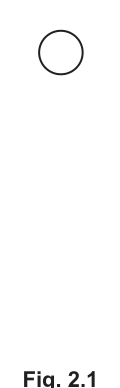
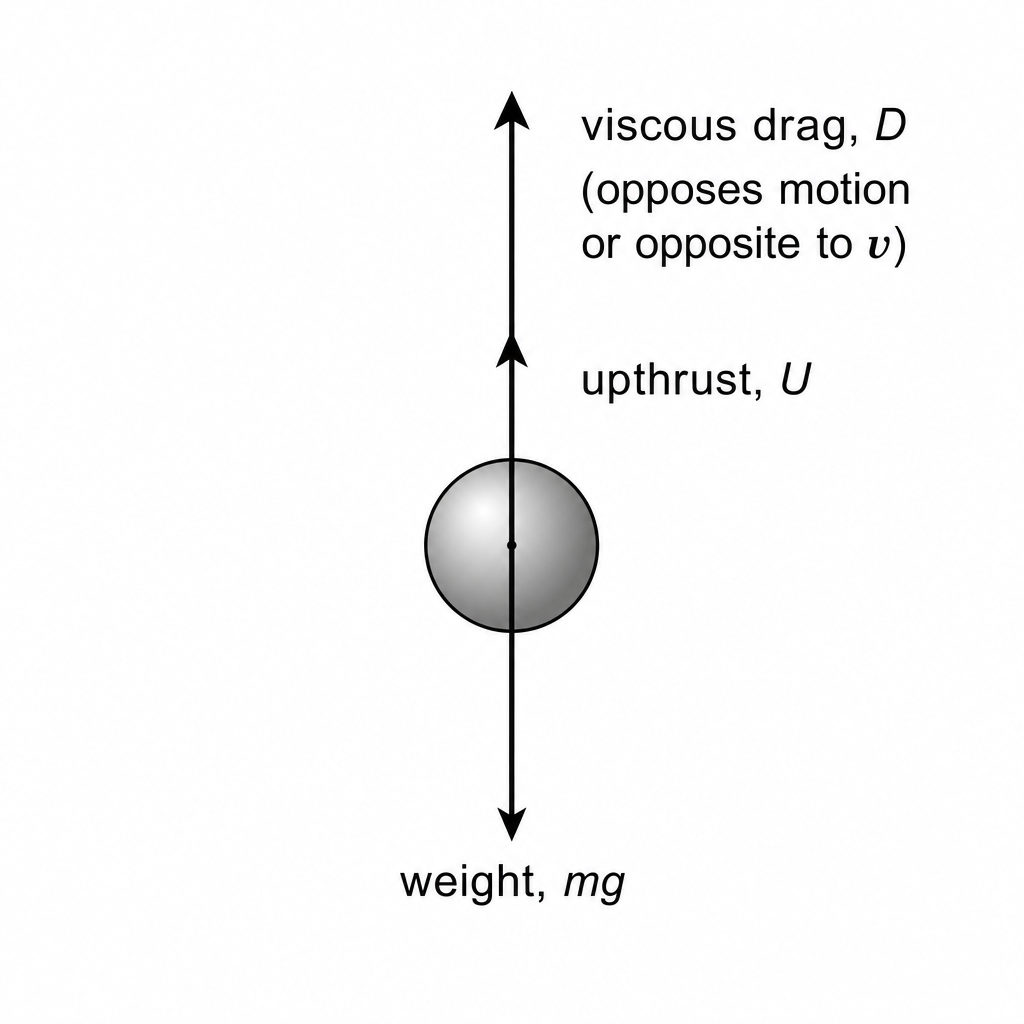
On Fig. 2.1, draw labelled arrows from the ball to show the directions of the three forces that act on the ball as it falls.
Answer
Weight vertically downward.
Upthrust vertically upward.
Viscous drag vertically upward (opposes the downward motion).
Forces: weight mg downward; upthrust U upward; drag D upward.
Background Concept
When an object falls through a fluid, forces commonly include:
- Weight acting downward.
- Upthrust (buoyant force) acting upward due to hydrostatic pressure.
- Drag (viscous resistive force) acting opposite to the direction of motion.
At terminal speed, the acceleration is zero, so the resultant force is zero, but you still draw all forces with correct directions.
Understanding the Question
A steel ball is falling vertically through oil at terminal speed. You must draw three force arrows on the ball and label them, showing their directions.
Approach
List the forces present in this situation and apply direction rules:
- Gravity always acts downward.
- Upthrust acts upward.
- Drag acts opposite to the velocity (here velocity is downward, so drag is upward).
Step-by-Step Reasoning
- Draw the ball.
- Draw a downward arrow from the ball labelled .
- Draw an upward arrow labelled (or “upthrust”).
- Draw an upward arrow labelled (or “drag”).
Key Takeaways
- Drag always opposes motion.
- Objects in a fluid experience upthrust.
- A correct force diagram needs correct directions and clear labels.
Common Mistakes
- Drawing drag downward (same direction as motion).
- Missing the upthrust force.
- Labelling forces vaguely (e.g. “resistance” without indicating it is drag and without direction).
Things to Be Careful About
- There are two upward forces here (upthrust and drag); both must be shown separately.
- Arrows should start at the ball and point in the force direction.
Working
From
Units:
Answer
kg m^-1 s^-1
Background Concept
To find SI base units of a quantity, use an equation that relates it to known quantities and substitute units for each symbol. The constant is dimensionless, so it does not affect units.
Force unit:
Understanding the Question
You are given Stokes’ law for drag on a sphere:
and asked for SI base units of viscosity .
Approach
Rearrange the equation to make the subject, then substitute SI units for , , and , and simplify to base units.
Step-by-Step Reasoning
Rearrange:
Now substitute units:
- has units N.
- has units m.
- has units .
So
Replace N with base units:
Key Takeaways
- Rearranging first avoids confusion.
- Dimensionless constants (like ) do not change units.
- Viscosity has base units .
Common Mistakes
- Treating as if it has units.
- Using for velocity (mixing up and ).
- Leaving the answer in N s m without converting to base units when asked.
Things to Be Careful About
- Write velocity as .
- Ensure final expression is in SI base units (kg, m, s).
The oil in (b) has a density of and a viscosity of 4.7 in SI units.
The steel ball has a mass of and a radius of .
Working
Volume of ball:
Upthrust:
Answer
2.8 × 10^-3 N
Background Concept
Archimedes’ principle states that the upthrust (buoyant force) on an immersed object equals the weight of the fluid displaced:
where:
- is the fluid density,
- is gravitational field strength,
- is the volume of fluid displaced (for a fully immersed object, this is the object’s volume).
For a sphere:
Understanding the Question
You are given oil density and the ball radius . The ball is immersed in the oil, so it displaces a volume of oil equal to its own volume. You must show the upthrust is .
Approach
- Compute the sphere’s volume from its radius.
- Multiply by to obtain upthrust.
Step-by-Step Reasoning
Calculate volume:
Numerically this is
Now calculate upthrust:
which matches the required value.
Key Takeaways
- Upthrust depends on fluid density and displaced volume, not on the object’s mass.
- For a fully submerged sphere, use .
Common Mistakes
- Using the steel density instead of the oil density.
- Using diameter instead of radius.
- Forgetting the factor .
Things to Be Careful About
- Keep powers of ten consistent: .
- Include units: in gives in newtons when multiplied by and .
Working
At terminal speed, resultant force is zero:
Using
Answer
5.6 × 10^-2 m s^-1
Background Concept
Terminal speed occurs when an object moving through a fluid has zero acceleration, so the resultant force is zero.
For a falling sphere in a fluid:
- Weight acts downward.
- Upthrust acts upward.
- Drag acts upward (opposes downward motion).
At terminal speed:
Stokes’ law for viscous drag on a sphere is:
Understanding the Question
You are given:
- ,
- ,
- (SI units),
- Upthrust from (c)(i): .
You must find the terminal speed .
Approach
- Use terminal-speed condition (forces balance) to find drag .
- Substitute into Stokes’ law and rearrange for .
Step-by-Step Reasoning
- Force balance at terminal speed:
Calculate weight:
Now drag:
- Use Stokes’ law:
Substitute values:
This gives
Key Takeaways
- At terminal speed, set resultant force to zero.
- For a falling object in a fluid: is balanced by upthrust + drag.
- Stokes’ law links drag to viscosity, radius, and speed.
Common Mistakes
- Setting and forgetting upthrust.
- Using (wrong sign).
- Substituting radius in mm instead of m.
Things to Be Careful About
- Terminal speed means , not that forces disappear.
- Keep all quantities in SI units before substitution.
- Use a sensible number of significant figures (typically 2 s.f. here, matching given data).
A wire has length and cross-sectional area . The wire is made from a metal that has Young modulus and resistivity .
Answer
Young modulus is the ratio of tensile stress to tensile strain, within the limit of proportionality:
Young modulus is tensile stress divided by tensile strain (within the limit of proportionality).
Background Concept
Young modulus measures how stiff a material is when stretched (or compressed) elastically. It is defined using:
- Stress: force per unit cross-sectional area
- Strain: fractional change in length
Within the limit of proportionality (the straight-line region where Hooke’s law holds), stress is proportional to strain, so their ratio is constant.
Understanding the Question
You are asked to define Young modulus. That means you must give the relationship between stress and strain and state the condition (valid only where stress ∝ strain).
Approach
Write the definition in words and/or as an equation. Include “tensile” and “within the limit of proportionality” to match what examiners look for.
Step-by-Step Reasoning
- Recognise that Young modulus uses stress and strain.
- State the ratio:
- If writing in terms of measured quantities for a wire:
This is enough for full credit.
Key Takeaways
- is a material property that links stress and strain in the linear elastic region.
- Always mention the limit of proportionality.
Common Mistakes
- Defining as (that is spring constant for a specific object, not a material property).
- Omitting “stress” and “strain” and only describing “force and extension”.
Things to Be Careful About
- Young modulus applies to uniform stress and strain and to the straight-line region of the stress–strain graph.
- Stress and strain are different: stress has units of Pa, strain is dimensionless.
State an expression, in terms of some or all of , , and , for the resistance of the wire.
= ______
Answer
R0 = \rho L / A
Background Concept
For a uniform wire of length and cross-sectional area , the resistance depends on:
- the material property resistivity (units ), and
- the geometry of the wire.
The defining relationship is
This comes from microscopic models or can be taken as an empirical law for uniform conductors.
Understanding the Question
You are told the wire has length , area , and resistivity . You must state an expression for the unstretched resistance using these symbols.
Approach
Use the standard resistivity formula and label the resistance as for the original wire.
Step-by-Step Reasoning
Start with
For the original (unstretched) wire, this is
Key Takeaways
- Resistance increases with length and decreases with cross-sectional area.
- Resistivity is a material constant (for a given temperature).
Common Mistakes
- Writing (inverting the relationship).
- Missing the subscript and writing an expression for when the question asks specifically for .
Things to Be Careful About
- Units check: has units , so gives .
- The formula assumes uniform cross-section along the length.
Working
Since ,
Answer
k0 = EA/L
Background Concept
A wire behaves like a spring in the elastic (proportional) region:
where is the extension and is the spring constant.
Young modulus connects force and extension via stress and strain:
This is essentially “Hooke’s law” written in a way that separates material property () from geometry ( and ).
Understanding the Question
You must show that the spring constant of a uniform wire (original length , area , Young modulus ) is
So you need to manipulate the Young modulus definition until it looks like .
Approach
- Write .
- Rearrange to make the subject.
- Compare with to read off .
Step-by-Step Reasoning
Start from the definition:
Divide by a fraction by multiplying by its reciprocal:
Rearrange for :
Compare with Hooke’s law form . Therefore the coefficient of is the spring constant:
Key Takeaways
- For a wire, the “spring constant” depends on geometry and material:
- larger → stiffer (larger )
- larger → less stiff (smaller )
- larger → stiffer
Common Mistakes
- Using (confusing with ).
- Forgetting that strain is (missing the division by ).
Things to Be Careful About
- This result holds only in the linear elastic region (limit of proportionality).
- here is for the wire as a spring, so it changes if changes.
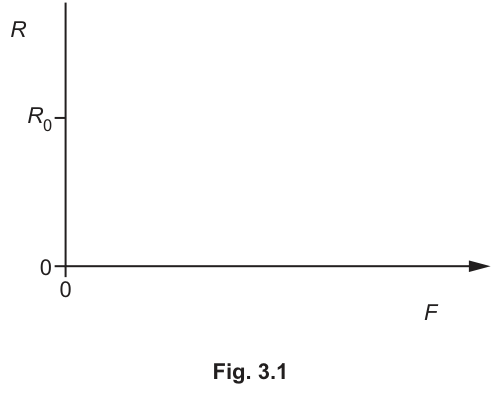
The wire is stretched, within the limit of proportionality, by a tensile force . Assume that any changes in the cross-sectional area of the wire are negligible.
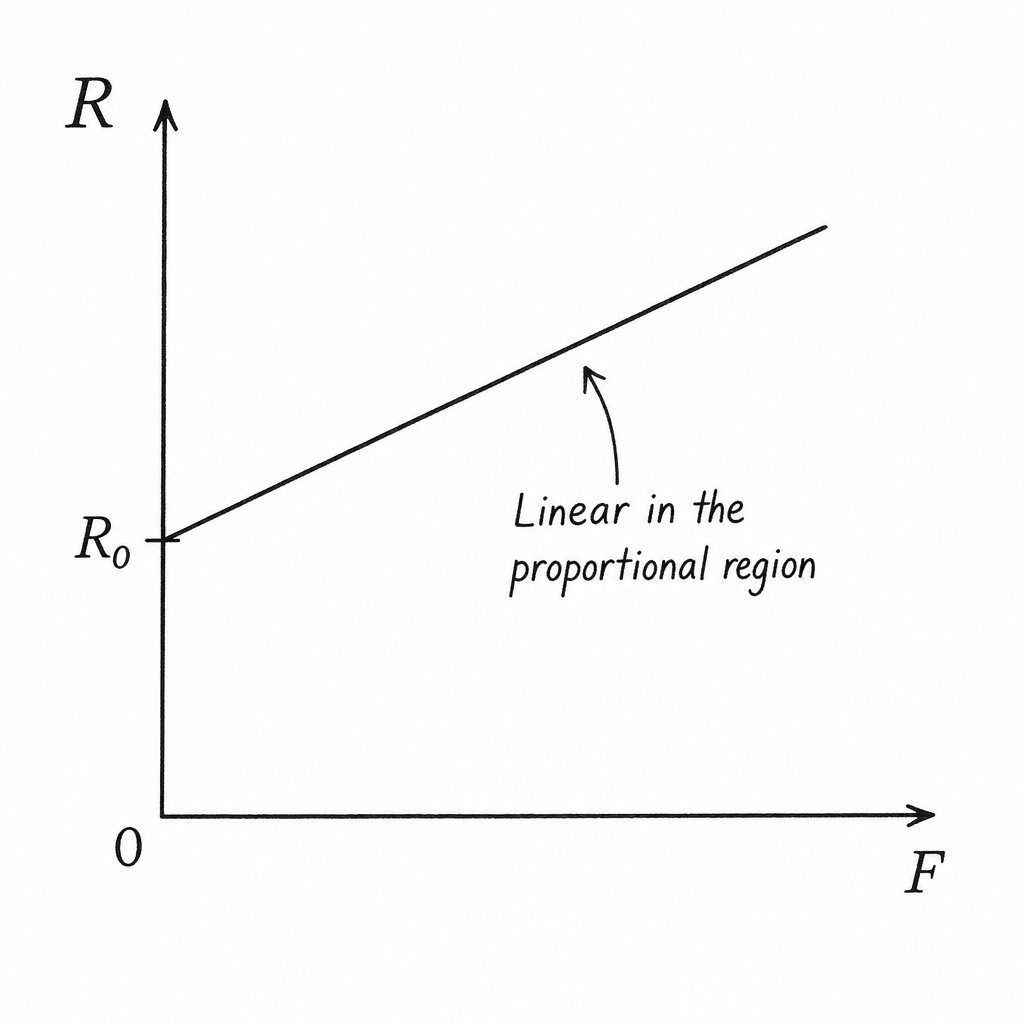
Answer
increases linearly with (straight line with positive gradient) starting at .
Straight line increasing from R0 at F = 0.
Background Concept
Resistance of a uniform wire is
If and are constant, then .
When a wire is stretched within the limit of proportionality, extension is proportional to force:
so the new length is , which increases linearly with .
Understanding the Question
You are stretching a wire elastically with tensile force . You are told to neglect changes in cross-sectional area, so take constant. You must sketch how the wire’s resistance varies with , and the axes already show that at the resistance is .
Approach
- Use .
- Under elastic stretching, , so increases with .
- Therefore increases with . For a 1-mark sketch, show the correct trend and intercept at .
Step-by-Step Reasoning
- Start with
- With constant and constant, .
- In the proportional region, , hence
increases linearly with .
4. Therefore increases linearly with .
5. At , , so , meaning the graph passes through .
Key Takeaways
- If area change is negligible, stretching increases and hence increases .
- In the Hooke’s law region, the increase is proportional to , giving a straight line.
Common Mistakes
- Drawing the line through the origin instead of starting at .
- Drawing decreasing with .
- Assuming decreases significantly (the question tells you to neglect this).
Things to Be Careful About
- The y-intercept is given as on the axis: the sketch must start there at .
- Only valid within the limit of proportionality; beyond that, the trend could become non-linear.
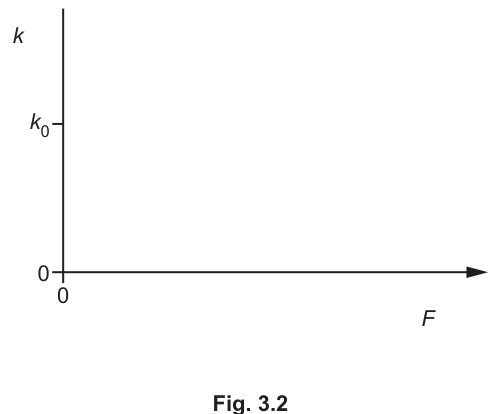
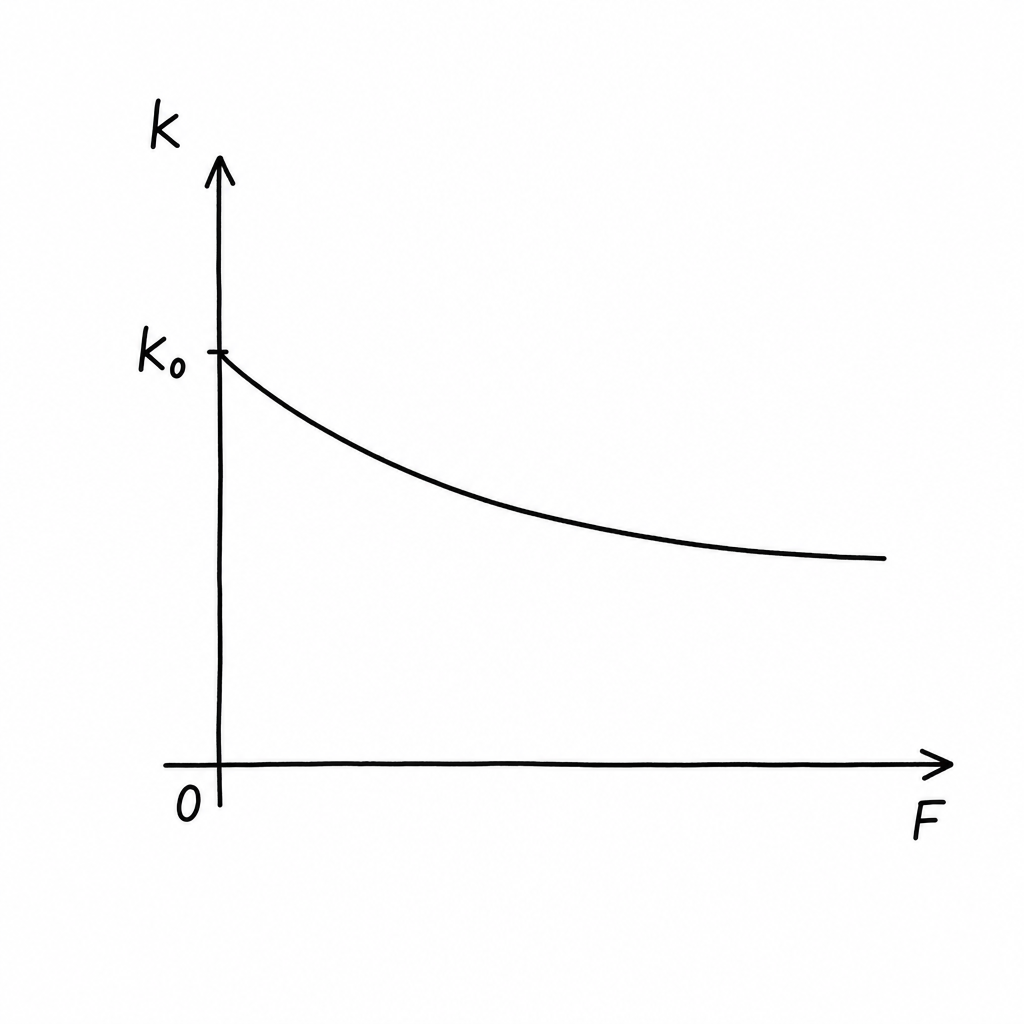
Answer
decreases as increases, starting at .
k decreases from k0 as F increases.
Background Concept
For a wire acting as a spring (in the proportional region), the spring constant is
If (material) and (cross-sectional area) are constant, then
Stretching the wire increases its length , so it becomes less stiff (smaller ).
Understanding the Question
You are told the wire is stretched within the limit of proportionality by a tensile force , and changes in area are negligible. You must sketch how varies with on axes where the initial value at is shown.
Approach
- As increases (still elastic), the wire length increases.
- Because , increasing makes smaller.
- For a 1-mark sketch, the key is correct direction of change and correct intercept at .
Step-by-Step Reasoning
- Initially, when , the wire has length and spring constant
- Under tension, the wire extends: new length .
- With and constant,
and since , then .
4. As increases, increases, so increases and decreases further.
Key Takeaways
- A wire becomes less stiff as it is stretched (because stiffness is inversely proportional to length).
- Always use the intercepts shown ( at ).
Common Mistakes
- Drawing constant (forgetting depends on ).
- Drawing increasing with .
- Drawing the curve through the origin instead of starting at .
Things to Be Careful About
- The question specifies extension is within the limit of proportionality, but even there need not be constant because the object is changing length.
- Since only a sketch is required, detailed curvature is not usually assessed, but the trend must be correct.
Copper has a resistivity of and a Young modulus of .
A copper wire of diameter has a resistance of .
Working
Diameter , so
Using ,
Answer
3.8 m
Background Concept
For a uniform wire,
where:
- is resistance ()
- is resistivity ()
- is length ()
- is cross-sectional area ()
If the wire is circular with diameter , then
Understanding the Question
You are given for copper:
- wire diameter
- resistance
You must show the length is . This is a straightforward application of after finding .
Approach
- Convert diameter to metres.
- Calculate area .
- Rearrange the resistivity equation to .
- Substitute values carefully in SI units.
Step-by-Step Reasoning
- Convert diameter:
So radius .
- Area:
- Rearrange :
- Substitute:
Compute powers of ten first:
Then numbers:
Key Takeaways
- Always convert mm to m before using SI equations.
- For circular wires, area comes from .
Common Mistakes
- Using instead of .
- Forgetting to convert to (gives length wrong by a factor of ).
- Rearranging incorrectly (e.g. ).
Things to Be Careful About
- Keep enough significant figures during intermediate steps (area) to avoid rounding error.
- Check units: .
Use the equation in (b)(ii) to determine the spring constant of the wire.
spring constant = ______
Working
Answer
6.9 × 10^4 N m^-1
Background Concept
For a wire behaving elastically, the effective spring constant is
where:
- is Young modulus ()
- is cross-sectional area ()
- is length ()
The units check works nicely:
so dividing by (m) gives .
Understanding the Question
You are told to use the result from (b)(ii) and the given copper values. From (d)(i) the wire length is , and from the diameter you can use the same area calculated previously.
Approach
- Use (already found in (d)(i)).
- Substitute , , and into .
- Give the answer in .
Step-by-Step Reasoning
- Cross-sectional area (from diameter ):
-
Use and .
-
Substitute into
so
Multiply first:
Then divide by :
Key Takeaways
- A wire’s stiffness increases with area and Young modulus and decreases with length.
- Always check the final unit for spring constant is .
Common Mistakes
- Using diameter instead of area directly in .
- Forgetting to use SI units for (must be ).
- Arithmetic error with powers of ten: .
Things to Be Careful About
- Use the length found in (d)(i); don’t reuse the original symbolic .
- Quote an appropriate number of significant figures (typically 2 s.f. is fine here, matching given data).
Answer
Diffraction is the spreading (bending) of a wave as it passes through a gap or around an obstacle.
The effect is significant when the gap/obstacle size is comparable to the wavelength.
Diffraction is the spreading (bending) of a wave as it passes through a gap or around an obstacle, most noticeable when the gap/obstacle size is comparable to the wavelength.
Background Concept
Diffraction is a wave effect that occurs because different parts of a wavefront can interfere with each other after the wave encounters an aperture (gap) or an obstacle. When a wave passes through a narrow gap, the emerging wavefronts are no longer straight: they spread out into the region beyond the gap.
The amount of spreading depends mainly on the ratio of the aperture size to the wavelength. If the aperture is very large compared with the wavelength, the wave continues almost straight with little spreading. If the aperture size is comparable to the wavelength, the wave spreads out strongly.
Understanding the Question
The question asks for what diffraction “means”, i.e. a definition. For full credit you should mention:
- spreading/bending of waves at an aperture or around an edge/obstacle, and
- that it becomes significant when the aperture/obstacle size is comparable to the wavelength.
Approach
Give a concise definition (spreading around edges / through gaps), then add the condition for when it is most noticeable (gap size (\sim \lambda)).
Step-by-Step Reasoning
- State the core meaning: the wave spreads out (or bends) when it encounters a gap or obstacle.
- Add the standard condition: diffraction is greatest when the gap (or obstacle size) is of the same order as the wavelength.
Key Takeaways
- Diffraction = spreading of a wave after an aperture/edge.
- The smaller the aperture compared to (\lambda), the greater the spreading.
Common Mistakes
- Saying only “bending of light” without mentioning gaps/edges (too vague).
- Confusing diffraction with refraction (refraction is change of direction due to change of speed in a new medium).
Things to Be Careful About
- Use wave language (spreading of the wave/wavefront).
- Include the “comparable to wavelength” condition to secure the second mark when available.
A beam of vertically polarised light of wavelength is incident normally on a diffraction grating, as shown in Fig. 4.1.
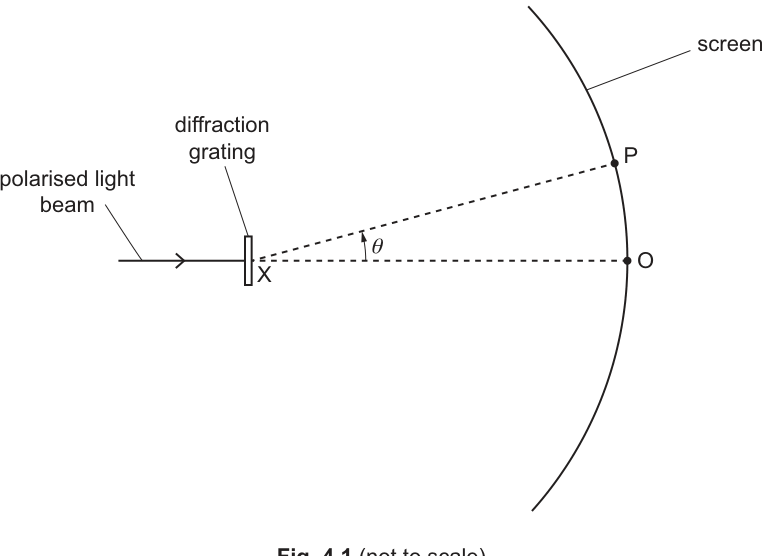
The diffraction grating has a line spacing of .
The light transmitted by the diffraction grating illuminates a circular screen. The diffraction grating is at the centre X of the circle.
The central bright fringe is formed at point O on the screen and has intensity .
P is a point on the screen where the line XP is at a variable angle to the line XO. The intensity of light on the screen at P varies with .
Working
For a grating,
First order: .
Answer
6.2°
Background Concept
A diffraction grating has many equally spaced slits. Light from adjacent slits interferes, producing principal maxima (bright fringes) at angles where the path difference between waves from adjacent slits is an integer number of wavelengths.
The grating equation is:
where:
- is the slit (line) spacing,
- is the angle from the central (straight-through) direction,
- is the order number (),
- is the wavelength.
This applies for normal incidence and when measuring from the central maximum direction.
Understanding the Question
You are given:
- wavelength ,
- line spacing ,
- need the angle for the first-order maximum ().
“Show that” means you must demonstrate the calculation clearly.
Approach
Convert into metres, use in , calculate , then take to obtain .
Step-by-Step Reasoning
- Convert wavelength:
- For first order, , so:
- Evaluate the fraction:
- Find angle:
(Angle is small, so it is reasonable it comes out only a few degrees.)
Key Takeaways
- Use for grating maxima.
- Always put and into consistent SI units.
Common Mistakes
- Using as if it were (unit mismatch).
- Forgetting for first order.
- Using instead of (not the grating equation).
Things to Be Careful About
- is measured from the central direction (the maximum).
- Keep enough significant figures in intermediate steps so the final rounds correctly to .
Working
Second order: .
Answer
12.5°
Background Concept
For a diffraction grating, the th order maximum occurs when the path difference between adjacent slits equals , giving:
As increases, increases, so the maxima move further from the central maximum, until eventually would exceed 1 and no higher orders are possible.
Understanding the Question
You must find the angle for the second-order bright fringe () using the same and as in part (i).
Approach
Use in the grating equation, calculate , then take .
Step-by-Step Reasoning
- Start with:
- Substitute :
- Using the value from (i), :
- Take inverse sine:
Key Takeaways
- Higher order () gives a larger angle than first order.
- You can reuse from the first-order calculation to save time.
Common Mistakes
- Doubling the angle instead of doubling (i.e. writing is not correct, because is not linear).
- Forgetting that must be (\le 1).
Things to Be Careful About
- Use degrees consistently (calculator mode).
- Final rounding: typically to 1 d.p. here (matching the style of part (i)).
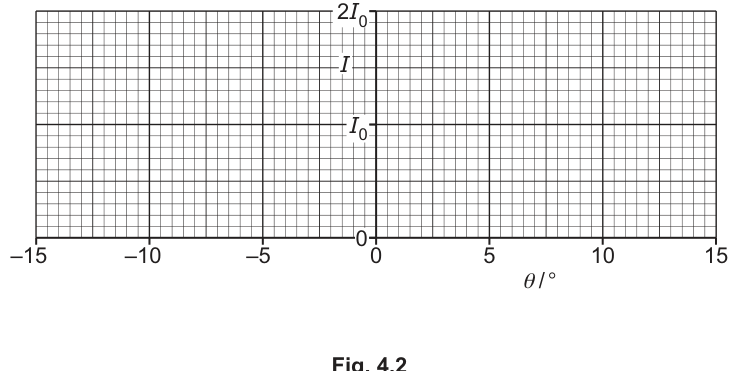
Answer
Sketch a symmetric pattern about with narrow principal maxima at:
- (central maximum) with intensity ,
- (first order),
- (second order),
with intensity very small between these maxima.
Peaks at 0°, ±6.2°, ±12.5°; symmetric; intensity ~0 between peaks; central peak at I0.
Background Concept
A diffraction grating produces very sharp (narrow) bright fringes at angles that satisfy:
Each integer gives an “order” of maximum. Because the grating has many slits, the constructive interference is strong only at very specific angles, so the maxima are narrow compared with a two-slit pattern.
The pattern is symmetric: if there is a maximum at there is also one at , because and negative orders correspond to the other side.
Understanding the Question
You must sketch intensity against angle from to .
From earlier parts:
- first order at ,
- second order at ,
and the central maximum at has intensity (given).
So the sketch should show where the maxima are located and the overall qualitative shape.
Approach
- Mark the positions of the principal maxima at .
- Draw narrow peaks at these angles (very thin compared with the scale).
- Ensure the graph is symmetric about .
- Between maxima, show intensity close to zero (or much smaller than the peaks).
Step-by-Step Reasoning
- Central maximum: at by definition; label its height as .
- First orders: at from (b)(i). Add two narrow peaks there.
- Second orders: at from (b)(ii). Add two narrow peaks there.
- There are no other orders within because the next would be :
which is outside the plotted range.
- Between these angles, the grating produces minima and very low intensity, so the sketch should drop close to the axis between the sharp peaks.
(Exact relative heights of different orders are not usually determinable without extra information about the slit width/envelope, so the key marks are typically for correct positions and symmetry and indicating sharp maxima.)
Key Takeaways
- Grating maxima occur only at discrete angles given by .
- The pattern is symmetric about the central maximum.
- A grating gives narrow, well-separated bright fringes.
Common Mistakes
- Placing peaks at the wrong angles (e.g. at because of the grid markings).
- Drawing broad sinusoidal oscillations like a two-source interference pattern instead of sharp grating maxima.
- Forgetting the negative-angle side (pattern must be symmetric).
Things to Be Careful About
- Put the first-order peaks at (not unless your sketch resolution forces it; aim clearly between and ).
- Put the second-order peaks at (between and ).
- Central maximum height should be labelled as stated in the question.
A polarising filter is placed in the path of the light beam that is incident on the diffraction grating in Fig. 4.1. The transmission axis of the filter is at to the vertical.
Suggest how the variation of intensity with for the light on the screen compares with the answer in (b)(iii).
Answer
The filter reduces the incident intensity by Malus’ law:
So the maxima/minima occur at the same values as in (b)(iii), but the whole – graph is reduced in height by a factor (central maximum becomes ).
Same fringe angles as (b)(iii), but all intensities are halved (central becomes 0.5 I0).
Background Concept
For plane-polarised light passing through a polarising filter, the transmitted intensity is given by Malus’s law:
where is the angle between the incident polarisation direction and the transmission axis of the polariser.
A diffraction grating’s angular positions of maxima depend on wavelength and grating spacing via:
These angles do not depend on the intensity of the incoming light; changing input intensity simply scales the output intensity at all angles.
Understanding the Question
Initially the light is vertically polarised. A polarising filter is inserted with its transmission axis at to the vertical.
You are asked how the intensity pattern on the screen compares to your sketch in (b)(iii). In other words: do the peaks move, and do their heights change?
Approach
- Use Malus’s law with to find the factor by which the incident intensity is reduced.
- Argue that the grating equation (and hence the values for maxima) is unchanged because and are unchanged.
- Therefore the whole graph is the same shape but scaled vertically.
Step-by-Step Reasoning
- The incident light is vertically polarised, so its electric field oscillates vertically.
- The polariser axis is at to vertical, so .
- Apply Malus’s law:
and since ,
so
- The diffraction grating still sends light into the same orders at the same angles because is unchanged.
- Therefore at every angle (including the maxima and minima), the observed intensity is half what it was in (b)(iii):
In particular, the central maximum changes from to .
Key Takeaways
- Malus’s law gives an intensity scaling factor of through a polariser.
- Diffraction angles depend on geometry and wavelength, not on intensity.
- Adding a polariser before the grating changes peak heights, not peak positions.
Common Mistakes
- Saying the peaks move to different values (they do not, because and are unchanged).
- Using instead of .
- Thinking the output intensity becomes zero because the axis is not vertical (at it transmits half, not none).
Things to Be Careful About
- The light becomes polarised along the transmission axis after the filter, but that does not affect the grating equation in this syllabus context.
- Make sure you compare to (b)(iii): “same shape, scaled down” is the key comparison.
Answer
At any junction, the total current entering equals the total current leaving (algebraic sum of currents at a junction is zero).
At any junction, the total current entering equals the total current leaving (algebraic sum of currents at a junction is zero).
Background Concept
Kirchhoff’s first law (often called KCL) is a direct consequence of conservation of charge. Charge cannot build up at a junction in a steady d.c. circuit, so the rate at which charge arrives at the junction must equal the rate at which charge leaves.
Current is defined as charge flow rate:
So if charge is conserved at a junction, the currents must balance.
Understanding the Question
You are asked to state Kirchhoff’s first law, so you should give a clear sentence definition. No calculation or circuit diagram is required.
Approach
Write the law in words (and optionally as an equation) emphasising that it applies at a junction and it is about currents in and out.
Step-by-Step Reasoning
- In a steady circuit, no net charge accumulates at a junction.
- Therefore, charge per unit time entering = charge per unit time leaving.
- Since current is charge per unit time, total current into the junction = total current out.
Equivalent mathematical statement:
(or algebraic sum of currents at a node is zero).
Key Takeaways
- Kirchhoff’s first law expresses conservation of charge in circuit form.
- It is applied at junctions where currents split or combine.
Common Mistakes
- Stating Kirchhoff’s second law (about voltages around a loop) instead.
- Forgetting to specify “at a junction”.
Things to Be Careful About
- Use correct wording: currents entering and leaving a junction.
- You may say “sum of currents into a node equals sum out” or “algebraic sum is zero”; both are acceptable when clearly expressed.
Fig. 5.1 shows a circuit containing a thermistor T that has a negative temperature coefficient.
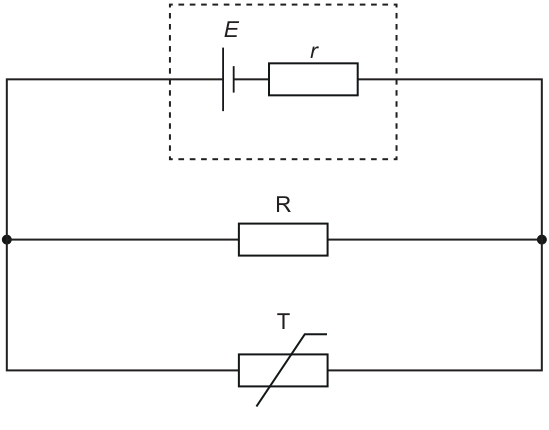
The thermistor has resistance at a temperature of .
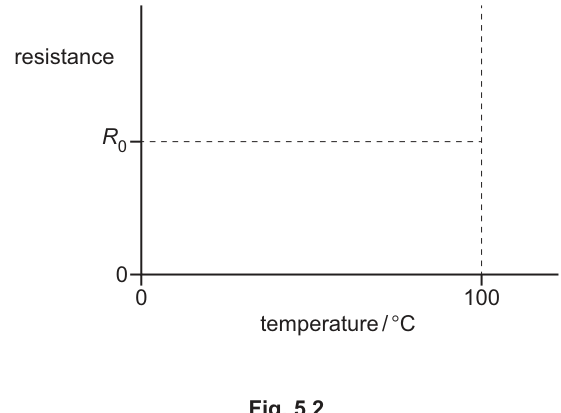
On Fig. 5.2, sketch a possible variation of the resistance of the thermistor with temperature between and .
Answer
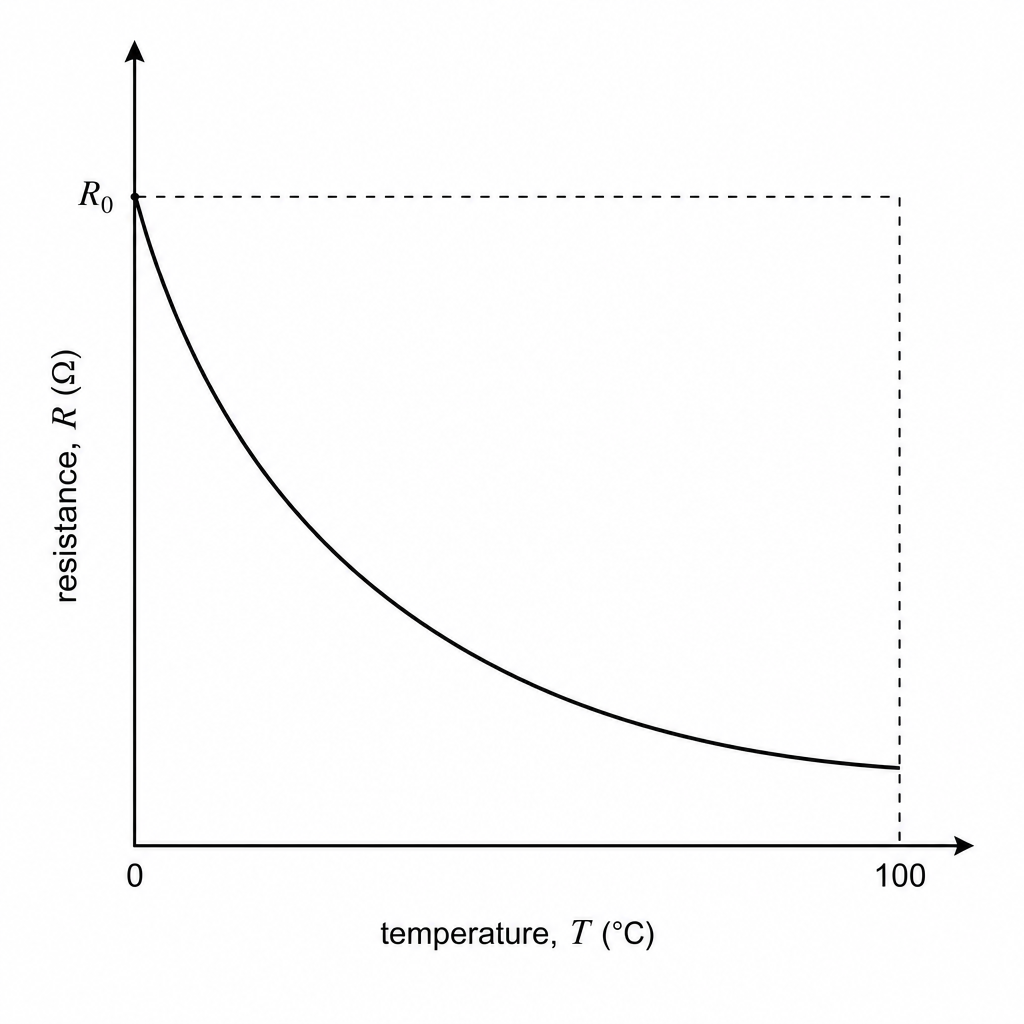
A decreasing curve starting at at and falling to a lower resistance at (non-linear, typical NTC shape).
Resistance decreases with increasing temperature from R0 at 0°C to a lower value at 100°C (non-linear NTC curve).
Background Concept
A thermistor is a resistor whose resistance changes significantly with temperature. A negative temperature coefficient (NTC) thermistor has resistance that decreases as temperature increases.
Physically, increasing temperature increases the number of charge carriers available in the semiconducting material, so conductivity increases and resistance decreases. The relationship is typically non-linear (often close to exponential over wide ranges), so the graph is not a straight line.
Understanding the Question
You are told the thermistor has resistance at . You must sketch how its resistance might vary from to .
Key requirements implied by the wording/axes:
- The curve must pass through .
- Because it is NTC, the resistance must be lower at than at .
- “Possible variation” means the exact numbers are not needed, but the overall trend and a sensible non-linear shape are.
Approach
Draw axes as given. Place the starting point at when . Then sketch a smooth curve that decreases as temperature increases, typically steep at first and then flattening somewhat (a common NTC behaviour).
Step-by-Step Reasoning
- Mark the point on the x-axis and on the y-axis; start the curve there.
- Move to the right (increasing temperature): because it is NTC, resistance must go down.
- Make it non-linear: a typical NTC thermistor shows a rapid fall at lower temperatures and then the rate of decrease becomes smaller at higher temperatures (curve becomes less steep).
Any smooth decreasing non-linear curve passing through at gains full credit.
Key Takeaways
- NTC thermistor: decreases as temperature increases.
- Sketch questions award marks for correct trend, correct anchoring at given points, and a realistic (non-linear) curve.
Common Mistakes
- Drawing an increasing graph (that would be a positive temperature coefficient).
- Drawing a straight line when a curved relation is expected.
- Not passing through the given point at .
Things to Be Careful About
- Ensure the curve is clearly below by .
- Keep the sketch smooth (not jagged) and clearly non-linear unless the question explicitly indicates linear behaviour.
With reference to the current in the cell, explain why the current in resistor R decreases with increasing temperature of the thermistor.
Answer
As temperature increases, the thermistor resistance decreases, so the parallel combination has a smaller equivalent resistance and the current in the cell increases.
The larger cell current causes a larger p.d. drop across internal resistance (), so the terminal p.d. across the parallel network (and across ) decreases:
With constant, decreases.
Thermistor resistance falls, so cell current increases; increased Ir drop across internal resistance reduces terminal p.d. across R, so I_R = V/R decreases.
Background Concept
In a circuit with a cell of e.m.f. and internal resistance , the terminal potential difference across the external circuit is
where is the current delivered by the cell. If increases, the voltage lost inside the cell across (the “lost volts” ) increases, so the terminal p.d. decreases.
For resistors in parallel, both branches have the same potential difference across them. If the p.d. across the parallel network changes, the current in a branch with fixed resistance changes according to
An NTC thermistor’s resistance decreases as temperature increases.
Understanding the Question
The circuit has a cell (with internal resistance ) supplying a parallel pair: a fixed resistor and a thermistor .
You must explain why the current in resistor decreases when the thermistor’s temperature increases, and you must do this with reference to the current in the cell.
So your explanation must mention:
- what happens to thermistor resistance with temperature,
- what that does to the total (cell) current,
- how the cell current affects terminal p.d. because of internal resistance,
- why that makes the current in smaller.
Approach
Link the chain of cause and effect:
- Temperature up (\Rightarrow) thermistor resistance down.
- Parallel equivalent resistance down (\Rightarrow) cell current increases.
- Cell current up (\Rightarrow) bigger internal drop (Ir) (\Rightarrow) terminal p.d. down.
- Terminal p.d. across down (\Rightarrow) down.
Step-by-Step Reasoning
- The thermistor is NTC, so increasing temperature decreases its resistance .
- and the thermistor are in parallel. When one branch resistance decreases, the equivalent resistance of the parallel combination decreases:
If decreases, increases, so increases and therefore decreases.
3. The external resistance seen by the cell becomes smaller, so the current drawn from the cell increases (consistent with ).
4. Because the cell has internal resistance, a larger cell current produces a larger internal p.d. drop . Therefore the terminal p.d. across the parallel network is reduced:
- Resistor has this same (reduced) p.d. across it (parallel branches share the same voltage), so
decreases since decreases while is constant.
That is why the current in decreases even though the thermistor branch current increases.
Key Takeaways
- NTC thermistor: temperature up (\Rightarrow) resistance down.
- Reduced equivalent resistance in parallel (\Rightarrow) increased supply (cell) current.
- Internal resistance causes terminal voltage to fall as cell current rises.
- Branch current through a fixed resistor depends on the shared branch voltage.
Common Mistakes
- Saying “thermistor resistance decreases so current in decreases” with no link to internal resistance (in an ideal cell with , would not drop and would stay the same).
- Claiming the p.d. across increases because “current increases” (it is the internal drop that increases).
- Treating the circuit as if is in series with the thermistor (they are in parallel).
Things to Be Careful About
- The question explicitly asks for reference to current in the cell; include the step that cell current increases.
- Use the correct expression (lost volts). If you write you reverse the effect.
- Remember: in parallel, the p.d. across each branch is the same as the terminal p.d. across the combination.
The electromotive force (e.m.f.) of the cell in Fig. 5.1 is . The internal resistance of the cell is .
Resistor R has a resistance of .
At a particular temperature of the thermistor, the current in R is .
For this temperature of the thermistor, determine:
Working
Potential difference across (and across the parallel network):
Using :
Answer
2.50 A
Background Concept
With internal resistance , a cell of e.m.f. delivers a terminal p.d. given by
where is the current in the cell. The external circuit here is a parallel combination, so the terminal p.d. is the same p.d. across each parallel branch.
For a resistor, Ohm’s law gives
Understanding the Question
Given:
- current in resistor :
Find: the current in the cell, .
Key idea: because is in parallel with the thermistor, the p.d. across equals the terminal p.d. of the cell.
Approach
- Use to find the p.d. across resistor .
- Treat this as the terminal p.d. across the external circuit.
- Use to solve for .
Step-by-Step Reasoning
- Compute the p.d. across :
- This is also the terminal p.d. across the parallel network.
- Use the internal resistance relation:
Rearrange for :
Substitute:
Key Takeaways
- In parallel, each branch has the same p.d. as the terminal p.d.
- Internal resistance means terminal p.d. is less than e.m.f. when current flows.
- Combine with to connect a branch current to the supply current.
Common Mistakes
- Using directly (ignoring internal resistance).
- Treating as the cell current (it is only the current in one branch).
- Using instead of .
Things to Be Careful About
- Keep units consistent: volts, ohms, amps.
- Recognise that the found from is the terminal p.d., not the e.m.f.
- Quote the final current to appropriate significant figures (here matches the given data).
Working
Terminal p.d. across the parallel network:
From (c)(i), cell current , so thermistor current:
Thermistor resistance:
Answer
0.522 Ω
Background Concept
In a parallel circuit, currents split at a junction. Kirchhoff’s first law states
where is the current from the cell and , are the branch currents in resistor and thermistor .
Also, the p.d. across parallel branches is the same, so the voltage across the thermistor equals the voltage across . Once you know the branch voltage and the thermistor current , the thermistor resistance is
Understanding the Question
At the stated temperature, you already know:
- and so you can find the branch voltage .
- From part (c)(i) you can find the cell current .
You must determine the thermistor’s resistance .
Approach
- Calculate the terminal p.d. using .
- Use Kirchhoff’s first law to find .
- Use .
Step-by-Step Reasoning
- Voltage across resistor :
This same is across the thermistor because of the parallel connection.
- The current in the cell (from part (c)(i)) is . Apply Kirchhoff’s first law at the junction where current splits:
So
- Now find thermistor resistance:
Key Takeaways
- Use KCL to connect total current to branch currents in parallel.
- In parallel circuits, the p.d. across each branch is the same.
- Resistance can be found directly from once and for that component are known.
Common Mistakes
- Using (wrong sign/order).
- Using instead of the actual branch voltage (here the correct branch voltage is ).
- Assuming the thermistor current equals the cell current.
Things to Be Careful About
- Ensure you use the terminal p.d. across the parallel network, not the e.m.f.
- Keep enough significant figures in intermediate steps; rounding too early can shift the final resistance.
- The thermistor resistance comes out very small because the thermistor branch current is large; this is consistent with an NTC thermistor at high temperature (low resistance).
The nuclide is an isotope of hydrogen that is called tritium.
Determine the numbers of protons, neutrons and electrons in a neutral atom of tritium.
number of protons = ______
number of neutrons = ______
number of electrons = ______
Working
For : proton number , nucleon number .
Protons .
Neutrons .
Neutral atom: electrons protons .
Answer
number of protons
number of neutrons
number of electrons
protons 1, neutrons 2, electrons 1
Background Concept
Nuclide notation is written as , where:
- is the proton (atomic) number = number of protons.
- is the nucleon (mass) number = number of protons + number of neutrons.
For a neutral atom, the total charge is zero, so:
- number of electrons = number of protons.
Understanding the Question
You are told the nuclide is tritium, . You must find how many protons, neutrons and electrons are in a neutral atom (so it includes the electron(s) outside the nucleus).
Approach
- Read to get the number of protons.
- Use to get the number of neutrons.
- Use neutrality to get the number of electrons.
Step-by-Step Reasoning
From :
- , so there is proton.
- , meaning total nucleons in the nucleus is .
Neutrons are the remaining nucleons after counting the protons:
Because the atom is neutral, total positive charge from proton is balanced by electron:
- electrons .
Key Takeaways
- gives protons directly.
- gives neutrons.
- Neutral atom: electrons = protons.
Common Mistakes
- Using as the number of neutrons (it is total nucleons, not neutrons).
- Forgetting the word neutral and giving electrons as .
Things to Be Careful About
- Distinguish nucleus (protons + neutrons) from the whole atom (includes electrons).
- Always subtract in the correct order: , not .
Draw a labelled diagram to represent a simple model of the arrangement of the protons, neutrons and electrons in a tritium atom.
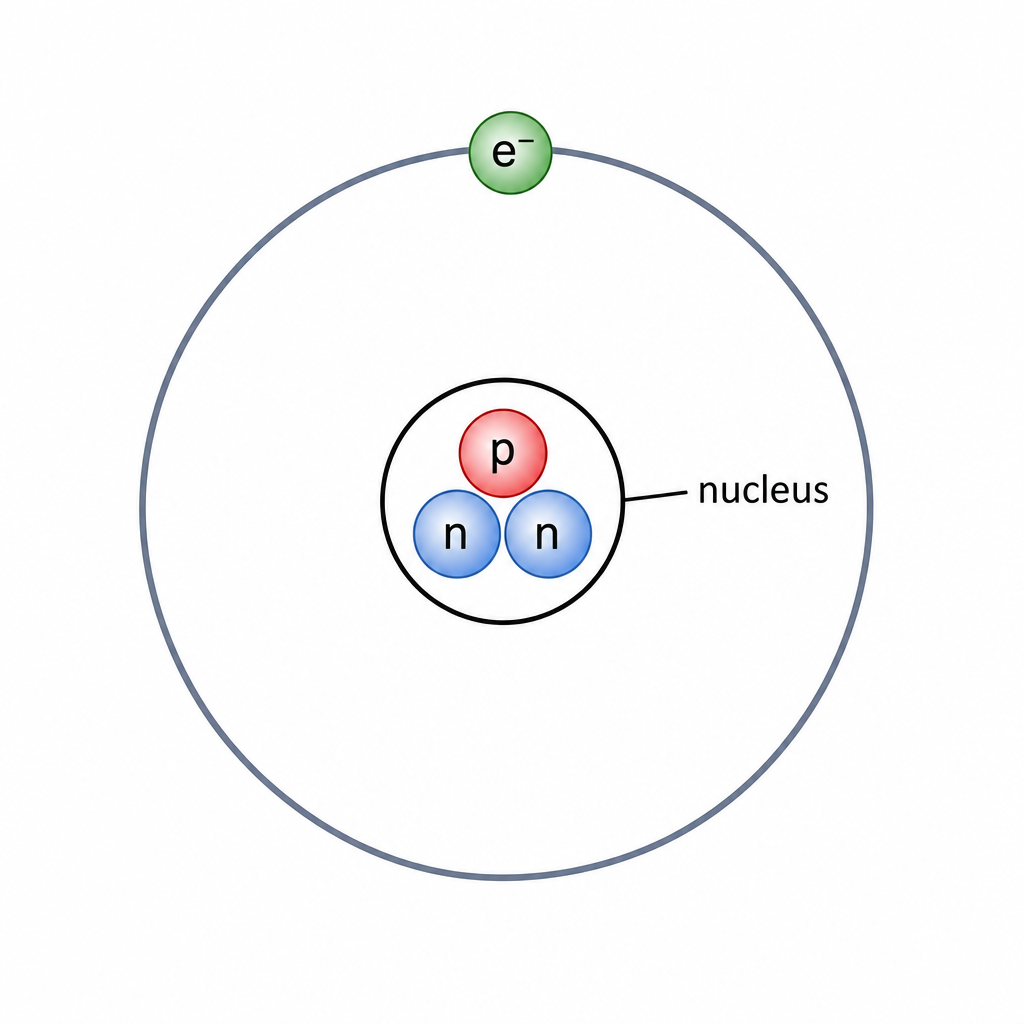
Answer
Nucleus containing proton and neutrons, with electron shown outside the nucleus (on a shell/orbit), all particles labelled.
Diagram showing nucleus (1p, 2n) with 1 electron outside
Background Concept
A simple atomic model for A-Level credit usually shows:
- A small central nucleus containing protons and neutrons.
- Electrons occupying regions outside the nucleus (often drawn as shells/orbits in a simplified Bohr-style diagram).
The key marking points are typically correct placement (nucleons in nucleus, electrons outside) and correct labels and numbers.
Understanding the Question
You must draw a labelled diagram for tritium, , showing how many protons, neutrons and electrons it has and where they are found.
Approach
- Use to identify nucleus contents: proton, neutrons.
- For a neutral atom, add electron outside the nucleus.
- Label each particle type clearly.
Step-by-Step Reasoning
- Tritium has so its nucleus contains one proton.
- It has , so total nucleons are and therefore neutrons are .
- Neutral atom means one electron outside the nucleus.
A correct diagram can be very simple: a central circle labelled “nucleus” containing symbols like and with correct counts (e.g. one and two ), and one electron on an outer circle/ellipse.
Key Takeaways
- Protons and neutrons belong in the nucleus.
- Electrons are outside the nucleus.
- Include correct numbers and labels.
Common Mistakes
- Putting electrons inside the nucleus.
- Drawing the correct shape but not labelling , , and .
- Drawing the wrong number of neutrons (e.g. neutrons instead of ).
Things to Be Careful About
- The question asks for a simple model: do not overcomplicate; clear labels matter most.
- Make sure the diagram indicates one electron (not two, which would correspond to helium).
Tritium is radioactive and undergoes decay to form an isotope of helium (He). Gamma radiation is not emitted during this decay.
Working
In decay, nucleon number is unchanged and proton number increases by .
So .
Beta particle: .
To conserve lepton number, an antineutrino is emitted: .
Answer
^3_1H -> ^3_2He + ^0_-1β + ^0_0X
Background Concept
In nuclear equations you must conserve:
- Nucleon number (total number of protons + neutrons).
- Proton number (total charge in units of ).
For decay:
- A neutron in the nucleus changes into a proton.
- An electron (the particle) is emitted.
- An electron antineutrino is also emitted.
This is commonly summarised as:
So stays the same, but increases by .
Understanding the Question
You are told tritium () undergoes decay to form an isotope of helium, and no gamma is emitted. You must fill in the missing nuclide numbers for helium and for the beta particle, and keep the extra particle .
Approach
- Use decay rule: unchanged, .
- Write the beta particle as (or equivalent).
- Keep as as shown, meaning it has zero nucleon number and zero charge.
Step-by-Step Reasoning
Start with tritium:
- Left side has , .
After decay:
- remains (no nucleons are created/destroyed).
- increases by : .
So the daughter nucleus is:
A particle is an electron, written in nuclear notation as:
To account for the weak interaction process, an additional neutral particle with and is emitted; it is written as and will be identified in part (ii).
Putting it all together:
Key Takeaways
- In decay: constant, increases by .
- The beta particle has and .
Common Mistakes
- Writing (forgetting increases).
- Using instead of (wrong sign on for the beta particle).
- Changing (it should not change for decay).
Things to Be Careful About
- The question explicitly says gamma is not emitted, so do not add .
- Ensure the daughter is helium, so the symbol must be He with .
Answer
Particle is an electron antineutrino, .
electron antineutrino
Background Concept
In decay, the emitted electron is not the only particle produced. The weak interaction also produces an electron antineutrino to conserve quantities such as lepton number and to account for the observed continuous energy spectrum of beta particles.
The decay at particle level is:
The antineutrino has:
- no charge ()
- negligible mass and no nucleon number ()
Understanding the Question
The decay equation in part (i) already includes a term . You must name what is for decay.
Approach
Recall the standard products of decay and match the particle with , .
Step-by-Step Reasoning
- In decay, a neutron becomes a proton.
- The emitted beta particle is the electron .
- The remaining neutral particle is the electron antineutrino.
So is:
Key Takeaways
- decay emits and .
- The neutrino/antineutrino carries away some energy and momentum.
Common Mistakes
- Saying “neutrino” instead of antineutrino for decay.
- Naming as a gamma photon (the question states gamma is not emitted).
Things to Be Careful About
- Remember the pair:
- decay:
- decay:
Working
Tritium nucleus: proton and neutrons.
Proton: .
Neutron: .
Total quarks:
Answer
Quark composition of the tritium nucleus: up quarks and down quarks (i.e. ).
4 up quarks and 5 down quarks
Background Concept
Baryons (such as protons and neutrons) are made of three quarks:
- Proton:
- Neutron:
A nucleus contains protons and neutrons, so its total quark content is found by adding the quarks from each nucleon.
Understanding the Question
A tritium nucleus is the nucleus of , so it contains the nucleons only (no electrons). From the nuclide notation, it has proton and neutrons. You must write the quark composition of this nucleus.
Approach
- Identify how many protons and neutrons are in the nucleus.
- Replace each proton with and each neutron with .
- Count total up-quarks () and down-quarks ().
Step-by-Step Reasoning
For :
- proton.
- neutrons neutrons.
Write quark content:
- One proton contributes .
- Two neutrons contribute .
Add them:
So the tritium nucleus contains up quarks and down quarks in total.
Key Takeaways
- Remember: proton , neutron .
- Nucleus quark content is the sum over all nucleons present.
Common Mistakes
- Using for the proton and for the neutron (swapped).
- Forgetting that tritium has two neutrons.
- Giving quark composition for the atom (including electrons) instead of just the nucleus.
Things to Be Careful About
- The question asks for the nucleus: ignore electrons completely.
- Count quarks systematically (either write out each nucleon’s quarks or count and per nucleon and multiply).