Physics 9702/24 — May/June 2025
Cambridge AS Level · AS Level Structured Questions · worked solutions for every part, with the mark scheme
Topics Dynamics · Electricity · D.C. Circuits · Forces, Density and Pressure · Kinematics · Work, Energy and Power · +4 more
Answer
The moment of a force about a point is the product of the force and the perpendicular distance from the point (pivot) to the line of action of the force.
Moment = force × perpendicular distance from pivot to line of action.
Background Concept
A force can cause a turning effect about a point (pivot). This turning effect is called the moment (or torque).
The moment about a chosen point depends on:
- the size of the force
- how far the line of action of the force is from the pivot, measured perpendicularly.
Mathematically:
where is the perpendicular distance from the pivot to the force’s line of action.
Understanding the Question
You are asked to define “moment of a force”. That means you must state the standard physics definition clearly and include the key phrase perpendicular distance to the line of action.
Approach
Give the definition in one sentence, naming the pivot (or point) and stating that the distance used is perpendicular to the line of action.
Step-by-Step Reasoning
- Identify that “moment” refers to turning effect about a pivot.
- State it is calculated by multiplying:
- the force, by
- the perpendicular distance from the pivot to the line of action.
Key Takeaways
- Moment depends on both force size and lever arm.
- The distance must be perpendicular to the line of action.
Common Mistakes
- Saying “distance from pivot to where the force acts” (not necessarily perpendicular).
- Missing the phrase “line of action”.
Things to Be Careful About
- Always specify “about a point/pivot”.
- Use “perpendicular distance” explicitly; it is the mark-winning detail.
A trapdoor has a hinge at end A, as shown in Fig. 1.1.
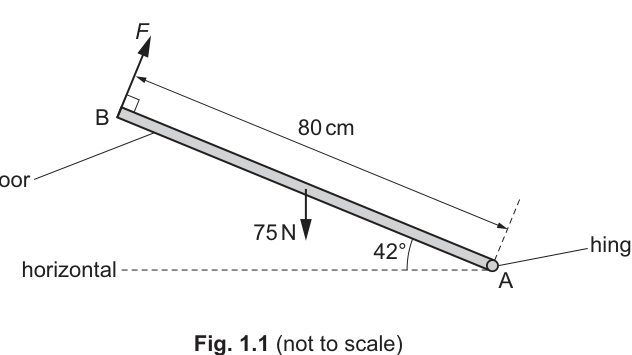
The trapdoor has length and weight . The mass of the trapdoor is uniformly distributed along its length.
A force acts at right angles to the trapdoor at end B so that the trapdoor is held in equilibrium at an angle of to the horizontal.
Answer
For a body in equilibrium, the sum of the clockwise moments about any point equals the sum of the anticlockwise moments about that point (net moment is zero).
In equilibrium, total clockwise moment = total anticlockwise moment about a point (net moment = 0).
Background Concept
If an object is not rotating, it has rotational equilibrium. This requires the resultant turning effect (moment) about any point to be zero.
This can be written as:
or equivalently:
Understanding the Question
The question asks you to state the principle of moments. This is a recall statement: no numbers, just the equilibrium condition for moments.
Approach
Write the standard form used in exams: “sum of clockwise moments equals sum of anticlockwise moments about the same point” and link it to equilibrium.
Step-by-Step Reasoning
- In equilibrium, there is no angular acceleration.
- Therefore the net torque (moment) about any point is zero.
- So clockwise moments must balance anticlockwise moments.
Key Takeaways
- Equilibrium requires both:
- net force (translational equilibrium)
- net moment (rotational equilibrium)
Common Mistakes
- Saying “moments are equal” without mentioning clockwise vs anticlockwise.
- Forgetting “about any point” / “about the same point”.
Things to Be Careful About
- Moments must be taken about a specified point, and all moments compared about the same point.
Calculate the component of the weight that is perpendicular to the trapdoor.
component of weight = ______
Working
Angle between trapdoor and horizontal .
Component of weight perpendicular to trapdoor:
Answer
56 N
Background Concept
To find the turning effect or to analyse forces on an inclined object, it is often useful to resolve a force into components:
- perpendicular to the object (normal to the surface/rod)
- parallel to the object
If a force makes an angle with the perpendicular direction, then the perpendicular component is . Equivalently, if is the angle between the force and the object itself, then the perpendicular component is .
Understanding the Question
The trapdoor is at to the horizontal. The weight acts vertically downward. The question asks for the component of this weight that is perpendicular to the trapdoor.
This is the component that would act “into” the door, at right angles to its surface.
Approach
- Use the given angle of the trapdoor to work out the relevant angle for resolving .
- Resolve into a component perpendicular to the trapdoor using sine/cosine.
A fast recognition here is that the perpendicular component comes out as .
Step-by-Step Reasoning
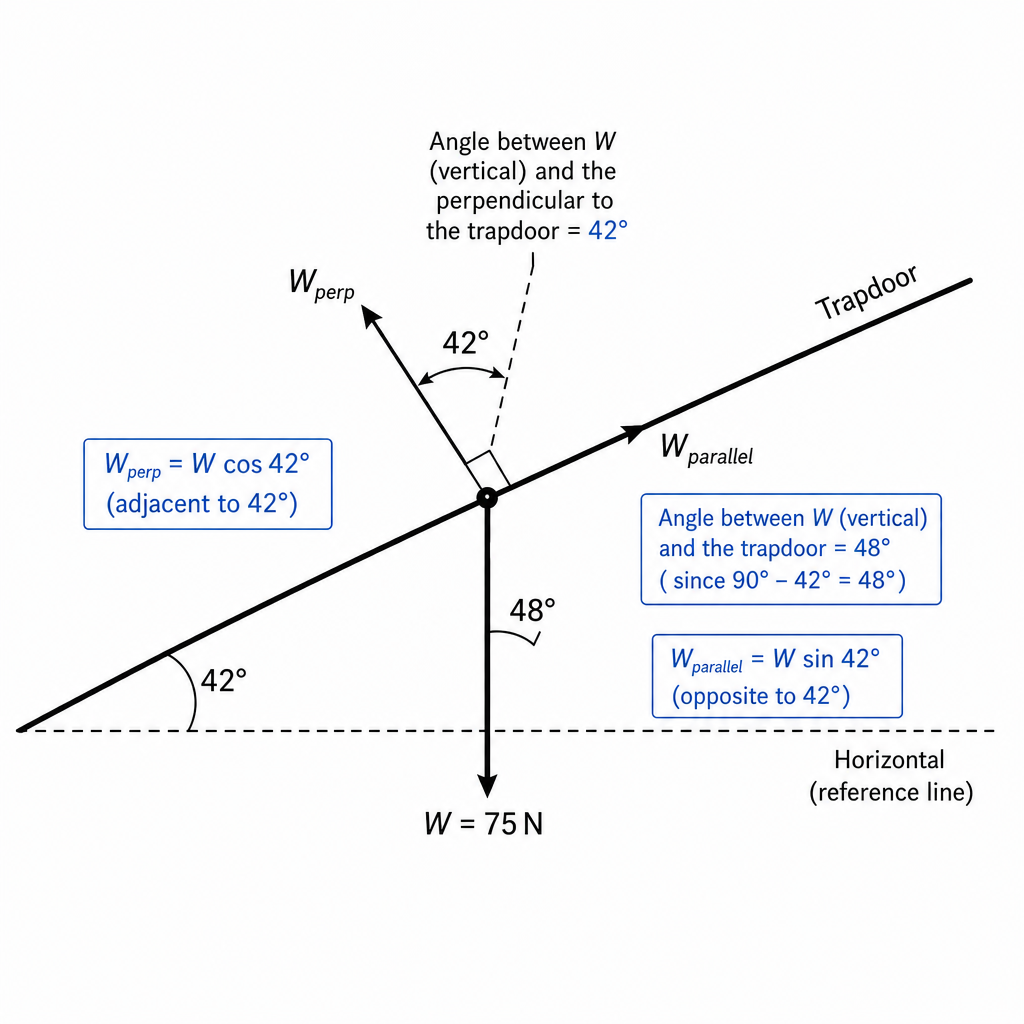
- The trapdoor is tilted above the horizontal.
- The vertical direction is to the horizontal.
- The angle between the trapdoor and the vertical is:
- The component of perpendicular to the trapdoor is:
and since :
Key Takeaways
- Resolve forces relative to the object (parallel/perpendicular) using the correct angle.
- Use complementary angles: .
Common Mistakes
- Using instead of (wrong component).
- Treating as the angle between the weight and the trapdoor (it is not).
Things to Be Careful About
- Always sketch or imagine a right-angled triangle of components to decide whether to use sine or cosine.
- Give the answer with a sensible number of significant figures and include the unit .
Working
Take moments about hinge at .
Weight acts at centre: distance from along trapdoor .
Using ,
Answer
28 N
Background Concept
For a rigid body in equilibrium:
A moment is found from:
where is the perpendicular distance from the pivot to the force’s line of action.
A very useful exam technique is to take moments about a pivot where unknown reaction forces act (here, the hinge at ). Any force whose line of action passes through then produces zero moment, simplifying the equation.
Understanding the Question
The trapdoor (length ) is hinged at and held in equilibrium at to the horizontal by a force applied at end .
Given:
- weight acting at the centre (uniform mass distribution) so at from along the door
- acts at right angles to the trapdoor at
Find .
Approach
- Choose pivot at the hinge .
- Write a moment balance: clockwise moments = anticlockwise moments.
- Use perpendicular distances:
- For : since it is perpendicular to the door at , its moment arm is simply .
- For the weight: either use the perpendicular distance to the vertical line of action, or (often simpler) use the component of the weight perpendicular to the door acting at .
Step-by-Step Reasoning
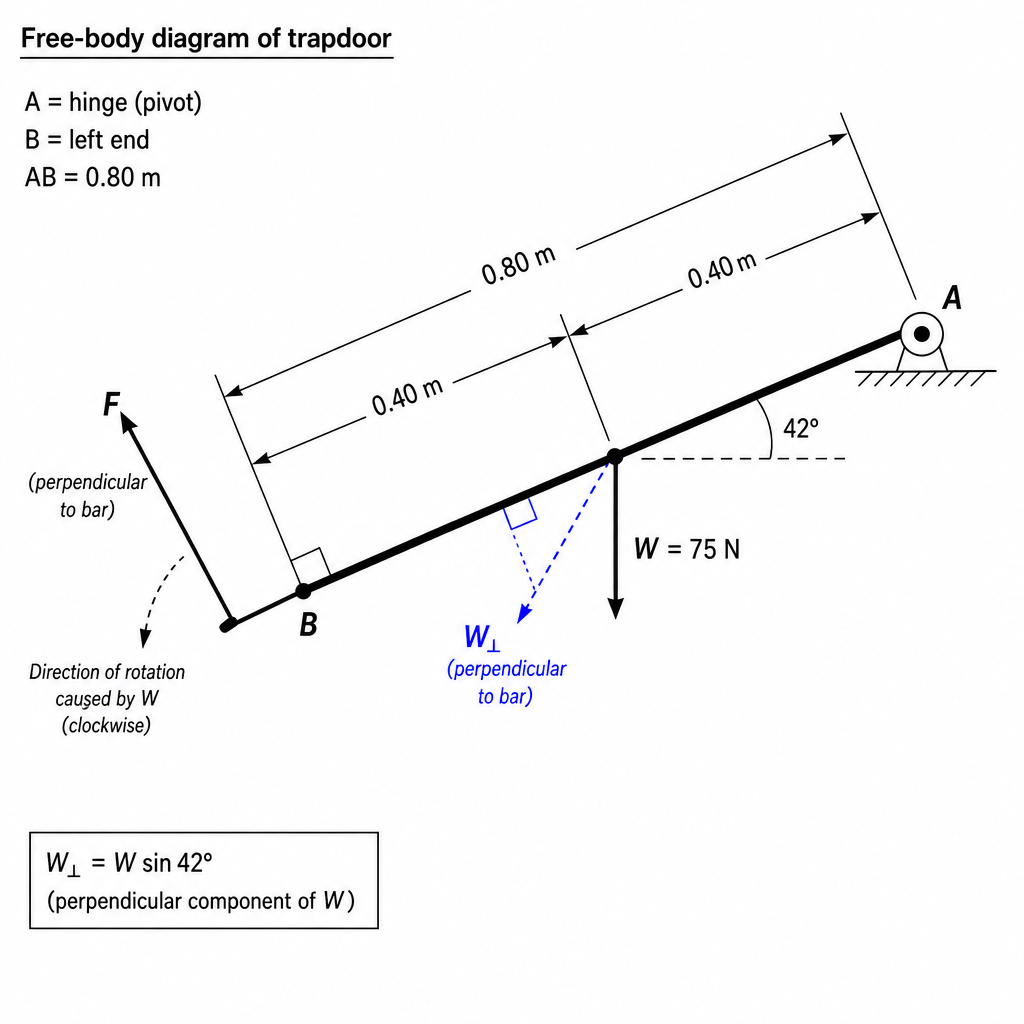
- Perpendicular component of weight to the trapdoor:
- Moments about :
- Anticlockwise moment from at :
- Clockwise moment from the weight component perpendicular to the door, acting at the centre:
- Equilibrium condition:
- Solve for :
(Notice the geometry makes half of because the lever arm is twice as long.)
Key Takeaways
- In rotational equilibrium: clockwise moments = anticlockwise moments.
- Taking moments about the hinge avoids needing to consider hinge reaction forces.
- If a force is not perpendicular to the lever arm, use the perpendicular component (or perpendicular distance).
Common Mistakes
- Using the full weight instead of the perpendicular component to the door.
- Using for the weight’s lever arm instead of (weight acts at the centre).
- Mixing centimetres and metres (e.g. using 80 instead of 0.80).
Things to Be Careful About
- Always use SI units in calculations of moments: distances in metres.
- Be consistent about which forces cause clockwise vs anticlockwise rotation.
- Because is stated to act at right angles to the door, you do not need to multiply by any sine/cosine for its moment arm.
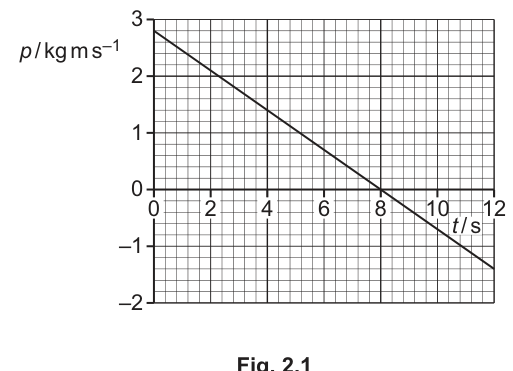
An object of constant mass moves in a straight line. The variation with time of the momentum of the object is shown in Fig. 2.1.
Answer
Momentum is the product of mass and velocity:
(in the direction of the velocity).
Momentum is the product of mass and velocity, p = mv (in the direction of the velocity).
Background Concept
Linear momentum is a vector quantity that describes “quantity of motion”. For an object of mass moving with velocity ,
Because is a vector, momentum has both magnitude and direction (same as the velocity direction).
Understanding the Question
You are asked to define momentum. No calculation is needed; you just need the correct physics statement, ideally with the equation.
Approach
State momentum as mass (\times) velocity, and make clear it is a vector (direction as velocity).
Step-by-Step Reasoning
- Identify the standard definition: momentum depends on both how massive an object is and how fast it is moving.
- Write the defining equation .
- Add the vector nature: direction of is the same as direction of .
Key Takeaways
- Momentum is defined by .
- Momentum is a vector (direction matters).
Common Mistakes
- Defining momentum as (that is kinetic energy).
- Omitting the fact that momentum has direction.
Things to Be Careful About
- Use the correct symbol and include that mass is constant but momentum can still change if velocity changes.
Calculate the change in momentum of the object from time to .
change in momentum = ______
Working
From the graph: and .
Answer
-4.5 kg m s^-1
Background Concept
The change in any quantity is calculated as
A negative change means the momentum has decreased (or changed direction, depending on signs).
Understanding the Question
The momentum–time graph shows at different times. You must find how much momentum changes between and .
Given from the graph:
- at ,
- at ,
Approach
Read at the two times, then compute .
Step-by-Step Reasoning
- Read initial momentum: .
- Read final momentum: .
- Subtract:
The negative sign is expected because the graph falls with time.
Key Takeaways
- Always use “final minus initial”.
- Signs on a momentum graph matter: negative momentum corresponds to motion in the opposite direction.
Common Mistakes
- Doing (wrong order).
- Ignoring the negative sign at .
Things to Be Careful About
- Quote the unit .
- Don’t confuse “change” with “magnitude of change” unless asked for magnitude.
Working
Resultant force:
Using points and :
Magnitude .
Answer
0.38 N
Background Concept
Newton’s second law can be written in momentum form:
So on a graph of momentum against time , the gradient is the resultant force. The unit works out because
Understanding the Question
You are given a straight-line – graph. You must find the magnitude of the resultant force, so you find the gradient and then take its absolute value.
Approach
Pick two clear points on the straight line, compute , then take the magnitude.
Step-by-Step Reasoning
- Choose convenient points on the line, e.g. and .
- Calculate the gradient:
- Interpret this as the force:
The negative sign means the force is opposite to the positive direction of momentum.
4. The question asks for magnitude, so
Key Takeaways
- The gradient of a – graph is the resultant force.
- “Magnitude” means you report a positive value.
Common Mistakes
- Using instead of .
- Calculating (inverting the gradient).
- Forgetting to take the magnitude when asked.
Things to Be Careful About
- Use two points that lie exactly on the line to reduce reading error.
- Include the unit and round sensibly (typically 2 s.f. here).
Answer
Since and is constant, .
From to the momentum decreases linearly to zero, so the speed decreases uniformly to zero (object comes to rest at ).
Speed decreases uniformly to zero, reaching zero at t = 8.0 s.
Background Concept
For constant mass,
So velocity is directly proportional to momentum . Speed is the magnitude of velocity.
- If is positive, the object moves in the positive direction.
- If becomes zero, velocity is zero (the object is momentarily at rest).
Understanding the Question
You must describe how the speed changes between and . The – graph shows falling from to in a straight line over this interval.
Approach
Use to map the momentum graph into a velocity (and therefore speed) description. A straight-line change in means a straight-line change in .
Step-by-Step Reasoning
- Because is constant, dividing the entire momentum graph by would give the velocity–time graph.
- From to , the momentum decreases linearly from to .
- Therefore velocity decreases linearly from some positive value to .
- Since speed is the magnitude and the velocity stays positive until it reaches zero, the speed also decreases steadily (uniformly) to zero.
Key Takeaways
- With constant mass, and have the same “shape” as functions of time.
- When reaches zero, the object is at rest.
Common Mistakes
- Saying the speed is constant because the force is constant (constant force implies constant acceleration, not constant speed).
- Saying the speed becomes negative (speed cannot be negative; velocity can).
Things to Be Careful About
- The question only asks up to , where the momentum reaches zero; after that the direction changes (negative momentum).
By reference to Fig. 2.1, explain why the resultant force acting on the object during the first of its motion cannot be due to air resistance.
Answer
From Fig. 2.1 the gradient of the – graph is constant for to , so the resultant force is constant.
Air resistance depends on speed, so as the object slows (speed decreasing to zero at ) the air resistance would decrease to zero and would not remain constant. Hence the resultant force cannot be due to air resistance.
Because the p–t graph has constant gradient (constant force) while air resistance would decrease with speed and be zero at t = 8 s when v = 0.
Background Concept
Air resistance (drag) is a resistive force that acts opposite to the direction of motion and depends on speed. Common models are:
- low speeds:
- higher speeds:
In all cases, if decreases, the drag force decreases; and if , the drag force is .
Also, from momentum form of Newton’s second law:
So a constant gradient on a – graph means constant resultant force.
Understanding the Question
You are asked to use the graph to argue that the resultant force during the first cannot be air resistance.
From the graph:
- The – line is straight, so its gradient is constant force constant.
- Momentum falls to at → velocity (and speed) is at .
Approach
- Use the straight-line – graph to deduce the force is constant.
- Use the fact that speed decreases to zero to deduce that any air resistance would decrease to zero.
- Show these two conclusions are incompatible.
Step-by-Step Reasoning
- On a – graph, gradient .
- The graph is a straight line from to , so is constant → resultant force is constant.
- But and is constant, so as decreases to , the speed decreases to .
- Air resistance depends on speed, so it would decrease as the object slows, and it would be exactly at the instant the object is at rest.
- Therefore the resultant force being constant (and non-zero even approaching ) cannot be explained by air resistance.
Key Takeaways
- Straight line on – → constant resultant force.
- Drag force is not constant when speed changes; it falls to zero at .
Common Mistakes
- Saying “air resistance is always constant” (it is not; it varies with speed).
- Forgetting that implies for constant mass.
Things to Be Careful About
- The key evidence from the graph is the constant gradient and the momentum reaching zero at .
- Use wording like “depends on speed” and “would be zero at rest” to secure the explanation marks.
At time the displacement of the object is zero.
On Fig. 2.2, sketch the variation of with time from to .
Numerical values of are not required.
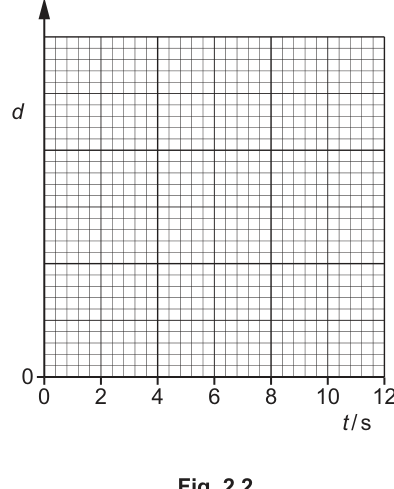
Answer
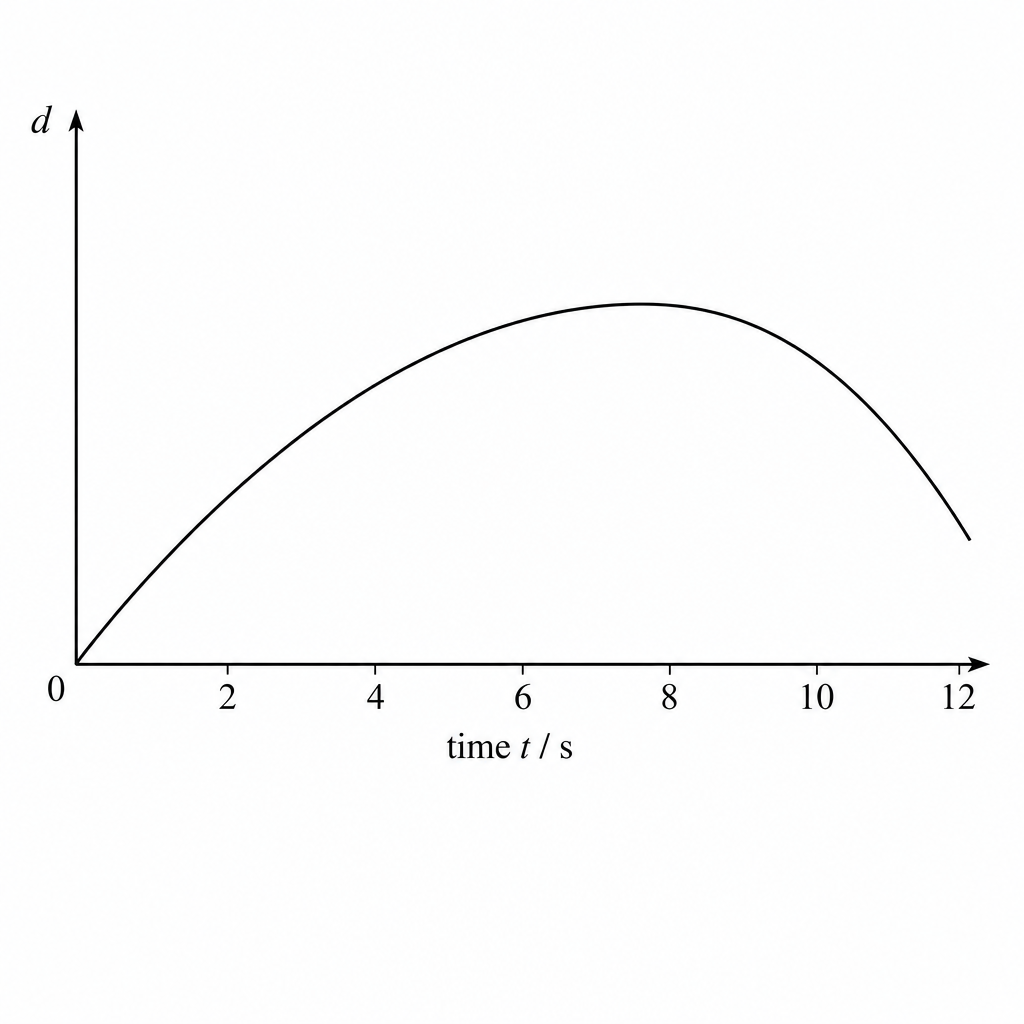
Sketch: displacement increases concave down to a maximum at t = 8 s, then decreases (still concave down), remaining above zero at t = 12 s.
Background Concept
Displacement , velocity , and acceleration are related by:
- gradient of a displacement–time graph is velocity:
- if acceleration is constant, then velocity changes linearly with time and displacement is a quadratic (parabolic) function of time.
Here we are given momentum rather than velocity. With constant mass,
So the shape of the velocity–time graph is the same as the shape of the momentum–time graph (just scaled by ).
Understanding the Question
You must sketch against from to , starting at when . Numerical values are not required, but the correct shape is.
From the momentum graph:
- decreases linearly from at to at .
- then continues linearly to at .
So velocity is positive then becomes zero at , then becomes negative after .
Approach
- Convert momentum behaviour to velocity behaviour using .
- Use “gradient of – equals ”:
- positive means increases;
- zero means a horizontal tangent;
- negative means decreases.
- Use the fact that changes linearly (straight line in –) to set the curvature: should be a smooth concave-down parabola.
Step-by-Step Reasoning
- For : .
- Therefore is increasing.
- But (hence ) is decreasing, so the gradient of the – graph decreases with time.
- This means the curve rises but flattens out: concave down.
- At : .
- The displacement curve has zero gradient here: a turning point (maximum displacement).
- For : .
- Therefore decreases after (object moves back in the negative direction).
- The momentum continues to become more negative linearly, so the speed in the negative direction increases; the slope of the – graph becomes more negative.
- With constant negative acceleration, the curve remains concave down.
- Since the negative momentum area from to is smaller than the positive area from to , the object has not returned to by , so the curve at is still above the axis.
A correct sketch is therefore: start at origin, rise concave down to a maximum at , then fall (still concave down) but stay above at .
Key Takeaways
- Use (constant mass) to translate a – graph into a – description.
- Use “gradient of – is ” to sketch displacement.
- Linear implies parabolic .
Common Mistakes
- Drawing as a straight line (would imply constant velocity).
- Making a sharp corner at (displacement should be smooth; velocity changes continuously).
- Making the curve change concavity at (acceleration is constant, so concavity stays the same).
- Bringing the curve back to at (not consistent with areas under the velocity graph).
Things to Be Careful About
- The turning point must be exactly at because there.
- The displacement at should still be positive (above the axis).
- Label axes correctly: horizontal, vertical, and the curve must start at as stated.
The lower end of a vertical spring is fixed to a horizontal surface, as shown in Fig. 3.1.
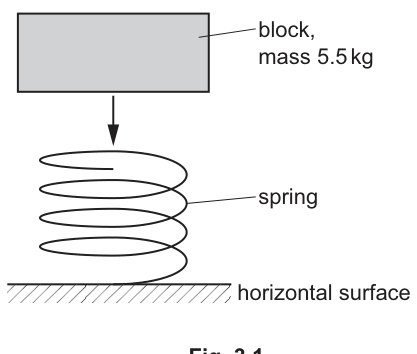
The mass of the spring is negligible. A block of mass drops vertically onto the spring and is brought to rest as the spring is compressed.
The block has kinetic energy as it makes contact with the spring.
Calculate the speed of the block as it makes contact with the spring.
speed = ______
Working
Answer
6.3 m s^-1
Background Concept
Kinetic energy is the energy an object has because it is moving. For a mass moving with speed ,
This comes from the work done to accelerate the object from rest. It applies in normal (non-relativistic) situations such as this one.
Understanding the Question
You are told that the block (mass ) has kinetic energy at the instant it first touches the spring. The question asks for the speed at that instant.
So:
- known: ,
- unknown: .
Approach
Use the kinetic energy formula and rearrange it to solve for . Then substitute the given values.
Step-by-Step Reasoning
Start with
Rearrange:
Substitute and :
Rounding to 2 s.f. gives .
Key Takeaways
- Use to link energy and speed.
- Rearranging for introduces a square root.
Common Mistakes
- Forgetting the square root and giving as the final answer.
- Using the wrong mass (e.g. confusing the spring as having mass when it is stated negligible).
- Dropping units or giving instead of .
Things to Be Careful About
- Significant figures: here a 2 s.f. answer is appropriate ().
- Keep in and in so that comes out in .
The gravitational potential energy of the block decreases by as the spring is compressed to its maximum compression .
Show that is .
Working
Decrease in GPE:
Answer
0.37 m
Background Concept
Gravitational potential energy (GPE) changes when an object moves vertically in a uniform gravitational field. Near Earth’s surface,
where is mass, is gravitational field strength, and is the vertical displacement. If the object moves downward by , its GPE decreases by .
Understanding the Question
As the spring compresses to its maximum compression , the block moves downward by the same distance . You are told the block’s GPE decreases by during this compression. You must use this to show that .
Known:
- decrease in GPE
Unknown: .
Approach
Use (magnitude of the decrease). Rearrange to find .
Step-by-Step Reasoning
The magnitude of the GPE decrease is
So
Calculate:
This matches what you were asked to show.
Key Takeaways
- For vertical motion near Earth, GPE change is .
- When an object moves down, GPE decreases; the magnitude is still .
Common Mistakes
- Using (that would be spring energy, not GPE).
- Using and then not matching the required .
- Confusing (compression distance) with speed or acceleration.
Things to Be Careful About
- The vertical distance moved during compression is the compression .
- Use consistent units: , so dividing by (in N) gives m.
- Keep enough significant figures in intermediate steps to obtain .
Assume that, as the spring compresses, all of the energy lost by the block is converted into the elastic potential energy of the spring.
Use the data from (a) and (b) to determine the maximum elastic potential energy of the spring.
Show your working.
maximum elastic potential energy = ______
Working
Energy lost by block during compression:
Answer
130 J
Background Concept
When a block interacts with a spring, energy can be transferred between:
- kinetic energy of the block,
- gravitational potential energy of the block (if it moves vertically),
- elastic potential energy stored in the spring.
If we assume no energy is dissipated (no sound, heat, deformation losses), then the total mechanical energy is conserved: energy lost by the block becomes energy stored in the spring.
Understanding the Question
From the instant the block first contacts the spring until it reaches maximum compression:
- the block’s kinetic energy falls from to (it comes to rest), so it loses of kinetic energy.
- the block moves downward and its GPE decreases by .
The question states to assume all energy lost by the block becomes elastic potential energy of the spring. You must find that maximum elastic potential energy.
Approach
Add the two energy losses (loss of kinetic energy + decrease in GPE). That total must equal the spring’s maximum elastic potential energy.
Step-by-Step Reasoning
- Initial kinetic energy at contact: .
- Final kinetic energy at maximum compression: .
So the decrease in kinetic energy is .
The GPE decreases by during the same interval.
Total energy transferred to the spring is therefore
Key Takeaways
- During compression, both the loss of kinetic energy and the decrease in GPE can contribute to energy stored in the spring.
- With no dissipation, energy lost by the block equals energy gained by the spring.
Common Mistakes
- Using only and forgetting the extra from the drop during compression.
- Subtracting instead of adding it (a decrease in GPE means additional energy is released).
- Thinking the spring energy must be less because the block stops; actually all the mechanical energy must be stored somewhere at that instant.
Things to Be Careful About
- Sign convention: “GPE decreases by ” means the block loses of GPE, which becomes available to store in the spring.
- The maximum elastic potential energy occurs at maximum compression, when the block’s speed is zero.
The variation of the force acting on the spring with the compression of the spring is shown in Fig. 3.2.
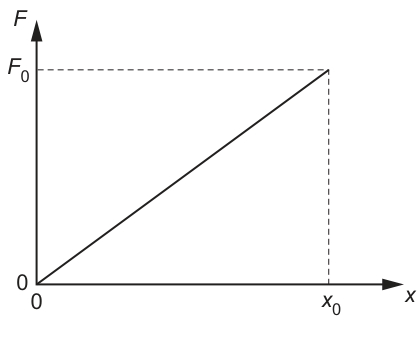
Use the information in (b) and your answer in (c) to show that the maximum force exerted on the spring by the block is .
Working
Maximum elastic potential energy is area under - graph:
Using and ,
Answer
700 N
Background Concept
For a spring that obeys Hooke’s law, force is proportional to extension/compression:
A force–displacement graph for such a spring is a straight line through the origin. The work done in compressing the spring from to equals the area under the – graph:
That work done is stored as elastic potential energy in the spring.
Understanding the Question
You are given:
- maximum compression (from part (b)),
- maximum elastic potential energy (from part (c)),
- a linear vs graph from to .
You must use these to show the maximum force is .
Approach
Because the graph is a straight line from the origin, the area under it is a triangle. So:
Rearrange for and substitute the values.
Step-by-Step Reasoning
Since increases linearly with , the – graph is triangular. The base is and the height is .
So elastic energy stored is
Rearrange:
Substitute and :
To appropriate significant figures:
Key Takeaways
- Energy stored in a spring equals the work done compressing it.
- Work done is the area under an – graph.
- For a Hooke’s law spring, that area is a triangle: .
Common Mistakes
- Using (rectangle area) instead of half that for a triangle.
- Mixing up (compression) with the vertical drop from earlier parts.
- Forgetting that ; units help confirm the formula.
Things to Be Careful About
- The graph must pass through the origin for the triangular area argument; the question shows it does.
- Keep enough precision in intermediate calculation (e.g. ) before rounding to .
Use the information in (d) to determine, for the instant that the block is first brought to rest by the spring, the magnitude of:
Working
At maximum compression, spring force on block (upward).
Weight:
Resultant force on block:
Answer
6.5 × 10^2 N
Background Concept
Forces add vectorially. In vertical 1D problems, choose an upward or downward positive direction and add forces with signs.
At the instant the block is at maximum compression, it is momentarily at rest but not in equilibrium (unless forces balance). The resultant force is the net force:
Weight acts downward with magnitude . The spring exerts an upward force on the block.
Understanding the Question
At the instant the block is first brought to rest by the spring (i.e. at maximum compression):
- the spring force is at its maximum (from part (d)), upward on the block.
- the weight of the block is , downward.
You are asked for the magnitude of the resultant force on the block at that instant.
Approach
Draw/visualise the free-body diagram, take upward as positive, then calculate
Step-by-Step Reasoning
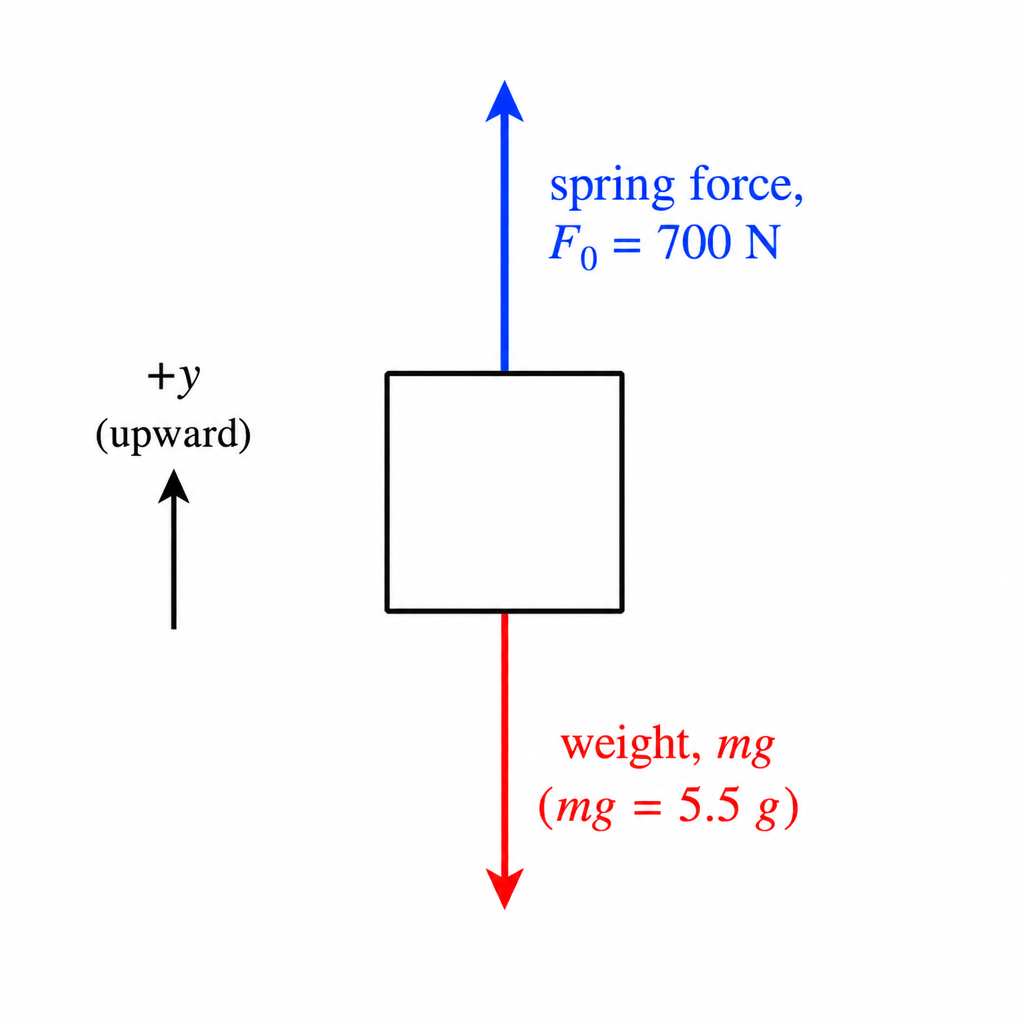
Calculate the weight:
Take upward as positive:
- spring force:
- weight:
So the resultant force is
Magnitude to 2 s.f.:
(Direction would be upward, but the question asks only for magnitude.)
Key Takeaways
- At maximum compression, the spring force is largest.
- Resultant force is not zero just because the speed is momentarily zero.
- Net force is found by subtracting weight from the upward spring force.
Common Mistakes
- Setting resultant force to zero because the block is at rest at that instant.
- Adding and instead of subtracting (directions are opposite).
- Using in earlier parts but switching to a very rough value here and losing consistency.
Things to Be Careful About
- Always include directions when forming the resultant; only at the end take magnitude if asked.
- Keep to a sensible precision; it is much smaller than but still affects the result by nearly .
Working
Using ,
Answer
1.2 × 10^2 m s^-2
Background Concept
Newton’s second law links resultant force and acceleration:
where is the net (resultant) force on the object, is its mass, and is its acceleration. The acceleration is in the direction of the resultant force.
Understanding the Question
At maximum compression the block is momentarily at rest, but it experiences an upward resultant force (spring force larger than weight). You are asked for the magnitude of the acceleration at that instant.
Known:
- spring force at that instant
- weight
- resultant force magnitude .
Unknown: .
Approach
- Use the same force situation as part (e)(i) to get the resultant force.
- Apply .
Step-by-Step Reasoning
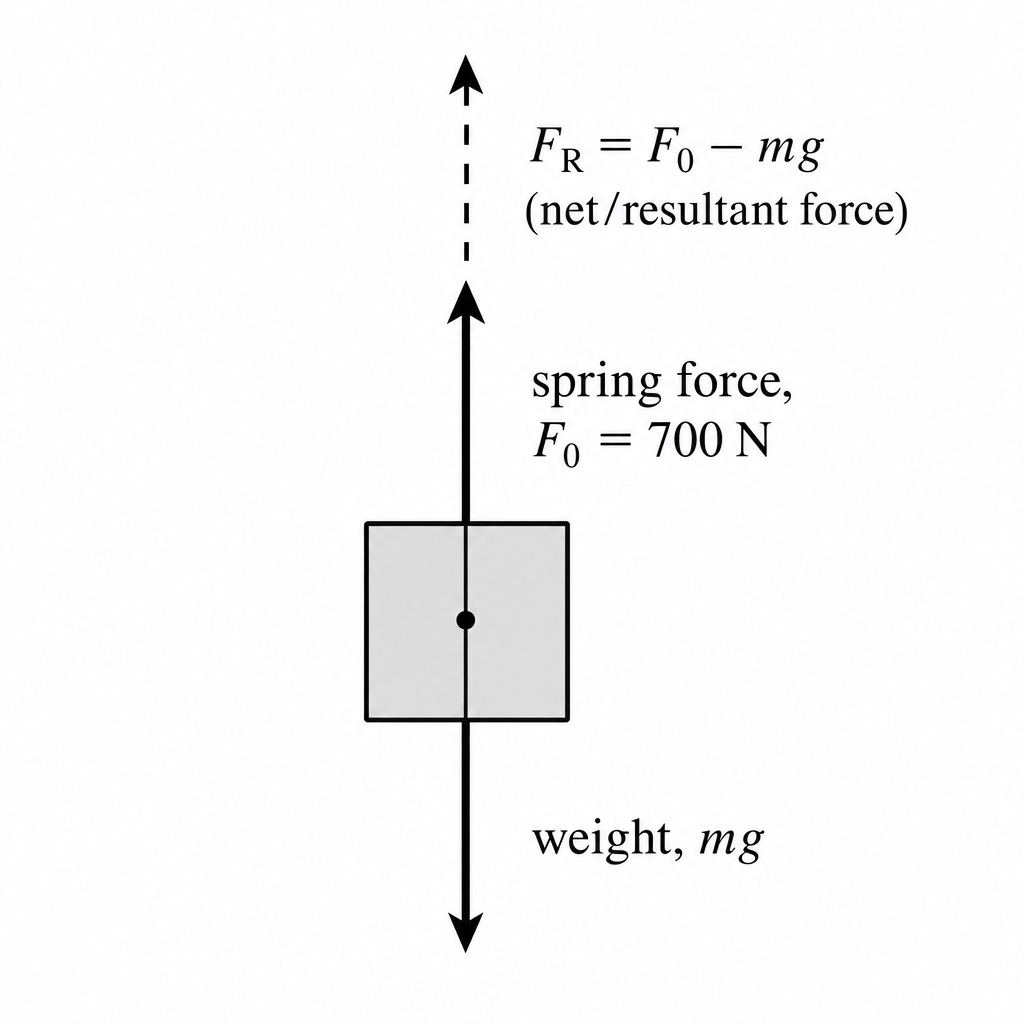
Resultant force (upward) is
Apply Newton’s second law:
Magnitude to 2 s.f.:
(The acceleration direction would be upward, but only magnitude is requested.)
Key Takeaways
- Zero speed at an instant does not imply zero acceleration.
- Use with the net force, not any single force.
Common Mistakes
- Using (this is not free fall; the spring exerts a large additional force).
- Dividing by the wrong mass or accidentally using weight instead of mass.
- Using directly as the resultant force and forgetting to subtract .
Things to Be Careful About
- Ensure is in newtons and in kilograms so comes out in .
- Quote acceleration to sensible significant figures consistent with earlier parts.
A source oscillates with frequency to produce a progressive wave of wavelength . The source takes time to produce complete oscillations.
Answer
A progressive wave is a travelling disturbance that transfers energy from one point to another, with no net transfer of matter.
A travelling disturbance that transfers energy from one point to another, with no net transfer of matter.
Background Concept
A progressive (travelling) wave is a disturbance that moves through space (or through a medium). The important physics idea is that the wave carries energy (and momentum) from the source to other places.
In a mechanical wave (e.g. water waves, sound), the particles of the medium oscillate about fixed equilibrium positions. They do not travel along with the wave over long distances.
Understanding the Question
You are asked to state what is meant by a progressive wave. For 1 mark, Cambridge typically wants the defining idea that:
- the disturbance travels, and
- energy is transferred, but
- there is no net transfer of matter.
Approach
Give a single, clear sentence including the key phrases above. Avoid describing stationary waves or interference (not relevant here).
Step-by-Step Reasoning
- “Progressive” means the wave pattern moves through space.
- As it moves, it transports energy away from the source.
- The medium’s particles oscillate, but their average position stays the same (so no net mass transport).
Key Takeaways
- Progressive wave = travelling wave.
- Transfers energy (and momentum) without net transfer of matter.
Common Mistakes
- Describing a stationary wave (nodes/antinodes) instead.
- Saying “particles move along the wave” (confuses oscillation with net drift).
Things to Be Careful About
- “No net transfer of matter” does not mean particles do not move; they do move, but they oscillate about equilibrium positions.
State expressions, in terms of some or all of , and , for:
- the distance moved by a wavefront in time
distance = ______
- time .
time = ______
Working
In , the source makes oscillations, so the wavefront advances wavelengths:
Also
Answer
distance = n\lambda, t = n/f
Background Concept
Frequency is the number of complete oscillations per second:
Wavelength is the distance between adjacent points in phase (e.g. crest-to-crest). A key interpretation is:
- in one period , a wave travels forward by one wavelength .
- since , in time corresponding to oscillations (i.e. periods), the wave travels .
Understanding the Question
The stem says: a source oscillates with frequency , wavelength , and takes time to produce oscillations.
You must write expressions for:
- the distance moved by a wavefront in time ,
- the time itself,
using some or all of , , and .
Approach
- Convert “ complete oscillations” into “ periods”.
- Use the fact that each period corresponds to one wavelength of forward travel.
- Use the definition of frequency to link and .
Step-by-Step Reasoning
- Distance travelled by a wavefront in time
- In one oscillation (one period), the wave pattern moves forward by .
- In oscillations, it moves forward by .
So:
- Time
Using the definition of frequency:
Rearrange for :
Key Takeaways
- (frequency definition).
- Each oscillation corresponds to an advance of one wavelength for the travelling wave pattern.
Common Mistakes
- Writing or (mixing up proportionality).
- Writing (algebra error).
Things to Be Careful About
- The wavefront distance is about the wave pattern, not about a particle in the medium.
- Keep the meanings clear: is a pure number (no units).
Use your answers in (ii) to determine an expression for the speed of the wave in terms of and .
Working
Answer
v = f\lambda
Background Concept
Wave speed is the rate at which the wave pattern (e.g. a crest) moves:
For a progressive wave, a wave crest moves one wavelength in one period . Since , the standard wave equation is:
Understanding the Question
You previously found:
- distance moved by a wavefront in time is ,
- .
Now you must combine these to obtain an expression for wave speed in terms of and only.
Approach
Use and substitute the expressions from (ii). The number of oscillations should cancel.
Step-by-Step Reasoning
Start with speed definition:
Substitute from (ii):
Dividing by is multiplying by :
Cancel :
Key Takeaways
- Deriving comes directly from speed = distance/time and the meaning of wavelength and frequency.
- The result is independent of how many oscillations you consider.
Common Mistakes
- Forgetting to invert when dividing by a fraction: writing .
- Leaving in the final expression (it should cancel).
Things to Be Careful About
- Units check: is and is , so has units , consistent with speed.
Two identical microwave sources X and Y emit waves in phase. The sources are separated by a distance of , as shown in Fig. 4.1.
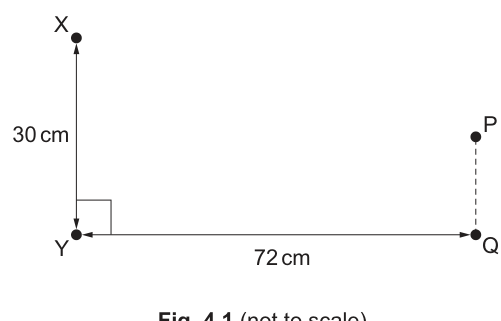
The intensity of the microwaves is to be investigated at points P and Q.
Line PQ is parallel to line XY. Distance XP is equal to distance YP. Distance YQ is and angle XYQ is .
The wavelength of the microwaves is .
Working
For microwaves, .
Answer
7.5 GHz
Background Concept
All electromagnetic (e.m.) waves in air/vacuum travel at speed
They satisfy the wave equation
For e.m. waves, , so:
Also, .
Understanding the Question
You are given microwave wavelength and asked for frequency in GHz. The only subtlety is converting cm to m and then Hz to GHz.
Approach
- Convert to metres.
- Use .
- Convert Hz to GHz.
Step-by-Step Reasoning
Convert wavelength:
Compute frequency:
Convert to GHz:
Key Takeaways
- Use for e.m. waves.
- Always convert wavelength to SI (metres) before calculating.
Common Mistakes
- Using instead of .
- Forgetting that GHz is Hz.
- Using with still in cm.
Things to Be Careful About
- Significant figures: is usually taken as (2 s.f.) and is 2 s.f., so to 2 s.f. is appropriate (7.5 GHz).
Working
Triangle is right-angled at , with and .
Answer
Difference in path lengths .
6 cm
Background Concept
For interference questions, we often need the path difference between two waves reaching the same point. If the sources are at and , and the point is , then the path difference is:
(You can take the magnitude; the important thing is how many wavelengths it corresponds to.)
Here, the geometry provides a right-angled triangle, so Pythagoras’ theorem applies:
Understanding the Question
Given:
- the sources are separated by ,
- ,
- angle (so ).
You must show that is longer than by .
Approach
- Recognise is right-angled at .
- Use Pythagoras to find .
- Subtract from .
Step-by-Step Reasoning
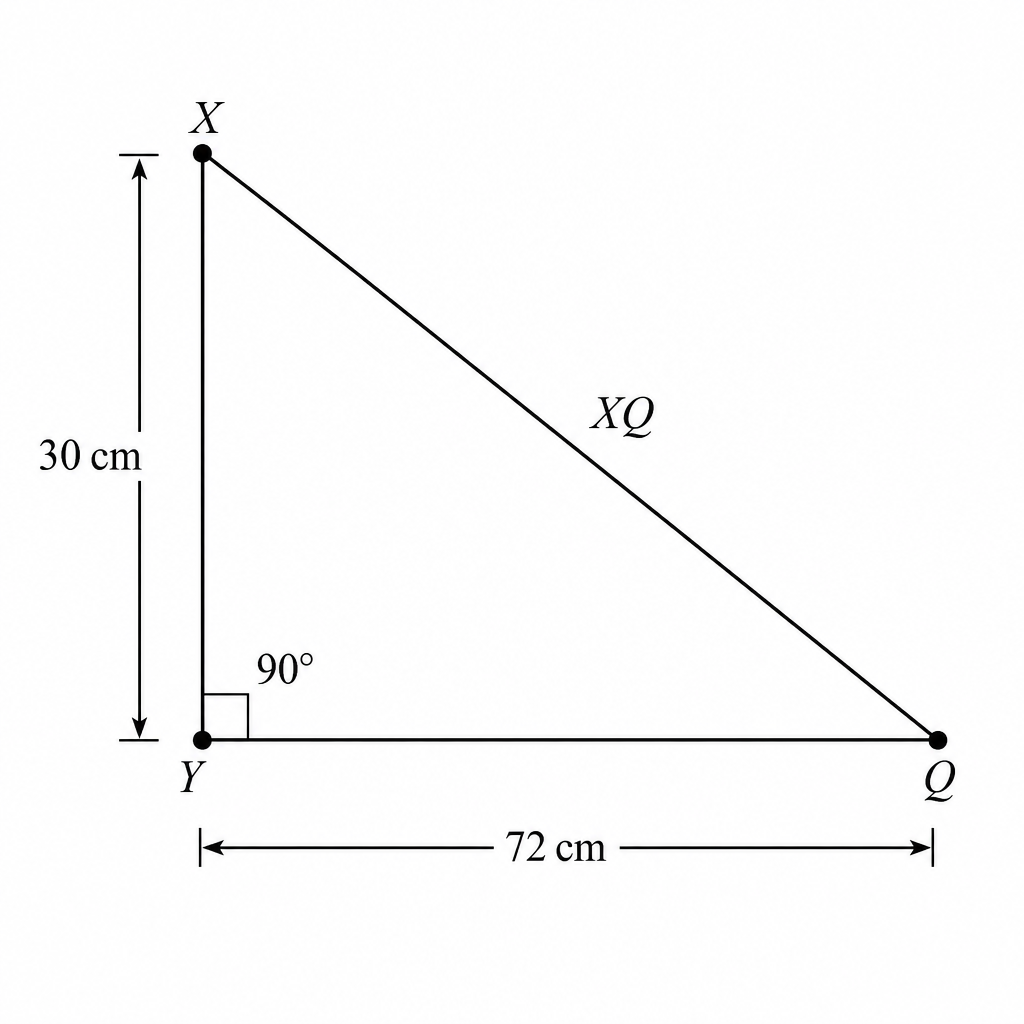
Use Pythagoras:
So:
Now path difference:
Key Takeaways
- Right angle given implies Pythagoras.
- Path difference is found by subtracting the two path lengths.
Common Mistakes
- Using instead of Pythagoras.
- Squaring incorrectly or forgetting the square root.
- Finding and then giving a negative value without stating magnitude.
Things to Be Careful About
- Keep units consistent (both given in cm here, so no conversion needed in this part).
- The “show that” mark is earned by demonstrating the key calculation clearly.
State and explain what may be deduced about the intensity of the microwaves at point Q.
Working
Path difference so the waves arrive in antiphase.
Answer
The intensity at is a minimum (destructive interference; ideally zero) because gives a phase difference of an odd multiple of .
Minimum intensity (destructive interference) at Q.
Background Concept
Two coherent sources emitting in phase produce interference.
At a point, the path difference determines the phase difference :
Interference conditions:
- Constructive interference (maximum intensity):
- Destructive interference (minimum intensity):
For perfect equal amplitudes, destructive interference would give zero resultant amplitude.
Understanding the Question
You have already shown that at point the path difference is . The wavelength is and the sources are in phase.
You must state and explain what can be deduced about the intensity at .
Approach
- Express the path difference as a multiple of the wavelength.
- Compare with the conditions for constructive/destructive interference.
- State the resulting intensity (maximum or minimum) and explain via phase difference.
Step-by-Step Reasoning
Given:
Find the number of wavelengths:
So:
This matches the destructive condition , so the waves arrive at in antiphase.
You can also show the phase difference explicitly:
Since differs from by , it is still effectively an odd multiple of , meaning the two wave contributions oppose each other.
Therefore the resultant amplitude (and hence intensity) is minimal at .
Key Takeaways
- Convert path difference to a fraction/multiple of .
- Half-integer multiples of correspond to destructive interference.
Common Mistakes
- Saying “ is constructive because it’s a multiple of ” (it is not an integer multiple).
- Mixing up amplitude and intensity: intensity .
- Forgetting the sources are in phase (the interference conditions depend on that starting phase).
Things to Be Careful About
- If amplitudes from X and Y are not equal at Q, the minimum may not be exactly zero, but it is still a minimum. Cambridge often accepts “minimum (may be zero)” wording.
A microwave detector is positioned at P and connected to a cathode-ray oscilloscope (CRO). The controls of the CRO are adjusted so that a waveform is shown on the screen.
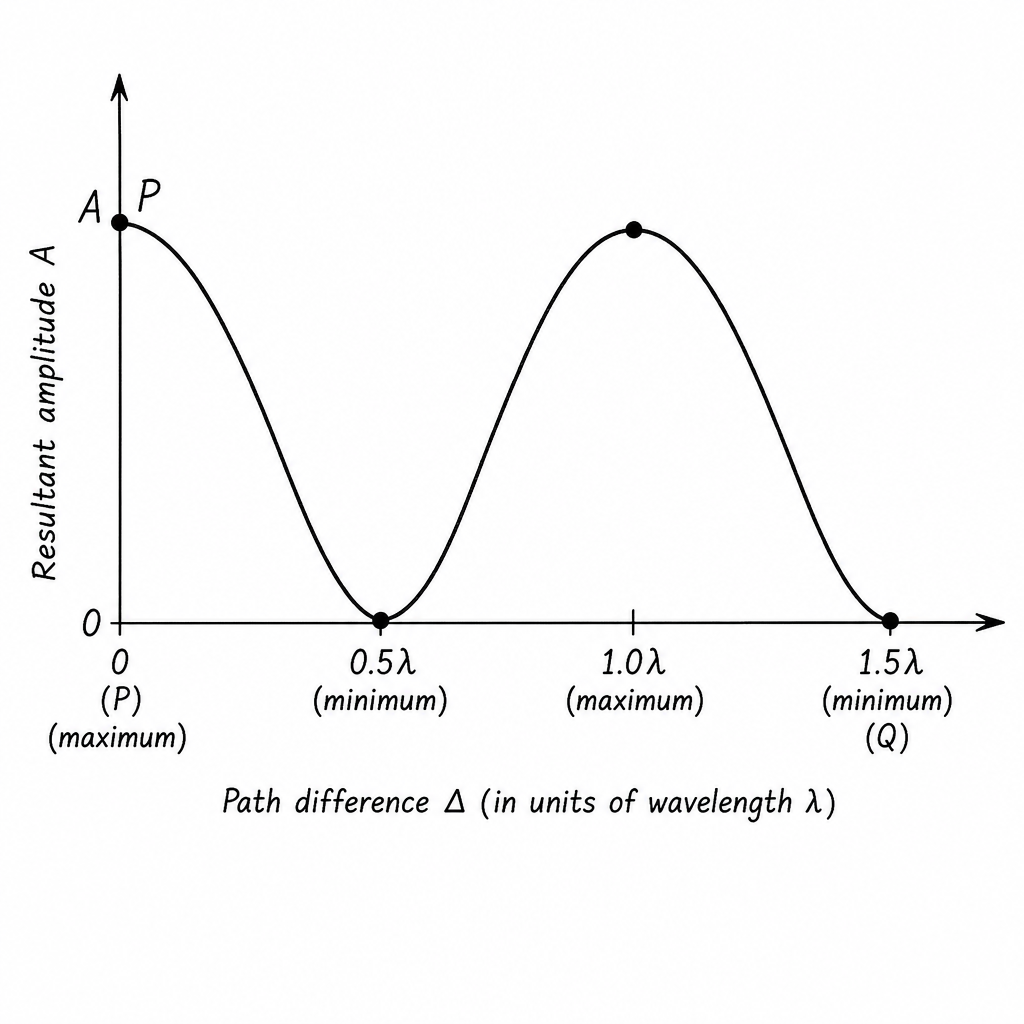
Describe the changes to the amplitude of the waveform as the detector is moved from P to Q.
Answer
At , so path difference and the CRO waveform has maximum amplitude.
As the detector moves from to , the path difference increases, so the amplitude alternates between maxima and minima (constructive and destructive interference).
Since at the path difference is , the amplitude at is a minimum.
Amplitude is maximum at P, then alternates through maxima/minima, ending at a minimum at Q.
Background Concept
The CRO displays a voltage signal from the detector that is proportional to the resultant wave amplitude at the detector. For two coherent sources, the resultant amplitude depends on their phase difference.
As you move the detector through space, the path lengths from the two sources change, so the path difference changes, causing alternating:
- maxima when ,
- minima when .
Understanding the Question
- The detector starts at , where , so .
- It moves along the line from to .
- Earlier parts establish that at , the path difference is , and , so at .
You must describe how the CRO waveform amplitude changes as you move from to .
Approach
- Identify whether the starting point is a maximum or minimum (use path difference).
- Determine whether the end point is a maximum or minimum.
- State that as you move, you pass through alternating maxima and minima.
Step-by-Step Reasoning
At :
So is a constructive interference point → CRO amplitude is maximum.
Moving from towards increases the asymmetry in path lengths, so increases from up to .
The sequence of interference as increases from to is:
- at : maximum,
- at : minimum,
- at : maximum,
- at : minimum (this is ).
So the CRO amplitude falls from a maximum to a minimum, rises back to a maximum, then falls again to a minimum at .
Key Takeaways
- CRO amplitude tracks resultant wave amplitude.
- Moving the detector changes path difference, producing alternating constructive/destructive interference.
- Identify the endpoints using in units of .
Common Mistakes
- Saying amplitude “steadily decreases” (ignores alternating maxima/minima).
- Confusing intensity and amplitude: intensity changes more sharply because .
- Assuming Q is a maximum because it is “further away”.
Things to Be Careful About
- In real experiments, minima may not reach exactly zero due to unequal amplitudes or reflections, but the pattern is still alternating maxima/minima.
- Use the given wavelength to decide whether the endpoint is constructive or destructive.
State and explain the effect, if any, on the resistance of a filament wire in a lamp as the current in the wire decreases.
Answer
As the current decreases, the filament becomes cooler, so its resistance decreases (lower temperature (\Rightarrow) lower resistivity).
Resistance decreases (filament cools so resistivity falls).
Background Concept
A filament lamp is non-ohmic because its resistance depends on its temperature. The resistivity (\rho) of a metal increases with temperature, so the resistance
increases when the filament gets hotter.
The filament is heated mainly by electrical power
So changing current changes heating, which changes temperature, which changes resistance.
Understanding the Question
You are asked what happens to the resistance of the filament wire when the current decreases, and you must explain the cause.
Approach
- State whether (R) increases or decreases.
- Explain using: lower current (\Rightarrow) less heating power (\Rightarrow) lower temperature (\Rightarrow) lower resistivity (\Rightarrow) lower resistance.
Step-by-Step Reasoning
- When current decreases, the rate of electrical energy transfer to the filament decreases (from (P = I^2R) or (P=IV)).
- The filament temperature therefore falls.
- For a metal filament, a lower temperature means fewer lattice vibrations and less scattering of electrons, so resistivity (\rho) decreases.
- Since (R \propto \rho), the resistance decreases.
Key Takeaways
- Filament lamps are non-ohmic because (R) depends strongly on temperature.
- Decreasing current cools the filament, reducing (\rho) and hence (R).
Common Mistakes
- Saying resistance increases when current decreases (reverses the temperature argument).
- Using (R = V/I) without considering that (V) may also change; the key physics is the temperature dependence.
Things to Be Careful About
- The explanation must mention temperature (or heating) and the metal’s resistivity changing with temperature to secure the mark.
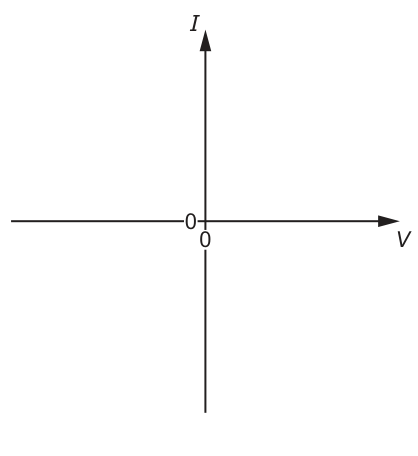
Answer
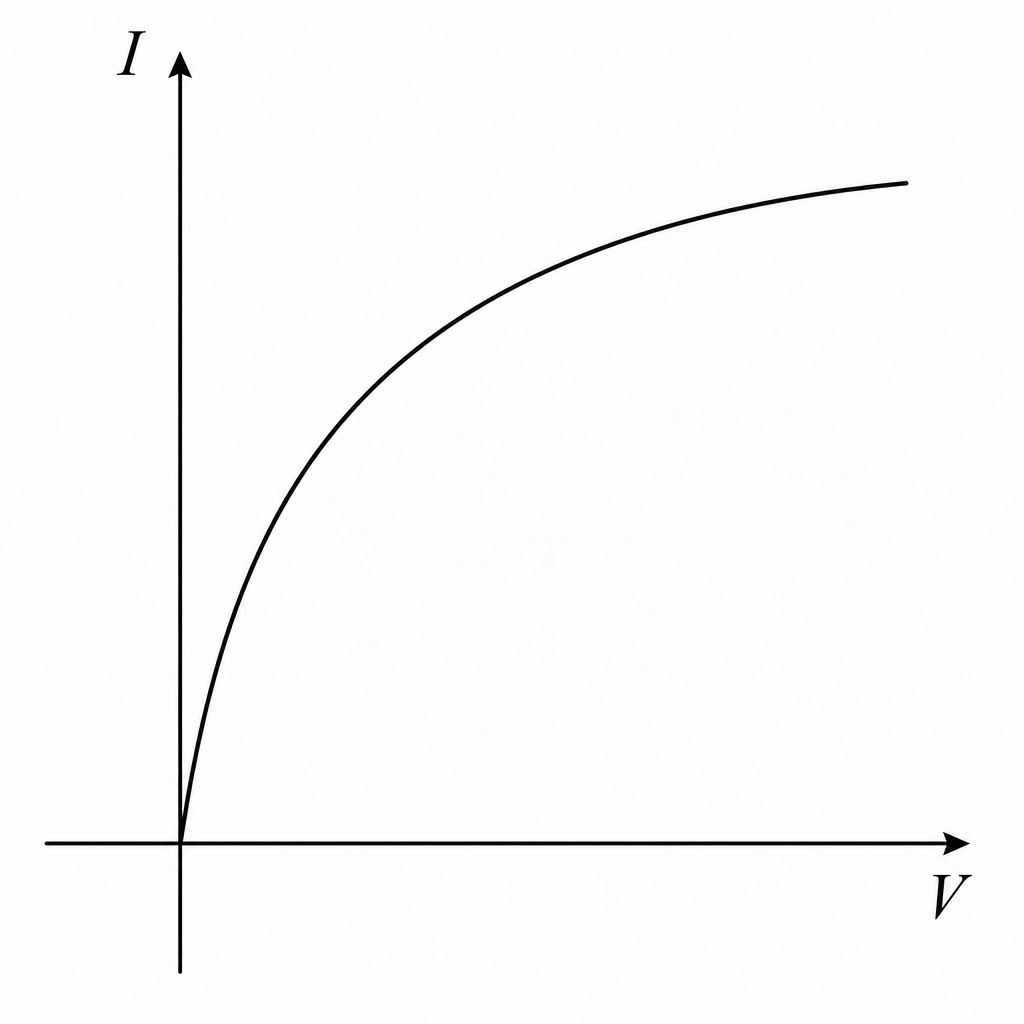
Curve through the origin that becomes less steep as (V) increases (decreasing gradient).
Non-linear curve through origin with decreasing gradient as V increases.
Background Concept
For an (I)-(V) graph, the gradient is
So:
- a steeper graph means smaller resistance,
- a shallower graph means larger resistance.
A filament lamp heats up as the voltage/current increase. Hotter filament (\Rightarrow) larger resistivity (\Rightarrow) larger resistance. Therefore the resistance increases at higher currents.
Understanding the Question
You must sketch the (I)-(V) characteristic for a filament lamp on given axes ((I) vertical, (V) horizontal). The key feature is that the lamp is non-ohmic, so the graph is not a straight line.
Approach
- Start at the origin (when (V=0), (I=0)).
- At small (V), filament is cool (\Rightarrow) low (R) (\Rightarrow) large gradient.
- As (V) increases, filament heats (\Rightarrow) (R) increases (\Rightarrow) gradient decreases.
Step-by-Step Reasoning
- Draw a curve that initially rises quite steeply from the origin.
- As (V) increases further, make the curve bend over so that it becomes less steep (concave down in the first quadrant).
- This represents the increasing resistance as the filament temperature increases.
Key Takeaways
- Filament lamp: non-linear (I)-(V) curve.
- Increasing (V) heats filament, increasing (R), so (I) rises more slowly: decreasing gradient.
Common Mistakes
- Drawing a straight line through the origin (that would be an ohmic conductor).
- Drawing a curve that becomes steeper with (V) (wrong direction of temperature effect for metals).
Things to Be Careful About
- The curve must pass through ((0,0)).
- If you draw only the first quadrant, ensure the shape clearly shows decreasing gradient with increasing (V).
A battery of electromotive force (e.m.f.) and negligible internal resistance is connected in parallel with two filament lamps A and B, as shown in Fig. 5.2.
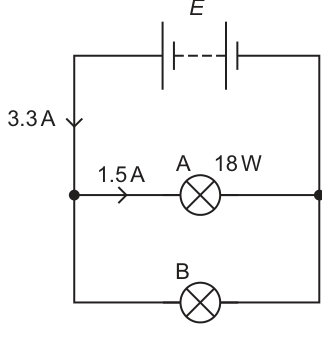
The current in the battery is and the current in lamp A is . The power dissipated in lamp A is .
Working
For lamp A,
In parallel with negligible internal resistance, supply e.m.f. (E) equals the p.d. across lamp A.
Answer
12 V
Background Concept
Electrical power transferred in a component is
where (I) is the current through the component and (V) is the potential difference across it.
In a parallel circuit, each branch is connected across the same two nodes, so the potential difference across each branch is the same as the supply potential difference. If the battery has negligible internal resistance, the terminal p.d. is essentially the e.m.f. (E).
Understanding the Question
Lamp A and lamp B are connected in parallel to a battery of e.m.f. (E) (internal resistance negligible). You are given for lamp A:
- current (I_A = 1.5\ \text{A})
- power (P_A = 18\ \text{W})
You must find (E).
Approach
- Use (P = IV) for lamp A to find the p.d. across it.
- Because the lamps are in parallel and internal resistance is negligible, set (E) equal to this p.d.
Step-by-Step Reasoning
- Apply (P = IV) to lamp A:
- In parallel, (V_A = E). Therefore (E = 12\ \text{V}).
Key Takeaways
- Use (P=IV) to find p.d. when power and current are known.
- In parallel circuits, all branches share the same p.d. as the supply.
Common Mistakes
- Using the total battery current (3.3 A) in (P=IV) for lamp A instead of (I_A).
- Forgetting that in parallel, (V_A) equals the battery voltage.
Things to Be Careful About
- The statement “negligible internal resistance” is the clue that terminal p.d. (\approx E).
- Keep units consistent: (\text{W} / \text{A} = \text{V}).
The filament wire of lamp B has a cross-sectional area of . The number of free (conduction) electrons per unit volume in the metal of the filament wire is .
Calculate the average drift speed of the free electrons in the filament wire of lamp B.
average drift speed = ______
Working
Current in lamp B:
Using (I = Anvq):
Answer
0.24 m s^-1
Background Concept
In a metal, the electric current is due to drifting conduction electrons. The current is related to drift speed by
where:
- (I) is current (A)
- (A) is cross-sectional area of the wire (m(^2))
- (n) is number density of free electrons (m(^{-3}))
- (v) is drift speed (m s(^{-1}))
- (q) is charge on each carrier (for electrons, (q = 1.6\times 10^{-19}\ \text{C})).
In a parallel circuit, currents add at a junction (Kirchhoff’s first law):
Understanding the Question
Two lamps A and B are in parallel. You are given:
- total current from the battery: (I_{\text{total}} = 3.3\ \text{A})
- current in lamp A: (I_A = 1.5\ \text{A})
- for lamp B filament: (A = 1.4\times 10^{-9}\ \text{m}^2), (n = 3.4\times 10^{28}\ \text{m}^{-3})
You must calculate the drift speed of electrons in lamp B, so you need (I_B) first, then use (I = Anvq).
Approach
- Use current conservation to find (I_B) from the total current.
- Rearrange (I = Anvq) to (v = I/(Anq)).
- Substitute values in SI units, including (q = 1.6\times 10^{-19}\ \text{C}), and calculate.
Step-by-Step Reasoning
- Find the current in branch B:
- Rearrange drift-current equation:
- Substitute:
So
Key Takeaways
- In parallel: currents split, and (I_{\text{total}} = I_A + I_B).
- Drift speed comes from (v = I/(Anq)); it is usually small because (n) is very large.
Common Mistakes
- Using (I = 3.3\ \text{A}) in (I = Anvq) instead of the branch current (I_B).
- Forgetting the electron charge (q = 1.6\times 10^{-19}\ \text{C}).
- Errors with powers of ten when multiplying (10^{-9}), (10^{28}), and (10^{-19}).
Things to Be Careful About
- (A) must be in (\text{m}^2) and (n) in (\text{m}^{-3}) (already given in SI here).
- Quote the final drift speed to 2–3 s.f. with unit (\text{m s}^{-1}).
- The negative charge of electrons does not affect the speed (a magnitude); direction would be opposite to conventional current if asked.
A battery of electromotive force (e.m.f.) and negligible internal resistance is connected in series with a variable resistor and a uniform resistance wire XY, as shown in Fig. 6.1.
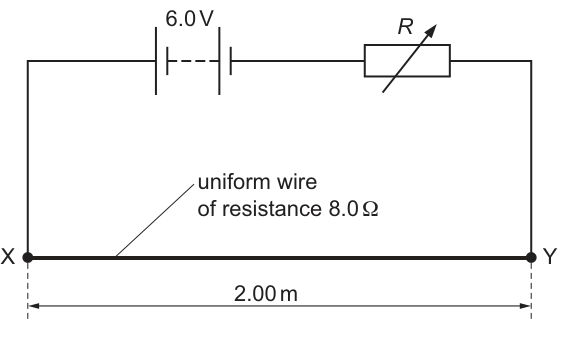
Wire XY has length and resistance . The resistance of the variable resistor is adjusted so that the potential difference across wire XY is .
Working
Resistance of wire XY and p.d. across it .
Total supply , so p.d. across variable resistor .
Answer
12 Ω
Background Concept
In a series circuit, the same current flows through every component. The potential differences (p.d.s) across components add to the supply e.m.f. (here internal resistance is negligible, so the terminal p.d. is ).
Ohm’s law for a component of resistance is
So if we know the p.d. across a component and its resistance, we can find the circuit current.
Understanding the Question
A ideal battery is connected in series with:
- a variable resistor of resistance (unknown), and
- a uniform resistance wire XY of resistance .
The p.d. across XY is adjusted to be . We must find .
Approach
- Use on wire XY to find the series current .
- Subtract the p.d. across XY from the supply to get the p.d. across .
- Use for the variable resistor.
Step-by-Step Reasoning
For wire XY:
Since it is a series circuit, also flows through the variable resistor.
The supply is , so
Then
Key Takeaways
- Series circuit: same current through each component.
- P.d.s add in series: .
- Use to link p.d., current, and resistance.
Common Mistakes
- Using as the p.d. across the variable resistor (forgetting is already across the wire).
- Treating the wire and resistor as if they were in parallel (they are in series).
- Arithmetic slip: must give .
Things to Be Careful About
- Internal resistance is stated negligible, so the full is available across the series combination.
- Quote the final resistance with appropriate significant figures (here is fine).
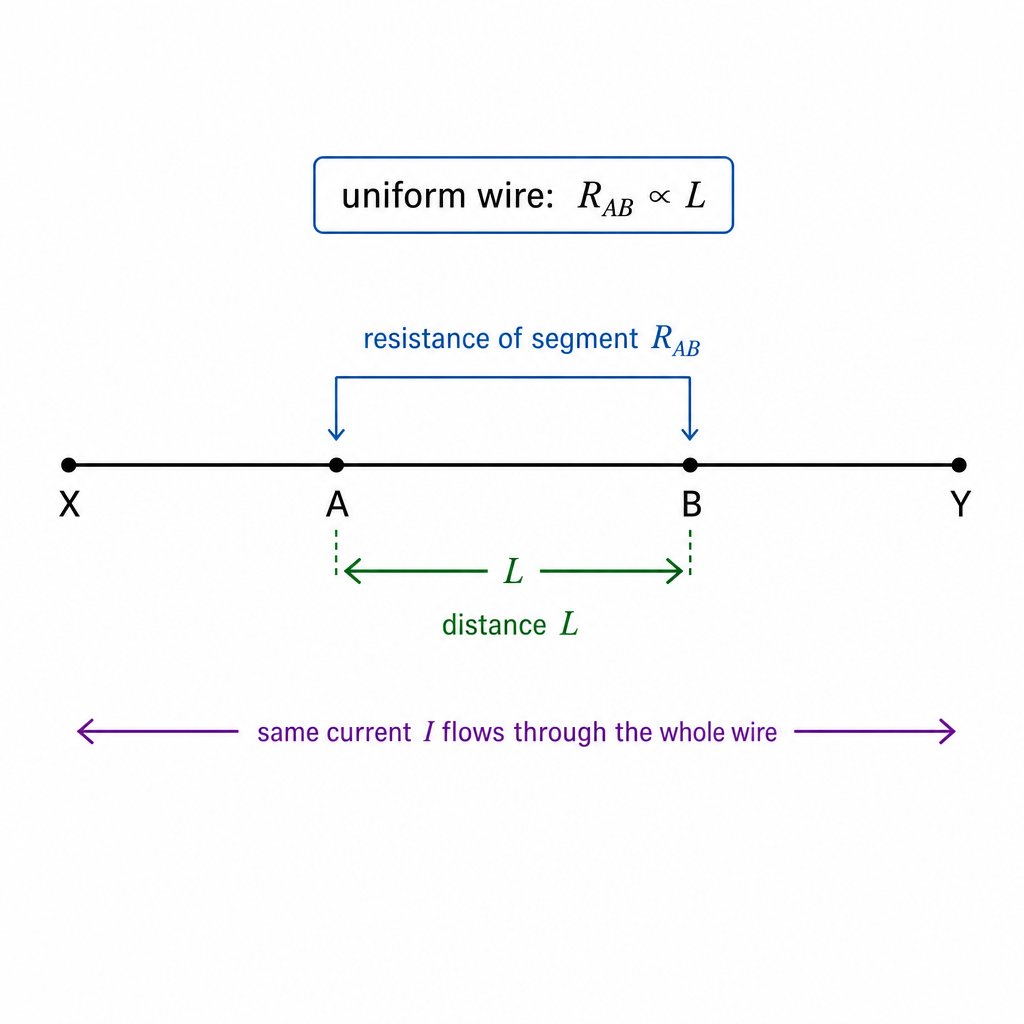
Explain why the potential difference between any two points on wire XY is proportional to the distance between those points.
Answer
For a uniform wire, cross-sectional area and resistivity are constant, so
In the wire, the current is the same through all sections, so
Hence for any section of the wire,
so the p.d. between two points is proportional to their separation along the wire.
Because the wire is uniform so R ∝ L and, with constant current, V = IR ⇒ V ∝ L.
Background Concept
A uniform resistance wire has constant resistivity and constant cross-sectional area . Its resistance depends on its length by
So for a uniform wire, .
If a steady current flows through the wire, the potential difference across any section of resistance is given by Ohm’s law:
If is the same throughout the wire (series path, no branches), then .
Understanding the Question
You are asked to justify the key potentiometer idea: along the uniform wire XY, the p.d. between two points depends linearly on how far apart those points are.
So we need to connect “distance along the wire” to “resistance of that piece” and then to “potential difference across that piece”.
Approach
- Consider a short section of the wire of length .
- Use to show that the section’s resistance is proportional to its length.
- Use with the same current through all sections to show .
Step-by-Step Reasoning
Take any two points on the wire, separated by distance .
Because the wire is uniform:
Since the wire is part of a series circuit, the current in the wire is the same through every section (no current is “used up” in earlier parts of the wire).
Applying Ohm’s law to just that section:
With constant for all sections, this gives
So the p.d. is proportional to the distance between the points.
Key Takeaways
- Uniform wire: .
- Same current through each section of a series conductor.
- Therefore makes p.d. proportional to length (constant potential gradient).
Common Mistakes
- Saying “voltage is shared equally” without the condition of equal lengths (it is shared in proportion to resistance, and resistance is proportional to length only for a uniform wire).
- Forgetting to mention constant cross-sectional area / resistivity when using .
- Confusing current and voltage: it is current that is the same in series, not voltage.
Things to Be Careful About
- The statement only holds if the wire is uniform (constant and ) and if the current is steady.
- If significant current is taken from a point on the wire (a “load” connected), the current in the wire would not be constant along its length and the linear relationship would no longer be exact.
A cell of e.m.f. and internal resistance is connected to the circuit, as shown in Fig. 6.2.
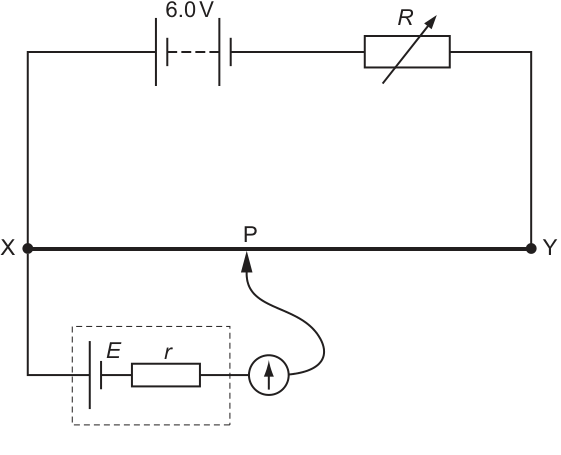
Resistance is unchanged.
The movable connection P is positioned on wire XY so that the galvanometer reading is zero. Distance XP is .
Working
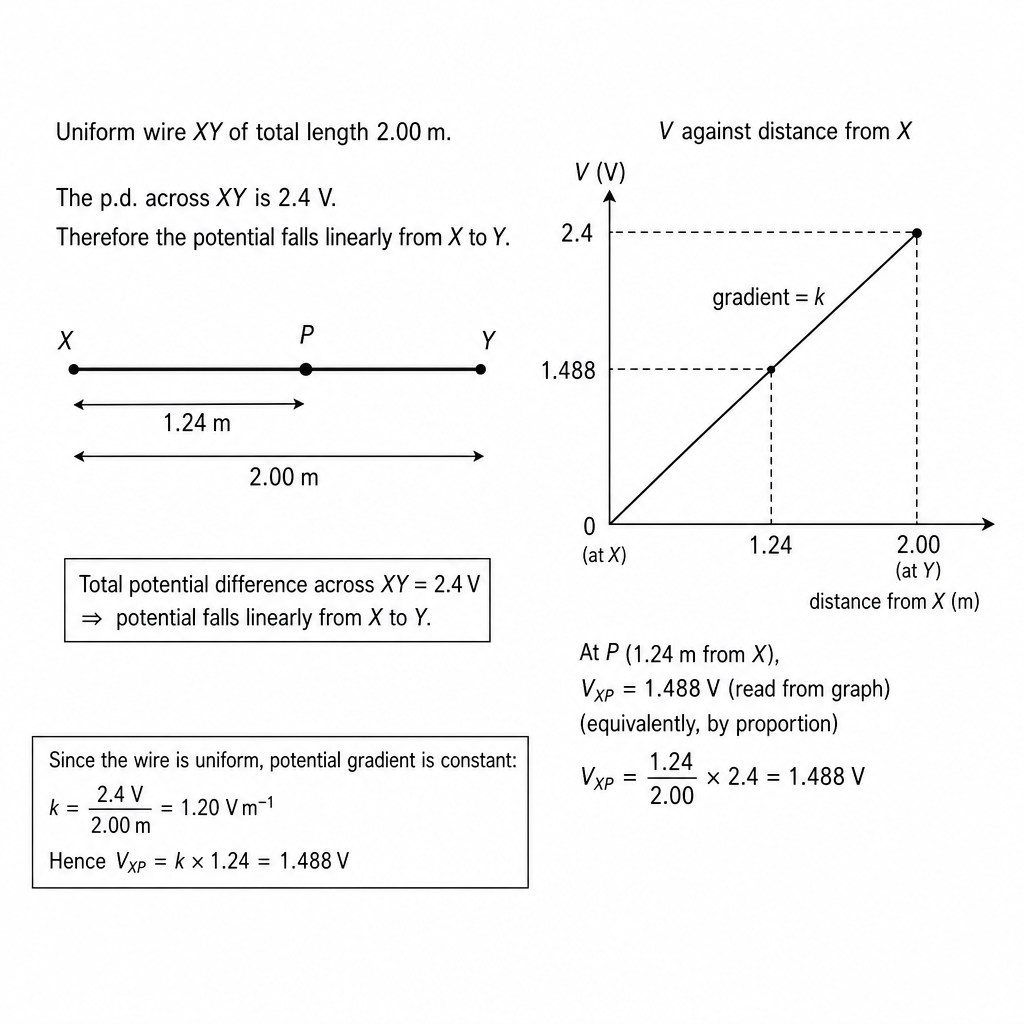
Potential gradient along XY:
At balance (galvanometer zero), :
Answer
1.49 V
Background Concept
A potentiometer uses a uniform wire carrying a steady current to create a uniform potential gradient (constant p.d. per unit length).
If the p.d. across the entire wire of length is , then the potential gradient is
For any point P at distance from X, the p.d. between X and P is
At the null point (galvanometer reading zero), no current flows in the secondary circuit, so the cell’s terminal p.d. equals its e.m.f. (because there is no voltage drop across its internal resistance). Therefore,
Understanding the Question
The main circuit is unchanged from earlier: wire XY still has a known p.d. across it. A test cell (e.m.f. , internal resistance ) is connected between X and a sliding contact P via a galvanometer.
When the galvanometer reads zero, P is at a balance position. You are told and must calculate .
Approach
- Find the potential gradient along XY using the given p.d. across the full wire and its length.
- Multiply by the balance length to get .
- Use the null condition to set .
Step-by-Step Reasoning
Across the full wire XY:
So the potential gradient is
At balance, with :
Because the galvanometer reads zero, no current flows through the test cell, so there is no drop inside it and its terminal p.d. equals its e.m.f. Hence
Key Takeaways
- Potentiometer null point: galvanometer zero means equals the p.d. across the corresponding wire length.
- Use a potential gradient for uniform wires.
- Internal resistance does not affect the result at null because current in the test circuit is zero.
Common Mistakes
- Using the full instead of the across the potentiometer wire.
- Forgetting that is needed to find the gradient.
- Thinking depends on here; at balance it does not.
Things to Be Careful About
- Ensure lengths are in metres if you want in .
- Rounding: can be quoted as (3 s.f.) or (2 s.f.); keep consistent with expected exam precision.
The value of is now decreased.
State and explain the change that must be made to the position of P on wire XY so that the galvanometer reads zero again.
Answer
Decreasing increases the current in the main circuit, so the p.d. across XY (and the potential gradient along the wire) increases.
Since at balance and is unchanged, a larger means must be smaller.
So P must be moved towards X (reduce ) to obtain zero galvanometer reading again.
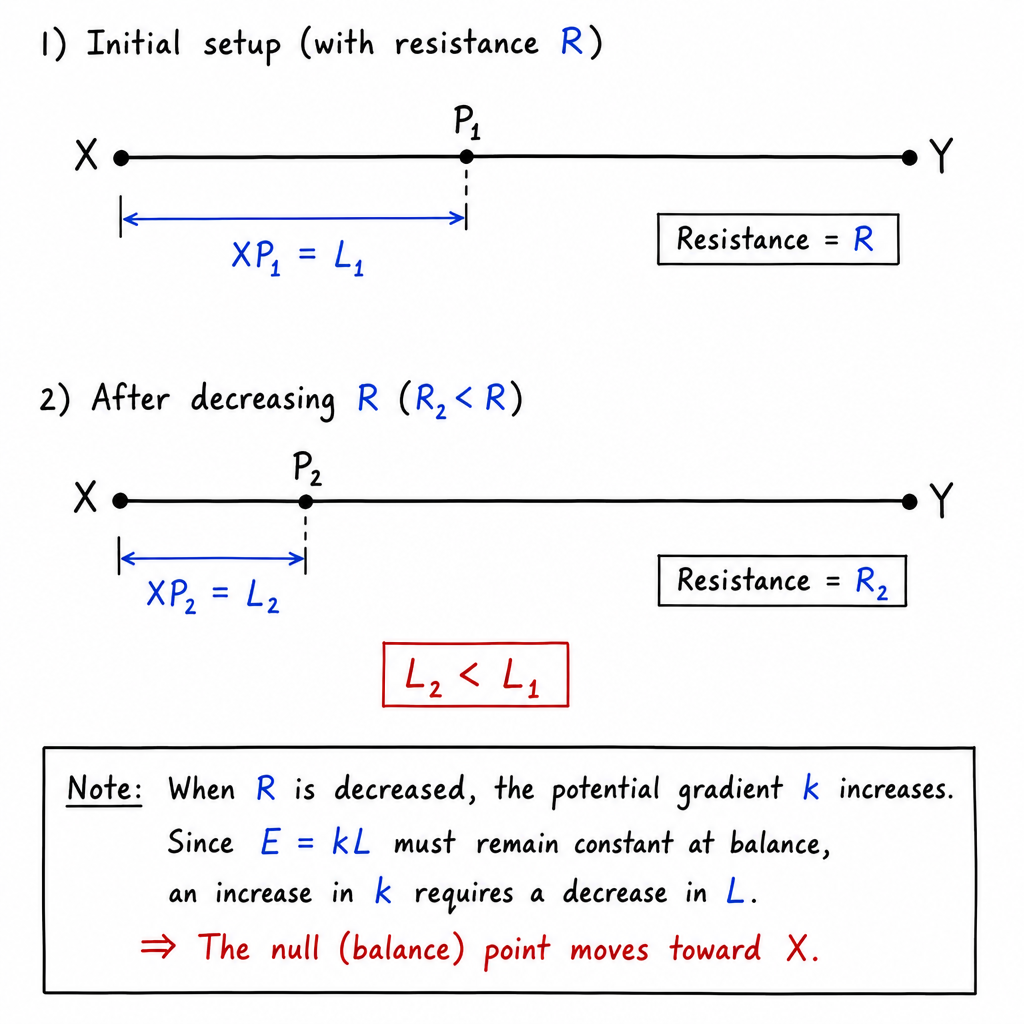
Move P towards X (smaller XP) because the potential gradient increases when R is decreased.
Background Concept
For the potentiometer wire, the p.d. per unit length (potential gradient) is
The p.d. across the wire is also
where is the main-circuit current and is fixed (wire resistance doesn’t change).
At the balance (null) point,
So if changes but the cell e.m.f. does not, the balance length must adjust inversely.
Understanding the Question
You reduce the variable resistor value in the main circuit while keeping the same supply and the same potentiometer wire XY.
You need to state what change to the slider position P is required to get the galvanometer back to zero, and explain why.
Approach
- Decide how reducing affects the main-circuit current .
- Use to decide how the p.d. across XY changes.
- Convert that into how the potential gradient changes.
- Use the balance condition to infer the required change in , hence the direction to move P.
Step-by-Step Reasoning
- The main circuit is a series circuit: supply, variable resistor , and wire XY.
- If is decreased, the total series resistance decreases.
Therefore the main current increases:
The resistance of the potentiometer wire is fixed ( constant), so the p.d. across the wire becomes larger:
Since is fixed, the potential gradient increases:
At balance,
is the property of the test cell and is unchanged. If increases, then to keep the same, must decrease.
So the contact P must move closer to X, reducing , until the p.d. across XP matches again.
Key Takeaways
- Reducing a series resistor increases current.
- Higher current through the potentiometer wire increases its potential gradient.
- Balance condition implies larger requires smaller balance length .
Common Mistakes
- Saying P must move towards Y (this would increase and make even bigger when has increased).
- Thinking the galvanometer reads zero when ; actually it reads zero when equals the cell e.m.f. in magnitude (with correct polarity).
- Forgetting that is unchanged by changing in the main circuit.
Things to Be Careful About
- The reasoning depends on the wire’s resistance being constant; heating could slightly change it in real life, but this is usually neglected at this level.
- Direction statement must be clear: “towards X” or “reduce ”.
Answer
1 electron
2 muon
electron; muon
Background Concept
Leptons are a family of fundamental particles that do not experience the strong nuclear force. They are not made of quarks.
Common leptons include:
- electron and positron
- muon and antimuon
- tau and antitau
- neutrinos (, , ) and antineutrinos (, etc.)
Understanding the Question
You are asked to state the names of two different leptons. Any two distinct leptons are acceptable (for example, electron and muon).
Approach
Select any two particles from the lepton list (charged leptons or neutrinos) and write their names.
Step-by-Step Reasoning
- Recall that electrons, muons, taus, neutrinos (and their antiparticles) are leptons.
- Choose two different ones.
- Write their names clearly.
For example: electron and muon.
Key Takeaways
- Leptons are fundamental particles (not made of quarks).
- Valid examples: , , , neutrinos and their antiparticles.
Common Mistakes
- Naming a hadron (e.g. proton, neutron, meson) as a lepton.
- Giving two names that refer to the same particle (e.g. writing “electron” twice).
Things to Be Careful About
- The question asks for two different leptons.
- Antiparticles (e.g. positron, antineutrino) are also leptons and are usually acceptable if named correctly.
In the following list, underline all the particles that are hadrons.
antineutrino beta-plus meson neutron
Answer
Hadrons: meson, neutron
meson and neutron
Background Concept
Hadrons are particles that experience the strong nuclear force and are made of quarks.
There are two main types:
- Baryons: made of three quarks (e.g. proton, neutron)
- Mesons: made of a quark and an antiquark
Leptons (e.g. neutrinos, electrons/positrons) are not made of quarks.
Understanding the Question
You are given the list:
- antineutrino
- beta-plus
- meson
- neutron
You must underline all particles that are hadrons.
Approach
Identify which entries are baryons or mesons (hadrons) and exclude leptons.
Step-by-Step Reasoning
- antineutrino: a lepton (specifically an antilepton) not a hadron.
- beta-plus: this is radiation, i.e. a positron (a lepton) not a hadron.
- meson: by definition, a hadron (quark + antiquark) underline.
- neutron: a baryon (three quarks) underline.
Key Takeaways
- Hadrons include baryons (like neutrons) and mesons.
- Neutrinos and positrons are leptons, not hadrons.
Common Mistakes
- Thinking “beta-plus” is a proton; it is actually a positron .
- Underlining antineutrino because it appears in nuclear reactions; it is still a lepton.
Things to Be Careful About
- “Meson” is a category name, not a specific particle name, but it is still a hadron.
- In A-level contexts, is explicitly the positron ().
Working
Proton composition is .
Up quark charge , down quark charge .
With ,
Answer
+1.6 × 10^-19 C
Background Concept
Quarks have fractional charges in multiples of the elementary charge :
- up-type quarks (, , ) have charge
- down-type quarks (, , ) have charge
A proton is a baryon made of three quarks, with composition .
The elementary charge is:
Understanding the Question
You must use the quark model of the proton to calculate its total charge and show that it equals . This is effectively showing that the proton has charge .
Approach
- Write the proton quark content ().
- Replace each quark by its charge in units of .
- Add the three charges to get the total in units of .
- Multiply by .
Step-by-Step Reasoning
- Proton quark composition:
- Charges of each quark:
- Total proton charge: Substitute:
- Add the fractions:
- Convert to coulombs using :
Key Takeaways
- Proton is .
- Add quark charges (in units of ) to get the hadron’s total charge.
- Proton total is .
Common Mistakes
- Using the wrong quark composition (e.g. writing , which is a neutron).
- Swapping the quark charges (writing as ).
- Forgetting to multiply by to convert from “in units of ” to coulombs.
- Missing the sign of the charge.
Things to Be Careful About
- Keep the elementary charge symbol separate from scientific notation (do not confuse it with “\times 10^”).
- Show the fractional-charge addition clearly; that is usually where the marks are.
- Final answer must include the unit and the positive sign is implied but may be written.