Physics 9702/23 — May/June 2025
Cambridge AS Level · AS Level Structured Questions · worked solutions for every part, with the mark scheme
Topics Work, Energy and Power · Dynamics · Waves · Kinematics · Forces, Density and Pressure · Deformation of Solids · +5 more
Answer
Velocity is the rate of change of displacement with time (speed in a given direction).
Velocity is the rate of change of displacement with time.
Background Concept
Velocity is a vector quantity that describes how fast an object’s displacement changes.
The average velocity is
and the instantaneous velocity is
Here, is displacement (a vector component along a line), and is time.
Understanding the Question
You are asked to define velocity. For 1 mark, Cambridge typically wants the key idea: rate of change of displacement, and ideally the idea that it includes direction.
Approach
Write a concise statement linking velocity to displacement and time, making clear it is not just speed.
Step-by-Step Reasoning
- Identify that “velocity” relates to displacement rather than distance.
- State that it is the rate of change of that displacement with respect to time.
- (Optional but helpful) Note that this implies a direction.
Key Takeaways
- Velocity uses displacement, not distance.
- Velocity is a vector (direction matters).
Common Mistakes
- Defining velocity as “distance travelled per unit time” (that is speed).
- Forgetting that velocity involves direction (vector nature).
Things to Be Careful About
- Use the word displacement in the definition to secure the mark.
- “Speed in a given direction” is acceptable wording, but “rate of change of displacement” is the most standard.
In an experiment, two objects A and B are released from the side of a building, as shown in Fig. 1.1.
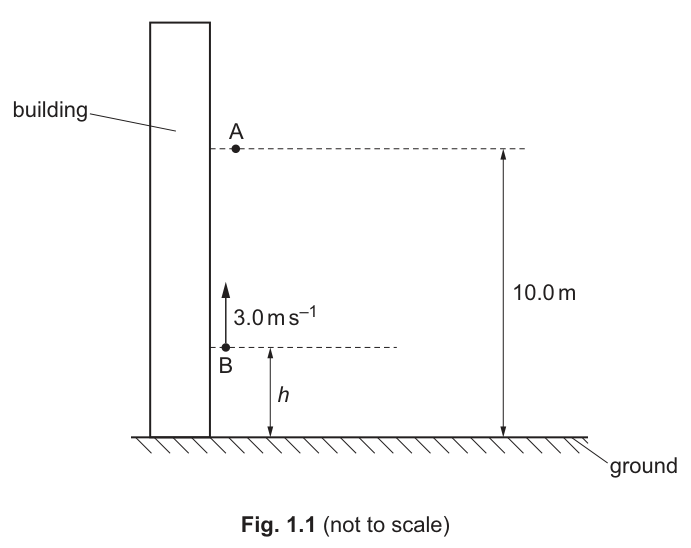
Object A is released from rest at a height of above horizontal ground.
Object B is released with an initial upward velocity of at a height above the ground.
Both objects take the same time to reach the ground and they do not collide with each other.
Air resistance is negligible.
Calculate .
= ______
Working
For A: , , .
For B: take downward as positive. , , .
With ,
Answer
5.7 m
Background Concept
For vertical motion with constant acceleration (free fall, negligible air resistance), we can use the SUVAT equation
where:
- is displacement along the chosen axis,
- is initial velocity,
- is acceleration (for free fall, magnitude ),
- is time.
A key idea here is that if two objects take the same time to reach the ground, we can find that common from one object and substitute into the other.
Understanding the Question
- Object A is dropped from rest from height .
- Object B is released from height with initial upward speed .
- They take the same time to hit the ground.
- Air resistance is negligible, so acceleration is constant downward.
We need to calculate .
Approach
- Find the time for object A to fall from rest.
- Use the same for object B, with its initial velocity, to find the height .
The cleanest method is to use for both objects with a consistent sign convention.
Step-by-Step Reasoning
1) Choose a sign convention
Take downward as positive so .
2) Object A (dropped from rest)
Apply SUVAT:
So
Using :
3) Object B (thrown upward initially)
Downward positive means an initial upward velocity is negative:
It falls from height to the ground, so the downward displacement is .
Apply SUVAT:
But from object A we already know
So
Substitute :
Key Takeaways
- Use one object to determine the common time, then substitute into the other equation.
- A consistent sign convention (upward positive or downward positive) avoids sign errors.
- For free fall with negligible air resistance, acceleration is constant .
Common Mistakes
- Taking while also taking downward as positive (sign inconsistency).
- Forgetting that for object A equals exactly, which simplifies the algebra.
- Rounding too aggressively before substituting, causing noticeable rounding error in .
Things to Be Careful About
- The displacement is the vertical drop to the ground: for A and for B.
- Use in and heights in .
- Give the final height to a sensible number of significant figures (here ).
In a second experiment, object B is released from the same height as in (b) but with a speed of at an angle of to the vertical, as shown in Fig. 1.2.
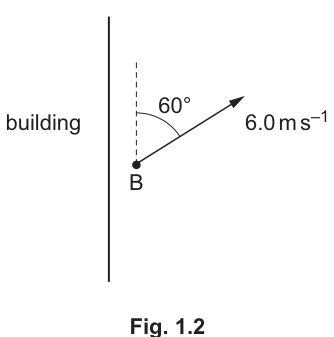
State and explain whether the time taken for object B to reach the ground is less than, the same as, or greater than the time taken in the first experiment.
Answer
The time is the same.
The initial vertical component is
u_y = 6.0\cos 60^\circ = 3.0\ \text{m s}^{-1}$$ which is the same as in the first experiment, and horizontal velocity does not affect the vertical motion/time to reach the ground.The same.
Background Concept
In projectile motion (neglecting air resistance):
- The horizontal motion has zero acceleration (constant horizontal velocity).
- The vertical motion has constant acceleration downward.
Crucially, the time taken to reach the ground depends only on the vertical motion, because the vertical displacement to the ground is achieved by the vertical component of velocity under vertical acceleration.
To compare situations, we often resolve the initial velocity into components:
Understanding the Question
Object B is released from the same height found in part (b), but now with speed at to the vertical.
You must state and explain whether the time to reach the ground is less than, the same as, or greater than in the first experiment (where B had an initial upward velocity of ).
Approach
- Resolve the velocity into its vertical component.
- Compare this vertical component to the initial vertical velocity in the first experiment.
- Use the fact that horizontal motion does not affect time of flight.
Step-by-Step Reasoning
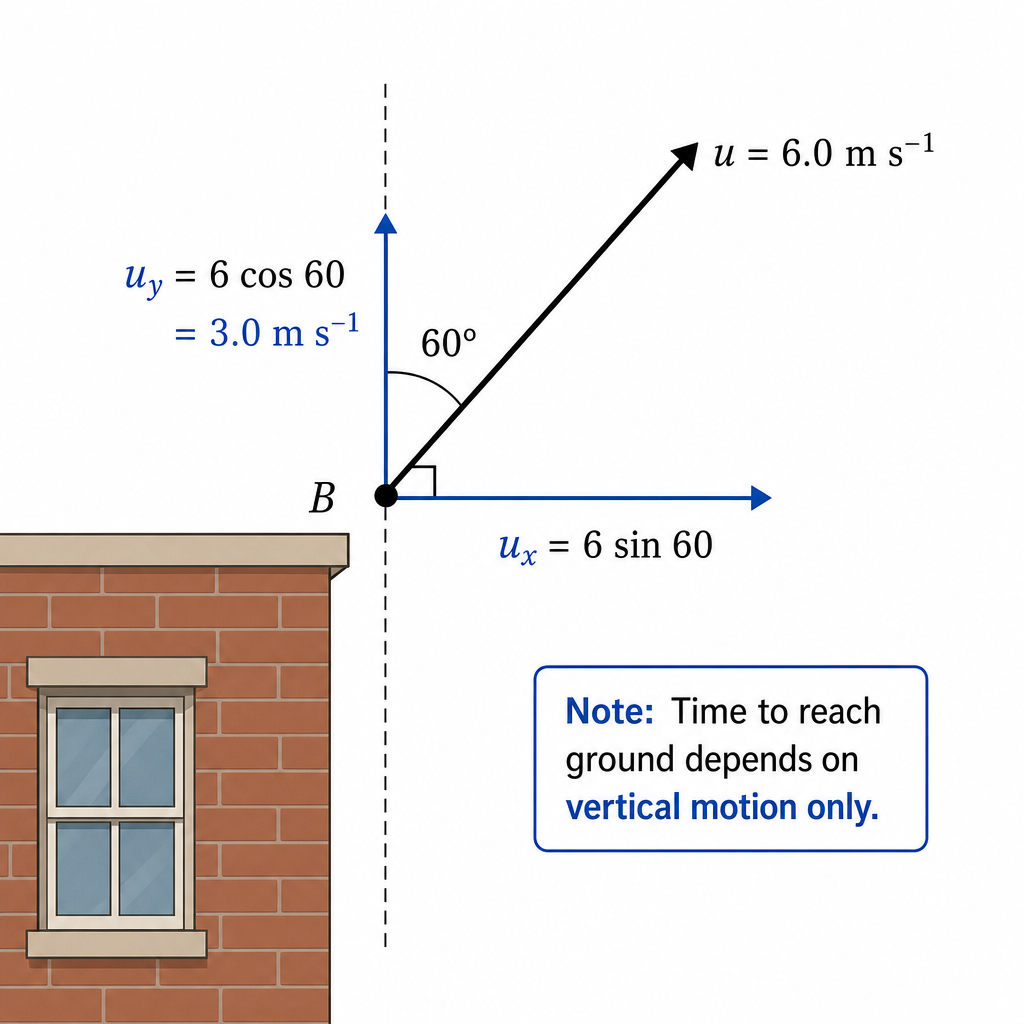
- The angle is given to the vertical, so the upward vertical component is
- Since ,
- In the first experiment, object B was released with initial upward velocity . So the initial vertical conditions are identical:
- same height ,
- same initial vertical velocity ,
- same vertical acceleration .
Therefore the vertical motion (and hence the time to reach the ground) is the same.
- The additional horizontal component only changes how far sideways B travels, not how long it takes to fall.
Key Takeaways
- Time of flight is determined by vertical displacement, vertical initial velocity, and .
- Horizontal and vertical motions are independent in projectile motion.
- Be careful about whether the angle is to the horizontal or to the vertical when resolving components.
Common Mistakes
- Using instead of (because the angle is to the vertical).
- Thinking that a larger total speed automatically means a shorter time (not true if the vertical component is unchanged).
Things to Be Careful About
- Always write down what the angle is measured from.
- State explicitly that horizontal velocity does not affect the vertical fall time; this is usually required for the explanation mark.
By considering energy, state and explain whether the speed at which object B reaches the ground is less than, the same as, or greater than in the first experiment.
Answer
Greater.
From energy conservation,
The height is the same in both experiments, so gained is the same, but in experiment 2 so the initial kinetic energy is larger than in experiment 1 where . Hence is larger in experiment 2.
Greater.
Background Concept
With negligible air resistance, mechanical energy is conserved:
Taking the ground as zero gravitational potential energy, an object dropped from height loses GPE and gains the same amount of KE.
Between release (initial) and impact (final):
where:
- is the initial speed,
- is the final speed at the ground.
Note: energy depends on speed squared, and does not care about direction of the velocity components — all components contribute to KE.
Understanding the Question
You compare experiment 1 (object B released upward at from height ) with experiment 2 (released at speed from the same height at an angle).
You must decide whether the speed at the ground is less, same, or greater in experiment 2, using energy reasoning.
Approach
- Use conservation of mechanical energy from release to ground.
- Recognise that is the same, so the change in GPE is the same in both experiments.
- Compare the initial kinetic energies: experiment 2 has larger initial speed, so larger initial KE.
- Conclude the final KE (and speed) must be larger in experiment 2.
Step-by-Step Reasoning
- Write energy conservation for each experiment:
-
Since is identical (same mass and same height), the only difference is the initial kinetic energy term.
-
Compare initial KE:
So
Therefore, the speed at the ground in the second experiment is greater.
Key Takeaways
- With negligible air resistance, use energy conservation to relate speeds and heights.
- If the drop height is the same, a larger initial speed means a larger final speed.
- KE depends on total speed, not just the vertical component.
Common Mistakes
- Using only the vertical component of speed in the energy equation (energy uses total speed).
- Thinking that because the vertical component in (c)(i) matches experiment 1, the final speed must also match (that is true for time, but not for KE because there is extra horizontal KE).
- Assuming the object “loses” horizontal kinetic energy (it does not; horizontal KE stays as KE if no air resistance).
Things to Be Careful About
- The phrase “By considering energy” indicates you should mention conservation of mechanical energy and compare KE and GPE.
- State clearly that is the same, so the GPE change is the same; this is the key comparison point.
Answer
The moment of a force about a pivot is the product of the force and the perpendicular distance from the pivot to the line of action of the force.
Moment = force × perpendicular distance from pivot to the force’s line of action.
Background Concept
A force can cause a turning effect (rotation) about a pivot. This turning effect is called the moment (or torque) of the force about that pivot.
For a force acting at a point, the moment about a pivot is
where is the perpendicular distance from the pivot to the line of action of the force.
Understanding the Question
You are asked to give the standard definition used in equilibrium/moments problems. The key phrase examiners look for is “force multiplied by perpendicular distance from the pivot to the line of action of the force”.
Approach
Write the definition in one sentence, ensuring you include:
- reference to a pivot,
- the line of action,
- perpendicular distance.
Step-by-Step Reasoning
- Identify that “moment about a pivot” refers to rotational effect.
- Use the definition .
- State clearly that must be the perpendicular distance to the line of action (not just distance to the point).
Key Takeaways
- Moment depends on both the force and how far it acts from the pivot.
- The distance must be perpendicular to the line of action.
Common Mistakes
- Saying “moment = force × distance” without specifying perpendicular.
- Measuring distance to the point of application instead of to the line of action.
Things to Be Careful About
- Always mention “about a pivot” and “perpendicular distance”; these are the mark-winning words.
Three objects A, B and C are placed on a horizontal beam. The beam is in equilibrium, as shown in Fig. 2.1.
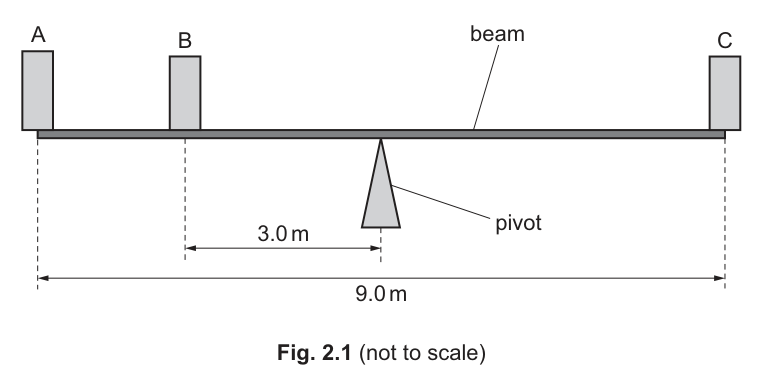
The beam is uniform and has length .
A pivot is at the midpoint of the beam.
Object A has mass and is at one end of the beam.
Object B has mass and is a distance of from the pivot.
Object C has mass and is at the other end of the beam.
Working
Taking moments about the pivot (beam weight acts at pivot so has no moment):
Answer
90 kg
Background Concept
For a rigid body in rotational equilibrium about a pivot:
- sum of clockwise moments about the pivot = sum of anticlockwise moments about the pivot.
Using , each moment is the force (often the weight ) multiplied by the perpendicular distance from the pivot.
If a force acts through the pivot, its moment is zero because .
Understanding the Question
A uniform beam of length is balanced on a pivot at its midpoint, so each end is from the pivot.
- Object A: at one end (left end in the diagram) .
- Object B: mass at from the pivot on the left side .
- Object C: at the other end (right end) .
The beam is uniform, so its own weight acts at its centre, which coincides with the pivot, so it produces no turning effect.
Approach
- Choose the pivot as the point about which to take moments (this removes any unknown reaction at the pivot).
- Write an equation equating clockwise and anticlockwise moments.
- Substitute distances and weights () and solve for .
Step-by-Step Reasoning
Take moments about the midpoint pivot.
- Clockwise moment is produced by the weight of C on the right.
- Anticlockwise moments are produced by the weights of A and B on the left.
So,
Cancel (it appears in every term):
Compute:
Key Takeaways
- For equilibrium, total clockwise moment equals total anticlockwise moment.
- Choosing the pivot as the moment point often eliminates unknown support forces.
- Forces through the pivot have zero moment.
Common Mistakes
- Using instead of for the end distances.
- Including the weight of the beam as a moment (it acts at the pivot so moment is zero).
- Forgetting that B is from the pivot (not from the end).
Things to Be Careful About
- Keep a consistent sign convention (clockwise vs anticlockwise) and stick to it.
- Use perpendicular distances; here the beam is horizontal and weights are vertical, so the perpendicular distance is just the horizontal distance shown.
Object A is removed and replaced by a wire fixed to the end of the beam and to the ground, as shown in Fig. 2.2.
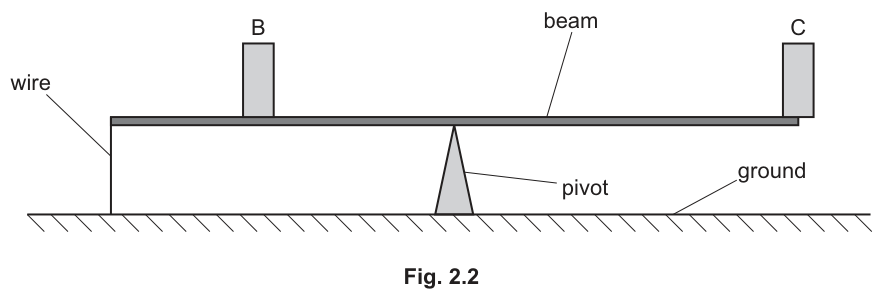
After the change, the beam is again horizontal and in equilibrium. The positions of B and C are unchanged.
The wire has a diameter of and has a strain of .
The wire is not extended beyond its limit of proportionality.
Calculate the Young modulus of the wire.
Young modulus = ______
Working
From (i), .
Take moments about the pivot:
Wire cross-sectional area:
Young modulus:
Using ,
Answer
Young modulus
2.9 × 10^11 Pa
Background Concept
1) Moments in equilibrium
A rigid body is in equilibrium when:
- net force is zero, and
- net moment about any point is zero.
In many beam problems, using moments about the pivot is efficient because the pivot reaction force has zero moment.
2) Young modulus
For a wire within its limit of proportionality,
Stress is force per unit area:
Strain is extension per original length, given here directly.
For a circular wire of diameter ,
Understanding the Question
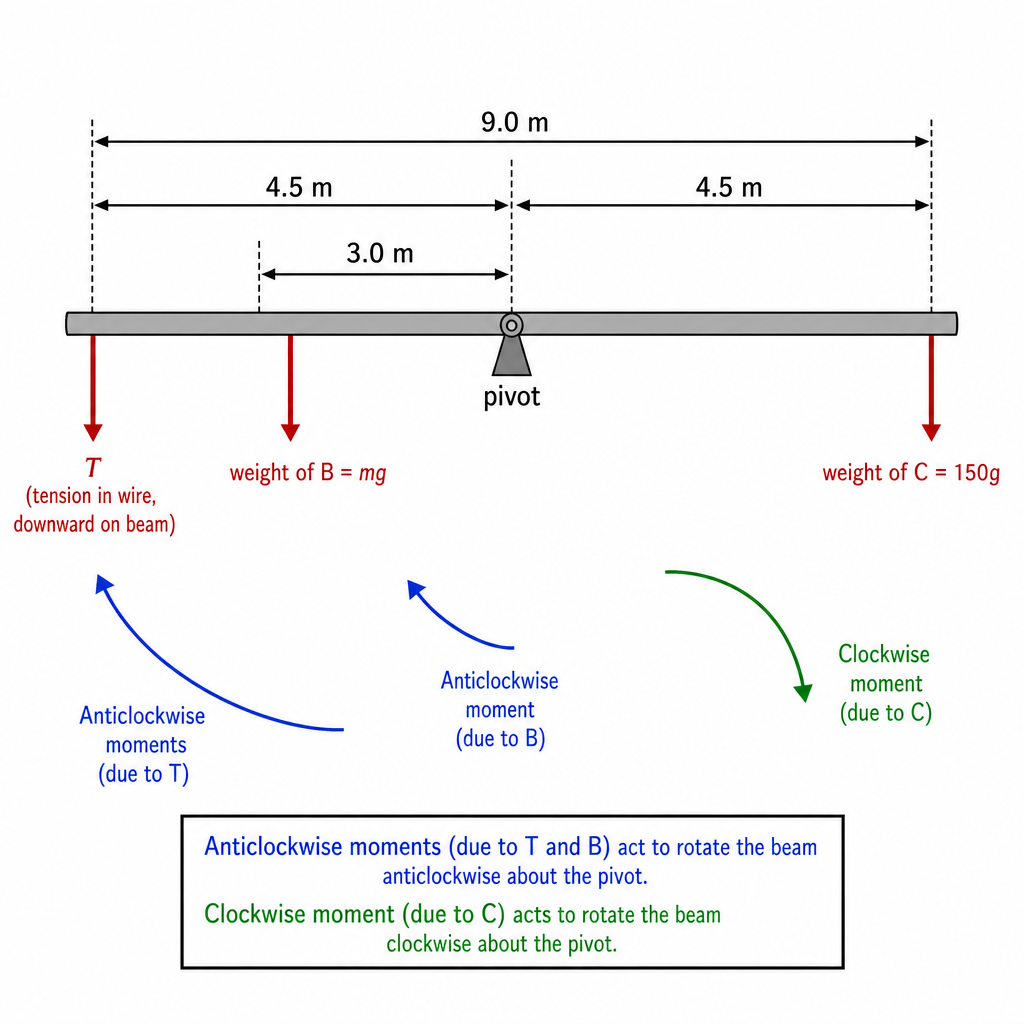
Object A is replaced by a vertical wire attached to the left end of the beam and to the ground. The beam is again horizontal and in equilibrium; objects B and C stay where they were.
So, instead of the weight of A producing a moment, the tension in the wire provides a force at the left end. Because the wire is connected to the ground below, the wire pulls downward on the beam (tension acts along the wire, away from the beam).
Given:
- diameter
- strain
- wire is within proportional region Hooke’s law behaviour is constant.
We must find .
Approach
- Use the principle of moments about the pivot to find the tension in the wire.
- Compute the wire’s cross-sectional area from its diameter.
- Compute stress .
- Divide by the given strain to obtain .
Step-by-Step Reasoning
Step 1: Find the tension using moments
Distances from pivot:
- left end:
- B: to the left
- C: to the right
Clockwise moment is due to C (right side). Anticlockwise moments are due to B and the wire tension at the left end.
Solve:
Step 2: Calculate area
Radius .
Step 3: Stress and Young modulus
Then
Key Takeaways
- Replace a weight on a beam with another force: you still use moments about the pivot to find that force.
- Young modulus links force and extension via stress and strain: .
- For circular wires, careful area calculation (radius is half the diameter) is essential.
Common Mistakes
- Assuming the wire pulls upward on the beam (it pulls down if it is connected to the ground below).
- Using as the radius in (forgetting to halve the diameter).
- Forgetting to divide by strain (giving stress instead of Young modulus).
- Using the full beam length as a moment arm for end forces instead of .
Things to Be Careful About
- The beam being uniform matters because its own weight acts at the pivot (zero moment).
- Keep units consistent: diameter must be in metres for in , giving in .
- Significant figures: the given data (e.g. , ) supports about 2 s.f. for .
Object B is now moved to a new position closer to the pivot without passing it. The beam is again horizontal and in equilibrium.
State and explain the effect, if any, that this has on the strain in the wire.
Answer
Strain increases.
Moving B closer to the pivot reduces its anticlockwise moment, so to balance the unchanged clockwise moment from C the wire must provide a larger moment, meaning the tension increases. Since the wire is within the proportional region, strain is proportional to stress (and hence tension), so the strain increases.
Strain increases.
Background Concept
For rotational equilibrium about the pivot:
A moment is . If a force stays the same but its distance from the pivot changes, its moment changes.
For a wire within its limit of proportionality:
- stress strain
- and stress .
So if the cross-sectional area is constant, then strain is proportional to the tension .
Understanding the Question
In the modified arrangement (with the wire), object C stays at the right end and object B stays on the left side but is moved closer to the pivot (without crossing it).
You must state and explain what happens to the strain in the wire.
Approach
- Decide what moving B does to the moment produced by B about the pivot.
- Use equilibrium of moments to infer how the wire tension must change to keep the beam horizontal.
- Use the fact that the wire is within the proportional region to link tension change to strain change.
Step-by-Step Reasoning
- The weight of C and its distance from the pivot do not change, so the clockwise moment from C is unchanged.
- B remains the same weight, but is moved closer to the pivot, so its distance decreases. Therefore its moment decreases.
- The total anticlockwise moment must still equal the (unchanged) clockwise moment. Since B now contributes less anticlockwise moment, the wire must contribute more anticlockwise moment.
- The wire’s moment is because it acts at the end of the beam. The distance is unchanged, so the only way for to increase is for to increase.
- Stress in the wire is , and is unchanged, so stress increases.
- Within the proportional limit, strain stress, so the strain increases.
Key Takeaways
- Moving a load closer to the pivot reduces its moment.
- If the opposing moment must stay the same, another force (here the wire tension) must increase.
- In the linear elastic region, increased tension means increased strain.
Common Mistakes
- Saying the strain decreases because B is “closer” (it is the moment balance that matters, not closeness alone).
- Forgetting that the clockwise moment from C is unchanged.
- Claiming strain is unchanged because the wire’s length is unchanged (strain refers to extension relative to original length; here extension changes because tension changes).
Things to Be Careful About
- The phrase “without passing it” means B stays on the same side of the pivot, so its moment keeps the same rotational sense (still anticlockwise), only its magnitude changes.
- The proportionality statement is only valid because the question states the wire is not extended beyond its limit of proportionality.
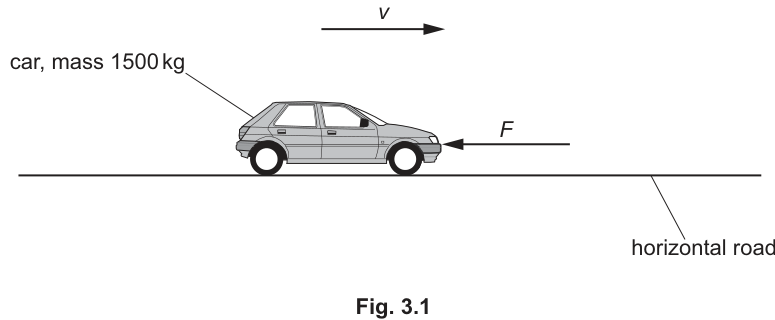
A car of mass is travelling along a straight horizontal road at constant velocity . The car is subject to a total resistive force , as shown in Fig. 3.1.
Show that the power developed by the engine in overcoming the total resistive force is given by the equation
Working
Power:
Work done against resistive force over distance :
So
But , hence
Answer
P = Fv
Background Concept
Power is the rate at which work is done (or energy is transferred).
If a constant force acts in the direction of motion and the object moves a distance , the work done by that force is
Speed is distance per unit time:
Understanding the Question
The engine is providing a driving force that balances the total resistive force while the car moves at constant velocity on a horizontal road. The question asks you to show (derive) the expression for the engine power needed to overcome the resistive force.
Approach
Connect power to work done per unit time. The work done in overcoming a resistive force over some distance is . Divide by the time taken, then recognise that is the speed .
Step-by-Step Reasoning
- Start from the definition of power:
- The resistive force opposes motion; to maintain constant speed, the engine must do work against this force. Over a distance , work done against a constant force is:
- Substitute into the power definition:
- Group as , and use :
Key Takeaways
- Use and for constant forces.
- Recognise as the speed , giving .
Common Mistakes
- Using (inverting incorrectly).
- Mixing up distance with displacement in a different direction than the force (here force and motion are along the same line).
Things to Be Careful About
- applies when the force is along the direction of motion (here, the resistive force is opposite the velocity, so the engine supplies an equal forward force in magnitude).
- Units check: gives .
The car now moves up a slope at a constant speed of .
The slope is at an angle to the horizontal of , as shown in Fig. 3.2.
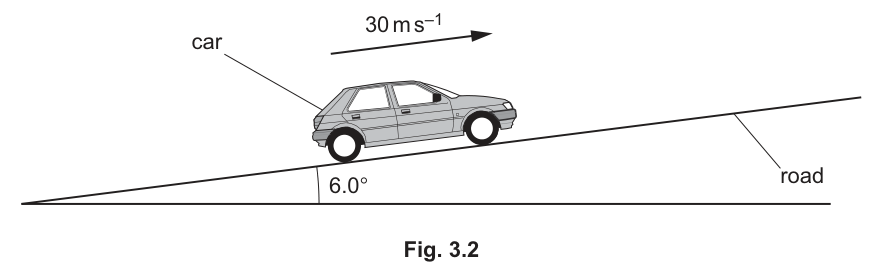
The total resistive force acting on the car is .
Working
Distance moved along slope in :
Vertical height gained:
Increase in GPE:
Answer
(in ).
46000 J
Background Concept
Gravitational potential energy (GPE) increases when an object gains height in a gravitational field:
where is mass and is gravitational field strength. On a slope, the car’s movement is along the slope, but only the vertical component of that movement contributes to the height gained.
If the car travels distance up a slope at angle to the horizontal, the vertical height gained is:
Understanding the Question
The car moves up a slope at constant speed . In a time of , you must find how much its GPE increases. You are given the mass and can take .
Approach
- Find the distance travelled along the slope in using .
- Convert that slope distance into a vertical height using .
- Substitute into .
Step-by-Step Reasoning
- Distance up the slope in :
- Height gained is the vertical component of this displacement:
Numerically, , so .
- Increase in GPE:
This rounds to as required.
Key Takeaways
- On a slope, height gained is , not .
- Then use .
Common Mistakes
- Using (wrong component).
- Forgetting to multiply by time when finding distance ().
- Using without being consistent with expected rounding.
Things to Be Careful About
- Angle is to the horizontal, so the vertical component of the slope distance uses .
- Keep units consistent: in kg, in m, in to get joules.
Use the information in (b)(i) to determine the power developed by the engine to move the car up the slope.
power = ______
Working
Power to overcome resistive force:
From (b)(i), increase in GPE in is , so
Total engine power:
Answer
9.4 × 10^4 W
Background Concept
Power is the rate of energy transfer:
For motion at constant speed with a force in the direction of motion, the rate of doing work against that force is:
When a car climbs a hill at constant speed, the engine must supply energy per second for two main purposes:
- to increase the car’s gravitational potential energy (gain height),
- to overcome resistive forces (air resistance + friction etc.).
Understanding the Question
The car climbs at constant speed up a slope. The total resistive force is . From part (b)(i), the car gains of GPE every . We need the total engine power output.
Approach
Calculate two powers and add them:
- Resistive power: .
- Power used to gain height: .
Since speed is constant, the engine’s power output must supply both rates of energy transfer.
Step-by-Step Reasoning
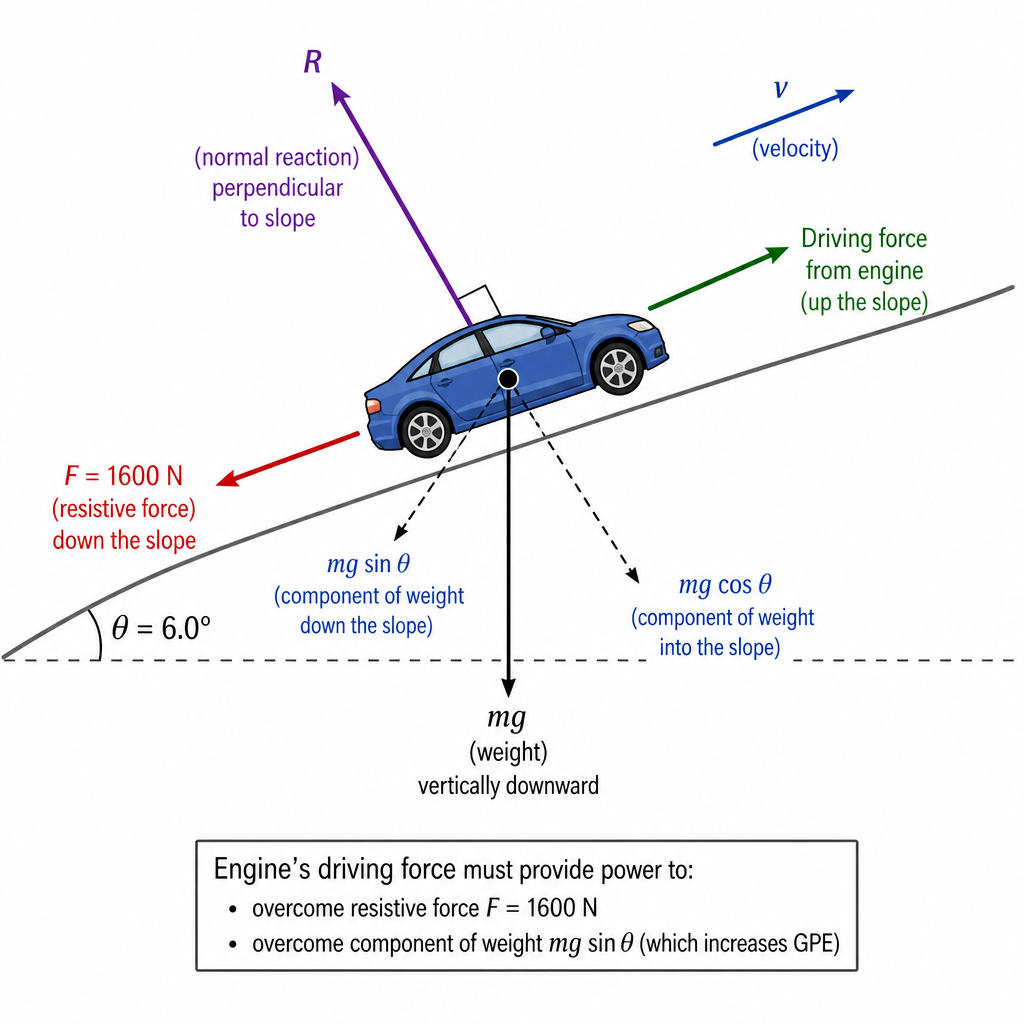
- Resistive forces remove energy at a rate
Substitute and :
- The car’s GPE increases by in . That is an energy gain per second, so the corresponding power is:
- Total power supplied by the engine is the sum:
Key Takeaways
- Total engine power on a hill at constant speed = (power against resistance) + (rate of increase of GPE).
- Use and appropriately.
Common Mistakes
- Using only with the resistive force and forgetting the power needed to gain GPE.
- Treating as the final power (forgetting to divide by time, though here makes it numerically the same).
- Mixing up the resistive force with the component of weight down the slope.
Things to Be Careful About
- Constant speed means no change in kinetic energy, but it does NOT mean no power is needed.
- Ensure the resistive force given is already the total resistive force (so you do not add another friction term).
- Keep consistent significant figures; is appropriate here.
The car picks up a passenger and then continues up the slope at the same speed as in (b).
State and explain the effect, if any, that the passenger has on:
Answer
No effect (approximately): at the same speed and with the same shape/frontal area, the air resistance is unchanged.
No change (approximately).
Background Concept
Air resistance (drag) depends mainly on the car’s speed relative to the air and its shape/frontal area (and air density). For many road speeds, a common model is
Mass does not directly appear in the drag force.
Understanding the Question
A passenger is added, increasing the mass of the car, but the car continues up the slope at the same speed as before. The question asks whether the passenger affects the air resistance.
Approach
Decide what air resistance depends on. If speed and the external shape/area of the car are unchanged, then the air resistance is unchanged.
Step-by-Step Reasoning
- Adding a passenger increases the weight (mass) but does not change the car’s speed (given) or (typically) its frontal area/shape.
- Therefore the air resistance force at that speed stays the same (to a good approximation).
Key Takeaways
- Drag depends on speed and geometry, not on mass.
Common Mistakes
- Saying air resistance increases because the car is “heavier”. Weight affects rolling resistance and the component of weight on the slope, not aerodynamic drag.
Things to Be Careful About
- In real life, a passenger might slightly change ride height or open windows etc., which could alter drag, but exam answers assume no change in shape/frontal area unless stated.
Answer
Power increases: the passenger increases the mass, so the component of weight down the slope () is larger and the rate of gain of GPE is larger; at the same speed a larger driving force is needed, so is larger.
Power increases.
Background Concept
When climbing a slope at constant speed, the engine must supply energy per second to:
- overcome resistive forces,
- increase gravitational potential energy.
The rate of increase of GPE is
Also, at constant speed, required power associated with a required forward (driving) force along the slope is
Understanding the Question
A passenger increases the car’s mass, but the car continues up the same slope at the same speed as in (b). You must state and explain what happens to the engine power.
Approach
At fixed speed, power is proportional to the driving force required. Increasing mass increases the component of weight down the slope and increases the GPE gained per second, so the engine must supply more power.
Step-by-Step Reasoning
- Speed is unchanged, so if the required driving force increases, engine power must increase because .
- Adding a passenger increases mass .
- The downslope component of weight is , so it increases with .
- The car also gains height at the same rate (same speed up the slope), so the GPE gained each second is proportional to :
- Therefore the engine must provide a greater rate of energy transfer, so the power developed increases.
Key Takeaways
- At constant speed on a hill, engine power is set by the total opposing force and the speed.
- Increasing mass increases the opposing gravitational component and the power needed to gain GPE.
Common Mistakes
- Saying power is unchanged because speed is unchanged (ignores that the required force changes).
- Claiming air resistance increases due to mass (it does not, if speed and shape are unchanged).
Things to Be Careful About
- Constant speed means net force is zero, but the driving force must still balance all opposing forces.
- If the question had said the engine power stays the same, then speed would have to decrease; here it states speed is the same, so power must increase.
Answer
The total momentum of a system remains constant (momentum before = momentum after) provided no resultant external force acts on the system (system is isolated).
Total momentum remains constant provided no resultant external force acts.
Background Concept
Momentum is defined by
where is mass and is velocity.
Newton’s second law can be written as
If the resultant external force on a system is zero, then , so the total momentum of the system cannot change.
Understanding the Question
You are asked to state (not calculate) the principle. That means you should give the core statement and the condition under which it applies (usually worth the second mark): no resultant external force on the system.
Approach
Write a single clear sentence:
- “total momentum is constant” (or “momentum before equals momentum after”), and
- the condition: “isolated system / no resultant external force”.
Step-by-Step Reasoning
- Conservation means a quantity stays the same.
- Momentum is conserved for a system only when external influences do not provide a net force (otherwise external impulse changes momentum).
- Therefore, state that total momentum before an interaction equals total momentum after, provided the system is isolated (no resultant external force).
Key Takeaways
- Momentum conservation is about the total momentum of the system, not individual objects.
- The required condition is zero resultant external force (isolated system).
Common Mistakes
- Saying “momentum is always conserved” without stating the condition.
- Referring to “forces between the objects are equal” (Newton’s third law) but not concluding total momentum is constant.
- Writing about kinetic energy conservation (that is only for elastic collisions).
Things to Be Careful About
- Use the word total momentum.
- Include the condition “no resultant external force” (or “isolated system”).
An object A of mass travels at a velocity of to the right on a horizontal frictionless surface. It moves towards a second object B of mass that is moving at a velocity of in the same direction as A, as shown in Fig. 4.1.
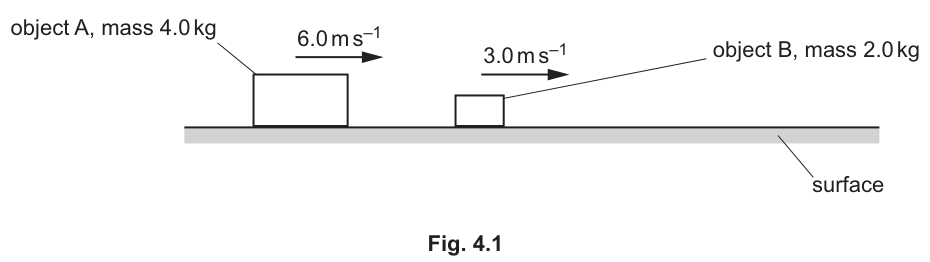
Object A collides with object B. The two objects join and move off together with velocity .
Working
Take right as positive.
Initial momentum:
Final momentum (joined mass ):
Conservation of momentum :
Answer
5.0 m s⁻1
Background Concept
For a collision in one dimension (straight line), if the system is isolated (no resultant external force), total momentum is conserved:
Momentum is . When objects join together after impact, the collision is perfectly inelastic: momentum is still conserved, but kinetic energy is not.
Understanding the Question
Object A () moves right at and catches object B () moving right at . After they collide, they stick together and move with a common speed .
You need to find that common speed using momentum conservation.
Approach
- Choose a positive direction (right is easiest).
- Calculate total initial momentum: .
- After collision the combined mass is with speed , so final momentum is .
- Set initial momentum = final momentum and solve for .
Step-by-Step Reasoning
Choose right as positive.
Initial momentum:
Substitute values:
After collision they stick, so total mass is
Final momentum:
Conservation of momentum gives:
The value is between and , which makes physical sense: after sticking together, the speed should lie between the two initial speeds.
Key Takeaways
- For an isolated system, momentum before = momentum after.
- If objects stick together, treat them as one mass after collision.
- A quick check: the final speed should lie between the initial speeds (when both move in the same direction).
Common Mistakes
- Adding masses incorrectly (using or using only one mass in ).
- Using kinetic energy conservation (not valid when they stick).
- Sign errors if choosing left as positive or if one object were moving opposite (not the case here).
Things to Be Careful About
- Keep a consistent sign convention (right positive).
- Use the correct unit for momentum () and for velocity ().
- Sticking together implies one final velocity for the combined mass.
the percentage of the total initial kinetic energy of the two objects that is transferred to other forms of energy during the collision.
percentage = ______
Working
Initial total kinetic energy:
After collision (, total mass ):
Energy transferred to other forms:
Percentage transferred:
Answer
7.4 %
Background Concept
Kinetic energy is
In collisions:
- Momentum is conserved if there is no resultant external force.
- Kinetic energy is conserved only in elastic collisions.
If objects stick together, the collision is perfectly inelastic, so some kinetic energy is converted into other forms (internal energy/heat, sound, deformation).
Understanding the Question
You are asked for the percentage of the total initial kinetic energy that is transferred to other forms during the collision.
So you must:
- find total initial of both objects,
- find final of the combined object moving at speed (from part (i)),
- calculate the loss ,
- express this loss as a percentage of .
Approach
- Compute by adding for A and B.
- Compute using the combined mass and the common velocity .
- Percentage transferred:
Step-by-Step Reasoning
1) Initial kinetic energy
For A:
For B:
Total initial kinetic energy:
2) Final kinetic energy
After collision they move together. Total mass:
From part (i), , so
3) Energy transferred to other forms
4) Percentage transferred
Key Takeaways
- Perfectly inelastic collision: momentum conserved, kinetic energy decreases.
- “Transferred to other forms” means the loss in kinetic energy.
- Percentage loss is always relative to the initial kinetic energy.
Common Mistakes
- Using the final kinetic energy divided by the initial kinetic energy (that gives percentage remaining, not percentage transferred).
- Forgetting to add both objects’ initial kinetic energies.
- Using without first obtaining it from momentum conservation.
- Treating the loss as negative (you should report a positive percentage transferred away from kinetic energy).
Things to Be Careful About
- Use (square the speeds correctly).
- Keep enough significant figures during the working so the final percentage rounds correctly (here to ).
- Ensure you use the combined mass for the final kinetic energy.
Answer
Sound waves are longitudinal, so the vibrations are parallel to the direction of travel and there is no transverse plane of oscillation to restrict (so they cannot be polarised).
Sound waves are longitudinal, so there is no transverse plane of oscillation to restrict; hence sound cannot be polarised.
Background Concept
Polarisation is a property of transverse waves. A transverse wave vibrates in directions perpendicular to the direction it travels, so there are many possible directions (planes) in which the oscillations could occur.
A polariser works by allowing only oscillations in one direction (along its transmission axis). This only makes sense if the wave has oscillations perpendicular to its direction of travel.
Sound in air is (to A-level standard) a longitudinal wave: the particle displacements/pressure variations are parallel to the direction of propagation.
Understanding the Question
The question asks for the reason sound waves cannot be polarised. So we must connect (i) what “polarised” means to (ii) the nature of sound waves.
Approach
State that only transverse waves can be polarised, then state that sound is longitudinal (oscillations along the direction of travel), so there is no perpendicular direction/plane to “select”.
Step-by-Step Reasoning
- Polarisation means restricting the oscillations of a wave to one plane/direction perpendicular to propagation.
- Sound waves in air are longitudinal, so their oscillations are along the line of travel.
- Therefore there is no transverse oscillation direction to restrict, so sound cannot be polarised.
Key Takeaways
- Polarisation is only possible for transverse waves.
- Sound in air is longitudinal, so it is not polarisable.
Common Mistakes
- Saying “sound cannot be polarised because it is not electromagnetic” (not the reason).
- Saying “sound waves have no direction” (they do; but the oscillations are parallel to travel).
Things to Be Careful About
- In some solids, transverse (shear) waves can exist, but the standard statement for “sound waves” in air is longitudinal, hence not polarisable.
A plane-polarised light wave is incident on a polarising filter as shown in Fig. 5.1.
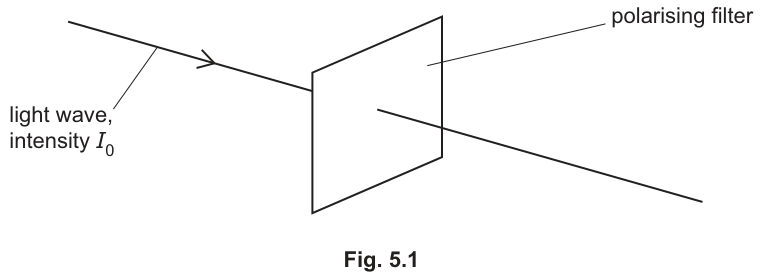
The intensity of the light incident on the filter is .
The light is incident normally on the filter and the transmission axis of the filter is initially perpendicular to the plane of polarisation of the light.
The filter is now rotated through about the direction of travel of the light wave.
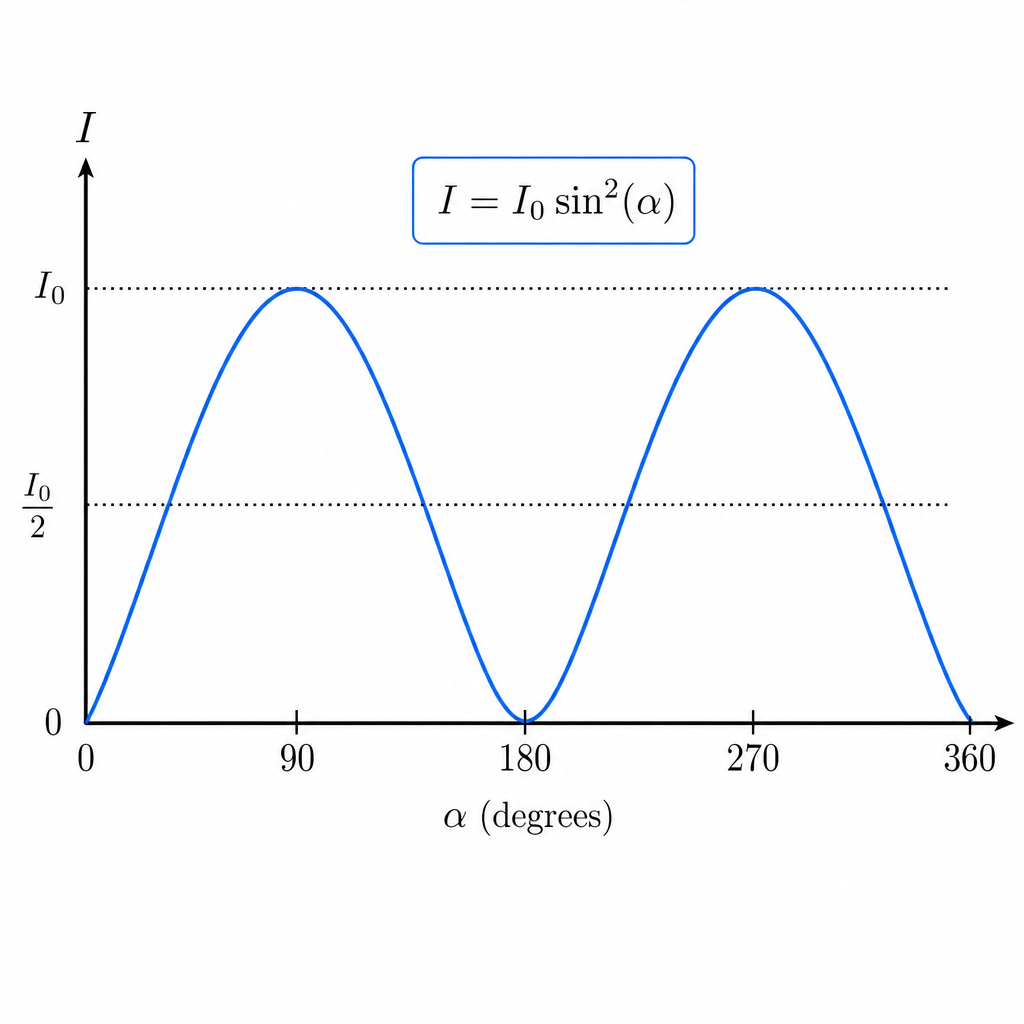
On Fig. 5.2, sketch the variation of the intensity of the transmitted light with the angle of rotation as the filter is rotated through from its initial position.
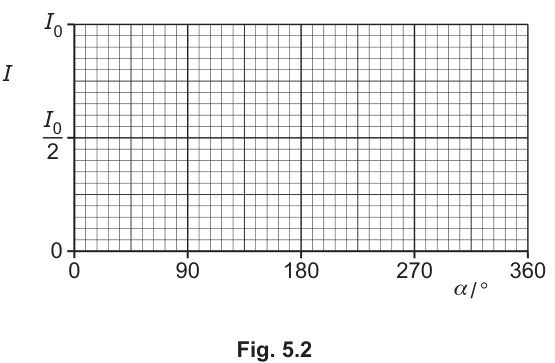
Answer
With transmission axis initially perpendicular, at . Variation follows
So at and , and at (smooth curve).
A (\sin^2) curve: (I=0) at 0°, 180°, 360°; (I=I_0) at 90°, 270°.
Background Concept
For plane-polarised light incident on an ideal polarising filter, Malus’s law gives the transmitted intensity:
where:
- is the incident intensity,
- is the transmitted intensity,
- is the angle between the light’s plane of polarisation (electric field direction) and the filter’s transmission axis.
Because of the square, the intensity repeats every (since ).
Understanding the Question
- Initially, the transmission axis is perpendicular to the plane of polarisation.
- The filter is rotated by an angle through .
- We must sketch against .
Key implication: at , , so no light is transmitted.
Approach
- Relate (the Malus angle) to (the rotation from the initial position).
- Use Malus’s law to find how varies.
- Mark the important points () and sketch a smooth curve through them.
Step-by-Step Reasoning
Initially (at ):
- transmission axis is perpendicular to polarisation, so .
- hence
After rotating the filter by , the angle between the transmission axis and the (fixed) polarisation direction becomes
So
Now read off key values:
- :
- : (maximum)
- :
- : (maximum)
- :
So the sketch is a smooth curve with maxima at and .
Key Takeaways
- Malus’s law: .
- If the initial position is perpendicular, the graph is shifted so starts at zero.
- The transmitted intensity pattern repeats every .
Common Mistakes
- Using (missing the square).
- Starting the graph at at (would correspond to initially parallel, not perpendicular).
- Drawing a or curve that goes negative (intensity cannot be negative).
Things to Be Careful About
- Distinguish the rotation angle from the Malus angle ; you must account for the initial offset.
- Ensure the peak is at (not ) because a single ideal polariser transmits when aligned.
The amplitude of the incident light wave is when the intensity of the wave is .
Use Malus’s law to determine, in terms of , the amplitude of the transmitted wave when .
amplitude = ______
Working
Initially transmission axis is perpendicular, so
At :
Since ,
Answer
0.342 A0
Background Concept
Two key ideas are used together:
- Malus’s law for a polariser:
where is the angle between the polarisation direction and the polariser transmission axis.
- Intensity and amplitude:
For electromagnetic waves,
So if an intensity changes by a factor, the amplitude changes by the square root of that factor.
Understanding the Question
We are told:
- incident intensity is and its amplitude is ,
- the transmission axis starts perpendicular to the plane of polarisation,
- the filter is rotated by ,
- we must find the transmitted amplitude as a multiple of .
Approach
- Write the transmitted intensity in terms of given the initial perpendicular condition.
- Compute the ratio at .
- Convert intensity ratio to amplitude ratio using .
Step-by-Step Reasoning
1) Express in terms of .
At , the axis is perpendicular, so the Malus angle is . After rotating by ,
Substitute into Malus’s law:
2) Evaluate the transmitted intensity fraction at .
3) Convert intensity fraction to amplitude fraction.
Because ,
So
Taking the positive root is correct because amplitude is a magnitude.
Numerically,
so
Key Takeaways
- Malus’s law gives an intensity ratio using a squared trig function.
- To get an amplitude, take the square root: .
- The initial perpendicular orientation shifts the dependence to .
Common Mistakes
- Forgetting and writing .
- Using directly without accounting for the initial perpendicular position.
- Giving (missing the square root).
Things to Be Careful About
- Ensure the angle used in Malus’s law is the angle between polarisation direction and transmission axis, not just the rotation angle unless the initial alignment is stated.
- Keep the result in the requested form “___ ”; either or its decimal is acceptable, but match typical exam rounding (3 s.f. is safe here).
Answer
Diffraction is the spreading (bending) of a wave as it passes through a gap or around an obstacle/edge.
Diffraction is the spreading (bending) of a wave as it passes through a gap or around an obstacle/edge.
Background Concept
Diffraction is a wave effect in which a wavefront spreads out after encountering an aperture (slit) or an edge. It occurs for all types of waves and is most noticeable when the size of the gap/obstacle is comparable to the wavelength.
Understanding the Question
You are asked to state what diffraction means. This is a definition question (1 mark), so the answer should be a short, clear statement that mentions spreading/bending of waves at a gap/edge.
Approach
Give the key phrase “spreading out (or bending) of waves” and link it to passing through a slit or around an obstacle/edge.
Step-by-Step Reasoning
- A wave approaching a slit/edge emerges with wavefronts that are no longer straight/parallel.
- This change is described as the wave spreading out into the region beyond the slit/around the edge.
Key Takeaways
- Diffraction = spreading of waves after a gap/edge.
- Strongest diffraction when aperture size is similar to wavelength.
Common Mistakes
- Describing interference instead of diffraction.
- Saying only “bending of light” without mentioning spreading at a gap/edge.
Things to Be Careful About
- Keep it general (applies to all waves), but mentioning slit/edge is usually essential for the mark.
Light of wavelength in a vacuum is incident normally on a diffraction grating as shown in Fig. 6.1.
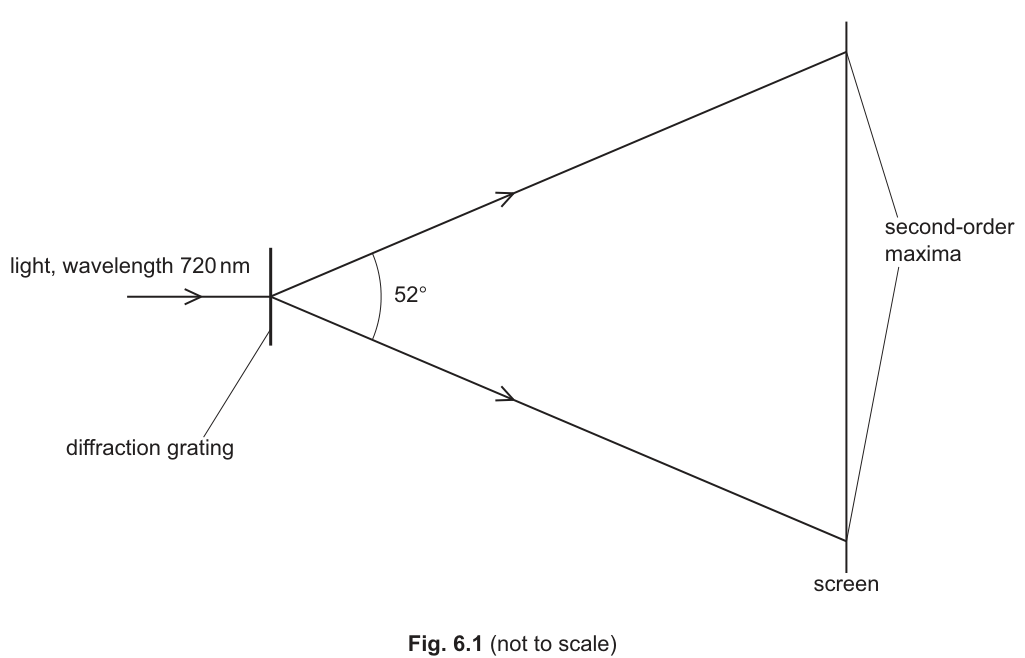
A screen is parallel to the grating. An interference pattern is seen on the screen and the angle between the second-order maxima is .
Working
Answer
4.17 × 10^14 Hz
Background Concept
For any wave,
For electromagnetic waves in a vacuum, the speed is
So the frequency is
Understanding the Question
You are given the wavelength of light in vacuum, , and asked for its frequency . Since it is in vacuum, you should use .
Approach
- Convert into metres.
- Apply .
- Give the answer to an appropriate number of significant figures and include units (Hz).
Step-by-Step Reasoning
Convert the wavelength:
Now calculate the frequency:
Handle the powers of ten and the numerical part:
Key Takeaways
- Use for light in vacuum.
- Always convert nm to m before substituting.
- is typically very large for visible/near-visible light (around to Hz).
Common Mistakes
- Forgetting to convert nm to m (gives an answer smaller by ).
- Using incorrectly (e.g. writing ).
Things to Be Careful About
- Use (vacuum specified).
- Quote the final answer with unit and sensible significant figures.
Calculate the number of lines per unit length in the diffraction grating.
number per unit length = ______
Working
Angle to one second-order maximum:
Diffraction grating:
For and ,
Number of lines per unit length:
Answer
3.05 × 10^5 m^-1
Background Concept
A diffraction grating has many equally spaced slits. Constructive interference (principal maxima) occurs when the path difference between light from adjacent slits is an integer multiple of the wavelength:
where:
- is the grating spacing (distance between adjacent slits),
- is the angle from the normal to the grating to the th order maximum,
- is the order number (),
- is the wavelength.
The “number of lines per unit length” is the line density:
Understanding the Question
You are told the angle between the two second-order maxima (one on each side of the central maximum) is . The pattern is symmetric, so each second-order maximum is at the same angle from the central axis (normal). Therefore the given is actually .
You must use the grating equation to find , then invert to get .
Approach
- Convert “angle between the second-order maxima” into the single angle for one side: .
- Apply with and .
- Compute , then calculate .
Step-by-Step Reasoning
Symmetry gives:
Apply the grating equation for second order ():
Rearrange:
Substitute :
Now invert to find line density:
Key Takeaways
- In grating questions, angles are measured from the normal.
- If the question gives the angle between maxima on opposite sides, halve it to get .
- Line density is the reciprocal of slit spacing.
Common Mistakes
- Using directly as (gives a wrong and wrong line density).
- Forgetting to convert into metres.
- Mixing up and (some students report when asked for lines per unit length).
Things to Be Careful About
- Ensure for second order.
- Use , not .
- Quote in and in standard form.
The light in Fig. 6.1 is now replaced with light of a different wavelength . It is observed that the third-order maxima of this light are at the same positions as the second-order maxima of the light in Fig. 6.1.
Calculate, in nm, the wavelength .
= ______
Working
Same grating and same positions on the screen same angle , so is the same.
Answer
480 nm
Background Concept
For a fixed grating (fixed ), the angle of an th order maximum is determined by
If two different wavelengths produce maxima at the same angle, then the left-hand side is identical for both cases, so the products must be equal.
Understanding the Question
The original light has wavelength and its second-order maxima occur at certain positions on the screen (i.e. certain angles). A new wavelength is used, and its third-order maxima appear at exactly the same positions. That means the third-order of the new light has the same angle as the second-order of the old light.
So we can equate for the two cases.
Approach
- Use the grating condition .
- Since is the same and the positions are the same, is the same, hence is the same.
- Set and solve.
Step-by-Step Reasoning
Original light (second order):
New light (third order at the same angle):
Equate them:
Solve:
Key Takeaways
- “Same position on the screen” means “same diffraction angle ”.
- For the same grating, same implies is constant.
- Higher order ( larger) at the same angle requires a smaller wavelength.
Common Mistakes
- Using frequency ratios instead of wavelength ratios.
- Forgetting that order number matters: equating wavelengths directly instead of .
Things to Be Careful About
- Keep units consistent (nm is fine here since it cancels in the ratio).
- Ensure you match the correct orders: second order for and third order for .
A nichrome resistance wire has length , cross-sectional area and resistivity .
Calculate, to three significant figures, the resistance of the wire.
resistance = ______
Working
Answer
6.86 Ω
Background Concept
For a uniform wire, the resistance depends on:
- its length (longer wire (\Rightarrow) larger resistance),
- its cross-sectional area (thicker wire (\Rightarrow) smaller resistance),
- and the material property resistivity .
The relationship is
This equation assumes the wire has a constant cross-sectional area and is at (approximately) constant temperature.
Understanding the Question
You are given:
- ,
- ,
- .
You must calculate the wire resistance and quote it to three significant figures.
Approach
- Convert the length from cm to m to match the SI units in and .
- Substitute into .
- Round the final result to 3 s.f. and include the unit .
Step-by-Step Reasoning
- Convert length:
- Substitute into the resistivity equation:
- Evaluate:
- Round to three significant figures:
Key Takeaways
- Always match units to the formula (here, convert cm to m).
- Use for uniform wires.
- Quote answers to the requested significant figures with units.
Common Mistakes
- Using instead of .
- Mixing cm with and (unit inconsistency).
- Incorrect rounding (e.g. giving 6.9 or too many s.f.).
Things to Be Careful About
- is in , so must be in m.
- Significant figures: since data are typically 3 s.f., giving is appropriate.
The nichrome wire forms part of a potentiometer circuit together with a cell of electromotive force (e.m.f.) and negligible internal resistance, as shown in Fig. 7.1.
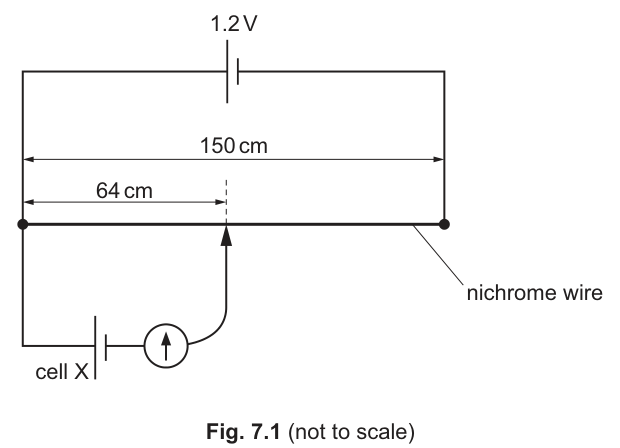
The circuit is used to determine the e.m.f. of cell X.
The galvanometer is used in a null method to find the null point from the left-hand end of the nichrome wire.
Answer
A null method is one where the result is obtained when the galvanometer shows zero deflection (no current flows in the test circuit at balance).
A method where the balance point is found when the galvanometer reads zero (no current in the test circuit).
Background Concept
A galvanometer detects current in a circuit branch. In a potentiometer, you slide a contact along a uniform resistance wire to find a point where the potential difference along a length of the wire equals the e.m.f. being measured.
At the balance point, the galvanometer reads zero, meaning there is no current in the branch containing the unknown cell and galvanometer.
Understanding the Question
The circuit is used as a potentiometer to measure the e.m.f. of cell X. You are asked to explain what “null method” means in this context.
Approach
State what “null” refers to (zero galvanometer deflection) and what that implies physically (no current through the measured cell/galvanometer branch).
Step-by-Step Reasoning
- You adjust the slider until the galvanometer shows zero deflection.
- Zero deflection means the current through the galvanometer is zero.
- If no current flows in that branch, the cell X is not supplying current to an external circuit; the potential difference along the selected length of potentiometer wire exactly equals the e.m.f. of cell X.
Key Takeaways
- “Null” means a zero reading on the detector.
- In potentiometers, null balance implies equality of potential differences and allows e.m.f. measurement without drawing current from the cell being measured.
Common Mistakes
- Saying “null method means minimum reading” rather than zero reading.
- Not linking the null reading to “no current in the test circuit”.
Things to Be Careful About
- The crucial point is no current in the branch with the unknown cell at balance (this is why potentiometers are accurate for e.m.f. measurement).
Working
Potential gradient along wire:
At null, e.m.f. of X equals p.d. across :
Answer
0.512 V
Background Concept
In a potentiometer, a known source drives a steady current through a uniform resistance wire. This creates a uniform potential gradient (potential drop per unit length) along the wire, provided the current is constant and the wire is uniform.
If the full wire of length has a potential difference across it, then the potential difference across a shorter length is
At the null point, the unknown e.m.f. equals this potential difference because no current flows in the test branch.
Understanding the Question
- The 1.2 V cell is connected across the full nichrome wire.
- The null point is at from the left end.
- At null, the p.d. along the section equals the e.m.f. of cell X.
Approach
Use the proportionality of potential difference to length on a uniform potentiometer wire:
Step-by-Step Reasoning
- Full wire has p.d. across .
- Potential gradient is constant, so p.d. across is the same fraction of :
- Calculate:
Key Takeaways
- Uniform wire + constant current (\Rightarrow) constant potential gradient.
- At null, of the unknown cell equals the p.d. across the balancing length.
- Use ratios of lengths to avoid unnecessary steps.
Common Mistakes
- Using but leaving in cm (mixing units in the ratio). The ratio must use the same unit for both lengths.
- Forgetting that it is a fraction of .
- Writing (inverting the ratio).
Things to Be Careful About
- The 1.2 V is across the entire wire, so the p.d. across is less than 1.2 V.
- Sensible check: so must be less than .
The cell of e.m.f. is replaced by a new cell with the same e.m.f. but with an internal resistance that is not negligible.
State and explain the effect, if any, of the internal resistance of the new cell on the position of the null point.
Answer
The internal resistance causes a drop in terminal p.d. across the potentiometer wire, so the current in the wire (and hence the potential gradient) decreases.
Therefore a greater length of wire is needed to balance the same e.m.f. of X, so the null point moves further to the right (beyond ).
Null point shifts to a larger length (to the right) because internal resistance reduces the p.d. across the wire and hence the potential gradient.
Background Concept
A real cell with e.m.f. and internal resistance delivers a terminal potential difference
when it supplies current . The term is the “lost volts” inside the cell.
In a potentiometer, the potential gradient along the wire depends on the potential difference across the wire and the wire length:
If decreases, the gradient decreases.
Understanding the Question
Originally, the 1.2 V cell is ideal (negligible internal resistance), so essentially the full 1.2 V appears across the 150 cm wire.
Now it is replaced by another cell with the same e.m.f. (still 1.2 V) but with non-negligible internal resistance. You must state and explain what happens to the balance (null) point position.
Approach
- Recognise the driving cell now has internal resistance, so when it drives current through the potentiometer wire, some voltage is lost inside the cell.
- That means the terminal p.d. across the wire is less than 1.2 V.
- A smaller p.d. across the same 150 cm gives a smaller potential gradient.
- To get the same balancing p.d. equal to , you need a longer length of wire.
Step-by-Step Reasoning
- With internal resistance , current flows through the wire, so the terminal p.d. is
- Because when current flows, then
- Potential gradient becomes
which is smaller than before.
- The unknown e.m.f. has not changed. At balance,
If the gradient is smaller, must be larger for the product to equal the same .
Therefore the null point moves to the right (a distance greater than 64 cm from the left end).
Key Takeaways
- Internal resistance matters only when the cell supplies current.
- Lost volts reduce the terminal p.d. across the potentiometer wire.
- Smaller potential gradient (\Rightarrow) longer balancing length for the same unknown e.m.f.
Common Mistakes
- Saying “no effect because e.m.f. is unchanged” (e.m.f. is unchanged, but the terminal p.d. across the wire is reduced when current flows).
- Claiming the null point moves left (this would require the gradient to increase, which does not happen here).
- Confusing the internal resistance of the driving cell with that of cell X (at null, cell X has no current so its internal resistance does not affect the balance).
Things to Be Careful About
- The potentiometer wire is not directly at the e.m.f. when internal resistance is present; it is at the terminal p.d.
- The direction of shift should be justified: reduced gradient means you need more length, so the null point must move further from the left end.
An antiparticle equivalent of the neutron is called the antineutron. The quarks in the antineutron are the antiparticles of the quarks in a neutron.
The elementary charge is .
In Table 8.1, state the flavour and charge of the three antiquarks that comprise the antineutron.
Table 8.1
| flavour | charge / |
|---|---|
A neutron is , so an antineutron is .
| flavour | charge / |
|---|---|
with , and two each with .
Background Concept
Hadrons (such as protons and neutrons) are made of quarks. The relevant quark flavours here are:
- up quark with charge
- down quark with charge
An antiquark has:
- the same flavour name but with a bar (e.g. )
- the opposite electric charge to its corresponding quark
So:
- has charge
- has charge
Understanding the Question
You are told the antineutron is the antiparticle of the neutron, and that its quarks are the antiparticles of the neutron’s quarks. The question asks for the three antiquarks in an antineutron, and their charges (in units of ).
Approach
- Recall the quark composition of a neutron.
- Replace each quark by its corresponding antiquark.
- Write the charge of each antiquark as the negative of the corresponding quark’s charge.
Step-by-Step Reasoning
- Neutron composition is:
- neutron: .
- Therefore antineutron composition is the antiquarks:
- antineutron: .
- Charges:
- since is , is .
- since is , is .
- there are two antiquarks, so the last two rows are the same.
Key Takeaways
- Neutron quark content: .
- Antiparticles have opposite charge: .
- Antineutron quark content: .
Common Mistakes
- Writing the antineutron as (that is an antiproton).
- Giving the charge (forgetting the sign change).
- Listing only two quarks instead of three.
Things to Be Careful About
- The table wants charge in units of , so write and (not in coulombs).
- Use bars (or the word “anti-”) clearly to distinguish quarks from antiquarks.
In decay, a neutron decays to form a proton.
Theory predicts that an antineutron should decay to form an antiproton. A particle and an antiparticle should also be observed.
Suggest the names of the particle and the antiparticle.
particle: ______
antiparticle: ______
For decay:
So for an antineutron:
particle: neutrino ()
antiparticle: positron ()
particle: neutrino (νe); antiparticle: positron (e+).
Background Concept
In decay (a weak interaction process), a neutron changes into a proton and emits:
- an electron
- an electron antineutrino
A standard decay equation is:
For the corresponding antiparticle process, every particle is replaced by its antiparticle:
This ensures conservation laws (especially charge) still hold.
Understanding the Question
You are told that theory predicts:
- an antineutron should decay to an antiproton
- and that “a particle and an antiparticle” should also be observed
So you must name the additional two emitted particles, and specify which is the particle and which is the antiparticle.
Approach
Start from the known neutron decay equation, then convert each product to its antiparticle to get the antineutron decay. Finally, label which emitted product is the “particle” and which is the “antiparticle”.
Step-by-Step Reasoning
- Write the known decay:
- Replace each particle by its antiparticle:
- (positron)
- (electron neutrino)
So:
- Decide which is “particle” and which is “antiparticle”:
- is an antiparticle (the antielectron)
- is a particle (the neutrino; its antiparticle would be )
Therefore:
- particle: neutrino ()
- antiparticle: positron ()
(Quick check: charges balance: LHS charge , RHS charge .)
Key Takeaways
- decay: .
- Antiparticle version swaps each particle for its antiparticle: .
- Positron is the antiparticle; neutrino is the particle.
Common Mistakes
- Writing an electron instead of a positron.
- Writing an antineutrino instead of a neutrino (mixing up which one accompanies ).
- Naming “electron” as the antiparticle (it is the particle; the antiparticle is the positron).
Things to Be Careful About
- Neutrino vs antineutrino notation: is particle, is antiparticle.
- Always check charge conservation to confirm the correct lepton (e.g. must be accompanied by in this context).