Physics 9702/22 — May/June 2025
Cambridge AS Level · AS Level Structured Questions · worked solutions for every part, with the mark scheme
Topics Work, Energy and Power · Dynamics · Kinematics · Physical Quantities and Units · Forces, Density and Pressure · Waves · +5 more
Table 1.1 lists some physical quantities. Identify with ticks (✓) which quantities are vectors and which are scalars.
Table 1.1
| quantity | scalar | vector |
|---|---|---|
| acceleration | ||
| displacement | ||
| gravitational potential energy | ||
| speed | ||
| temperature |
Answer
- acceleration: vector
- displacement: vector
- gravitational potential energy: scalar
- speed: scalar
- temperature: scalar
acceleration vector; displacement vector; gravitational potential energy scalar; speed scalar; temperature scalar
Background Concept
A scalar quantity has magnitude only (a size, with units). Examples include mass, time, energy, speed, temperature.
A vector quantity has magnitude and direction. Examples include displacement, velocity, acceleration, force, momentum.
Understanding the Question
You are given a list of common physical quantities and a table with columns “scalar” and “vector”. You must tick the correct column for each quantity.
Approach
For each quantity, ask: “Does this quantity need a direction to be fully described?”
- If yes: it is a vector.
- If no: it is a scalar.
Step-by-Step Reasoning
- Acceleration: change of velocity per unit time; since velocity has direction, acceleration also has direction → vector.
- Displacement: straight-line change in position from start to finish, which requires a direction (e.g. 5 m east) → vector.
- Gravitational potential energy: energy stored due to height in a gravitational field; energy is a single number (no direction) → scalar.
- Speed: rate of change of distance; it does not include direction (that would be velocity) → scalar.
- Temperature: a measure related to average kinetic energy of particles; no direction → scalar.
Key Takeaways
- Vectors: need magnitude and direction.
- Scalars: need magnitude only.
- Speed (scalar) vs velocity (vector) is a common comparison.
Common Mistakes
- Calling speed a vector (confusing it with velocity).
- Thinking energy is a vector because it is related to forces; energy is always scalar.
Things to Be Careful About
- Use the definitions: displacement/velocity/acceleration are directional; distance/speed are not.
- Some quantities can sound “directional” in everyday language, but only the physics definition matters.
A constant resultant force acts on a car of mass . The car moves from rest with constant acceleration along horizontal ground. When the car has displacement , the speed of the car is .
Using the concept of work done on the car, show that the kinetic energy of the car is given by the equation
Working
Work done by resultant force:
With constant resultant force,
So
Using with :
Hence
Therefore .
Answer
EK = (1/2)mv^2
Background Concept
For motion along a straight line, the work done by a resultant (net) force is the energy transferred:
when the force is constant and acts in the same direction as the displacement .
Newton’s second law links force and acceleration:
For constant acceleration, kinematics gives:
The key idea (the work–energy principle) is that net work done equals the increase in kinetic energy.
Understanding the Question
A car of mass starts from rest and accelerates uniformly under a constant resultant force over displacement , reaching speed . You must use the concept of work done to show that its kinetic energy is:
Approach
- Start with .
- Replace using .
- Replace using the constant-acceleration relationship between , , and .
- Show that the expression becomes .
Step-by-Step Reasoning
Work done by the resultant force over displacement is
Because the resultant force causes the acceleration of the car,
Substitute into the work expression:
Now we need to eliminate and in favour of the speed . The motion is from rest, so , and acceleration is constant, so we can use
With :
Substitute into :
Since the net work done equals the gain in kinetic energy, the car’s kinetic energy is
Key Takeaways
- Use for constant force along the displacement.
- Use to connect forces to motion.
- Use to remove and .
- Net work done becomes kinetic energy gained.
Common Mistakes
- Using (that is related to power, not work).
- Forgetting (starts from rest), so writing incorrectly.
- Using instead of eliminating via (still possible, but you must then connect and consistently).
Things to Be Careful About
- assumes the force is constant and in the direction of motion (true here: horizontal, constant resultant).
- Distinguish resultant force (net force) from just the engine driving force; the question states “constant resultant force ”.
The mass of the car is . At time , the car is at rest. At time , its velocity is .
Calculate the kinetic energy of the car at time .
kinetic energy = ______
Working
Answer
1.33 × 10^5 J
Background Concept
Kinetic energy is the energy associated with motion. For a mass moving at speed :
This formula uses speed (a scalar) and gives energy in joules (J).
Understanding the Question
At , the car has mass and speed . You are asked to calculate the kinetic energy at that time.
Approach
Use
and substitute the given and (already in SI units).
Step-by-Step Reasoning
Substitute values:
First square the speed:
Now multiply:
Write to 3 significant figures:
Key Takeaways
- Kinetic energy depends on , so it increases rapidly with speed.
- Keep units in SI: kg and m s give joules.
Common Mistakes
- Forgetting to square .
- Using but treating it as (incorrect arithmetic).
- Omitting the unit J.
Things to Be Careful About
- Significant figures: input data (, ) suggests an answer to about 2–3 s.f.
- Ensure you use speed (magnitude) and not try to include a direction; kinetic energy is scalar.
Between time and time , the work done against resistive forces is .
Determine the average output power of the car during this time.
power = ______
Working
Increase in kinetic energy:
Total work done by the car (engine output energy):
Average output power:
Answer
3.1 × 10^4 W
Background Concept
Power is the rate of energy transfer:
where is the energy transferred (work done) in time .
When a vehicle accelerates with resistive forces (air resistance, rolling friction), the engine’s energy output is used for two things:
- increasing kinetic energy,
- doing work against resistive forces,
So an energy balance is:
Understanding the Question
From to :
- the car speeds up from rest to (so its kinetic energy increases)
- additionally, of work is done against resistive forces.
You must find the average output power over this time interval.
Approach
- Calculate using (since initial speed is zero).
- Add the given resistive work to get total engine work output.
- Divide by to get average power.
Step-by-Step Reasoning
The kinetic energy at is
Since the car starts from rest, , so
Work done against resistive forces is given:
Therefore total work done by the car (engine output energy) is
Average output power over :
So the average power is about .
Key Takeaways
- Engine output energy during acceleration goes into both and resistive losses.
- Average power is total energy transferred divided by the time interval.
Common Mistakes
- Using only and forgetting to add the resistive work.
- Dividing the resistive work by time but not including the kinetic energy increase.
- Using with : that gives instantaneous power at one moment only, not average over the whole interval.
Things to Be Careful About
- The resistive work given is for the whole time interval, so it must be added to the kinetic energy gain to get total output work.
- Quote the final power to an appropriate number of significant figures (here s.f. is reasonable).
At time , the speed of the car becomes constant.
State and explain whether the output power of the car is greater than, less than or the same as the output power just before .
Answer
Less than.
At constant speed, so kinetic energy is not increasing; the engine only supplies power to balance resistive forces. Just before , the engine supplied power both to increase kinetic energy and to overcome resistive forces, so it was greater.
Less than.
Background Concept
If speed is constant, acceleration is zero:
Newton’s second law then gives resultant force zero:
For a moving vehicle, this means the driving force equals the resistive force (they balance).
Power is the rate of energy transfer. During acceleration, engine power is used to:
- increase kinetic energy (increase in )
- overcome resistive forces (energy lost to heat/sound etc.)
During constant speed, kinetic energy is constant, so there is no power needed to increase .
Understanding the Question
At the car’s speed becomes constant. You must compare the car’s output power after this time to the output power just before , when it was still accelerating.
Approach
- Constant speed implies no increase in kinetic energy.
- Compare energy requirements:
- before: power for + resistive losses
- after: power only for resistive losses
Therefore, after , the required output power is smaller.
Step-by-Step Reasoning
Just before , the car is accelerating, so its kinetic energy is increasing with time (its speed is still rising). That means the engine must supply energy each second to increase .
At and after , the speed is constant, so the kinetic energy
is constant too (since and are constant). So the rate of increase of kinetic energy is zero.
The engine then only needs to provide power to compensate for energy lost to resistive forces (drag/rolling resistance). Since it no longer needs to increase kinetic energy, the output power is less than it was during acceleration.
Key Takeaways
- Constant speed no kinetic energy increase.
- During acceleration, engine power must cover both resistive losses and kinetic energy gain.
- During steady motion, engine power just balances resistive losses.
Common Mistakes
- Saying the power is the same because the car is still moving (movement alone does not require increasing energy; only resisting forces do).
- Saying the power is greater because the speed is larger; while instantaneous power to overcome drag can be larger at higher speed, the question compares to the moment just before 5.8 s when it was also moving fast and still increasing kinetic energy.
Things to Be Careful About
- “Becomes constant” means from that time onward the acceleration is zero.
- The comparison is with just before (still accelerating), not with the start at rest.
Answer
The moment of a force about a point is
where is the perpendicular distance from the point to the line of action of the force.
Moment about a point = force × perpendicular distance from the point to the force’s line of action.
Background Concept
The moment (torque) of a force about a point measures the turning effect of that force about that point.
It depends on two things:
- the magnitude of the force (in newtons, )
- the perpendicular distance (in metres, ) from the point (pivot) to the line of action of the force.
The magnitude of the moment is
Understanding the Question
You are asked to define “moment of a force about a point”. A definition must include:
- the product
- that is perpendicular to the line of action
- that the moment is taken about a point (pivot/reference point).
Approach
Write the standard definition in words and (optionally) as an equation.
Step-by-Step Reasoning
- Identify that “moment about a point” means the turning effect relative to that point.
- Use the rule: moment force perpendicular distance.
- State clearly that the distance must be measured to the line of action of the force, not to where the force is applied (unless that happens to be perpendicular).
Key Takeaways
- Moment depends on perpendicular distance to the line of action.
- Correct definition: .
Common Mistakes
- Using the distance to the point of application instead of the perpendicular distance to the line of action.
- Forgetting to mention “about a point”.
Things to Be Careful About
- The line of action is an infinite line in the direction of the force; the perpendicular distance is measured to that line.
- In calculations, ensure is in metres to get moment in .
A tree of mass grows out of sloping ground and is supported by a post, as shown in Fig. 2.1.
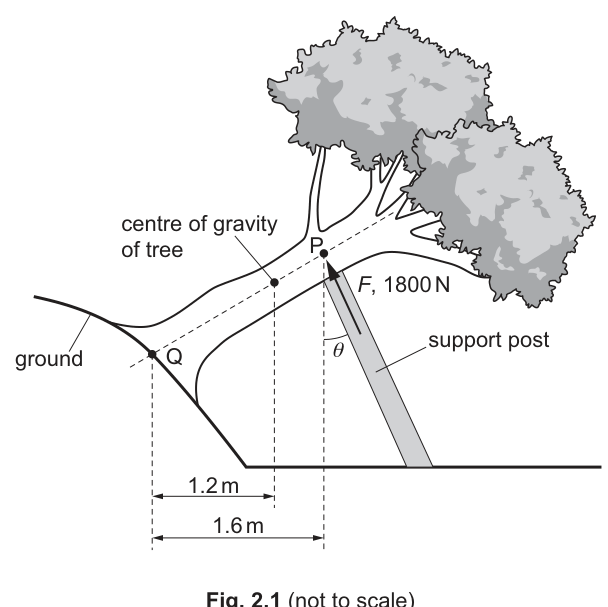
The ground applies a total force on the tree at point .
The centre of gravity of the tree is a horizontal distance of from .
The post applies a force of perpendicular to the line . The line of action of passes through point at an angle to the vertical. is a horizontal distance of from .
The tree is in equilibrium and all forces act on the tree in the same plane.
Working
Taking moments about (equilibrium):
Weight .
Moment of weight about :
Since is perpendicular to , moment of about is
and with making angle to the horizontal, its horizontal projection is , so
Equating moments:
Answer
25°
Background Concept
For a body in rotational equilibrium, the net moment about any point is zero. This is the principle of moments:
The moment of a force about a point is
where is the perpendicular distance from the point to the line of action.
A useful alternative form is
where is the distance from the point to the point of application, and is the angle between and the force.
Understanding the Question
You have a tree in equilibrium. About point :
- the weight acts vertically downward through the centre of gravity, with a given perpendicular distance (horizontal) of from .
- the post exerts a force at .
- you are told is perpendicular to , which is a key clue because it makes the moment calculation simple.
- the horizontal distance from to is .
You must show that the angle (the angle the force makes to the vertical) is .
Approach
- Take moments about to eliminate the unknown reaction force (because its line of action passes through , so its moment about is zero).
- Write the moment of the weight as .
- Write the moment of as because .
- Use geometry to express in terms of the given horizontal distance and .
- Solve for .
Step-by-Step Reasoning
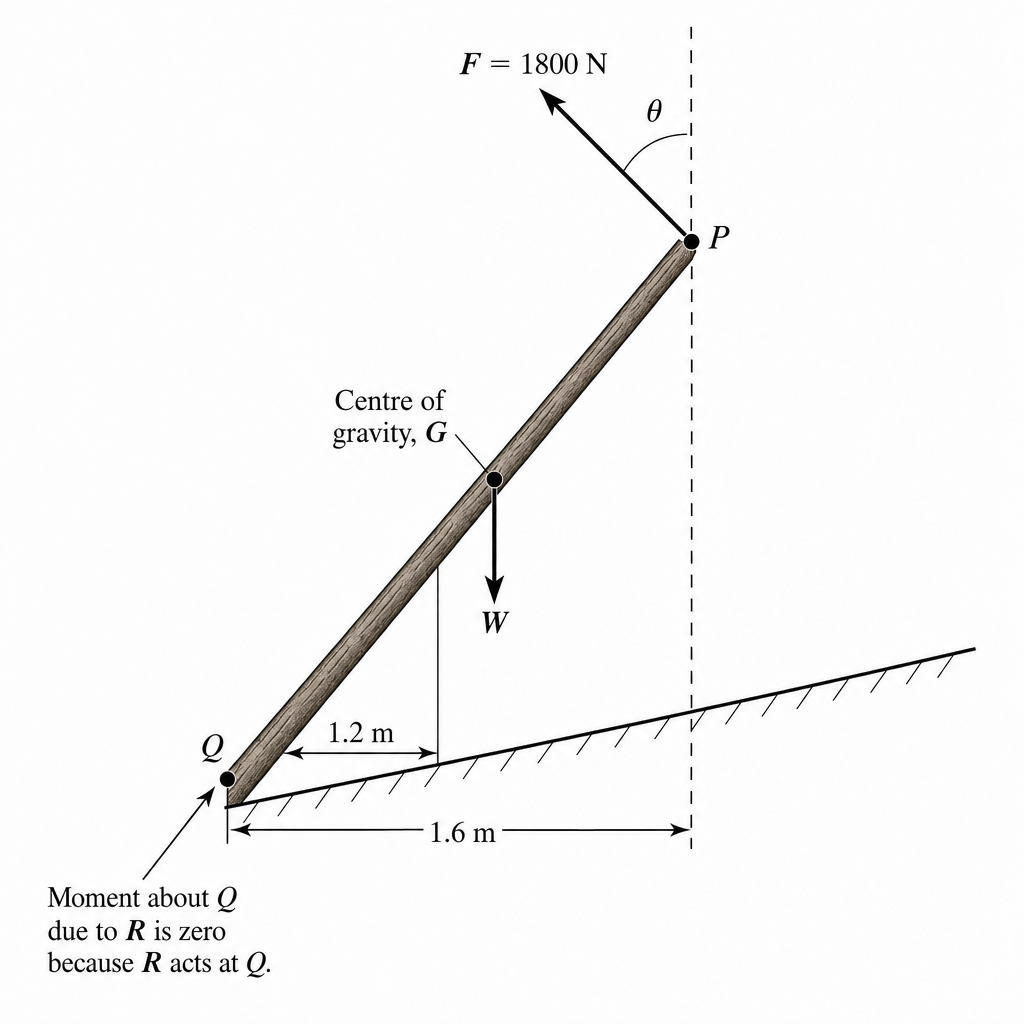
-
Moment of the reaction at : zero, because it acts at .
-
Moment due to weight:
- .
- The weight acts vertically; the perpendicular distance from to a vertical line is the horizontal distance, given as .
- So moment magnitude is .
-
Moment due to :
- You are told .
- Using with and ,
- Relate to the horizontal distance:
- The force is at angle to the vertical, so it is at angle to the horizontal.
- Since is perpendicular to , makes angle to the horizontal.
- The horizontal projection of is then , which is given as .
- Equate clockwise and anticlockwise moments:
Solve for :
So
Key Takeaways
- Taking moments about a point where an unknown force acts can eliminate that force.
- If a force is perpendicular to the line from pivot to point of application, the moment is simply .
- Use projections (here, horizontal projection) to relate an unknown length to a given one.
Common Mistakes
- Using directly as the moment arm for (it is not generally the perpendicular distance to the line of action).
- Forgetting that because , the angle in is .
- Using and then getting a noticeably different angle if rounding too aggressively.
Things to Be Careful About
- The is a perpendicular distance for the weight because the weight is vertical.
- Keep angles consistent: is given at to vertical; converting to angle to horizontal may be needed.
- In equilibrium, choose the moment point strategically (here is best).
On Fig. 2.2, draw a labelled scale vector triangle to represent the forces acting on the tree. The weight of the tree has been drawn to scale.

Answer
In equilibrium, the three forces , and form a closed vector triangle.
From the tail of the given vector, draw to scale () at to the vertical in the correct direction.
Then draw to scale to join the head of to the head of (closing the triangle), and label and .
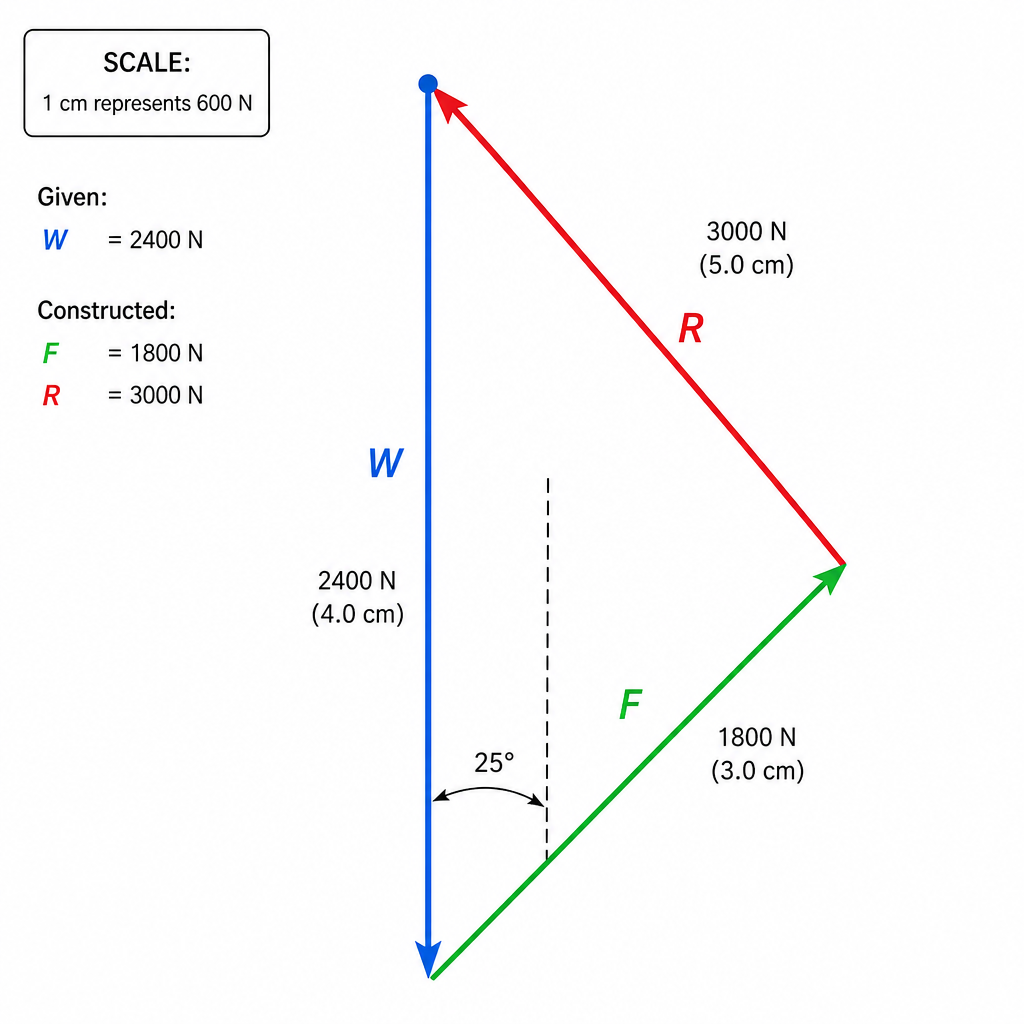
Scale vector triangle of W, F and R drawn (closed triangle).
Background Concept
If an object is in equilibrium under three coplanar forces, then:
- the resultant force is zero, and
- the three force vectors can be drawn head-to-tail to form a closed triangle (often called a force triangle or vector triangle).
Mathematically:
So if you draw , then starting at the head of (or vice versa), the final vector must close the polygon.
Understanding the Question
You are told:
- the tree is in equilibrium,
- all forces lie in one plane,
- the weight vector has already been drawn to scale on Fig. 2.2.
You must add the other two forces:
- at the known direction (angle to the vertical),
- (the ground reaction at ), whose direction and magnitude are found from closing the triangle.
Approach
- Use the given weight arrow as one side of the triangle.
- Draw with the correct length (scale) and direction (at to vertical).
- Draw the final side to close the triangle and label it.
Step-by-Step Reasoning
- Start with the weight vector already drawn (downwards).
- Choose an end of (commonly the tail) and from there draw :
- length proportional to according to the same scale as the weight
- direction at to the vertical (matching the force direction on the tree).
- The remaining force must connect the head of the last drawn vector back to the starting point to make a closed triangle.
- Put arrowheads so each vector direction is clear, and label each vector (, , ).
Key Takeaways
- Three-force equilibrium in a plane implies a closed force triangle.
- Scale drawing: direction is as important as magnitude.
Common Mistakes
- Drawing vectors not head-to-tail (triangle does not close).
- Drawing at to the horizontal instead of to the vertical.
- Not labelling and or missing arrowheads.
Things to Be Careful About
- Use the same scale as the given weight arrow.
- The angle must be measured from the vertical line.
- is not necessarily vertical; its direction comes from the triangle closure, not from guessing.
The tree exerts a pressure of on the top of the post.
Determine the surface area of the tree in contact with the post.
area = ______
Working
Pressure:
Answer
0.012 m^2
Background Concept
Pressure is defined as normal force per unit area:
where:
- is pressure in pascals ()
- is the normal contact force in newtons ()
- is the contact area in square metres ()
Understanding the Question
The tree presses on the top of the post with a pressure of . The contact force between the tree and the post is the same magnitude as the force the post exerts on the tree (Newton’s third law). From earlier information, the post’s force is .
You are asked to find the surface area of contact between the tree and the post.
Approach
- Convert into pascals.
- Rearrange to .
- Substitute values and calculate.
Step-by-Step Reasoning
- Convert pressure:
- Rearrange the definition:
- Substitute:
So the contact area is .
Key Takeaways
- Use and convert .
- Newton’s third law links the contact forces between two objects.
Common Mistakes
- Forgetting to convert to .
- Using the weight instead of the contact force from the post ().
- Giving area in without converting to .
Things to Be Careful About
- Pressure must be in for SI consistency.
- The force used must be the normal contact force causing the pressure on the post.
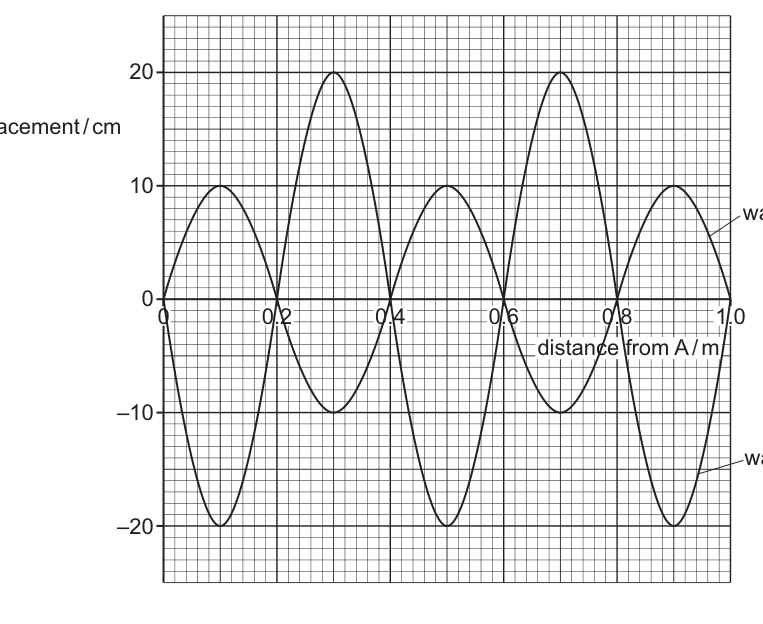
Two progressive water waves and travel along a straight line from point to point . The variation of displacement of the waves with distance from at an instant in time is shown in Fig. 3.1.
Answer
Amplitude of wave is the maximum displacement from the equilibrium line.
10 cm
Background Concept
For a progressive wave, the amplitude is the maximum displacement of the medium from its equilibrium (zero-displacement) position.
On a displacement–distance graph at a fixed instant, the amplitude is read as the largest vertical distance from the midline (equilibrium) to a crest (or to a trough, taking the magnitude).
Understanding the Question
Fig. 3.1 shows displacement (in ) against distance from (in ) for two waves and at the same instant.
You are asked to state the amplitude of wave by reading it from the graph.
Approach
- Identify the equilibrium line (displacement ).
- Find the maximum displacement of wave (highest crest or deepest trough).
- Quote that value (magnitude) as the amplitude.
Step-by-Step Reasoning
- From Fig. 3.1, wave reaches a crest at about (and a trough at about ).
- The amplitude is the magnitude of this maximum displacement:
Key Takeaways
- Amplitude is a maximum displacement, not peak-to-peak height.
- On a graph, read amplitude from the midline to a crest/trough.
Common Mistakes
- Quoting peak-to-peak value () instead of amplitude ().
- Mixing units (e.g. converting to metres unnecessarily when the answer line asks for ).
Things to Be Careful About
- Use the equilibrium line (displacement ) as the reference.
- Give the amplitude as a positive value (it is a magnitude).
Both waves have frequency .
Working
From Fig. 3.1, .
Answer
6.4 m s^-1
Background Concept
For a progressive wave,
where:
- is wave speed (),
- is frequency (),
- is wavelength (), the distance between successive points in phase (e.g. crest-to-crest).
A displacement–distance graph at a fixed time shows the spatial pattern, so you can read directly along the distance axis.
Understanding the Question
Both waves have frequency . Using Fig. 3.1, you read the wavelength of wave and then calculate its speed.
Approach
- Read for wave from the graph (distance between adjacent crests/troughs).
- Apply .
- Substitute and calculate, keeping SI units.
Step-by-Step Reasoning
- From Fig. 3.1, wave repeats its shape every , so:
- Use the wave equation:
- Substitute and :
Key Takeaways
- A displacement–distance graph lets you read wavelength directly.
- Wave speed depends on both and via .
Common Mistakes
- Reading half a wavelength (crest to trough) instead of a full wavelength.
- Using the amplitude values when finding speed (amplitude does not appear in ).
Things to Be Careful About
- Frequency in is already , so the units work automatically: .
- Ensure the wavelength you read is for wave (though here and have the same ).
Answer
and are coherent because they have the same frequency and a constant phase difference (they are in antiphase, i.e. phase difference ).
Yes; same frequency and constant phase difference (antiphase).
Background Concept
Two waves are coherent if they maintain a constant phase difference (and, in practice for exam questions, they also have the same frequency).
- “Same frequency” means the phase difference does not drift with time.
- “Constant phase difference” means that if one wave is, for example, at a crest when the other is at a trough, that relationship stays the same.
Being in antiphase means a phase difference of radians (or ).
Understanding the Question
You are told both waves have frequency , and Fig. 3.1 shows that when wave has a crest, wave has a trough at the same position (and vice versa). You must decide whether that makes them coherent and explain.
Approach
- Recall the definition: coherence requires a constant phase difference.
- Use the diagram description (“in antiphase”) and the given equal frequency to justify that the phase difference is constant.
Step-by-Step Reasoning
- The question states both waves have , so their phase difference will not change due to different frequencies.
- The diagram information states they are in antiphase, meaning:
- is a fixed (constant) value, so the waves are coherent.
Key Takeaways
- Coherence is about a stable phase relationship.
- “Antiphase” is still coherent if it stays antiphase (constant phase difference).
Common Mistakes
- Saying “not coherent because they are in antiphase” (antiphase is a constant phase difference, so it can be coherent).
- Mentioning only “same frequency” but not stating “constant phase difference”.
Things to Be Careful About
- Coherence does not require the waves to be in phase; any fixed phase difference (including ) is acceptable.
- If the frequencies were different, the phase difference would change with time and they would not be coherent.
Wave and wave superpose to form a resultant wave.
On Fig. 3.2, sketch the variation of displacement of the resultant wave with distance from at the instant of time shown in Fig. 3.1.
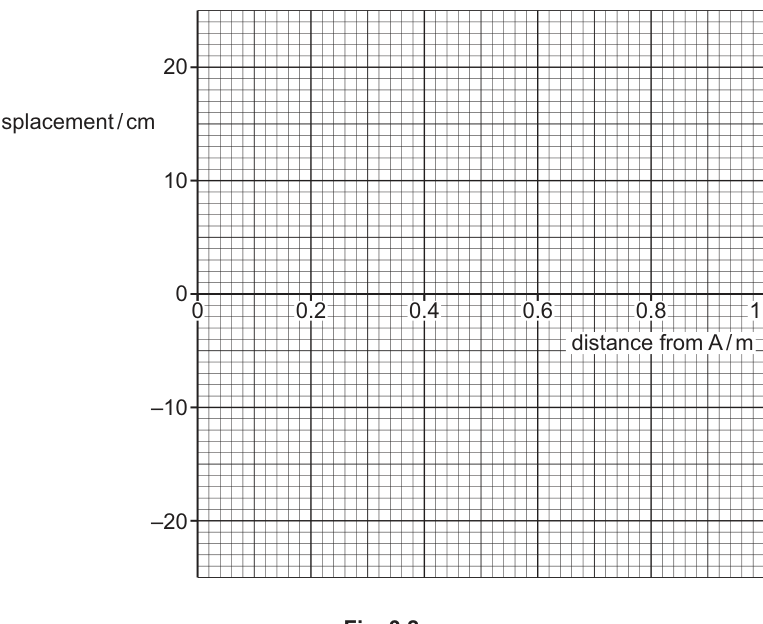
Working
Resultant displacement .
From Fig. 3.1 the waves have the same wavelength and are in antiphase, with amplitudes and .
So the resultant is a sinusoid of wavelength and amplitude , in phase with wave (opposite phase to ).
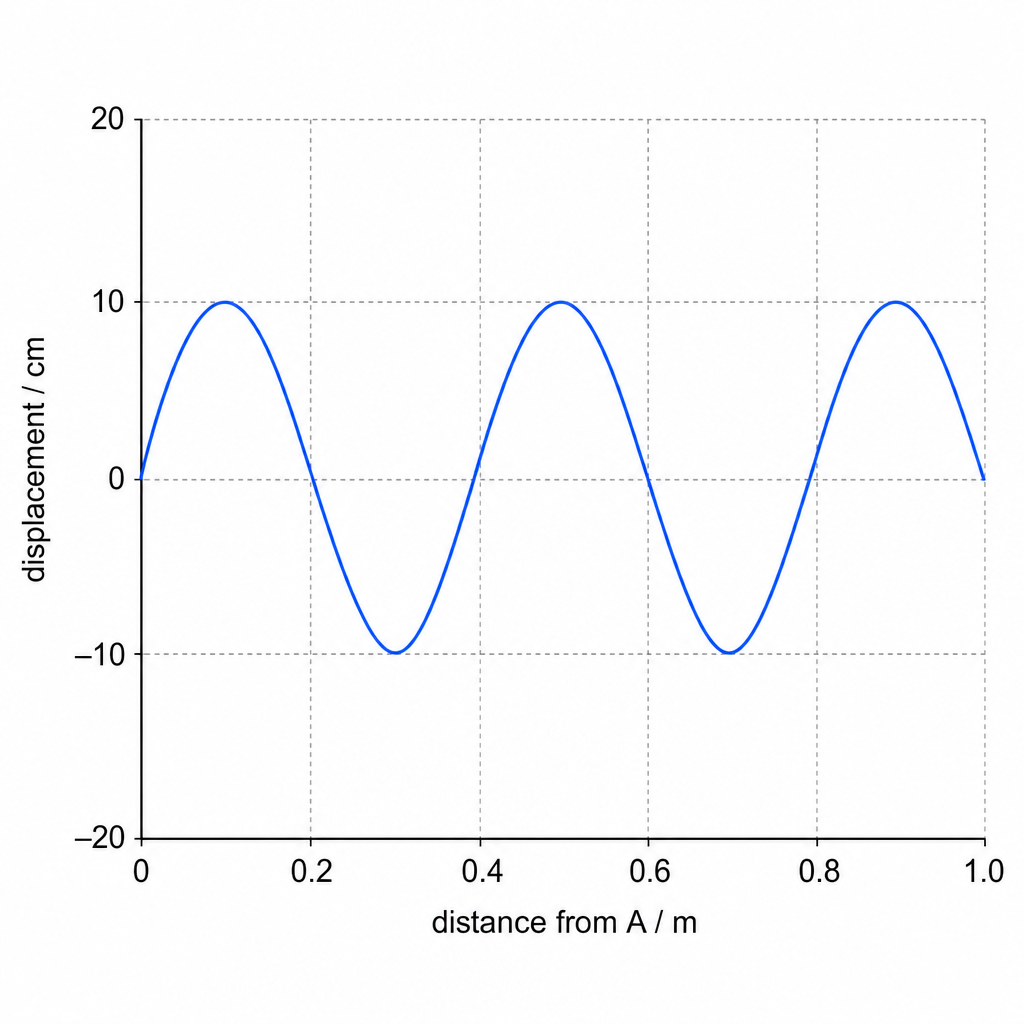
Answer
Sketch: sinusoidal wave, amplitude , wavelength , with crests where has crests (and troughs where has troughs).
Resultant: sinusoid, amplitude 10 cm, wavelength 0.40 m, in phase with Y (antiphase with X).
Background Concept
The principle of superposition states that when waves overlap, the resultant displacement at any point is the algebraic sum of the individual displacements:
If two waves have the same wavelength and frequency:
- In phase (): amplitudes add (constructive interference).
- In antiphase (): amplitudes subtract (destructive interference).
For antiphase waves of unequal amplitude and , the resultant amplitude is:
and the resultant oscillates in phase with the larger-amplitude wave.
Understanding the Question
Fig. 3.1 shows waves and along the line from to at the same instant. They have:
- the same wavelength (),
- amplitudes and ,
- antiphase relationship (crest of one aligns with trough of the other).
You must sketch, on Fig. 3.2, the resultant displacement vs distance at that same instant.
Approach
- Because both waves have the same wavelength and are perfectly antiphase everywhere, one wave’s displacement is the negative of the other (scaled by amplitude).
- So at each position you can add them quickly by thinking “the larger one wins by the difference in amplitudes”.
- The resultant will still be a sinusoid with the same wavelength, but with reduced amplitude.
Step-by-Step Reasoning
- Read amplitudes from Fig. 3.1:
-
Antiphase means when is , is at the same , so the sum is . Similarly, when is , is , sum is .
-
Therefore the resultant is a sinusoid with amplitude:
-
The wavelength stays the same () because you are adding two sinusoids of the same spatial period.
-
The sign (phase) follows wave because it has the larger amplitude: wherever is positive, the resultant is positive (but smaller).
Key Takeaways
- Superposition means add displacements point-by-point.
- For equal and perfect antiphase, the resultant amplitude is the difference of amplitudes.
- The resultant is in phase with the wave of larger amplitude.
Common Mistakes
- Adding amplitudes () even though the waves are in antiphase.
- Drawing a non-sinusoidal shape even though both waves are sinusoids with the same wavelength.
- Keeping the phase of wave instead of matching the larger wave .
Things to Be Careful About
- Use algebraic addition: positive + negative can cancel.
- Keep the same wavelength () on the sketch.
- Make sure peaks/troughs line up with the correct wave (with here).
The intensity of wave is . The intensity of wave is .
Use Fig. 3.1 to determine the ratio .
ratio = ______
Working
From Fig. 3.1: and .
Intensity , so
Answer
1/4
Background Concept
For many waves (including water waves at this level), the intensity is proportional to the square of the amplitude:
So for two waves and ,
This works because intensity is related to energy transferred per unit time per unit area, and wave energy typically scales with .
Understanding the Question
Fig. 3.1 provides the amplitudes of waves and . You must use those to calculate the ratio .
Approach
- Read and from the displacement–distance graph.
- Use .
- Form the ratio and simplify.
Step-by-Step Reasoning
- From Fig. 3.1:
- Apply the proportionality:
- Substitute:
Key Takeaways
- Intensity depends on amplitude squared, so doubling amplitude makes intensity four times larger.
- Ratios are convenient because units cancel (cm is fine here).
Common Mistakes
- Using instead of .
- Using peak-to-peak displacement instead of amplitude.
- Inverting the ratio (calculating ).
Things to Be Careful About
- You do not need to convert cm to m because you are taking a ratio; the unit cancels as long as both amplitudes use the same unit.
- Make sure you square both amplitudes before simplifying.
A small ball is dropped from rest from height above the ground and falls vertically downwards. The ball collides with the ground and bounces back vertically upwards, reaching a maximum height . Fig. 4.1 shows the ball just before and just after hitting the ground.
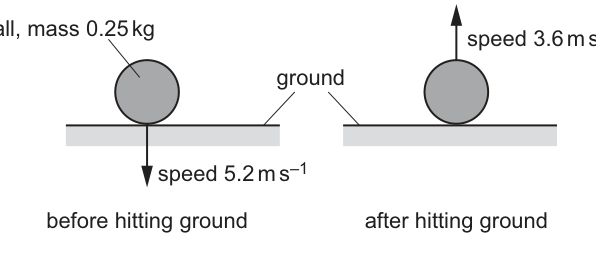
The ball has mass and is in contact with the ground for a time of .
Just before the ball hits the ground, it has speed . Just after it leaves the ground, it has speed .
Air resistance acting on the ball is negligible.
Answer
The collision is inelastic because the speed (and hence kinetic energy) after the bounce is less than before, so kinetic energy is not conserved.
Inelastic (kinetic energy not conserved).
Background Concept
An elastic collision is one in which the total kinetic energy of the colliding bodies is conserved (as well as momentum).
An inelastic collision is one in which kinetic energy is not conserved; some kinetic energy is transformed into other forms such as internal energy (heating), sound, and deformation.
In a bounce off the ground, momentum of the ball changes because an impulse acts during the contact time. Kinetic energy may or may not be conserved; that decides elastic vs inelastic.
Understanding the Question
We are told the ball hits the ground with speed and leaves the ground with speed . We must state whether the collision is elastic or inelastic and explain using these speeds.
Approach
Compare the kinetic energy just before and just after impact. Since and the mass is unchanged, comparing is enough.
Step-by-Step Reasoning
Before collision:
After collision:
Because , we have . Therefore kinetic energy decreased during the collision, so it was not conserved.
Hence the collision is inelastic.
Key Takeaways
- Elastic: kinetic energy conserved.
- Inelastic: kinetic energy not conserved (even though momentum changes due to impulse).
- If the rebound speed is smaller than the impact speed, the collision must be inelastic.
Common Mistakes
- Saying “momentum is not conserved so it is inelastic”: momentum of the ball alone is not conserved because an external force (ground) acts, but that does not define elastic/inelastic.
- Confusing “inelastic” with “completely inelastic” (objects stick together). Here the ball rebounds, so it is not completely inelastic.
Things to Be Careful About
- Use kinetic energy (or speed) to classify the collision, not momentum.
- Speeds are magnitudes; the direction change does not by itself indicate elasticity.
Calculate the change in momentum of the ball during the collision with the ground.
change in momentum = ______
Working
Take upward as positive.
Before collision:
After collision:
Answer
(upwards)
2.2 kg m s^-1 (upwards)
Background Concept
Linear momentum is
where is mass and is velocity.
The change in momentum is
Because momentum depends on velocity, direction matters: we must use a sign convention.
Understanding the Question
We are given:
- speed just before impact downward
- speed just after leaving ground upward
We need the ball’s change in momentum during the collision.
Approach
Pick upward as positive. Convert the given speeds into signed velocities ( before, after), then use .
Step-by-Step Reasoning
-
Choose sign convention: upward .
-
Write velocities:
- Before collision the ball is moving downward, so
- After collision it is moving upward, so
- Calculate change in momentum:
The bracket is the total change in velocity: from to is a change of .
So
The positive sign means the momentum change is upward.
Key Takeaways
- Use velocity (with sign), not speed, for momentum.
- A bounce reverses direction, so involves adding magnitudes.
Common Mistakes
- Using and both as positive, giving which is wrong because it ignores direction.
- Forgetting units: momentum change is in .
Things to Be Careful About
- State the direction (or ensure your sign convention makes it clear).
- Keep the same sign convention for part (ii) so the force direction is consistent.
Determine the average force on the ball during the collision with the ground.
force = ______
Working
Answer
upwards
12 N upwards
Background Concept
Impulse is the change in momentum:
So the average resultant force over the contact time is
Understanding the Question
During the that the ball is in contact with the ground, its momentum changes by (found in part (i) as upward). We are asked for the average force on the ball during this collision.
Approach
Use the impulse relation with the momentum change from (i) and the given contact time.
Step-by-Step Reasoning
From (i):
Contact time:
Average force:
This is upward (same direction as ).
To appropriate significant figures, upward.
Key Takeaways
- Average force during a collision is found from impulse: .
- Direction of force matches direction of change of momentum.
Common Mistakes
- Using with estimated poorly; the question gives contact time specifically to use impulse.
- Dividing the wrong way round (using ).
Things to Be Careful About
- This value is the average resultant force on the ball during the collision, based on momentum change.
- If a question specifically asked for the average contact force from the ground, you would need to consider weight as well (since ). Here the standard impulse calculation gives the required average force.
Working
For the fall from rest:
For the rise to rest:
Divide:
Answer
0.48
Background Concept
When air resistance is negligible, a falling or rising object moves under constant acceleration due to gravity .
A useful constant-acceleration equation is
For vertical motion:
- take upward as positive
- acceleration is
For a drop from rest through height , the speed at the bottom satisfies
(similarly for an object projected upward with initial speed that rises a height until ).
Understanding the Question
We have two separate journeys:
- The ball is dropped from rest from height and reaches speed just before hitting the ground.
- After bouncing, it leaves the ground at speed upward and rises to maximum height where its speed becomes zero.
We must find the ratio .
Approach
Use for each part of the motion:
- For the drop: , downward, distance .
- For the rise: final speed , acceleration , distance .
Then divide the two equations so that cancels, leaving a ratio in terms of the given speeds only.
Step-by-Step Reasoning
1) Falling from rest
Taking downward as the direction of acceleration for the fall (or using magnitudes):
with , so
2) Rising to a maximum height
At maximum height, final speed is zero. Using magnitudes again:
with upward launch speed , so
3) Form the ratio
Divide the second equation by the first:
Compute:
Key Takeaways
- For motion under gravity with negligible air resistance: links speed and vertical height change.
- Forming ratios can cancel constants like .
- Because , halving the speed would quarter the height.
Common Mistakes
- Using instead of squaring the speeds.
- Mixing up which speed corresponds to which height.
- Forgetting that at the top of the rebound the speed is .
Things to Be Careful About
- You can use either a consistent sign convention or use the magnitude forms carefully; both must reflect constant acceleration.
- The ratio is dimensionless, so no units are included in the final answer.
- Round appropriately (typically 2 s.f. here): .
Answer
Young modulus is the ratio of tensile stress to tensile strain (within the limit of proportionality / elastic limit):
Young modulus is the ratio of tensile stress to tensile strain (within the elastic region).
Background Concept
Young modulus (Young’s modulus), usually written as , quantifies how stiff a material is when it is stretched.
It is defined using:
- Tensile stress:
where is tensile force and is cross-sectional area.
- Tensile strain:
where is extension and is original length.
Young modulus is then:
This definition is only valid in the region where stress is proportional to strain (Hooke’s law region), i.e. before plastic deformation.
Understanding the Question
The question asks you to define Young modulus, so you need a clear statement involving stress and strain, and ideally the condition that it applies in the elastic/proportional region.
Approach
Recall the definition: Young modulus is stress divided by strain. Mention the “elastic / proportional” condition because outside that region the ratio is not constant.
Step-by-Step Reasoning
- Start from the basic definition of Young modulus as a material property in extension.
- Use the standard relationship:
- State the condition: it is taken for elastic deformation (up to limit of proportionality).
Key Takeaways
- Young modulus measures stiffness in tension/compression.
- Definition: .
- Only constant in the Hooke’s law (linear elastic) region.
Common Mistakes
- Writing (inverted).
- Forgetting to mention it applies within the elastic / proportional region.
- Confusing Young modulus with spring constant (spring constant depends on the object’s dimensions; is a material property).
Things to Be Careful About
- Stress uses original cross-sectional area .
- Strain uses original length .
- Units: stress is Pa, strain is dimensionless, so is in Pa.
A wire of unstretched length is made of a metal with Young modulus . The wire obeys Hooke’s law and has a constant cross-sectional area. Fig. 5.1 shows the force–extension graph for the wire.
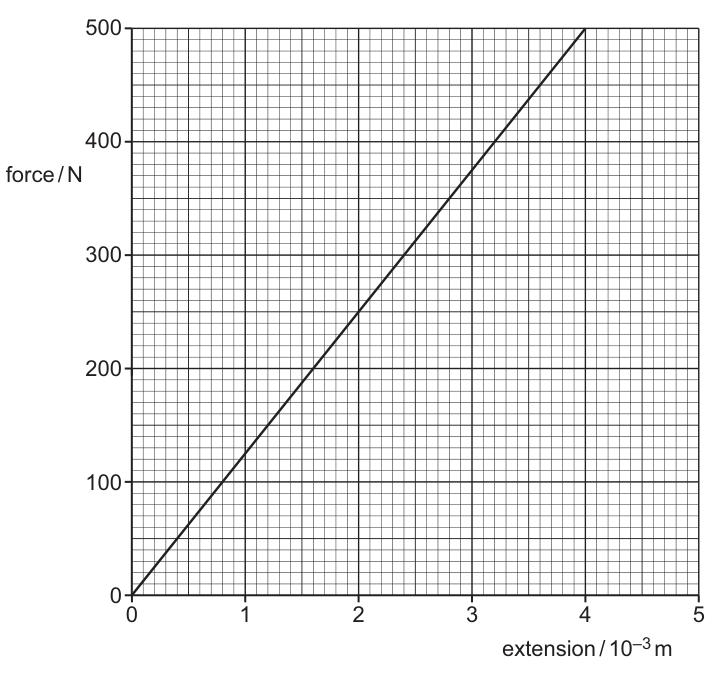
Working
From the graph, gradient
For a wire obeying Hooke’s law:
So
Answer
1.1 × 10⁻⁶ m²
Background Concept
For a uniform wire of original length and cross-sectional area , the Young modulus relates force and extension (in the elastic, Hooke’s law region) by:
Rearranging gives the useful working form:
So if you plot against , the gradient is:
Understanding the Question
You are given:
- A straight-line force–extension graph passing through the origin and the point .
You are asked to find the cross-sectional area of the wire.
Approach
- Use the straight-line graph to find the gradient .
- Use the relationship .
- Rearrange to solve for .
Step-by-Step Reasoning
-
Read one convenient point on the line (since it passes through the origin, one point is enough):
- at .
-
Compute the gradient:
- Use the wire equation:
Rearrange:
- Substitute values:
- Quote to a sensible number of significant figures (limited by 95 GPa and 4.0):
Key Takeaways
- For a Hooke’s law wire, the – graph is linear through the origin.
- Gradient of vs equals .
- Convert to before substituting.
Common Mistakes
- Forgetting to convert to .
- Using in “ units” incorrectly (the axis label means you must multiply by ).
- Rearranging wrongly (e.g. instead of ).
Things to Be Careful About
- The gradient is ; because the line goes through the origin, at any point is fine.
- Unit check: has units and also gives .
- Significant figures: do not overstate precision (e.g. is unnecessary).
The extension of the wire is initially .
Determine the work done to increase the extension of the wire to .
work done = ______
Working
From the straight line, so
At :
At :
Work done = area under graph between and (trapezium):
Answer
0.31 J
Background Concept
The work done by a force when it causes an extension is:
On a force–extension graph, this integral is the area under the graph between the two extensions.
For a Hooke’s law wire, (a straight line through the origin), so the area can be found using simple shapes (triangle or trapezium).
Understanding the Question
The wire is initially extended to and then further extended to .
You are asked for the additional work done in increasing the extension from to , i.e. the area under the – graph between those two values.
Approach
- Use the straight-line graph to find the force at each extension ( at and at ).
- The work between and is the area under the line segment: a trapezium of width and parallel sides and .
- Compute:
Step-by-Step Reasoning
- First find the constant gradient (spring constant for the whole wire):
So .
- Force at :
- Force at :
- Work done from to is trapezium area:
Here, , so:
Rounded:
(Equivalent method: use .)
Key Takeaways
- Work done in stretching equals area under the – graph.
- Between two non-zero extensions, use a trapezium (or use ).
- For Hooke’s law, force scales linearly with extension.
Common Mistakes
- Finding the total energy at (area from to ) instead of the additional energy from to .
- Using a triangle area with height and base (this would ignore the non-zero starting force ).
- Forgetting that the extension axis is in .
Things to Be Careful About
- Units: .
- Don’t round intermediate forces too aggressively if it affects the final rounding.
- The straight-line assumption relies on “wire obeys Hooke’s law”; if it were curved, you would need a different area estimate.
Answer
Electric potential difference is the work done (energy transferred) per unit charge passing through the component.
Work done (energy transferred) per unit charge passing through the component.
Background Concept
Electric potential difference (p.d.) between two points is defined by energy transfer per unit charge.
where is the potential difference, is the energy transferred (work done), and is the charge that passes.
Understanding the Question
You are asked for the definition of the p.d. across a component. That means you must describe what represents physically in terms of energy/work and charge.
Approach
Use the defining equation and translate it into words: “energy transferred (work done) per unit charge”.
Step-by-Step Reasoning
From the definition,
So if of charge passes through a component, the p.d. is numerically equal to the energy transferred in joules. Therefore p.d. across a component is the energy transferred (work done) per coulomb.
Key Takeaways
- Potential difference is an energy-per-charge quantity.
- The key phrase is “work done/energy transferred per unit charge”.
Common Mistakes
- Defining p.d. as “energy” without dividing by charge.
- Confusing p.d. with e.m.f. (both are energy per charge, but e.m.f. refers to the source).
Things to Be Careful About
- Include “per unit charge” (or “per coulomb”) explicitly to make it a definition.
- Either “work done” or “energy transferred” is acceptable if linked to charge.
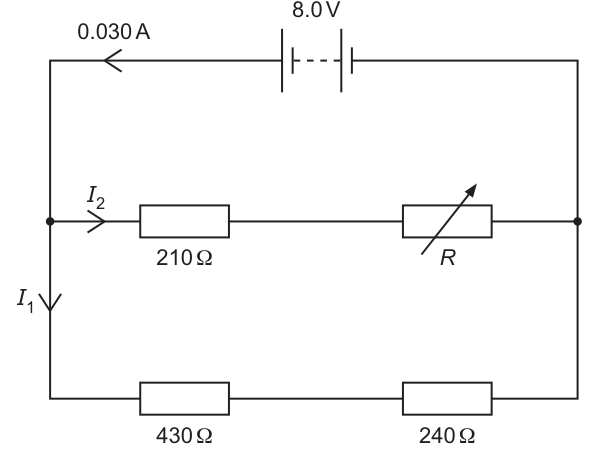
A circuit contains four resistors and a battery of electromotive force (e.m.f.) with negligible internal resistance. When the variable resistor has resistance , the currents in the circuit are , and , as shown in Fig. 6.1.
Working
Time
Answer
7.2 C
Background Concept
Current is the rate of flow of charge:
Rearranging gives:
Understanding the Question
The total current through the battery is given as . You must find the total charge that passes through the battery in .
Approach
Convert minutes to seconds, then use .
Step-by-Step Reasoning
- Convert time:
- Use :
(Using ensures the unit becomes coulombs.)
Key Takeaways
- Always convert time into seconds before using .
- Charge is proportional to both current and time.
Common Mistakes
- Using instead of converting minutes.
- Writing the unit as instead of .
Things to Be Careful About
- Significant figures: current and time are both given to 2 s.f., so to 2 s.f. () is appropriate.
Working
Resistance in branch:
p.d. across branch :
Answer
1.2 × 10^-2 A
Background Concept
- Resistors in series add: .
- In a parallel circuit, each branch has the same potential difference as the supply (here the battery has negligible internal resistance, so the full is across each branch).
- Ohm’s law:
Understanding the Question
You need the current in the branch that contains the and resistors in series. That whole branch is connected directly across the battery.
Approach
- Add the series resistances in the branch.
- Use with for that branch.
Step-by-Step Reasoning
- Combine the series resistors:
- Apply Ohm’s law to the branch:
Rounded appropriately:
Key Takeaways
- Series resistors: add them.
- Parallel branches: same p.d. across each branch.
Common Mistakes
- Treating the two branches as series with each other and adding all four resistors.
- Using the total current in for this branch.
Things to Be Careful About
- The is across each branch (because the branches are in parallel).
- Keep enough significant figures during intermediate steps to avoid rounding errors later.
Working
Answer
0.018 A
Background Concept
Kirchhoff’s first law (junction rule): the total current entering a junction equals the total current leaving it.
Understanding the Question
The battery supplies a total current of into two parallel branches. One branch current is (found in part (ii)). The other branch current is , which you must calculate.
Approach
Use the junction rule: , then rearrange to get .
Step-by-Step Reasoning
At the junction where the current splits:
So,
Rounded suitably:
Key Takeaways
- In parallel circuits, current divides but is conserved: is the sum of branch currents.
Common Mistakes
- Adding instead of subtracting.
- Using (wrong sign).
Things to Be Careful About
- Don’t over-round before subtracting if you need for a later calculation (as in part (iv)).
Working
p.d. across branch , so
But
So
Answer
2.3 × 10^2 Ω
Background Concept
In a parallel circuit, each branch has the same potential difference as the supply. For any branch:
If the branch contains series resistors, their resistances add.
Understanding the Question
The branch contains a resistor in series with the variable resistor of resistance . You already found the current in that branch in part (iii). Since the battery has negligible internal resistance, the full is across that branch.
Approach
- Use to find the total resistance of the branch.
- Subtract to obtain the variable resistor resistance .
Step-by-Step Reasoning
- Total resistance of the branch:
Using a more accurate (to reduce rounding error), e.g. :
- Since the branch resistors are in series:
So
Key Takeaways
- Same p.d. across parallel branches lets you find branch resistance from .
- Series resistors add; then isolate the unknown by subtraction.
Common Mistakes
- Using the total circuit current instead of the branch current .
- Adding instead of subtracting it.
Things to Be Careful About
- Keep extra significant figures for and before the final rounding, because depends sensitively on .
- Final answer should be sensible: it must be positive and of the same order as the other resistors in the circuit.
The variable resistor in (b) is fitted with a scale so that its resistance can be accurately determined.
The resistor of resistance is now replaced by a new resistor of unknown resistance. A galvanometer is connected as shown in Fig. 6.2.
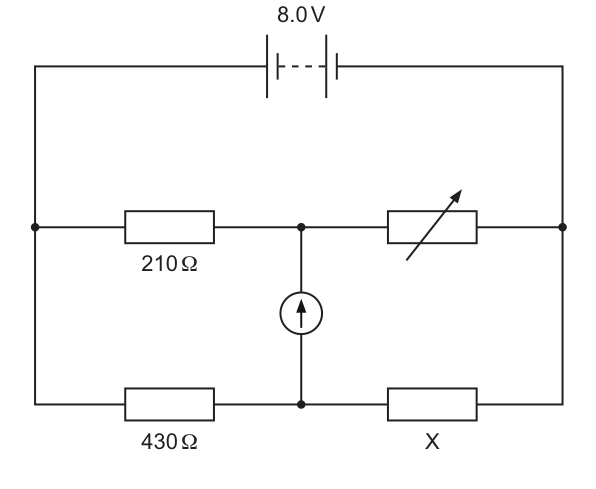
With reference to ratios of resistances, explain how this circuit can be used to determine the resistance of .
Answer
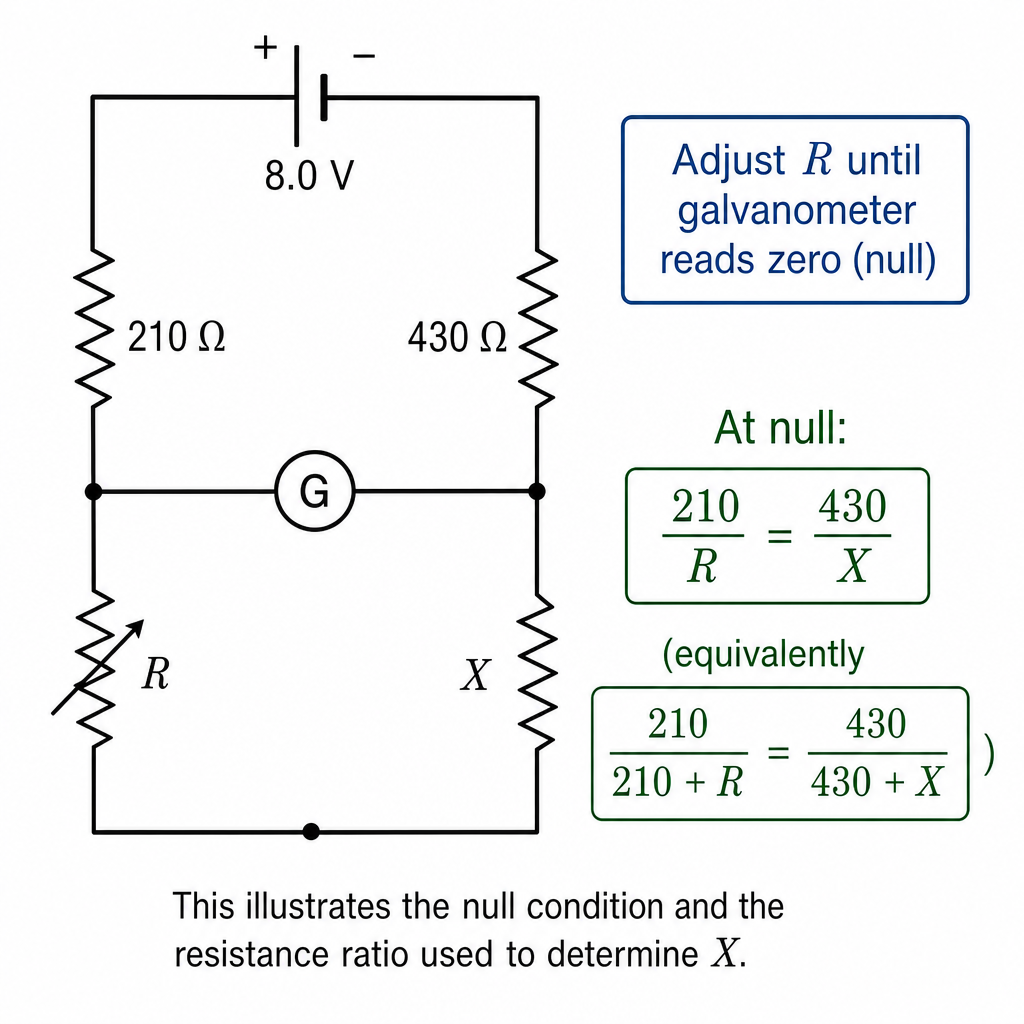
Adjust the variable resistor until the galvanometer shows zero (no current).
At balance the midpoints are at the same potential, so the potential-divider ratios are equal:
Hence
Read from the variable-resistor scale and calculate .
Balance bridge (galvanometer zero), then use 210/R = 430/X so X = (430/210)R.
Background Concept
This is a bridge (Wheatstone-bridge type) null method. Each side branch acts as a potential divider. If the galvanometer connects between the midpoints, it measures the potential difference between those midpoints.
- If the midpoint potentials are equal, the galvanometer p.d. is zero and no current flows through it (null condition).
- For a series pair (top) and (bottom) across a supply, the p.d. across is a fraction of the supply:
At balance, the fractions on both branches match.
Understanding the Question
The resistor is replaced by an unknown resistor , and a galvanometer is connected between the junctions of the two branches. The variable resistor has a scale, so once you set it, you know its resistance accurately.
You must explain (using ratios of resistances) how to find .
Approach
- Vary the variable resistor until the galvanometer reads zero.
- At this null point, the midpoint potentials are equal, so the voltage-divider ratios on each side are the same.
- Convert that condition into a resistance ratio and rearrange to calculate .
Step-by-Step Reasoning
Let the variable resistor be .
At balance, no current flows through the galvanometer, so the two junctions it connects are at the same potential.
Each branch is a series pair across the same supply, so the fraction of the supply voltage dropped across the top resistor in each branch must be equal:
Cross-multiplying:
The terms cancel, leaving:
So:
Experimentally: adjust until the galvanometer reads zero, read from its scale, and calculate from the above ratio.
Key Takeaways
- A null method uses a zero reading (galvanometer zero) to avoid needing to know the galvanometer resistance or its calibration.
- Bridge balance gives a simple ratio relationship between resistances.
Common Mistakes
- Thinking the galvanometer current is used directly; at balance it should be zero.
- Writing an incorrect ratio (e.g. swapping top and bottom resistors in one branch without consistency).
Things to Be Careful About
- The balance condition compares ratios of the two resistors in each branch in the same order (top-to-bottom).
- State clearly that you adjust to get zero deflection, then read and compute ; this is what makes it a practical method.
Answer
A fundamental particle is one that has no internal structure (not made of smaller constituent particles).
A fundamental particle is one that has no internal structure (not made of smaller constituent particles).
Background Concept
In particle physics, some particles are composite (made from smaller constituents) and some are fundamental (have no smaller constituents within the model).
At this syllabus level:
- Hadrons (such as protons and neutrons) are composite because they are made of quarks.
- Leptons (such as the electron and neutrino) are treated as fundamental.
So “fundamental” means “not built from smaller particles”.
Understanding the Question
The question asks for the meaning of “fundamental particle”. It is not asking for examples, but you may think of examples (electron, quark) to check your definition.
Approach
State the definition directly: fundamental means no internal structure / not composed of smaller constituents.
Step-by-Step Reasoning
- Identify the key idea: whether a particle is made of smaller parts.
- Write the definition in a clear sentence: a particle that cannot be broken down into smaller constituent particles.
Key Takeaways
- Fundamental particle: no internal structure (in the syllabus model).
- Composite particle: made of constituents (e.g. hadrons are made of quarks).
Common Mistakes
- Saying “a particle found in nature” (not the meaning).
- Confusing “fundamental” with “stable”. Fundamental particles can decay.
- Giving only examples without a definition.
Things to Be Careful About
- Use wording like “not made of smaller particles” or “no internal structure”; avoid vague phrases like “basic particle” without explanation.
A nucleus has nucleons and protons. The ratio of charge to mass for nucleus is .
Working
Charge on nucleus .
Mass of nucleus .
Using and ,
Answer
6
Background Concept
For a nucleus with proton number (often written ):
- The nuclear charge is
where is the elementary charge.
- The nuclear mass is approximately the number of nucleons times the nucleon mass :
This approximation is used because the mass of protons and neutrons are very similar and binding energy corrections are ignored at this level.
So the charge-to-mass ratio is
Understanding the Question
You are told nucleus has:
- nucleon number ,
- proton number (unknown),
- charge-to-mass ratio .
You must determine the integer .
Approach
- Write .
- Approximate .
- Substitute into and rearrange to solve for .
- Your final value should be close to an integer because counts protons.
Step-by-Step Reasoning
Start from the given ratio:
Write expressions for and :
Substitute:
Rearrange for :
Insert constants (, ):
So .
Key Takeaways
- Nucleus charge .
- Nuclear mass .
- A calculated proton number should be an integer (within rounding).
Common Mistakes
- Using as the number of protons (it is total nucleons).
- Forgetting to multiply by 14 for the mass.
- Using the electron mass instead of nucleon mass.
- Rounding to the wrong integer (always check the value is very close to an integer).
Things to Be Careful About
- Keep powers of ten consistent; this calculation involves , and .
- Use standard constants with appropriate significant figures; the final must be an integer.
Nucleus undergoes decay to form nucleus .
Complete the equation representing this decay.
Working
In decay: nucleon number unchanged, proton number increases by .
Answer
Background Concept
In nuclear equations, two key quantities are conserved:
- Nucleon number (total protons + neutrons)
- Charge / proton number
For decay:
- A neutron in the nucleus changes into a proton.
- The nucleus emits an electron (the particle) and an electron antineutrino.
Symbolically:
Consequences for the nucleus:
- stays the same (still the same total number of nucleons)
- increases by 1 (one more proton)
Understanding the Question
You found in part (b)(i) that nucleus has and .
The question says nucleus undergoes decay to form nucleus (new nucleus, labelled ). You must complete the nuclear equation by filling in:
- the missing proton numbers and nucleon numbers,
- the identities of the emitted particles.
Approach
- Write in nuclide notation using and proton number .
- For decay, increase proton number by 1 and keep nucleon number unchanged for the daughter nucleus.
- Add the emitted electron and antineutrino with correct nuclide notation.
- Check conservation of and on both sides.
Step-by-Step Reasoning
Start with :
After decay:
- nucleon number stays ,
- proton number becomes ,
so daughter nucleus is
The emitted particle is an electron:
and the other emitted particle is an electron antineutrino:
So the completed equation is:
Check conservation:
- Nucleon number:
- Proton number:
Both are conserved, so the equation is correct.
Key Takeaways
- In decay: unchanged, increases by 1.
- Always include the (anti)neutrino in decay equations.
- Verify by checking conservation of nucleon number and charge.
Common Mistakes
- Writing as (wrong sign).
- Omitting the antineutrino.
- Changing the nucleon number (it does not change in decay).
- Increasing in decay (it actually decreases by 1 for ).
Things to Be Careful About
- The nuclide notation for an electron is .
- The antineutrino has (zero nucleon number and zero charge).
- Use the proton number you found in part (b)(i) for .
A sample of a radioactive substance emits particles that are positively charged and have a continuous range of kinetic energies.
State and explain whether the nuclei in the sample are undergoing -decay, decay or decay.
Answer
decay.
The emitted particles are positively charged, so they are not particles. particles are positively charged but have discrete energies, whereas a continuous range of kinetic energies indicates decay (energy shared with a neutrino). Hence .
β⁺ decay
Background Concept
Three common nuclear decays at AS level are:
-
decay: emits an particle (a helium nucleus ), charge . Because it is a two-body decay (daughter nucleus + ), the kinetic energy of the particle is typically discrete (one main value).
-
decay: emits an electron . The electron’s kinetic energy is continuous because the decay also emits an antineutrino, so energy is shared between particles.
-
decay: emits a positron . The positron’s kinetic energy is also continuous because a neutrino is emitted and shares the energy.
So:
- charge tells you the sign of the emitted particle,
- continuous energy spectrum strongly suggests a decay (because of the neutrino).
Understanding the Question
The sample emits particles that are:
- positively charged,
- have a continuous range of kinetic energies.
You must decide which of , , or decay is occurring, and explain using these observations.
Approach
- Use the charge information to rule out (negative).
- Then use the energy spectrum to decide between (discrete energy) and (continuous energy).
- Conclude the decay and explain both clues.
Step-by-Step Reasoning
-
Charge clue:
- particles are electrons with charge , so they cannot match “positively charged”.
- That leaves either (charge ) or (positrons, charge ).
-
Energy spectrum clue:
- decay produces particles with (approximately) one kinetic energy because the decay is effectively two-body, so the energy is fixed by conservation laws.
- decay produces positrons with a continuous range of kinetic energies because the decay also emits a neutrino; the available decay energy is shared in varying proportions between the positron and the neutrino.
Since the particles are positively charged and have a continuous range of kinetic energies, the decay must be decay.
Key Takeaways
- Positive charge eliminates .
- Continuous kinetic energy spectrum is the signature of decay (neutrino involved).
- emissions are typically monoenergetic (discrete energy).
Common Mistakes
- Choosing decay just because the particles are positive, ignoring the continuous energy spectrum.
- Saying “continuous energy means multiple decays happening” (the key reason is energy sharing with a neutrino).
- Mixing up the charges of and .
Things to Be Careful About
- The question says “particles ... positively charged” (not “nuclei”), so think about the emitted radiation.
- Always use both pieces of evidence (charge + energy distribution) to justify the choice for full marks.