Physics 9702/21 — May/June 2025
Cambridge AS Level · AS Level Structured Questions · worked solutions for every part, with the mark scheme
Topics Work, Energy and Power · Electricity · Kinematics · Forces, Density and Pressure · Deformation of Solids · Dynamics · +4 more
Answer
Acceleration is the rate of change of velocity with time (change in velocity per unit time).
Rate of change of velocity with time.
Background Concept
Acceleration describes how velocity changes. Since velocity is a vector, acceleration is also a vector.
Mathematically, average acceleration is
and instantaneous acceleration is
Understanding the Question
You are asked to define acceleration. For a definition mark, you should give the idea of a rate of change and specify it is the rate of change of velocity (not speed).
Approach
Write the standard physics definition in words (and optionally the formula). Make it clear it is per unit time.
Step-by-Step Reasoning
- Identify the quantity: acceleration.
- State what it measures: how velocity changes.
- Include “per unit time” / “with respect to time” to show it is a rate.
So: acceleration = rate of change of velocity with time.
Key Takeaways
- Acceleration is connected to velocity, not just speed.
- It is a rate of change, so it involves time.
Common Mistakes
- Writing “rate of change of speed” (this loses the vector idea and is not the standard definition).
- Missing “with time” / “per unit time”.
Things to Be Careful About
- Velocity is a vector, so acceleration has direction as well.
- For full credit, the definition must explicitly involve velocity and time.
In an experiment, two objects A and B are released from the side of a building, as shown in Fig. 1.1.
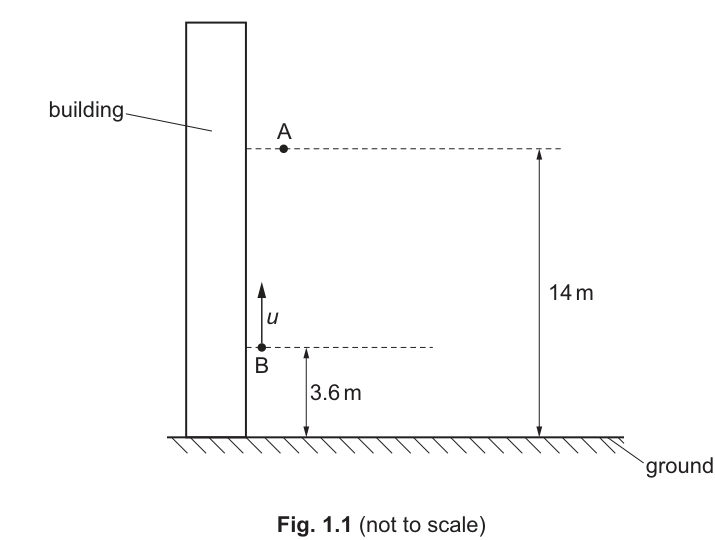
Object A is released from rest at a height of above the horizontal ground.
Object B is released with an initial upwards vertical velocity at a height of above the ground.
Both objects take the same time to reach the ground and they do not collide with each other.
Air resistance is negligible.
Working
For object A: , , .
Answer
1.69 s
Background Concept
For motion with constant acceleration (here, free fall with negligible air resistance), the kinematics equations apply. A useful one is
where:
- is displacement,
- is initial velocity,
- is acceleration,
- is time.
In free fall near Earth, the acceleration magnitude is downward.
Understanding the Question
Object A is released from rest at a height of above the ground. You must find the time to reach the ground. Since it is released from rest and air resistance is negligible, it undergoes constant downward acceleration .
Given:
- ,
- distance fallen ,
- .
Unknown: .
Approach
Take downward as positive (or upward as positive, but be consistent). Then use
and solve for .
Step-by-Step Reasoning
Choose downward positive.
- Displacement to the ground: .
- Initial velocity: .
- Acceleration: .
Substitute into the equation:
Rearrange:
So
(We take the positive root because time is positive.)
Key Takeaways
- Free fall with negligible air resistance means constant acceleration .
- If released from rest, simplifies the equation greatly.
Common Mistakes
- Using (only valid for constant velocity, not accelerating motion).
- Sign errors from mixing “upward positive” with “”.
- Forgetting to square root at the end or giving a negative time.
Things to Be Careful About
- Use a consistent sign convention.
- Use in and height in .
- Quote the time to a sensible number of significant figures (typically 2 or 3).
Working
Take upward as positive. For object B: , , time .
Answer
6.16 m s^-1
Background Concept
For vertical motion under gravity with negligible air resistance, acceleration is constant ( downward). The displacement–time relation is
The key skill is choosing a sign convention and then keeping it consistent for , and .
Understanding the Question
Object B starts at height above the ground, but is thrown upwards with initial vertical speed . It takes the same time to reach the ground as object A, i.e. from (b)(i).
Given:
- ,
- initial height above ground ,
- acceleration due to gravity.
Unknown: the initial upward speed .
Approach
Use the vertical displacement from release point to ground (downwards by ). Choose upward as positive, so the displacement is negative and the acceleration is . Substitute into
and solve for .
Step-by-Step Reasoning
Take upward as positive.
- From release point to the ground, object B moves downward , so
- Initial velocity is upward, so it is .
- Acceleration due to gravity is downward, so
Substitute:
Rearrange to make the subject:
Now use (and ):
This is reasonable: the term is about , and the object only needs to end up lower than it started, so must be a few upwards.
Key Takeaways
- The same kinematics equation applies even when the object is initially thrown upwards.
- The main difficulty is consistent signs for and .
Common Mistakes
- Putting while also using (inconsistent sign convention).
- Using for object B’s displacement (wrong height).
- Forgetting that is the vertical initial velocity in part (b).
Things to Be Careful About
- Keep the direction convention explicit (e.g. “upward positive”).
- Use the time from (b)(i) without rounding too aggressively, to avoid losing accuracy.
- Ensure the final unit is .
In a second experiment, object B is released from the same height and given the same initial speed as in (b) but at a release angle to the vertical, as shown in Fig. 1.2.
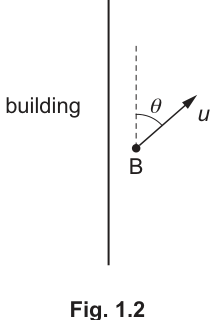
State and explain whether the time taken for object B to reach the ground is less than, the same as or greater than the time in (b)(i).
Answer
Less than.
Vertical component of initial velocity is (smaller than for ). The time to reach the ground depends only on vertical motion (horizontal motion does not affect time), so with a smaller initial upward vertical component, B reaches the ground sooner.
Less than.
Background Concept
In projectile motion (neglecting air resistance):
- Horizontal acceleration is zero, so horizontal velocity is constant.
- Vertical acceleration is constant and equal to downward.
Crucially, the horizontal and vertical motions are independent, meaning the time to reach the ground is determined entirely by the vertical motion.
If a launch speed makes an angle to the vertical, then the components are:
Understanding the Question
In (b), object B was projected straight up with speed from height , and it took time (same as object A).
Now B is launched from the same height and with the same speed , but at an angle to the vertical. You must decide whether the time to hit the ground is less than, the same as, or greater than the time in (b)(i), and explain.
Approach
Compare only the vertical component of the initial velocity, because that is what affects the vertical displacement to the ground. Since for , the upward “delay” is smaller, so the object hits the ground sooner.
Step-by-Step Reasoning
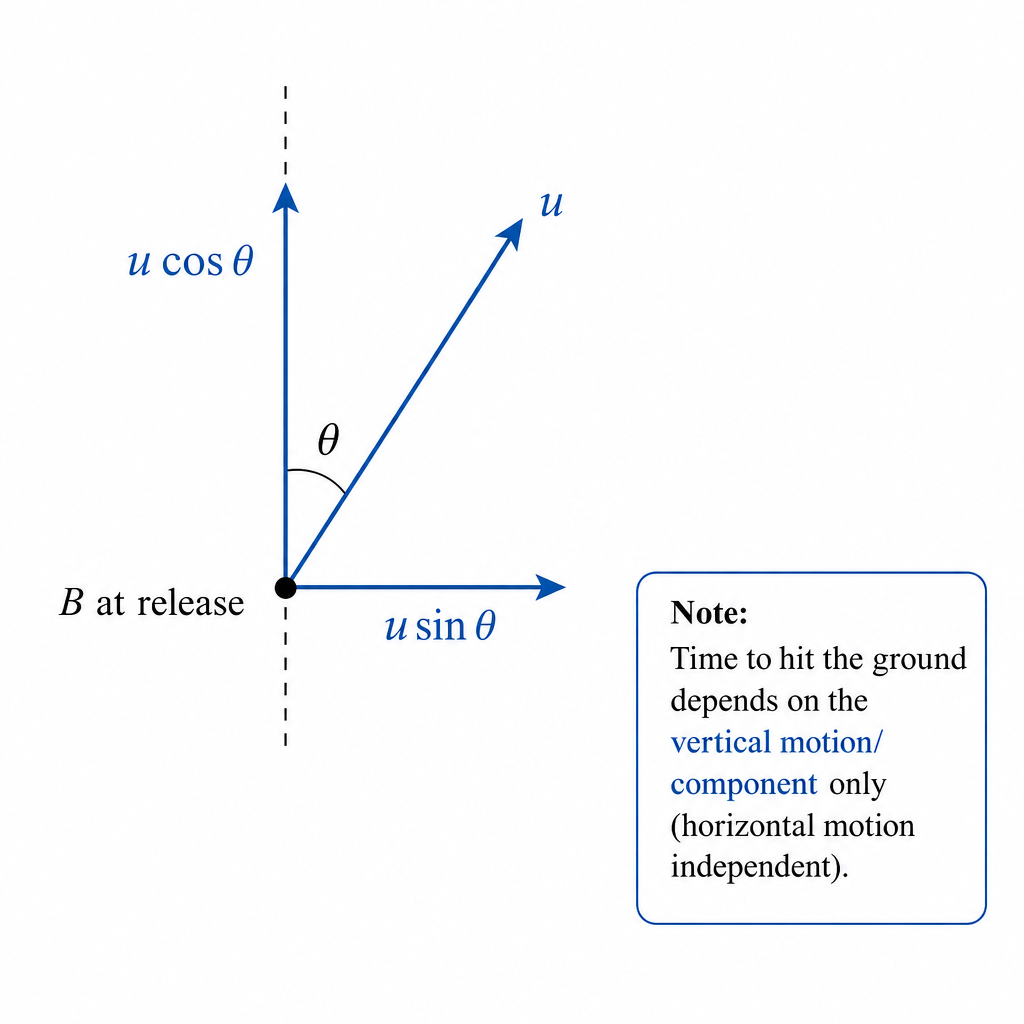
- In (b), initial vertical velocity was .
- In this experiment, initial vertical velocity is
For (angled away from the vertical), , so
That means:
- It rises to a smaller maximum height (or may rise for a shorter time).
- Therefore it spends less time moving upward before descending.
Since the horizontal motion does not change how far it must fall vertically (still to the ground) and does not change the vertical acceleration, the reduced upward vertical component makes the total time to reach the ground less than in (b).
Key Takeaways
- Time of flight depends on the vertical component of velocity and the vertical displacement.
- Changing the horizontal component does not affect the time to hit the ground (if air resistance is neglected).
Common Mistakes
- Saying the time is the same because the speed is the same (direction matters for vertical motion).
- Thinking the horizontal component “adds extra distance so it takes longer” (distance travelled is not what sets the time here; vertical displacement and vertical acceleration do).
- Using as the vertical component (wrong because the angle is to the vertical).
Things to Be Careful About
- The phrase “angle to the vertical” means vertical component is .
- You must explicitly mention independence of horizontal and vertical components to fully justify the comparison.
By considering energy, state and explain the effect of the change in release angle on the speed at which B reaches the ground.
Answer
No effect: the speed at the ground is the same.
Initial kinetic energy is (same because initial speed is unchanged) and loss of gravitational potential energy is (same height). With no air resistance, total mechanical energy is conserved, so final kinetic energy (and hence final speed) is unchanged by the release angle.
No change (same speed at the ground).
Background Concept
With negligible air resistance, mechanical energy is conserved:
Where
Only speed appears in kinetic energy, not direction. Gravitational potential energy depends only on height.
Understanding the Question
Object B is released from the same height ( above the ground) and with the same initial speed as in (b), but now the direction is changed (angle to the vertical).
You are asked: how does changing the release angle affect the speed when it reaches the ground, using an energy argument.
Approach
Compare initial and final mechanical energy:
- Initial energy: .
- Final energy at the ground: (taking ground as zero potential).
Since both and the height are unchanged, the final speed must be unchanged.
Step-by-Step Reasoning
Take the ground as .
Initial (at height ):
Final (at ground):
Conservation of mechanical energy gives:
Cancel and rearrange:
This expression contains and the height only; there is no . Therefore changing the release angle does not change the impact speed (as long as air resistance remains negligible).
Key Takeaways
- Kinetic energy depends on speed, not direction.
- Gravitational potential energy depends only on height.
- With no dissipative forces, impact speed depends only on initial speed and the vertical drop.
Common Mistakes
- Claiming the impact speed is smaller because the vertical component is smaller (vertical component affects time and trajectory, but not total energy).
- Mixing up speed and velocity: direction changes velocity, but speed can be unchanged.
- Forgetting that the object starts above the ground, so there is a gain in kinetic energy from losing gravitational potential energy.
Things to Be Careful About
- The conclusion relies on “air resistance negligible”; with air resistance, different paths could lead to different energy losses.
- Be explicit that same initial speed means same initial kinetic energy .
Answer
For a body in equilibrium, the sum of clockwise moments about any point equals the sum of anticlockwise moments about that point (resultant moment is zero).
In equilibrium, total clockwise moment about a point equals total anticlockwise moment (net moment = 0).
Background Concept
The moment (turning effect) of a force about a point (pivot) is
where is the force and is the perpendicular distance from the pivot to the line of action of the force.
For an object that is not rotating (rotational equilibrium), the resultant moment about any point is zero. This is commonly written as:
Understanding the Question
You are asked to state the principle of moments. So you need a clear sentence relating clockwise and anticlockwise moments for a body in equilibrium.
Approach
Give the standard equilibrium condition in words (and/or symbols): clockwise moments equal anticlockwise moments about the same pivot.
Step-by-Step Reasoning
- In equilibrium, there is no angular acceleration, so the net turning effect must be zero.
- The turning effects are moments, which can be clockwise or anticlockwise.
- Therefore, the total clockwise moment must equal the total anticlockwise moment (about the same point).
Key Takeaways
- Moment perpendicular distance.
- Rotational equilibrium means resultant moment is zero.
- Hence clockwise moments = anticlockwise moments.
Common Mistakes
- Saying “forces are equal” (that is translational equilibrium, not the principle of moments).
- Forgetting to specify “about a point/pivot”.
- Not indicating clockwise vs anticlockwise (or not stating “resultant moment is zero”).
Things to Be Careful About
- The distance must be perpendicular to the line of action of the force.
- The principle applies when the body is in rotational equilibrium (not turning).
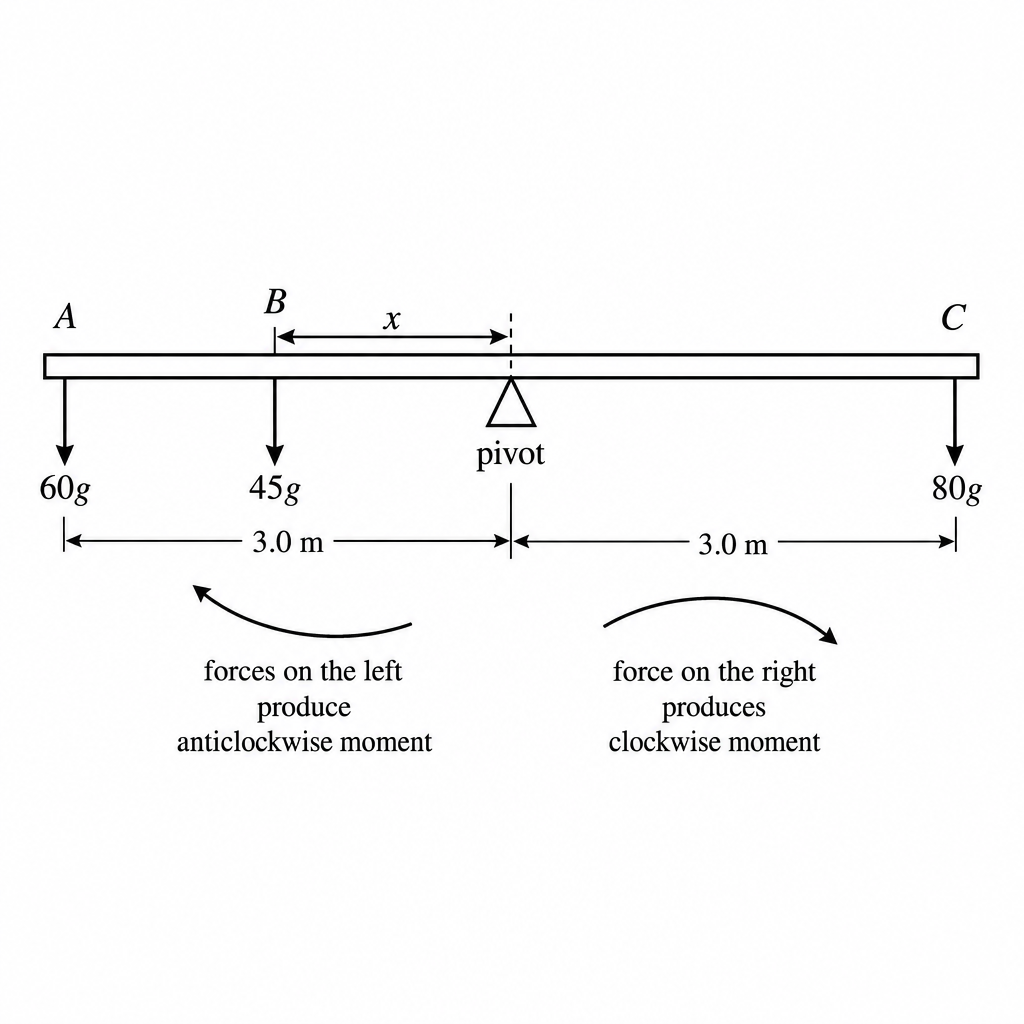
Three objects A, B and C are placed on a horizontal beam. The beam is in equilibrium, as shown in Fig. 2.1.
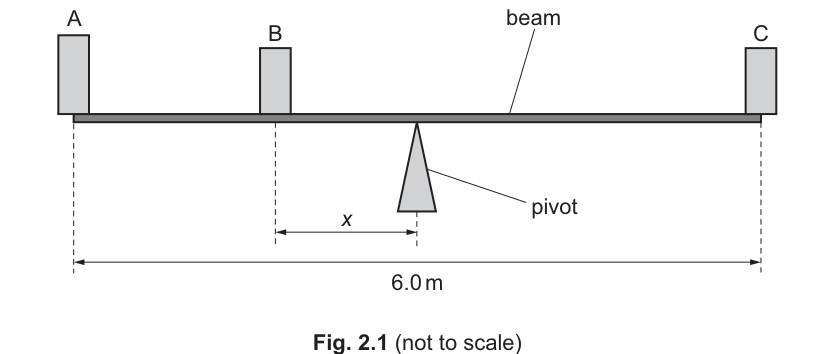
The beam is uniform and has length .
The pivot is at the midpoint of the beam.
Object A has mass and is at one end of the beam.
Object B has mass and is at a distance from the pivot.
Object C has mass and is at the other end of the beam.
Calculate .
= ______
Working
About the pivot (midpoint), distances to ends are .
Anticlockwise moments (left) = clockwise moments (right):
Answer
1.33 m
Background Concept
For a horizontal beam pivoted at a point, each downward weight produces a turning effect (moment) about the pivot:
For equilibrium (no rotation):
With weights, , so moments are often written as . If every force is a weight, the factor cancels.
Understanding the Question
A uniform beam is pivoted at its midpoint, so each end is from the pivot. Masses and are at the ends; mass is on the left side at distance from the pivot. The beam is in equilibrium, so the total moment to the left must balance the total moment to the right.
Approach
- Choose the pivot as the point to take moments about (this eliminates any unknown reaction force at the pivot).
- Write anticlockwise moments (from left-side weights) = clockwise moments (from right-side weights).
- Substitute distances and masses, cancel , and solve for .
Step-by-Step Reasoning
- Distance from pivot to each end:
- Take moments about the pivot.
- On the left: at and at both produce anticlockwise moments.
- On the right: at produces clockwise moment.
So:
Cancel :
Key Takeaways
- Always take moments about the pivot to avoid the unknown pivot reaction.
- For equilibrium, clockwise moments = anticlockwise moments.
- When all forces are weights, cancels.
Common Mistakes
- Using instead of for the distance to the ends.
- Putting on the wrong side of the pivot (it is between and the pivot).
- Forgetting that moments use perpendicular distance.
Things to Be Careful About
- Be consistent with clockwise/anticlockwise sign convention.
- Distances must be measured from the pivot, not from an end of the beam.
- Quote in metres and to a sensible number of significant figures (here 3 s.f. matches the data).
The beam is above horizontal ground.
Object A is removed and replaced by a spring connected to the ground and the beam, as shown in Fig. 2.2.
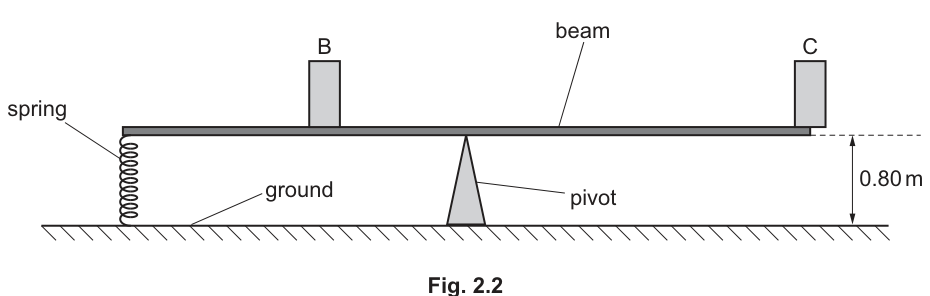
After the change, the beam is again horizontal and in equilibrium. The positions of B and C are unchanged.
The spring has an unstretched length of and obeys Hooke’s law.
Working
From (b), moment balance implies the required downward force at the left end equals the weight of :
Spring length , natural length :
Hooke's law :
Answer
2.8 × 10^3 N m^-1
Background Concept
In equilibrium, a beam must satisfy the principle of moments:
A spring that obeys Hooke’s law provides a force proportional to its extension:
where is the spring constant and is the extension (stretched length minus natural length).
Understanding the Question
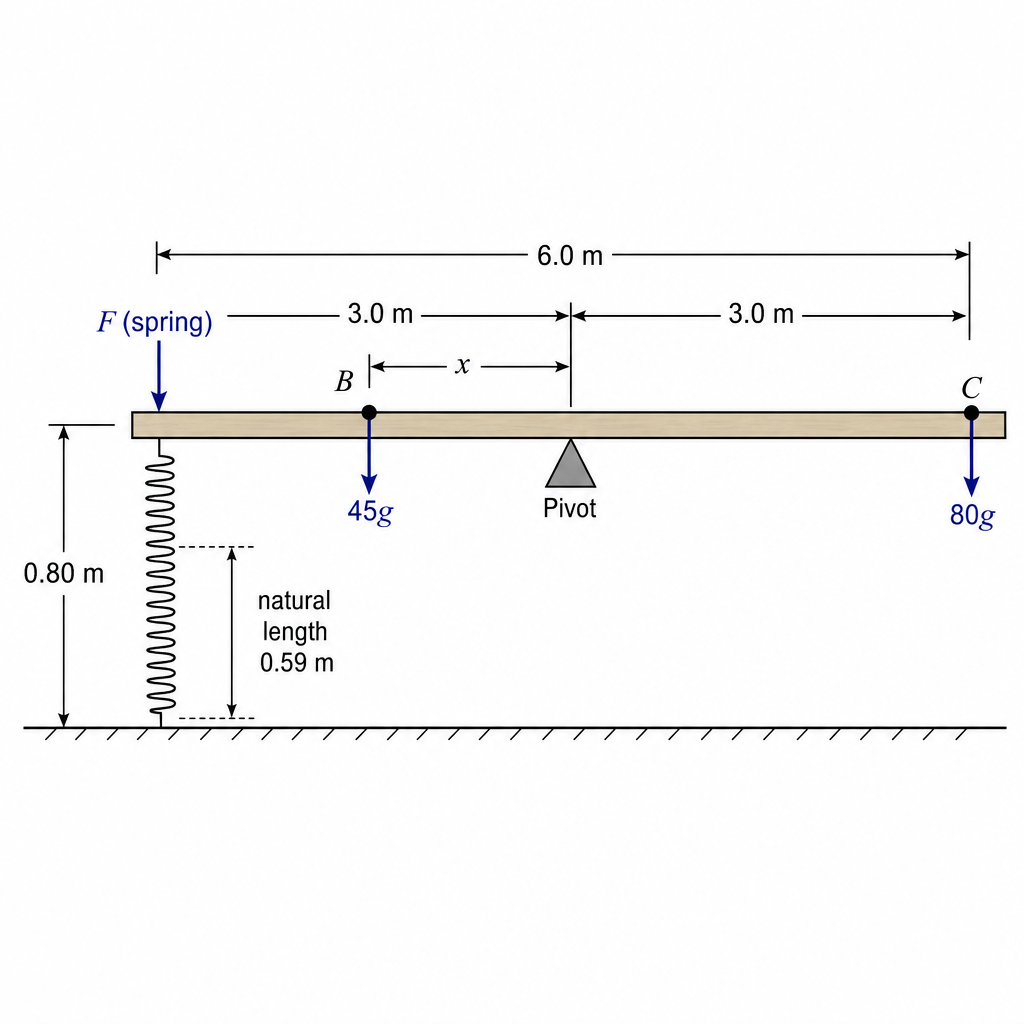
Object (mass ) is removed and replaced by a vertical spring at the left end of the beam. The beam is still horizontal and in equilibrium, with and unchanged from before. The beam is above the ground, so the spring’s actual length is . Its natural (unstretched) length is .
We must find the spring constant .
Approach
- Use the fact that with and unchanged and equilibrium regained, the moment that used to be provided by the weight of A must now be provided by the spring force at the same position (left end).
- Calculate the spring force needed (equal to the previous weight of ).
- Find the extension from the given lengths.
- Use .
Step-by-Step Reasoning
1) Spring force from moments
From part (b), the beam was in equilibrium with a downward force at the left end equal to the weight of , i.e. . When is replaced by a spring at the same point (the left end), and and are unchanged, the moment balance requires the spring to provide the same downward force at that point as before.
So the spring force on the beam is:
(Using would give , essentially the same.)
2) Extension of the spring
Actual length is the beam height above the ground: .
Natural length: .
3) Use Hooke’s law
Key Takeaways
- If only one force is replaced at the same position and equilibrium is restored with all other loads unchanged, the replacement must provide the same moment about the pivot.
- Extension is (stretched length) minus (unstretched length).
- Hooke’s law links force, extension, and spring constant.
Common Mistakes
- Using (giving a negative extension).
- Forgetting that the beam height is the spring’s length.
- Mixing up and .
- Using the full beam length as the moment arm for the spring instead of (if re-deriving from scratch).
Things to Be Careful About
- Units: must be in , so must be in metres.
- A spring pulls back: since it is stretched here, it exerts a downward force on the beam (consistent with replacing the removed weight at that end).
- Significant figures: and imply to 2 d.p.; giving to 2 s.f. or 3 s.f. is acceptable.
Calculate the elastic potential energy of the spring.
elastic potential energy = ______
Working
Using with and :
Answer
62 J
Background Concept
For a spring obeying Hooke’s law, the force increases linearly with extension:
The elastic potential energy stored is the work done stretching it. On a force–extension graph it is the area under the straight line, giving:
Since , an equivalent form is:
Understanding the Question
The spring is stretched from to , so . From part (c)(i), the spring force is about (and ). We need the elastic potential energy stored in the spring.
Approach
Use either (using from part (i)) or (using the spring force and extension). The second is quickest here.
Step-by-Step Reasoning
Extension:
Energy:
So (2 s.f.).
(Checking with gives the same value because .)
Key Takeaways
- Elastic potential energy in a Hooke’s law spring is .
- If you already know the final force and extension , is often fastest.
Common Mistakes
- Using (missing the factor ; the force is not constant while stretching).
- Squaring the spring length instead of the extension.
- Using in cm instead of m.
Things to Be Careful About
- Ensure is the extension, not the natural length or the stretched length.
- Keep units consistent: in N and in m gives in J.
- Round appropriately (typically 2–3 significant figures).
Answer
Power is the rate of doing work (rate of energy transfer), so
Power is the rate of doing work (rate of energy transfer), P = W/t.
Background Concept
Power describes how quickly energy is transferred or how quickly work is done.
Work done is energy transferred by a force, measured in joules (J). Time is measured in seconds (s). Power is measured in watts (W), where .
The definition is:
Understanding the Question
You are asked to define power, so you should give the meaning in words (rate of doing work / energy transfer per unit time) and may include the defining equation.
Approach
Use the standard definition: power is work done per unit time.
Step-by-Step Reasoning
- Work done (or energy transferred) is .
- If this happens in time , then the amount per second is .
- Therefore the power is
Key Takeaways
- Power is a rate quantity.
- Unit link: .
Common Mistakes
- Writing the equation for mechanical power as the definition without mentioning it is a special case for constant speed in the direction of the force.
- Defining power as “energy” rather than “energy per unit time”.
Things to Be Careful About
- Use “rate of doing work” or “rate of energy transfer” (either is fine).
- Do not confuse power (W) with energy (J).
An electric car is powered by a motor. The car is travelling at a constant speed of along a straight horizontal road, as shown in Fig. 3.1.
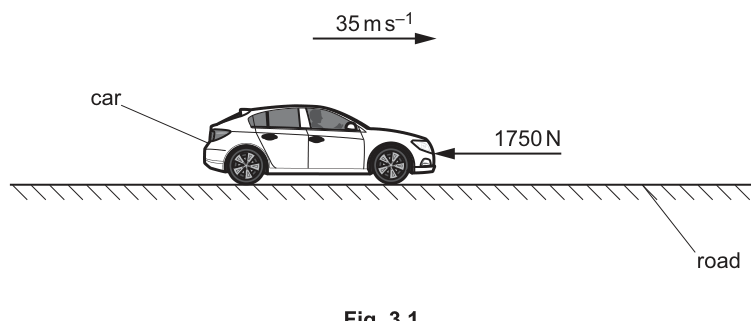
There is a total resistive force of acting on the car.
Working
At constant speed, driving force balances resistive force, so
Answer
6.1 × 10^4 W
Background Concept
For an object moving at constant speed, the mechanical power transferred by a force parallel to the motion is
where is the force (N) and is the speed (m s). This comes from combining with and .
Understanding the Question
The car travels at constant speed on a horizontal road, with a total resistive force of . At constant speed, the motor must provide a driving force equal in magnitude to the resistive force. You are asked for the power transmitted to the wheels (mechanical output power).
Approach
Use the constant-speed power relation with and .
Step-by-Step Reasoning
At constant speed on a horizontal road:
- Resultant force is zero.
- Driving force from the wheels equals resistive force in magnitude.
So the motor’s output power at the wheels is
Rounding to appropriate s.f. gives about .
Key Takeaways
- Constant speed implies no acceleration and therefore balanced forces.
- Mechanical power at constant speed is found from .
Common Mistakes
- Using (electrical power) instead of mechanical power at the wheels.
- Forgetting that at constant speed the driving force equals the resistive force.
Things to Be Careful About
- Use SI units: N and m s give watts automatically.
- Do not add extra forces (e.g. weight) on a horizontal road for the along-motion calculation.
Calculate the useful work done by the motor when the car travels a distance of .
work done = ______
Working
Answer
3.0 × 10^7 J
Background Concept
Work done by a constant force acting in the direction of motion over distance is
Work is measured in joules (J), where .
Understanding the Question
The car travels a distance of at constant speed. The useful work done by the motor is the mechanical energy transferred to overcome the resistive force over that distance. The resistive force magnitude is .
Approach
Convert to metres, then use .
Step-by-Step Reasoning
Convert distance:
Calculate work:
Rounded suitably:
Key Takeaways
- For a constant opposing force, energy required grows linearly with distance.
- Always convert km to m before using in SI units.
Common Mistakes
- Leaving the distance in kilometres, giving an answer too small by a factor of .
- Using without finding the time (unnecessary here).
Things to Be Careful About
- Use the correct force: it is the resistive force that must be overcome at constant speed.
- Quote the final answer in J and preferably in standard form for large values.
The potential difference (p.d.) across the motor has a constant value of and the motor has an efficiency of .
Calculate the current in the motor.
current = ______
Working
From (i), mechanical output power:
Efficiency:
Electrical power :
Answer
120 A
Background Concept
Efficiency compares useful output to total input:
Electrical input power for a device with p.d. and current is
Understanding the Question
The motor produces the mechanical power needed to keep the car moving (found in part (i)). The p.d. across the motor is constant at , and the motor efficiency is . You must find the current drawn, so you need the electrical input power, then use .
Approach
- Take the mechanical power at the wheels as .
- Use to find .
- Use .
Step-by-Step Reasoning
From part (i):
Efficiency is , so
Using with :
Key Takeaways
- Mechanical output power and electrical input power differ when efficiency is below 100%.
- Convert percentage efficiency to a decimal before using it.
- Use to relate electrical power, p.d. and current.
Common Mistakes
- Multiplying by instead of dividing (mixing up input and output).
- Using directly (that would only be true for 100% efficiency).
- Keeping efficiency as instead of .
Things to Be Careful About
- Be clear: here is the power at the wheels (useful mechanical power).
- Round only at the end to avoid rounding error (especially before dividing by ).
The car in (b) now reaches a slope, as shown in Fig. 3.2.
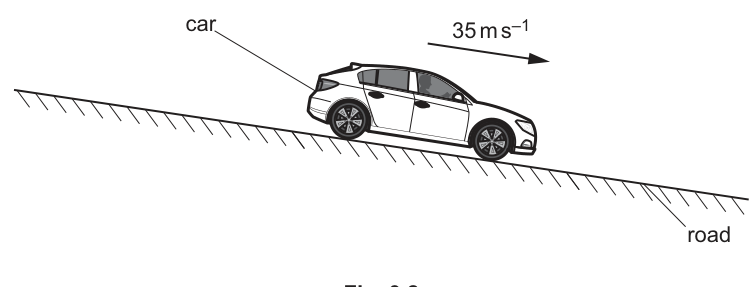
The car continues down the slope at the same speed as in (b).
State and explain the effect, if any, of the slope on:
Answer
No change: at the same speed, the air resistance is the same (air resistance depends on speed through the air, not on whether the road is sloping).
No change (same speed ⇒ same air resistance).
Background Concept
Air resistance (drag) depends mainly on the object’s speed relative to the air (often approximately proportional to or depending on the regime), and on factors like shape and frontal area.
Understanding the Question
The car goes down a slope but continues at the same speed as before (). You are asked whether the slope changes the air resistance.
Approach
Compare what determines drag in the two situations: if speed and car shape are unchanged, then drag is unchanged.
Step-by-Step Reasoning
- The car’s speed is stated to be the same as in part (b).
- With the same speed (and assuming similar wind conditions), the drag force due to air remains the same.
- The road being sloped changes components of weight along the road, but does not directly change the airflow speed past the car.
Key Takeaways
- Drag depends on speed through the air, not on the slope angle of the road.
Common Mistakes
- Saying drag increases because the car is “going downhill” (it is not going faster here).
- Mixing up air resistance with the component of weight down the slope.
Things to Be Careful About
- The question explicitly states the speed is unchanged; that is the key clue.
- In real life, wind could change the relative speed, but exam questions usually assume still air unless stated.
Answer
Current decreases: on the slope, a component of weight acts down the slope and helps the motion, so the motor needs a smaller driving force (and smaller power at the same speed), hence smaller electrical power and smaller current.
Decreases.
Background Concept
For motion at constant speed, the resultant force along the direction of motion is zero.
On a slope of angle , the weight has a component down the slope:
Mechanical power from the motor (when driving) is
and electrical input power is related to current by (for fixed , smaller power means smaller current).
Understanding the Question
The car now travels down a slope at the same constant speed as before. Air resistance is unchanged (part (c)(i)), and the resistive forces still oppose the motion. The new feature is that gravity has a component along the slope in the direction of motion, which reduces how much force the motor must supply to maintain the same speed.
Approach
- Draw/think of the forces along the slope.
- Use constant speed condition (forces along slope balance).
- Conclude the required driving force is smaller than on the horizontal, so the motor output power is smaller at the same speed.
- With the same p.d. across the motor, smaller input power implies smaller current.
Step-by-Step Reasoning
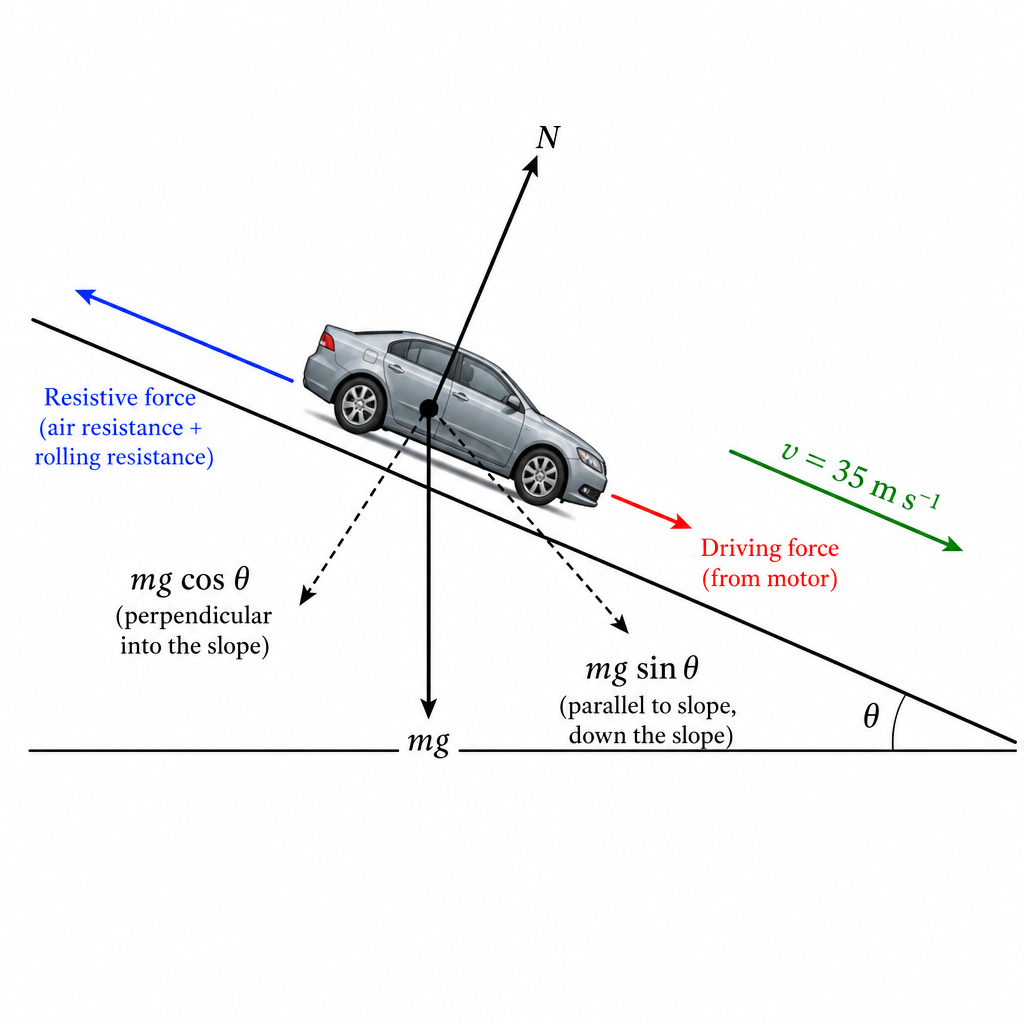
- On the horizontal road, the motor must supply a driving force equal to the total resistive force to keep speed constant.
- On a downhill slope, the component of weight down the slope acts in the same direction as the motion.
- Therefore the force balance along the slope becomes (qualitatively):
So
which is smaller than .
At the same speed , the useful mechanical power is
so decreases.
Since the p.d. is constant, electrical input power also decreases, and using :
shows the current decreases.
(If were larger than the resistive force, the motor might need to provide no driving power and could even act as a generator/brake, but the mark here is for “smaller current”.)
Key Takeaways
- Constant speed means forces along the direction of motion balance.
- Downhill, assists motion, reducing required driving force.
- Reduced mechanical power demand implies reduced electrical power and hence reduced current for constant .
Common Mistakes
- Saying current increases because the car is on a slope (downhill actually reduces the required motor effort at fixed speed).
- Ignoring the component of weight along the slope.
- Claiming air resistance changes because of the slope (it changes mainly with speed).
Things to Be Careful About
- Direction matters: downhill means the weight component is in the direction of motion.
- Do not assume the motor must always provide the same force; constant speed does not mean constant driving force when the slope changes.
- The question asks for the effect on current: link force (\rightarrow) power (\rightarrow) current.
Answer
When two (or more) waves overlap, the resultant displacement at any point is the (vector/algebraic) sum of the individual displacements of the waves at that point.
The resultant displacement is the sum of the individual displacements.
Background Concept
The principle of superposition applies to waves in a linear medium (i.e. where waves do not permanently change each other when they pass). Each wave produces its own displacement of the medium (or field, for electromagnetic waves).
Superposition states that when waves overlap, the medium responds to all of them at once. The total displacement is found by adding the displacements from each wave.
Understanding the Question
You are asked to state the principle. That means a concise definition, not an example.
Key idea to include for full credit:
- “resultant displacement at a point”
- equals the “sum of individual displacements” (algebraic sum, including sign)
Approach
Write a single sentence definition:
- mention overlap/superpose
- mention resultant displacement
- mention sum of displacements of the individual waves
Step-by-Step Reasoning
- Identify the quantity that superposes: displacement (not intensity).
- State what happens during overlap: the displacements combine.
- Express combination rule: resultant displacement equals the algebraic (or vector) sum of the separate displacements at the same position and time.
Key Takeaways
- Superposition adds displacements, not intensities.
- It is a point-by-point, instant-by-instant rule.
Common Mistakes
- Saying “intensities add” (only true in special cases; generally incorrect for interference).
- Forgetting to specify “at a point” and “at that instant”.
Things to Be Careful About
- Use the word displacement (Cambridge expects that phrasing).
- “Algebraic sum” implies sign: upward and downward displacements can cancel.
Light of wavelength is incident normally on a double slit, as shown in Fig. 4.1.
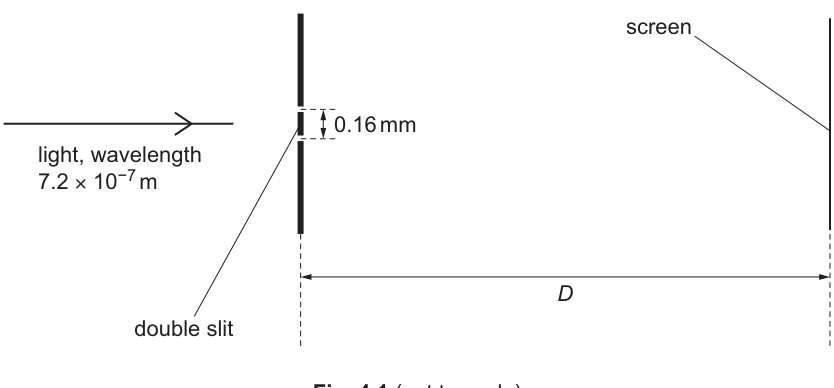
A screen is at a distance from the double slit. The double slit and the screen are parallel.
The separation of the slits in the double-slit arrangement is . The resulting interference pattern on the screen contains nine dark fringes, as shown in Fig. 4.2.
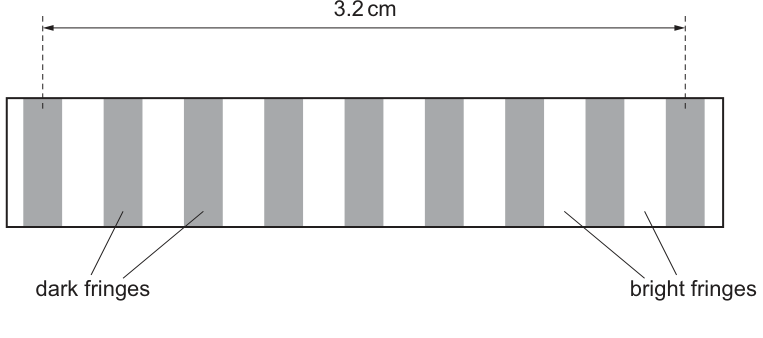
The distance between the centres of the first and ninth dark fringes is .
Working
Distance from 1st to 9th dark fringe contains spacings, so
For double-slit fringes,
So
Answer
0.89 m
Background Concept
In Young’s double-slit interference, light from two coherent slits acts like two coherent sources. At a point on a distant screen, the path difference between the two rays determines whether interference is constructive (bright) or destructive (dark).
For small angles (screen far compared with slit separation), the spacing between adjacent bright fringes (and also adjacent dark fringes) is
where:
- is the fringe spacing on the screen,
- is the wavelength,
- is the slit-to-screen distance,
- is slit separation.
This comes from and , giving between successive fringes.
Understanding the Question
You are given:
- wavelength ,
- slit separation ,
- nine dark fringes are shown,
- distance between centres of the 1st and 9th dark fringes is .
You must find the screen distance .
The key interpretation point: “between the 1st and 9th dark fringes” means there are 8 gaps (8 equal spacings) between them.
Approach
- Convert the given 3.2 cm into a single fringe spacing by dividing by the number of spacings (8).
- Convert slit separation into metres.
- Use and rearrange for .
Step-by-Step Reasoning
-
Count spacings:
- Dark fringes numbered 1 through 9.
- Spacings between their centres: .
-
Find the fringe spacing :
- Convert slit separation:
- Rearrange the double-slit formula:
- Substitute:
So .
Key Takeaways
- Adjacent dark fringes have the same spacing as adjacent bright fringes.
- When given a distance spanning several fringes, divide by the number of intervals, not the number of fringes.
- Use with consistent SI units.
Common Mistakes
- Dividing by 9 instead of 8.
- Not converting to or to .
- Using and swapped (writing ).
Things to Be Careful About
- Significant figures: inputs are mostly 2 s.f., so to 2 s.f. is appropriate.
- The small-angle approximation is assumed in this standard A-level formula; the diagram implies so it is valid here.
The slit separation is now gradually decreased from to . The distance between the centres of adjacent dark fringes is .
On Fig. 4.3, sketch the variation of with slit separation.
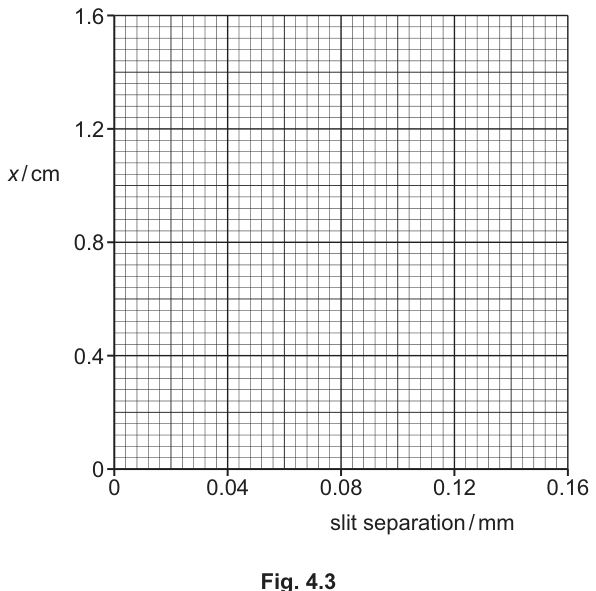
Answer
Using with constant, .
So the sketch is a decreasing inverse curve (rectangular hyperbola): as slit separation decreases, increases.
It passes through approximately:
- ,
- ,
x is inversely proportional to slit separation (decreasing hyperbola).
Background Concept
For a double-slit pattern at small angles, the fringe spacing is
If the wavelength and the slit-to-screen distance are unchanged, then the only variable affecting fringe spacing is the slit separation .
This gives an inverse proportionality:
So reducing slit separation increases the spacing of the fringes.
Understanding the Question
The slit separation is changed gradually from down to . You must sketch how the distance between adjacent dark fringes, , varies with slit separation.
You are not asked to compute many points; a correct shape with correct key values is what gains marks.
From part (i), when the fringe spacing is
The axes on Fig. 4.3 are:
- horizontal: slit separation / mm (up to 0.16 mm)
- vertical: / cm (up to 1.6 cm)
This strongly hints that at 0.04 mm, reaches the top of the axis.
Approach
- Start from .
- Treat and as constants, so is inversely proportional to .
- Use scaling: if is reduced by a factor of 4 (0.16 mm to 0.04 mm), then increases by a factor of 4.
- Sketch a smooth inverse curve through the key points.
Step-by-Step Reasoning
- Write the dependence:
- Use the known point from the original arrangement:
- at , .
- Find at by proportionality:
So
- Sketch:
- The curve must go downwards as increases.
- It is not a straight line (because ).
- It should pass through (0.04, 1.6) and (0.16, 0.40) and be smoothly curved.
Key Takeaways
- In double-slit interference, decreasing slit separation spreads the fringes out.
- Recognise and sketch an inverse proportionality: gives a hyperbola.
Common Mistakes
- Drawing a straight line (suggesting or changes linearly).
- Drawing the trend the wrong way round (thinking smaller separation means smaller spacing).
- Forgetting to use the given axis limits to place the point at .
Things to Be Careful About
- Ensure you interpret the axes correctly: is on the vertical axis in cm, slit separation on the horizontal axis in mm.
- The curve should be smooth and decreasing; it should not kink or become horizontal over this range.
Working
In one period , the wave travels one wavelength , so
Also
Hence
Answer
v = f\lambda
Background Concept
For a progressive wave:
- Wavelength is the distance between two successive points in phase (e.g. crest to crest).
- Period is the time for one complete oscillation.
- Frequency is the number of oscillations per second, so .
- Wave speed is the distance travelled per unit time.
A key idea is: in the time for one complete cycle (), the pattern of the wave advances by exactly one wavelength ().
Understanding the Question
You are asked to derive the wave equation
using only the definitions of speed, frequency, and wavelength. So you must link these definitions through the period .
Approach
- Use the definition of speed: .
- Choose a time interval that makes the distance easy to express: one period .
- In time , the wave moves forward by one wavelength , so .
- Replace using the definition of frequency .
Step-by-Step Reasoning
In one period , one complete cycle passes a point. Over that time, the wave profile advances by one wavelength, so the distance travelled is .
So by the definition of speed:
From the definition of frequency (cycles per second):
Substitute into :
Key Takeaways
- Using the interval of one period is the simplest way to connect , , and .
- The equation is essentially “speed = (cycles per second) (metres per cycle)”.
Common Mistakes
- Writing or (mixing up how frequency relates to period).
- Not explicitly stating that in one period the wave travels one wavelength.
Things to Be Careful About
- Frequency is not the same as period: always use .
- This derivation assumes a steady wave speed in a uniform medium.
A source of sound waves of frequency is travelling at a constant velocity of .
A stationary observer has a microphone connected to a cathode-ray oscilloscope (CRO). The microphone detects the sound waves as the source moves directly towards the observer.
The resulting trace on the CRO is shown in Fig. 5.1.
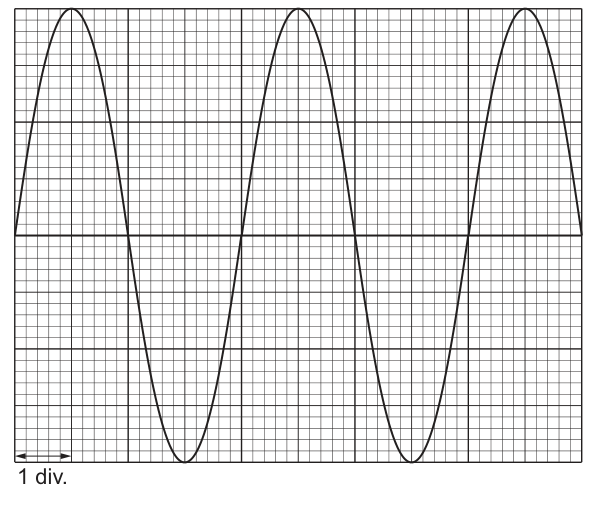
The time-base on the CRO is set to .
Calculate the frequency of the sound waves detected by the microphone.
frequency = ______
Working
From the CRO trace, one cycle occupies divisions.
Time-base , so
Answer
2.5 × 10^2 Hz
Background Concept
A cathode-ray oscilloscope (CRO) time-base tells you the time per horizontal division. If you can measure the period (time for one complete cycle) from the screen, you can find frequency using
Understanding the Question
The microphone detects the sound as the source moves towards the observer, producing a sinusoidal trace. You are given the time-base setting . You must read off the period from the trace (count divisions for one complete cycle) and then calculate the frequency.
Approach
- Pick two identical points on the wave (e.g. crest to next crest).
- Count the number of horizontal divisions between them: this gives divisions per period.
- Convert divisions to time using per division to get .
- Use .
Step-by-Step Reasoning
From the trace, one complete cycle spans about horizontal divisions.
Each division corresponds to , so the period is
Now calculate the frequency:
Key Takeaways
- CRO frequency questions are nearly always: measure from divisions then use .
- Convert to before taking the reciprocal to avoid powers-of-ten errors.
Common Mistakes
- Counting divisions for multiple cycles but forgetting to divide by the number of cycles.
- Using instead of .
- Leaving the period in ms and treating it as seconds.
Things to Be Careful About
- Choose clear, matching points (crest-to-crest or same zero-crossing direction) to avoid a half-cycle error.
- Use as many divisions as possible (e.g. measure over several cycles and divide) to reduce reading uncertainty.
Working
For a source moving towards a stationary observer,
So
With (from (i)), and ,
Answer
3.6 × 10^2 m s^-1
Background Concept
The Doppler effect describes how the observed frequency changes when there is relative motion between source and observer.
For a source moving towards a stationary observer in a medium where the wave speed is :
where
- is the emitted frequency,
- is the detected (observed) frequency,
- is the speed of the source towards the observer,
- is the speed of sound in air.
The minus sign in is because the moving source reduces the wavelength in front of it, increasing the detected frequency.
Understanding the Question
You are told:
- emitted frequency ,
- source speed towards the observer ,
- from the CRO trace you found the detected frequency .
You must use these to find the speed of sound .
Approach
- Use the Doppler formula for a moving source towards a stationary observer.
- Rearrange it to make the subject (because is unknown).
- Substitute , , and and calculate.
- Check the answer is of the right order (a few hundred ).
Step-by-Step Reasoning
Start with
Multiply both sides by :
Expand the left side:
Collect the terms on one side:
Factor out :
So
Substitute , , :
This is a plausible value for the speed of sound in air.
Key Takeaways
- Choose the correct Doppler expression for the situation (moving source, stationary observer).
- Rearranging algebra carefully is essential when the wave speed is the unknown.
- Moving source towards observer gives .
Common Mistakes
- Using the wrong sign: writing for a source approaching (would wrongly reduce ).
- Using the formula for a moving observer instead of a moving source.
- Substituting in the wrong place (e.g. adding it to rather than subtracting).
Things to Be Careful About
- Ensure is positive for an approaching source (since ).
- Use consistent units (here frequencies in Hz and speed in ).
- Round sensibly (typically 2–3 s.f. unless instructed otherwise).
A nichrome wire X of length and cross-sectional area is connected into the circuit shown in Fig. 6.1.
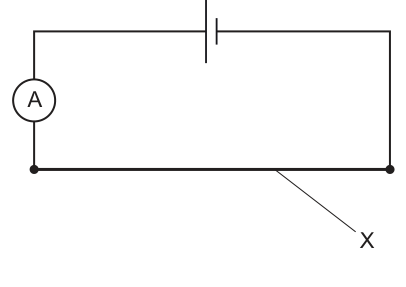
The resistance of X is . The cell has electromotive force (e.m.f.) and negligible internal resistance.
Working
Answer
1.2 A
Background Concept
For a conductor that obeys Ohm’s law, the current through it is related to the potential difference across it and its resistance by
If the cell has negligible internal resistance, the full e.m.f. appears across the external circuit component(s).
Understanding the Question
Wire has resistance and is connected directly to a supply (internal resistance negligible). The question asks for the current in .
Approach
Use Ohm’s law with across :
Step-by-Step Reasoning
Substitute the given values:
To appropriate significant figures, this is .
Key Takeaways
- With negligible internal resistance, across the load equals the e.m.f.
- Current is found directly from .
Common Mistakes
- Using or other incorrect unit.
- Rounding too aggressively (e.g. writing ).
Things to Be Careful About
- Quote the unit ().
- Use a sensible number of significant figures consistent with the data (typically 2 s.f. here).
The number density of charge carriers (electrons) in nichrome is .
Calculate the average drift speed of the charge carriers in X.
average drift speed = ______
Working
Answer
1.8 × 10^-4 m s^-1
Background Concept
When charge carriers move through a conductor, their average drift speed is linked to the current by
where:
- is number density of charge carriers (),
- is cross-sectional area (),
- is charge per carrier ( for an electron),
- is the drift speed ().
This comes from “current = charge passing per second” and the fact that in time the carriers in a length of wire pass a cross-section.
Understanding the Question
You are given for nichrome, the wire area , and (from part (a)(i)) the current in . You must calculate the average drift speed of electrons in wire .
Approach
- Use the current from (a)(i).
- Rearrange to make the subject.
- Substitute values carefully in standard form.
Step-by-Step Reasoning
Start from
Rearrange:
Substitute , , , :
Combine powers of ten: , so the denominator is of order .
Evaluating gives
This very small speed is normal: the signal travels fast, but individual electrons drift slowly.
Key Takeaways
- Use for drift speed.
- Drift speed is typically tiny (often to in metals).
Common Mistakes
- Forgetting .
- Using in instead of .
- Mixing up (number density) with the number of electrons.
Things to Be Careful About
- Keep everything in SI units.
- Check powers of ten: is huge, so should come out small.
- Quote as the unit.
Working
Answer
1.1 × 10^-6 Ω m
Background Concept
Resistivity is a material property that relates resistance to geometry:
where is the length of the conductor and is its cross-sectional area. For a uniform wire of the same material, increasing increases and increasing decreases .
Understanding the Question
The wire has:
- ,
- ,
- .
You are asked for the resistivity of nichrome, , in .
Approach
- Convert the length to metres.
- Rearrange to .
- Substitute values and present in standard form.
Step-by-Step Reasoning
Convert length:
Rearrange the resistivity equation:
Substitute:
Calculate , so
Key Takeaways
- Resistivity is found from .
- Always convert lengths to metres for .
Common Mistakes
- Leaving as (gives a result wrong by a factor of 100).
- Using (incorrect rearrangement).
- Omitting the unit .
Things to Be Careful About
- The unit of resistivity is (not ).
- Standard form is usually expected because for metals is often around to .
Wire Y is identical to wire X. Wire Y is added to the circuit in parallel with wire X, as shown in Fig. 6.2.
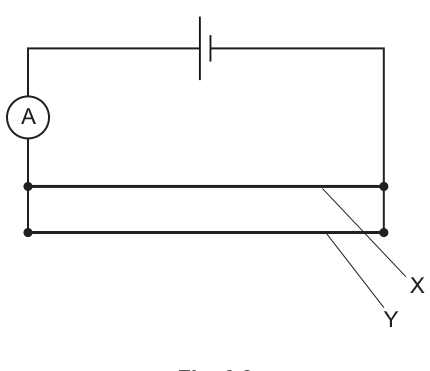
State and explain the effect, if any, of this change on:
Answer
Two identical wires in parallel give
So the total current is
i.e. the ammeter reading increases (approximately doubles).
Increases (approximately doubles to about 2.4 A).
Background Concept
For resistors in parallel, the potential difference across each branch is the same, and the total current is the sum of branch currents. The equivalent resistance satisfies
For two identical resistances in parallel, this simplifies to
With a fixed supply voltage , the total current drawn is
Understanding the Question
Initially, only wire is connected, so the circuit resistance is and the ammeter reads the current through .
Then an identical wire is added in parallel with , while the cell e.m.f. remains (internal resistance negligible). The question asks what happens to the ammeter reading (which is in the main line, so it measures the total current from the cell).
Approach
- Find the new equivalent resistance of the parallel pair.
- Use to determine how the total current changes.
- State the change and link it to the decrease in resistance.
Step-by-Step Reasoning
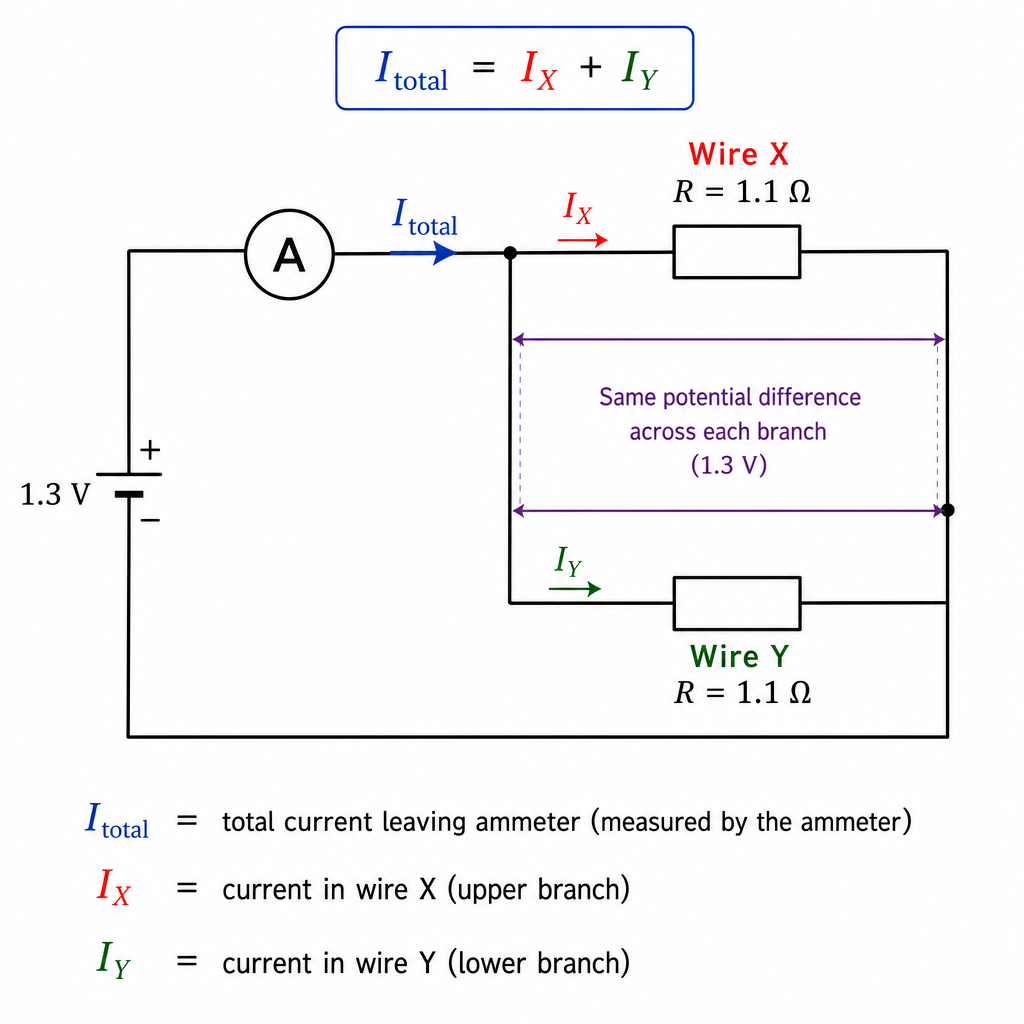
Each wire has . With two in parallel:
The supply voltage is still , so the total current becomes
Compare with the original current : it has doubled, because the equivalent resistance has halved.
Key Takeaways
- Adding a parallel branch reduces total resistance.
- With constant supply voltage, reduced resistance means increased total current.
- The main-branch ammeter reads the sum of currents in the parallel branches.
Common Mistakes
- Treating the two wires as series (incorrectly giving and a smaller current).
- Saying “current splits so the ammeter reading stays the same” (the ammeter is before the split, so it measures the total).
Things to Be Careful About
- “Negligible internal resistance” means the voltage across the external circuit stays at even when current changes.
- Be clear whether you mean current in a branch or total current from the supply.
Answer
The p.d. across is still (parallel branches), so
is unchanged. Since from , the drift speed in is unchanged.
Unchanged.
Background Concept
In a parallel circuit:
- Each branch has the same potential difference as the supply.
- The current in each branch depends only on that branch’s resistance:
Drift speed is linked to current by
So if the current in wire does not change, the drift speed in does not change.
Understanding the Question
After adding identical wire in parallel, the total current from the cell increases, but the question specifically asks about the drift speed of charge carriers in wire .
Approach
- Decide whether the current in wire changes.
- Use the parallel-circuit rule: same p.d. across each branch.
- Use for fixed , , and .
Step-by-Step Reasoning
Because the cell has negligible internal resistance, the supply voltage is . In a parallel arrangement, the p.d. across each branch is the supply p.d., so the p.d. across remains .
Wire still has resistance , hence its branch current is still
In the drift-speed equation , the quantities , , and for wire are unchanged, so unchanged means unchanged .
Key Takeaways
- Adding a parallel branch changes total current, but not necessarily the current in an unchanged branch.
- Drift speed in a given wire depends on the current in that wire, not the total circuit current.
Common Mistakes
- Thinking the current in halves because “current splits equally”; the total splits, but the p.d. across each branch stays the same.
- Using the new total current in the drift-speed formula for wire .
Things to Be Careful About
- The conclusion relies on negligible internal resistance: the supply voltage stays at .
- Be explicit that it is (branch current) that matters for drift speed in .
Nitrogen-12 () is an unstable isotope of nitrogen that decays by the emission of radiation to carbon-12 ().
Complete the full nuclear equation for the decay, including all the particles involved.
Working
Conserve nucleon number and proton number .
so emitted particles have .
so emitted particle must have (positron) and include a neutrino.
Answer
^{12}{7}N -> ^{12}{6}C + ^{0}{+1}e + ^{0}{0}nu_e
Background Concept
In nuclear decay equations, two quantities must be conserved:
- Nucleon number (total number of protons + neutrons).
- Proton number (also called atomic number).
In (\beta^+) (positron) decay, a proton in the nucleus changes into a neutron:
So, for the nucleus:
- stays the same (still the same total number of nucleons).
- decreases by 1 (one less proton).
A neutrino () is included because it is required to conserve lepton number and helps satisfy energy and momentum conservation in the decay.
Understanding the Question
You are told that unstable nitrogen-12 decays to carbon-12 by emission of radiation, and you must complete the full nuclear equation including all particles.
Given:
- Initial nuclide:
- Final nuclide:
Unknown:
- What emitted particle(s) make the equation balance in both and .
Approach
- Compare values: if unchanged, emitted particle(s) must have .
- Compare values: if decreases by 1, the decay corresponds to emission (or electron capture, but the question says emission).
- Write the emitted positron as and include an electron neutrino .
Step-by-Step Reasoning
- Check nucleon number:
So emitted particle(s) must have .
- Check proton number:
So the emitted particle(s) must carry away net proton number (so that ). The particle with and is a positron (): .
- Include the neutrino (required in decay): .
So the completed equation is:
Key Takeaways
- Balance both and in nuclear equations.
- If decreases by 1 with unchanged, it is typically positron emission ().
- In beta decays, include the appropriate (anti)neutrino.
Common Mistakes
- Omitting the neutrino.
- Writing an electron () instead of a positron ().
- Changing the nucleon number (e.g. writing an alpha particle, which would reduce by 4).
Things to Be Careful About
- The question says emission, which points to emission rather than electron capture.
- Ensure the positron is written with and .
- Use correct nuclide notation: .
Hydrogen-1 () is an isotope of hydrogen. An atom of hydrogen-1 comprises a proton with an orbiting electron.
An antiparticle equivalent of hydrogen-1 comprises an antiproton with an orbiting positron. The antiquarks in the antiproton are the antiparticles of the quarks in a proton.
Answer
Charge on a positron .
+1
Background Concept
The elementary charge is the magnitude of the charge on a proton.
- Proton has charge .
- Electron has charge .
- A positron is the antiparticle of the electron, so it has the same mass as the electron but opposite charge.
Understanding the Question
You are asked for the positron charge written in terms of , i.e. you only need the sign and coefficient multiplying .
Approach
Recall that the positron is the electron’s antiparticle, so its charge is the opposite of the electron’s.
Step-by-Step Reasoning
- Electron charge is .
- Therefore positron charge is , i.e. .
Key Takeaways
- Positron = anti-electron.
- Anti-particles have opposite charge to their corresponding particles.
Common Mistakes
- Writing by confusing the positron with the electron.
- Writing or including units (not needed here because the question already gives ).
Things to Be Careful About
- The answer line is “charge = ____ ”, so you should write just the number and sign, e.g. .
Answer
The positron is a lepton.
Lepton
Background Concept
Fundamental particles (in this syllabus context) are grouped into:
- Leptons (e.g. electron, positron, neutrinos, muons).
- Hadrons, which are made of quarks (baryons and mesons).
A positron is the antiparticle of the electron, and electrons are leptons.
Understanding the Question
You are asked for the group/class of fundamental particle that the positron belongs to.
Approach
Identify what family the electron belongs to, then note that the positron is its antiparticle (same family).
Step-by-Step Reasoning
- Electron is a lepton.
- Positron is the electron’s antiparticle.
- Therefore the positron is also a lepton.
Key Takeaways
- Leptons are not made of quarks.
- Positron is a lepton (not a hadron).
Common Mistakes
- Saying “baryon” because it is involved in atoms (confusing it with protons/antiprotons).
- Saying “antimatter” as the class (that describes the nature, not the particle family).
Things to Be Careful About
- “Fundamental particle group” here means lepton vs hadron, not “fermion/boson”.
In Table 7.1, state the flavour and charge of the three antiquarks that comprise the antiproton.
Table 7.1
| flavour | charge/ |
|---|---|
Working
Proton .
Antiproton .
Charges: ; .
Answer
- , charge
- , charge
- , charge
anti-up (−2/3), anti-up (−2/3), anti-down (+1/3)
Background Concept
A baryon is made of three quarks. The proton is a baryon with quark content:
Quark charges (in units of ):
- Up quark:
- Down quark:
An antiquark has the same mass as the corresponding quark but opposite charge and other quantum numbers. So:
- has charge
- has charge
An antiproton is the antiparticle of the proton, so it contains the corresponding antiquarks.
Understanding the Question
You must fill Table 7.1 with the flavour and charge/ of the three antiquarks in an antiproton.
Given in the stem:
- Antiproton antiquarks are antiparticles of the quarks in a proton.
So we need:
- What quarks are in a proton.
- Replace each with its antiquark and reverse the charge.
Approach
- Recall proton composition: .
- Write antiproton composition: .
- Use quark charges and reverse sign for antiquarks.
Step-by-Step Reasoning
- Proton is .
- Therefore antiproton is:
- Determine each charge:
- Since has charge , the anti-up has charge .
- Since has charge , the anti-down has charge .
So the three antiquarks are:
- with charge/
- with charge/
- with charge/
(You can check: total antiproton charge is , i.e. , as expected.)
Key Takeaways
- Proton quark content: .
- Antiquarks have opposite charge: is negative, is positive.
- Antiproton: .
Common Mistakes
- Writing (that is a neutron, not a proton).
- Giving antiquark charges with the wrong sign.
- Listing quarks instead of antiquarks (writing instead of ).
Things to Be Careful About
- The table asks for charge/, so write the fraction only (e.g. ), not .
- Make sure you include two antiquarks and one antiquark (matching the proton’s ).