Physics 9702/14 — May/June 2025
Cambridge AS Level · Multiple Choice (AS Level) · answer key with instant marking and worked solutions
Topics Waves · Electricity · Physical Quantities and Units · Forces, Density and Pressure · Superposition · D.C. Circuits · +5 more
Tap an option under each question to check it — your score builds as you go.
The number of atoms in a mobile phone handset may be estimated by dividing the approximate volume of the handset by the approximate volume of an atom.
What is a reasonable estimate of the number of atoms in a mobile phone handset?
Options
A
B
C
D
Working
Estimate handset volume: about .
Atomic diameter , so atomic volume .
Number of atoms
Answer
B
B
Background Concept
A “reasonable estimate” question is a Fermi calculation: you approximate a complicated quantity using simple, sensible orders of magnitude. Here the idea is:
If an atom has a typical diameter of order , then an order-of-magnitude estimate for the volume occupied by one atom is the cube of this length scale:
This is not exact (atoms are not cubes and solids have empty space), but it is suitable for an order-of-magnitude choice among widely separated options.
Understanding the Question
You are told to estimate the number of atoms in a mobile phone handset by dividing:
- an approximate handset volume (from typical dimensions), by
- an approximate atomic volume (from a typical atomic size).
The multiple-choice options are powers of ten, so you only need the correct order of magnitude.
Approach
- Estimate typical handset dimensions and hence its volume.
- Convert that volume to .
- Use atomic diameter to estimate .
- Divide to get and match to the nearest option.
Step-by-Step Reasoning
- A typical handset might be about by by .
So the volume is
- Convert to :
so
- Atomic volume estimate using a typical atomic diameter :
- Number of atoms:
So the closest option is .
Key Takeaways
- For order-of-magnitude estimates, use typical dimensions and typical microscopic length scales.
- Always convert units consistently before dividing.
- Cubing a length scale changes powers of ten dramatically: .
Common Mistakes
- Forgetting that (not or ).
- Using atomic radius instead of diameter without consistency (either is fine, but it changes the estimate by only a factor of about , not by many orders of magnitude).
- Using for atomic size (that is closer to a small molecule or some lattice spacings; typical atomic diameters are around ).
Things to Be Careful About
- The options differ by many orders of magnitude, so you should not overthink factors like shape or packing; powers of ten dominate.
- Keep track of indices carefully when dividing powers of ten:
- If you estimate the handset volume slightly differently (e.g. instead of ), you still land near , which is the point of the question.
Which unit is not equivalent to a unit of energy?
Options
A
B
C
D
Working
Energy has unit .
.
.
.
(force), not energy.
Answer
D
D
Background Concept
Energy is measured in joules (J). Many different-looking units are equivalent to the joule because they are built from other definitions:
- Work done (energy transferred):
So .
- Potential difference is energy per unit charge:
So .
- Power is energy per unit time:
So .
A common trap is confusing force units (newtons) with energy units (joules). A newton is:
Understanding the Question
You are given four possible units and asked which one is not equivalent to an energy unit (joule). So we check whether each option can be rewritten as .
Approach
Take each option and use standard physics definitions to rewrite it in joules:
- Use for .
- Use for .
- Use for .
- Recognise as a newton (force), which is not energy unless multiplied by distance.
Step-by-Step Reasoning
- Option A:
From , work (energy) = force distance. So the unit is newton metre:
So A is an energy unit.
- Option B:
From , rearrange to . Multiply units:
So B is an energy unit.
- Option C:
From , rearrange to . Multiply units:
So C is an energy unit.
- Option D:
This is the base-unit form of the newton:
A newton is a unit of force, not energy. To become energy you would need to multiply by distance (metres) to get .
Therefore, D is the unit that is not equivalent to energy.
Key Takeaways
- Check unit equivalence using defining equations (e.g. , , ).
- can appear as , , or .
- is (force), not energy.
Common Mistakes
- Thinking any derived SI unit must be energy: force () is not energy.
- Forgetting that , so is energy.
- Mixing up (power) with energy; you must multiply by time to get energy.
Things to Be Careful About
- Always reduce to base definitions: , while (missing one factor of ).
- Check whether a unit represents “rate of change” (like ) versus the quantity itself.
Calipers are used to determine the thickness of the wall of a glass tube.
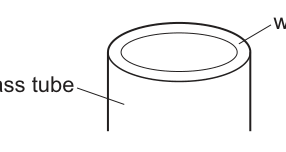
The following measurements are made.
internal diameter of the tube
external diameter of the tube
What is the thickness of the wall of the tube?
Options
A
B
C
D
Working
Wall thickness
Uncertainty in difference:
So
Answer
(Option A)
A
Background Concept
The wall thickness of a hollow cylindrical tube is the radial difference between the outer and inner radii.
If the external diameter is and the internal diameter is , then the external radius is and the internal radius is . So the wall thickness is
For uncertainty propagation at AS level (worst-case method):
- when adding or subtracting quantities, add absolute uncertainties;
- when multiplying/dividing by a constant, the absolute uncertainty is multiplied/divided by the same constant.
Understanding the Question
You are given two caliper measurements:
- internal diameter:
- external diameter:
You must find the thickness of the glass wall (one side only), not the difference in diameters.
The options differ both in the thickness value (1.0 mm or 2.0 mm) and in the stated uncertainty (0.1 mm or 0.2 mm), so you must compute both correctly.
Approach
- Use geometry: thickness is half the difference between external and internal diameters.
- Find the best estimate of from the best estimates of the diameters.
- Propagate uncertainty:
- first find uncertainty in by adding absolute uncertainties,
- then divide that uncertainty by 2 (because thickness is half the difference).
- Match to the closest option.
Step-by-Step Reasoning
- Compute thickness:
- Uncertainty in the diameter difference:
Because and are subtracted, the worst-case absolute uncertainty is
- Uncertainty in thickness:
Since is the difference divided by 2,
So the thickness is
which corresponds to Option A.
Key Takeaways
- For a tube, wall thickness is half the difference between external and internal diameters: .
- For subtraction, add absolute uncertainties.
- Scaling a quantity by a constant scales its absolute uncertainty by the same constant.
Common Mistakes
- Using as the thickness (giving instead of ).
- Quoting uncertainty of for the thickness (forgetting to divide the uncertainty by 2 as well).
- Mixing percentage uncertainties here (not needed; absolute is simplest for sums/differences).
Things to Be Careful About
- The thickness is on one side of the tube, so you must divide the diameter difference by 2.
- Keep units consistent (all in mm here, so no conversion needed).
- In MCQs, the uncertainty often distinguishes the correct option: propagate it through every operation, including the final division by 2.
The diagram shows two fixed pins, Y and Z. A length of elastic is stretched between Y and Z and around pin X, which is attached to a trolley.
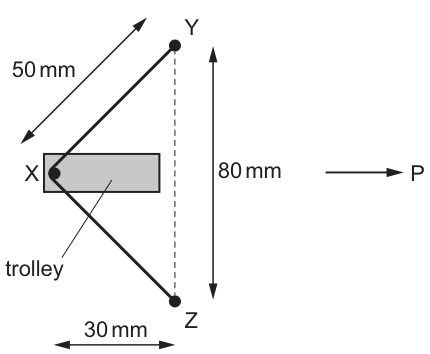
X is at the centre of the elastic and the trolley is to be propelled in the direction P at right angles to YZ. The tension in the elastic is .
What is the force accelerating the trolley in the direction P when the trolley is released?
Options
A
B
C
D
Working
Each side of the elastic pulls on pin with tension .
From the diagram, for one side:
Horizontal component (direction ) from one tension:
Two sides act symmetrically, so resultant in direction :
Answer
C
C
Background Concept
Tension forces act along the line of the elastic. When two equal forces act symmetrically about a direction, their components perpendicular to that direction cancel and their components along that direction add.
To find the force in a particular direction (here, direction ), resolve each force into components using trigonometry:
- component along the chosen direction (if is the angle between the force and that direction)
- component perpendicular
Understanding the Question
Two fixed pins and are vertically separated by , and an elastic band runs from to a trolley pin and then to . The arrangement is symmetric, with at the centre of the elastic.
Each sloping section and has length . The horizontal distance from to the vertical line through and is . The tension in the elastic is in each sloping section.
We want the resultant force on the trolley in direction (horizontal, at right angles to ) when released.
Approach
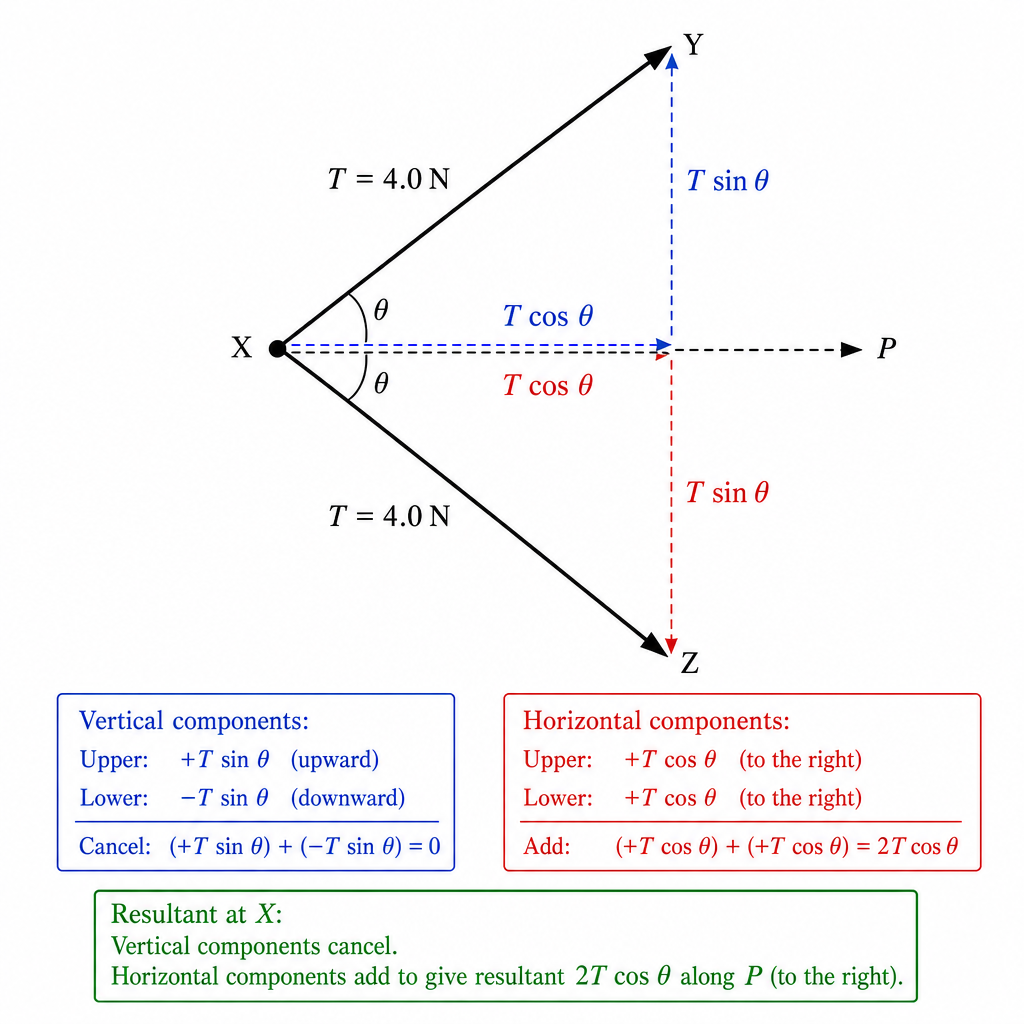
- Draw the forces acting on pin : two equal tension forces along and .
- Use symmetry: vertical components cancel (one up, one down), while horizontal components (towards the right) add.
- Find the horizontal component of one tension using the given triangle dimensions, then double it.
Step-by-Step Reasoning
-
There are two tension forces on , each of magnitude , one directed along and one along .
-
Consider one side, say . The geometry forms a right triangle:
- hypotenuse
- horizontal adjacent side
- vertical opposite side (half of ), confirming consistency since .
Let be the angle between the tension and the horizontal direction . Then
- Horizontal component of one tension is
- The second tension has the same horizontal component (also to the right). So the total force in direction is
This matches option C.
Key Takeaways
- Tension acts along the elastic, not horizontally/vertically by default.
- In symmetric situations, components perpendicular to the symmetry direction cancel.
- Use triangle ratios from the diagram: here .
- Resultant in the required direction is the sum of components in that direction.
Common Mistakes
- Using instead of for the horizontal component (depends on which angle you define).
- Adding the full tensions without resolving into components.
- Forgetting there are two elastic segments, so only taking instead of doubling.
- Using instead of as the vertical side for one segment.
Things to Be Careful About
- Identify clearly which side of the triangle is the hypotenuse (it is the elastic length ).
- The required force is specifically in direction , so only horizontal components matter.
- Check symmetry: one tension pulls slightly upward, the other slightly downward, so vertical components cancel exactly.
A student cycles uphill from home to a shop, taking minutes. The student then spends minutes in the shop before cycling home downhill at twice the initial speed.
Which graph could show the variation with time of the distance travelled by the student?
Options
Working
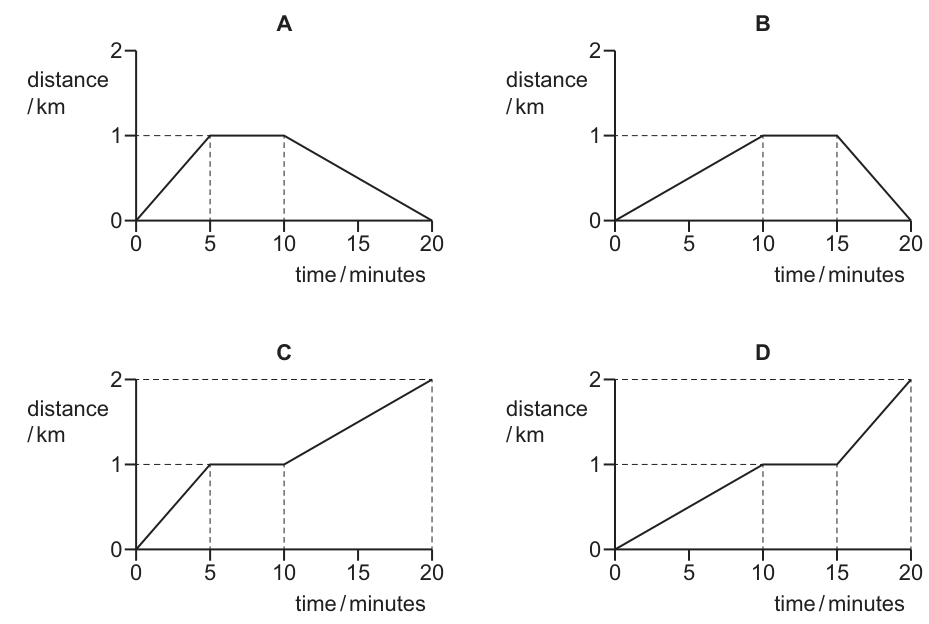
Distance travelled is a cumulative scalar quantity and never decreases, eliminating graphs A and B which show distance returning to zero (these would represent displacement).
The journey has three stages:
- Uphill ride: takes 10 min, distance increases to 1 km. (Eliminates C, which shows this taking 5 min).
- Stop in shop: takes 5 min (from to min), distance remains constant at 1 km.
- Downhill ride: speed is twice the initial speed, so time taken is half (5 min). Total time = 20 min. Total distance = 1 km + 1 km = 2 km. The graph must show a steeper slope from to min, increasing from 1 km to 2 km.
This matches graph D.
Answer
D
D
Background Concept
Distance is a scalar quantity representing the total path length covered by an object. Unlike displacement, which is a vector and can decrease if an object returns towards its starting point, distance travelled never decreases over time. On a distance-time graph, the gradient represents the speed of the object. A steeper gradient indicates a higher speed, and a horizontal line indicates the object is stationary.
Understanding the Question
The student's journey has three stages:
- Cycling uphill from home to a shop: takes 10 minutes. Distance increases from 0 to some value (let's say 1 km based on the graphs). Speed is .
- Spending time in the shop: takes 5 minutes. The student is stationary, so distance travelled remains constant. Time goes from 10 to 15 minutes.
- Cycling home downhill: speed is . Since distance = speed \times time, and the speed is doubled, the time taken to cover the same 1 km distance is halved (from 10 min to 5 min). The total time is minutes. The total distance travelled is . Distance continues to increase, it does not decrease.
Approach
First, eliminate graphs where distance decreases (A and B), as distance travelled is cumulative and cannot decrease. Second, check the time intervals and gradients for the remaining graphs (C and D) to see which matches the 10-minute uphill ride, 5-minute stop, and 5-minute downhill ride at twice the speed.
Step-by-Step Reasoning
- Stage 1 (0 to 10 min): The student cycles uphill for 10 minutes. The distance increases linearly. Looking at the graphs, both C and D show a linear increase, but C reaches 1 km at 5 minutes, while D reaches 1 km at 10 minutes. Since the ride takes 10 minutes, D is correct and C is incorrect.
- Stage 2 (10 to 15 min): The student spends 5 minutes in the shop. The distance travelled does not change, so the graph must be horizontal. Graph D is horizontal from to min at a distance of 1 km.
- Stage 3 (15 to 20 min): The student cycles home at twice the initial speed. Since distance = speed \times time, and the speed is doubled, the time taken to cover the same 1 km distance is halved (from 10 min to 5 min). The total time is minutes. The total distance travelled is . The gradient of this section is twice as steep as the first section. Graph D shows a steeper linear increase from 1 km at min to 2 km at min.
- Graphs A and B show the distance decreasing back to 0, which would be correct for a displacement-time graph, but the question specifically asks for distance travelled.
Key Takeaways
- Distance is a scalar and always increases or stays constant; it never decreases. Displacement can decrease.
- The gradient of a distance-time graph gives the speed. A steeper gradient means a higher speed.
- Always read the question carefully to ensure you are plotting the correct quantity (distance vs. displacement).
Common Mistakes
- Choosing graph A or B: confusing distance travelled with displacement. If the question asked for displacement from home, A or B might be considered (though A has the wrong times). Distance travelled is cumulative.
- Choosing graph C: misreading the time axis or not noticing that the first leg takes 10 minutes, not 5 minutes.
Things to Be Careful About
- The exact wording "distance travelled" vs "displacement". This is a classic trap in kinematics questions.
- Reading the axes correctly: the time axis is in minutes, and the distance axis is in km. Ensure the slopes and time intervals match the problem description.
A ball is released from rest from a window at a height of above the ground. Air resistance is negligible.
What is the time taken after release for the ball to reach the ground?
Options
A
B
C
D
Working
For free fall from rest,
Answer
C
C
Background Concept
When air resistance is negligible, an object in free fall near the Earth’s surface experiences a constant downward acceleration equal to the gravitational field strength . This is an example of uniformly accelerated motion, so we can use the SUVAT equations.
One useful equation that connects displacement , acceleration , and time (without needing final velocity) is:
where:
- is displacement in ,
- is initial velocity in ,
- is acceleration in ,
- is time in .
Understanding the Question
A ball is released (so initial speed is zero) from a height of above the ground. The question asks for the time taken to reach the ground. Since the ball starts from rest and accelerates uniformly under gravity, we model the vertical motion with constant acceleration.
Known:
- downward
Unknown:
Approach
Choose a SUVAT equation that includes , , , and . Since we are not asked about final velocity , use:
Substitute and , then rearrange to solve for , and compare the calculated value with the options.
Step-by-Step Reasoning
Start with:
Here , , so:
Rearrange for :
Substitute and :
Rounded to match the options, , which corresponds to option C.
Key Takeaways
- Negligible air resistance means constant acceleration (uniformly accelerated motion).
- “Released from rest” implies .
- For free-fall time from a known height, a quick route is .
Common Mistakes
- Using instead of (missing the factor ).
- Taking and then not matching the closest option carefully.
- Mixing up distance and displacement signs; if you choose upward as positive, then and (the negatives cancel if done consistently).
Things to Be Careful About
- Keep units consistent: in and in gives in seconds.
- Rounding: the computed value rounds to (2 s.f.), matching the provided choices.
Which word equation is not correct?
Options
A force change of momentum
B force mass acceleration
C force
D force
Working
Newton’s second law:
So force is the rate of change of momentum, not just the change of momentum.
Answer
A
A
Background Concept
Force is connected to momentum by Newton’s second law in its most general form:
where is momentum. This means force depends not only on how much momentum changes, but also on how quickly it changes.
Other useful related definitions:
- Moment (torque) about a pivot:
- Work done by a force along its line of action:
(where is displacement in the direction of the force).
Understanding the Question
You are given four “word equations” for force. Three of them match standard definitions/formulae. One is incorrect. The task is to identify the incorrect one.
Approach
Check each option against the standard physics relationship:
- For momentum, ensure “rate of change” (includes time) is present.
- For , moment, and work, check rearrangements are consistent.
Step-by-Step Reasoning
- Option A: “force = change of momentum”
Correct physics is:
Option A is missing division by time, so it is incorrect.
- Option B: “force = mass acceleration”
This is Newton’s second law for constant mass:
So B is correct.
- Option C: “force = moment / perpendicular distance from the pivot”
From
rearrange to
So C is correct.
- Option D: “force = work done / displacement in the direction of the force”
From
rearrange to
So D is correct.
Therefore the only incorrect word equation is A.
Key Takeaways
- Force equals the rate of change of momentum, not just the change.
- Many MCQs test whether you remember the correct wording (“rate of change”) and the implied time factor.
- Rearranging standard definitions (moment, work) can quickly verify options.
Common Mistakes
- Forgetting the time term and writing instead of .
- Thinking “change of momentum” automatically implies “per second” (it does not unless explicitly stated).
- Confusing moment (torque) with force without including the perpendicular distance.
Things to Be Careful About
- The exact phrase matters: “rate of change of momentum” is the correct definition.
- For momentum questions, always check whether time (or an equivalent rate) appears.
- Ensure the distance in moments is perpendicular to the line of action of the force, as stated in option C.
A skydiver is falling vertically with terminal velocity when their parachute opens fully.
Which statement describes the motion of the skydiver for the first few seconds after the parachute opens fully?
Options
A falling with non-uniform acceleration and increasing speed
B falling with non-uniform acceleration and decreasing speed
C falling with uniform acceleration and increasing speed
D falling with uniform acceleration and decreasing speed
Working
Before the parachute opens fully, terminal velocity means resultant force is zero ().
When the parachute opens fully, the drag force increases suddenly so initially, giving an upward resultant force and hence upward acceleration while the skydiver is still moving downward. Therefore the downward speed decreases.
As speed decreases, drag decreases, so the resultant force (and hence acceleration) changes with time (non-uniform acceleration).
Answer
B
B
Background Concept
Terminal velocity occurs when an object falls through a fluid (air) and the resistive (drag) force has increased to equal the weight.
- Weight: acts downward and is (approximately) constant.
- Drag force: acts upward (opposes motion) and increases with speed (often roughly proportional to or ).
- Newton's second law: resultant force . So if , then and the object moves at constant velocity.
When conditions change (e.g. opening a parachute), the drag changes, so the resultant force changes and the object accelerates (which may mean it slows down if the acceleration is opposite to the direction of motion).
Understanding the Question
The skydiver is initially falling at terminal velocity, so they are moving downward at constant speed.
The parachute then opens fully. For the first few seconds after this, we must decide:
- whether the speed increases or decreases,
- whether the acceleration is uniform (constant) or non-uniform (changing).
Approach
- Use terminal velocity to state the initial force balance.
- Immediately after the parachute opens, the drag force becomes much larger than before, so compare drag with weight to find the direction of the resultant force and hence the direction of acceleration.
- Decide whether the speed is increasing or decreasing by comparing the direction of acceleration with the direction of motion.
- Decide whether the acceleration is uniform by noting that drag depends on speed, and the speed is changing.
Step-by-Step Reasoning
-
At terminal velocity (before opening):
so .Therefore:
The skydiver falls downward at constant speed.
-
Just after the parachute opens fully:
The parachute greatly increases the area, so for the same downward speed the drag force increases suddenly.So initially after opening:
Drag acts upward, weight acts downward, so the resultant force is upward.
-
Link to acceleration:
Using , an upward resultant force means an upward acceleration.But the velocity is still downward at that moment, so the upward acceleration acts opposite to the motion. That means the skydiver’s downward speed decreases.
-
Uniform or non-uniform acceleration?
As the skydiver slows down, their speed decreases, so the drag decreases (since depends on ).Therefore the resultant force decreases with time, so the acceleration changes with time. Hence the acceleration is non-uniform.
So the motion is: falling downward with decreasing speed and non-uniform acceleration → option B.
Key Takeaways
- Terminal velocity means and .
- After the parachute opens, drag becomes larger than weight, giving acceleration upward while motion is still downward, so speed decreases.
- Because drag depends on speed and the speed is changing, the acceleration is not constant (non-uniform).
Common Mistakes
- Saying the skydiver has “uniform deceleration”: drag changes as speed changes, so acceleration is not constant.
- Thinking acceleration must be downward because the skydiver is falling: acceleration depends on the resultant force, not the direction of motion.
- Confusing “slowing down” with “negative acceleration” without defining a sign convention; the safer statement is “acceleration is upward” or “opposite to the motion”.
Things to Be Careful About
- The question asks about the first few seconds after opening: initially is very large, but it quickly decreases as the skydiver slows.
- “Decreasing speed” does not mean the velocity is upward; the velocity is still downward until (much later) it could change direction (which does not happen here).
- “Non-uniform acceleration” here comes from the speed-dependence of drag, not from any change in weight.
Two gliders are travelling towards each other on a horizontal air track. Glider P has mass and is moving with a constant speed of . Glider Q has mass and is moving with a constant speed of .
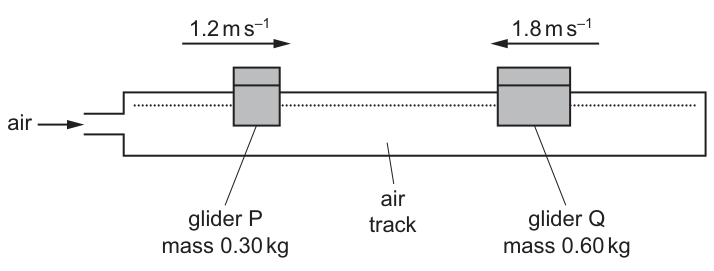
The gliders have a perfectly elastic collision.
What are the speeds of the two gliders after the collision?
Options
| speed of P / | speed of Q / | |
|---|---|---|
| A | 1.2 | 0.6 |
| B | 2.0 | 1.4 |
| C | 2.8 | 0.2 |
| D | 3.6 | 0.6 |
Working
Take right as positive.
,
,
Conservation of momentum:
Perfectly elastic (): relative speed of separation = relative speed of approach:
So .
Speeds: , .
Answer
C
C
Background Concept
In a collision on a straight line (1D), the total linear momentum is conserved provided external forces are negligible (an air track makes friction very small).
For a perfectly elastic collision, kinetic energy is also conserved. A very convenient equivalent statement is the coefficient of restitution:
For a perfectly elastic collision, , so
With objects and in 1D, this becomes
provided you use a consistent sign convention.
Understanding the Question
Two gliders move towards each other:
- with speed to the right.
- with speed to the left.
After a perfectly elastic head-on collision, we must find their speeds (magnitudes of velocities) and match them to options A–D.
Approach
- Choose a positive direction (take right as positive).
- Write the momentum conservation equation in that sign convention.
- Write the elastic-collision condition using (relative speeds).
- Solve the two simultaneous equations for and .
- Convert to speeds by taking absolute values and compare to the options.
Step-by-Step Reasoning
1) Assign signs
Take right as positive.
- .
- (because it moves left).
2) Conservation of momentum
Total initial momentum equals total final momentum:
Substitute values:
Compute the left-hand side:
so
3) Elastic collision condition ()
Relative approach speed is (with the chosen signs):
So relative separation speed must also be :
Rearrange:
4) Solve simultaneously
Substitute into momentum:
Expand:
So
Then
5) Convert to speeds and match option
Speeds are magnitudes:
- Speed of is .
- Speed of is .
This matches option C.
Key Takeaways
- In 1D collisions, pick a sign convention first; velocities towards the negative direction must be negative.
- Use momentum conservation plus either kinetic energy conservation or the relative-speed condition for perfectly elastic collisions.
- Final speeds are magnitudes of the final velocities.
Common Mistakes
- Treating both initial velocities as positive because the question gives “speeds”. You must convert speeds to signed velocities.
- Using (wrong order): the correct elastic condition is for consistent signs.
- Forgetting the question asks for speeds, so quoting as the speed.
Things to Be Careful About
- The heavier glider does not necessarily reverse direction; here ends up moving right slowly.
- Keep units consistent (all are already in SI units here).
- When matching to multiple-choice options, compare speeds (positive values) not signed velocities.
Which statement about a couple is correct?
Options
A It acts to produce both translational motion and rotation.
B It acts to produce rotation only.
C It acts to produce translational motion only.
D It acts to produce neither rotation nor translational motion.
Working
A couple is two equal and opposite parallel forces separated by a distance.
Resultant force so no translation, but resultant moment so it causes rotation.
Answer
B
B
Background Concept
A couple consists of two forces that are:
- equal in magnitude,
- opposite in direction,
- parallel, and
- separated by a perpendicular distance.
Because the forces are equal and opposite, their resultant (net) force is zero. However, because they act along different lines (they are separated), they produce a non-zero turning effect (moment).
The moment of a couple is
where is the magnitude of one of the forces and is the perpendicular separation between their lines of action.
Understanding the Question
The options ask what a couple can produce:
- translational motion (requires a non-zero resultant force),
- rotational motion (requires a non-zero resultant moment/torque).
So we decide whether a couple has net force, net moment, or both.
Approach
- Use the definition of a couple to evaluate the net force.
- Use the separated lines of action to evaluate the net moment.
- Match these conclusions to the statements A–D.
Step-by-Step Reasoning
- In a couple, the two forces have equal magnitude and opposite direction.
Therefore the vector sum of forces is
So the object does not accelerate translationally due to the couple alone.
-
Even though the net force is zero, the forces act at different positions. Each force produces a moment about (almost) any point, and these moments act in the same rotational sense, so they add.
Hence
So a couple produces rotation.
Therefore, the correct statement is: it acts to produce rotation only.
Key Takeaways
- Translational motion needs .
- Rotational motion needs .
- A couple gives but , so it causes rotation without translation.
Common Mistakes
- Thinking a couple must cause translation because “forces are acting”: the forces cancel in pairs, so the net force is zero.
- Confusing a single force causing a moment (about some pivot) with a couple: a single force generally gives both net force and a moment, whereas a couple has zero net force.
Things to Be Careful About
- The key feature is separation of lines of action: equal and opposite forces at the same line of action would cancel both force and moment.
- A couple’s moment is independent of the choice of pivot point (unlike the moment of a single force).
A picture frame hangs from a string. The string is supported by a pin. The frame is in equilibrium.
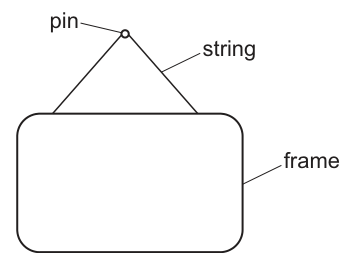
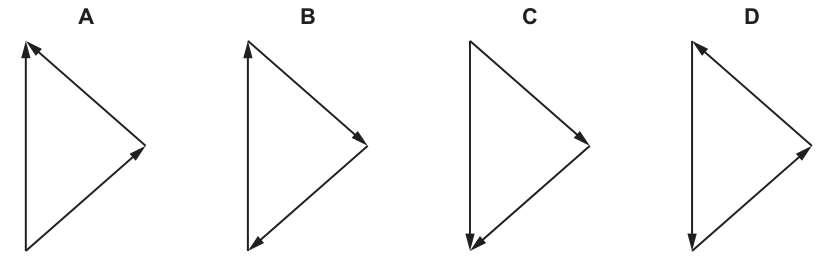
Which diagram shows the vector triangle of forces acting on the picture frame?
Options
Working
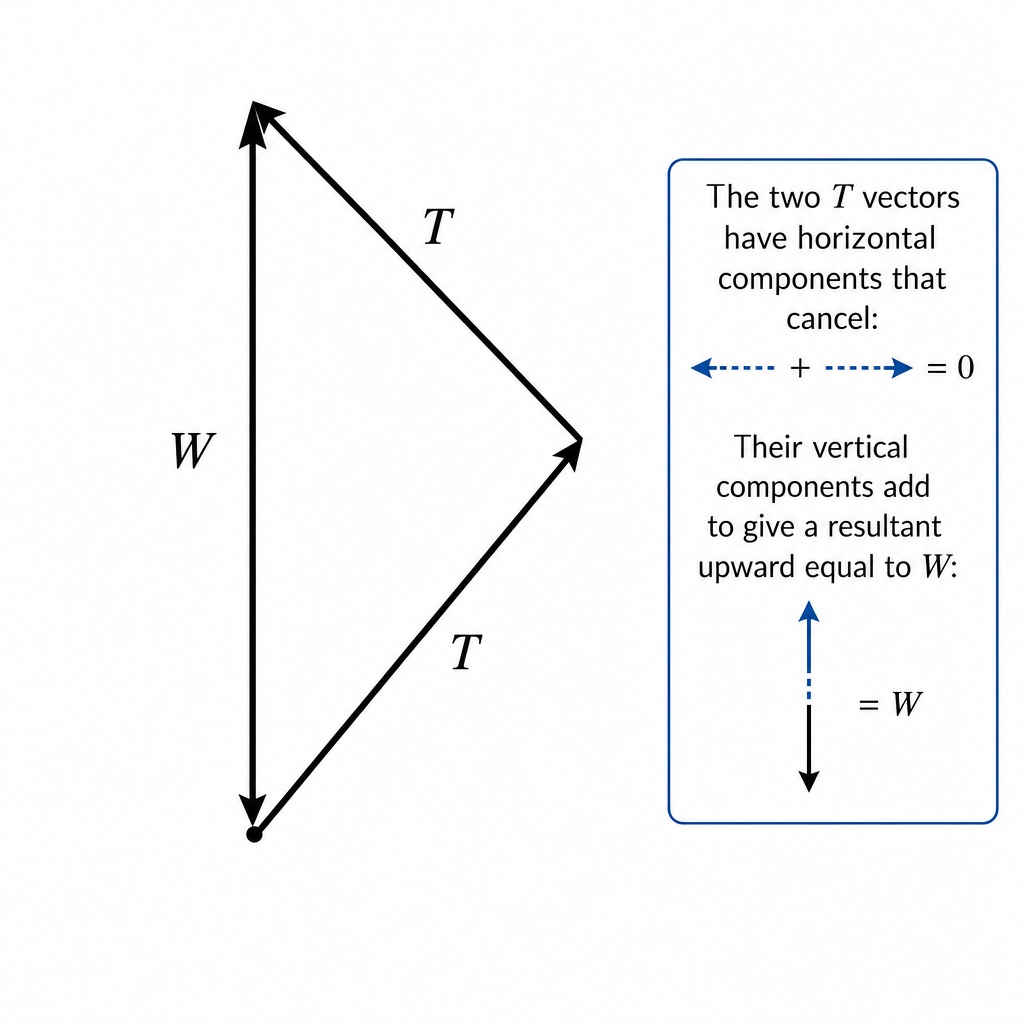
Forces on the frame: weight vertically downward; two tensions along the strings, each directed up towards the pin (one up-left, one up-right).
In equilibrium, the three force vectors must form a closed triangle head-to-tail, so the weight must be the downward vertical side and the two tensions must be the two sloping sides directed upwards.
Answer
D
D
Background Concept
If an object is in equilibrium, both translational and rotational equilibrium apply. For a particle / for the condition of no net translation, the key statement is:
For three forces acting in equilibrium, this means that if you draw the three force vectors head-to-tail in sequence, they must form a closed triangle (a “vector triangle”). Each side of the triangle represents one force, with its arrow showing the force direction.
Tension forces always act along the string, pulling away from the object towards the support.
Understanding the Question
A picture frame is hanging symmetrically from two segments of string that meet at a pin above. The frame is at rest, so it is in equilibrium.
So the frame has exactly three forces:
- its weight acting vertically downward through its centre of mass,
- a tension at the left attachment point directed along the left string up towards the pin,
- a tension at the right attachment point directed along the right string up towards the pin.
The question asks which option shows the correct vector triangle for these three forces.
Approach
- Draw (or imagine) a free-body diagram of the frame and mark the directions of the three forces.
- Use : the three vectors must close to form a triangle.
- Decide what each side must look like:
- must be vertical and downward.
- the two tensions must both point upward (one up-left, one up-right), because each string pulls the frame towards the pin.
- Compare with the options and select the only triangle with these directions and with head-to-tail closure.
Step-by-Step Reasoning
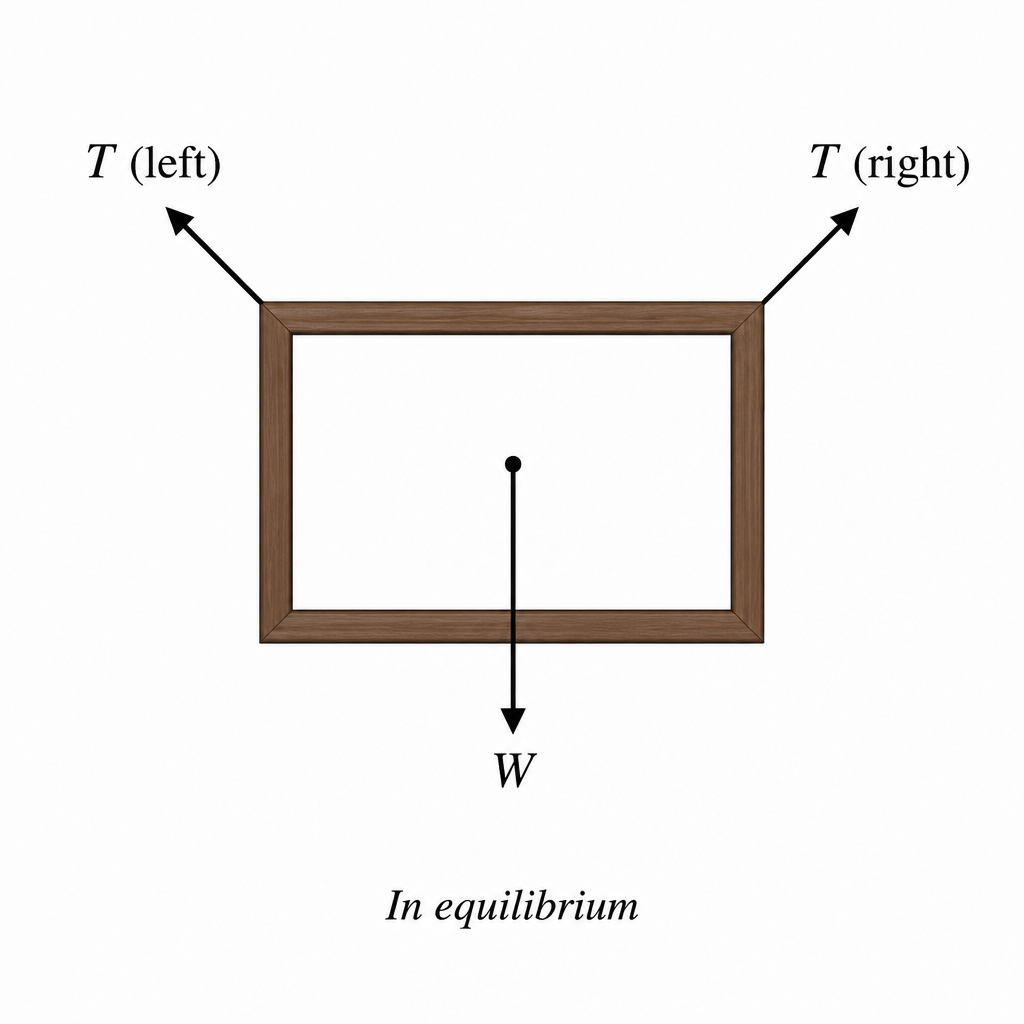
- The weight acts straight down: draw vertically downward.
- The left string slopes up towards the pin, so the tension on the frame at the left corner acts along the string towards the pin: up and towards the middle (up-right).
- Similarly, the right tension acts up and towards the middle (up-left).
Now form the vector triangle (head-to-tail):
- Place one tension vector.
- From its head, place the other tension vector.
- The resultant of the two tensions is vertically upward (horizontal components cancel by symmetry).
- To make the sum zero, the third vector (weight) must be vertically downward, closing the triangle.
So the correct option must show:
- a downward vertical vector for ,
- two upward sloping vectors for the tensions.
Among C and D (the only ones with a downward vertical arrow), only D has both sloping arrows directed upwards in the correct sense to close the triangle.
Key Takeaways
- Equilibrium implies .
- For three forces in equilibrium, the vectors form a closed head-to-tail triangle.
- Tension acts along the string, pulling the object towards the support.
Common Mistakes
- Drawing the tension direction the wrong way (tension does not push; it pulls along the string).
- Using an upward weight vector (weight must be vertically downward).
- Drawing vectors tail-to-tail and calling it a “triangle” (the triangle must be head-to-tail to represent addition).
Things to Be Careful About
- The vector triangle is about directions and closure, not about where forces are applied on the object.
- Ensure the vertical side corresponds to (downward), not to the resultant of tensions.
- In a symmetric situation the tensions are equal, but you don’t need lengths here—only correct directions and closure to match the options.
A solid metal cuboid of density has sides of lengths , and .
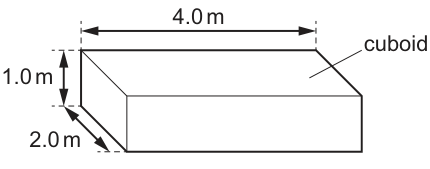
The cuboid can be placed on a horizontal surface so that it rests on any one of its six faces.
What is the largest pressure that the cuboid can exert on the surface due to its weight when it rests on one of its six faces?
Options
A
B
C
D
Working
Volume:
Mass:
Weight:
Smallest face area:
Pressure:
Answer
D
D
Background Concept
Pressure is defined as force per unit area:
For an object resting on a surface, the force it exerts on the surface due to its weight is essentially its weight (assuming it is at rest and there are no extra vertical forces).
Density links mass and volume:
For a cuboid, the volume is the product of its three side lengths. The contact area depends on which face is on the ground. Since , for a fixed force the pressure is largest when the contact area is smallest.
Understanding the Question
You are given a metal cuboid with density and dimensions , , and . The cuboid can rest on any face, so the contact area can be , , or (each occurs twice among the six faces).
You must find the largest pressure due to weight, so you need:
- the weight (same in all orientations),
- the smallest possible contact area.
Approach
- Calculate the cuboid volume from its dimensions.
- Use to find the mass.
- Use to find the weight.
- List the possible face areas and choose the smallest.
- Compute and match to the closest option.
Step-by-Step Reasoning
- Volume
- Mass from density
- Weight (taking )
- Smallest contact area
Possible face areas:
So
- Maximum pressure
Convert to kPa:
This corresponds to option D.
Key Takeaways
- Use for pressure.
- For an object at rest on a surface, is its weight .
- For a fixed weight, maximum pressure occurs with the minimum contact area.
- Use to connect density to weight.
Common Mistakes
- Using the largest face area instead of the smallest (this gives the minimum pressure).
- Forgetting to convert from Pa to kPa (or converting incorrectly: ).
- Calculating volume incorrectly (e.g. adding dimensions instead of multiplying).
- Using density as if it were weight density (mixing up with ).
Things to Be Careful About
- Keep units consistent: density is in so volume must be in .
- The cuboid has six faces but only three distinct areas (each area occurs twice).
- Your final option should match the nearest given value; rounds to in the options.
A cylindrical iceberg of height floats in sea water. The top of the iceberg is at height above the surface of the water.
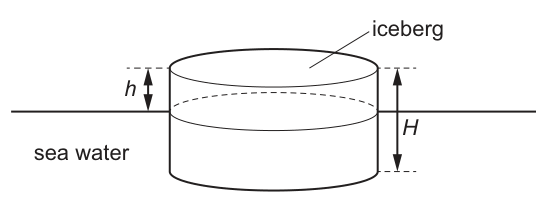
The density of ice is and the density of sea water is .
What is the height of the iceberg above the sea water?
Options
A
B
C
D
Working
For floating equilibrium,
Let submerged height be . For a cylinder of cross-sectional area :
Height above water:
Answer
A
A
Background Concept
A floating object is in vertical equilibrium, so the resultant vertical force is zero. The two key forces are:
- Weight of the object:
- Upthrust (buoyant force): equal to the weight of displaced fluid,
For an object that floats (not accelerating up or down):
This immediately links the fraction submerged to the ratio of densities.
Understanding the Question
We have a cylindrical iceberg of total height and uniform cross-sectional area . A portion of height is above the sea-water surface, so the submerged height is .
We are given the densities: ice and sea water , and we must choose the expression for .
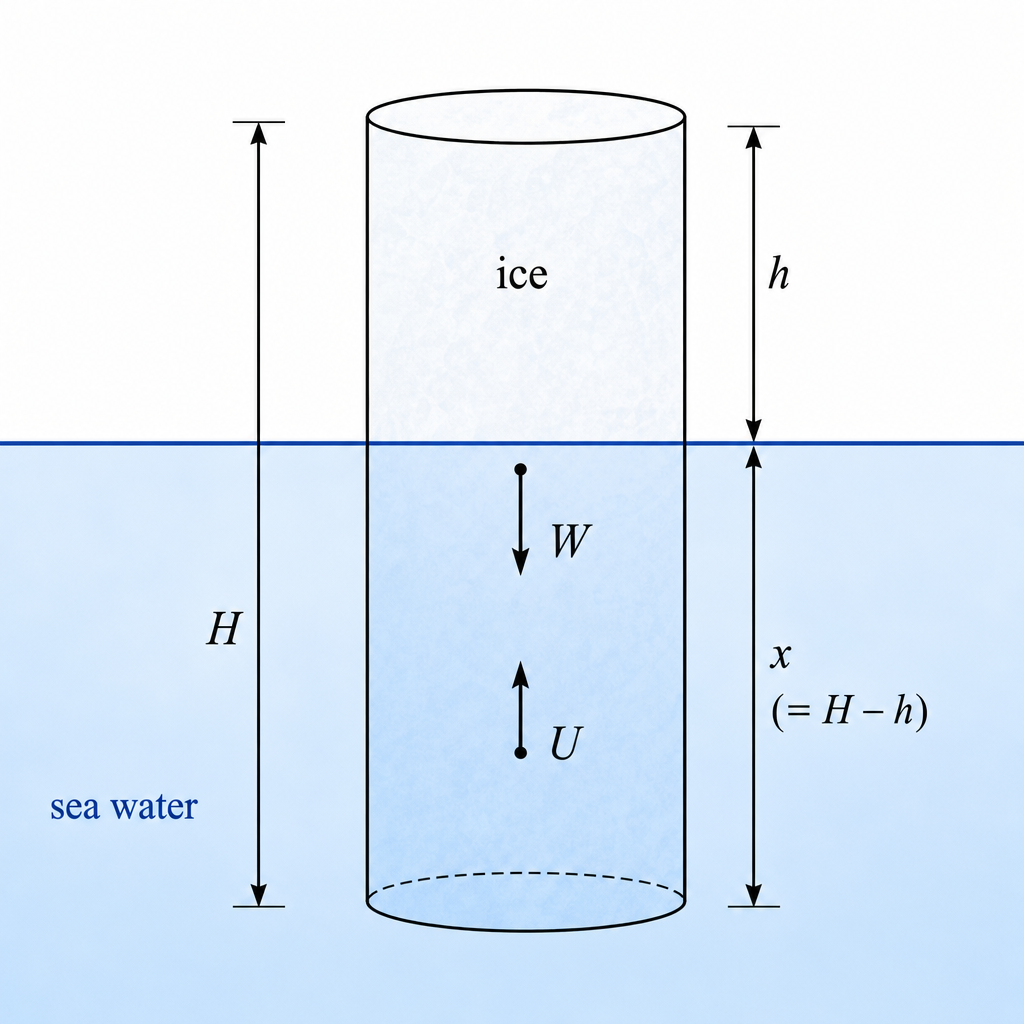
Approach
- Let the submerged height be (so ).
- Write expressions for weight of the iceberg and the upthrust in terms of densities and volumes.
- Use equilibrium .
- Solve for and then calculate .
Step-by-Step Reasoning
Let cross-sectional area be .
- Total volume of iceberg:
- Submerged volume (displaced water volume):
Weight of iceberg:
Upthrust:
Floating equilibrium gives:
Cancel and :
\rho_w x = \rho_i H n$$ Sox = \frac{\rho_i}{\rho_w}H
But $h$ is the height above water:h = H - x = H - \frac{\rho_i}{\rho_w}H = \left(1-\frac{\rho_i}{\rho_w}\right)H
This matches option **A**. ## Key Takeaways - For a floating object: $\rho_w V_{\text{displaced}} = \rho_{\text{object}} V_{\text{object}}$. - The fraction submerged is $\dfrac{V_{\text{displaced}}}{V_{\text{object}}} = \dfrac{\rho_{\text{object}}}{\rho_w}$. - The height above the surface is total height minus submerged height. ## Common Mistakes - Using $\rho_i/\rho_w$ as the *height above water* instead of the *submerged fraction*. - Writing $U = \rho_i V_{\text{sub}} g$ (wrong fluid density in the upthrust). - Choosing an expression that makes $h$ negative (e.g. option B) even though the iceberg is clearly partly above water. ## Things to Be Careful About - Upthrust depends on the density of the surrounding fluid ($\rho_w$), not the object. - The displaced volume is the submerged volume (here $Ax$), not the total volume. - A quick reasonableness check: since typically $\rho_i < \rho_w$, we expect $0<h<H$; option A satisfies this.In which situation is work done on an object?
Options
A The object slides with a constant velocity along a horizontal frictionless surface in a vacuum.
B A person holds the object at arm’s length and at a fixed height above the ground.
C A person pushes the object up a frictionless ramp.
D The stationary object floats partially submerged in water.
Working
Work done , so work is done only if there is displacement with a force component along the displacement.
Only in C (pushing the object up the ramp) is there displacement in the direction of the pushing force, so work is done.
Answer
C
C
Background Concept
Work done on an object by a force is the energy transferred when a force causes a displacement.
For a constant force, the work done is
where:
- is the magnitude of the force,
- is the displacement,
- is the angle between the force and the displacement.
So, if there is no displacement, the work done is zero. Also, if the force is always perpendicular to the displacement (), then and the work done is zero.
Understanding the Question
We must pick the situation where energy is transferred to the object by a force doing work, i.e. where there is a displacement in the direction of a force acting on the object.
Approach
Check each option for:
- whether the object moves (non-zero displacement), and
- whether there is a force component along the motion.
Step-by-Step Reasoning
A: Object slides at constant velocity on a horizontal frictionless surface in a vacuum.
- No resistive forces; weight and normal reaction are vertical and cancel.
- No horizontal force is needed to maintain constant velocity.
- Hence no force component along the displacement, so no work is done on the object.
B: Held at arm’s length at fixed height.
- Displacement is zero.
- So and .
C: Pushed up a frictionless ramp.
- The object moves up the ramp, so .
- The applied push has a component along the ramp in the direction of motion.
- Therefore and work is done on the object.
- This work appears mainly as an increase in gravitational potential energy ().
D: Stationary object floats partially submerged.
- Displacement is zero.
- So .
Therefore the correct option is C.
Key Takeaways
- Work is done only when a force causes displacement along (or partly along) its direction.
- Stationary situations (no displacement) imply zero work done on the object.
- Moving an object upward typically involves work against weight, increasing gravitational potential energy.
Common Mistakes
- Thinking that “a force exists” automatically means work is done (e.g. weight and upthrust exist in D, but no displacement so ).
- Thinking that constant velocity implies work must be done (in A, with no friction/drag, no driving force is needed).
- Confusing work done by a person with work done on the object (in B the person may get tired, but physically the object has no displacement so no work is done on it).
Things to Be Careful About
- Work depends on the component of force along the displacement: if the force is perpendicular to the motion, work is zero.
- Always check whether the object’s position changes; “fixed height” or “stationary” means immediately.
An electric motor operating a lift has an output power of .
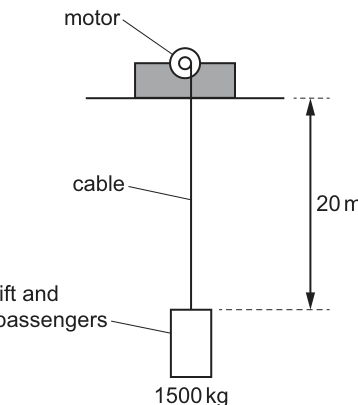
The lift and passengers have a combined mass of . The motor raises the lift at constant speed through a distance of .
How long does it take?
Options
A
B
C
D
Working
Energy gained:
Power , and :
Answer
B
B
Background Concept
Power is the rate at which energy is transferred (or work is done):
When a lift is raised at constant speed, its kinetic energy does not change, so the motor’s useful output energy goes into increasing gravitational potential energy:
Combining these gives:
Understanding the Question
We are told:
- motor output power (this is the useful power delivered to the lift)
- mass of lift + passengers
- vertical distance raised
- constant speed (so no change in kinetic energy)
We need the time taken to rise through .
Approach
- Find the energy transferred to the lift as it rises: use .
- Convert the given power to watts.
- Use rearranged to .
- Compare with the options.
Step-by-Step Reasoning
- Gravitational potential energy gained:
- Convert power to SI units:
- Use power to find time:
This rounds to , which matches option B.
Key Takeaways
- At constant speed, the motor’s output energy goes into (not changing kinetic energy).
- Use with consistent SI units (watts and joules).
- Convert by multiplying by .
Common Mistakes
- Forgetting to convert to .
- Using and then rounding poorly (it still gives about , but arithmetic errors can shift you to a neighbouring option).
- Treating power as but then not linking to correctly.
Things to Be Careful About
- “Output power” means useful power delivered to lifting (so you can use directly without efficiency corrections).
- Constant speed implies no acceleration, so you should not introduce equations of motion or extra kinetic energy terms.
- Ensure the final time is compared sensibly to the discrete answer options (here is clearly option ).
In which situation is the least amount of energy transferred?
Options
A A student and a motorcycle of total mass come to rest from a speed of .
B A student of mass falls a vertical distance of .
C A student pushes a car with a horizontal force of for a horizontal distance of .
D A student switches on a lamp for .
Working
A:
B:
C:
D:
Least energy transferred is in C.
Answer
C
C
Background Concept
Energy transferred depends on the process:
- Loss of kinetic energy when something comes to rest:
- Gain in gravitational potential energy (or energy transferred by gravity during a fall):
- Work done by a constant force along the direction of motion:
- Electrical energy transferred by a device of power operating for time :
Power is the rate of energy transfer, so multiplying by time gives the energy transferred.
Understanding the Question
Each option describes an energy transfer situation with given numerical values. The task is to calculate the energy transferred in each case (in joules) and identify which is smallest.
Approach
Compute energy for each situation using the relevant formula:
- A: kinetic energy change as it stops.
- B: gravitational potential energy change for a fall of height .
- C: work done by the student pushing the car through .
- D: energy delivered by a lamp in .
Then compare the four numerical results and pick the least.
Step-by-Step Reasoning
A (coming to rest): energy transferred equals the kinetic energy lost.
B (falling): energy transferred by gravity equals the decrease in gravitational potential energy, magnitude .
C (pushing with horizontal force): work done by a constant force parallel to displacement.
D (lamp on): power is energy per unit time.
Compare: , , , . The least is , which is option C.
Key Takeaways
- Use the correct energy expression for the physical situation.
- Convert power to energy with .
- For constant force along displacement, work done is .
- Comparing magnitudes across scenarios is a common MCQ skill.
Common Mistakes
- Using (not enough information here) instead of .
- Forgetting the square on speed in .
- Using or mixing up distance and time.
- Taking and then making an arithmetic slip that changes the ordering.
Things to Be Careful About
- Units: check that each calculation ends in joules (e.g. ).
- The question asks for the least energy transferred, not the greatest.
- In option C the force and displacement are both horizontal, so applies directly (no cosine factor needed).
What is the definition of strain?
Options
A extension per unit cross-sectional area
B extension per unit original length
C force per unit cross-sectional area
D force per unit extension
Working
Strain is defined as
This corresponds to option B.
Answer
B
B
Background Concept
When a material is stretched, it undergoes extension (change in length), usually written as . Two important related quantities are:
- Strain: a measure of fractional change in length.
- Stress: a measure of force per unit cross-sectional area.
Strain is defined by
where is strain, is extension, and is the original length. Because it is a ratio of two lengths, strain has no units.
Understanding the Question
The question asks for the correct definition of strain from four options. Each option is a common quantity used in deformation:
- some involve force and area (these relate to stress),
- some involve extension and length (these relate to strain),
- and one option involves force per extension (this resembles a spring constant).
Approach
- Recall the definition of strain as a fractional extension.
- Match it to the option that states “extension per unit original length”.
- Briefly check the other options correspond to different physical quantities.
Step-by-Step Reasoning
- By definition,
-
Option B states “extension per unit original length”, which is exactly .
-
Quick identification of the others:
- A: extension per unit cross-sectional area (not a standard definition for strain).
- C: force per unit cross-sectional area (this is stress).
- D: force per unit extension (this is related to the spring constant ).
Therefore the correct answer is B.
Key Takeaways
- Strain is the fractional change in length: .
- Strain is dimensionless (no units).
- Stress is and is measured in pascals (Pa).
Common Mistakes
- Choosing C because stress and strain are often mentioned together; but is stress, not strain.
- Thinking strain involves area; strain depends only on lengths.
- Forgetting that strain uses the original length, not the final length.
Things to Be Careful About
- Use the correct symbols and wording: extension is , original length is .
- Remember: stress has units, strain does not. This is a fast way to check definitions in MCQs.
A spring of unstretched length is suspended vertically from a support.
A weight of is attached to the bottom of the spring and its length increases to .
An additional weight of is then added to the bottom of the spring.
The spring obeys Hooke’s law.
How much extra elastic potential energy is stored in the spring due to the addition of the weight?
Options
A
B
C
D
Working
Extension with (2.0\ \text{N}:\ x_1 = 0.15 - 0.10 = 0.050\ \text{m})
With additional (4.0\ \text{N}), total force (= 6.0\ \text{N}):
Extra elastic potential energy:
Answer
D
D
Background Concept
For a spring that obeys Hooke’s law, the force (load) is proportional to the extension:
where:
- is the applied force (in ),
- is the extension from the natural (unstretched) length (in ),
- is the spring constant (in ).
The elastic potential energy (strain energy) stored in a Hooke’s-law spring stretched by extension is the area under the straight-line force–extension graph from to , which gives:
Understanding the Question
You are told the spring’s natural length is . When a weight is attached, the spring length becomes , so you can find the extension and hence .
Then an additional is added (so the total load becomes ). The question asks for the extra elastic potential energy stored due to adding the , i.e. the difference between the final and initial stored energies.
Approach
- Calculate the initial extension .
- Use with the initial load to determine .
- Use the total load after adding the to find the new extension .
- Compute and , then find .
Step-by-Step Reasoning
1) Initial extension
Natural length .
Loaded length with .
2) Spring constant
Using Hooke’s law :
3) New extension after adding the extra weight
The extra weight is , so the total becomes:
Then
4) Extra elastic potential energy
Energy stored initially:
Energy stored finally:
So the extra energy added is:
Substitute values:
Compute the bracket:
Then:
This matches option D.
Key Takeaways
- Find extension from the change in length: .
- Use Hooke’s law () to determine from one load–extension pair.
- Elastic potential energy in a Hooke’s-law spring is .
- “Extra” energy means final minus initial, not the final value alone.
Common Mistakes
- Using the additional as if it were the final force (forgetting the spring already had ).
- Using instead of (missing the factor ).
- Calculating energy from where ; the correct change is .
- Forgetting to convert to extension (using lengths directly without subtracting ).
Things to Be Careful About
- Keep units consistent in SI: lengths in so that ends up in and energy in .
- The force–extension graph is linear only because the spring obeys Hooke’s law; that justifies using the same for both loads.
- Ensure you compute the difference in energies to match the wording “extra elastic potential energy stored”.
Two progressive waves meet at a fixed point P. The variation with time of the displacement of each wave at point P is shown in the graph.
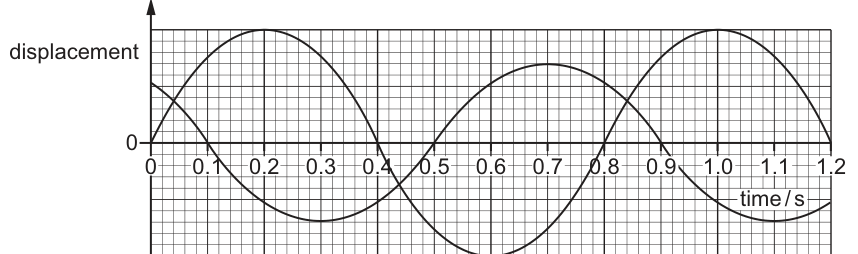
What is the phase difference between the two waves at point P?
Options
A
B
C
D
Working
From the graph, for wave 1 the first maximum is at about , so
A minimum for wave 2 is at about , while the corresponding minimum for wave 1 is at about , so the time shift is
Answer
C
C
Background Concept
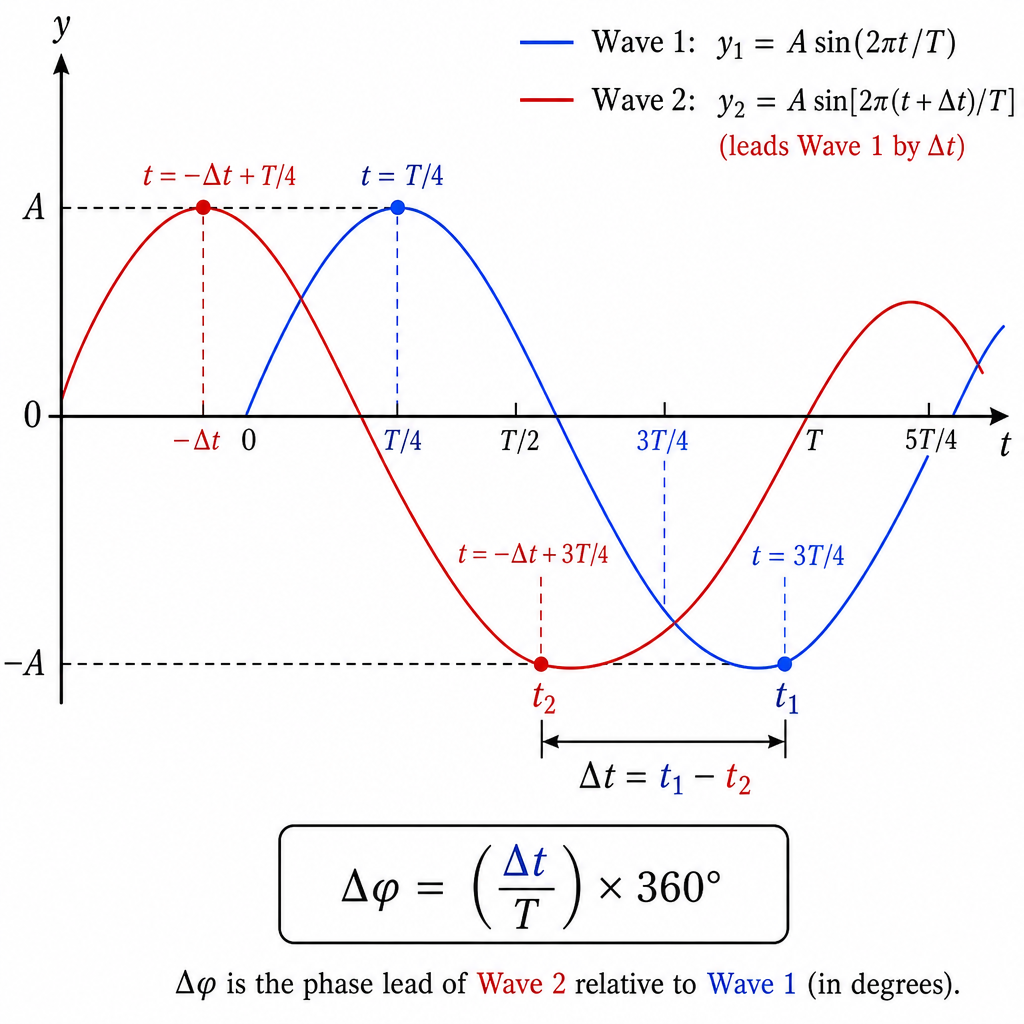
For two sinusoidal waves of the same frequency at a point, their phase difference tells you how much one wave is shifted relative to the other within one cycle.
A full cycle corresponds to a phase change of (or radians). If two waves are shifted in time by and have period , then
This works because the phase increases uniformly with time for a steady sinusoid.
Understanding the Question
You are shown two displacement–time curves (same point ). They have the same amplitude and the same period, but one is horizontally shifted relative to the other.
You need the phase difference at , i.e. how far one waveform is ahead/behind the other, expressed as an angle. The multiple-choice options are , , , .
Approach
- Read the period from either wave (using a clear feature such as successive maxima/minima or using quarter-cycle from zero-to-maximum).
- Pick a matching feature on both waves (e.g. a minimum) and read the time difference between when that feature occurs.
- Convert into phase using .
Step-by-Step Reasoning
- Find the period .
From wave 1, the motion starts at zero displacement and rises to a first maximum at about . For a sine wave, going from zero (rising) to maximum is a quarter of a cycle, so
- Measure the time shift using corresponding points.
A clear corresponding point is a minimum. From the graph:- wave 2 has a minimum at about ,
- wave 1 has a minimum at about .
So wave 2 reaches the minimum earlier (it leads), and the magnitude of the shift is
- Convert to phase difference.
So the phase difference is , which matches option C.
Key Takeaways
- For same-frequency sinusoids, phase difference comes from horizontal (time) shift.
- Use a clear repeated feature (max, min, or same-direction zero crossing) to find .
- Convert using .
Common Mistakes
- Using points that are not equivalent (e.g. comparing a maximum on one wave with a zero crossing on the other).
- Using half-cycle or quarter-cycle incorrectly when finding from the graph.
- Calculating with instead of .
Things to Be Careful About
- Ensure both waves truly have the same period before using the time-shift method (here they do).
- Read times consistently from the grid; a small reading error changes .
- Phase difference is usually quoted as the smallest positive angle; here is already in that range.
A microphone is connected to a cathode-ray oscilloscope (CRO). The diagram shows the waveform on the display of the CRO when the microphone detects a sound.
The y-gain is set to . The time-base is set to .
Which row gives the amplitude and frequency of the waveform?
Options
| amplitude / V | frequency / Hz | |
|---|---|---|
| A | 3 | 125 |
| B | 3 | 250 |
| C | 6 | 125 |
| D | 6 | 250 |
Working
Amplitude: The waveform has a peak-to-peak height of . With a -gain of ,
Period: One complete cycle occupies horizontally. With a time-base setting of ,
Frequency:
Thus the correct option is B.
Answer
B
B
Background Concept
A cathode-ray oscilloscope (CRO) displays voltage on the vertical axis and time on the horizontal axis. The vertical scale is controlled by the y-gain (volts per division), and the horizontal scale by the time-base (seconds per division).
- Amplitude of a waveform is the maximum displacement from the equilibrium (central) line. A sine wave peaks above and below this line by equal amounts. The peak-to-peak voltage is twice the amplitude.
- Period is the time taken for one complete cycle. On the screen, this is the horizontal distance between successive peaks (or troughs) in divisions, multiplied by the time-base setting.
- Frequency is the number of cycles per second: .
Understanding the Question
A microphone picks up a sound, and the electrical signal is shown on the CRO. The y-gain is , meaning each vertical division corresponds to 1 V. The time-base is , so each horizontal division represents 2.0 ms. The waveform is a sine wave; we are asked to determine its amplitude and frequency from the display.
We are not given the exact number of divisions, but from the correct answer we can infer the pattern: the peak-to-peak height is 6 divisions (amplitude 3 V), and one cycle spans 2 divisions horizontally (period 4 ms, frequency 250 Hz).
Approach
- Amplitude: Count the number of vertical divisions from the centre line to a peak (or divide the peak-to-peak height by 2). Multiply by the y-gain to get the voltage amplitude.
- Period: Count the number of horizontal divisions for one complete cycle (e.g., from one peak to the next). Multiply by the time-base setting to get the period in seconds.
- Frequency: Take the reciprocal of the period.
No equations other than are needed.
Step-by-Step Reasoning
Step 1 – Determine the amplitude
The waveform's peaks appear 3 divisions above the centre line, so the amplitude is 3 divisions. With a y-gain of 1 V/div, the amplitude in volts is:
(Alternatively, peak-to-peak height is 6 divisions → .)
Step 2 – Determine the period
One complete cycle (e.g., from peak to peak) occupies 2 horizontal divisions. With time-base , the period is:
Step 3 – Compute frequency
Matching the options: only row B gives amplitude 3 V and frequency 250 Hz.
Key Takeaways
- The CRO is a standard tool for measuring voltage and time. The y-gain and time-base settings are essential for converting screen divisions into physical quantities.
- Amplitude is the maximum displacement from the mean, not the peak-to-peak value (unless the question specifically asks for peak-to-peak).
- Frequency is the inverse of the period; always convert the period to seconds before calculating.
Common Mistakes
- Using peak-to-peak as amplitude – The amplitude is half the peak-to-peak. For a 6-div peak-to-peak, wrongly stating amplitude as 6 V leads to incorrect option C or D.
- Counting the wrong number of divisions for the period – E.g., mistaking half a cycle (one peak to trough) for a full cycle gives half the period and double the frequency.
- Forgetting to convert milliseconds to seconds – Using ms directly in without converting would give Hz, which is nonsensical.
- Misreading the y-gain or time-base – Confusing the two scales causes swapped values.
Things to Be Careful About
- Always read the calibration settings carefully. The y-gain is given as – that is one volt per division, not one division per volt.
- The time-base is in milliseconds: . Convert to seconds () for frequency calculation.
- Give the answer with the correct number of significant figures: the data have 2 s.f. (2.0), so the frequency should be 250 Hz (2 s.f. in the coefficient 2.5, but since it's 250, it's ambiguous; in practice, 3 s.f. is fine as the settings are given to 2 s.f.).
- On the CRO, ensure you measure from the proper reference point (the centre line for amplitude, and between corresponding points of successive cycles for the period).
A progressive longitudinal wave is travelling horizontally from left to right.
A graphical representation of the wave at one instant in time is shown.
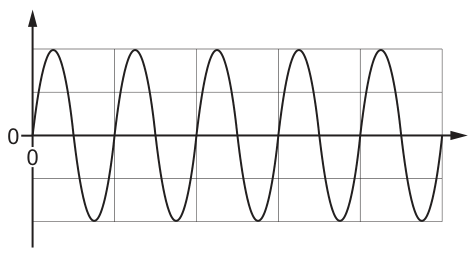
Which row could give the correct labels for the x-axis and y-axis of this graph?
Options
| x-axis | y-axis | |
|---|---|---|
| A | distance | displacement of particles to the right |
| B | distance | displacement of particles upwards |
| C | time | displacement of particles to the right |
| D | time | displacement of particles upwards |
Working
The graph is stated to be at one instant in time, so the horizontal axis must be distance.
For a longitudinal wave travelling left to right, particles oscillate parallel to the direction of travel, i.e. their displacement is to the right/left.
Answer
A
A
Background Concept
A progressive wave can be represented either:
- as a snapshot in space at a fixed time: displacement (or pressure/density variation) plotted against distance , or
- as the motion of one point: displacement plotted against time .
For a longitudinal wave, the oscillations of particles are parallel to the direction of wave travel. So if the wave travels horizontally to the right, particle displacement is also horizontal (right/left), not vertical.
Understanding the Question
You are told:
- the wave is progressive and longitudinal,
- it is travelling horizontally from left to right,
- the graph shown is the wave at one instant in time.
So you must choose which option correctly labels:
- what the horizontal axis represents (distance or time), and
- what the vertical axis represents (direction of particle displacement).
Approach
- Use the phrase “at one instant in time” to decide whether the x-axis is (distance) or (time).
- Use “longitudinal” plus “travelling left to right” to decide the direction of particle displacement.
- Match these conclusions to the table of options.
Step-by-Step Reasoning
-
Since the graph is a representation of the wave at one instant, time is fixed. Therefore the graph must show how displacement varies with position along the direction of travel.
- So the x-axis is distance.
-
The wave is longitudinal, so particle displacement is parallel to the direction of propagation.
- The wave travels left to right, so particle displacement is to the right/left (horizontal), not upwards/downwards.
-
The only row with x-axis = distance and y-axis = displacement of particles to the right is A.
Key Takeaways
- “At one instant” (\Rightarrow) displacement vs distance (a spatial snapshot).
- Longitudinal wave (\Rightarrow) particle displacement is parallel to the direction of wave travel.
Common Mistakes
- Choosing time on the x-axis even though the question says “at one instant in time”.
- Treating a longitudinal wave like a transverse one and selecting “displacement upwards”.
- Thinking the sine shape means the wave must be transverse; longitudinal waves can also be drawn with displacement vs distance as a sinusoidal curve.
Things to Be Careful About
- The vertical axis in such diagrams is a displacement component, not the direction the wave is moving.
- In longitudinal waves you may also see graphs of pressure or density vs distance; here the options explicitly talk about particle displacement, so you must use the longitudinal displacement direction (parallel to travel).
A vehicle is moving with a speed of directly towards a stationary observer. The horn of the vehicle emits sound of frequency . The speed of sound in air is .
What is the frequency of the sound heard by the observer?
Options
A
B
C
D
Working
For a source moving towards a stationary observer,
Answer
D
D
Background Concept
The Doppler effect is the apparent change in frequency when there is relative motion between a wave source and an observer. For sound in air, the wave speed is set by the medium (air). When the source moves, it changes the spacing of wavefronts in front of it, changing the wavelength there, so a stationary observer detects a different frequency.
For a source moving towards a stationary observer:
where:
- is the emitted frequency,
- is the observed frequency,
- is the speed of sound in air,
- is the speed of the source (vehicle) towards the observer.
If the source moves away, the sign changes to in the denominator and the observed frequency decreases.
Understanding the Question
A vehicle (the sound source) approaches a stationary observer at speed . The horn emits sound of frequency . Sound speed in air is . We must calculate the frequency heard by the observer and choose the closest option.
Because the source is approaching, the observer should hear a higher frequency than , so we expect an answer greater than (this already suggests C or D).
Approach
- Recognise this is Doppler effect with moving source and stationary observer.
- Use the approaching-source formula .
- Substitute the values and compute , then match to the nearest option.
Step-by-Step Reasoning
Use the Doppler formula for a moving source approaching:
Substitute , , :
Compute the denominator:
So:
Evaluate the fraction:
Hence:
Rounded to the nearest whole number (as in the options):
So the correct option is D.
Key Takeaways
- For sound, use different Doppler formulas depending on whether the source or observer is moving.
- Approaching motion increases observed frequency; receding motion decreases it.
- With a moving source and stationary observer: .
Common Mistakes
- Using the moving-observer formula instead of the moving-source formula.
- Getting the sign wrong: using for an approaching source would incorrectly predict a lower frequency.
- Forgetting that the observer is stationary and trying to include an observer speed.
Things to Be Careful About
- Check the direction: “towards” means frequency must increase, so .
- Ensure is less than (here ), so the denominator stays positive.
- Match the rounding to the options given (here the closest is ).
Which row could describe electromagnetic waves?
Options
| type of wave | speed in free space | |
|---|---|---|
| A | longitudinal | faster for shorter wavelengths |
| B | longitudinal | the same for all wavelengths |
| C | transverse | faster for shorter wavelengths |
| D | transverse | the same for all wavelengths |
Electromagnetic waves are transverse.
In free space, all electromagnetic waves travel at the same speed (independent of wavelength).
Answer
D
D
Background Concept
Electromagnetic (EM) waves are oscillations of electric and magnetic fields that propagate through space. Key facts at AS level:
- EM waves are transverse: the oscillating fields are perpendicular to the direction of travel.
- In free space (vacuum), all EM waves travel at the same speed:
This speed does not depend on wavelength or frequency in vacuum.
Understanding the Question
The table gives two properties in each row:
- whether the wave is longitudinal or transverse,
- how its speed in free space depends on wavelength.
We must pick the row that matches EM waves.
Approach
Recall the two defining properties of EM waves in vacuum:
- they are transverse,
- their speed in free space is constant for all wavelengths.
Then match these to the options.
Step-by-Step Reasoning
- Type of wave: EM waves are transverse, not longitudinal.
- So eliminate A and B.
- Speed in free space: in a vacuum the speed is always for EM waves, regardless of wavelength.
- So eliminate C (it says faster for shorter wavelengths).
- The remaining option is D: transverse and same speed for all wavelengths.
Key Takeaways
- EM waves are transverse.
- In vacuum, EM waves all travel at the same speed , independent of wavelength/frequency.
Common Mistakes
- Confusing EM waves with sound waves (sound is longitudinal and needs a medium).
- Thinking “shorter wavelength means faster”: this can happen in dispersive media (e.g. glass) but not in free space.
Things to Be Careful About
- The question specifies free space (vacuum). In materials, wave speed can depend on wavelength (dispersion), but that is not relevant here.
- Use the correct wording: “same for all wavelengths” in vacuum corresponds to constant .
A horizontal beam of light is incident normally on a polarising filter. The incident light is vertically polarised and has an intensity of . The direction of the transmission axis of the filter is at an angle of to the vertical.
What is the intensity of the light in the transmitted beam?
Options
A
B
C
D
Working
Use Malus's law:
Angle between vertical polarisation and transmission axis: .
Answer
A
A
Background Concept
A polarising filter (polariser) transmits only the component of the electric field oscillation that lies along its transmission axis. For plane-polarised light incident on a polariser, the transmitted intensity is given by Malus's law:
where:
- is the incident intensity,
- is the transmitted intensity,
- is the angle between the direction of polarisation of the incident light and the transmission axis of the polariser.
Understanding the Question
The light is already vertically polarised with intensity . The polariser’s transmission axis is at to the vertical, so the angle between the incident polarisation direction (vertical) and the transmission axis is . The question asks for the transmitted intensity.
Approach
- Identify as the angle between the incident polarisation direction and the transmission axis.
- Substitute and into Malus's law.
- Match the numerical result to the given options.
Step-by-Step Reasoning
Angle between the incident polarisation (vertical) and the transmission axis is:
Apply Malus's law:
Use :
So
This corresponds to option A.
Key Takeaways
- For plane-polarised light through a polariser: .
- is the angle between the incident polarisation direction and the transmission axis.
- Intensity depends on the square of the cosine, not just the cosine.
Common Mistakes
- Using instead of .
- Using the wrong angle (e.g. taking instead of ).
- Confusing this with unpolarised light, where the first polariser gives .
Things to Be Careful About
- Always check whether the incident light is already polarised; if it is, do not halve the intensity.
- Ensure is measured between the polarisation direction and the transmission axis (both in the same plane).
- Keep units as for intensity.
A pipe of length is open at both ends. A loudspeaker situated at one end of the pipe can emit sound of different wavelengths.
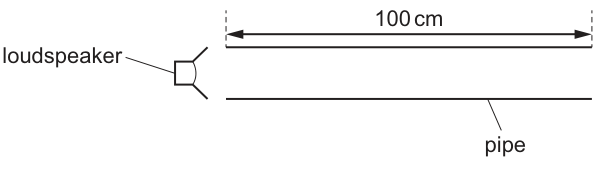
Which wavelength can produce a stationary wave in the pipe?
Options
A
B
C
D
Working
For a pipe open at both ends:
With :
Check options:
- (integer) (\checkmark)
Answer
A
A
Background Concept
A stationary (standing) wave in a pipe forms when waves reflect and superpose to give fixed nodes (zero displacement) and antinodes (maximum displacement).
For an open end of a pipe, the air is free to move, so the displacement is maximum: an antinodes occurs at each open end.
Therefore, for a pipe open at both ends, both ends are antinodes and the length of the pipe must fit an integer number of half-wavelengths:
Understanding the Question
The pipe has length and is open at both ends. We must choose which offered wavelength can produce a stationary wave pattern that satisfies the open-end boundary conditions.
Approach
Use the open-open pipe condition . Rearrange to find
A wavelength is possible only if it corresponds to an integer harmonic number .
Step-by-Step Reasoning
Start with
Rearrange:
Substitute :
Now test each option by calculating .
- Option A:
This is an integer, so a valid stationary wave exists (it is the 4th harmonic).
- Option B: gives (not integer) so the pipe length would not match the required pattern.
- Option C: gives (not integer).
- Option D: gives (not integer and also must be at least 1).
So only works.
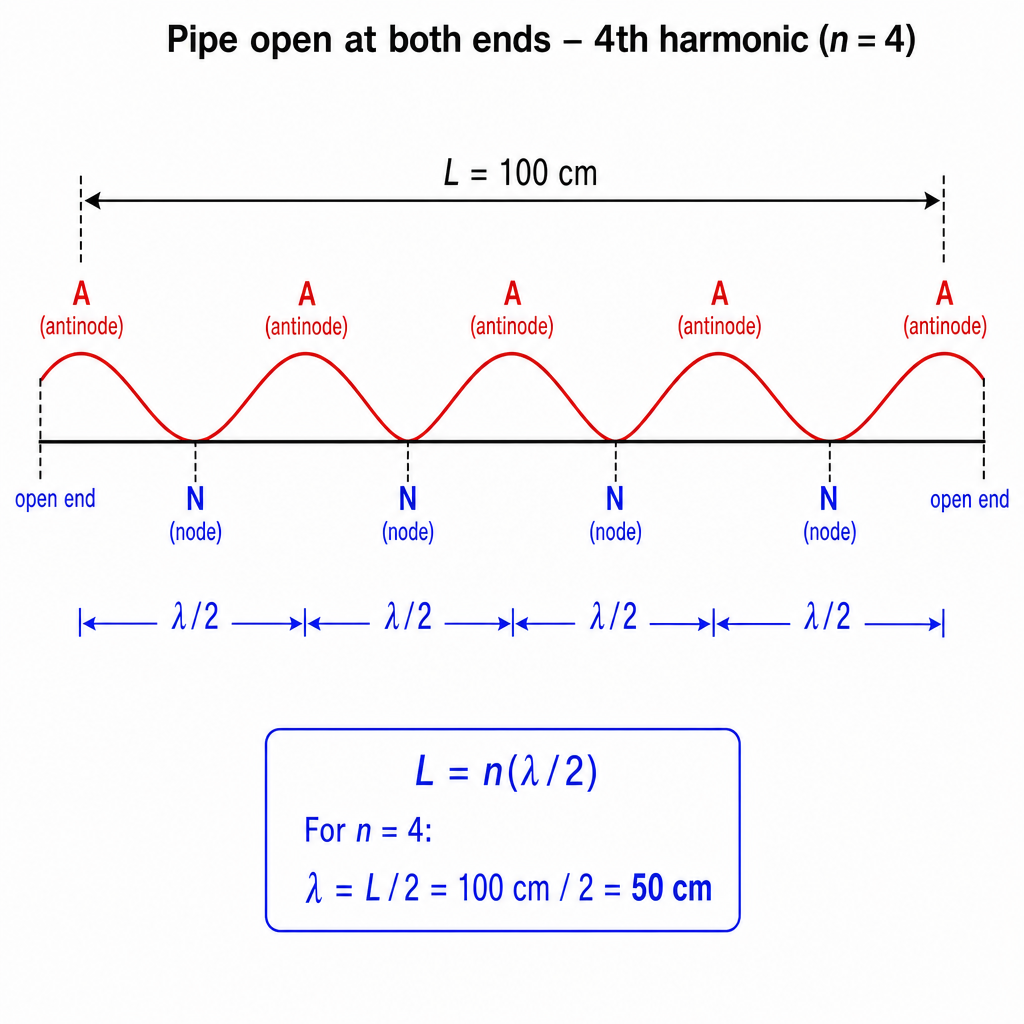
Key Takeaways
- For a pipe open at both ends: ends are displacement antinodes.
- Allowed wavelengths satisfy .
- In MCQs, quickly test each option by checking whether is an integer.
Common Mistakes
- Using the closed-pipe condition (this applies only when one end is closed).
- Forgetting that must be a positive integer.
- Mixing up (wrong) with for open-open pipes.
Things to Be Careful About
- The pipe length is , so keep units consistent (all options are also in cm here).
- Open ends correspond to antinodes for displacement (nodes for pressure), but the wavelength condition is the same standard result: for open-open.
- The loudspeaker position does not change the boundary condition: the ends being open is what fixes the standing-wave pattern.
A student makes a sound at point R near a building. A second student, standing at point S around the corner of the building, hears the sound. The building is a solid structure and there are no other structures nearby.
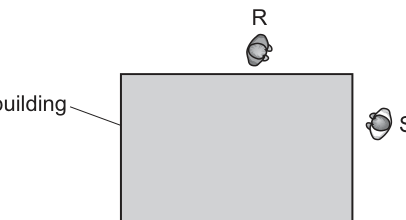
Which effect best explains how the student at point S is able to hear the student at point R?
Options
A diffraction
B interference
C polarisation
D reflection
Working
Sound waves spread out when they pass an edge/opening, so they can bend around the corner of the building (diffraction).
Answer
A
A
Background Concept
Diffraction is the spreading of waves when they pass through a gap or around an obstacle/edge. It is most noticeable when the size of the obstacle or opening is comparable to the wavelength.
Sound has relatively long wavelengths (compared with light), so it diffracts significantly around edges, allowing it to be heard even when the прямой (straight-line) path is blocked.
Understanding the Question
Student at makes a sound. Student at is around the corner of a solid building, so there is no direct line of sight and the straight path for the sound is blocked. There are no other structures nearby, so we should not rely on reflections from other walls/objects.
The question asks which single effect best explains how the sound reaches .
Approach
Decide which wave phenomenon allows energy to reach a region that would be in the “shadow” of an obstacle:
- diffraction: waves spread into the shadow region around an edge,
- reflection: requires a suitable surface sending sound toward ,
- interference: needs two coherent sources/paths,
- polarisation: does not apply to longitudinal sound in air.
Step-by-Step Reasoning
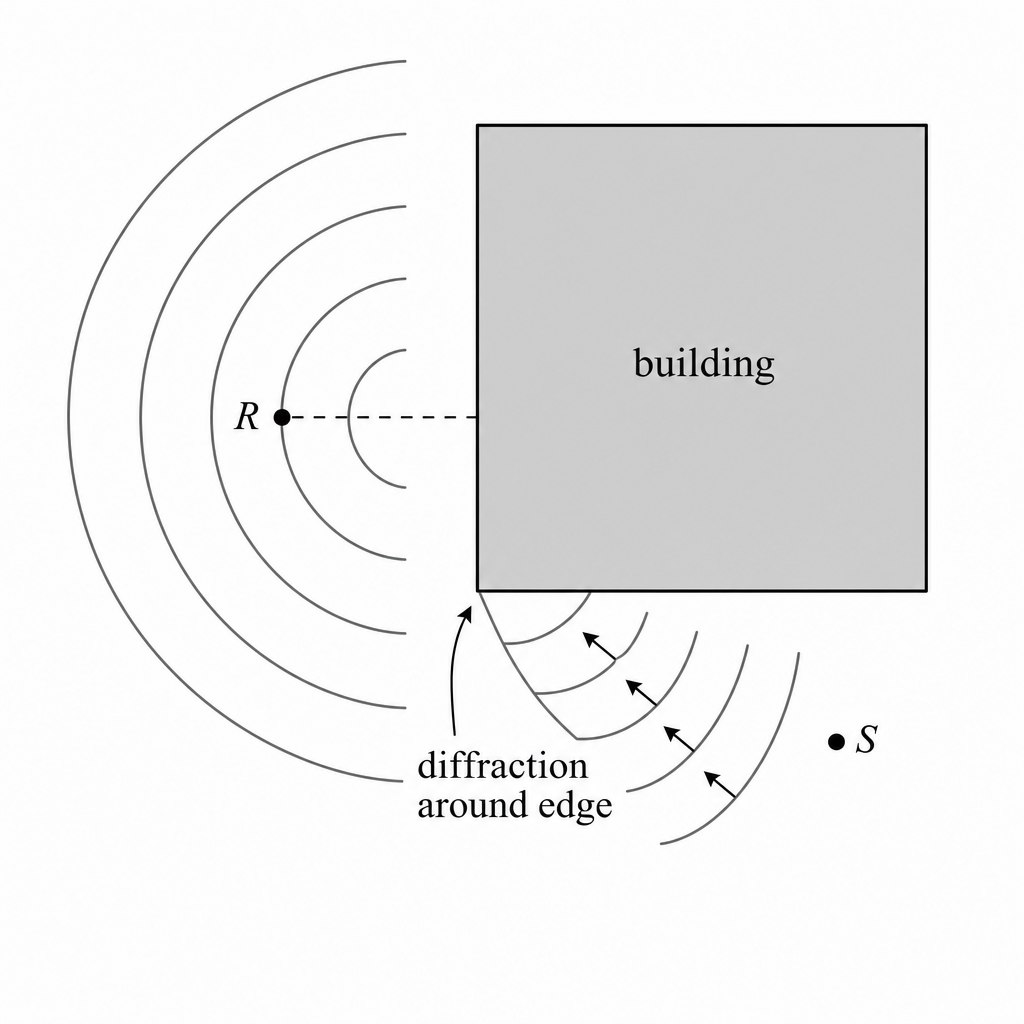
-
The building blocks the straight-line path from to , so simple straight propagation cannot explain hearing.
-
Since there are no other structures nearby, there is no obvious second surface to reflect the sound around the corner. Also, reflection would typically require a clear path to a reflecting surface and then to .
-
Interference is not the right explanation because it requires two (or more) coherent waves arriving at the point (e.g. two sources or two well-defined paths). Here there is just one source at .
-
Polarisation is a property of transverse waves. Sound in air is longitudinal, so polarisation is not applicable.
-
Diffraction does exactly what is needed: the sound wave spreads out at the building edge and can propagate into the region around the corner, reaching .
Therefore the correct choice is diffraction.
Key Takeaways
- Diffraction is wave spreading around edges/through gaps and explains “hearing around corners”.
- Sound diffracts more than light because its wavelength is much larger.
- Polarisation applies only to transverse waves, not sound in air.
Common Mistakes
- Choosing reflection just because the building has walls: the scenario specifies no other structures, and reflection is not the primary reason sound is heard around a corner.
- Choosing interference without identifying two coherent sources/paths.
- Choosing polarisation for sound waves in air.
Things to Be Careful About
- If the question mentioned another wall or a corridor that could provide a clear reflecting path, reflection might contribute; here the “around the corner” shadow region points strongly to diffraction.
- Remember: diffraction is stronger when wavelength is large compared with the size of the obstacle/edge features, which is why it is very noticeable for sound.
Red light of a single wavelength from a laser is incident on a double slit.
A pattern of interference fringes is observed on a flat screen that is placed parallel to the double slit.
Which change increases the separation of the interference fringes on the screen?
Options
A Decrease the distance from the double slit to the screen.
B Decrease the separation of the slits.
C Replace the red light with blue light.
D Replace the red light with green light.
Working
For double-slit interference,
To increase , increase or , or decrease .
Only decreasing slit separation increases .
Answer
B
B
Background Concept
In a double-slit experiment, bright fringes occur where the path difference between light from the two slits equals an integer number of wavelengths. For small angles, the spacing between adjacent bright fringes on a distant screen is
where:
- is the fringe separation on the screen,
- is the wavelength of the light,
- is the distance from the slits to the screen,
- is the separation of the slits.
This shows the proportionalities: , , and .
Understanding the Question
We are told a single-wavelength laser shines on a double slit and an interference pattern is seen on a screen parallel to the slit plane. The question asks which single change would make the fringes further apart (increase ).
Approach
Use the relationship
Then test each option by seeing whether it increases or , or decreases . Also remember the colour-wavelength ordering: red has a longer wavelength than green, and green is longer than blue.
Step-by-Step Reasoning
From
- Option A: decrease (\Rightarrow x) decreases. Not correct.
- Option B: decrease (\Rightarrow x) increases because . Correct.
- Option C: replace red with blue. Blue has smaller than red (\Rightarrow x) decreases. Not correct.
- Option D: replace red with green. Green has smaller than red (\Rightarrow x) decreases. Not correct.
So the only change that increases fringe separation is decreasing slit separation.
Key Takeaways
- Fringe spacing for double-slit interference is
- Increase fringes by: larger , larger , or smaller .
- Wavelengths: red > green > blue.
Common Mistakes
- Thinking that bringing the screen closer (smaller ) makes fringes larger; it actually makes them closer together.
- Mixing up and in the formula (using instead of ).
- Assuming “higher frequency” (blue) gives larger spacing; since , blue has smaller .
Things to Be Careful About
- The formula depends on the small-angle approximation (typical in exam double-slit fringe questions).
- Always check proportionality carefully: if a variable is in the denominator (here ), decreasing it increases the result.
An electromagnetic wave is incident normally on a diffraction grating.
A second-order maximum is produced at an angle of to the direction of the incident light.
The grating has lines per cm.
What is the wavelength of the wave?
Options
A
B
C
D
Working
Number of lines per metre:
Grating spacing:
Using with and :
Answer
B
B
Background Concept
A diffraction grating has many equally spaced lines (slits). Light from adjacent slits travels to a point on a distant screen at slightly different path lengths. Constructive interference (a bright maximum) occurs when the path difference is an integer number of wavelengths.
For normal incidence (light arriving perpendicular to the grating), the condition for the th order maximum at angle is:
where:
- is the grating spacing (distance between adjacent lines),
- is the angle of the diffracted maximum from the straight-through (incident) direction,
- is the order number (),
- is the wavelength.
Also, if the grating has lines per metre, then:
Understanding the Question
You are told:
- a second-order maximum () occurs at ,
- the grating has lines per cm.
You must find and then choose the option that matches.
The key detail is converting “lines per cm” into “lines per m” so that comes out in metres.
Approach
- Convert line density to in .
- Find spacing .
- Substitute into and rearrange for .
- Compare to the options.
Step-by-Step Reasoning
Convert to per metre:
Now find the spacing:
Use the grating equation with and :
Since ,
This matches option B.
Key Takeaways
- Always convert line densities to before finding in metres.
- For normal incidence, maxima satisfy .
- Higher order () means a larger path difference requirement; for fixed and , scales as .
Common Mistakes
- Using instead of converting from (gives a wavelength too large).
- Forgetting to divide by the order .
- Using (mixing up with ).
- Giving in cm while giving in m (unit inconsistency).
Things to Be Careful About
- The angle is measured from the incident (straight-through) direction, which is the standard in the grating equation.
- Quote in metres to match the options.
- Keep track of powers of ten carefully when inverting to get .
The resistance of a lamp is and the potential difference across it is .
How many electrons pass through the lamp in a time of hours?
Options
A
B
C
D
Working
Answer
D
D
Background Concept
Electric current is the rate of flow of charge:
For a component that obeys Ohm’s law (or when resistance and p.d. are given), the current is found from:
Once the total charge has passed, the number of electrons is
where is the elementary charge.
Understanding the Question
You are told the lamp has resistance and potential difference across it.
You must find how many electrons pass through in hours.
So we need: current (from and ), then charge in 24 h (from and ), then electrons (from ).
Approach
- Use to get the current through the lamp.
- Convert into seconds so SI units are consistent.
- Use to find total charge transferred.
- Divide by to convert charge into number of electrons.
- Match the final value to the closest option.
Step-by-Step Reasoning
Current:
Time conversion:
Charge transferred:
Number of electrons:
This rounds to , which corresponds to option D.
Key Takeaways
- Use to link resistance, p.d., and current.
- Use to get total charge transferred over a time.
- Convert hours to seconds to keep SI units consistent.
- Number of electrons is , not .
Common Mistakes
- Forgetting to convert into seconds (gives an answer too small by a factor of ).
- Using instead of .
- Using instead of for the current.
Things to Be Careful About
- Keep units consistent: volts, ohms, amperes, seconds, coulombs.
- Significant figures: is 2 s.f., so the final option choice should be consistent with rounding.
- The question asks for electrons passing through (a count), so the final result has no unit.
What is equivalent to one volt?
Options
A one coulomb per second
B one joule per coulomb
C one joule per second
D one joule second per coulomb squared
Working
Potential difference is defined by
So .
Answer
B
B
Background Concept
Potential difference (p.d.) between two points is the energy transferred (work done) per unit charge when charge moves between those points.
Mathematically,
where:
- is potential difference in volts (V),
- is energy transferred / work done in joules (J),
- is charge in coulombs (C).
So the volt is a derived unit: joule per coulomb.
Understanding the Question
The question asks which unit expression is equivalent to one volt. You are given four possible combinations of joule, coulomb and second. The correct one must match the definition of p.d. (energy per charge).
Approach
Recall the definition , then express “one volt” in base units of the quantities in the options. Choose the option that matches .
Step-by-Step Reasoning
Start from the definition of potential difference:
So, for one volt:
Comparing with the options:
- B is “one joule per coulomb”, which matches exactly.
Key Takeaways
- A volt measures energy transferred per coulomb of charge: .
- Many unit MCQs reduce to recalling a definition and matching units.
Common Mistakes
- Confusing volt with watt: (this is option C, but it is power, not p.d.).
- Confusing volt with ampere: (this is option A, but it is current, not p.d.).
Things to Be Careful About
- Keep the physical meaning in mind: p.d. is about energy per charge, not charge per time (current) or energy per time (power).
- Don’t try to combine unrelated units unless you can link them via a defining equation (here, is the key).
The resistance of some electrical components may change with changing conditions.
Which component’s resistance increases?
Options
A a filament lamp as the potential difference (p.d.) across it increases
B a light-dependent resistor (LDR) as the intensity of the light incident on it increases
C a metallic conductor at constant temperature as the current through it increases
D a thermistor as its temperature increases
Working
- Filament lamp: increasing p.d. (\Rightarrow) larger current (\Rightarrow) filament temperature rises, so resistivity increases and hence resistance increases.
- LDR: increasing light intensity decreases resistance.
- Metallic conductor at constant temperature: (R) is constant (Ohm’s law), so does not increase with current.
- (NTC) thermistor: increasing temperature decreases resistance.
Answer
A
A
Background Concept
Resistance depends on both the material and its physical state. For many conductors,
where is the resistivity.
- For metals, (and hence ) increases with temperature because lattice vibrations increase and electrons collide more often.
- Some components are designed so that changes strongly with an external condition:
- Filament lamp: metal filament heats up when current increases, so increases (non-ohmic behaviour).
- LDR: more light creates more charge carriers, so decreases.
- Thermistor (in A-level, typically NTC): higher temperature gives more carriers, so decreases.
- An ohmic metallic conductor at constant temperature obeys
with constant (independent of ) as long as temperature is fixed.
Understanding the Question
You are asked to choose which component shows an increase in resistance when the stated condition increases:
- lamp: p.d. increases,
- LDR: light intensity increases,
- metallic conductor: current increases but temperature is constant,
- thermistor: temperature increases.
Approach
Check each option against the standard behaviour of that component:
- Decide whether the stated condition makes temperature rise (important for metals).
- Use the known qualitative vs condition trend (lamp, LDR, thermistor).
- Pick the only one where increases.
Step-by-Step Reasoning
Option A (filament lamp): Increasing p.d. increases current, so the filament power increases and the filament gets hotter. Since the filament is metal, higher temperature means higher resistivity, so increases.
Option B (LDR): More light generates more mobile charge carriers in the semiconductor, so conductivity increases and resistance decreases. So does not increase.
Option C (metallic conductor at constant temperature): If temperature is constant, resistivity is constant, so stays constant. Changing changes proportionally; it does not increase .
Option D (thermistor): At this level thermistors are taken as NTC devices: as temperature increases, resistance decreases.
Therefore only A fits “resistance increases”.
Key Takeaways
- Metals: increases with temperature.
- Filament lamps are non-ohmic because heating changes .
- LDR: more light (\Rightarrow) lower .
- NTC thermistor: higher temperature (\Rightarrow) lower .
- An ohmic conductor at constant temperature has constant .
Common Mistakes
- Thinking that increasing p.d. across any component must decrease resistance (confusing with without considering that is not proportional to for non-ohmic components).
- Mixing up LDR and thermistor behaviour (both typically have resistance that decreases when the stimulus increases).
- Forgetting the phrase “at constant temperature” in option C, which forces to remain constant.
Things to Be Careful About
- Filament lamp: the key is temperature rise due to higher power dissipation.
- Thermistors can be NTC or PTC in general, but in 9702 the standard assumption is NTC unless explicitly stated otherwise.
- For option C, “current increases” does not by itself change resistance if temperature is controlled.
Gold is sometimes used to make very small connecting wires in electronic circuits.
A particular gold wire has length and cross-sectional area . Gold has resistivity .
What is the resistance of the wire?
Options
A
B
C
D
Working
For a uniform wire,
Answer
C
C
Background Concept
The resistance of a uniform conductor depends on:
- its resistivity (a material property, unit ),
- its length (longer wire (\Rightarrow) larger resistance),
- its cross-sectional area (thicker wire (\Rightarrow) smaller resistance).
They are related by
This equation applies when the wire has constant cross-sectional area and the material is homogeneous.
Understanding the Question
You are given , , and for a gold wire and asked to find its resistance . The answer must match one of the four options A–D.
Given:
Unknown: in .
Approach
Use the resistivity formula
Then do standard-form arithmetic carefully: multiply and , then divide by , and finally compare the numerical value to the options.
Step-by-Step Reasoning
Start with
Substitute values:
Multiply the numerator:
Now divide by :
This corresponds to option C.
Key Takeaways
- Use for uniform wires.
- Check the power of ten: here .
- After calculating, compare directly to the given options.
Common Mistakes
- Using instead of (inverts the effect of length and area).
- Power-of-ten error when dividing: is , not or .
- Wrong unit for or treating as .
Things to Be Careful About
- Keep in and in (they already are).
- Do the standard-form arithmetic systematically: separate the decimal division from the powers of ten.
- Ensure the final unit is .
A cell of constant electromotive force (e.m.f.) and negligible internal resistance is separately connected into four different circuits.
In which circuit does the power dissipated by the lamp stay the same as the variable resistor is adjusted?
Options
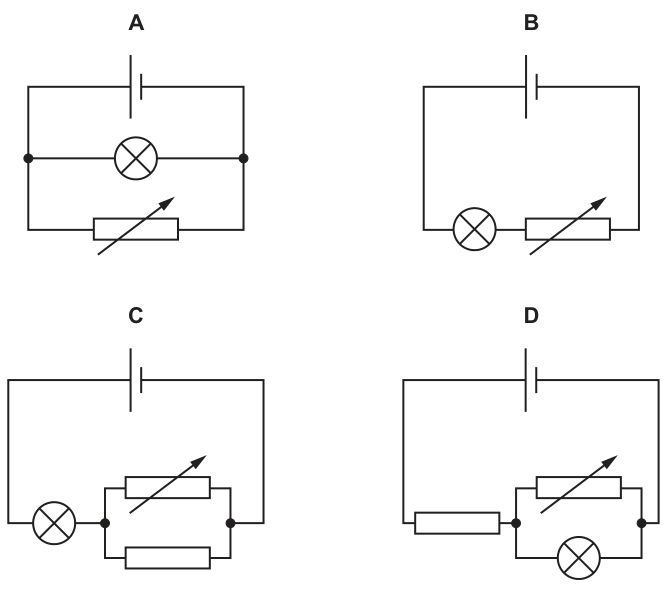
Working
For the lamp (assume constant resistance ),
So stays constant if the p.d. across the lamp stays constant.
In circuit A the lamp is directly in parallel with the ideal cell, so
independent of the variable resistor setting.
Answer
A
A
Background Concept
Power dissipated in a component can be written as
For a lamp treated as a resistor of (approximately) constant resistance , the simplest way to keep its power constant is to keep the potential difference across it constant, because then
Also, in a parallel circuit, components connected between the same two nodes have the same p.d. across them. An ideal cell with negligible internal resistance maintains a constant terminal p.d. equal to its e.m.f. regardless of the current drawn.
Understanding the Question
The same ideal cell is connected to four different resistor/lamp arrangements. The variable resistor is adjusted (its resistance changes), and we want the circuit in which the lamp’s power does not change as that adjustment is made.
So we must look for a circuit where the lamp’s p.d. (or current, in a compensating way) is unaffected by changing the variable resistor.
Approach
- Treat the lamp as having fixed resistance (standard assumption at this level unless stated otherwise).
- Use : constant power requires constant .
- Inspect each circuit to see whether changing the variable resistor can change .
Step-by-Step Reasoning
- Circuit A: The lamp is connected directly across the cell terminals, and the variable resistor is in a separate parallel branch across the same two terminals.
- Because the cell is ideal, the p.d. across its terminals is always .
- Since the lamp is directly across those same terminals,
-
Changing the variable resistor only changes the current in its own branch and the total current drawn from the cell, not the lamp’s p.d.
-
Circuit B: Lamp and variable resistor are in series.
- Changing the variable resistor changes the total series resistance, so the current changes. Then changes.
-
Circuit C: Lamp is in series with a parallel network (variable resistor in parallel with a fixed resistor).
- Changing the variable resistor changes the equivalent resistance of the parallel part, changing the total current, so the current through the lamp changes and hence its power changes.
-
Circuit D: A fixed resistor is in series with a parallel combination of (lamp || variable resistor).
- Changing the variable resistor changes the equivalent resistance of the parallel section, which changes the circuit current and therefore changes the voltage drop across the series fixed resistor. That means the p.d. across the parallel section (and hence across the lamp) changes, so lamp power changes.
Therefore only circuit A keeps (and thus ) constant.
Key Takeaways
- With an ideal supply, any component directly in parallel with the supply has constant p.d.
- For a component of fixed resistance, constant p.d. implies constant power via .
- Adding or adjusting resistors elsewhere generally changes current distribution and/or potential division unless the lamp remains directly across the supply.
Common Mistakes
- Thinking “parallel means current splits so power must change”: the crucial point is p.d. in parallel is the same, not the current.
- Forgetting that an ideal cell with negligible internal resistance keeps its terminal p.d. constant even if the total current changes.
- Using without recognising that both and might change in most circuits.
Things to Be Careful About
- The conclusion relies on the cell being ideal (negligible internal resistance). If internal resistance were significant, changing total current would change terminal p.d., and even circuit A would no longer keep lamp power perfectly constant.
- At this level the lamp is typically treated as having constant resistance unless its non-ohmic behaviour is explicitly part of the question.
The sum of the electrical currents into a point in a circuit is equal to the sum of the currents out of the point.
Which statement is correct?
Options
A This is Kirchhoff’s first law, which results from the conservation of charge.
B This is Kirchhoff’s first law, which results from the conservation of energy.
C This is Kirchhoff’s second law, which results from the conservation of charge.
D This is Kirchhoff’s second law, which results from the conservation of energy.
At a junction, the total current entering equals the total current leaving: this is Kirchhoff’s first law.
It follows from conservation of charge (no net charge accumulates at the junction).
Answer
A
A
Background Concept
Kirchhoff’s laws describe how current and potential difference behave in electrical circuits.
Kirchhoff’s first law (junction law):
At any junction,
This comes from conservation of charge. If charge cannot be created or destroyed, then charge cannot continuously build up at a junction in a steady circuit. Since current is the rate of flow of charge,
a balance of charge flow rates implies a balance of currents.
Kirchhoff’s second law (loop law): the sum of electromotive forces equals the sum of potential drops around a closed loop; it results from conservation of energy.
Understanding the Question
The statement given is: “The sum of the electrical currents into a point in a circuit is equal to the sum of the currents out of the point.”
A “point” here means a junction/node where branches meet. The question asks which option correctly names the law (first or second) and the principle it results from (charge or energy conservation).
Approach
- Recognise the described rule as a junction rule (currents in = currents out).
- Identify which Kirchhoff law corresponds to junction behaviour.
- State the underlying conservation principle that leads to that law.
- Choose the matching option.
Step-by-Step Reasoning
- The statement “sum of currents into a point equals sum out” is exactly the junction law.
- Kirchhoff’s first law is the junction law.
- At a junction in steady conditions, charge does not accumulate, so the rate of charge entering equals the rate leaving. Using , this gives .
- This is therefore a consequence of conservation of charge, not conservation of energy.
So the correct statement is: “This is Kirchhoff’s first law, which results from the conservation of charge.” → option A.
Key Takeaways
- Kirchhoff’s first law applies at junctions and follows from conservation of charge.
- Kirchhoff’s second law applies around closed loops and follows from conservation of energy.
Common Mistakes
- Swapping the laws: calling the junction law “Kirchhoff’s second law”.
- Linking current balance to conservation of energy instead of conservation of charge.
- Forgetting that the loop law (second law) is the one associated with energy changes around a circuit.
Things to Be Careful About
- The wording “into a point” and “out of the point” is a strong clue that this is about a junction/node, not a loop.
- Kirchhoff’s first law assumes no net charge accumulation at the junction (steady-state circuit).
A battery of electromotive force (e.m.f.) and negligible internal resistance is connected to three resistors, as shown.
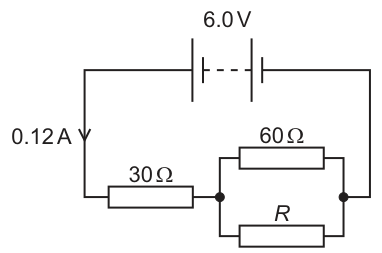
The current in the battery is .
What is resistance ?
Options
A
B
C
D
Working
Total resistance:
Since is in series with the parallel pair,
For in parallel with :
Answer
B
B
Background Concept
In d.c. circuits:
- Ohm’s law relates the potential difference across a complete circuit to the current through it:
- Resistors in series carry the same current, and their resistances add:
- Resistors in parallel have the same potential difference across them, and their combined resistance satisfies:
Here the battery has negligible internal resistance, so the terminal p.d. equals the e.m.f. (i.e. the full is across the external resistors).
Understanding the Question
You are told:
- e.m.f.
- current from the battery
- a resistor is in series with a parallel combination of and an unknown .
You must determine the value of the unknown resistor .
Approach
- Use to find the equivalent resistance of the entire network.
- Subtract the known series resistance () to get the equivalent resistance of the parallel section.
- Use the parallel formula with and to solve for .
- Match the result to the given options.
Step-by-Step Reasoning
- Find total resistance of the circuit:
- Identify series and parallel parts.
The resistor is in series with the parallel pair, so:
Hence:
- Apply parallel combination to and :
Substitute :
Solve for :
So:
This corresponds to option B.
Key Takeaways
- Use when the supply voltage and total current are known.
- Series resistances add directly; parallel resistances add as reciprocals.
- In mixed series–parallel circuits, simplify stepwise: find an equivalent for the parallel part, then combine with series parts.
Common Mistakes
- Adding and directly (that would only be correct if they were in series).
- Using (inverting by mistake).
- Forgetting that the resistor is not part of the parallel section.
Things to Be Careful About
- Internal resistance is stated negligible, so take across the whole external network.
- When subtracting to find the parallel equivalent, ensure you subtract the series resistor from the total resistance, not from voltage or current.
- Handle reciprocals carefully in the parallel equation (common arithmetic slips occur here).
A potentiometer circuit may be used to determine the unknown electromotive force (e.m.f.) of a cell. The circuit diagrams shown include a battery of known e.m.f. and negligible internal resistance, a uniform resistance wire XY and a galvanometer.
Which circuit diagram shows a suitable arrangement for determining ?
Options
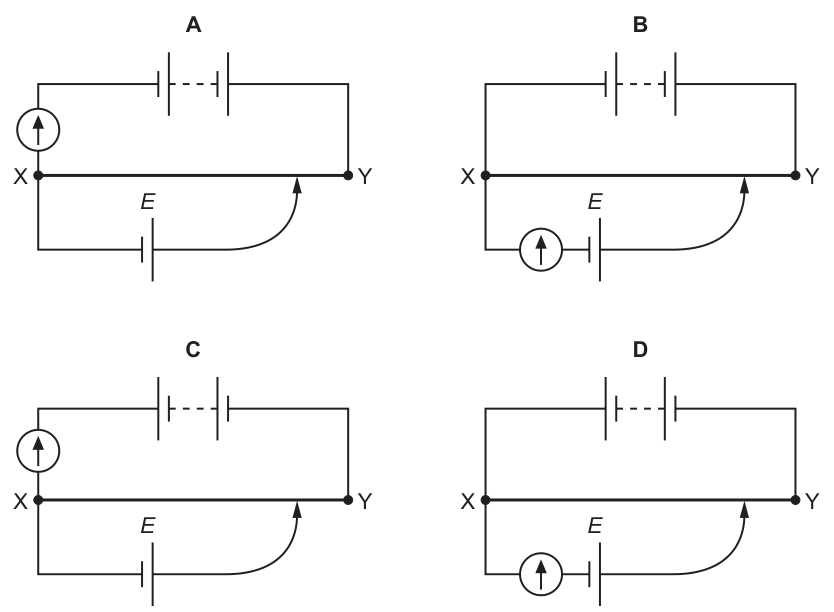
Working
In a potentiometer, the driving battery sets a uniform potential gradient along the wire . The unknown cell must be in a separate (secondary) circuit with the galvanometer between and a sliding contact, so that a null (zero galvanometer current) can be obtained without drawing current from the unknown cell.
Only diagram B places the galvanometer in series with the unknown cell in this secondary branch; A and C put the galvanometer in the main driving circuit, and D has the unknown cell reversed.
Answer
B
B
Background Concept
A potentiometer measures an unknown e.m.f. by a null method. A separate “driving” circuit uses a battery of known e.m.f. (and negligible internal resistance) to push a steady current through a uniform resistance wire. This creates a constant potential gradient along the wire, so the potential difference between and a point a distance from is proportional to .
To measure the unknown e.m.f. , the unknown cell is connected in a secondary circuit with a galvanometer. The sliding contact is moved until the galvanometer shows zero current (null). At null, no current is drawn from the unknown cell, so the measured balance corresponds to its true e.m.f., not a terminal p.d. reduced by internal resistance.
Understanding the Question
We are shown four possible circuit arrangements involving:
- a driving battery connected across a uniform wire ,
- an unknown cell of e.m.f. ,
- a galvanometer and a sliding contact.
We must choose which diagram is suitable for determining by a potentiometer method.
Key features to look for:
- Driving battery must be connected across and to set a potential gradient.
- Galvanometer must be in the secondary branch (null detector), not in the main driving circuit.
- The unknown cell must be connected so that its e.m.f. opposes the p.d. along the chosen length of wire, allowing a balance point where net p.d. around the secondary loop is zero.
Approach
Eliminate diagrams that violate the essential potentiometer requirements:
- If the galvanometer is placed in the main (driving) circuit, it is not acting as a null detector for the unknown e.m.f. → unsuitable.
- Between the remaining candidates, choose the one where the unknown cell polarity is correct for opposition and a possible null.
Step-by-Step Reasoning
-
Check where the galvanometer is connected.
- In diagrams A and C, the galvanometer is described as being in the left vertical branch of the main driving circuit above . That means it is not simply detecting a null in a separate measurement loop. These are not standard potentiometer measuring connections.
-
Identify the diagrams with a separate null-detecting branch.
- In B and D, the galvanometer and unknown cell are in series in a secondary branch connected between and the sliding contact on . This matches the potentiometer null method layout.
-
Check polarity of the unknown cell.
- For a balance point to exist, the e.m.f. of the unknown cell must oppose the p.d. along the wire segment between and the sliding contact. Diagram D is stated to have the polarity of the unknown cell reversed relative to the correct arrangement, so it would drive current the wrong way and not give the standard opposing condition.
Therefore, the suitable arrangement is B.
Key Takeaways
- A potentiometer measures e.m.f. using a null condition (zero galvanometer current).
- The galvanometer must be in the secondary circuit with the unknown source.
- Correct polarity is needed so the unknown e.m.f. opposes the p.d. along the wire and a balance point can be found.
Common Mistakes
- Choosing a circuit where the galvanometer is in the main driving circuit (it then does not function as a null detector for ).
- Ignoring cell polarity: reversing the unknown cell generally prevents the required opposition for a balance.
- Thinking any connection between and the slider works: the whole point is no current drawn from the unknown cell at balance.
Things to Be Careful About
- The driving battery must have negligible internal resistance so the potential gradient along stays stable.
- The resistance wire must be uniform; otherwise p.d. is not proportional to length and the method fails.
- At balance, the galvanometer reading must be exactly zero (or as close as possible), since the method relies on zero current in the secondary circuit.
A uranium atom with a charge of has a nucleon number of and a proton number of .
is the elementary charge.
What is the total number of protons, neutrons and electrons in this charged atom?
Options
A
B
C
D
Working
Protons .
Neutrons .
Charge so electrons .
Total .
Answer
B
B
Background Concept
For a nuclide:
- Proton number (atomic number) = number of protons.
- Nucleon number (mass number) = number of protons + number of neutrons.
So number of neutrons is
For a charged atom (an ion):
- A neutral atom has electrons = protons.
- A charge of means it has lost 2 electrons compared with the neutral atom, so
Understanding the Question
You are told the uranium atom has:
- charge
- nucleon number
- proton number
You must find the total number of particles (protons + neutrons + electrons) in this charged atom.
Approach
- Use directly for the number of protons.
- Use for neutrons.
- Use the ion charge to determine the electron count ( means 2 fewer electrons than protons).
- Add the three numbers.
Step-by-Step Reasoning
- Protons:
- Neutrons:
- Electrons:
A ion has lost 2 electrons, so
- Total number of protons, neutrons and electrons:
So the correct option is B.
Key Takeaways
- Use to relate nucleon number, proton number, and neutron number.
- Positive ion charge means fewer electrons than protons by the charge number.
- Always use the charged atom’s electron count, not the neutral atom’s.
Common Mistakes
- Using electrons for a ion (sign error).
- Using neutrons (mixing up protons and electrons in the nucleus calculation).
- Forgetting to include electrons in the total.
Things to Be Careful About
- Proton number refers to protons only (in the nucleus), regardless of ionisation.
- Nucleon number counts protons + neutrons only (electrons are not nucleons).
- The charge indicates a deficit of 2 electrons compared with neutral: electrons .
A nucleus W of a radioactive isotope emits a particle and forms nucleus X.
Nucleus X emits an -particle to form nucleus Y.
Nucleus Y emits a particle to form nucleus Z.
Which statement about Z is correct?
Options
A Z is a nucleus of a different element from W and has a higher nucleon number.
B Z is a nucleus of a different element from W and has a lower nucleon number.
C Z is a nucleus of the same element as W and has a higher nucleon number.
D Z is a nucleus of the same element as W and has a lower nucleon number.
Working
For decay: proton number increases by , nucleon number unchanged.
So : , .
For decay: decreases by , decreases by .
So : , .
For decay again:
So : , .
Net change from to :
So is the same element as (same ) and has a lower nucleon number.
Answer
D
D
Background Concept
In nuclear decay we track two key numbers:
- proton (atomic) number : determines the element
- nucleon (mass) number : total number of protons + neutrons
The standard changes are:
- decay: a neutron turns into a proton + electron + antineutrino.
So stays the same, and increases by .
- decay: the nucleus emits an particle ().
So decreases by , and decreases by .
Understanding the Question
We are told a decay chain:
- emits to become
- emits to become
- emits to become
The options ask whether is the same or different element compared with (so compare proton number ), and whether it has higher or lower nucleon number .
Approach
Track the effect of each decay on and on proton number (call it to avoid confusion with nucleus in the question). Then add the changes to find the net change from the start () to the end (nucleus ).
Step-by-Step Reasoning
- First decay: is .
- unchanged
- proton number increases by
So after this step: , .
- Second decay: is .
- decreases by
- proton number decreases by
So for this step: , .
- Third decay: is again.
- unchanged
- proton number increases by
So: , .
Add them:
A net change of in proton number means the final nucleus is the same element as the initial nucleus (because elements are defined by proton number).
For nucleon number:
So the final nucleus has lower nucleon number than .
Therefore the correct option is D.
Key Takeaways
- The element depends only on proton number .
- decay: , unchanged.
- decay: , .
- In decay chains, add the changes step by step to get the net effect.
Common Mistakes
- Thinking decay changes (it does not).
- Mixing up what defines the element (it is proton number, not nucleon number).
- Applying the wrong sign for decay (both and decrease).
- Forgetting to combine all three steps to get the overall change.
Things to Be Careful About
- The nucleus labelled in the question is not the same as proton number ; keep that distinction clear.
- Two decays cancel the change of one decay here: balances .
- Nucleon number can only change in decays that emit nucleons (like emission), not in decays.
Which particle is not a lepton?
Options
A electron
B neutrino
C neutron
D positron
Leptons include the electron, positron (anti-electron) and neutrinos.
The neutron is a baryon (hadron), not a lepton.
Answer
C
C
Background Concept
In particle physics at AS level, particles are grouped into families.
- Leptons are fundamental particles (they are not made of quarks). Examples: electron , muon , tau , and their corresponding neutrinos (, , ). Their antiparticles (e.g. positron ) are also leptons.
- Hadrons are particles made of quarks and experience the strong nuclear interaction. Hadrons include:
- Baryons (three quarks), e.g. proton, neutron.
- Mesons (quark–antiquark), e.g. pion.
So to decide whether something is a lepton, you ask: is it one of the lepton species (or an anti-lepton), i.e. not a quark composite?
Understanding the Question
You are given four particles and asked which one is not a lepton:
- electron
- neutrino
- neutron
- positron
The task is a classification question: identify the odd one out that belongs to a different family.
Approach
- List which options are known leptons (including antiparticles).
- Identify any option that is a hadron (made of quarks), which therefore cannot be a lepton.
Step-by-Step Reasoning
- Electron : a lepton.
- Neutrino : a lepton.
- Positron : anti-electron, still a lepton (an anti-lepton).
- Neutron : a baryon (made of three quarks, specifically ), so it is a hadron and not a lepton.
Therefore the correct choice is neutron.
Key Takeaways
- Leptons are not made of quarks (electrons and neutrinos are leptons; positrons are also leptons).
- Neutrons (and protons) are baryons, hence hadrons, hence not leptons.
Common Mistakes
- Thinking “neutral” means “neutrino”: a neutron is neutral but it is a baryon, not a neutrino.
- Forgetting that antiparticles (like the positron) remain in the same family (anti-leptons are still leptons in classification questions).
Things to Be Careful About
- Don’t classify by charge alone: both neutrinos and neutrons have charge but belong to different families.
- Remember the hadron/lepton split: nucleons (proton, neutron) are always hadrons (baryons).
How many flavours (types) of antiquark are there?
Options
A
B
C
D
Working
There are quark flavours (), and each has a corresponding antiquark flavour.
Answer
D
D
Background Concept
In the quark model (Standard Model), quarks come in different "flavours" (types). For every quark flavour, there is a corresponding antiquark flavour with the same mass but opposite additive quantum numbers (e.g. opposite electric charge and opposite baryon number).
The six quark flavours are:
- up (), down ()
- strange (), charm ()
- top (), bottom ()
So there are six antiquark flavours: .
Understanding the Question
The question asks for the number of different antiquark flavours (types). Since flavours are categories like up/down/strange etc., we simply need to know how many quark flavours exist and then note that antiquarks mirror them one-for-one.
Approach
- Recall the number of quark flavours.
- Use the fact that each quark flavour has a corresponding antiquark flavour.
- Choose the option that matches this count.
Step-by-Step Reasoning
- The Standard Model contains quark flavours: .
- Each quark has an antiquark of the same flavour (e.g. has , has , etc.).
- Therefore the number of antiquark flavours is also .
- The option for is D.
Key Takeaways
- "Flavour" means the type of quark (up, down, strange, charm, top, bottom).
- There is exactly one antiquark for each quark flavour.
- Therefore the number of antiquark flavours equals the number of quark flavours: .
Common Mistakes
- Confusing the number of flavours with the number of colours (quarks have 3 colours, but that is not the same as flavour).
- Counting only the lighter quarks () and forgetting the top and bottom quarks.
Things to Be Careful About
- The question is about flavours (types), not about charges, colours, or how many quarks are in a hadron.
- Ensure you include all six flavours used at A Level: (and hence six antiquark flavours).
Your score so far
Answer a question to start scoring
Your marks add up here as you work through the paper.