Physics 9702/11 — May/June 2025
Cambridge AS Level · Multiple Choice (AS Level) · answer key with instant marking and worked solutions
Topics Waves · Work, Energy and Power · Physical Quantities and Units · Dynamics · Forces, Density and Pressure · Electricity · +5 more
Tap an option under each question to check it — your score builds as you go.
Which quantity is a vector?
Options
A pressure
B temperature
C weight
D work
A vector has both magnitude and direction.
Pressure, temperature and work are scalars, but weight is a force and acts towards the centre of the Earth.
Answer
C
C
Background Concept
A scalar quantity has magnitude only (a size).
A vector quantity has magnitude and direction, and vectors add using vector addition rules.
Forces are vectors because they act in a particular direction. Weight is a force due to gravity, with magnitude and direction towards the Earth's centre.
Understanding the Question
You are given four quantities (pressure, temperature, weight, work) and asked which one is a vector. So we check whether each quantity has an inherent direction.
Approach
Go through each option and decide:
- Does it need a direction to be fully specified?
- Or is a single number (with a unit) enough?
Step-by-Step Reasoning
- Pressure: defined as force per unit area, but pressure at a point is treated as a scalar (same in all directions in a fluid at rest). So not a vector.
- Temperature: describes how hot something is; no direction. Scalar.
- Weight: a gravitational force. Forces have direction. Weight acts vertically downward (towards the centre of the Earth). Therefore weight is a vector.
- Work: energy transferred; no direction. Scalar.
Hence the only vector is weight.
Key Takeaways
- Scalars: magnitude only (e.g. temperature, work, pressure).
- Vectors: magnitude + direction (e.g. force, velocity, acceleration).
- Weight is a force, so it is a vector.
Common Mistakes
- Choosing pressure because it involves force: pressure is force per area but is not treated as a vector.
- Thinking work is a vector because it can be positive/negative: sign does not make a quantity a vector; direction is required for a vector.
Things to Be Careful About
- Do not confuse a quantity having a formula involving vectors (e.g. pressure involves force) with the quantity itself being a vector.
- A negative value does not imply a vector; it usually just indicates a chosen sign convention along one axis.
Four students, A, B, C and D, have completed an experiment to determine the acceleration of free fall, . Each student repeated the experiment three times. The determined values of are shown in the table.
Which set of results has a high precision and a low accuracy?
| experiment 1 | experiment 2 | experiment 3 | |
|---|---|---|---|
| acceleration of free fall / | |||
| A | 7.2 | 9.4 | 8.3 |
| B | 9.5 | 9.8 | 10.2 |
| C | 9.8 | 9.8 | 9.9 |
| D | 10.1 | 10.2 | 10.1 |
Options
A A
B B
C C
D D
Working
High precision: values close together.
Low accuracy: mean far from .
Set D: (very small spread) but all are significantly above .
Answer
D
D
Background Concept
Precision describes how close repeated measurements are to each other (small random uncertainty gives a small spread).
Accuracy describes how close a measurement (often judged using the mean of repeats) is to the true/accepted value.
So:
- high precision + low accuracy typically means a consistent offset from the true value (often due to a systematic error),
- low precision means readings are scattered (large random error), regardless of whether the mean is close.
Understanding the Question
Each student measured three times. We must pick the student whose three values are:
- tightly clustered (high precision), and
- not close to the accepted value (low accuracy).
Approach
- Look at the spread/range of each student’s three values to judge precision.
- Compare the cluster (or the mean) with to judge accuracy.
Step-by-Step Reasoning
-
Student A: .
- Very wide spread (range ), so low precision. Not the answer.
-
Student B: .
- Moderate spread (range ).
- Mean:
-
Mean is close to , so accuracy is not low. Not the answer.
-
Student C: .
- Very small spread (range ) so high precision.
- Values are also very close to , so high accuracy. Not the answer.
-
Student D: .
- Very small spread (range ) so high precision.
- Mean:
- This is noticeably higher than , so the results are low accuracy (consistent systematic overestimate).
Therefore the required set is D.
Key Takeaways
- Precision is about repeatability (small scatter).
- Accuracy is about closeness to the true value (mean close to accepted value).
- A tight cluster that is shifted away from the true value indicates a systematic error.
Common Mistakes
- Choosing the set with values closest to (that tests accuracy only, not low accuracy).
- Thinking that a small spread automatically means accurate.
- Picking set B as “high precision” even though its spread is much larger than C or D.
Things to Be Careful About
- Use the accepted value as the reference for accuracy.
- For precision, compare the range (or scatter) of the three readings, not just one value.
- High precision + low accuracy commonly means the apparatus/procedure introduces a consistent bias (systematic error).
The diameter of a ball is measured as .
What is the absolute uncertainty in the volume of the ball?
Options
A
B
C
D
Working
For a sphere,
So fractional uncertainty:
Volume:
Absolute uncertainty:
Answer
B
B
Background Concept
When a measured quantity is used to calculate another quantity, the uncertainty “propagates”. For quantities related by a power law,
the fractional (or percentage) uncertainty approximately multiplies by the power:
This is widely used in A Level Physics for uncertainties in derived quantities.
For the volume of a sphere,
so the volume depends on the cube of the radius (or diameter).
Understanding the Question
You are given the diameter of a ball:
The question asks for the absolute uncertainty in the volume (in ). Since the options are numerical, we calculate and then calculate .
Approach
- Express volume in terms of diameter: .
- Use fractional uncertainty propagation for a cube: .
- Find using the central value of .
- Convert fractional uncertainty to absolute uncertainty: .
Step-by-Step Reasoning
Start with the sphere formula and write it in terms of diameter :
Because , the fractional uncertainty is three times the fractional uncertainty in :
Now calculate the volume using :
Convert fractional uncertainty into absolute uncertainty:
This matches option B.
Key Takeaways
- If , then .
- Sphere volume depends on the cube of diameter/radius, so the fractional uncertainty is tripled.
- Absolute uncertainty is found by multiplying the fractional uncertainty by the calculated value.
Common Mistakes
- Using (forgetting to multiply by ).
- Using instead of when finding .
- Giving a fractional/percentage uncertainty instead of an absolute uncertainty in .
Things to Be Careful About
- Use consistent units: in gives in .
- Apply the power rule to the quantity that is actually being measured (here ).
- Round sensibly: the option corresponds to the calculated .
Two vectors, X and Y, are shown.
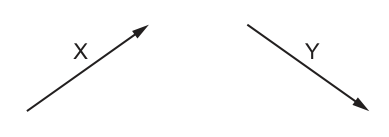
What are the directions of and ?
Options
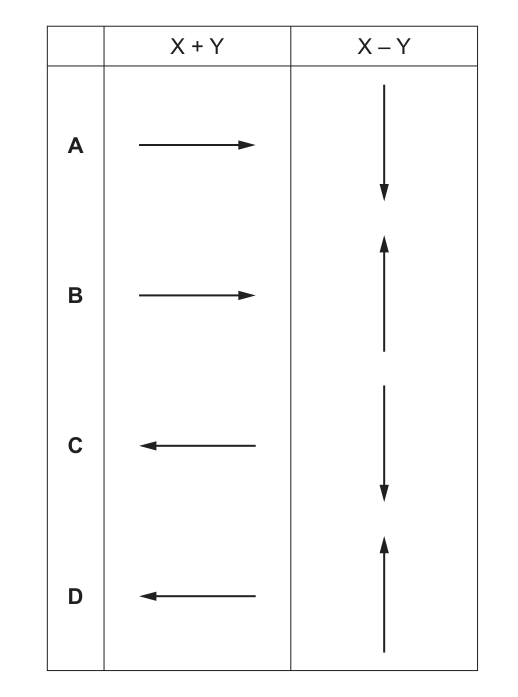
Working
is up-right and is down-right (similar magnitudes).
For : horizontal components add (to the right) and vertical components cancel resultant is to the right.
For : is up-left, so horizontal components cancel and vertical components add upwards resultant is upwards.
Answer
B
B
Background Concept
A vector has both magnitude and direction. When combining vectors, it is often simplest to use components:
- Choose perpendicular axes (usually horizontal and vertical ).
- Add vectors by adding their components: .
- Subtract vectors using
where has the same magnitude as but the opposite direction.
Understanding the Question
points up and to the right; points down and to the right, and they are drawn with similar lengths. You are asked only for the directions of:
The options show possible arrow directions for each resultant.
Approach
- Think in terms of horizontal and vertical components.
- For , check whether vertical parts cancel or add, and whether horizontal parts cancel or add.
- For , reverse first (to get ), then add to .
Step-by-Step Reasoning
Let right be and up be .
- is up-right, so and .
- is down-right, so and .
1) Direction of
Components of the sum are:
- Horizontal: is positive (both are to the right), so the resultant points to the right.
- Vertical: is approximately zero because one is up and one is down with similar magnitude.
So is (approximately) horizontal to the right.
2) Direction of
Rewrite as .
- points opposite to , so it is up-left.
Now add (up-right) to (up-left):
- Horizontal components oppose and (with similar magnitudes) cancel.
- Vertical components are both upwards, so they add.
So is vertical upwards.
This matches option B.
Key Takeaways
- Add vectors by adding components; same-direction components reinforce, opposite-direction components cancel.
- Subtraction is addition of the negative: .
- If two vectors are symmetric about the horizontal, their sum is horizontal; if they are symmetric about the vertical (after reversing one), the result is vertical.
Common Mistakes
- Treating as “somehow smaller” without reversing .
- Thinking must lie between and without considering that the vertical components can cancel.
- Mixing up which resultant is horizontal vs vertical.
Things to Be Careful About
- The vectors do not need to be drawn from the same point; you are allowed to translate vectors parallel to themselves to compare directions/components.
- The question asks for direction only; the key clue is the similar magnitudes, implying near-cancellation of the opposite components.
A ball is projected vertically downwards with an initial velocity of . Air resistance is negligible.
What is the displacement from its initial position of the ball after a time of ?
Options
A
B
C
D
Working
Take downward as positive.
Answer
D
D
Background Concept
For motion with constant acceleration, the displacement after time is related to the initial velocity and acceleration by
For vertical motion near Earth with negligible air resistance, the acceleration is approximately constant and equal to the acceleration of free fall , directed downward.
Understanding the Question
The ball is thrown vertically downwards with initial speed . Air resistance is negligible, so the only acceleration is gravity. We are asked for the displacement from the starting point after .
Approach
Pick a sign convention that makes substitution easy. Since the motion is downward and gravity is downward, choose downward as positive, so and . Then use
and compare the calculated with the given options.
Step-by-Step Reasoning
With downward positive:
Substitute:
Compute each part:
Total displacement:
This matches option D.
Key Takeaways
- Free fall with negligible air resistance has constant acceleration .
- Use a consistent sign convention; then apply a SUVAT equation.
- For MCQs, calculate and then match to the nearest option with sensible rounding.
Common Mistakes
- Using while also taking downward as positive (inconsistent signs).
- Using the wrong equation (e.g. doesn’t directly give displacement).
- Forgetting the in .
- Confusing displacement with distance in cases where direction could change (not an issue here because it continues downward).
Things to Be Careful About
- State/keep a clear positive direction before substituting into SUVAT.
- Use (or ); rounding should still land on .
- Ensure units are consistent: , , give for .
A surveyor’s device emits a pulse of light. The light is reflected from a wall away.
What is the total time taken for the pulse to travel from the device to the wall and then back to the device?
Options
A
B
C
D
Working
Total distance travelled .
Using with :
Answer
D
D
Background Concept
For any wave (including light), the average speed is
where is speed, is distance travelled, and is time taken. For light in air (and for A-Level questions unless stated otherwise), take
A reflected pulse makes a round trip, so the total distance is twice the one-way distance.
Understanding the Question
The wall is from the device. The pulse travels from the device to the wall and then reflects back to the device.
So:
- one-way distance
- total distance
- speed
- required: total time for the round trip.
Approach
- Double the one-way distance to get the round-trip distance.
- Use .
- Convert the result from seconds to microseconds to match the options.
Step-by-Step Reasoning
Round-trip distance:
Time taken:
Now convert seconds to microseconds. Since ,
This corresponds to option D.
Key Takeaways
- Reflected signals travel a there-and-back distance: .
- Use with for light.
- Know common time conversions: , .
Common Mistakes
- Using instead of (forgetting the return journey), giving (option C).
- Using but mishandling powers of ten, leading to answers in ns.
- Confusing and ns (a factor of ).
Things to Be Careful About
- The wording “then back to the device” is the key cue to double the distance.
- Keep units consistent: metres and give seconds.
- When matching to options, convert carefully: microseconds are , not .
Which equation of uniformly accelerated motion can be derived using only the gradient of a velocity–time graph?
Options
A
B
C
D
Working
For a velocity–time graph, the gradient is
With uniform acceleration, is constant so
Answer
C
C
Background Concept
A velocity–time ((v)–(t)) graph shows how velocity changes with time.
Two key features of a (v)–(t) graph are:
- Gradient (slope):
so the gradient gives the acceleration.
- Area under the graph between two times gives the displacement (s).
For uniform (constant) acceleration, the (v)–(t) graph is a straight line.
Understanding the Question
You are asked which SUVAT equation can be derived using only the gradient of a velocity–time graph.
So we must pick an equation that depends only on the idea “gradient (=) acceleration” and does not require using the area under the graph (which would bring in displacement (s)).
Approach
- Recall what information comes from the gradient of a (v)–(t) graph: it gives (a).
- For constant (a), connect velocity change to time using (a = \Delta v/\Delta t).
- Check options: any equation involving (s) typically requires area under the graph, not just gradient.
Step-by-Step Reasoning
From the definition of acceleration as gradient of the (v)–(t) graph:
For motion starting with initial velocity (u) and reaching velocity (v) after time (t):
So:
Rearrange:
This matches Option C.
Why the others are not “gradient-only”:
- A and B involve displacement (s), which comes from the area under the (v)–(t) graph.
- D also involves (s) (implicitly, because it links (v), (u), (a) and displacement), so it cannot be obtained from gradient alone.
Key Takeaways
- Gradient of a (v)–(t) graph (\to) acceleration: (a = \Delta v/\Delta t).
- With constant acceleration, velocity varies linearly with time: (v = u + at).
- Displacement (s) is linked to area under the (v)–(t) graph, not the gradient.
Common Mistakes
- Confusing gradient with area under the graph and choosing an (s)-equation (A or B).
- Thinking that because option D contains (a), it must come from the gradient; but it also requires displacement information.
Things to Be Careful About
- The question says only the gradient: this rules out any method that needs the area under the (v)–(t) graph.
- For uniform acceleration, the (v)–(t) graph being a straight line is the clue that a linear relation (v = u + at) is appropriate.
An object is projected horizontally from a table at time . The object falls in a uniform gravitational field. Air resistance is negligible.
Graphs P, Q, R and S are velocity–time graphs.
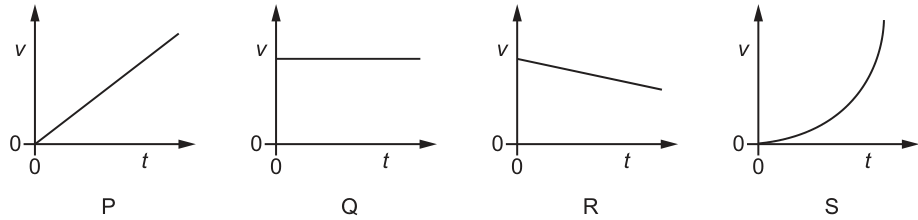
Which graphs represent the horizontal and vertical components of the velocity of the object?
Options
| horizontal | vertical | |
|---|---|---|
| A | Q | P |
| B | Q | S |
| C | R | P |
| D | R | S |
Working
Horizontal motion has no acceleration, so is constant and non-zero → graph Q.
Vertical motion starts from and has constant acceleration , so changes linearly with from the origin → graph P.
Answer
A
A
Background Concept
In projectile motion with negligible air resistance, the horizontal and vertical motions are independent.
- Horizontally: there is no resultant force, so and the horizontal velocity stays constant.
- Vertically: the only acceleration is due to gravity, so (taking downward as positive) and the vertical velocity changes uniformly with time.
On a velocity–time graph:
- A constant velocity is a horizontal line.
- Constant acceleration gives a straight line with constant gradient, since
Understanding the Question
The object is projected horizontally from a table at .
So:
- Initial horizontal velocity is non-zero.
- Initial vertical velocity (because it is launched horizontally).
- Vertical acceleration is constant (uniform gravitational field), and air resistance is negligible.
We must choose which of the provided graphs correspond to and .
Approach
- Decide the time-dependence of using .
- Decide the time-dependence of using constant acceleration from gravity and the initial condition .
- Match these behaviours to the shapes of graphs P, Q, R, S.
Step-by-Step Reasoning
Horizontal component
Since air resistance is negligible, there is no horizontal force, hence
So horizontal velocity is constant:
Among the graphs, Q is a horizontal line above the axis (constant positive velocity), so it represents .
Vertical component
The object is projected horizontally, so initially
In a uniform gravitational field, the vertical acceleration is constant with magnitude ; taking downward as positive gives
Then
which is a straight line through the origin with positive gradient. That matches graph P.
Therefore, horizontal is Q and vertical is P, which corresponds to option A.
Key Takeaways
- In projectile motion (no air resistance), is constant because .
- The vertical velocity changes linearly with time because is constant ( depending on sign convention).
- A straight-line – graph indicates constant acceleration; a horizontal line indicates constant velocity.
Common Mistakes
- Choosing the curved graph S for vertical velocity: curvature would imply changing acceleration, which contradicts uniform gravity.
- Choosing graph R for vertical velocity: it does not start from at , so it cannot represent here.
- Forgetting that a horizontal launch means .
Things to Be Careful About
- Sign convention: if upward were taken as positive, the vertical velocity graph would be a straight line through the origin with negative gradient. In this question the available straight line through the origin is P (positive gradient), so the implied convention is that downward velocity is positive.
- The key features to match are (i) initial value at and (ii) whether the gradient is constant (uniform acceleration) or zero (constant velocity).
What is always conserved in elastic collisions?
Options
| total kinetic energy | total velocity | |
|---|---|---|
| A | yes | yes |
| B | yes | no |
| C | no | yes |
| D | no | no |
Working
In an elastic collision, total kinetic energy is conserved.
Total velocity is not conserved (only total momentum is conserved).
Answer
B
B
Background Concept
In any isolated system (no external resultant force), total linear momentum is conserved in a collision.
An elastic collision is defined as a collision in which total kinetic energy is also conserved (in addition to momentum). Kinetic energy is a scalar quantity.
Velocity is a vector, and there is no general conservation law for “total velocity” in collisions. Instead, velocities change according to the constraints of momentum conservation (and kinetic energy conservation if the collision is elastic).
Understanding the Question
The table asks which quantities are always conserved in elastic collisions:
- “total kinetic energy”
- “total velocity”
You must choose the option (A–D) that matches what is always conserved.
Approach
- Use the definition of an elastic collision to decide about kinetic energy.
- Consider whether “total velocity” is a meaningful conserved quantity in collisions (compare with momentum, which is conserved).
- Match the yes/no combination to the options.
Step-by-Step Reasoning
-
By definition of an elastic collision:
- total kinetic energy before = total kinetic energy after
So “total kinetic energy” → yes.
- total kinetic energy before = total kinetic energy after
-
“Total velocity” is not a standard conserved quantity.
- Example idea: two objects can collide and rebound; their individual velocities change, and there is no rule that the sum of their velocities stays the same.
- What is conserved (in an isolated system) is momentum, not velocity.
So “total velocity” → no.
-
The combination is: kinetic energy yes, total velocity no → option B.
Key Takeaways
- Elastic collision: momentum conserved and kinetic energy conserved.
- “Total velocity” is not a conservation law in collisions.
Common Mistakes
- Thinking velocity is conserved because momentum is conserved (they are only proportional for a single object of fixed mass; for a system with different masses, conservation applies to momentum, not velocity).
- Confusing “total velocity” with “velocity of the centre of mass” (which can be constant if no external force, but that is not the same as total velocity).
Things to Be Careful About
- Elastic vs inelastic: inelastic collisions still conserve momentum but do not conserve kinetic energy.
- The question says “always conserved”: only select quantities that are guaranteed by the definition/laws for collisions in an isolated system.
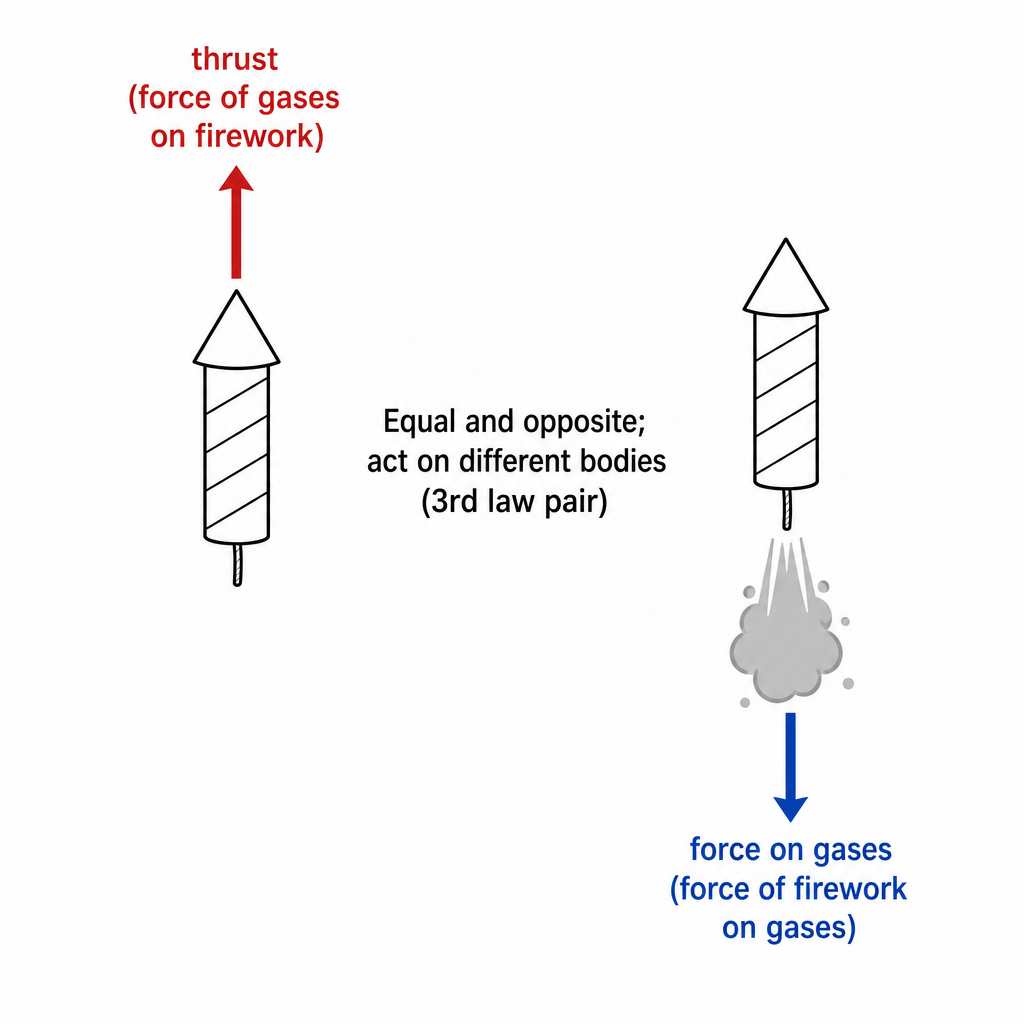
A firework travels vertically upwards in air. Gases are pushed vertically downwards from the firework.
Several forces that act on the firework and gases are shown.
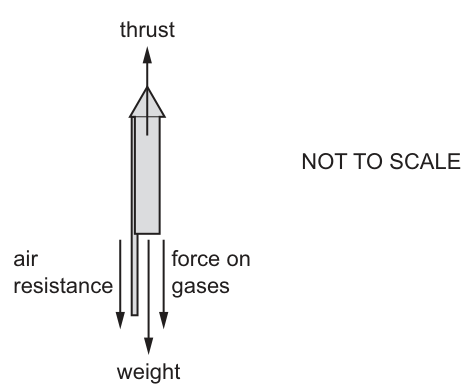
Which forces are a Newton’s third law pair?
Options
A air resistance and force on gases
B air resistance and thrust
C force on gases and thrust
D thrust and weight
Working
Newton’s third law pair must be equal and opposite forces of the same interaction acting on different bodies.
The firework pushes the gases downward (force on gases), and the gases push the firework upward (thrust).
Answer
C
C
Background Concept
Newton’s third law states that when body A exerts a force on body B, body B exerts an equal and opposite force on body A.
Key points for identifying a third-law pair:
- The two forces act on different bodies.
- They are the same type of interaction (e.g. contact force on contact force).
- They are equal in magnitude and opposite in direction.
- They do not cancel, because they do not act on the same object.
Understanding the Question
A firework is moving vertically upward. It ejects gas downward. The diagram shows forces labelled:
- thrust (up on the firework)
- weight (down on the firework)
- air resistance (down on the firework)
- force on gases (down on the gases)
The question asks which two labelled forces form a Newton’s third law pair.
Approach
- For each labelled force, decide which object it acts on (firework or gases or air/Earth).
- Newton’s third law pair must be forces from the same interaction acting on the two different objects involved in that interaction.
- Match the correct pair from the options.
Step-by-Step Reasoning
- Thrust: this is the upward force on the firework due to the expelled gases pushing on it.
- Force on gases: this is the downward force on the gases due to the firework pushing them out.
These two forces come from the same interaction (contact/pressure forces between firework and gas):
- firework on gases: downward (force on gases)
- gases on firework: upward (thrust)
So they form the Newton’s third law pair.
Other forces shown:
- Weight is the gravitational force of Earth on the firework; its third-law partner would be the gravitational force of the firework on Earth (not shown).
- Air resistance is the force of air on the firework; its third-law partner would be the force of the firework on the air (not shown).
Therefore the correct option is C.
Key Takeaways
- Newton’s third law pairs act on different bodies.
- For a rocket/firework, thrust on the rocket pairs with force on exhaust gases.
- Weight and air resistance pair with forces on Earth/air respectively, not with forces on the rocket itself.
Common Mistakes
- Thinking forces that are equal and opposite on the same object (e.g. thrust and weight) are a third-law pair.
- Pairing forces just because they point in opposite directions, without checking the bodies involved.
- Assuming air resistance pairs with thrust because both act on the firework.
Things to Be Careful About
- Always name the interaction as “force of X on Y”; then the pair is “force of Y on X”.
- A third-law pair is not necessarily drawn on the same free-body diagram (because that diagram is for one body only).
Two blocks K and L slide towards each other along a horizontal frictionless surface.
The diagram shows the momentum of the two blocks just before they collide.
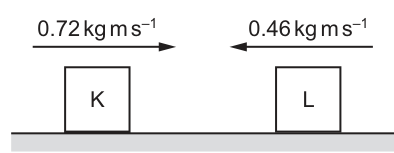
During the collision, the blocks are in contact with each other for a time of .
After the collision, the blocks separate and block L moves back along its original path with a momentum of .
What is the magnitude of the average force exerted on block L by block K during the collision?
Options
A
B
C
D
Working
Take rightwards as positive.
Initial momentum of block :
After collision, moves back along its original path (\Rightarrow) to the right:
Change in momentum of :
Average force magnitude:
Answer
C
C
Background Concept
During a collision, the interaction force between objects typically changes with time. Instead of needing the detailed force–time graph, we can use impulse.
Impulse on an object is defined as:
It is also equal to the change in momentum of the object:
where momentum and is a vector quantity, so direction matters.
Understanding the Question
We are told the momenta of blocks and just before collision (from the diagram), and that they remain in contact for . After the collision, block moves back along its original path with momentum .
We want the magnitude of the average force on block due to block during contact. This is found from the impulse on :
Approach
- Choose a positive direction (e.g. rightwards).
- Write the initial momentum of with the correct sign from the diagram.
- Interpret “moves back along its original path” as a reversal of direction, so the final momentum has the opposite sign to the initial.
- Compute .
- Divide by the contact time to get the average force magnitude, then match to the given options.
Step-by-Step Reasoning
Take rightwards as positive.
- Before collision, block has momentum to the left, so
- After collision, it “moves back along its original path”. Since it was originally moving left, “back along” means it now moves right. Its momentum magnitude is , so
- Change in momentum of :
- Impulse on equals . Average force magnitude:
This corresponds to option C.
Key Takeaways
- Use the impulse relation for collisions.
- Momentum is directional; choose a sign convention and stick to it.
- “Moves back along its original path” indicates a reversal of direction.
Common Mistakes
- Treating momentum as a scalar and using instead of for the initial momentum.
- Interpreting “moves back along its original path” incorrectly and keeping the same direction for the final momentum.
- Using instead of .
Things to Be Careful About
- The question asks for the magnitude of the average force: compute with signs, then take the final force as a positive magnitude.
- Keep units consistent: for momentum and seconds for time gives force in newtons because .
- Use sufficient significant figures to match the options (here ).
Leonardo da Vinci proposed a flying machine that would work like a screw to lift the pilot into the air. The ‘screw’ is rotated by the pilot.
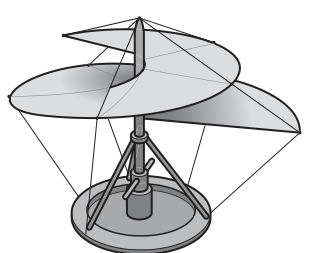
The machine and the pilot together have a total mass of .
Which useful output power must the pilot provide to move vertically upwards at a constant speed of ?
Options
A
B
C
D
Working
At constant vertical speed, useful upward force .
Answer
D
D
Background Concept
Power is the rate of doing work:
When a force moves its point of application at speed in the direction of the force, the mechanical power transferred is
For vertical lifting at constant speed, the object’s kinetic energy is not changing, so the useful work done goes into increasing gravitational potential energy. The rate of gain of gravitational potential energy is
So for steady upward motion, the useful output power required is .
Understanding the Question
The combined mass of the pilot and machine is and it rises vertically upward at a constant speed of . The question asks for the useful output power the pilot must supply to achieve this steady climb (i.e. the minimum mechanical power needed to increase gravitational potential energy at that rate).
Approach
- Use the fact that the speed is constant: acceleration is zero, so the resultant force is zero.
- Therefore, the upward lift/thrust force must balance the weight .
- Use the power relation for motion at speed in the direction of the force: .
- Substitute to get , then calculate and match to the closest option.
Step-by-Step Reasoning
- Constant speed means , so by Newton’s second law the net force is zero.
- The weight is
- For steady upward motion, the useful upward force equals the weight: .
- Useful power needed is
- Substitute the values:
- This rounds to , which corresponds to 2900 W.
Therefore the correct option is D.
Key Takeaways
- Constant speed implies zero acceleration, so the driving force balances the opposing force.
- For lifting vertically at steady speed, useful power is
- Always check units: .
Common Mistakes
- Using without recognising that (often leads to confusion about what to use for and ).
- Forgetting that constant speed means no net force, and incorrectly using .
- Using and then failing to pick the closest option (though it still gives about , closest to D).
- Choosing option C (470 W) by mistakenly using (that’s energy, not power for lifting).
Things to Be Careful About
- The question asks for useful output power for vertical ascent: this is the rate of increase of gravitational potential energy, not including inefficiencies.
- Use a realistic value of (typically in A Level calculations unless told otherwise).
- Match significant figures to the options: rounds to (option D).
Which row describes a pair of forces that forms a couple?
Options
| direction of the forces | magnitude of the forces | |
|---|---|---|
| A | opposite | different |
| B | opposite | equal |
| C | same | different |
| D | same | equal |
Working
A couple is formed by two parallel forces that are equal in magnitude and opposite in direction (acting along different lines).
So the correct row is: opposite directions, equal magnitudes.
Answer
B
B
Background Concept
A couple is a pair of forces that produces a turning effect (moment/torque) but no resultant force. For the net (resultant) force to be zero, the two forces must:
- be equal in magnitude
- act in opposite directions
They must also act along parallel but different lines of action (i.e. separated by a perpendicular distance), otherwise they would just cancel with no turning effect.
Understanding the Question
You are given a table of options describing only:
- the direction relationship between the two forces (same or opposite)
- the magnitude relationship between the two forces (equal or different)
You must choose which combination corresponds to a couple.
Approach
Use the definition: a couple requires zero resultant force but a non-zero turning effect. Zero resultant force requires the two forces to be equal and opposite.
Step-by-Step Reasoning
- If the two forces had the same direction, their resultant force would be the sum of the forces, so the object would experience a net force: not a couple.
- If the two forces were opposite directions but different magnitudes, there would still be a non-zero resultant force equal to the difference: not a couple.
- Therefore, the only valid description is opposite directions and equal magnitudes.
- This matches row B.
Key Takeaways
- A couple is two equal and opposite parallel forces separated by a distance.
- The key identifying feature is no resultant force, so magnitudes must be equal and directions opposite.
Common Mistakes
- Choosing “opposite, different” because it still “turns”: it also produces a net force, so it is not a pure couple.
- Forgetting that a couple requires forces on different lines of action (separation), not just equal and opposite at the same point.
Things to Be Careful About
- The table does not mention “parallel” or “separation”, but in MCQs they often test only the core condition equal and opposite.
- A couple produces rotation without translation (resultant force is zero).
A uniform cylinder of weight is suspended from a newton meter.
The cylinder is fully submerged in water, as shown.
The reading on the newton meter is .
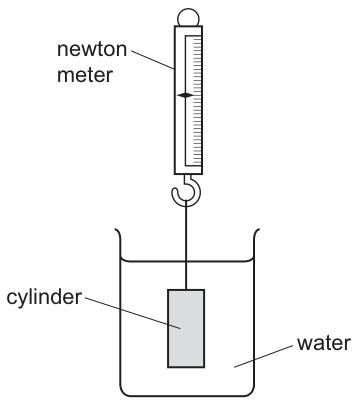
The water is replaced by a liquid with a density greater than the density of water. The cylinder remains fully submerged.
What is the new reading on the newton meter?
Options
A
B
C
D
Working
Weight , newton meter reading in water .
Upthrust in water:
Density increases by so upthrust increases by :
New tension (reading):
Answer
A
A
Background Concept
When an object is fully submerged in a fluid, it experiences an upthrust (buoyant force) due to the pressure difference between the bottom and the top. Archimedes' principle states that the upthrust equals the weight of the displaced fluid:
where is the fluid density, is gravitational field strength, and is the volume of fluid displaced (equal to the object's volume if fully submerged).
If the object is hanging at rest, forces are in equilibrium:
- Weight acts downward.
- Tension (newton meter reading) acts upward.
- Upthrust acts upward.
So,
Understanding the Question
The cylinder has true weight in air. When fully submerged in water, the newton meter reads only because upthrust supports some of the weight.
Then the water is replaced by a liquid whose density is higher, with the cylinder still fully submerged. The cylinder's volume (and hence displaced volume ) is unchanged, and is unchanged, so the only change in upthrust comes from .
We must find the new tension (the new meter reading).
Approach
- Use the given reading in water to deduce the upthrust in water from equilibrium: .
- Use (since with constant) to increase the upthrust by .
- Use to get the new meter reading.
Step-by-Step Reasoning
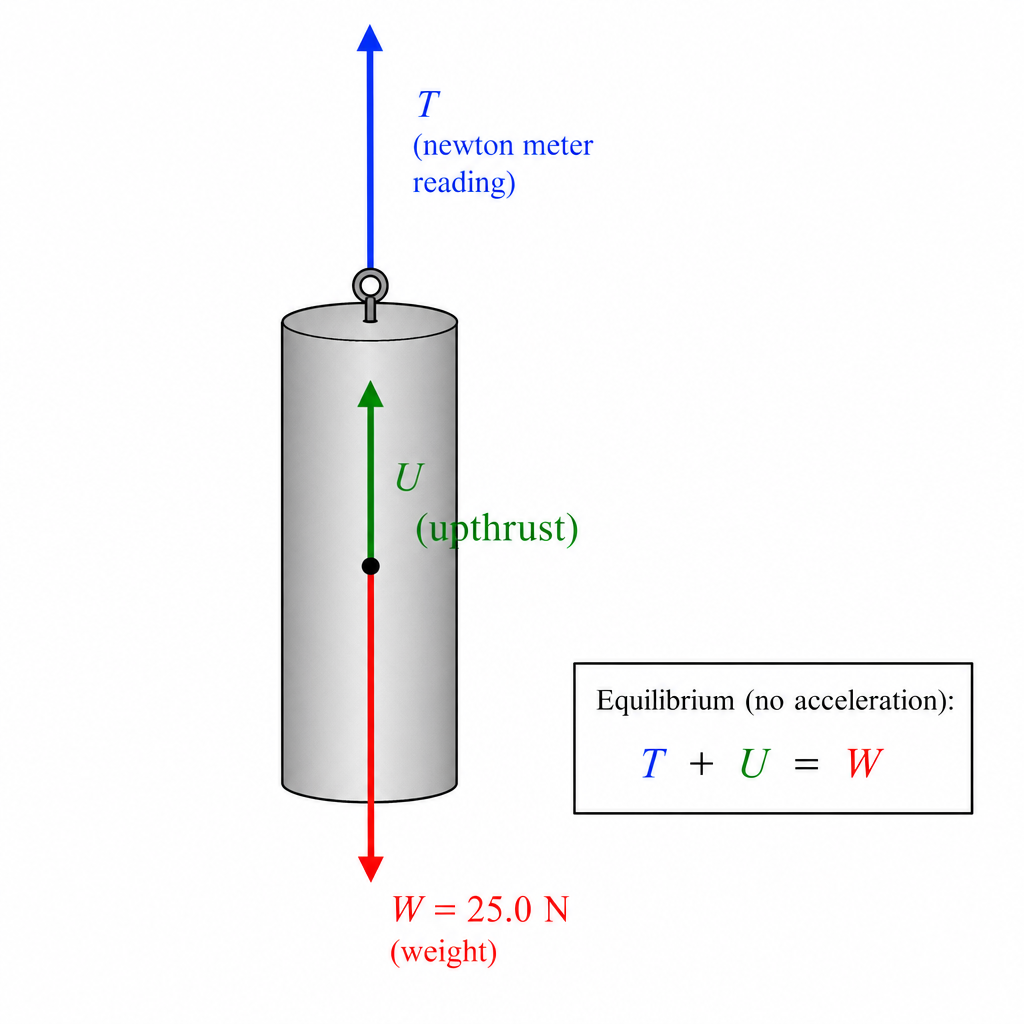
- In water, the cylinder is stationary, so:
Given and :
- Upthrust depends on density via . Since the cylinder remains fully submerged, is constant, and is constant. Therefore:
The new liquid has density greater than water:
- New tension (meter reading):
This corresponds to option A.
Key Takeaways
- For a fully submerged object, upthrust is .
- If and are constant, then .
- Newton meter reading (tension) for a hanging submerged object is .
Common Mistakes
- Adding the upthrust instead of subtracting it: using gives an impossible reading larger than the true weight.
- Assuming the reading changes by directly: it is the upthrust that scales with density, not the tension.
- Forgetting that “fully submerged” means displaced volume stays constant.
Things to Be Careful About
- The cylinder’s weight does not change when changing liquids.
- The density change affects only the upthrust, because .
- Check physical sense: denser liquid gives larger upthrust, so tension (reading) must decrease from , matching .
A student balances a ruler on a fulcrum set at the mark. She then places a mass on the mark and a mass on the mark, as shown.
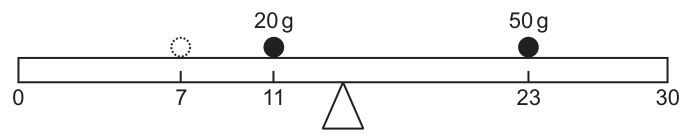
Which mass should she place on the mark to restore the balance?
Options
A
B
C
D
Working
Take moments about the mark.
Clockwise moment:
Anticlockwise moment:
For balance:
Answer
B
B
Background Concept
The moment of a force about a pivot is a measure of its turning effect:
where is the force (here proportional to the mass, since ) and is the perpendicular distance from the pivot to the line of action of the force.
For an object in rotational equilibrium (balanced, not turning), the principle of moments applies:
- total clockwise moment about the pivot = total anticlockwise moment about the pivot.
Because all masses are vertical forces and the ruler is horizontal, the perpendicular distances are just the horizontal separations from the fulcrum.
Understanding the Question
The ruler is supported at the mark (the pivot). A mass is at (to the right), a mass is at (to the left), and an unknown mass is to be placed at (also to the left) to restore balance.
The ruler was initially balanced at , so its own weight acts through the pivot (at its centre) and produces no moment about the fulcrum.
Approach
- Choose the pivot at so the support force does not appear in the moments equation.
- Work out each mass's distance from .
- Form clockwise and anticlockwise moments.
- Set them equal and solve for the unknown mass.
Step-by-Step Reasoning
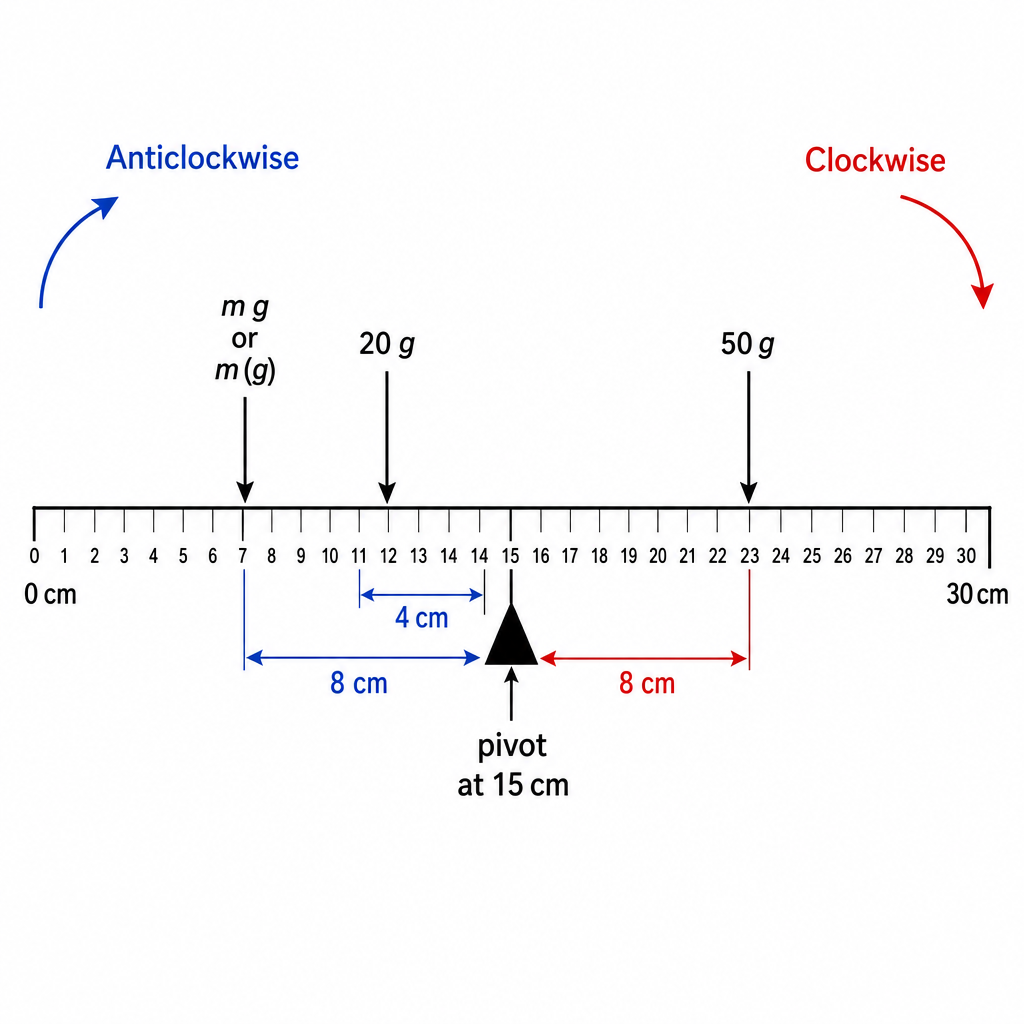
-
Distance of from pivot:
This produces a clockwise moment:
-
Distance of from pivot:
This produces an anticlockwise moment:
-
Distance of unknown mass at from pivot:
Anticlockwise moment:
For balance:
so
This corresponds to option B.
Key Takeaways
- Use and take moments about the pivot.
- For balance: clockwise moments = anticlockwise moments.
- When comparing moments from hanging masses on the same gravitational field, using mass instead of weight is fine because cancels.
Common Mistakes
- Measuring distances from the end of the ruler (e.g. using directly) instead of from the pivot at .
- Mixing up which side gives clockwise vs anticlockwise moments.
- Forgetting to include both left-hand masses in the anticlockwise total.
- Including the ruler's weight as an extra moment, even though it acts through the pivot here.
Things to Be Careful About
- Always use the perpendicular distance from the pivot: here that is the horizontal separation in cm.
- Keep distances consistent (all in cm), and use the same unit for all moments (e.g. or ).
- Check plausibility: the unknown mass is at the same distance () from the pivot as the mass, but it shares the left side with an additional moment, so it must be less than , which matches .
A submarine is at a depth of below the surface of the sea.
The pressure on the submarine due to the sea water is .
The submarine sinks to a depth of below the surface.
Assume that the density of sea water is constant.
What is the difference between the pressures on the submarine due to the sea water at the two depths?
Options
A
B
C
D
Working
Hydrostatic (gauge) pressure:
At , pressure due to sea water is .
At ,
Difference:
Answer
C
C
Background Concept
In a fluid of constant density (\rho) that is at rest, the pressure increases with depth because of the weight of the water above. The increase in pressure (often called the hydrostatic or gauge pressure) at depth (h) below the surface is
where (g) is the gravitational field strength. This tells us that, if (\rho) is constant, pressure is directly proportional to depth: doubling (h) doubles (p).
Understanding the Question
You are told that at a depth of (130\ \text{m}), the pressure on the submarine due to sea water is (p). The submarine then goes to (260\ \text{m}) (which is twice as deep), and you must find the difference between the sea-water pressures at the two depths.
Approach
Use (p = \rho g h). Since density is constant, compare the two depths using proportionality to express the deeper pressure in terms of (p), then subtract to get the difference.
Step-by-Step Reasoning
At (h_1 = 130\ \text{m}), the pressure due to water is
At (h_2 = 260\ \text{m}),
Because (260 = 2 \times 130),
The difference between the pressures is
So the correct option is (p), which is C.
Key Takeaways
- Hydrostatic pressure in a constant-density fluid follows (p = \rho g h).
- Pressure is proportional to depth, so doubling depth doubles the hydrostatic pressure.
- “Difference” means subtract the two pressures, not take a ratio.
Common Mistakes
- Choosing (2p) (option D) by giving the deeper pressure instead of the difference.
- Choosing (0.5p) by incorrectly thinking pressure halves with increasing depth.
- Forgetting that the question states pressure “due to sea water” (hydrostatic/gauge pressure) rather than including atmospheric pressure.
Things to Be Careful About
- Check whether the pressure given is absolute or due to the liquid only; here it explicitly says “due to the sea water”.
- Use the constant density assumption: it justifies simple proportionality with depth.
- Make sure the final step is a subtraction: (p_2 - p_1), not (p_2/p_1).
An object is falling in a uniform gravitational field.
Which two quantities are sufficient to calculate the change in gravitational potential energy?
Options
A mass and acceleration of free fall
B mass and change in vertical displacement
C weight and acceleration of free fall
D weight and change in vertical displacement
Working
In a uniform gravitational field,
Since weight ,
So the two sufficient quantities are weight and change in vertical displacement.
Answer
D
D
Background Concept
In a uniform gravitational field, the gravitational force on a mass is constant and equal to its weight:
The change in gravitational potential energy (GPE) when an object moves vertically by a height change (\Delta h) is
Equivalently, since (mg) is the weight (W),
(Here (g) is constant because the field is uniform.)
Understanding the Question
The object is falling vertically in a uniform gravitational field. The question asks which pair of quantities lets you calculate the change in GPE.
From (\Delta E_p = mg\Delta h), you need enough information to determine the product (mg\Delta h) using only two given quantities.
Approach
Start from the GPE change formula in a uniform field. Then check each option to see whether those two quantities allow you to evaluate (mg\Delta h) without needing a third quantity.
Step-by-Step Reasoning
We use
- Option A (mass and (g)): gives (mg) but not (\Delta h), so not enough.
- Option B (mass and (\Delta h)): gives (m) and (\Delta h), but still needs (g) as an additional value, so not sufficient as a pair in general.
- Option C (weight and (g)): gives (W) but not (\Delta h), so not enough.
- Option D (weight and (\Delta h)): since (W = mg),
This uses exactly those two quantities, so it is sufficient.
Key Takeaways
- In a uniform gravitational field, (\Delta E_p = mg\Delta h).
- Weight already contains (g) because (W = mg).
- Therefore (\Delta E_p) can be found from (W) and (\Delta h) alone.
Common Mistakes
- Choosing mass and displacement (B) without noticing that (g) would still be required unless it is explicitly provided.
- Choosing options that omit the vertical displacement, even though energy change depends on height change.
- Confusing “acceleration of free fall” (g) with “change in displacement” (\Delta h); both are needed unless weight is used.
Things to Be Careful About
- The displacement must be the vertical change in height, not distance travelled along a path.
- The sign of (\Delta h): for falling, (\Delta h) is negative if upward is taken as positive, so (\Delta E_p) is negative (a decrease in GPE). MCQs often ignore sign and focus on required quantities.
- “Uniform gravitational field” means (g) is constant, not that (g) can be omitted unless it is embedded in another given quantity (weight).
The points X, Y and Z are on a rough, horizontal surface.
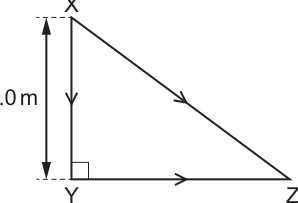
A box P is pushed across the surface from X to Y and then from Y to Z.
The distance from X to Y is . The work done against the frictional force in moving the box from X to Y is .
The work done against the frictional force in moving the box from Y to Z is .
An identical box Q is pushed in a straight line from X to Z.
The magnitude of the frictional force between the boxes and the surface is constant.
How much extra work is done against the frictional force in moving P than Q?
Options
A
B
C
D
Working
For X to Y:
For Y to Z:
Total work for P:
Straight-line distance:
Work for Q:
Extra work:
Answer
A
A
Background Concept
For a constant force acting along the direction of motion, the work done is
For kinetic friction on a horizontal surface (with the same surfaces in contact), the frictional force can be treated as constant in magnitude, so the work done against friction is proportional to the distance moved.
Understanding the Question
Box P travels from X to Y and then Y to Z (a right-angled path). You are told the work done against friction on each segment.
An identical box Q travels directly from X to Z in a straight line. Because the frictional force has constant magnitude, the only reason the work might differ is that the total distances travelled differ.
We must find the extra work done for P compared with Q:
Approach
- Use the X to Y data to find the constant frictional force using .
- Use that same force with the Y to Z work to find the length .
- Use Pythagoras to find the straight-line distance .
- Calculate and , then subtract.
Step-by-Step Reasoning
- From X to Y, the distance is and work against friction is :
So the frictional force magnitude is everywhere.
- From Y to Z, work against friction is :
- Total work for P is just the sum along both segments:
- The direct distance is the hypotenuse of a right triangle with legs and :
- Work for Q along the straight path:
- Extra work done for P compared with Q:
So the correct option is A.
Key Takeaways
- With constant friction, work done against friction depends only on distance: .
- Different paths between the same points can require different work if their lengths differ.
- Geometry (Pythagoras) can be needed to find a straight-line distance.
Common Mistakes
- Adding distances incorrectly (e.g. assuming for the straight line).
- Forgetting that you must compare work, not distance.
- Using the wrong distance for the work on a segment (mixing up , , and ).
Things to Be Careful About
- The frictional force is stated to be constant in magnitude; this is what allows you to use one value of for all parts.
- Keep units consistent: metres for distance, joules for work, newtons for force.
- For a right-angled path, the straight-line distance is the hypotenuse, always shorter than the sum of the two legs, so should be smaller than .
The momentum of a car of mass increases from to .
What is the increase in the kinetic energy of the car?
Options
A
B
C
D
Working
From , .
Increase in kinetic energy:
Answer
A
A
Background Concept
Momentum and kinetic energy are both linked to speed for a non-relativistic particle (speeds much less than the speed of light).
Key relations:
- Momentum:
- Kinetic energy:
If you eliminate between these two equations, you can write kinetic energy directly in terms of momentum.
Understanding the Question
A car of mass has its momentum increase from to . The question asks for the increase in kinetic energy, i.e.
So we need an expression for that uses and , then evaluate it at and .
Approach
- Use to express in terms of .
- Substitute into to get as a function of .
- Subtract initial from final to get the increase in kinetic energy.
- Match the resulting expression to the given options.
Step-by-Step Reasoning
Start with momentum:
Substitute into kinetic energy:
Simplify:
Now compute the increase:
This corresponds to option A.
Key Takeaways
- For non-relativistic motion, kinetic energy can be expressed in terms of momentum as:
- An increase in momentum does not generally mean kinetic energy increases by something proportional to ; you must subtract the squares.
Common Mistakes
- Using : this incorrectly treats the change in kinetic energy as if it depends on the square of the change in momentum.
- Forgetting to square when rewriting in terms of .
- Writing (linear in momentum change): kinetic energy is quadratic in speed and hence quadratic in momentum.
Things to Be Careful About
- This derivation assumes the classical expressions and ; at relativistic speeds these are not valid.
- When taking differences, it is (difference of squares), not (square of the difference).
A parachutist is falling at constant (terminal) velocity.
Which statement is not correct?
Options
A Gravitational potential energy is converted into kinetic energy of the air.
B Gravitational potential energy is converted into kinetic energy of the parachutist.
C Gravitational potential energy is converted into thermal energy of the air.
D Gravitational potential energy is converted into thermal energy of the parachutist.
At terminal velocity, speed is constant so the parachutist’s kinetic energy does not increase.
Therefore gravitational potential energy is not converted into kinetic energy of the parachutist.
Answer
B
B
Background Concept
When an object falls under gravity, it loses gravitational potential energy (GPE)
That lost energy must be transferred to other forms. If the object speeds up, its kinetic energy
increases. If there is significant air resistance (drag), work is done against the drag force and energy is transferred mainly into internal (thermal) energy of the air and the falling system, and also into kinetic energy of the moving air (turbulence, airflow).
At terminal velocity, the drag force equals the weight, so the resultant force is zero and the acceleration is zero. The speed stays constant.
Understanding the Question
A parachutist is stated to be falling at constant (terminal) velocity. The question asks which energy-conversion statement is NOT correct.
Key clue: “constant (terminal) velocity” means no acceleration and therefore no change in the parachutist’s kinetic energy.
Approach
- Use terminal velocity to decide whether the parachutist’s kinetic energy is increasing or constant.
- Decide where the lost GPE goes when speed is constant: it must be transferred to the surroundings (mainly thermal energy of air and possibly the parachutist/parachute) and can also appear as kinetic energy of the air.
- Identify which option contradicts these facts.
Step-by-Step Reasoning
-
Terminal velocity implies:
- resultant force ,
- acceleration ,
- speed is constant.
-
If is constant, then
for the parachutist is constant, so there is no conversion of GPE into kinetic energy of the parachutist.
-
The GPE that is being lost each second is accounted for by work done against drag. That energy appears mainly as:
- thermal (internal) energy of the air (heating due to friction/turbulence),
- some thermal energy of the parachutist/parachute,
- some kinetic energy of the air (air set in motion).
-
Therefore the statement “GPE is converted into kinetic energy of the parachutist” is the one that is not correct.
So the incorrect option is B.
Key Takeaways
- Terminal velocity means and the object’s kinetic energy is not increasing.
- With drag present, lost GPE is transferred largely to thermal energy of the surroundings (and some kinetic energy of the air), not to increasing of the falling object.
Common Mistakes
- Thinking “falling” automatically means GPE becomes kinetic energy of the object, forgetting that at terminal velocity is constant.
- Assuming all energy must become thermal energy only; in reality the air can also gain kinetic energy (turbulent motion).
Things to Be Careful About
- “Converted into kinetic energy” implies an increase in kinetic energy; at constant speed this cannot be true for the parachutist.
- Terminal velocity does not mean energy transfer stops; it means the rate of GPE loss equals the rate of energy dissipation by drag.
A student investigates a spring. The variation of the length of the spring with the force applied to the spring is shown.
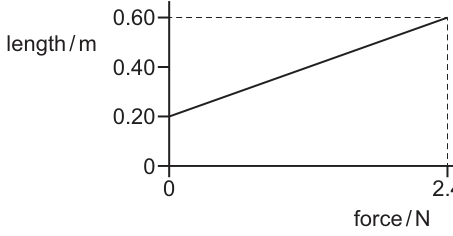
What is the spring constant of the spring?
Options
A
B
C
D
Working
From the graph, natural length at is .
At , length , so extension
Using ,
Answer
D
D
Background Concept
For a spring that obeys Hooke's law, the force is proportional to the extension (the increase in length from its natural length):
where is the spring constant in . A common trap is to use the total length instead of the extension . The extension is
where is the natural length (length when no force is applied).
Understanding the Question
The graph given is of spring length (vertical axis) against applied force (horizontal axis). You are asked for the spring constant .
Key readings from the graph:
- At , the spring has length .
- At , the spring has length .
Approach
- Read the natural length from the intercept at .
- Choose another clear point on the straight line to read and .
- Convert length change into extension .
- Use .
Step-by-Step Reasoning
- Natural length is the length when no force acts:
-
Use the marked point .
-
Find extension:
- Apply Hooke's law and rearrange:
So the correct option is D.
Key Takeaways
- Hooke's law uses extension , not total length .
- On a graph of against , the intercept at gives the natural length .
- Compute using .
Common Mistakes
- Using instead of (e.g. calculating ), giving a much smaller incorrect value.
- Reading the gradient incorrectly: since the graph is vs , its gradient is , not .
- Mixing units (e.g. using cm for length but quoting in ).
Things to Be Careful About
- Make sure you subtract the natural length (the -intercept) to get extension.
- If using gradient, remember:
so you must invert the gradient to obtain .
The graph shows the variation with force of the extension of a wire.
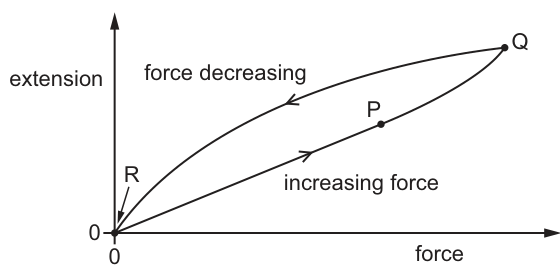
The force is gradually increased to a maximum at Q and then gradually decreased to zero at R.
Which statement is correct?
Options
A Along the line PQ, the wire obeys Hooke’s law.
B Along the line RP, the spring constant is equal to .
C The wire has elastic deformation at point Q.
D The work done in stretching the wire to P is equal to at point P.
Working
From to , when the force is reduced the extension decreases, so part of the extension at is recovered when the force is removed. Hence there is an elastic (recoverable) component of deformation at .
Answer
C
C
Background Concept
For a wire (or spring), Hooke’s law applies when extension is proportional to force :
where is the spring constant. On a graph of extension (vertical axis) against force (horizontal axis), Hooke’s law corresponds to a straight line through the origin, with
Elastic deformation is the part of the deformation that is recovered when the force is removed. Plastic deformation is permanent deformation remaining when .
The work done in stretching is
so it is the area under a graph of (vertical) against (horizontal). For a straight-line – graph from the origin, .
Understanding the Question
The graph shows extension vs force as the force is increased from the origin to a maximum at (loading curve), then decreased back to zero ending at (unloading curve). Since is above the origin at , there is a permanent extension (plastic deformation). Point is somewhere on the loading curve before .
We must choose which statement A–D is correct.
Approach
Use the shape of the loading/unloading curves:
- A Hooke’s-law region must be a straight line through the origin on an vs plot.
- Identify elastic deformation by seeing whether extension decreases when force is removed.
- Check definitions: , not .
- Work done is area under an – graph, not simply .
Step-by-Step Reasoning
- The unloading curve goes from down to as force decreases. Since extension decreases during unloading, the wire regains (recovers) some extension. That recovered part is elastic deformation.
- Because the wire does recover some extension when the force is reduced, at point there must be an elastic component of deformation present (even though there is also plastic deformation, evidenced by the non-zero extension at when ). Therefore statement C is correct.
Why the others are not correct:
- A: For Hooke’s law on an extension–force graph, the line must be straight and pass through the origin (extension proportional to force from zero). The segment referred to as is not a straight line through the origin on this hysteresis-type graph.
- B: Hooke’s law gives . The ratio is (the gradient of an extension–force graph in the Hooke’s-law region), not .
- D: Work done to stretch to is the area under a force–extension graph; it is not generally equal to at (and even for a Hooke’s-law straight line from the origin it would be , not ).
Key Takeaways
- Elastic deformation is identified by the amount of extension recovered on unloading.
- Plastic deformation is the remaining extension at zero force.
- Hooke’s law: and .
- Work done in stretching is the area under the – graph (or for a linear spring from the origin).
Common Mistakes
- Thinking any straight segment obeys Hooke’s law even if it does not pass through the origin.
- Using instead of .
- Using instead of the correct area/(\tfrac12 Fx) result.
- Saying deformation at is “not elastic” because there is plastic deformation; in reality it can be partly elastic and partly plastic.
Things to Be Careful About
- Check which variable is on which axis: extension vs force has gradient .
- A hysteresis loop indicates energy loss and (here) permanent extension, but it still allows an elastic component during unloading.
- Work done calculations depend on a force–extension plot; swapping axes changes what the area represents.
A uniform metal wire of length and diameter has spring constant .
What is the Young modulus of the metal?
Options
A
B
C
D
Working
For a wire,
So
But , hence
With ,
Answer
D
D
Background Concept
Young modulus measures how stiff a material is in tension/compression. It is defined (for small, elastic deformations) as
where:
- is the tensile force,
- is the cross-sectional area,
- is the extension,
- is the original length.
A stretched wire in its elastic region also behaves like a spring:
Understanding the Question
You are told a uniform wire has length , diameter , and behaves like a spring with spring constant (so is proportional to extension ). The question asks you to express the Young modulus in terms of , , and .
The key extra piece of geometry is that a circular wire has cross-sectional area
Approach
- Start from and simplify to relate to .
- Recognise is the spring constant .
- Substitute the area of a circular cross-section in terms of .
- Match the final expression to one of the options.
Step-by-Step Reasoning
From the definition of Young modulus:
Dividing by a fraction is multiplying by its reciprocal:
Now group it to reveal :
But the spring constant is , so:
For a wire of diameter :
Substitute into :
This corresponds to option D.
Key Takeaways
- For a uniform wire in the elastic region:
- Therefore, spring constant and Young modulus are linked by
- Always use the correct cross-sectional area: .
Common Mistakes
- Using instead of (missing the factor of ).
- Inverting the relationship and writing or similar.
- Confusing diameter with radius .
Things to Be Careful About
- The factor of 4 comes entirely from the geometry .
- The Young modulus is a material property, so it should scale like (stiffer for larger and longer , and less stiff for larger area ).
An aircraft produces a sound at a frequency of .
The speed of sound in air is .
The aircraft is directly in front of the stationary observer and travels in a straight line towards or away from the observer.
The observer hears the sound from the aircraft at a frequency of .
What is the speed and direction of the aircraft?
Options
| speed / | direction | |
|---|---|---|
| A | 110 | away from observer |
| B | 110 | towards observer |
| C | 165 | away from observer |
| D | 165 | towards observer |
Working
For a moving source and stationary observer,
Answer
Speed , away from the observer (\rightarrow) C
C
Background Concept
The Doppler effect is the change in observed frequency when there is relative motion between a wave source and an observer. For sound in air, the wave speed in the medium is fixed at (here ).
For a moving source and a stationary observer:
- If the source moves towards the observer, wavefronts are compressed (shorter wavelength), so the observed frequency increases.
- If the source moves away, wavefronts are stretched (longer wavelength), so the observed frequency decreases.
The relevant formula (stationary observer, source speed ):
Understanding the Question
The aircraft emits sound of frequency . The observer is stationary and hears . Since , the observed frequency is lower than the emitted frequency, which indicates the aircraft must be moving away from the observer.
We are asked for:
- the aircraft speed
- whether it is moving towards or away
Approach
- Decide the direction using whether is greater or less than .
- Use the Doppler formula for a receding source:
f' = f\frac{v}{v+v_s}
3. Substitute the given values and solve for $v_s$. 4. Match the result to the options. ## Step-by-Step Reasoning Because $f' = 20.0\ \text{Hz}$ is less than $f = 30.0\ \text{Hz}$, the source is receding, so:f' = f\frac{v}{v+v_s}
Substitute $f' = 20.0$, $f = 30.0$, $v = 330$:20.0 = 30.0\times \frac{330}{330+v_s}
Divide both sides by $30.0$:\frac{20.0}{30.0} = \frac{330}{330+v_s}
\frac{2}{3} = \frac{330}{330+v_s}
\frac{2}{3}(330+v_s) = 330
220 + \frac{2}{3}v_s = 330
\frac{2}{3}v_s = 110
v_s = 165\ \text{m s}^{-1}
So the aircraft travels at $165\ \text{m s}^{-1}$ **away from the observer**, which corresponds to option **C**. ## Key Takeaways - For a stationary observer, a moving source gives: - approaching: $f' > f$ and use $f' = f\, \frac{v}{v-v_s}$ - receding: $f' < f$ and use $f' = f\, \frac{v}{v+v_s}$ - A frequency decrease immediately signals the source is moving away. ## Common Mistakes - Using the wrong sign in the denominator (using $v-v_s$ when the source is moving away). - Mixing up “moving source” with “moving observer” formulas. - Thinking a lower frequency means the source is approaching (it is the opposite for a moving source). ## Things to Be Careful About - The formula depends on **who is moving**: here only the aircraft (source) moves; the observer is stationary. - Check direction using a quick sanity test: receding must give $f' < f$. - Ensure speeds are in the same units ($\text{m s}^{-1}$) before substituting.Which statement about longitudinal and transverse wave motion for a progressive wave is correct?
Options
A All transverse and longitudinal waves require a medium for propagation.
B All transverse waves travel at the same speed, but longitudinal waves can travel at different speeds.
C In both transverse waves and longitudinal waves, a particle with zero displacement has a maximum speed.
D In a longitudinal wave there is a net movement of particles in the direction of travel of the wave, but there is no net movement of particles in a transverse wave.
Working
In a progressive wave, each particle oscillates about its equilibrium position (no net drift). The particle motion is (approximately) SHM, so speed is maximum at zero displacement.
This is true for both transverse and longitudinal waves.
Answer
C
C
Background Concept
A progressive wave transfers energy through a medium (or through space for electromagnetic waves) without transferring matter overall. The key point is to separate:
- Wave motion: the disturbance pattern moving through space.
- Particle motion (for mechanical waves): the oscillation of particles of the medium about fixed equilibrium positions.
For a sinusoidal progressive wave, each particle undergoes simple harmonic motion (SHM). In SHM, if displacement from equilibrium is , then the speed satisfies
So is maximum when (equilibrium), and when (at extreme displacement).
Transverse vs longitudinal:
- Transverse: particle oscillations are perpendicular to the direction of wave travel.
- Longitudinal: particle oscillations are parallel to the direction of wave travel.
Understanding the Question
You are asked which statement correctly compares longitudinal and transverse wave motion for a progressive wave. So you must use general properties that are always true (not just for a specific wave type like sound).
The options mention: need for a medium, speeds of waves, particle speed vs displacement, and whether particles have net movement.
Approach
Check each option against core principles and known examples:
- Does every transverse/longitudinal wave require a medium?
- Is there a universal wave speed for transverse waves?
- In progressive waves, what is the relationship between particle displacement and particle speed?
- Is there net particle drift in a longitudinal progressive wave?
Step-by-Step Reasoning
Option A: False.
Electromagnetic waves (e.g. light) are transverse and can travel in a vacuum, so not all transverse waves require a medium.
Option B: False.
Transverse waves do not all travel at the same speed. For example, wave speed on a string depends on tension and mass per unit length; electromagnetic waves travel at different speeds in different media.
Option C: True.
For both transverse and longitudinal progressive waves, particles oscillate about equilibrium and (for a sinusoidal wave) execute SHM. In SHM, speed is maximum at zero displacement. Therefore a particle at zero displacement has maximum speed in both wave types.
Option D: False.
In a longitudinal progressive wave (e.g. sound in air), particles oscillate back and forth about fixed positions; there is no net movement of particles in the direction of wave travel (ignoring effects like wind or bulk flow). The same “no net movement” is also true for transverse mechanical waves.
Hence the correct choice is C.
Key Takeaways
- In a progressive wave, energy is transferred but there is no overall transport of matter.
- Particle motion in sinusoidal progressive waves is SHM.
- In SHM, speed is maximum at zero displacement and zero at maximum displacement.
- Electromagnetic waves are transverse and do not require a medium.
Common Mistakes
- Thinking longitudinal waves carry particles along the tube/air with the wave (confusing oscillation with drift).
- Assuming “transverse waves” implies “same speed” regardless of medium (wave speed depends on medium properties).
- Mixing up “particle speed” with “wave speed” (they are different quantities).
Things to Be Careful About
- The statement in C is about particle speed, not the speed of the wave.
- “Require a medium” distinguishes mechanical waves from electromagnetic waves; not all transverse waves are mechanical.
- “Net movement” means long-term drift of particles; oscillations about equilibrium do not count as net movement.
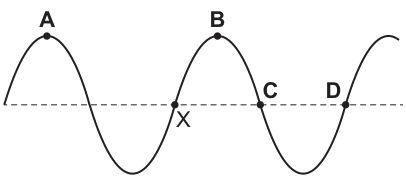
The diagram shows a progressive transverse wave on a stretched string at one instant in time.
One point on the string is labelled X.
Which point on the string is out of phase with X?
Options
A A
B B
C C
D D
Working
A phase difference of corresponds to a separation of
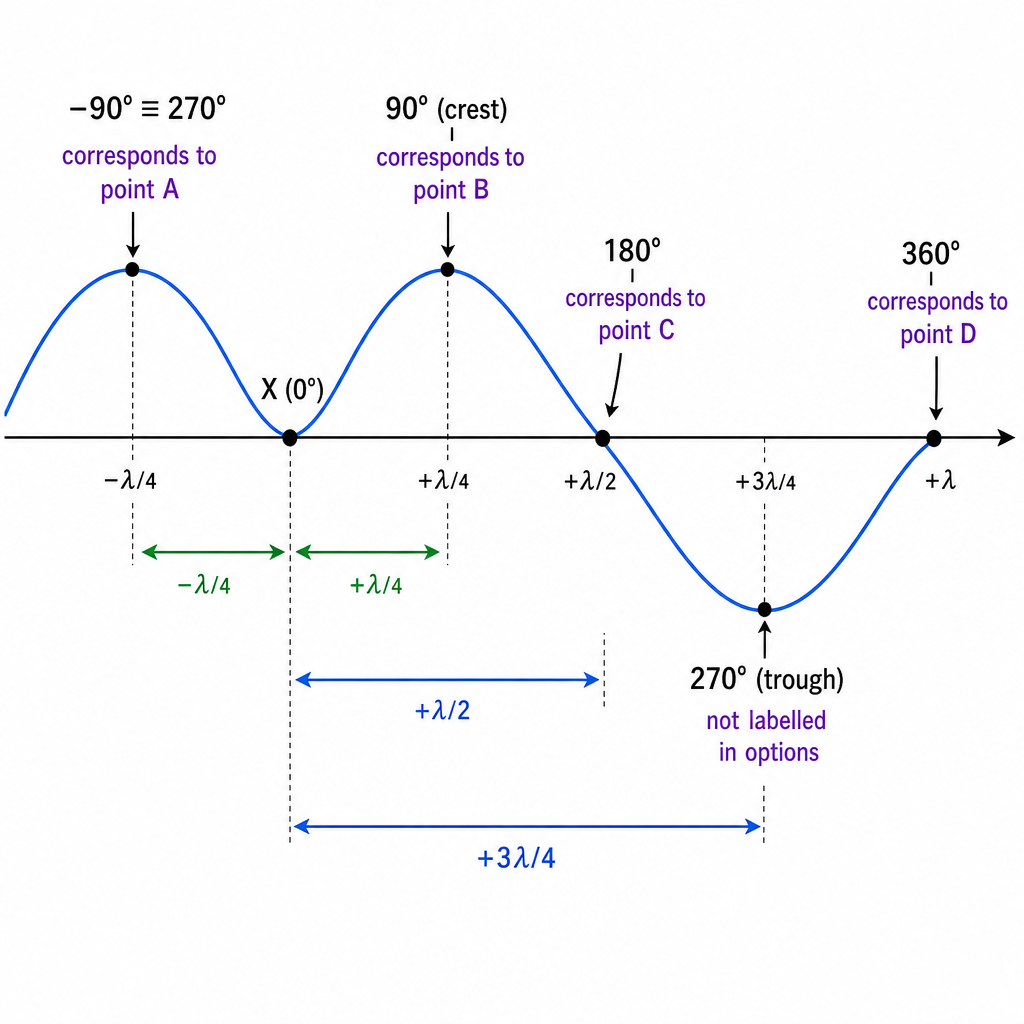
From point (upward equilibrium crossing), the point to the right would be at a trough (not labelled). The equivalent phase difference is (since ), i.e. a separation of to the left of , which is the previous crest, labelled .
Answer
A
A
Background Concept
For a progressive sinusoidal wave, the phase tells you where in the cycle a point is (crest, trough, zero crossing, etc.). At a fixed instant in time, the phase changes with position along the direction of travel.
Phase difference between two points on the same wave at the same time is related to their separation by
So fractions of a wavelength correspond directly to phase angles:
- (back in phase)
Also, phase is periodic: adding or subtracting gives an equivalent phase. So out of phase is the same as out of phase.
Understanding the Question
You are shown a snapshot of a transverse wave on a string. Point is at an equilibrium crossing with the wave going upwards (positive gradient).
You must choose which labelled point , , , or has a phase difference of relative to .
Approach
- Convert into a fraction of a wavelength.
- Starting from the known “type” of point (upward zero-crossing), work along the wave by the appropriate fraction of .
- If the required point is not labelled in that direction, use the equivalent phase difference () and look the other way.
Step-by-Step Reasoning
- Convert phase difference to distance:
So the point out of phase with is away along the string.
- Identify what happens as you move right from an upward crossing (taking as phase ):
- at (phase ): crest (this matches point )
- at (phase ): downward crossing (this matches point )
- at (phase ): trough (this point is not labelled)
- at (phase ): upward crossing again (this matches point )
So the direct position would be a trough, but there is no labelled trough.
- Use periodicity of phase:
A phase difference of corresponds to moving in the opposite direction (to the left). From an upward crossing, going left by takes you to the previous crest, which is labelled .
Therefore the correct option is A.
Key Takeaways
- Phase difference along a snapshot is proportional to distance along the wave: .
- Remember the “quarter-wavelength” landmarks: crest/trough and zero crossings.
- Angles like can be rewritten using (e.g. ) to find an equivalent point.
Common Mistakes
- Treating as if it meant of a wavelength (mixing degrees with radians ideas).
- Forgetting that is equivalent to and insisting only on moving one direction along the string.
- Choosing point (which is or out of phase, i.e. in phase with ).
Things to Be Careful About
- Phase difference is determined by position along the wave, not by whether a point is “above” or “below” the equilibrium line alone.
- Always relate the phase to a clear reference point type (here, an upward zero crossing).
- A question that says “ out of phase” usually allows the equivalent negative phase difference because phase is modulo .
Which wavelength of electromagnetic radiation in free space could be green light?
Options
A
B
C
D
Working
Visible light has wavelength about to ; green is roughly to .
Option C is , which is in the green region.
Answer
C
C
Background Concept
Electromagnetic (EM) radiation is described by its wavelength (and frequency ), related in free space by
where is the speed of light in free space. Different parts of the EM spectrum correspond to different wavelength ranges. The visible region is approximately
Green light lies near the middle of this range, around (about ).
Understanding the Question
You are asked which listed wavelength in free space could be green light. So you only need to know the typical wavelength range for green visible light and pick the option that lies in that range.
The options are:
- A:
- B:
- C:
- D:
Approach
- Recall the approximate visible wavelength range and the approximate value for green.
- Compare the powers of ten first (this quickly rules out non-visible regions).
- Choose the option close to .
Step-by-Step Reasoning
- Visible light is roughly to .
- Green is around the middle: about to .
- Options A and B are of order , which are X-ray wavelengths, far shorter than visible.
- Option D is , which is longer than the visible range (infrared).
- Option C is , which lies in the green region of visible light.
Therefore the correct choice is C.
Key Takeaways
- Visible wavelengths are about to (i.e. to ).
- Green light is around (i.e. ).
- Checking the power of ten is the fastest way to identify the correct spectral region.
Common Mistakes
- Confusing nanometres and metres: , not .
- Picking thinking “bigger means greener”; wavelengths above are beyond red (infrared).
- Not using the visible range at all and guessing based on the digits.
Things to Be Careful About
- Convert mental reference values correctly: and .
- Always compare orders of magnitude first: is visible; is X-ray; is infrared.
- The question specifies “in free space”, but the wavelength of light only changes in a medium; in free space it matches the standard visible spectrum values.
Which group contains only waves that can be polarised?
Options
A infrared waves, radio waves, sound waves
B visible light waves, microwaves, radio waves
C visible light waves, radio waves, sound waves
D microwaves, visible light waves, sound waves
Only transverse waves can be polarised.
All electromagnetic waves (visible light, microwaves, radio) are transverse, but sound waves in air are longitudinal so cannot be polarised.
Therefore the only group containing only waves that can be polarised is B.
Answer
B
B
Background Concept
Polarisation refers to restricting the direction of oscillation of a wave. This is only possible if the wave oscillations can be in more than one direction perpendicular to the direction of travel.
- Transverse waves oscillate perpendicular to the direction of propagation, so they can be polarised.
- Longitudinal waves oscillate parallel to the direction of propagation, so there is no “sideways” oscillation direction to restrict, and they cannot be polarised.
Electromagnetic (EM) waves (radio, microwaves, infrared, visible, etc.) are transverse, so they can be polarised. Sound waves in air are longitudinal, so they cannot be polarised.
Understanding the Question
Each option lists three types of waves. The question asks for the group in which every wave listed can be polarised.
So we must pick the option containing only transverse waves (in practice here: only EM waves), and reject any option that includes sound.
Approach
- Use the fact: only transverse waves can be polarised.
- Recognise EM waves as transverse (polarise-able).
- Recognise sound in air as longitudinal (not polarise-able).
- Choose the option with no sound waves.
Step-by-Step Reasoning
- Option A includes sound waves. Sound in air is longitudinal, so A is not all polarise-able.
- Option B includes visible light, microwaves, radio waves. All are electromagnetic waves, hence transverse, hence all can be polarised. So B works.
- Option C includes sound waves, so C is not all polarise-able.
- Option D includes sound waves, so D is not all polarise-able.
Therefore, the correct choice is B.
Key Takeaways
- Polarisation is a test for whether a wave is transverse.
- All electromagnetic waves are transverse and can be polarised.
- Sound waves in air are longitudinal and cannot be polarised.
Common Mistakes
- Thinking “sound can be polarised” because it can be made directional; directionality is not polarisation.
- Forgetting that all EM waves (radio through gamma) are transverse, not just visible light.
- Choosing an option because it contains mostly EM waves but overlooking that it also includes sound.
Things to Be Careful About
- The question says contains only waves that can be polarised: a single non-polarisable wave (sound) makes the whole option wrong.
- Polarisation is about the direction of oscillation, not about intensity or frequency.
One wave has an amplitude of . A second wave has an amplitude of . The waves are otherwise identical.
The two waves travel in opposite directions and overlap.
What is the ratio ?
Options
A
B
C
D
Working
Maximum amplitude when in phase:
Minimum amplitude when in antiphase:
Answer
B
B
Background Concept
When two waves overlap, the principle of superposition applies: the resultant displacement at any point is the algebraic sum of the individual displacements.
For two waves of the same frequency travelling in opposite directions, the resultant amplitude depends on their phase difference at that point:
- Constructive interference (in phase): amplitudes add, so the maximum resultant amplitude is
- Destructive interference (antiphase): amplitudes subtract, so the minimum resultant amplitude (still a positive magnitude) is
Understanding the Question
You are given two otherwise identical waves with amplitudes:
They travel in opposite directions and overlap. The question asks for the ratio
So we need the smallest and largest possible resultant amplitudes when they superpose.
Approach
- Treat the amplitudes as magnitudes and .
- Use constructive interference to find .
- Use destructive interference to find .
- Form the ratio .
Step-by-Step Reasoning
Maximum resultant amplitude:
Minimum resultant amplitude:
Now the required ratio:
So the correct option is B.
Key Takeaways
- Superposition means displacements add algebraically.
- Maximum amplitude occurs when waves are in phase: .
- Minimum amplitude occurs when waves are in antiphase: .
- The ratio cancels the common factor .
Common Mistakes
- Using automatically (that only happens when ).
- Dividing amplitudes directly () instead of finding min and max resultants.
- Forgetting the absolute value for the minimum amplitude.
Things to Be Careful About
- “Minimum amplitude” means the smallest possible magnitude of the resultant amplitude, not a negative value.
- Ensure you use the given amplitudes ( and ) and not their squares (intensity is proportional to amplitude squared, but this question is about amplitude).
Light of wavelength is incident normally on a diffraction grating with lines .
What is the angle of diffraction of the second-order maximum in the diffraction pattern that is produced?
Options
A
B
C
D
Working
Lines per mm so spacing
For second order, :
Answer
D
D
Background Concept
A diffraction grating has many equally spaced slits. For light incident normally (perpendicular) to the grating, bright maxima occur when the path difference between adjacent slits is an integer number of wavelengths. This condition is
where:
- is the slit spacing (grating spacing),
- is the diffraction angle (measured from the normal to the grating),
- is the order number (),
- is the wavelength.
If the grating is specified as “ lines per mm”, then
and you should convert into metres to match .
Understanding the Question
You are given:
- wavelength ,
- grating has , so you can find ,
- you need the angle for the second-order maximum, so .
Then you choose the option closest to the calculated angle.
Approach
- Convert the line density (lines per mm) to slit spacing .
- Use the grating equation with .
- Compute and match to the options.
Step-by-Step Reasoning
- Find the slit spacing:
Convert mm to m ():
- Apply the grating equation for :
- Take inverse sine:
This corresponds to option D.
Key Takeaways
- Convert “lines per mm” to spacing using .
- For normal incidence, use directly.
- Always check units: use metres for both and .
Common Mistakes
- Using (lines per mm) directly as instead of inverting it.
- Forgetting to convert to (causes answers off by ).
- Using instead of for the second order.
- Calculating instead of .
Things to Be Careful About
- Ensure ; otherwise and that order does not exist. Here , so the second order is possible.
- Give the angle to a sensible precision consistent with the options (nearest degree here).
A hollow tube is closed at one end and open at the other.
A stationary sound wave of the lowest possible frequency, , is produced in the tube.
The speed of sound in air is .
What is the length of the tube?
Options
A
B
C
D
Working
For a tube closed at one end and open at the other (fundamental):
Answer
A
A
Background Concept
A stationary wave in an air column forms when the sound reflects back and forth and interferes with itself. The boundary conditions depend on the ends:
- Closed end: air cannot move, so displacement is zero → displacement node.
- Open end: air is free to move most, so displacement is maximum → displacement antinode.
For the lowest possible frequency (the fundamental), the pattern in a closed–open tube is one quarter of a wavelength fitting into the tube:
The wavelength (\lambda) is related to wave speed (v) and frequency (f) by the wave equation:
Understanding the Question
We are told:
- A tube is closed at one end and open at the other.
- The lowest frequency resonance produced is (f = 820\ \text{Hz}).
- Speed of sound is (v = 330\ \text{m s}^{-1}).
We must find the tube length (L) and then choose the matching option.
Approach
- Use (v=f\lambda) to calculate the wavelength (\lambda) of the sound at (820\ \text{Hz}).
- For a closed–open tube at the fundamental, use (L=\lambda/4).
- Convert to cm and match to the given options.
Step-by-Step Reasoning
- Find the wavelength:
- Fundamental mode for a closed–open tube:
- Convert to cm:
So the correct option is A.
Key Takeaways
- Closed end → displacement node; open end → displacement antinode.
- Fundamental for a closed–open tube: (L=\lambda/4).
- Always use (v=f\lambda) to connect frequency and wavelength.
Common Mistakes
- Using (L=\lambda/2) (that is for an open–open or closed–closed tube).
- Forgetting the tube is closed at one end, so only odd harmonics are allowed.
- Unit slips when converting (\text{m}) to (\text{cm}).
Things to Be Careful About
- “Lowest possible frequency” means fundamental mode, not an overtone.
- Keep (v) in (\text{m s}^{-1}) and (f) in (\text{Hz} = \text{s}^{-1}) so (\lambda) and (L) come out in metres.
- When matching MCQ options, check that your final rounded value clearly corresponds to one choice (here (\approx 10\ \text{cm})).
Which expression gives the definition of resistance?
Options
A current divided by potential difference
B current multiplied by potential difference
C potential difference divided by current
D resistivity multiplied by length
Working
From Ohm's law,
So
Answer
C
C
Background Concept
Resistance is defined as the ratio of potential difference (p.d.) across a component to the current through it, when the component obeys Ohm's law. The relationship is
Rearranging this gives the defining expression for resistance.
Understanding the Question
You are given four expressions and asked which one matches the definition of resistance. So you should look for the expression that equals in terms of and .
Approach
Use Ohm's law, then rearrange to make the subject. Match the resulting expression to one of the options.
Step-by-Step Reasoning
Starting with
Divide both sides by :
This is “potential difference divided by current”, which corresponds to option C.
Key Takeaways
- The definition of resistance is .
- Be careful about the order: , not .
Common Mistakes
- Choosing (option A), which is actually the definition of conductance .
- Choosing (option B), which relates to electrical power .
- Confusing resistance with resistivity: , not (so option D is incomplete).
Things to Be Careful About
- Option D resembles part of the resistivity equation but misses the cross-sectional area .
- “Definition” here means the fundamental ratio for resistance; other equations for must reduce to under appropriate conditions.
The graph shows the – characteristic of an electrical component.
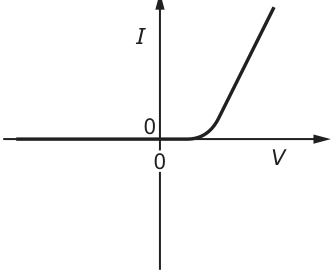
What is the component?
Options
A a filament lamp
B a metallic conductor at constant temperature
C a resistor
D a semiconductor diode
Working
For negative , (negligible reverse current).
For positive , remains near zero until a threshold, then rises steeply.
This is the forward/reverse bias behaviour of a semiconductor diode.
Answer
D
D
Background Concept
An – characteristic shows how the current through a component depends on the potential difference across it.
Typical shapes:
- Ohmic resistor / metallic conductor at constant temperature: straight line through the origin (constant resistance), symmetric for positive and negative .
- Filament lamp: curve through the origin that becomes less steep at higher because the filament heats up and resistance increases; still conducts in both directions (approximately symmetric).
- Semiconductor diode: conducts well only when forward biased; has very small current when reverse biased. In forward bias, current stays small until a “turn-on” region, then increases rapidly.
Understanding the Question
You are given an – graph. You must decide which component (A–D) produces this shape.
Key features described:
- For negative , the current is essentially zero.
- For small positive , current is still near zero.
- After a certain positive voltage, the current rises steeply.
Approach
Look for whether the graph is:
- Symmetric about the origin (would suggest a resistor/metal conductor/filament lamp), or
- Strongly asymmetric (suggesting a diode).
Then check for the diode’s signature: negligible reverse current and a sharp rise in current only for sufficiently positive .
Step-by-Step Reasoning
- In the negative region, the graph shows . That means the component does not conduct significantly for reverse polarity.
- For small positive , is also near zero, indicating a barrier to conduction.
- Beyond a positive threshold, the curve becomes very steep: a small increase in gives a large increase in .
- This combination (almost no reverse current + rapid increase in forward current after a threshold) matches the standard – curve of a semiconductor diode.
- Therefore the correct option is D.
Key Takeaways
- A diode’s – curve is directional: negligible reverse current, and a sharp rise in forward bias after turn-on.
- Ohmic components (resistors, metals at constant temperature) have straight-line – graphs through the origin.
- Filament lamps have a curved but largely symmetric – graph due to heating.
Common Mistakes
- Choosing a resistor/metallic conductor because of the steep section, while ignoring that the graph is not a straight line through the origin and is not symmetric.
- Confusing a filament lamp’s curve (which occurs in both polarities) with a diode (which conducts mainly in one direction).
Things to Be Careful About
- Always check the negative- behaviour: if is ~zero for negative , it strongly indicates a diode.
- A diode graph typically shows a very small current for small forward voltages and then a rapid increase; this is different from the gradual curvature of a filament lamp.
The diagram shows six identical resistors connected in a circuit.
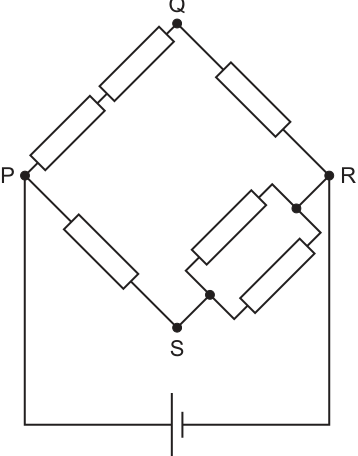
In which branch of the circuit is the most power dissipated?
Options
A PQ
B QR
C RS
D SP
Working
Let each resistor have resistance and the p.d. across be .
Upper path :
Lower path :
Powers in each labelled branch:
- has total resistance with current :
- has resistance with current :
- has resistance with current :
- has equivalent resistance with current :
Thus is greatest.
Answer
D
D
Background Concept
For a resistor, the electrical power dissipated (converted to thermal energy) can be written in several equivalent forms:
Which form is most useful depends on what you know. In circuit questions, if you can find the current through a branch, then is often the quickest.
Also recall how to simplify resistors:
- Series:
- Parallel (two resistors):
For identical resistors in parallel, .
Understanding the Question
All six resistors are identical (call each one ). The battery is connected across nodes and , so both the upper route () and the lower route () have the same total p.d. across them.
The question asks: among the labelled branches , , , and , which dissipates the most power.
- Branch contains two series resistors (total ).
- Branch contains one resistor ().
- Branch contains one resistor ().
- Branch contains two resistors in parallel (equivalent ).
Approach
- Reduce each path from to to an equivalent resistance.
- Use to compare the currents in the top and bottom paths.
- For each labelled branch, use (or for a group) with the appropriate current through that branch.
- Compare the resulting expressions to see which is largest.
Step-by-Step Reasoning
Let the supply p.d. across be .
1) Equivalent resistances of the two main paths
- Upper path :
- has two series resistors: .
- Then adds one more in series.
So:
- Lower path :
- is one resistor: .
- has two identical resistors in parallel:
Hence:
2) Currents in each path
Because the two paths are in parallel across the same :
So the lower path carries twice the current of the upper path.
3) Power in each labelled branch
Use (or for a branch that is itself a combination).
- Branch : total resistance , current :
- Branch : resistance , current :
- Branch : resistance , current :
- Branch : equivalent resistance , current :
Comparing coefficients of :
- (largest)
Therefore the most power is dissipated in branch .
Key Takeaways
- Simplify series/parallel parts first to compare currents in different routes.
- Parallel branches have the same p.d.; lower resistance branch takes higher current.
- For power comparison, is very effective once currents are known.
Common Mistakes
- Treating the whole circuit as if all resistors were in series or all in parallel.
- Forgetting that is two resistors in parallel, so its equivalent resistance is .
- Using with the wrong (each branch does not necessarily have the full supply p.d.).
- Comparing just the resistance values to decide power (power also depends on current through that branch).
Things to Be Careful About
- Current through and is the same (series in the upper path), but current through the lower path is different.
- When a “branch” contains more than one resistor (like and ), you can compute total branch power using the branch equivalent resistance with the branch current.
- Keep track of which sections are in series (same current) and which are in parallel (same p.d.).
The diagram shows a circuit containing a thermistor, a fixed resistor and a battery.
The graph shows the – characteristics of both components.
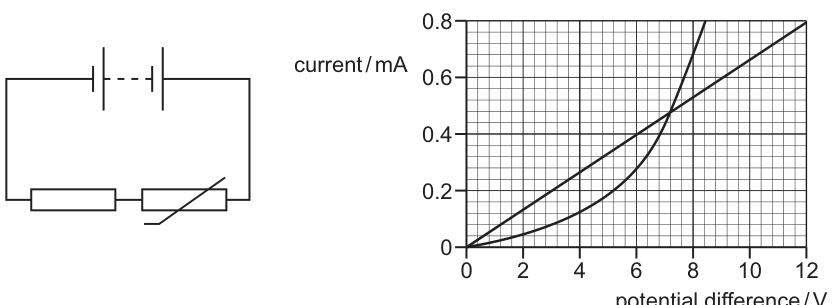
The battery has an e.m.f. of and negligible internal resistance.
What is the current in the fixed resistor?
Options
A
B
C
D
Working
The circuit is a series circuit containing a fixed resistor and a thermistor. Therefore, the current is the same through both components. By Kirchhoff's second law, the sum of the potential differences across the components equals the e.m.f. of the battery:
From the graph:
- The straight line through the origin represents the fixed resistor (Ohmic). At , . The resistance is . Thus, (with in mA and in V).
- The curved line represents the thermistor (non-Ohmic, resistance decreases as voltage increases).
We test the given current options to see which satisfies :
- Test Option C (): This is the intersection point where . Sum . (This is a distractor).
- Test Option A ():
- For the fixed resistor: . (Reading from graph: at , straight line is at ).
- We require .
- Reading from the graph for the thermistor (curve): at , the current is approximately . This matches.
Thus, the current in the circuit (and through the fixed resistor) is .
Answer
A
A
Background Concept
In a series circuit, the current is the same through all components, and the sum of the potential differences (voltages) across the components equals the total e.m.f. supplied by the battery (Kirchhoff's second law). This is expressed as .
The – characteristic graph shows how current varies with potential difference for a component. For an Ohmic conductor (fixed resistor), the graph is a straight line through the origin (). For a non-Ohmic component like a thermistor, the graph is curved. An NTC (Negative Temperature Coefficient) thermistor has a resistance that decreases as temperature increases. As voltage and current increase, power dissipation () increases, heating the thermistor and lowering its resistance. This means the slope of the – graph () increases, so the curve gets steeper.
Understanding the Question
We have a series circuit with a 12 V battery, a fixed resistor, and a thermistor. We are given the – graphs for both. We need to find the current flowing through the fixed resistor. Since they are in series, this is the same as the total circuit current.
The key constraint is that for the actual operating current , the voltage across the fixed resistor () plus the voltage across the thermistor () must equal 12 V. We cannot simply read a single point from the graph; we must find a current value where the corresponding voltages from both graphs add up to 12 V.
Approach
Since the current is common to both components, we can use the options provided to test which current is consistent with the total voltage of 12 V.
- Identify which graph corresponds to which component (straight line = fixed resistor, curve = thermistor).
- For a candidate current , read from the straight line and from the curve.
- Check if .
Alternatively, one could plot a "load line" on the graph. Since (from k) and , we have . Plotting this line on the same axes and finding its intersection with the thermistor curve would give the operating point. However, testing the options is faster for a multiple-choice question.
Step-by-Step Reasoning
- Identify components: The straight line passing through and is the fixed resistor. Its resistance is . The curved line, which gets steeper, is the thermistor.
- Apply circuit law: .
- Test Option C (): The graphs intersect at approximately and . If the current were , both components would have across them. Total voltage . This is too high, so the current must be lower. This eliminates C and D ( would require across just the fixed resistor, leaving 0 for the thermistor, which is impossible as the thermistor has resistance).
- Test Option B ():
- Fixed resistor: . (Check graph: at , straight line is at ).
- Thermistor: We need . Looking at the curve at , the current is only about . So at , the thermistor voltage is actually higher (around ). Total voltage . Still too high.
- Test Option A ():
- Fixed resistor: . (On graph, at , ).
- Thermistor: We need . Looking at the curve at (between 6 and 7), the current is approximately . This matches perfectly.
Key Takeaways
- In series circuits with non-Ohmic components, you cannot simply add resistances. You must use the – characteristics.
- The operating point is found where the current is the same for both components and the voltages sum to the supply voltage.
- Intersection points on – graphs for two components in series are not necessarily the operating point (unless the supply voltage happens to be ).
Common Mistakes
- Reading the intersection point (Option C): Students often see the intersection at and choose it. This is the current if the components were in parallel with a supply, or if the series supply was . In series, voltages add, so at the intersection, total .
- Ignoring the thermistor (Option D): Calculating current as . This assumes the thermistor has 0 resistance.
- Parallel assumption: Thinking currents add up. In series, currents are equal.
Things to Be Careful About
- Units: The graph uses mA and V. Resistance calculation: . Be careful with powers of ten.
- Graph reading precision: The graph has grid lines. 0 to 2 V is 4 small squares (0.5 V/square). 0 to 0.2 mA is 4 small squares (0.05 mA/square). Reading and requires estimating between grid lines.
- Series vs Parallel: Always check the circuit diagram. Series means same current, additive voltages.
Two resistors of resistances and are connected in parallel.
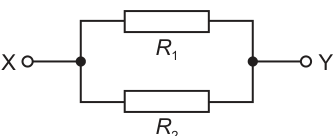
What is the combined resistance between X and Y?
Options
A
B
C
D
Working
In parallel, the p.d. across each resistor is .
For the equivalent resistance ,
So
Answer
B
B
Background Concept
For resistors:
In a parallel connection, each branch is connected across the same two nodes, so the potential difference is the same across each resistor. The total current supplied is the sum of the currents in each branch (Kirchhoff’s first law):
An equivalent (combined) resistance between the two terminals is defined so that it draws the same total current for the same terminal p.d.:
Understanding the Question
Two resistors of resistances and are connected in parallel between terminals X and Y (so both resistors share the same endpoints).
You are asked for the combined resistance between X and Y, i.e. the single resistor value that could replace the parallel pair and give the same – behaviour.
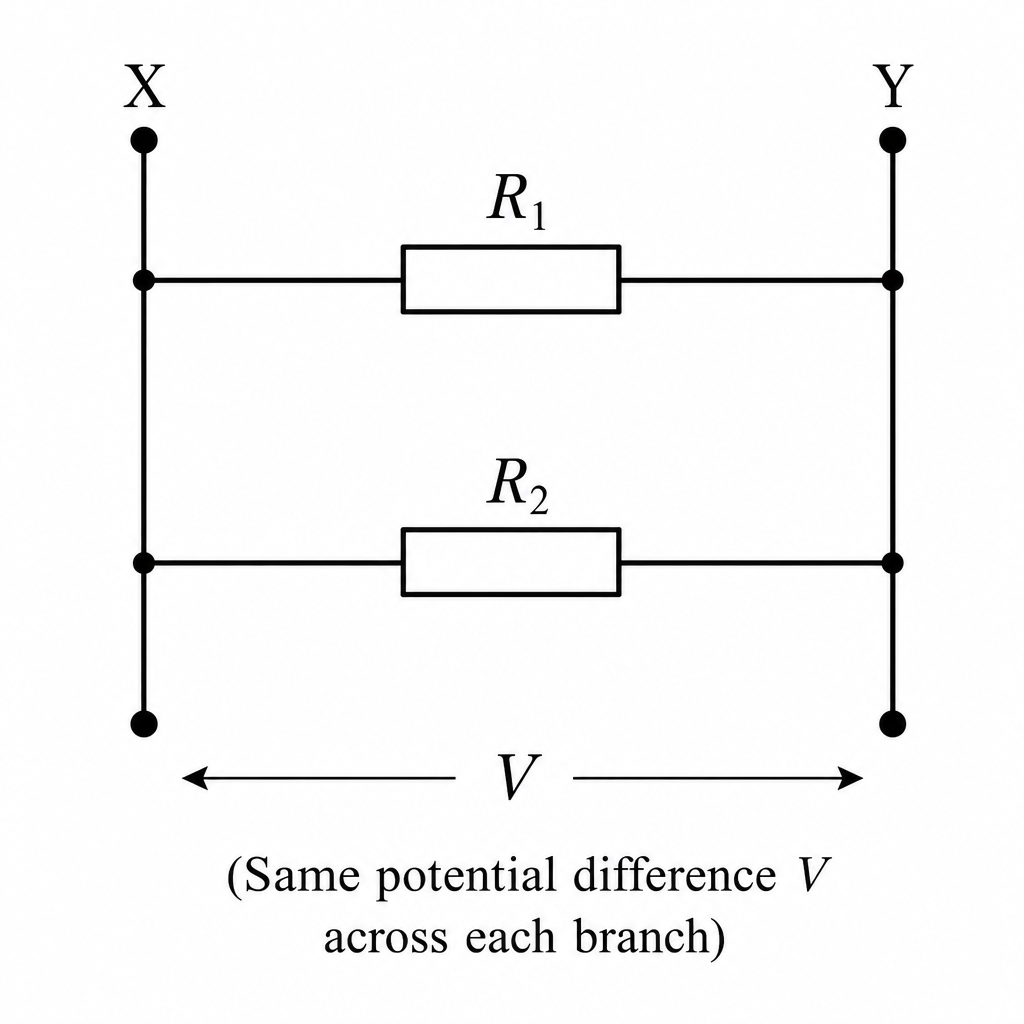
Approach
- Let the potential difference between X and Y be .
- Write the current in each branch using .
- Add the branch currents to get the total current.
- Set total current equal to and rearrange for .
- Match to the options.
Step-by-Step Reasoning
Let the p.d. between X and Y be .
Because the resistors are in parallel:
- p.d. across is so
- p.d. across is so
Total current leaving the supply is the sum:
Factor out :
Define the equivalent resistance by :
Cancel (assuming ):
Invert to get :
This corresponds to option B.
Key Takeaways
- In parallel: same p.d. across each branch, currents add.
- Equivalent resistance for two resistors in parallel:
- is always less than the smaller of and .
Common Mistakes
- Using the series formula for a parallel connection.
- Forgetting to add currents (writing instead of ).
- Inverting incorrectly when going from to .
Things to Be Careful About
- Make sure you recognise the connection: in parallel, both resistors share the same two nodes (X and Y).
- A quick sense-check: if , then
so the combined resistance halves, which is consistent with parallel paths reducing resistance.
A cell is connected in series with an ammeter and a variable resistor. A voltmeter is used to measure the p.d. across the variable resistor. The resistance of the variable resistor is varied, and the p.d. and the current are recorded.
The graph shows the variation with current of the p.d. across the variable resistor.
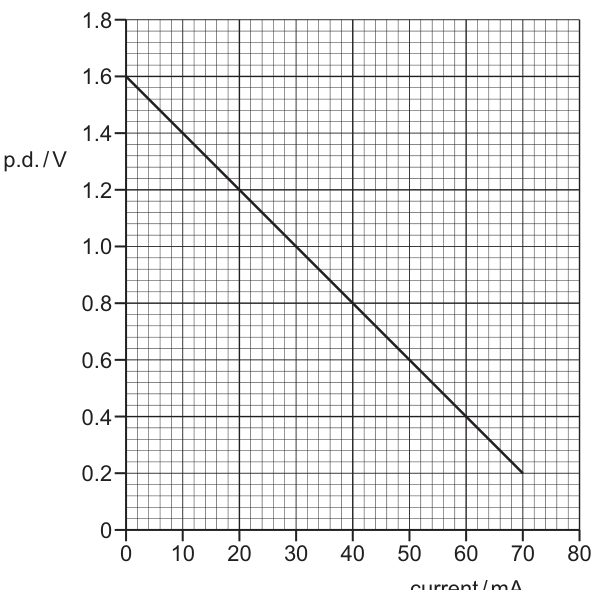
What is the internal resistance of the cell?
Options
A
B
C
D
Working
For a cell with internal resistance ,
So the gradient of a graph of against is .
Using two points: and :
Hence .
Answer
C
C
Background Concept
A cell can be modelled as an ideal source of electromotive force (e.m.f.) in series with an internal resistance . When a current flows, there is a “lost volts” drop across the internal resistance of magnitude , so the terminal potential difference available to the external circuit is
This is a straight-line equation in the form , where the intercept is and the gradient is .
Understanding the Question
The voltmeter measures the p.d. across the variable resistor, which is the same as the terminal p.d. of the cell (since the ammeter is in series and assumed to have negligible resistance). A graph of this p.d. is plotted against current . The question asks for the internal resistance of the cell, which can be obtained from the (negative) gradient of the straight line.
Approach
- Use the relation .
- Identify that the gradient of the – graph is .
- Read two clear points from the straight line, convert from mA to A, and calculate the gradient.
- Take the magnitude of the gradient to get .
Step-by-Step Reasoning
From the graph, at the p.d. is about (this is the e.m.f. ). Another point on the line is about when .
Convert to amperes:
Compute the gradient:
Since gradient , the internal resistance is
So the correct option is C.
Key Takeaways
- For a cell, terminal p.d. and current satisfy .
- On a vs graph: intercept and gradient .
- Always convert mA to A before using .
Common Mistakes
- Using current in mA directly (would give instead of ).
- Taking the intercept as instead of as .
- Forgetting the gradient is negative and concluding is negative (use magnitude for resistance).
Things to Be Careful About
- Choose two well-separated points on the best-fit straight line to reduce reading error.
- Make sure axes units are used correctly: here current is in but resistance needs .
- The measured p.d. is across the external resistor, so it is the terminal p.d., not the e.m.f. (unless ).
Which list contains only fundamental particles?
Options
A antineutrinos, baryons, neutrons, electrons
B mesons, electrons, neutrinos, protons
C positrons, quarks, hadrons, protons
D quarks, positrons, neutrinos, leptons
Working
Fundamental particles are quarks and leptons.
Baryons, mesons and hadrons are composite (made of quarks), so options containing them are not correct.
Only option D contains only quarks and leptons (positron and neutrino are leptons).
Answer
D
D
Background Concept
In the Cambridge A Level (9702) particle model, fundamental particles are those not known to have internal structure in this syllabus. These are:
- Quarks (and antiquarks)
- Leptons (e.g. electron, positron, neutrinos, muon, etc.)
By contrast, hadrons are composite particles made from quarks held together by the strong interaction. Hadrons split into:
- Baryons (three quarks), e.g. proton, neutron
- Mesons (quark + antiquark)
So any list containing hadrons/baryons/mesons/protons/neutrons contains composite particles and cannot be “only fundamental”.
Understanding the Question
You are given four lists (A–D) and asked which list contains only fundamental particles.
So you must check each term and decide whether it is:
- fundamental (quark or lepton), or
- composite (hadron such as proton/neutron/meson/baryon).
Approach
Use the classification rules:
- Cross out any option containing hadrons (or the subgroups baryons/mesons) because they are composite.
- Cross out any option containing protons or neutrons because they are baryons (hence hadrons), so composite.
- The remaining option should contain only quarks and/or leptons (including positrons and neutrinos).
Step-by-Step Reasoning
- Option A includes baryons and neutrons.
- Baryons are hadrons (composite), and neutrons are baryons (composite). So A is not correct.
- Option B includes mesons and protons.
- Mesons are hadrons (composite). Protons are baryons (composite). So B is not correct.
- Option C includes hadrons and protons.
- Hadrons are composite by definition; protons are baryons (composite). So C is not correct.
- Option D includes quarks, positrons, neutrinos, leptons.
- Quarks are fundamental.
- Positrons are leptons (fundamental).
- Neutrinos are leptons (fundamental).
- “Leptons” refers to the fundamental lepton family (not hadrons).
Therefore every item in D is fundamental.
So the correct choice is D.
Key Takeaways
- Fundamental particles (at this level): quarks and leptons.
- Hadrons are composite: baryons (e.g. proton, neutron) and mesons.
- Eliminating options containing hadrons/baryons/mesons/protons/neutrons quickly identifies the correct list.
Common Mistakes
- Thinking protons and neutrons are fundamental: they are made of quarks (baryons).
- Forgetting that mesons are also hadrons (composite).
- Treating “leptons” as if it implies composite particles; it is the fundamental lepton category.
Things to Be Careful About
- Category words matter: hadron, baryon, meson automatically mean “composite” in this syllabus.
- Particles like positrons and neutrinos are leptons, so they are fundamental.
- If an option contains even one composite particle, it fails the “only fundamental particles” requirement.
Which statement explains why alpha-particles have discrete energies, but beta-particles have a continuous range of energies?
Options
A Beta-particles have a much smaller mass than alpha-particles which means beta-particles can be emitted with a larger range of velocities.
B Only alpha-particles experience repulsion from the nucleus which is dependent on the number of protons in the nucleus.
C Only beta-particles are emitted with another lepton and some energy is transferred to the other lepton.
D Only the energy of alpha-particles is discrete because the composition of alpha-particles is always the same.
Working
In -decay the nucleus emits an -particle only, so (for a given transition) conservation of energy fixes a single kinetic energy (discrete line).
In -decay a neutrino/antineutrino is also emitted, so the available decay energy is shared between the -particle and the neutrino, giving a continuous range of energies.
Answer
C
C
Background Concept
In nuclear decays, the total energy released (the -value) is fixed by the difference in rest mass energies of the initial and final nuclei and emitted particles:
That released energy appears as kinetic energy (and sometimes as gamma radiation if the daughter nucleus is excited). The key point is how many particles share the kinetic energy.
- Alpha decay is effectively a two-body decay:
- Beta decay is a three-body decay because a neutrino (or antineutrino) is also emitted:
(or for emission, a neutrino is emitted instead).
Understanding the Question
You are asked why:
- -particles come out with discrete (line) energies, but
- -particles come out with a continuous range of energies.
So we must identify a feature present in beta decay that is not present in alpha decay, which affects how the fixed decay energy is distributed.
Approach
Use conservation of energy and momentum:
- For a two-body decay, the kinetic energies are uniquely determined (for a given nuclear transition), giving a discrete energy for the emitted particle.
- For a three-body decay, the kinetic energy can be shared in many proportions, so one particle (the beta particle) can take a range of energies.
Then match this reasoning to the option statements.
Step-by-Step Reasoning
-
Alpha decay gives discrete energies
- Consider the parent nucleus at rest.
- After decay, there are two products: the daughter nucleus and the -particle.
- Conservation of momentum forces them to recoil with equal and opposite momentum.
- Since the total available energy is fixed for that transition, there is only one way to satisfy both energy and momentum conservation, so the kinetic energy is a single value (a line in the spectrum).
-
Beta decay gives continuous energies
- In decay the products include the electron and an antineutrino (another lepton).
- The available energy is fixed, but now it can be partitioned among three bodies: electron, (anti)neutrino, and the recoiling daughter nucleus.
- Because the neutrino can take varying amounts of energy and momentum, the electron can emerge with many possible kinetic energies from near zero up to a maximum, producing a continuous spectrum.
-
Selecting the correct option
- Option C states that only -particles are emitted with another lepton and energy is transferred to that other lepton. This matches the neutrino/antineutrino sharing the decay energy, causing the continuous spectrum.
Key Takeaways
- Discrete vs continuous decay energies are explained by two-body vs three-body kinematics.
- decay (two bodies) produces discrete energies for each nuclear transition.
- decay includes a neutrino/antineutrino, so the particle energy is shared and therefore continuous.
Common Mistakes
- Claiming the continuous spectrum is due to the beta particle having small mass (it affects typical speeds but does not explain a continuous range of energies).
- Forgetting that a neutrino/antineutrino is emitted in beta decay.
- Thinking nuclear repulsion (Coulomb effects) is the main cause of the energy spread; it is not the core reason for the continuous beta spectrum.
Things to Be Careful About
- The continuous range is not because the -value varies randomly; for a given transition the -value is fixed, but the sharing varies.
- “Another lepton” in the option refers to the neutrino/antineutrino, which is hard to detect but crucial for energy and momentum conservation.
A hadron consists of antiquarks that are all identical.
What is a possible value, in terms of the elementary charge , for the charge on the hadron?
Options
A
B
C
D
Working
A hadron made only of identical antiquarks must be an antibaryon, so it contains three identical antiquarks.
For example, each has charge .
Total charge:
Answer
B
B
Background Concept
Hadrons are particles made from quarks.
- Baryons contain three quarks ().
- Mesons contain a quark and an antiquark ().
Quark charges are:
- : so :
- : so :
- : so :
The total charge of a hadron is the sum of the charges of its constituent quarks/antiquarks.
Understanding the Question
We are told the hadron consists of antiquarks that are all identical. We must decide which of the listed total charges (, , , ) could result from a valid hadron made from identical antiquarks.
Approach
- Decide what type of hadron could be made from only antiquarks.
- Use the fact that “all identical” means the constituents must all be or all be or all be .
- Add their charges and compare with the options.
Step-by-Step Reasoning
- A meson has the form , so it cannot consist only of antiquarks.
- A baryon-like hadron made from antiquarks is an antibaryon, with quark content .
- If all antiquarks are identical, possibilities include:
- :
- :
- gives the same as since has the same charge as :
- The options given include but not . Therefore a possible value from the list is .
Key Takeaways
- “Hadron made of only antiquarks” implies an antibaryon with three antiquarks.
- Antiquark charges are the negatives of the corresponding quark charges.
- Net charge is found by adding the constituent charges.
Common Mistakes
- Treating the hadron as a meson and trying to use two antiquarks (mesons are ).
- Forgetting that antiquarks have the opposite sign charge to their quarks.
- Adding the magnitudes but not the signs, leading to impossible totals like or .
Things to Be Careful About
- The phrase “all identical” strongly restricts the quark content to or (or ).
- Check that your computed charge matches one of the options exactly (including sign).
Your score so far
Answer a question to start scoring
Your marks add up here as you work through the paper.