Physics 9702/22 — February/March 2025
Cambridge AS Level · AS Level Structured Questions · worked solutions for every part, with the mark scheme
Topics Forces, Density and Pressure · Dynamics · Waves · Physical Quantities and Units · Kinematics · Work, Energy and Power · +3 more
Answer
Accuracy is how close a measured value is to the true (accepted) value.
Accuracy is how close a measured value is to the true (accepted) value.
Background Concept
Accuracy describes the quality of a measurement by comparing it to the true (or accepted) value of the quantity. If a measurement is accurate, it has a small error relative to the true value.
Accuracy is different from precision:
- Accuracy: closeness to the true value (strongly affected by systematic error).
- Precision: how close repeated readings are to each other (strongly affected by random error).
Understanding the Question
You are asked to explain what “accuracy” means for a measured value. This is a 1-mark definition, so one clear sentence is enough.
Approach
State that accuracy is about closeness to the true/accepted value. Avoid talking about repeatability (that is precision).
Step-by-Step Reasoning
- Identify that “accuracy” compares your measurement with the true value.
- Write the definition: “how close the measured value is to the true value.”
Key Takeaways
- Accuracy = closeness to true value.
- Precision = closeness of repeated readings.
Common Mistakes
- Defining accuracy as “repeatable results” (that is precision).
- Saying “small random error” only; systematic error is the main cause of poor accuracy.
Things to Be Careful About
- Use the phrase true value or accepted value.
- Keep it to one sentence for a 1-mark definition.
Two solid cubes, A and B, are measured to determine the density of their materials.
Table 1.1 shows the measurements for cube A.
Table 1.1
| quantity | measurement |
|---|---|
| length of side | |
| mass |
Working
Side length:
Mass:
Volume of cube:
Density:
Answer
8.7 × 10^3 kg m^-3
Background Concept
Density is defined as mass per unit volume:
For a cube of side length :
To get in , use SI units: mass in kg and length in m.
Understanding the Question
Cube A has:
- side length
- mass
You must calculate the density and show it rounds to .
Approach
- Convert to metres and to kilograms.
- Calculate .
- Use .
- Round to match the given form (2 s.f. in ).
Step-by-Step Reasoning
- Convert units:
- so
- so
- Volume of a cube:
Compute the power carefully:
- (approximately)
So
- Density:
Divide numbers and subtract powers:
- Rounding to 2 s.f. gives:
Key Takeaways
- Always convert to SI before calculating derived units.
- For cubes, , so small changes in can significantly affect .
Common Mistakes
- Forgetting to convert cm to m (would give density off by a factor of ).
- Using (surface area) instead of .
- Incorrect power handling: .
Things to Be Careful About
- Use consistent units to get .
- Keep sufficient significant figures during working, then round only at the end.
Calculate the percentage uncertainty in the density of the material of cube A.
percentage uncertainty = ______ %
Working
Fractional (percentage) uncertainty:
Answer
3.6%
Background Concept
When a quantity is calculated from measured values, its uncertainty depends on how those measurements combine.
For products and quotients, fractional uncertainties add:
For powers, multiply the fractional uncertainty by the power:
Here,
So contributes once, and contributes three times.
Understanding the Question
You are given uncertainties in:
- mass
- length
You must find the percentage uncertainty in .
Approach
- Write in terms of measured quantities: .
- Use fractional uncertainty rules:
- add the fractional uncertainty of
- add times the fractional uncertainty of
- Convert to a percentage.
Step-by-Step Reasoning
- Start with the relationship:
- Apply uncertainty propagation:
- Mass fractional uncertainty:
As a percentage:
- Length fractional uncertainty:
As a percentage:
- Because is cubed:
- Total percentage uncertainty:
Key Takeaways
- For , the length uncertainty is tripled because of the cube.
- Add fractional uncertainties for multiplied/divided quantities.
Common Mistakes
- Forgetting the factor of 3 for .
- Subtracting uncertainties because it is a division (you still add fractional uncertainties).
- Mixing units (cm vs m): fractional uncertainties are unit-independent, but values must be consistent when doing other calculations.
Things to Be Careful About
- Keep extra figures during intermediate steps, then round the final percentage.
- Quote the final uncertainty to a sensible number of significant figures (here ).
The density of the material of cube B is determined to be .
State and explain whether cube A and cube B could be made from the same material.
Working
For cube A:
Absolute uncertainty:
So range for A:
For cube B:
Range for B:
Answer
Yes. The uncertainty ranges overlap (about to ), so the two densities are consistent with the same material.
Yes; their density ranges overlap within uncertainties, so they could be the same material.
Background Concept
When two measured (or calculated) quantities have uncertainties, you decide whether they could represent the same true value by checking consistency.
A common exam method is to compare the ranges:
If the ranges overlap, the results are consistent (they could be the same). If there is no overlap, they are inconsistent (unlikely to be the same).
Understanding the Question
Cube A has a calculated density and from part (ii) a percentage uncertainty (about ).
Cube B has:
You must state and explain whether A and B could be the same material.
Approach
- Convert each percentage uncertainty into an absolute uncertainty.
- Write the min and max possible densities for A and B.
- Check whether the intervals overlap.
- Make a conclusion that matches the overlap test.
Step-by-Step Reasoning
- Cube A absolute uncertainty (using ):
So A could be anywhere between:
and
- Cube B absolute uncertainty:
So B could be between:
and
- Compare the ranges:
- A: to
- B: to
There is overlap from to . Therefore the two results are consistent.
Key Takeaways
- Use uncertainty ranges to judge if two results could agree.
- Overlap of ranges implies “could be the same” (consistent within uncertainty).
Common Mistakes
- Comparing only the central values ( vs ) and concluding “different” without using uncertainties.
- Using percentage uncertainty of one cube only and ignoring the other.
- Treating overlap as proof they are the same; the correct wording is “could be made from the same material”.
Things to Be Careful About
- Convert percentages to decimals correctly (e.g. ).
- Keep powers of ten consistent when forming the ranges.
- Use cautious language: consistent with / could be rather than “are definitely”.
Answer
For a body in equilibrium, the sum of the clockwise moments about any point equals the sum of the anticlockwise moments about that point (so the resultant moment about the point is zero).
In equilibrium, total clockwise moment about a point equals total anticlockwise moment (net moment is zero).
Background Concept
A moment of a force about a point (pivot) measures the turning effect of the force.
where is the force and is the perpendicular distance from the pivot to the line of action of the force.
For a rigid body to be in rotational equilibrium, it must have no angular acceleration, so the resultant (net) moment about any point must be zero.
Understanding the Question
You are asked to state (not calculate) the condition involving moments that must be true when an object is in equilibrium.
The expected statement must refer to clockwise and anticlockwise turning effects about the same point.
Approach
Recall the standard equilibrium condition:
- either “sum of clockwise moments = sum of anticlockwise moments”,
- or “algebraic sum of moments about a point is zero”.
Write it clearly and include the idea of a chosen pivot point.
Step-by-Step Reasoning
- Choose a point (pivot) about which moments are considered.
- In equilibrium, clockwise turning effects must balance anticlockwise turning effects.
- Therefore the total clockwise moment equals the total anticlockwise moment (equivalently net moment is zero).
Key Takeaways
- Moment perpendicular distance.
- Equilibrium requires no resultant moment.
- A correct equivalent statement is acceptable (clockwise = anticlockwise, or sum of moments = 0).
Common Mistakes
- Saying “forces are equal” rather than “moments are equal”.
- Missing the word perpendicular when defining moment (if asked).
- Stating the principle without mentioning about a point.
Things to Be Careful About
- It must be about the same point.
- Moments depend on perpendicular distance, not the distance along the beam unless the force is perpendicular to the beam (as it is in many beam problems).
A solid plastic cylinder floats in water. It is used to support one end of a horizontal uniform beam AB as shown in Fig. 2.1.
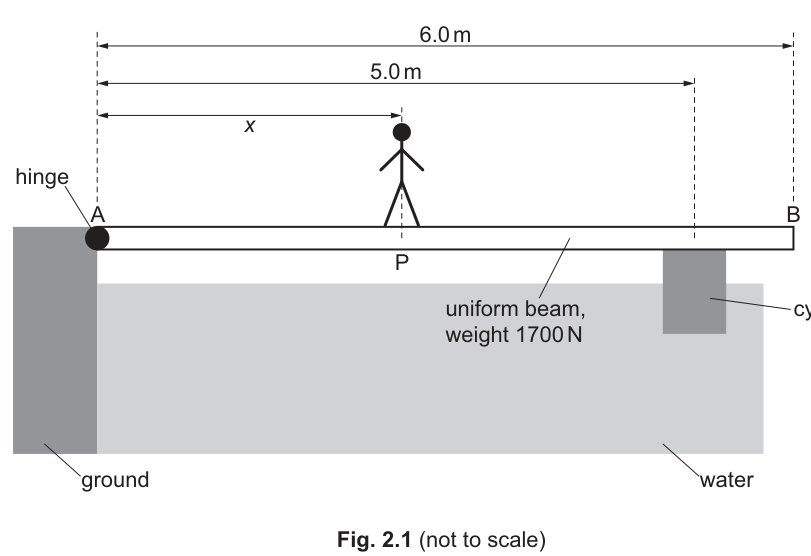
The beam has length and weight . The beam is attached to solid ground with a hinge at end A.
The cylinder is floating vertically in the water. The top of the cylinder is attached at its centre to the beam at a horizontal distance of from end A. The cylinder applies a vertical force of to the beam.
A person of weight stands on the beam at point P.
The beam AB is in equilibrium.
Working
Taking moments about :
Answer
2.1 m
Background Concept
For a horizontal beam in equilibrium about a hinge, we often take moments about the hinge because the unknown hinge reaction forces then have zero moment (their perpendicular distance is zero).
For equilibrium:
All forces here are vertical, so the perpendicular distance from is just the horizontal distance along the beam.
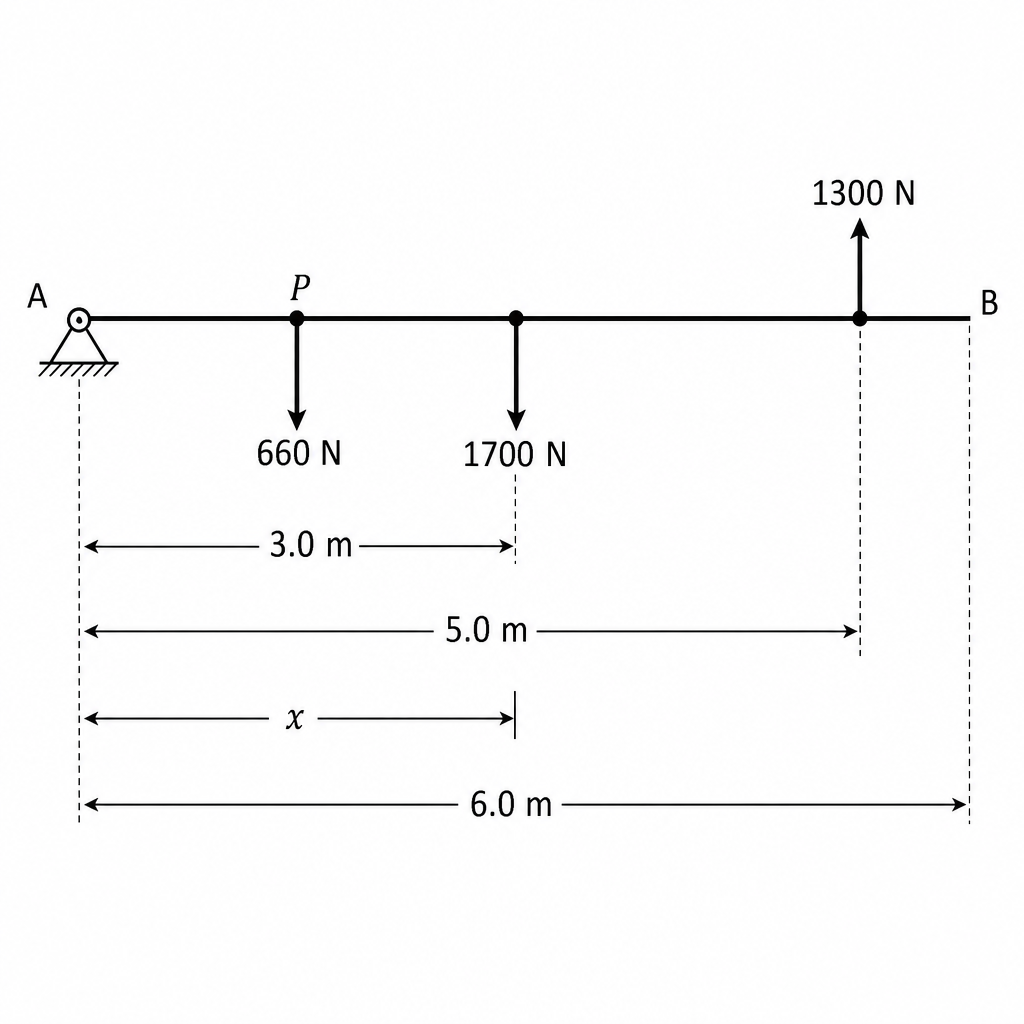
Understanding the Question
The beam of length is hinged at .
- Beam weight acts at its centre, from (downward).
- Cylinder pushes on the beam with at from (upward).
- Person of weight acts downward at point , distance from .
The beam is in equilibrium, so moments about balance. We must find .
Approach
- Choose pivot at .
- Identify which forces tend to rotate the beam clockwise and anticlockwise about .
- Write the moments equation and solve for .
Step-by-Step Reasoning
About pivot :
- The upward force at tends to lift the beam on the right, producing an anticlockwise moment:
- The beam’s weight acts downward at , producing a clockwise moment:
- The person’s weight acts downward at , also producing a clockwise moment:
Equilibrium:
Compute:
Key Takeaways
- Taking moments about the hinge removes hinge forces from the equation.
- For vertical forces on a horizontal beam, moment arm is the horizontal distance from pivot.
- Write a clear clockwise = anticlockwise equation.
Common Mistakes
- Putting the beam weight at instead of at .
- Using for the person’s distance when is defined from .
- Mixing clockwise/anticlockwise signs inconsistently.
Things to Be Careful About
- Check which forces produce clockwise vs anticlockwise turning about .
- Quote to sensible significant figures (here data are mostly 2 s.f., so is appropriate).
The bottom of the cylinder is submerged in the water to depth as shown in Fig. 2.2. The beam is still attached to the cylinder but not shown.
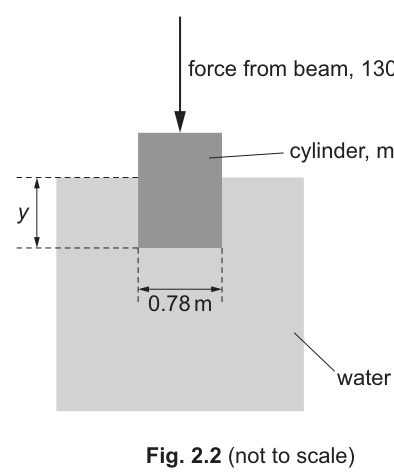
The cylinder has mass and diameter . The beam exerts a vertical force of on the cylinder. The cylinder is in equilibrium.
Show that the upthrust acting on the cylinder is .
Working
For the cylinder in equilibrium:
Answer
Upthrust
1400 N
Background Concept
For an object floating at rest, the vertical forces balance:
So the upthrust (buoyant force) equals the total downward forces.
Also, if two objects push on each other, Newton’s third law says the forces are equal in magnitude and opposite in direction.
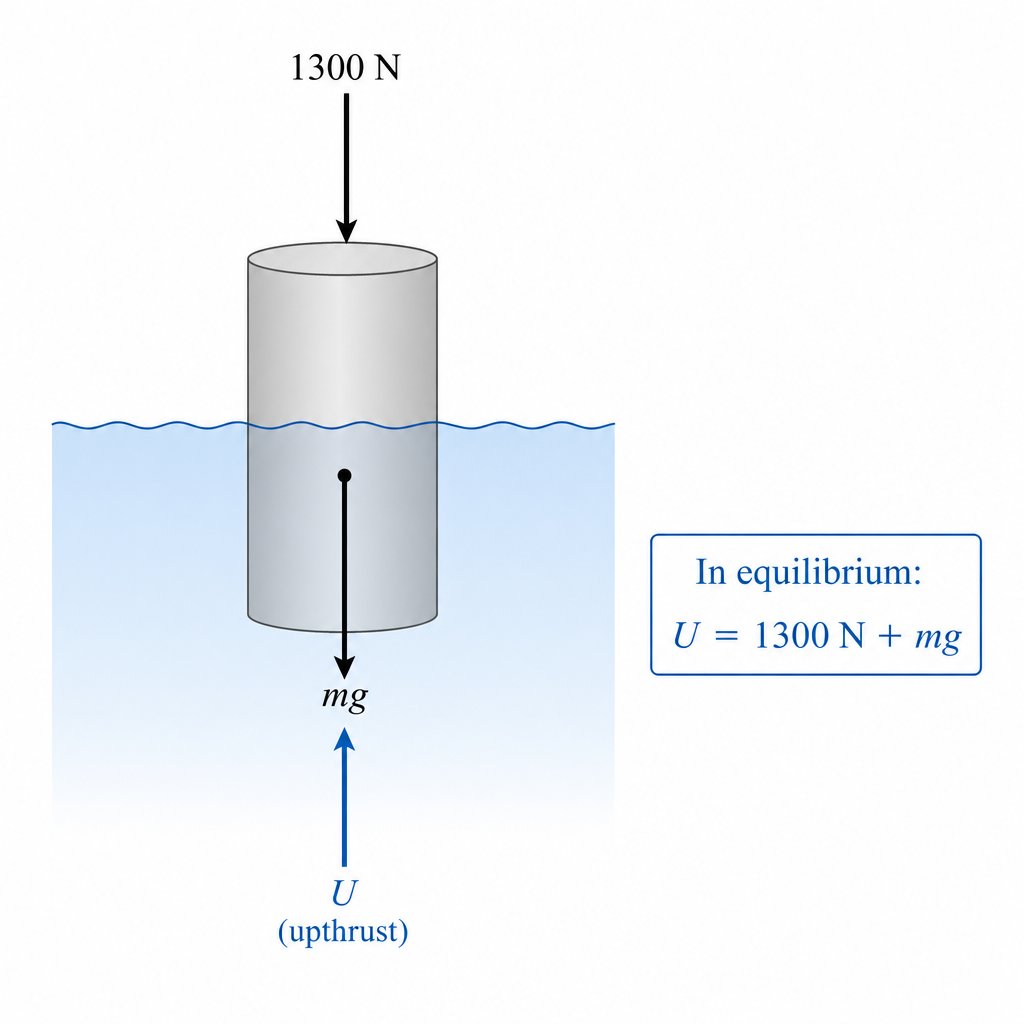
Understanding the Question
The beam exerts a downward vertical force of on the cylinder. The cylinder also has its own weight downward. The water provides an upthrust upward.
We must show that is (to appropriate s.f.).
Approach
Write the equilibrium condition for vertical forces on the cylinder:
Then substitute and .
Step-by-Step Reasoning
Forces on the cylinder:
- Upward: upthrust .
- Downward: force from beam and weight .
Equilibrium gives:
Compute weight:
So:
which is to 2 s.f.
Key Takeaways
- For equilibrium, net force is zero.
- Upthrust balances all downward forces, not just the object’s own weight.
- Action–reaction explains why the beam’s force on the cylinder is downward if the cylinder’s force on the beam is upward.
Common Mistakes
- Using instead of adding.
- Forgetting the cylinder’s own weight.
- Using without consistency (may shift rounding).
Things to Be Careful About
- Ensure you are balancing forces on the cylinder, not on the beam.
- State the equilibrium equation before substituting numbers (this is usually what earns the method mark).
Working
Upthrust:
Answer
0.30 m
Background Concept
Archimedes’ principle states that the upthrust on an object in a fluid equals the weight of fluid displaced:
For a vertical cylinder of constant cross-sectional area submerged to depth , the displaced volume is:
So:
Understanding the Question
You are given:
- upthrust from (ii): ,
- water density ,
- cylinder diameter so radius .
You must calculate the submerged depth .
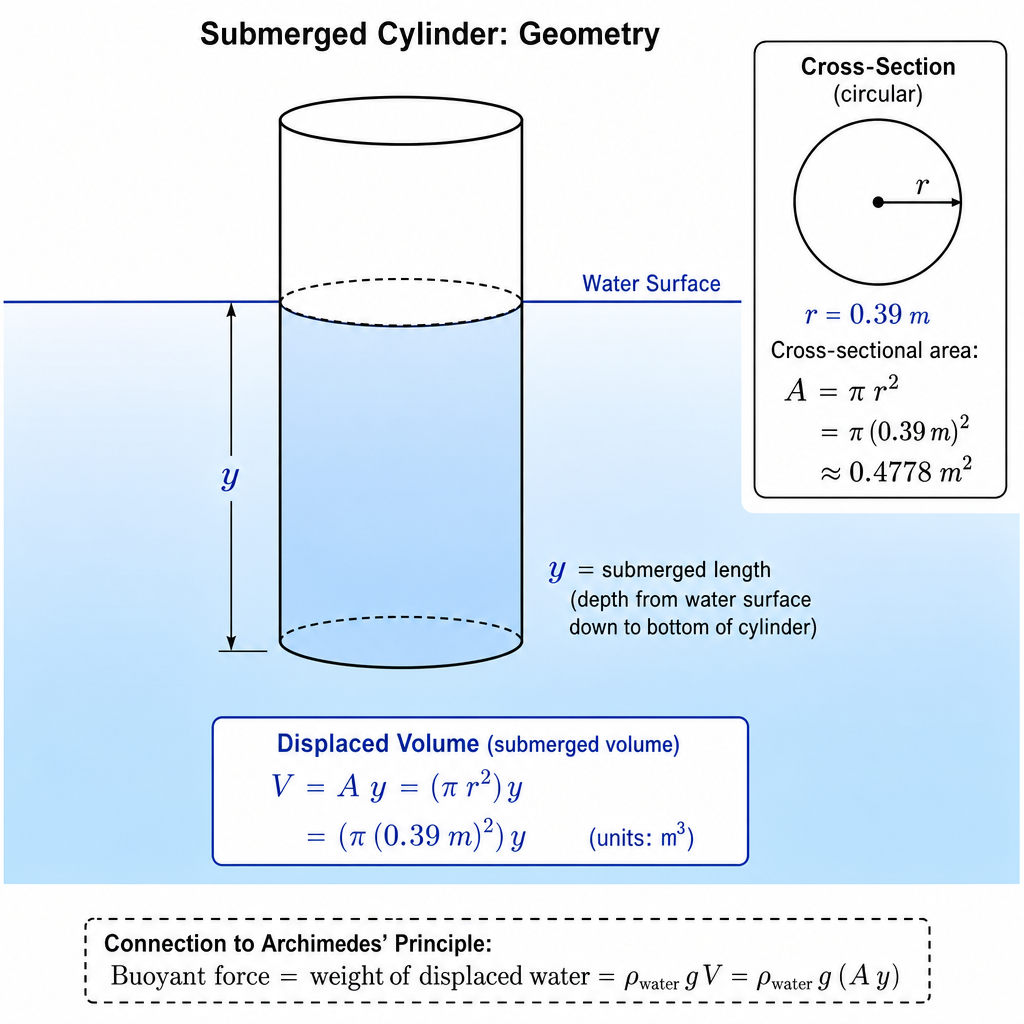
Approach
- Find the cylinder cross-sectional area .
- Use .
- Rearrange to get and substitute values.
Step-by-Step Reasoning
Radius:
Area:
Apply Archimedes:
Rearrange:
Substitute:
So to 2 s.f.
Key Takeaways
- Upthrust depends on displaced volume, not the object’s mass directly.
- For a cylinder, displaced volume is area submerged depth.
- Convert diameter to radius correctly before using .
Common Mistakes
- Using diameter as the radius in .
- Using (hydrostatic pressure) instead of (upthrust).
- Forgetting units and mixing cm with m.
Things to Be Careful About
- Use , not .
- Keep consistent significant figures (final to about 2 s.f. is appropriate here).
The person can stand anywhere between A and B.
On Fig. 2.3, sketch the variation of the depth of the bottom of the cylinder with the distance of the person from A, for distances between and . Numerical values are not required.
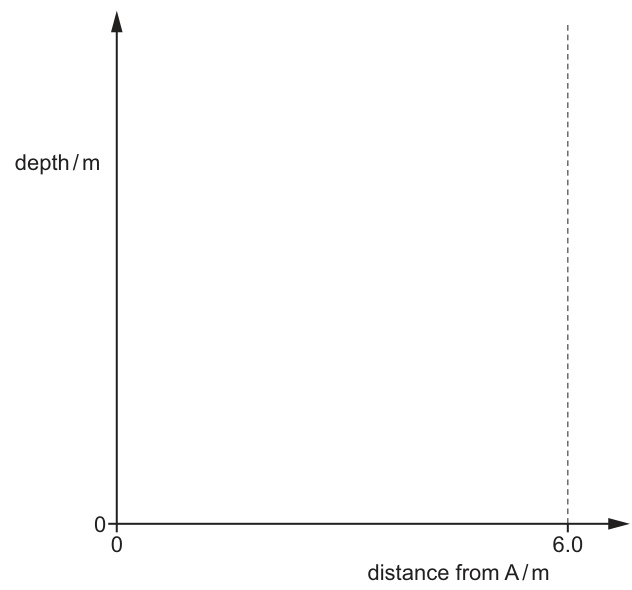
Answer
As the person moves further from , the clockwise moment about increases, so the upward force from the cylinder must increase.
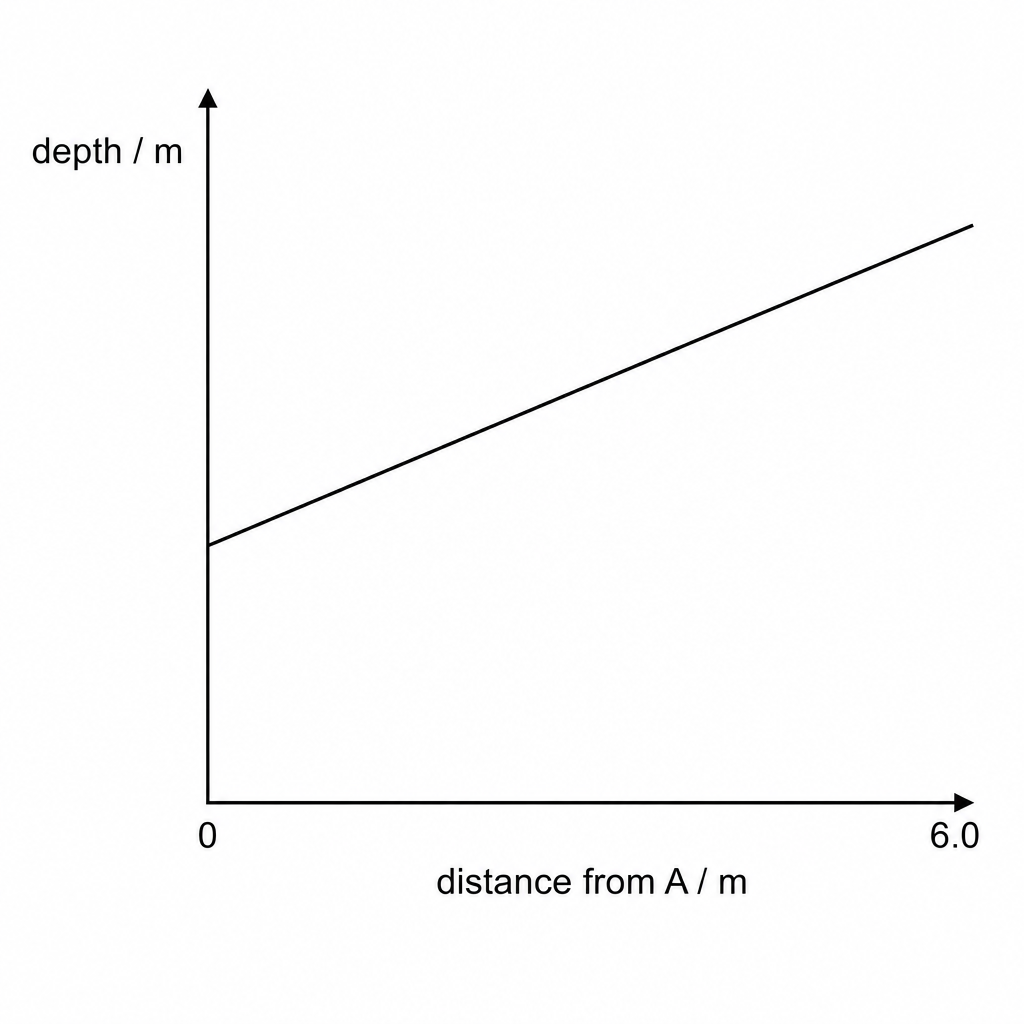
Since upthrust (and hence submerged depth ) increases with this force, increases linearly with distance from .
Sketch: a straight line with positive gradient (non-zero value at distance ).
Depth increases linearly with distance from A (straight line with positive gradient).
Background Concept
For the beam:
- Rotational equilibrium gives a moments equation relating the support force from the cylinder to the position of the person.
For the cylinder:
- Upthrust is proportional to displaced volume:
With , , and constant, we have:
So if the required upthrust increases, the depth must increase in direct proportion.
Understanding the Question
The person can stand anywhere between and (distance from between and ). You must sketch how the depth of the bottom of the cylinder varies with the person’s distance from .
No numerical scale is needed—only the correct shape/trend.
Approach
- Let the person’s distance from be .
- Use moments about to express the cylinder’s upward force on the beam, , in terms of .
- Relate to the cylinder’s upthrust (they differ only by the constant cylinder weight).
- Since , conclude the form of vs and sketch it.
Step-by-Step Reasoning
1) Beam equilibrium (moments about A)
Let the cylinder force on the beam be (upward) at .
Equilibrium about :
Rearrange:
This has the form:
So increases linearly with .
2) Cylinder equilibrium
For the cylinder:
Since is constant, also increases linearly with .
3) Link to depth
Because and is constant:
Therefore increases linearly with distance .
At , is still positive (it must support the beam’s own weight), so has a non-zero intercept.
Key Takeaways
- Person further from hinge larger clockwise moment.
- Support force must rise to balance moments.
- Floating cylinder: upthrust submerged depth, so depth rises in the same way.
- Linear moments equation straight-line sketch.
Common Mistakes
- Drawing a curve (e.g. quadratic) when the moments relationship is linear.
- Drawing the line through the origin; even with the person at , the cylinder still supports part of the beam’s weight, so depth is not zero.
- Sketching decreasing depth with distance (wrong direction of effect).
Things to Be Careful About
- The independent variable is the person’s distance from (0 to 6.0 m).
- You are sketching depth of the bottom of the cylinder below the water surface; greater upthrust means greater submerged length, hence greater depth.
A truck R of mass moves with constant acceleration in a straight line down a slope, as illustrated in Fig. 3.1.
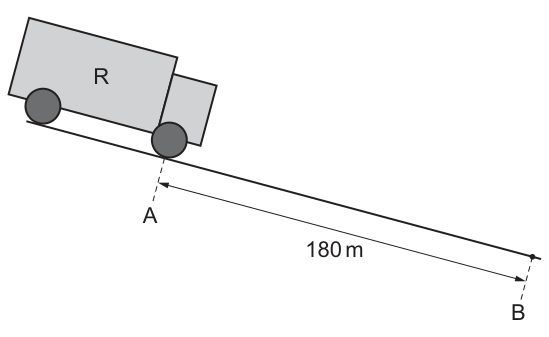
At point A the speed of the truck is and at point B the speed of the truck is . A and B are a distance of apart.
Working
For constant acceleration,
Answer
0.88 m s^-2
Background Concept
For motion in a straight line with constant acceleration, the kinematic (SUVAT) equations apply. One useful equation that links speeds and distance without time is
where:
- is the initial speed,
- is the final speed,
- is the (constant) acceleration,
- is the displacement along the line of motion.
This equation is valid only when acceleration is constant and motion is one-dimensional.
Understanding the Question
The truck moves down a slope in a straight line with constant acceleration. At point A: . At point B: . The distance along the slope between A and B is . We are asked to calculate the acceleration .
Approach
Use the SUVAT equation that contains , , , and but does not require time, then rearrange to make the subject.
Step-by-Step Reasoning
Start from
Rearrange:
Substitute values:
Compute:
So
Key Takeaways
- For constant acceleration, pick the SUVAT equation that uses the variables given.
- is ideal when time is not given.
Common Mistakes
- Using even though is not given.
- Forgetting the factor of in .
- Using with the wrong sign convention (here, taking motion down the slope as positive makes positive).
Things to Be Careful About
- Check the condition “constant acceleration” before using SUVAT.
- Quote acceleration with correct unit and sensible significant figures.
Determine the gain in kinetic energy of the truck between A and B.
gain in kinetic energy = ______
Working
Gain in kinetic energy
Answer
1.48 × 10^6 J
Background Concept
The kinetic energy of an object of mass moving at speed is
If its speed changes from to , the gain in kinetic energy is the difference:
Understanding the Question
The truck has mass . Its speed increases from at A to at B. We must find how much its kinetic energy increases between these points.
Approach
Compute kinetic energy at B and at A (or use the combined change formula), then subtract to get the gain.
Step-by-Step Reasoning
Use the change formula:
Substitute:
Calculate the bracket first:
Now multiply:
So the gain in kinetic energy is about (often rounded to depending on sig figs).
Key Takeaways
- Kinetic energy depends on , so a moderate speed increase can cause a large energy increase.
- Change in kinetic energy can be computed efficiently using .
Common Mistakes
- Using (this is incorrect).
- Forgetting to square the speeds.
- Writing the unit as instead of the accepted (joule).
Things to Be Careful About
- Keep the mass in and speeds in so the energy comes out in joules.
- Sensible rounding: the speeds are given to 2 s.f., so an energy to 2–3 s.f. is appropriate.
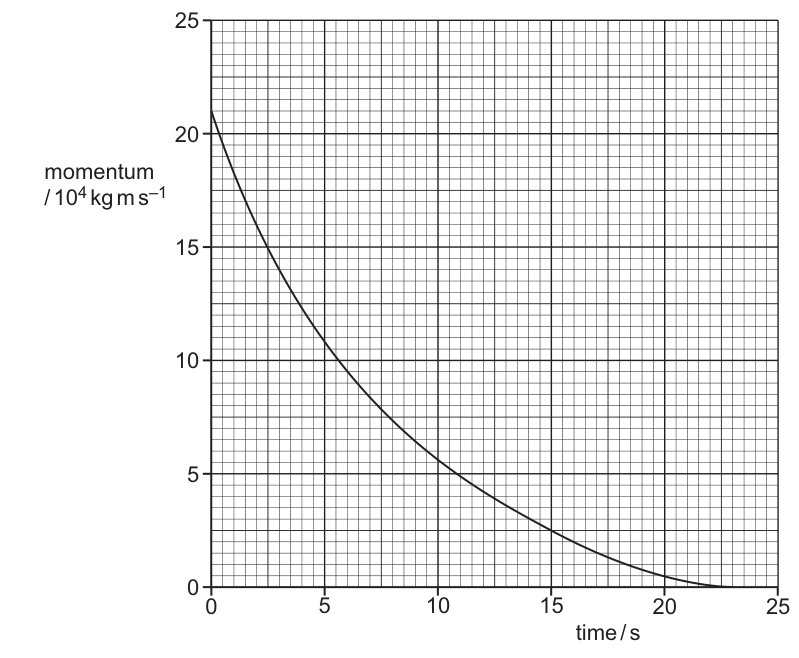
A short time after passing point B truck R moves in a straight line on horizontal ground. The driver of the truck applies the brakes. Fig. 3.2 shows the variation with time of the momentum of the truck.
Answer
Force is the rate of change of momentum:
Force is the rate of change of momentum, F = dp/dt.
Background Concept
Momentum is defined as
Newton’s second law can be written in a general form that applies even when the speed is changing:
For constant mass, this reduces to , but the momentum form is the definition examiners often want:
- Force tells you how quickly (and in what direction) momentum changes.
Understanding the Question
The question asks for a definition of force, and the context is a momentum–time graph. That strongly indicates the intended definition is in terms of momentum change per unit time.
Approach
State force as rate of change of momentum, either as a derivative or as an average change form.
Step-by-Step Reasoning
A definition must include both the quantity and the relationship:
or for instantaneous force:
Key Takeaways
- The most general statement of Newton’s second law is .
- On a momentum–time graph, force corresponds to the gradient.
Common Mistakes
- Defining force as “mass times acceleration” only; this may be accepted sometimes, but the momentum form is what matches the context.
- Saying “force is change of momentum” (missing “per unit time”).
Things to Be Careful About
- Include “rate of change” (i.e. divide by time) to make it a definition rather than a vague statement.
Working
Average force:
From the graph:
Answer
-1.2 × 10^4 N
Background Concept
Force is related to momentum by
On a graph of momentum against time :
- the gradient at a point gives the instantaneous force,
- the average gradient between two times gives the average force:
A negative value means the force acts opposite to the direction of the original momentum (a braking force).
Understanding the Question
You are given a momentum–time graph for truck R after braking begins. You must show that the average resultant force between and is . This means:
- read momentum at and ,
- calculate ,
- divide by .
Note: the -axis is labelled “momentum / ”, so a reading of 21 corresponds to .
Approach
Use average force formula with the two momentum values taken from the graph.
Step-by-Step Reasoning
Read off from the graph:
Compute the change:
Divide by the time interval :
The negative sign indicates the resultant force is opposite the truck’s initial direction of motion (as expected for braking).
Key Takeaways
- The force is the slope of the momentum–time graph.
- Average force over an interval is the change in momentum divided by the time taken.
Common Mistakes
- Forgetting the scale factor on the momentum axis.
- Using and then forgetting to include the negative sign.
- Dividing by (time to reach rest) instead of the required .
Things to Be Careful About
- Always include units: momentum in and force in .
- Keep sign conventions consistent: if initial momentum is positive, braking reduces it so is negative.
An identical truck S has the same initial momentum as truck R. Truck S experiences a constant force equal to the force in (b)(ii).
State and explain whether truck S will take more, less or the same amount of time to come to rest as truck R.
Working
For truck S, with constant force ,
Truck R comes to rest at about (from the graph).
Answer
Truck S takes less time to come to rest (about ).
The force on R decreases in magnitude with time (momentum–time graph becomes less steep), so its average force over the whole stop is smaller and it takes longer.
Less time (≈ 18 s); truck R’s braking force decreases so it stops later (≈ 25 s).
Background Concept
Using momentum form of Newton’s second law:
- If is constant, then is constant, so decreases linearly with time.
- The time to reduce momentum from to zero under a constant opposing force of magnitude is
For a variable force, the slope (gradient) of the – graph changes with time; a smaller magnitude slope means momentum is being removed more slowly.
Understanding the Question
Two trucks start with the same initial momentum.
- Truck R: braking force is not constant (shown by a curved – graph). It reaches at about .
- Truck S: experiences a constant braking force equal to the average force found for R between and , i.e. .
We must decide whether S takes more/less/same time to stop compared to R, and explain using momentum and force ideas.
Approach
- For truck S, use constant-force momentum relation to calculate stopping time.
- For truck R, use the graph to identify its stopping time (where momentum reaches zero).
- Explain the difference by discussing how the gradient (hence force) changes for truck R.
Step-by-Step Reasoning
1. Stopping time for truck S (constant force):
Initial momentum (from the same starting point as R) is
Constant braking force magnitude is . For constant ,
So truck S would stop in about .
2. Stopping time for truck R (from graph):
From the graph, momentum approaches zero at about . So truck R takes about to stop.
3. Comparison and explanation:
Truck S stops sooner () than truck R ().
The momentum–time curve for truck R is steep initially and becomes progressively less steep. Since the gradient is and equals force, this means the braking force on R is large at first but then decreases in magnitude. When the braking force becomes smaller, momentum is removed more slowly, increasing the total time to reach zero momentum.
In contrast, truck S maintains a constant force equal to throughout, so it continues removing momentum at a steady rate and comes to rest earlier.
Key Takeaways
- Constant force linear change of momentum with time.
- The gradient of a – graph gives force; a curve means force is changing.
- For a given initial momentum, a larger (or sustained) braking force gives a shorter stopping time.
Common Mistakes
- Saying “same time because same average force” without noticing that the given average force is only for the first .
- Confusing the momentum–time graph with a velocity–time graph.
- Ignoring the sign of the force and treating as if it were accelerating the truck forwards.
Things to Be Careful About
- Use the correct initial momentum value including the factor.
- When comparing times, read the stopping time for truck R at the point where .
- The key physics explanation must refer to gradient = force and the fact that the gradient decreases in magnitude for truck R (force becomes less effective with time).
A device containing a microwave emitter and receiver is placed in front of a large metal sheet in a vacuum as shown in Fig. 4.1.
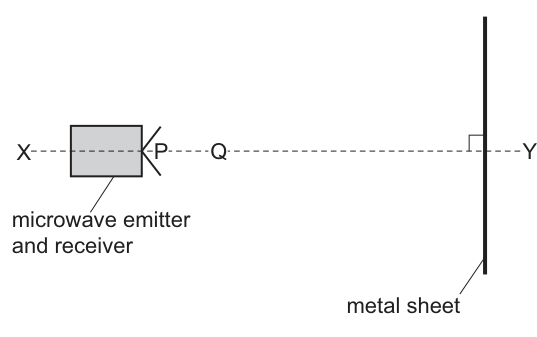
The line XY is perpendicular to the metal sheet. The device emits microwaves of frequency .
When the device is at position P, a stationary wave is formed between the device and the sheet.
Explain how the stationary wave, including the nodes and the antinodes, is formed.
Answer
- Microwaves from the emitter travel towards the metal sheet and are reflected.
- The reflected wave has the same frequency (and wavelength) and travels back along XY in the opposite direction.
- The incident and reflected waves superpose to give interference.
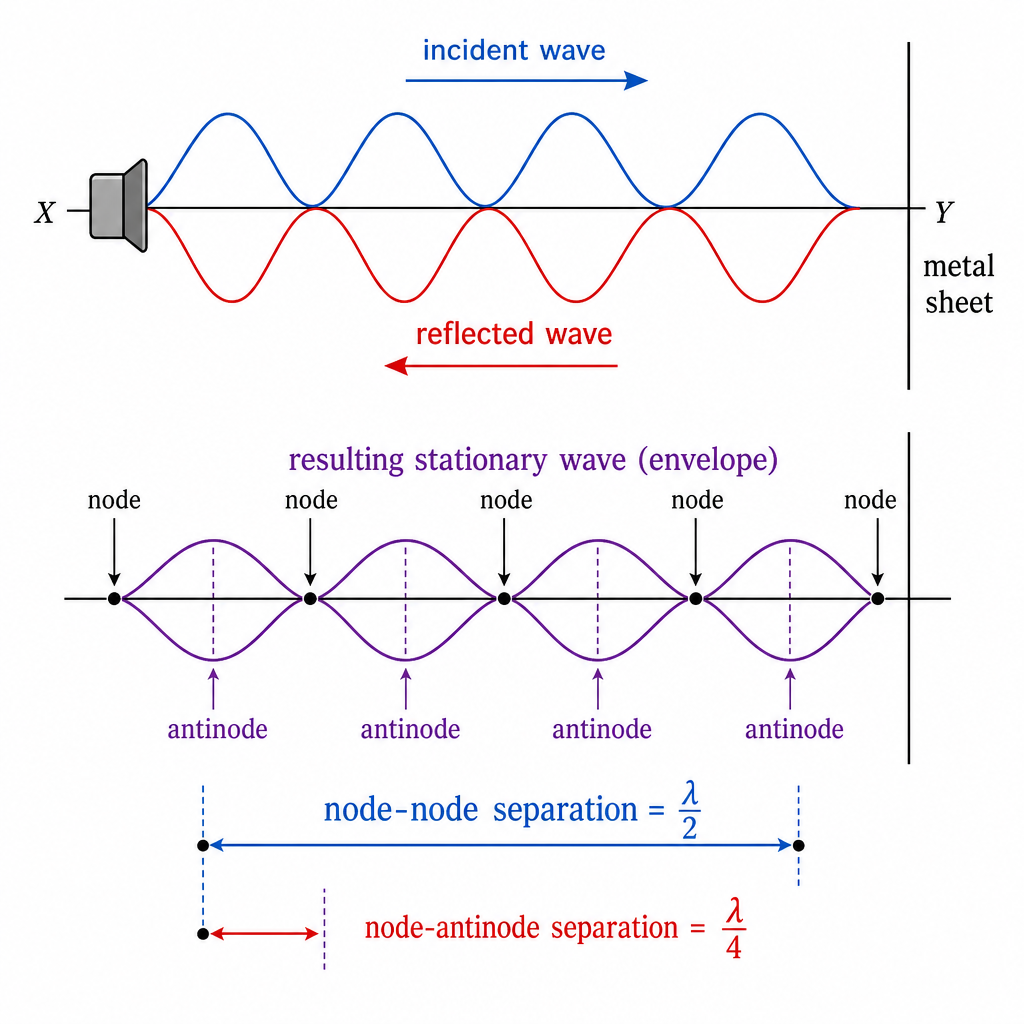
- Where the waves are always in antiphase, destructive interference gives a node (zero amplitude); where they are always in phase, constructive interference gives an antinode (maximum amplitude).
- Nodes and antinodes are fixed; adjacent nodes are separated by (node to nearest antinode is ).
A stationary wave forms by superposition of the incident and reflected microwaves, giving fixed nodes (zero amplitude, antiphase) and antinodes (maximum amplitude, in phase), spaced by (\lambda/2) between nodes.
Background Concept
A stationary (standing) wave is produced when two waves of the same frequency and wavelength travel in opposite directions along the same line and overlap.
The resultant displacement (or electric field for microwaves) at any point is found by the principle of superposition: the instantaneous displacements add.
- Node: a point where the resultant amplitude is always zero (complete destructive interference at all times).
- Antinode: a point where the resultant amplitude is maximum (complete constructive interference).
- Spacing: adjacent nodes are separated by , and a node to its nearest antinode is .
Understanding the Question
The device emits microwaves towards a large metal sheet in a vacuum. The sheet reflects the microwaves back along the same line XY. You are asked to explain how this reflection leads to a stationary wave pattern and what nodes and antinodes are.
Approach
- State that the metal sheet reflects the incident microwaves.
- Emphasise that the reflected wave travels back in the opposite direction with the same frequency.
- Use superposition to explain how interference produces fixed points of zero and maximum amplitude.
- Identify which phase relationships produce nodes and antinodes, and state the standard spacing.
Step-by-Step Reasoning
- The emitter produces a travelling wave that moves from the device towards the metal sheet.
- A metal sheet is a strong reflector for microwaves, so an additional travelling wave is produced that moves back from the sheet towards the device.
- Both waves have the same frequency (reflection does not change frequency) and therefore the same wavelength in the same medium (vacuum).
- Because they are travelling in opposite directions, at each position the two waves combine:
- If at a particular position the two waves are always equal and opposite (phase difference ), they cancel at all times. The resultant amplitude is zero: a node.
- If at a particular position the two waves are always in step (phase difference ), they reinforce. The resultant amplitude is maximum: an antinode.
- These positions do not move (they depend only on position along XY), so the pattern is “stationary”.
Key Takeaways
- Stationary waves come from two counter-propagating waves with the same and .
- Nodes are permanent zero-amplitude points (destructive interference); antinodes are permanent maximum-amplitude points (constructive interference).
- Key spacings: node-node , node-antinode .
Common Mistakes
- Saying a stationary wave is “one wave that stops moving” (it is a superposition of two travelling waves).
- Mixing up the spacing: writing node-node as .
- Forgetting to mention that reflection produces a wave travelling in the opposite direction.
Things to Be Careful About
- “Amplitude detected” corresponds to the wave’s field (or intensity) at the receiver position; nodes mean the detected amplitude is minimum (ideally zero).
- Frequency stays the same on reflection; the medium determines the wave speed and hence wavelength.
Working
In vacuum, .
Answer
4.8 × 10^-2 m
Background Concept
For any wave,
where is wave speed, is frequency, and is wavelength.
Microwaves are electromagnetic waves, and in a vacuum they travel at the speed of light:
Understanding the Question
You are given the microwave frequency and told the waves travel in a vacuum. You must find .
Approach
Convert to Hz, then rearrange to using .
Step-by-Step Reasoning
- Convert frequency:
- Rearrange and substitute:
- Evaluate:
Key Takeaways
- In vacuum, electromagnetic waves have .
- Always convert GHz to Hz before substituting.
Common Mistakes
- Using with instead of .
- Writing the wavelength in cm without converting to metres when the answer line requires metres.
Things to Be Careful About
- Powers of ten: dividing by gives a factor of , so the result must be much smaller than 1 m.
- Significant figures: frequency is given to 2 s.f., so should be quoted to 2 s.f.
At point P the receiver detects a maximum amplitude of the stationary wave.
The device is moved slowly from point P along the line XY and the receiver detects a series of minimum and maximum amplitudes. The first time a minimum amplitude is detected by the receiver is when the device is at point Q.
Determine the distance between P and Q.
distance = ______
Working
From a maximum (antinode) to the nearest minimum (node),
Answer
1.2 × 10^-2 m
Background Concept
In a stationary wave, nodes (minimum amplitude) and antinodes (maximum amplitude) occur at fixed positions.
Key spacing rules:
- node to adjacent node:
- node to adjacent antinode (or antinode to adjacent node):
Understanding the Question
At the receiver is at a maximum amplitude position (an antinode). As the device is moved, the first time it detects a minimum amplitude is at (a node). The question asks for the distance from an antinode to the nearest node.
Approach
Use the stationary-wave spacing: antinode to nearest node equals . Use the wavelength found in (i).
Step-by-Step Reasoning
- is an antinode, is the nearest node encountered.
- The nearest node is a quarter wavelength away:
- With :
Key Takeaways
- Moving from a maximum to the first minimum in a standing wave corresponds to .
Common Mistakes
- Using instead of .
- Measuring between successive maxima (which would be ) instead of maximum to minimum.
Things to Be Careful About
- “First minimum” means the nearest node, not the next one further away.
- Keep your answer in metres, matching the answer line.
The intensity of the microwaves emitted by the device is increased. The frequency of the microwaves is unchanged. The device is moved slowly along the line XY from point Q until the next maximum amplitude is detected at point R.
State and explain whether the distance QR is greater than, less than or the same as distance PQ.
Answer
is the same as .
Increasing intensity increases amplitude but does not change frequency, so is unchanged. The separation of a node and adjacent antinode remains , so .
Same as PQ
Background Concept
For waves in a fixed medium (vacuum here), the wavelength is set by
If is unchanged and is unchanged, then is unchanged.
Intensity is related to amplitude (for electromagnetic waves, intensity ). Changing intensity changes amplitude, not the spacing of nodes/antinodes.
Understanding the Question
At the receiver detects a minimum (a node). The device is then moved until the next maximum is detected at (an antinode). You are asked how compares with after the emitted intensity is increased but frequency stays the same.
Approach
Recognise that node/antinode positions depend on wavelength only. Since frequency is unchanged in vacuum, wavelength is unchanged. Therefore the node-to-adjacent-antinode distance stays , so equals .
Step-by-Step Reasoning
- At the receiver is at a node (minimum amplitude).
- The next maximum occurs at the adjacent antinode, a distance away.
- Increasing the emitted intensity increases the amplitude of both incident and reflected waves, so the maxima become larger and minima remain minima, but the positions of nodes/antinodes do not shift.
- Because is unchanged and the waves travel in vacuum ( constant),
is unchanged.
- Therefore,
Key Takeaways
- Changing intensity changes amplitude, not wavelength.
- Node/antinode spacing in a stationary wave depends on only.
Common Mistakes
- Saying is larger because the wave is “stronger” (strength affects amplitude, not spacing).
- Confusing intensity with frequency.
Things to Be Careful About
- The question explicitly says frequency is unchanged; that is the key clue that spacing is unchanged.
- “Next maximum” from a node means the adjacent antinode, not skipping one (which would add another ).
A stationary loudspeaker emits sound of constant frequency. A microphone is placed near to the loudspeaker and connected to a cathode-ray oscilloscope (CRO). The trace on the screen of the CRO is shown in Fig. 5.1.
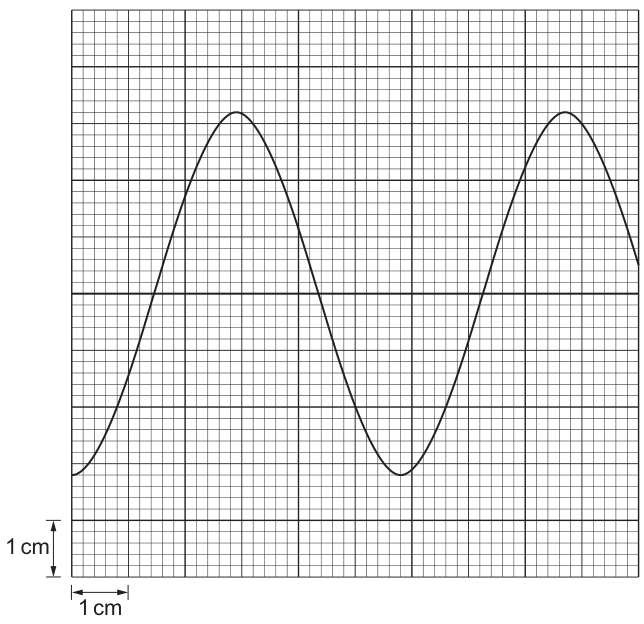
The time-base of the CRO is set to .
The speed of the sound emitted by the loudspeaker is .
Determine the wavelength of the sound.
wavelength = ______
Working
From the CRO trace, one period occupies .
Time-base , so
Using :
Answer
0.66 m
Background Concept
For a progressive wave,
where:
- is wave speed (),
- is frequency (),
- is wavelength ().
Since frequency is the reciprocal of period,
we can also write
A CRO time-base tells you how much time corresponds to horizontally, so the horizontal length of one cycle gives the period .
Understanding the Question
You are given:
- speed of sound ,
- CRO time-base ,
- the trace shows one complete cycle spanning major divisions, and each major division is .
You must find the wavelength of the sound.
Approach
- Read the horizontal distance for one full cycle from the CRO trace (in cm).
- Convert this to a time using the time-base to get the period .
- Use to calculate wavelength.
Step-by-Step Reasoning
- Period from the trace: one full cycle (e.g. crest to next crest) spans .
- Convert cm to seconds:
- Calculate wavelength:
Key Takeaways
- CRO time-base converts horizontal distance () into time ().
- The wave relations and combine to give .
Common Mistakes
- Using peak-to-peak vertical height to find period (period is horizontal).
- Forgetting the time-base is per cm and not per division (here they are the same because division ).
- Using but calculating incorrectly (e.g. using instead of ).
Things to Be Careful About
- Make sure you measure one complete cycle (same point on the wave to the next identical point).
- Keep track of powers of ten: multiplied by gives .
- Give wavelength in metres and to appropriate significant figures (here s.f. matches the data).
The loudspeaker now moves in a straight line while emitting the same sound of constant frequency. The period of the trace on the CRO increases continuously.
Describe the motion of the loudspeaker.
Answer
Since increases, the observed frequency decreases ().
For a moving source, a decrease in observed frequency means the loudspeaker is moving away from the microphone.
Because the period increases continuously, the loudspeaker’s speed away from the microphone is increasing (it is accelerating away).
It moves away from the microphone with increasing speed (accelerating away).
Background Concept
The Doppler effect is the change in observed frequency due to relative motion between a source and an observer.
For a moving source and a stationary observer in still air:
- If the source moves towards the observer, wavefronts are compressed in front: smaller , so larger observed frequency .
- If the source moves away, wavefronts are spread out behind: larger , so smaller observed frequency .
The CRO displays the microphone signal versus time, so the horizontal period is linked to observed frequency by
So an increasing period means the observed frequency is decreasing.
Understanding the Question
Initially the loudspeaker is stationary and emits constant frequency. Then it moves in a straight line while emitting the same sound frequency at the source.
The key observation is: the period shown on the CRO increases continuously.
- The CRO is connected to the microphone, so it shows the frequency arriving at the microphone.
- Therefore, the frequency arriving at the microphone is continuously decreasing.
The question asks you to describe the loudspeaker’s motion (direction and whether speed is changing).
Approach
- Convert “period increases” into “observed frequency decreases” using .
- Use Doppler-effect direction rule: decreasing observed frequency means the source is moving away.
- “Continuously increases” indicates the Doppler shift is getting larger with time, so the speed of recession is increasing (acceleration away).
Step-by-Step Reasoning
- From CRO period to frequency:
If increases, then
decreases.
-
Relate frequency change to motion direction (Doppler):
For sound, a moving source that is receding from the observer produces a lower observed frequency. Therefore the loudspeaker must be moving away from the microphone. -
Use “increases continuously” to infer acceleration:
If the loudspeaker moved away at constant speed, the observed frequency would be constant (so the CRO period would be constant).Because the period keeps increasing, the observed frequency keeps decreasing more and more, which implies the speed away from the microphone is increasing: the loudspeaker is accelerating away.
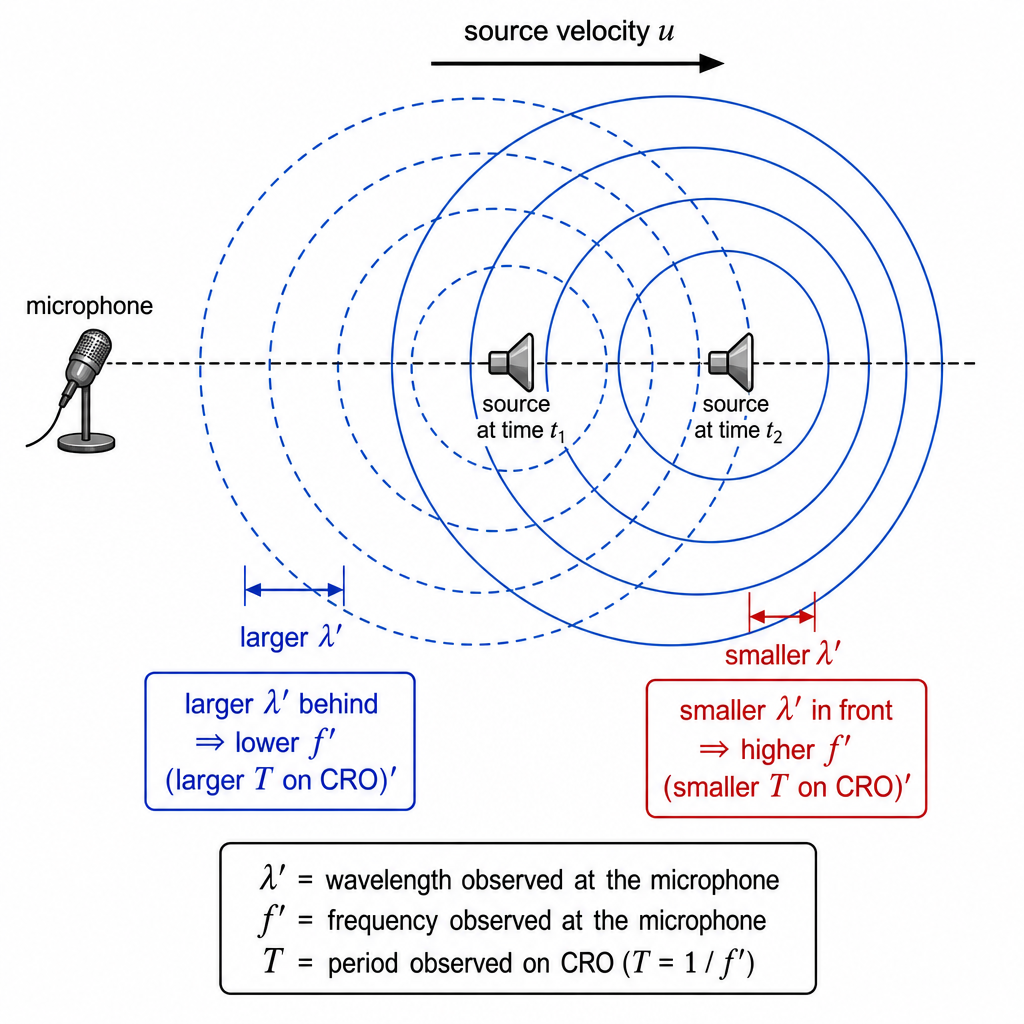
Key Takeaways
- CRO period is the reciprocal of observed frequency .
- For a moving source: moving away (\Rightarrow) lower observed frequency (larger period).
- A continuously changing period indicates changing speed (acceleration).
Common Mistakes
- Saying the loudspeaker is moving towards the microphone (that would make decrease).
- Confusing “source frequency constant” with “observed frequency constant” (Doppler effect changes the observed frequency).
- Not commenting on acceleration: “period increases continuously” implies the speed is not constant.
Things to Be Careful About
- The loudspeaker emits constant frequency in its own rest frame; the microphone measures the frequency it receives.
- “Straight line” does not automatically mean towards/away; you must infer direction from whether increases or decreases.
- “Continuously” is the clue that the speed is changing rather than constant.
A cylindrical copper wire P of length is shown in Fig. 6.1.
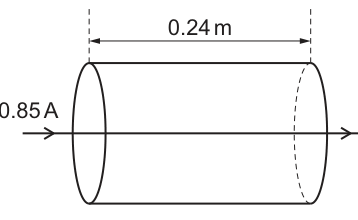
The current in the wire is .
The resistance of the wire is .
The total number of charge carriers in the wire is .
The resistivity of copper is .
Calculate the potential difference between the two ends of the wire.
potential difference = ______
Working
Answer
2.8 × 10⁻³ V
Background Concept
For a conductor at constant temperature, the potential difference across it is related to the current through it by Ohm’s law:
where is the resistance in ohms ($\Omega$). A common pitfall is unit conversion: milliohms (m$\Omega$) must be converted to ohms.
Understanding the Question
You are given the current in wire P () and its resistance (). The task is to find the potential difference between the ends of the wire.
Approach
- Convert from m$\Omega to \\Omega$.
- Substitute into .
Step-by-Step Reasoning
Convert resistance:
Apply Ohm’s law:
Round appropriately:
Key Takeaways
- Use for a simple potential difference calculation.
- Always convert prefixes correctly (m$\Omega\rightarrow\Omega means \\times 10^{-3}$).
Common Mistakes
- Using instead of (gives an answer 1000 times too large).
- Missing the unit of volts in the final answer.
Things to Be Careful About
- Significant figures: inputs are typically 2 s.f., so quote to 2 s.f.
- Keep powers of ten explicit to avoid calculator entry errors.
Working
Answer
1.3 × 10⁻⁶ m²
Background Concept
The resistance of a uniform cylindrical wire is related to its resistivity by
where:
- is resistance ($\Omega$),
- is resistivity ($\Omega,\text{m}$), a material property,
- is length (m),
- is cross-sectional area (m).
Understanding the Question
You are given , , and for wire P and asked to show that its cross-sectional area is .
Approach
Rearrange to make the subject, then substitute the given values (converting from m$\Omega to \\Omega$).
Step-by-Step Reasoning
Rearrange:
Substitute:
Compute:
Powers of ten:
So:
Hence .
Key Takeaways
- Know and use .
- Converting m$\Omega to \\Omega$ is essential.
Common Mistakes
- Forgetting to convert to .
- Rearranging incorrectly (e.g. ).
Things to Be Careful About
- Units: using in $\Omega,\text{m}LA^2$.
- Significant figures: final shown value matches the stated target (2 s.f.).
Working
Answer
8.3 × 10²⁸ m⁻³
Background Concept
Number density is the number of particles per unit volume:
For a uniform wire, the volume is
where is cross-sectional area and is length.
Understanding the Question
You are told the total number of charge carriers in the wire is . Using the wire’s volume (found from and ), you must show that the number density is .
Approach
- Find the wire’s volume .
- Use .
Step-by-Step Reasoning
Using and :
Then
So .
Key Takeaways
- Number density is always “total number divided by volume”.
- Keep track of standard form carefully when dividing.
Common Mistakes
- Using or other incorrect combinations.
- Forgetting that volume is in .
Things to Be Careful About
- Use consistent SI units: in and in m.
- When dividing by , the power of ten increases by 7.
Calculate the average drift speed of the charge carriers (electrons) in the wire.
average drift speed = ______
Working
Answer
4.9 × 10⁻⁵ m s⁻¹
Background Concept
In a metal wire, the current is due to charge carriers (electrons) drifting through the conductor. The current is related to drift speed by
where:
- is current (A),
- is number density of charge carriers (m),
- is cross-sectional area (m),
- is the magnitude of charge of one carrier ( for an electron),
- is average drift speed (m s).
Understanding the Question
You have already found (or been asked to show) that and . With , you must calculate the drift speed .
Approach
Rearrange to make the subject, then substitute , , , and .
Step-by-Step Reasoning
Rearrange:
Substitute:
Work through the denominator in parts:
- Numerical part: .
- Powers of ten: .
So
Hence
This small value is expected: drift speeds in metals are typically very slow.
Key Takeaways
- Use for drift speed problems.
- Drift speed is usually tiny compared with random thermal speeds.
Common Mistakes
- Using and carrying a negative sign into the speed (speed should be positive; direction is handled separately).
- Mixing up (number density) with (total number).
Things to Be Careful About
- Ensure is in and in so the units give .
- Power-of-ten errors are common: combine indices systematically.
A different copper wire Q has the same volume as wire P, but non-uniform radius, as shown in Fig. 6.2.
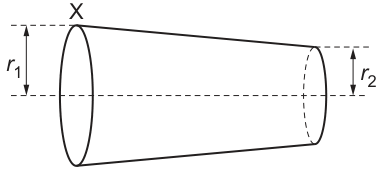
The radius at end X of wire Q is the same as the radius of wire P. Radius is less than .
Answer
Wire Q has a greater resistance than wire P.
Treat Q as many short lengths in series:
Towards the end where radius is smaller, is smaller so is larger. Although Q has the same total volume as P, the thin sections contribute a large resistance and this outweighs the reduced resistance of thicker sections, so overall .
Resistance of Q is greater than resistance of P.
Background Concept
For a uniform wire,
If the cross-sectional area is not uniform, you cannot use one single . Instead, split the wire into many tiny lengths . Each tiny piece has resistance
and the total is the sum (integral) of all pieces:
This shows directly that smaller area causes larger resistance per unit length.
Understanding the Question
Wire Q is copper (same ), has the same total volume as wire P, but its radius decreases from at end X to a smaller at the other end. You must compare its total resistance with that of uniform wire P.
Approach
- Think of the wire as a series combination of short sections.
- Compare how resistance depends on area: .
- Use the fact that Q has sections with area smaller than the uniform area of P (at least near the thin end), which increases significantly.
Step-by-Step Reasoning
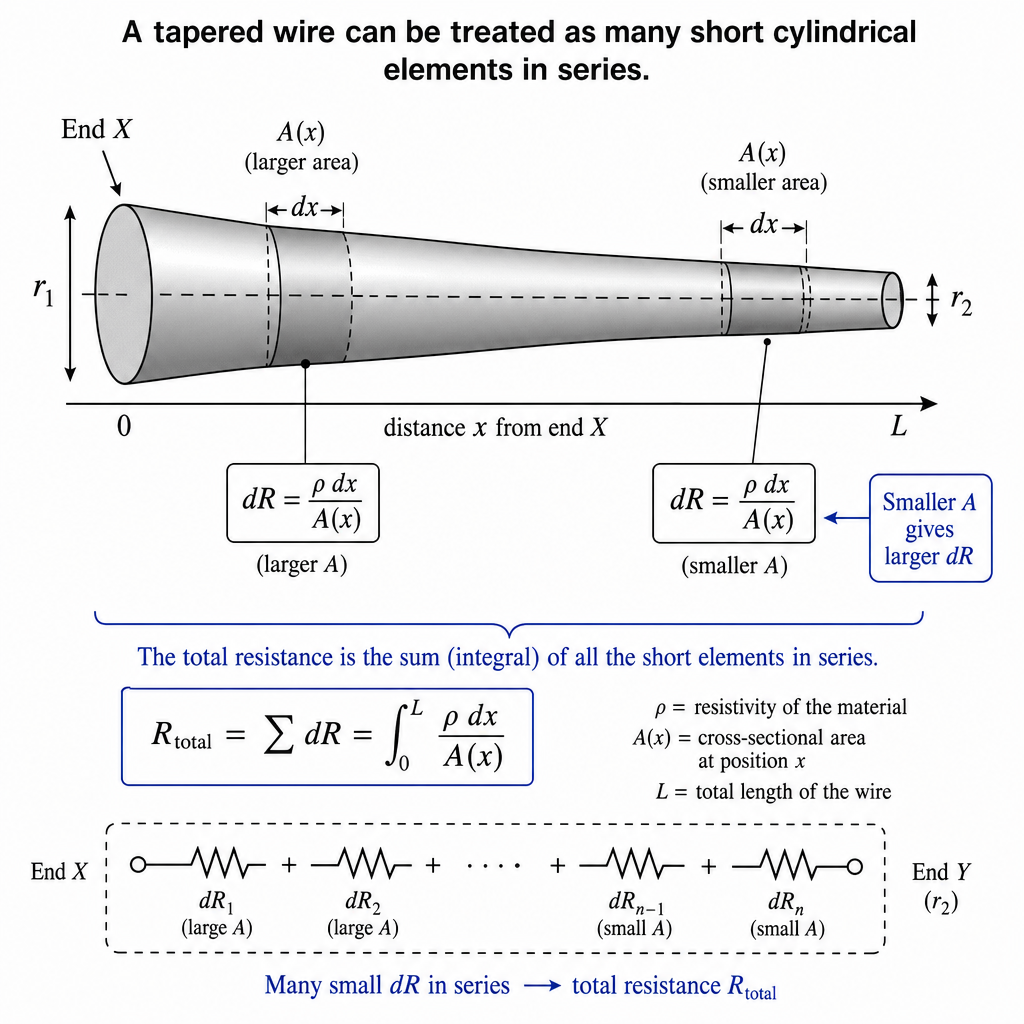
- Consider a short element of wire at position of length . Its resistance is
-
For wire P, is constant, so every equal length contributes the same resistance per unit length.
-
For wire Q, decreases towards the thin end, so for those regions is smaller and therefore is larger.
-
The wire has the same total volume as P, so if some parts are thinner (smaller ), other parts must be thicker to keep the total volume the same. However, because resistance depends on , the increase in resistance from a small-area section is larger than the decrease in resistance from an equally long large-area section.
-
Therefore the total resistance is greater for Q:
Key Takeaways
- A non-uniform conductor must be treated as series elements: .
- Thin regions dominate the resistance because of the dependence.
Common Mistakes
- Saying “same volume so same resistance”: resistance depends on how the area is distributed along the length, not just the total volume.
- Using with a single “average area” without justification.
Things to Be Careful About
- The current through a wire in steady state is the same through every cross-section, but resistance depends on geometry and material.
- If you mention an integral, you do not need to evaluate it; the key is the dependence on and the qualitative comparison.
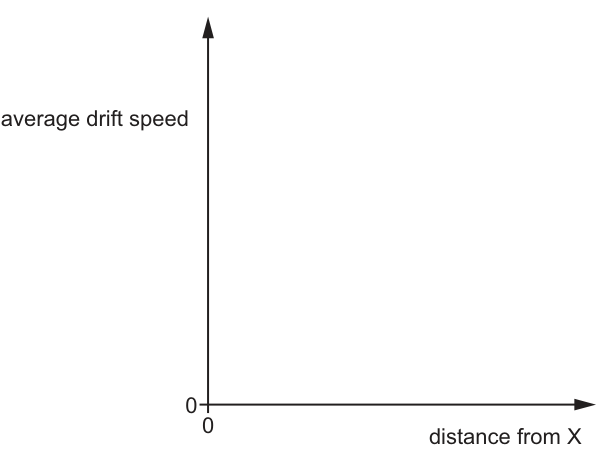
On Fig. 6.3, sketch a graph of the variation of the average drift speed of the charge carriers with distance from end X of wire Q.
Answer
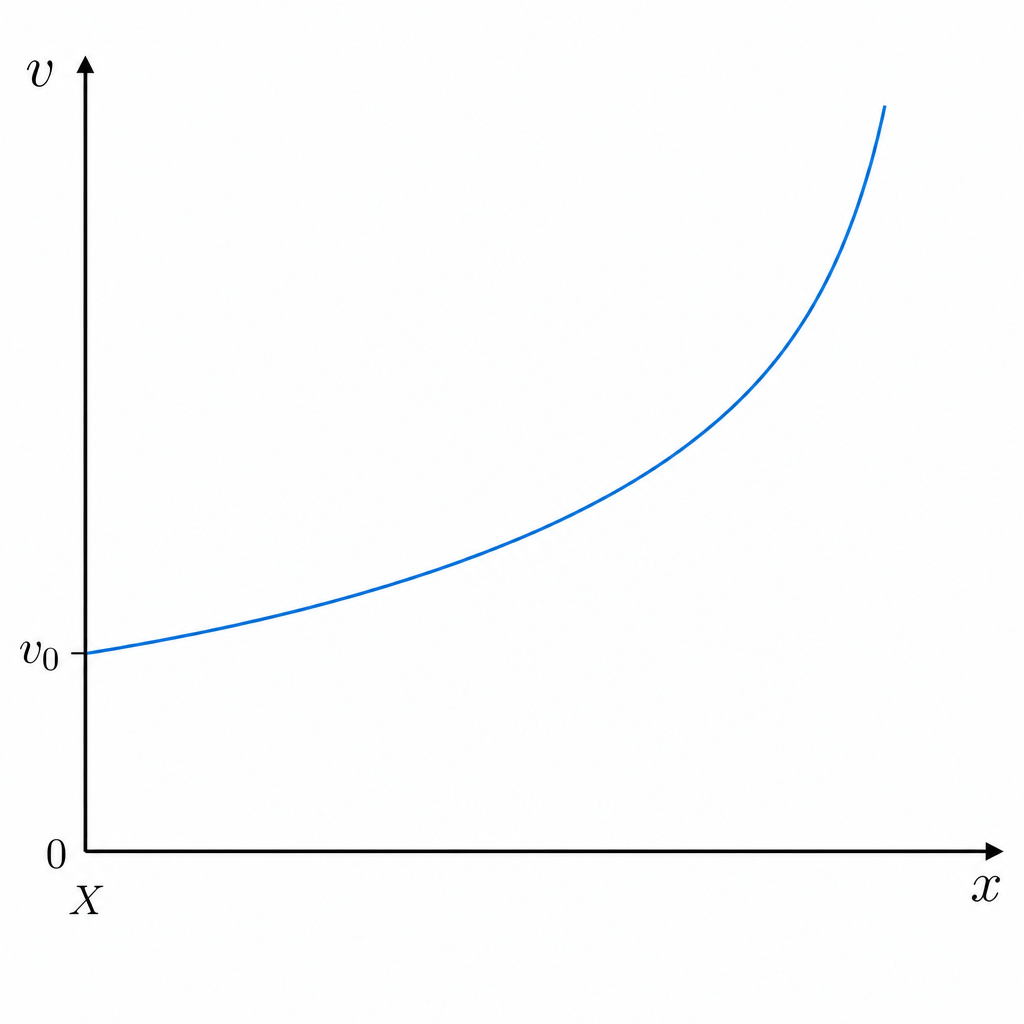
The drift speed increases with distance from X (smallest at X, largest at the thinner end), with the curve rising more steeply towards the end where the radius is smallest.
Drift speed increases from X towards the thinner end (upward-curving).
Background Concept
The drift speed of charge carriers in a wire is related to current by
For a given wire material, and are constant. In steady state, the same current flows through every cross-section. Therefore
So whenever the cross-sectional area decreases, the drift speed must increase to maintain the same current.
Understanding the Question
Wire Q is tapered: at end X the radius is (same as wire P), and further along the wire the radius decreases to . The question asks for a sketch of how average drift speed changes with distance from X.
Approach
- Use .
- Recognise decreases as you move away from X.
- Therefore must increase. Because area depends on , a steady decrease in radius generally makes increase more rapidly as the wire gets thinner, giving an upward-curving increase.
Step-by-Step Reasoning
- Current is constant along the wire: is the same through every cross-section.
- Since and are constant, from :
- At (end X), is largest, so is smallest.
- Moving away from X, decreases, so decreases, so increases.
- The sketch should therefore start at some positive drift speed at X and rise as increases. A reasonable sketch shows the slope increasing as the wire becomes thinner (upward curvature).
Key Takeaways
- With constant current, drift speed is inversely proportional to cross-sectional area.
- Tapered (narrowing) wires force carriers to drift faster in the narrower region.
Common Mistakes
- Drawing drift speed decreasing (it would only decrease if area increased).
- Starting the graph at zero drift speed at X: current is non-zero so drift speed is non-zero.
- Drawing a constant drift speed despite changing radius.
Things to Be Careful About
- The question asks for a sketch: the key marking points are correct start (non-zero), correct trend (increasing), and sensible curvature (increasing more rapidly as area gets smaller).
- Do not confuse drift speed with electron random thermal speed (which is much larger and not what changes here).
An isolated stationary nucleus Q decays into nucleus R and an -particle. The -particle has speed .
Answer
{}{88}^{226}Q \rightarrow {}{86}^{222}R + {}_{2}^{4}\alpha
Background Concept
In any nuclear decay equation, two key quantities must be conserved:
- Nucleon number (mass number) : total number of protons + neutrons.
- Proton number (atomic number) : total number of protons (this is also the nuclear charge in units of ).
In alpha decay, an -particle is a helium nucleus:
So when a nucleus emits an -particle, the parent nucleus loses nucleons and protons.
Understanding the Question
You are given the decay:
You must fill in the missing mass number of and the missing proton number of .
Approach
Use conservation on each side of the equation:
- Conserve mass number to find for .
- Conserve atomic number to find for .
Step-by-Step Reasoning
Mass numbers:
So must be .
Atomic numbers:
So must be .
Hence:
Key Takeaways
- Balance nuclear equations by conserving mass number and atomic number.
- In alpha decay: decreases by and decreases by for the daughter nucleus.
Common Mistakes
- Subtracting from the atomic number (it should be ).
- Mixing up which nucleus is the parent and which is the daughter.
- Forgetting that and must balance separately.
Things to Be Careful About
- Always check both conservation laws: and .
- Write nuclide notation in the correct form .
By considering momentum, calculate the speed of nucleus R after the decay.
speed = ______
Working
Initially nucleus is stationary, so total momentum is zero.
Using :
Answer
2.7 \times 10^5 m s^-1
Background Concept
Momentum is defined as
It is a vector quantity (it has direction). If a system is isolated (no external forces), then total momentum is conserved.
For a decay where the initial nucleus is at rest, the initial total momentum is zero. After decay into two particles, their momenta must be equal in magnitude and opposite in direction so that the vector sum remains zero.
For nuclear particles, a good approximation at this level is that nuclear mass is proportional to mass number :
where is the atomic mass unit. In ratios (like ), the factor cancels.
Understanding the Question
- A stationary nucleus decays into a nucleus and an -particle.
- The -particle speed is .
- You must calculate the speed of nucleus .
From part (a), has mass number , and the has mass number .
Approach
- Use conservation of momentum: initial momentum , so final momenta must balance.
- Write (magnitudes).
- Replace masses by mass numbers: .
- Solve for .
Step-by-Step Reasoning
Initial total momentum:
Final total momentum (taking the direction of the as positive):
So (in magnitudes):
Now use :
Hence
Calculate:
So
(And it moves in the opposite direction to the -particle, though only the speed was asked.)
Key Takeaways
- For an isolated decay from rest into two products, the two products have equal and opposite momentum.
- Using mass numbers as proportional to masses makes the calculation quick: .
Common Mistakes
- Setting but then forgetting the sign indicates opposite directions.
- Using (the parent mass number) instead of for .
- Treating momentum as a scalar and not recognising the recoil is opposite to the emitted .
Things to Be Careful About
- The system must be isolated for momentum conservation (the question states this).
- Keep units as throughout.
- Quote the final speed to an appropriate number of significant figures (here s.f. is reasonable).
State three quantities that are conserved during the decay.
1 ________________________________________________
2 ________________________________________________
3 ________________________________________________
Answer
-
Nucleon number (mass number)
-
Proton number / charge
-
Momentum
Nucleon number; charge (proton number); momentum
Background Concept
In nuclear and particle processes, several quantities are conserved. At AS level, the most commonly examined are:
- Nucleon number (mass number ) in nuclear reactions/decays.
- Charge (equivalently proton number for nuclei).
- Momentum (vector) for an isolated system.
- Energy (including rest mass energy) for an isolated system.
Different syllabuses/emphases may list slightly different sets, but for alpha decay, these are the standard conservation statements used to balance equations and describe recoil.
Understanding the Question
You are asked to state three quantities that are conserved during the decay of a stationary nucleus into a daughter nucleus and an -particle.
The question is not asking for calculations, just correct physics statements.
Approach
Pick three distinct conservation laws that always apply to this decay and that are commonly credited:
- nucleon number,
- charge (proton number),
- momentum.
(Energy is also conserved, but only three are needed.)
Step-by-Step Reasoning
- In alpha decay, the nucleus emits . To allow the decay equation to balance, the total mass number before equals the total mass number after. So nucleon number is conserved.
- The total charge before must equal total charge after. For nuclei, this is equivalent to conserving proton number. So charge/proton number is conserved.
- The system is isolated and initially at rest, so total momentum is initially zero and must remain zero: the products recoil with equal and opposite momentum. So momentum is conserved.
Key Takeaways
- Use nucleon number and proton number conservation to write correct decay equations.
- Use momentum conservation to explain recoil in decays.
Common Mistakes
- Stating “mass is conserved” (rest mass is not conserved; mass can convert to kinetic energy).
- Giving the same idea twice (e.g. listing “proton number” and “charge” as two separate quantities).
- Stating “velocity is conserved” (it is not).
Things to Be Careful About
- If you choose “energy”, it should be clearly stated as total energy (including rest energy), not just “kinetic energy”.
- Ensure the three quantities you list are genuinely distinct and are conservation laws that apply to nuclear decay.