Physics 9702/12 — February/March 2025
Cambridge AS Level · Multiple Choice (AS Level) · answer key with instant marking and worked solutions
Topics Physical Quantities and Units · Dynamics · Waves · Electricity · Kinematics · Forces, Density and Pressure · +5 more
Tap an option under each question to check it — your score builds as you go.
Which quantity is a scalar quantity?
Options
A force
B momentum
C velocity
D work
Working
Force, momentum and velocity have direction so they are vectors.
Work has no direction (it is energy transferred), so it is a scalar.
Answer
D
D
Background Concept
A scalar quantity has magnitude only (no direction). Examples include mass, time, energy and work.
A vector quantity has magnitude and direction, and must be added using vector rules. Examples include displacement, velocity, acceleration, force and momentum.
Understanding the Question
You are given four quantities (force, momentum, velocity, work) and asked which one is a scalar.
Approach
Identify which of the listed quantities requires a direction to be fully specified (vector) and which does not (scalar).
Step-by-Step Reasoning
- Force: described by both size and direction (e.g. 5 N to the right) (\Rightarrow) vector.
- Momentum: (\vec{p} = m\vec{v}), so it has the same direction as velocity (\Rightarrow) vector.
- Velocity: rate of change of displacement, so it includes direction of motion (\Rightarrow) vector.
- Work: defined by
Work is the dot product of two vectors, which produces a scalar result (energy transferred). It can be positive or negative depending on (\theta), but it still has no direction.
Therefore the scalar quantity is work.
Key Takeaways
- Scalars: magnitude only.
- Vectors: magnitude + direction.
- Dot products of vectors (e.g. work) produce scalars.
Common Mistakes
- Thinking “negative work” implies a direction; it does not—negative is a sign indicating energy transfer opposite to the displacement direction, not a vector direction.
- Confusing speed (scalar) with velocity (vector).
Things to Be Careful About
- Any quantity written with an arrow (e.g. (\vec{F}, \vec{v}, \vec{p})) is a vector.
- Work and energy share the unit joule (J) and are both scalars.
What is the effect of a systematic error on the measurement of a physical quantity?
Options
A It limits the precision of the measured value.
B It limits the range of values obtained in repeated measurements.
C It results in repeated measurements having different values from each other.
D It results in the measured value being different from the correct value.
Working
A systematic error shifts all measurements in the same direction, so the measured value is biased away from the correct (true) value.
Answer
D
D
Background Concept
Measurement errors are commonly grouped into:
- Systematic errors: a consistent bias that makes readings too large or too small each time (e.g. zero error, miscalibration). These affect accuracy (closeness to the true value).
- Random errors: unpredictable fluctuations between repeats (e.g. reaction time, small reading variations). These affect precision (spread of repeated readings).
Understanding the Question
You are asked for the effect of a systematic error on the measurement of a physical quantity. The options mention precision, range/spread, different repeated values, and being different from the correct value.
Approach
Recall what systematic error does to a set of measurements:
- It does not mainly increase scatter between repeats.
- It produces a consistent offset from the true value.
So choose the option describing a measured value being different from the correct value.
Step-by-Step Reasoning
- With a systematic error (e.g. a ruler with a +2 mm zero error), every length measured will be too large by about 2 mm.
- Repeated measurements can still be tightly clustered (good precision), but the whole cluster is shifted away from the true value (poor accuracy).
- Therefore the key effect is: the measured value is different from the correct value.
So the correct option is D.
Key Takeaways
- Systematic error → affects accuracy (bias from true value).
- Random error → affects precision (scatter between repeats).
Common Mistakes
- Choosing options about “different values from each other” (that describes random error).
- Thinking systematic error “limits precision” (precision is about spread, not bias).
Things to Be Careful About
- In MCQs, phrases like “different from each other” and “range of values” usually indicate random error.
- “Different from the correct/true value” is the hallmark of a systematic error.
A car is accelerated by a constant resultant force of for .
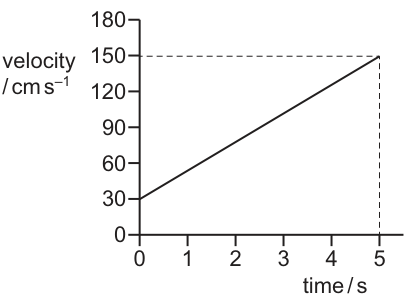
The variation with time of the velocity, in , of the car is shown.
What is the mass of the car?
Options
A
B
C
D
Working
Gradient of - graph:
Using :
Answer
C
C
Background Concept
A constant resultant force produces a constant acceleration (Newton's second law):
where is the resultant (net) force, is the mass, and is the acceleration.
From kinematics, the acceleration is the rate of change of velocity. On a velocity–time graph, this is the gradient:
Understanding the Question
The car experiences a constant resultant force of for . The velocity–time graph (velocity in ) shows the velocity increases linearly from at to at .
We need the car's mass, so we must find the acceleration from the graph and then use .
Approach
- Read the initial and final velocities from the graph and calculate the gradient .
- Convert the acceleration into SI units () because the force is in newtons.
- Apply and match to the nearest option.
Step-by-Step Reasoning
From the graph:
- Initial velocity:
- Final velocity after :
So the change in velocity is:
Acceleration is the gradient:
Convert to SI units:
Now use Newton's second law:
Rounded to the given options, , which corresponds to option C.
Key Takeaways
- The gradient of a velocity–time graph gives acceleration.
- Always convert to SI units before using with in newtons.
- With MCQs, compute the value then choose the closest option consistent with sensible rounding.
Common Mistakes
- Using directly instead of the change in velocity .
- Forgetting the unit conversion from to , giving a mass times too small/large.
- Taking the time as something other than (e.g. misreading the axis scale).
Things to Be Careful About
- The graph does not start at zero velocity; you must use , not just .
- Conversion: , so accelerations in must be multiplied by .
- Quote the final mass to a sensible number of significant figures consistent with the options (here, ).
An aircraft, initially stationary on a runway, takes off with a speed of in a distance of no more than .
What is the minimum constant acceleration necessary for the aircraft?
Options
A
B
C
D
Working
Convert to SI:
Using with :
Answer
A
A
Background Concept
For motion with constant acceleration in a straight line, the SUVAT equations apply. One useful equation that links speed and distance without needing time is
where:
- is initial speed,
- is final speed,
- is constant acceleration,
- is displacement.
All quantities must be in SI units (, ) so that comes out in .
Understanding the Question
The aircraft:
- starts from rest, so ,
- must reach take-off speed ,
- has at most runway distance.
“Minimum constant acceleration” means: to achieve the required final speed in the largest allowed distance (because for fixed , larger gives smaller required ).
Approach
- Convert and into SI units.
- Use with .
- Rearrange to and calculate.
- Match the result to the nearest option.
Step-by-Step Reasoning
Convert the speed:
Convert the distance:
Now apply the SUVAT equation:
With :
Substitute:
Rounding to 2 s.f. gives , which corresponds to option A.
Key Takeaways
- Use SUVAT equations only when acceleration is constant.
- Convert all values to SI units before substituting.
- For a required final speed, increasing the available distance reduces the required acceleration.
Common Mistakes
- Forgetting to convert to (this gives an answer too large by a factor of about ).
- Using (needs time, which is not given).
- Using (only valid for constant speed, not accelerating motion).
Things to Be Careful About
- The distance is “no more than” : the minimum acceleration corresponds to using exactly.
- Ensure is used in the denominator in .
- Quote acceleration in and match to the given options.
An object is fired upwards from horizontal ground. The object has an initial velocity of at an angle of to the horizontal. Air resistance is negligible.
Which statement describes the speed of the object after it is fired until immediately before it reaches the ground again?
Options
A Its speed decreases to a value greater than zero, then increases to .
B Its speed decreases to a value greater than zero, then increases to a value greater than .
C Its speed decreases to zero, then increases to .
D Its speed decreases to zero, then increases to a value less than .
Working
Resolve the initial velocity:
With no air resistance, stays constant and decreases to at the top, so the minimum speed is
When the object returns to the original height (just before hitting the ground), the speed equals the initial speed ().
Answer
A
A
Background Concept
For projectile motion with negligible air resistance:
- The only acceleration is gravitational acceleration vertically downward.
- Horizontal acceleration is zero, so the horizontal component of velocity stays constant.
- Vertical velocity changes uniformly: it decreases on the way up, becomes at the top, then increases in magnitude downward.
The speed is the magnitude of the velocity vector:
So even if one component becomes zero, the speed is not necessarily zero.
Understanding the Question
The object is launched at at above the horizontal from ground level and lands back at the same level. We must choose the statement that correctly describes how its speed changes from launch, through the highest point, to just before it returns to the ground.
Key clues:
- “Air resistance is negligible” (\Rightarrow) mechanical energy is conserved and horizontal speed remains constant.
- “Immediately before it reaches the ground again” (\Rightarrow) compare speeds at the same height (launch height = landing height).
Approach
- Resolve the initial velocity into horizontal and vertical components.
- Use projectile-motion facts: constant; becomes zero at the top.
- Find the minimum speed at the top from .
- Use symmetry / energy conservation to state the speed just before landing back at the original height.
- Match this behaviour to the given options.
Step-by-Step Reasoning
- Resolve the initial velocity:
- With negligible air resistance:
- Horizontal acceleration , so stays constant throughout.
- Vertical velocity decreases on the way up because acceleration is .
- At the highest point:
- Vertical component .
- Horizontal component still .
So the speed at the top is
This is greater than zero, so any option claiming the speed becomes zero is incorrect.
- Just before reaching the ground again (back to the same height as launch):
- With no air resistance, mechanical energy is conserved, so at the same height the speed is the same as initially.
- Equivalently, projectile symmetry gives the same speed on return to the original level.
Hence the speed becomes again.
- Therefore the speed:
- decreases from to a value greater than zero (about ),
- then increases back to .
This matches option A.
Key Takeaways
- In projectile motion (no air resistance), stays constant and only changes.
- The minimum speed occurs at the highest point and equals the horizontal component of the velocity.
- At the same height as launch, the speed is the same as the launch speed (energy conservation / symmetry).
Common Mistakes
- Confusing speed with vertical speed: the vertical component becomes zero at the top, but the overall speed does not.
- Thinking the object hits the ground faster than it was launched (true only if landing lower than launch, or with extra energy added).
- Assuming both velocity components decrease to zero at the top.
Things to Be Careful About
- The question asks for speed (a scalar), not velocity.
- “Immediately before it reaches the ground again” implies returning to the same height, so the speed matches the initial speed only because air resistance is negligible.
- If air resistance were present, the speed on return would be less than the initial speed.
What is a statement of the principle of conservation of momentum for a system?
Options
A The total momentum and the total kinetic energy are always conserved.
B The total momentum is conserved only in elastic collisions.
C The total momentum is conserved provided that no external forces act.
D The total momentum of each object in the system is the product of its mass and velocity.
Total momentum of a system remains constant provided there is no resultant external force acting on the system.
Answer
C
C
Background Concept
Momentum is defined as
where is mass and is velocity (a vector). The principle of conservation of momentum for a system states that the vector sum of the momenta of all objects in the system does not change, as long as the net external force on the system is zero. This follows from Newton's second law in momentum form:
So if , then and total momentum is constant.
Understanding the Question
You are asked to choose the correct statement of the conservation of momentum for a system. The key feature to look for is the condition under which momentum is conserved: it depends on external forces, not on whether the collision is elastic or inelastic.
Approach
Recall the correct conservation statement: “total momentum remains constant provided no net external force acts on the system.” Then compare this with the options.
Step-by-Step Reasoning
- Option A is wrong because kinetic energy is not always conserved (it is only conserved in elastic collisions).
- Option B is wrong because momentum is conserved in both elastic and inelastic collisions, provided external forces are negligible.
- Option C matches the correct condition: momentum is conserved provided that no external forces act (more precisely, no resultant external force).
- Option D is not a conservation principle; it is essentially the definition of momentum (and even then, it describes each object’s momentum, not a conservation law).
Therefore, the correct option is C.
Key Takeaways
- Momentum is a vector quantity: .
- Total momentum of a system is conserved if the net external force on the system is zero.
- Momentum conservation applies to elastic and inelastic interactions (condition: isolated system / negligible external forces).
Common Mistakes
- Thinking momentum is conserved only in elastic collisions (confusing momentum conservation with kinetic energy conservation).
- Forgetting that “no external forces” really means “no resultant external force” on the system.
- Choosing a statement that is just the definition of momentum rather than the conservation principle.
Things to Be Careful About
- In exam wording, “no external forces act” is usually accepted as shorthand for “no net external force”; small external forces (e.g. friction) would break exact conservation.
- Momentum conservation is about the total (vector) momentum of the system, not the momentum of each object separately.
Objects P and Q form an isolated system.
Object P has mass and is moving at a speed of .
Object Q has mass and is moving at a speed of at an angle of to the path of P.
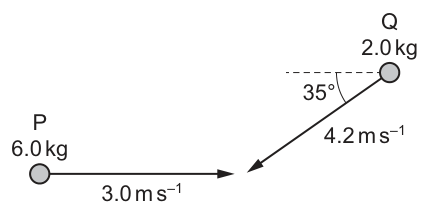
Objects P and Q collide and stick together.
What is the magnitude of the component of the final momentum of the combined objects in the original direction of P?
Options
A
B
C
D
Working
Momentum of P along its original direction:
Component of Q along P direction is opposite to P:
So component of total (and final) momentum along P direction:
Answer
B
B
Background Concept
Momentum is a vector quantity:
In an isolated system (no external resultant force), total momentum is conserved:
If objects stick together, the collision is perfectly inelastic, but momentum is still conserved.
Often we only need one component of momentum (e.g. along the original direction of P). Because momentum is a vector, we can conserve momentum separately in perpendicular directions by resolving into components.
Understanding the Question
P has mass and moves horizontally to the right at . Q has mass and moves at at to P’s path, as shown (Q is moving downwards and to the left toward P).
They collide and stick together. The question asks for the magnitude of the component of the final momentum in P’s original direction (take this as the +x direction).
Because momentum is conserved, this final x-component equals the initial total x-component.
Approach
- Choose axes with +x along P’s original direction.
- Calculate P’s momentum in the x-direction.
- Resolve Q’s velocity into an x-component and hence find Q’s x-momentum (with the correct sign).
- Add the x-components to get the total (and therefore final) momentum component along x.
Step-by-Step Reasoning
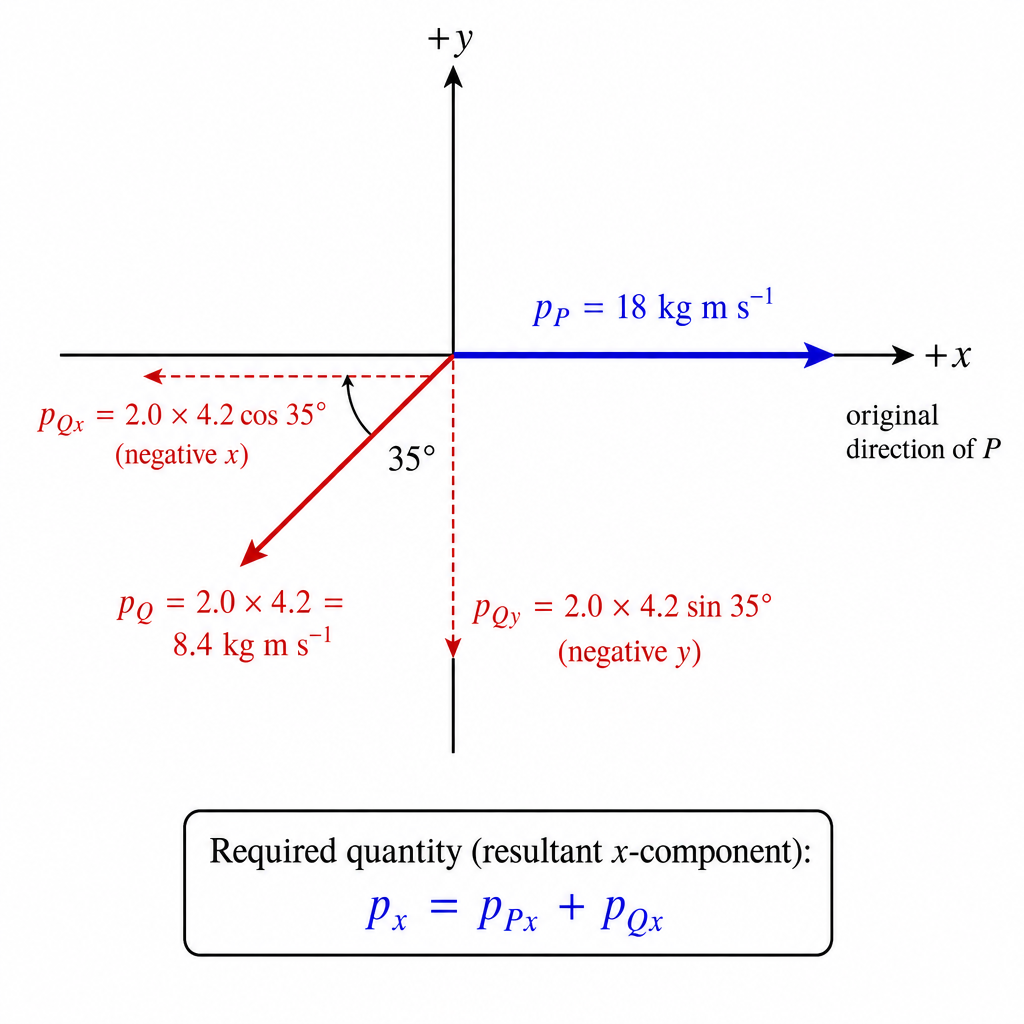
1) Momentum of P in the x-direction
P moves entirely along +x, so
2) x-component of Q’s momentum
Q’s speed is at to the horizontal, but from the diagram it is directed to the left. So the x-component of Q’s velocity has magnitude
but it is negative (opposite +x). Hence
Numerically,
so
3) Total x-momentum (and final x-momentum)
Since the system is isolated,
So
This matches option B.
Key Takeaways
- Momentum is a vector; conserve it using components.
- In an isolated system, total momentum is conserved even in perfectly inelastic collisions.
- Use for the component along a chosen axis, and include the correct sign from the direction.
Common Mistakes
- Ignoring direction/sign and adding to get (option D).
- Using instead of for the horizontal component.
- Calculating final velocity first (unnecessary here since only momentum component is asked).
Things to Be Careful About
- The phrase “component in the original direction of P” means along P’s original line of motion (the x-axis).
- Always decide from the diagram whether Q’s x-component is in the same direction as P or opposite; here it is opposite.
- Quote the momentum component with correct unit and appropriate rounding to match the options.
An astronaut of mass in a spacecraft experiences a gravitational force when stationary on the launchpad.
What is the gravitational force on the astronaut when the spacecraft is launched vertically upwards with an acceleration of ?
Options
A
B
C
D
The gravitational force (weight) on the astronaut is
Launching upwards changes the contact force/apparent weight, not the gravitational force.
Answer
B
B
Background Concept
The gravitational force on a mass near Earth is its weight:
where is the mass and is the gravitational field strength. This force depends on the gravitational field, not on whether the object is accelerating.
When an object is in contact with a surface (e.g. standing on a floor), there is also a normal contact force (reaction) from the surface. This is often what people informally call the "apparent weight" (what a scale reads), and it does change when there is acceleration.
Understanding the Question
At rest on the launchpad, the astronaut experiences gravitational force .
The spacecraft then accelerates upwards with acceleration .
The question asks specifically for the gravitational force on the astronaut during the launch.
Approach
Identify what is meant by gravitational force: it is weight , which stays the same as long as is unchanged.
Check the common trap: using Newton’s second law to find the resultant force and confusing that with the gravitational force.
Step-by-Step Reasoning
The gravitational force is always
Even when the spacecraft accelerates upward, the gravitational field is (by the question’s assumption) unchanged, so remains .
If we apply Newton’s second law to see where option A comes from:
Upward resultant force on astronaut:
with :
So is the normal reaction / apparent weight, not the gravitational force.
Therefore the gravitational force is → option B.
Key Takeaways
- Gravitational force near Earth is .
- Acceleration affects the contact force (apparent weight), not the gravitational force.
- Use Newton’s second law carefully: it relates to the resultant force, not any single force.
Common Mistakes
- Choosing by calculating the reaction force and calling it the gravitational force.
- Thinking weight becomes whenever there is upward acceleration.
- Answering by subtracting the acceleration effect from (confusing with apparent weight in downward-accelerating situations).
Things to Be Careful About
- The question says gravitational force, not "force on the astronaut" or "apparent weight".
- Only if itself changes significantly (e.g. large altitude change) would the gravitational force change; that is not implied here.
The diagram shows a child X of mass and a child Y of mass seated on a uniform plank.
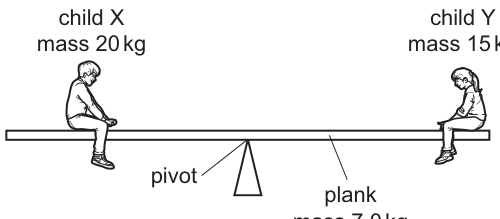
The plank has a mass of and has a pivot at its midpoint. The plank is horizontal and in equilibrium.
Which statement about the weight of the plank is correct?
Options
A The weight of the plank can be considered to be acting at its midpoint.
B The weight of the plank is causing an anticlockwise moment.
C The weight of the plank is causing a clockwise moment.
D The weight of the plank equals the force on the plank from the pivot.
Working
For a uniform plank, its weight acts at its centre of gravity (midpoint).
Since the pivot is at the midpoint, the plank's weight passes through the pivot so its moment about the pivot is zero.
Answer
A
A
Background Concept
The weight of an object acts through its centre of gravity (centre of mass in a uniform gravitational field). For a uniform plank, the mass is evenly distributed, so its centre of gravity is at the geometrical midpoint.
A moment (torque) about a pivot is given by
where is the force and is the perpendicular distance from the pivot to the line of action of the force. If a force’s line of action passes through the pivot, then and the moment is zero.
In equilibrium:
- net moment about any point is zero (clockwise moments = anticlockwise moments), and
- net force is zero.
Understanding the Question
A uniform plank is horizontal and balanced on a pivot at its midpoint. Two children sit on opposite sides. You are asked which statement about the weight of the plank is correct.
Key facts:
- “Uniform plank” (\Rightarrow) weight acts at plank midpoint.
- “Pivot at its midpoint” (\Rightarrow) that weight produces no turning effect about the pivot.
Approach
- Locate where the plank’s weight acts (centre of gravity).
- Decide whether that force produces a clockwise, anticlockwise, or zero moment about the pivot.
- Check the other options for common misconceptions (e.g. confusing plank weight with total reaction at pivot).
Step-by-Step Reasoning
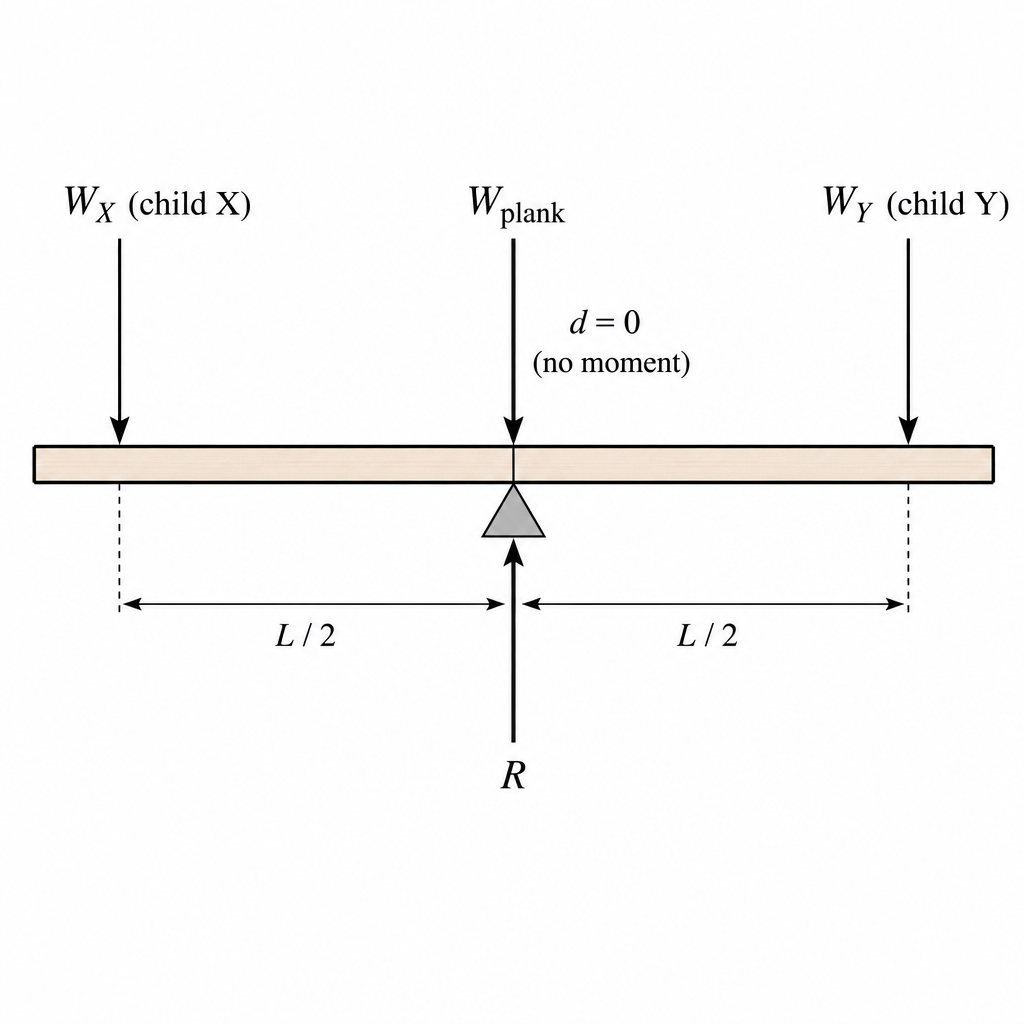
- Because the plank is uniform, its centre of gravity is at its midpoint.
- The pivot is also at the midpoint, so the line of action of the plank’s weight passes through the pivot.
- Therefore the perpendicular distance from pivot to the weight’s line of action is , so
So the plank’s weight causes no clockwise or anticlockwise moment.
Evaluating the options:
- A True: weight can be considered to act at the midpoint.
- B/C False: the plank’s weight produces zero moment about the midpoint pivot.
- D False: the pivot reaction equals the total downward force (weights of both children + plank), not just the plank’s weight.
Key Takeaways
- A uniform object’s weight acts at its geometrical centre.
- A force whose line of action passes through the pivot produces zero moment.
- The support force at a pivot balances the total weight in vertical equilibrium.
Common Mistakes
- Saying the plank’s weight causes a clockwise/anticlockwise moment without noticing it acts at the pivot.
- Confusing “force from the pivot” with “weight of the plank”; the pivot supports all loads.
- Thinking the weight acts where the label is drawn or where the children sit, rather than at the centre of gravity.
Things to Be Careful About
- Moments depend on perpendicular distance to the line of action, not just “left” or “right”.
- Even though the plank has mass, if its weight acts exactly at the pivot, it does not affect the moment balance (but it still affects the vertical force balance).
An object is fully submerged in a liquid.
A student determines the ratio
Which single change would double the value of this ratio?
Options
A Use a different liquid that has twice the density and the same volume as the original liquid.
B Use a different object that has half the volume and the same density as the original object.
C Use a different object that has twice the density and the same volume as the original object.
D Use a different object that has twice the volume and the same density as the original object.
Working
Weight of object:
Upthrust: (fully submerged, so volume displaced equals volume of object)
Ratio
To double the ratio, either double or halve .
- A: doubled → ratio doubled. Correct.
- B: Volume halved, densities unchanged → ratio unchanged.
- C: doubled → ratio halved.
- D: Volume doubled, densities unchanged → ratio unchanged.
Answer
A
A
Background Concept
Archimedes' principle states that the upthrust on a submerged object equals the weight of the fluid displaced. For an object fully submerged in a liquid, the volume of liquid displaced equals the volume of the object. Upthrust , where is the density of the liquid, is the volume of the object, and is the acceleration due to gravity. The weight of the object is . The ratio of upthrust to weight is therefore .
Understanding the Question
The question asks which single change would double the value of the ratio . The ratio depends only on the densities of the liquid and the object, not on the volume. We need to evaluate each option to see which one doubles .
Approach
Write the ratio in terms of densities. Then consider each option: how does it affect and ? The volume of the object does not affect the ratio, so options that only change volume (B and D) leave the ratio unchanged. Option A doubles , doubling the ratio. Option C doubles , halving the ratio. Thus A is correct.
Step-by-Step Reasoning
- Write expressions: , .
- Ratio .
- For to double, must double or must halve.
- Evaluate options:
- A: doubles → doubles.
- B: halves, but independent of → unchanged.
- C: doubles → halves.
- D: doubles, but independent of → unchanged.
- Therefore, only option A doubles the ratio.
Key Takeaways
- Upthrust depends on the density of the fluid and the volume of the object submerged.
- Weight depends on the density and volume of the object.
- For a fully submerged object, the ratio of upthrust to weight simplifies to the ratio of densities.
- Changing the volume of the object does not affect this ratio.
Common Mistakes
- Thinking that changing the volume of the object changes the ratio. Since both weight and upthrust are proportional to volume, the volume cancels out.
- Confusing weight/upthrust with upthrust/weight. The question asks for upthrust/weight, so doubling the liquid density doubles the ratio.
- Misapplying Archimedes' principle: forgetting that upthrust equals weight of displaced fluid, not weight of the object.
Things to Be Careful About
- Ensure the ratio is correctly identified: upthrust/weight, not weight/upthrust.
- The volume of the liquid itself is irrelevant; only the volume of the object matters.
- The object must be fully submerged for the displaced volume to equal the object's volume.
A shop sign weighing hangs from a frame attached to a vertical wall.
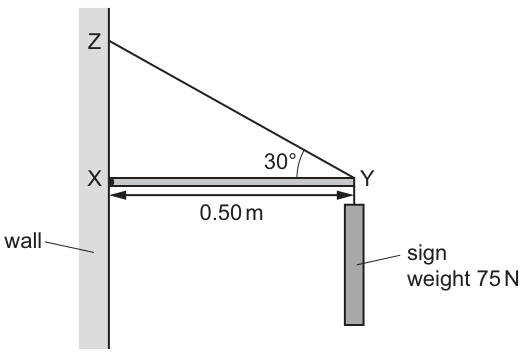
The frame consists of a horizontal rod XY and a rod YZ that is at an angle of to the horizontal.
Rod XY is attached to the wall by a hinge at X and has length . Assume that the weights of the rods are negligible.
What is the horizontal force exerted by the wall on rod XY?
Options
A
B
C
D
Working
At joint , forces are along rods (horizontal) and (at ), and weight downward.
Vertical equilibrium:
Horizontal equilibrium:
Answer
, option C
C
Background Concept
A pin-jointed frame made of light (negligible weight) straight rods often forms two-force members: if a rod is only pinned at its ends and has no other loads, the force it exerts at each end must act along the rod’s length (either tension or compression).
For a pin joint in equilibrium, the vector sum of forces is zero:
When a force acts along a rod at an angle to the horizontal, its components are:
Understanding the Question
The sign has weight acting downward at point . Two rods meet at :
- rod is horizontal,
- rod makes to the horizontal and goes up-left to the wall.
You are asked for the horizontal force exerted by the wall on rod , i.e. the horizontal hinge reaction at (which equals the axial force in rod because the rod is a two-force member).
Approach
- Consider equilibrium of the joint at (the only place where an external load, , is applied).
- Assume forces from rods act along their lengths: one horizontal (from ) and one at (from ).
- Use vertical equilibrium to find the force in .
- Use horizontal equilibrium to find the force in , which is the horizontal force transmitted to the wall at .
Step-by-Step Reasoning
At joint , there are three forces:
- weight downward,
- force from rod along the rod (up-left at ), magnitude ,
- force from rod along the rod (horizontal), magnitude .
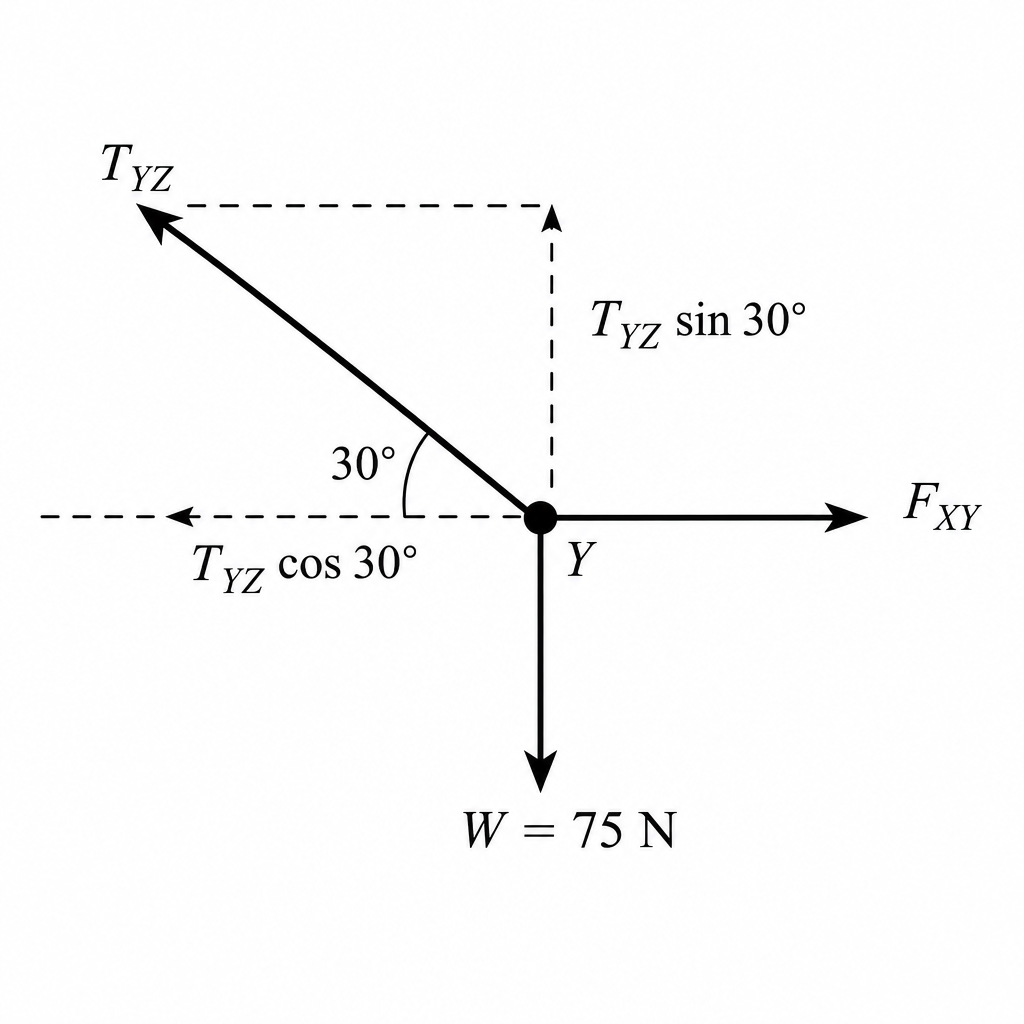
Vertical equilibrium (upward components balance the weight):
Since ,
Horizontal equilibrium (rightward and leftward components balance):
The horizontal component of is leftward with magnitude , so the horizontal force in rod must be equal in magnitude:
With ,
So the horizontal force exerted by the wall on rod has magnitude (option C).
Key Takeaways
- For a light pin-jointed rod with no other loads, forces at its ends act along the rod.
- For equilibrium at a joint: resolve forces into components and set and .
- A single angled support often provides the vertical component needed to balance weight.
Common Mistakes
- Using instead of for the vertical balance (vertical component is ).
- Forgetting that the force in is not ; it must be larger because only its vertical component supports the weight.
- Treating the length as necessary here; equilibrium at joint does not require taking moments.
Things to Be Careful About
- Be consistent about the angle: the rod is at to the horizontal, so vertical component uses .
- The question asks for the horizontal force from the wall on rod : its magnitude equals the axial force in for this two-force member.
- Round sensibly: rounds to , matching the option.
A student takes measurements to calculate the density of a liquid in a beaker.
The height of the liquid in the beaker is .
The internal diameter of the beaker is .
The mass of the liquid is .
What is the percentage uncertainty in the calculated density of the liquid?
Options
A
B
C
D
Working
Density
So
Percentage uncertainty:
Answer
D
D
Background Concept
When quantities are multiplied or divided, their percentage (or fractional) uncertainties add.
- If , then (approximately) .
- If , then .
- If , then .
These rules are used for “uncertainty in a derived quantity” when the uncertainties are small and independent.
Understanding the Question
You are given uncertainties in:
- height ,
- internal diameter ,
- mass .
The density is calculated from
where the liquid’s volume is the volume of a cylinder (beaker), using the measured and . The question asks for the percentage uncertainty in .
Approach
- Write in terms of and .
- Substitute into to see how depends on , , and .
- Add percentage uncertainties, remembering that is squared in the volume.
Step-by-Step Reasoning
- Cylinder volume using diameter :
So
- Density:
Ignoring constants ( and have no uncertainty), the dependence is:
- Combine percentage uncertainties:
- from :
- from in the denominator:
- from in the denominator:
Total:
So the correct option is D.
Key Takeaways
- For , uncertainty in depends on uncertainties in both and the measured dimensions used to find .
- For a cylinder, , so diameter uncertainty contributes twice.
- For products/quotients, add percentage uncertainties.
Common Mistakes
- Forgetting that is squared, and using instead of .
- Subtracting uncertainties because a variable is in the denominator (you still add percentage uncertainties).
- Using radius uncertainty without converting correctly from diameter (here ; the factor does not affect percentage uncertainty, but mixing and can lead to errors).
Things to Be Careful About
- Use the relationship (not ).
- Constants like and have no uncertainty, so they do not contribute.
- Apply the power rule carefully: if a quantity is squared, its percentage uncertainty doubles.
The diagram shows a uniform plank XY of length and weight .
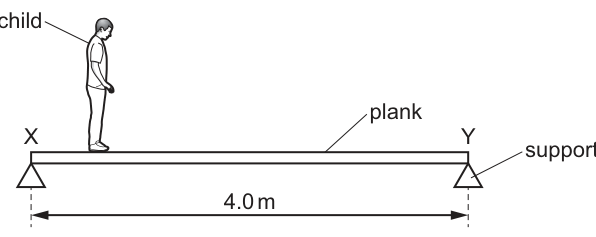
The plank rests on fixed supports at its ends X and Y.
A child of weight stands in different positions on the plank.
The support at end X exerts a force vertically upwards on the plank.
What is the magnitude of when the child stands at X and when the child stands at Y?
Options
| when child is at X | when child is at Y | |
|---|---|---|
| A | 600 | 0 |
| B | 600 | 150 |
| C | 750 | 0 |
| D | 750 | 150 |
Working
Total weight . Let reactions be at and at .
Child at
Taking moments about :
Child at
Taking moments about :
Answer
D
D
Background Concept
For a rigid body in static equilibrium:
- Resultant force is zero (vertical equilibrium here):
- Resultant moment about any point is zero:
The plank is uniform, so its weight acts at its centre of gravity, i.e. at the midpoint (here, from either end).
Understanding the Question
A uniform plank of length has weight acting at its centre. It is supported at both ends, giving upward reactions at and at .
A child of weight stands either at or at . We want the upward reaction at the left support (), called , in each case, then choose the option that matches both values.
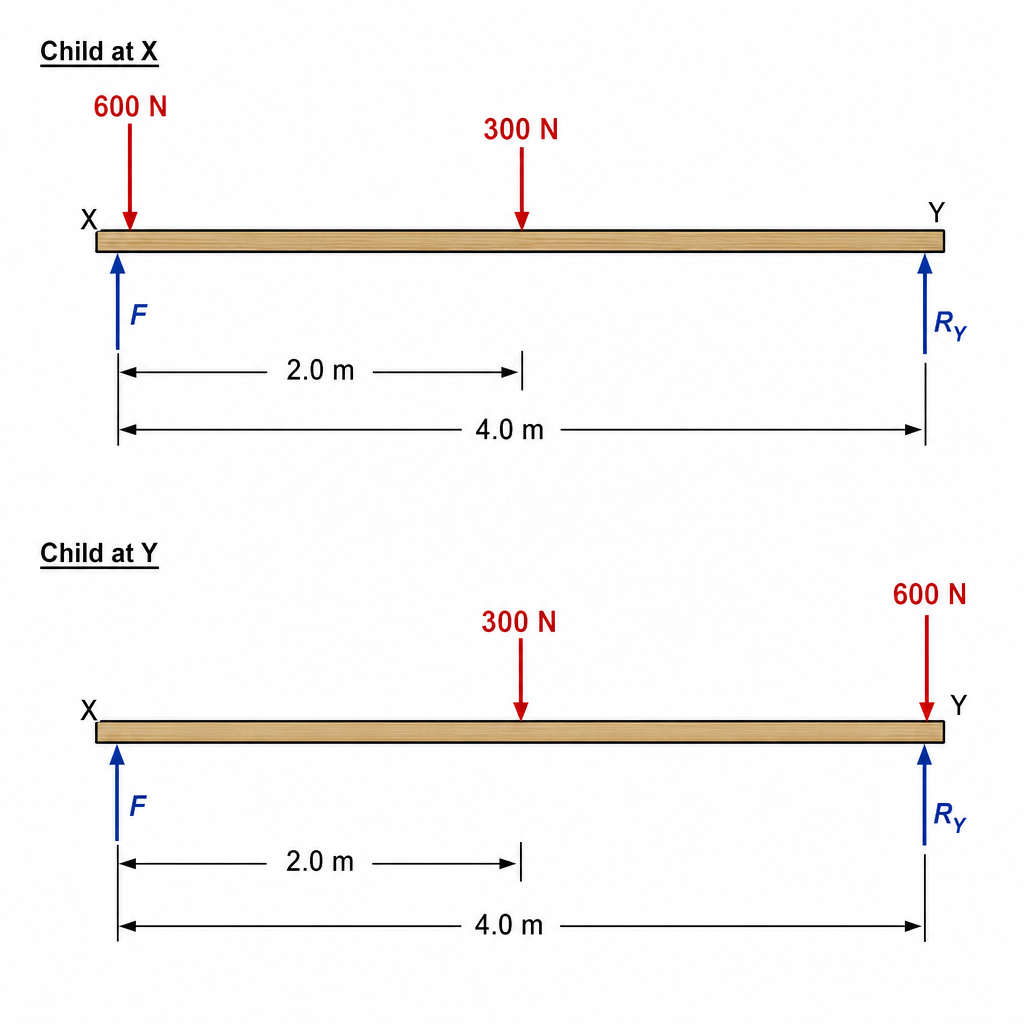
Approach
For each position of the child:
- Use moments about to find the reaction at (because the reaction at has zero moment about ).
- Use vertical force balance to get from
Step-by-Step Reasoning
Let be the upward reaction at and the upward reaction at .
Total downward force is always
1) Child stands at
Take moments about .
- Child is at , so its moment about is .
- Plank weight acts at from .
- Reaction at acts at from .
So
Vertical equilibrium:
2) Child stands at
Take moments about .
- Child weight acts at from .
- Plank weight contributes the same .
So
Vertical equilibrium:
This corresponds to option D.
Key Takeaways
- For a body in equilibrium: use and .
- Taking moments about a support is efficient because it removes that support’s reaction from the equation.
- A uniform object’s weight acts at its midpoint.
Common Mistakes
- Using the full plank length () as the distance for the plank’s own weight instead of .
- Forgetting to include the plank’s weight when the child’s weight is present.
- Mixing up which reaction you are solving for when taking moments.
Things to Be Careful About
- Distances in moments must be perpendicular distances to the line of action (here they are horizontal distances along the plank).
- Keep a consistent sign convention for clockwise/anticlockwise moments.
- Remember that when you pivot about , the moment due to is zero (because its line of action passes through the pivot).
Which relationship is used in the derivation of the equation shown?
Options
A displacement
B force
C momentum
D velocity
Working
Power is
and work done (force parallel to motion) is
So
Using
gives , hence .
Answer
A
A
Background Concept
Power is the rate of doing work:
If a constant force acts along the direction of motion and produces a displacement , then the work done is
Combining these gives
To turn into something recognisable, we use the definition of (constant) velocity:
or equivalently .
Understanding the Question
You are told the final equation is
The question asks which one of the listed relationships (A–D) is used in deriving this result. So we look for the missing step that connects displacement and time to velocity .
Approach
- Start from the standard definition .
- Replace using (force along displacement).
- Recognise that you then need a relationship to rewrite in terms of . That relationship is .
Step-by-Step Reasoning
Start with
Substitute :
Rearrange to highlight :
Now use the kinematics definition of velocity:
So and therefore
Hence the required relationship is displacement (Option A).
Key Takeaways
- and are the starting definitions.
- To reach , you must convert into using .
Common Mistakes
- Choosing (B): not needed because the derivation does not involve acceleration.
- Choosing (C): momentum is irrelevant here.
- Choosing (D): only applies for acceleration from rest and still doesn’t directly link displacement and time to velocity for this derivation.
Things to Be Careful About
- requires the force component parallel to displacement; more generally .
- Don’t confuse (average velocity for a displacement over time) with the constant-acceleration formulae; the derivation assumes the simple rate form is appropriate.
A block is released from rest at the top of a slope inclined at an angle to the horizontal. The slope has length as shown in the diagram.
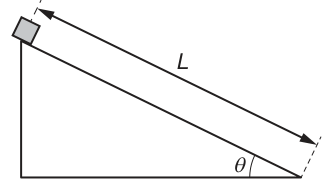
There are no resistive forces acting on the block.
What is the speed of the block at the bottom of the slope?
Options
A
B
C
D
Working
Loss of GPE with vertical drop .
Answer
B
B
Background Concept
With no resistive forces, mechanical energy is conserved: the decrease in gravitational potential energy becomes kinetic energy.
Gravitational potential energy change:
Kinetic energy:
So, for a block released from rest and sliding without friction:
Understanding the Question
The block starts from rest at the top of a slope of length , inclined at angle to the horizontal. You are asked for the speed at the bottom. The key is that the final speed depends only on the vertical drop , not on the path length, when there is no energy loss.
The vertical drop is the vertical component of the slope length:
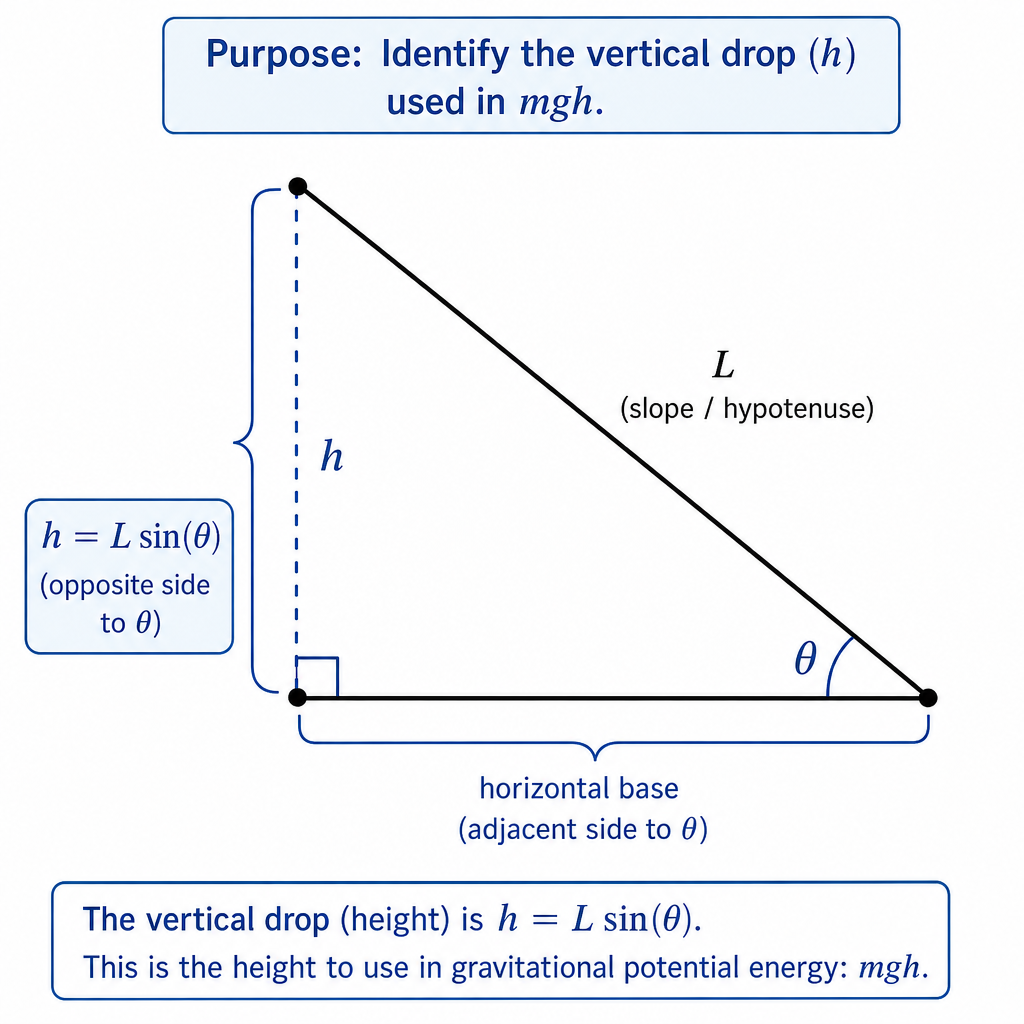
Approach
- Find the vertical height decrease using the right-triangle geometry of the slope.
- Use conservation of energy: .
- Cancel , substitute (so ), and match the expression to the options.
Step-by-Step Reasoning
From the slope geometry, the hypotenuse is and the angle to the horizontal is , so the opposite side (vertical drop) is:
Conservation of energy from top (rest) to bottom:
Cancel :
Rearrange:
Using :
This corresponds to option B.
Key Takeaways
- With no resistive forces, use conservation of mechanical energy.
- Final speed depends on vertical drop , not directly on the slope length.
- For an incline at angle to the horizontal, .
Common Mistakes
- Using (mixing up adjacent/opposite sides).
- Using kinematics along the slope but putting the wrong component of (e.g. instead of ).
- Forgetting the square root when solving for .
Things to Be Careful About
- Check the definition of : angle to the horizontal implies vertical drop is .
- Options A/B have the correct structure ; options C/D are dimensionally wrong for speed (they scale as , not ).
- Use an appropriate value for ; the options clearly use giving .
A skateboarder and her skateboard have a total mass of . She pushes on the ground with her foot to create a forward force of on herself and the skateboard, as shown in the diagram.
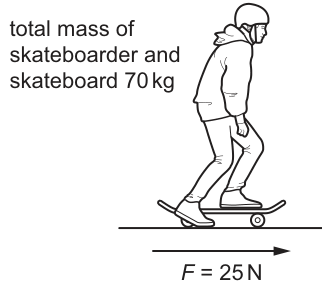
The skateboarder and skateboard travel forwards a distance of before the skateboarder lifts her foot from the ground.
What is the work done by on the skateboarder and skateboard?
Options
A
B
C
D
Working
Answer
A
A
Background Concept
Work done by a force is the energy transferred when a force causes a displacement.
For a constant force producing a displacement :
where is the angle between the force and the displacement. If the force is in the same direction as the motion, then and , so .
Understanding the Question
A forward horizontal force of magnitude acts on the skateboarder + skateboard while they move forward by before the foot leaves the ground. The question asks for the work done by this forward force during that displacement.
The given mass is not needed for calculating work done by a known constant force over a known distance.
Approach
- Identify that the force and displacement are in the same direction, so use .
- Substitute and .
- Round to match the answer options.
Step-by-Step Reasoning
Because the force is forward and the motion is forward, :
The closest option (and rounded to 2 s.f.) is:
So the correct choice is A.
Key Takeaways
- Work done by a constant force is .
- Only the component of force along the displacement does work.
- Mass is irrelevant if force and displacement are given directly.
Common Mistakes
- Using or trying to find acceleration first (unnecessary here).
- Forgetting the factor when force is not parallel to motion.
- Using instead of (unit confusion).
Things to Be Careful About
- Ensure is the displacement while the force acts (here, ).
- Quote work in joules: .
- Round appropriately to match the options (here rounds to ).
A turbine at a hydroelectric power station is situated at a vertical distance of below the level of the surface of a large lake. The water passes through the turbine at a rate of per minute.
The overall efficiency of the turbine and generator system is . The density of water is .
What is the useful power output of the power station?
Options
A
B
C
D
Working
Volume flow rate:
Mass flow rate:
Input power from loss of GPE:
Useful power:
Answer
B
B
Background Concept
When water falls through a vertical height , it loses gravitational potential energy (GPE):
If this energy is transferred each second, it becomes power:
For a continuous flow, it is convenient to use mass flow rate (mass per second). Then the rate of loss of GPE (the available input power) is
The useful electrical output is smaller due to inefficiency:
Understanding the Question
You are told:
- vertical drop:
- volume of water per minute:
- density:
- efficiency:
You must find the useful power output (electrical power delivered), and choose the closest option in MW.
Approach
- Convert the given volume flow rate from per minute to per second.
- Convert volume flow rate to mass flow rate using .
- Find the available power from GPE loss: .
- Multiply by efficiency: .
- Convert W to MW and select the matching option.
Step-by-Step Reasoning
1) Convert to per second
2) Convert to mass flow rate
Each second, the mass of water is density volume:
3) Power available from falling water
Each kilogram loses joules, so each second the energy loss is:
Compute:
4) Apply efficiency
Convert to MW:
This corresponds to option B.
Key Takeaways
- Hydroelectric input power comes from the rate of loss of GPE: .
- Convert volume flow rate to mass flow rate using .
- Useful output is found by multiplying by efficiency.
Common Mistakes
- Forgetting to convert to (gives an answer too large).
- Using for the total energy but not turning it into power by using mass per second.
- Using efficiency the wrong way round (dividing by instead of multiplying).
- Dropping factors of when converting W to MW.
Things to Be Careful About
- Keep track of units: in and in ensures is in .
- Use a sensible value of (typically or ); the option still comes out as .
- Efficiency is already “overall” (turbine + generator), so apply it once at the end.
A projectile is launched at to the horizontal with initial kinetic energy .
Assuming air resistance to be negligible, what will be the kinetic energy of the projectile when it reaches its highest point?
Options
A
B
C
D
Working
Let initial speed be . Then
At the highest point, vertical velocity is zero and horizontal velocity is unchanged:
So kinetic energy at highest point is
Answer
A
A
Background Concept
For projectile motion with negligible air resistance:
- The only acceleration is vertical (due to gravity), so the horizontal component of velocity remains constant.
- At the highest point, the vertical component of velocity is zero (it has been reduced to zero by gravity).
Kinetic energy depends on speed:
So if the speed changes by a factor, the kinetic energy changes by the square of that factor.
Understanding the Question
A projectile is launched at with initial kinetic energy . You are asked for its kinetic energy at the highest point.
Key idea: at the top, it is still moving horizontally, so its kinetic energy is not zero, but it is less than .
Approach
- Represent the initial velocity and resolve it into components at .
- Use the projectile facts: horizontal component stays constant; vertical component becomes zero at the top.
- Find the speed at the top (it equals the horizontal component only).
- Use to relate the kinetic energies.
Step-by-Step Reasoning
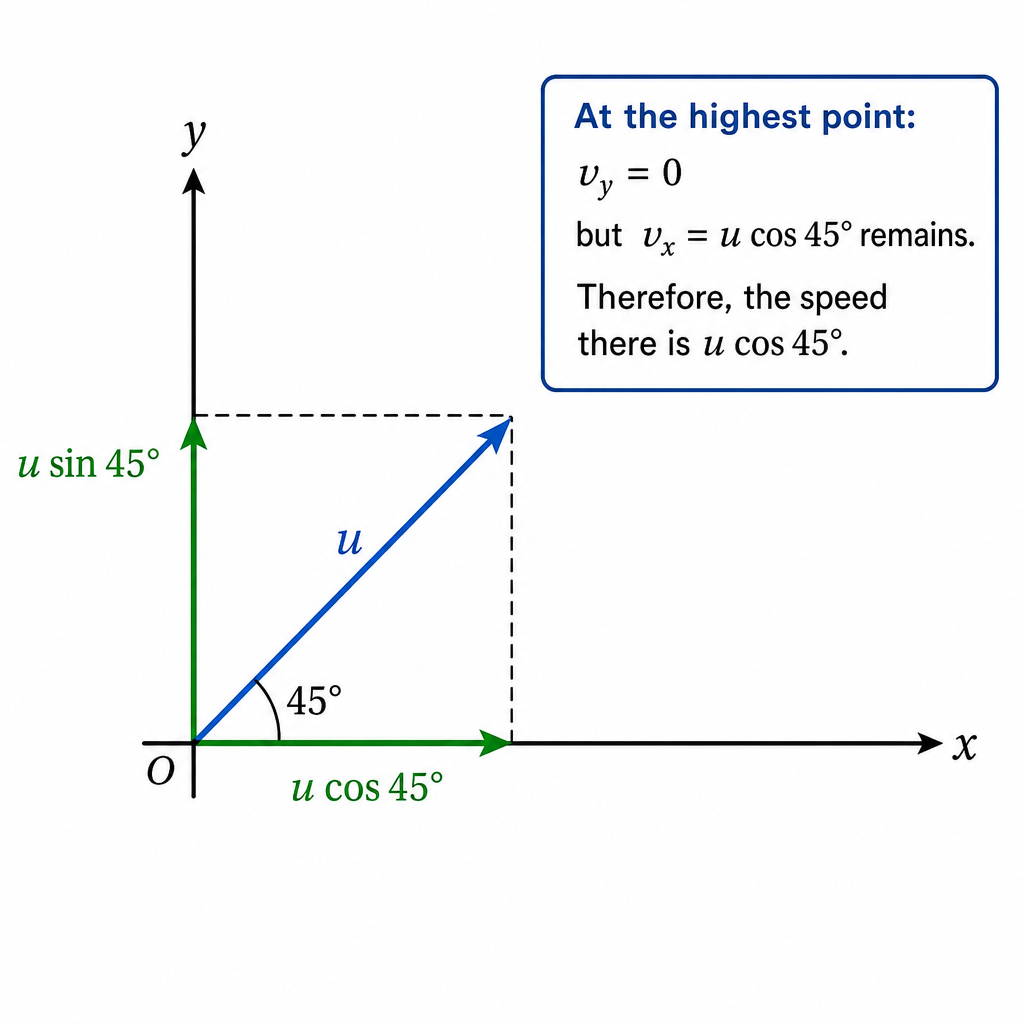
Let the initial speed be . Then the given initial kinetic energy is
Resolve at :
With no air resistance, there is no horizontal force, so horizontal velocity is constant:
At the highest point, vertical velocity is zero:
So the speed at the highest point is just the horizontal component:
Hence kinetic energy at the top is
Now
So
This matches option A.
Key Takeaways
- In projectile motion (no air resistance), horizontal velocity stays constant.
- At maximum height, vertical velocity is zero, but horizontal motion continues.
- Kinetic energy scales with , so a factor of in speed gives a factor of in kinetic energy.
Common Mistakes
- Thinking the kinetic energy at the top is zero because the projectile "stops" (only the vertical motion stops).
- Using directly as the kinetic energy factor, giving (you must square it).
- Mixing up and (at they are equal, but the method should still be correct).
Things to Be Careful About
- Kinetic energy depends on speed squared, not speed.
- The result here depends on the launch angle; specifically makes .
- The conclusion relies on the assumption "air resistance negligible"; otherwise horizontal speed would decrease and the top kinetic energy would be less than .
A wire is extended by a tensile force so that its deformation is elastic.
What is meant by elastic deformation?
Options
A The extension of the wire is proportional to the tensile force.
B The extension of the wire is not proportional to the tensile force.
C When the tensile force is removed, the wire does not return to its original length.
D When the tensile force is removed, the wire returns to its original length.
Working
Elastic deformation means the object returns to its original dimensions when the deforming force is removed.
Answer
D
D
Background Concept
Elastic deformation is a type of deformation where the material does not suffer permanent change in length/shape. If the deforming force (e.g. tensile force) is removed, the atoms return to (approximately) their original equilibrium separations, so the object returns to its original dimensions.
This is different from:
- Plastic deformation: permanent change remains after the force is removed.
- Hooke’s law / proportionality: the extension is proportional to force (or stress proportional to strain). This proportionality can hold only over part of the elastic region; elastic behaviour does not require proportionality.
Understanding the Question
The wire is stretched by a tensile force and the question states the deformation is elastic. The question asks what “elastic deformation” means, and provides four statements to choose from.
Approach
Use the definition: check which option describes what happens when the force is removed. Be careful not to confuse “elastic” with “extension proportional to force” (that’s specifically Hooke’s law).
Step-by-Step Reasoning
- Elastic deformation means no permanent extension.
- Therefore, when the tensile force is removed, the wire returns to its original length.
- Option D states exactly this.
- Option A describes Hooke’s law (a possible feature within the elastic region, but not the definition of elastic deformation).
Key Takeaways
- Elastic deformation: returns to original length/shape after unloading.
- Hooke’s law (proportionality) is not the same as “elastic”.
Common Mistakes
- Choosing A because you equate “elastic” with “extension proportional to force”. A material can be elastic but not obey Hooke’s law over the whole elastic range.
- Confusing elastic with plastic and choosing C (which describes plastic deformation).
Things to Be Careful About
- The defining test for elasticity is what happens after the force is removed.
- “Proportional extension” is an extra condition (Hooke’s law) and is not required by the word “elastic”.
A bolt is subjected to a tensile force, as shown.
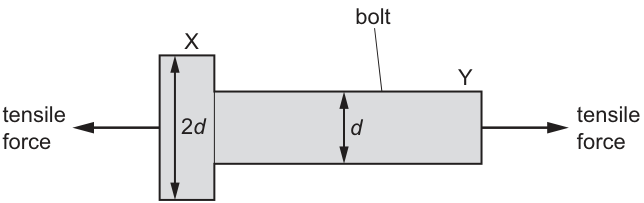
The bolt has a circular cross-section. At end X, the diameter is . At end Y, the diameter is .
What is the ratio
Options
A
B
C
D
Working
Stress is defined as force per unit cross-sectional area:
The tensile force is constant throughout the bolt.
Cross-sectional area at X (diameter ):
Cross-sectional area at Y (diameter ):
Ratio of stresses:
Answer
D
D
Background Concept
Stress () is defined as the force applied per unit cross-sectional area perpendicular to the force. The formula is:
where is the force and is the cross-sectional area. For a material under tension (like a bolt being pulled), the internal force is uniform throughout the object if it is in equilibrium (ignoring weight, which is negligible here). Therefore, the stress depends entirely on the cross-sectional area at that point. For a circular cross-section with diameter and radius , the area is . This means area is proportional to the square of the diameter ().
Understanding the Question
The question describes a bolt with a stepped geometry subjected to a tensile force, as shown in
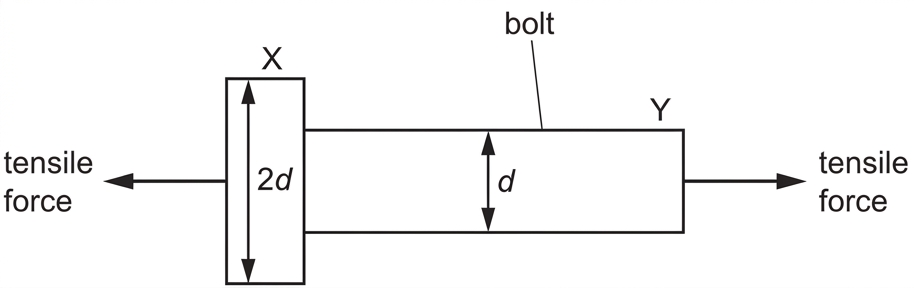
. At end X, the diameter is . At end Y, the diameter is . We are asked to find the ratio of the stress at Y to the stress at X (). Since the bolt is being pulled, the tensile force is the same at both ends.
Approach
Since the force is constant, stress is inversely proportional to the cross-sectional area (). We can calculate the area at both ends using the given diameters, then form the ratio. Alternatively, since , we can just use the ratio of diameters squared: .
Step-by-Step Reasoning
- Identify the constant: The tensile force is the same at X and Y because the bolt is in equilibrium (the force pulling at X is transmitted through to Y).
- Calculate Area at X: The diameter at X is . The radius is .
- Calculate Area at Y: The diameter at Y is . The radius is .
- Calculate Stresses:
- Calculate Ratio:
Alternatively, using proportionality:
Key Takeaways
- Stress is concentrated in thinner sections of a material under tension.
- If you halve the diameter of a circular rod, the cross-sectional area becomes one-quarter of the original, so the stress becomes four times larger.
Common Mistakes
- Using diameter directly in area formula: Students might think instead of . This would lead to a ratio of (Option C).
- Inverting the ratio: Calculating instead of would give (Option A).
- Confusing radius and diameter: Using instead of . While this cancels out in a ratio if done consistently for both, it is a bad habit.
Things to Be Careful About
- Significant figures: The answer is an exact integer ratio (4), presented as 4.0 in the options, so 2 significant figures is appropriate.
- Vector vs Scalar: Stress is a scalar quantity (force per area), though force is a vector. The direction is handled by the area vector (normal to the surface).
- Area calculation: Always remember or . The factor of 4 in the denominator is crucial.
The graph shows the relationship between force acting on a compression spring and change in length of the spring.
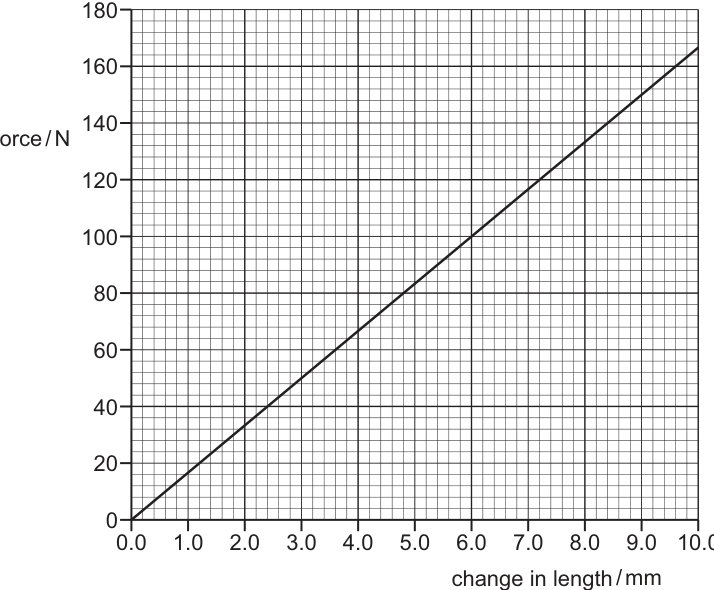
One of these springs is placed in each corner of a horizontal square plate. The axis of each spring is in a vertical direction. These four springs support a total load of .
What is the total elastic potential energy stored in the four springs?
Options
A
B
C
D
Working
From the graph, at , , so
Load shared by four identical springs:
Compression of each spring:
Elastic energy in one spring:
Total for four springs:
Answer
B
B
Background Concept
For a spring that obeys Hooke’s law,
where is the force, is the extension/compression from the natural length, and is the spring constant.
The elastic potential energy stored in a spring equals the work done in stretching/compressing it. On a force–extension (or force–change in length) graph, this is the area under the graph:
- For a straight line through the origin (Hooke’s law), the graph is a triangle.
- So
If identical springs support a load in parallel (all compressed by the same amount), the total load is shared equally.
Understanding the Question
You are given a straight-line graph of force against change in length for one compression spring.
Four identical springs support a total load of under a square plate. Because the plate is horizontal and the springs are at the corners, we assume the load is shared equally, so each spring supports .
The question asks for the total elastic potential energy in all four springs.
Approach
- Use the graph to find the spring constant (gradient ).
- Find the force on each spring: .
- Use Hooke’s law to find the compression of each spring.
- Find energy per spring using .
- Multiply by 4 to get the total energy.
Step-by-Step Reasoning
-
Read one clear point from the straight-line graph. At , the force is about .
-
Convert to SI units: .
-
Gradient (spring constant):
- Force on each spring (equal sharing):
- Compression of each spring:
- Energy stored in one spring (area under - graph up to this ):
- Total energy in four springs:
This corresponds to option B.
Key Takeaways
- The spring constant is the gradient of a straight-line vs graph.
- Elastic potential energy is the area under the - graph: for Hooke’s law, .
- With identical springs sharing a load, each spring carries an equal fraction of the force.
Common Mistakes
- Forgetting to divide the total load by 4 (using for one spring).
- Using directly without converting to metres, giving energy too large by a factor of 1000.
- Calculating instead of (missing the triangle area factor).
Things to Be Careful About
- Always convert mm to m before using in .
- Read the graph carefully: the force at is approximate, but the options are well separated so a sensible reading leads clearly to .
- The equal-sharing assumption relies on the plate being horizontal and the springs being identical and symmetrically placed (as stated/implied).
Which row correctly identifies the properties of all electromagnetic waves?
Options
| transverse wave | longitudinal wave | can travel in free space | |
|---|---|---|---|
| A | ✓ | ✗ | ✓ |
| B | ✓ | ✗ | ✗ |
| C | ✗ | ✓ | ✓ |
| D | ✗ | ✓ | ✗ |
Electromagnetic waves consist of oscillating electric and magnetic fields perpendicular to the direction of travel, so they are transverse (not longitudinal). They do not require a medium and can travel in free space.
Answer
A
A
Background Concept
Electromagnetic (EM) waves are oscillations of electric field and magnetic field . A key property is that these fields oscillate perpendicular to the direction of wave propagation, so EM waves are transverse. Unlike mechanical waves (e.g. sound), EM waves do not require particles of a medium to oscillate, so they can propagate through a vacuum (free space).
Understanding the Question
The table asks for a row that gives properties true for all electromagnetic waves:
- whether they are transverse,
- whether they are longitudinal,
- whether they can travel in free space.
We must choose the one row where each entry is correct.
Approach
Use two facts:
- All EM waves are transverse, so the transverse column must be ✓ and longitudinal must be ✗.
- All EM waves can travel in vacuum, so “can travel in free space” must be ✓.
Then match these to the options.
Step-by-Step Reasoning
- EM waves are transverse transverse ✓.
- EM waves are not longitudinal longitudinal ✗.
- EM waves propagate in free space (vacuum) can travel in free space ✓.
The row (✓, ✗, ✓) corresponds to option A.
Key Takeaways
- EM waves are transverse (fields oscillate perpendicular to the direction of travel).
- EM waves do not need a medium, so they can travel through a vacuum.
Common Mistakes
- Confusing EM waves with sound waves and thinking a medium is required.
- Thinking “transverse” and “longitudinal” are both possible for EM waves (only transverse applies).
Things to Be Careful About
- The question says all electromagnetic waves, so the properties must hold for the entire EM spectrum (radio to gamma), not just for some examples.
- “Free space” means vacuum: absence of a material medium.
What is the approximate range of wavelengths in free space for infrared radiation?
Options
A
B
C
D
Working
Infrared has wavelengths longer than visible red () up to about .
So the closest range given is to .
Answer
D
D
Background Concept
Electromagnetic (EM) waves can be ordered by wavelength (or frequency). The key approximate boundaries you are expected to know are:
- Visible light: about (violet) to (red).
- Infrared (IR): longer wavelength than visible red, up to about .
- Microwaves: typically from about up to many centimetres/metres.
So IR sits directly after visible light and before microwaves.
Understanding the Question
The question asks for the approximate wavelength range (in free space) for infrared radiation. You must choose the option whose wavelength limits match IR.
We compare each option with what we know about the EM spectrum:
- UV is shorter than visible (typically below ).
- Visible is .
- IR is roughly to .
- Microwaves are longer than .
Approach
- Recall where infrared lies relative to visible light.
- Convert units if needed (notably ).
- Pick the option that starts just above visible red and ends around .
Step-by-Step Reasoning
- Visible light ends at about (red).
- Infrared begins just beyond this, so a lower limit like is reasonable.
- Infrared extends up to about .
Convert to micrometres:
So an upper limit of matches the usual end of IR.
Now check options:
- A () is ultraviolet.
- C () is visible.
- B () is mostly microwave (too long).
- D () matches IR.
Therefore the correct option is D.
Key Takeaways
- Infrared wavelengths are just longer than visible red.
- A useful approximate range: to .
- Be comfortable converting between , and .
Common Mistakes
- Confusing infrared with ultraviolet (mixing up “beyond red” vs “beyond violet”).
- Not recognising that .
- Choosing option B because it contains micrometres, without noticing it extends to centimetres (microwave region).
Things to Be Careful About
- The boundaries are approximate, so pick the best match rather than expecting exact textbook endpoints.
- Check units carefully: nm () vs () differ by a factor of .
- The question specifies “in free space”, but for EM waves the wavelength ranges quoted for spectrum regions are conventionally free-space values anyway.
The diagram shows a car travelling at a constant speed in a straight line between person P and person Q from point X to point Y.
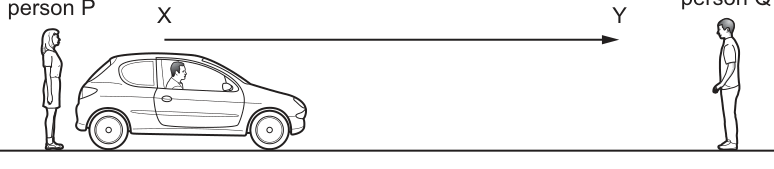
The car sounds its horn continuously as it travels. The horn emits sound of constant frequency.
Which statements about what person P and person Q hear during the motion of the car are correct?
1 Person P hears a sound of increasing frequency.
2 Person Q hears a sound of decreasing frequency.
3 Person Q always hears a sound of higher frequency than person P.
Options
A 1, 2 and 3
B 1 and 2 only
C 3 only
D none of them
Working
For person P the car is moving away, so the observed frequency is lower than the emitted frequency and does not increase.
For person Q the car is moving towards, so the observed frequency is higher than the emitted frequency and does not decrease.
So 1 is false, 2 is false, 3 is true.
Answer
C
C
Background Concept
The Doppler effect is the apparent change in the frequency heard by an observer when there is relative motion between the source and the observer.
For a moving source and stationary observers:
- when the source moves towards the observer, wavefronts are compressed so the observer hears a higher frequency than the emitted frequency.
- when the source moves away from the observer, wavefronts are spread out so the observer hears a lower frequency than the emitted frequency.
If the source speed and direction relative to the observer stay the same (straight line, constant speed), then the Doppler-shifted frequency heard is constant during that part of the motion.
Understanding the Question
A car moves at constant speed in a straight line from point X (nearer P) to point Y (nearer Q), always between P (left) and Q (right). The horn emits sound at constant frequency (so any change heard is due to Doppler effect only).
We must decide which of these statements are correct during this motion:
1 P hears increasing frequency.
2 Q hears decreasing frequency.
3 Q always hears a higher frequency than P.
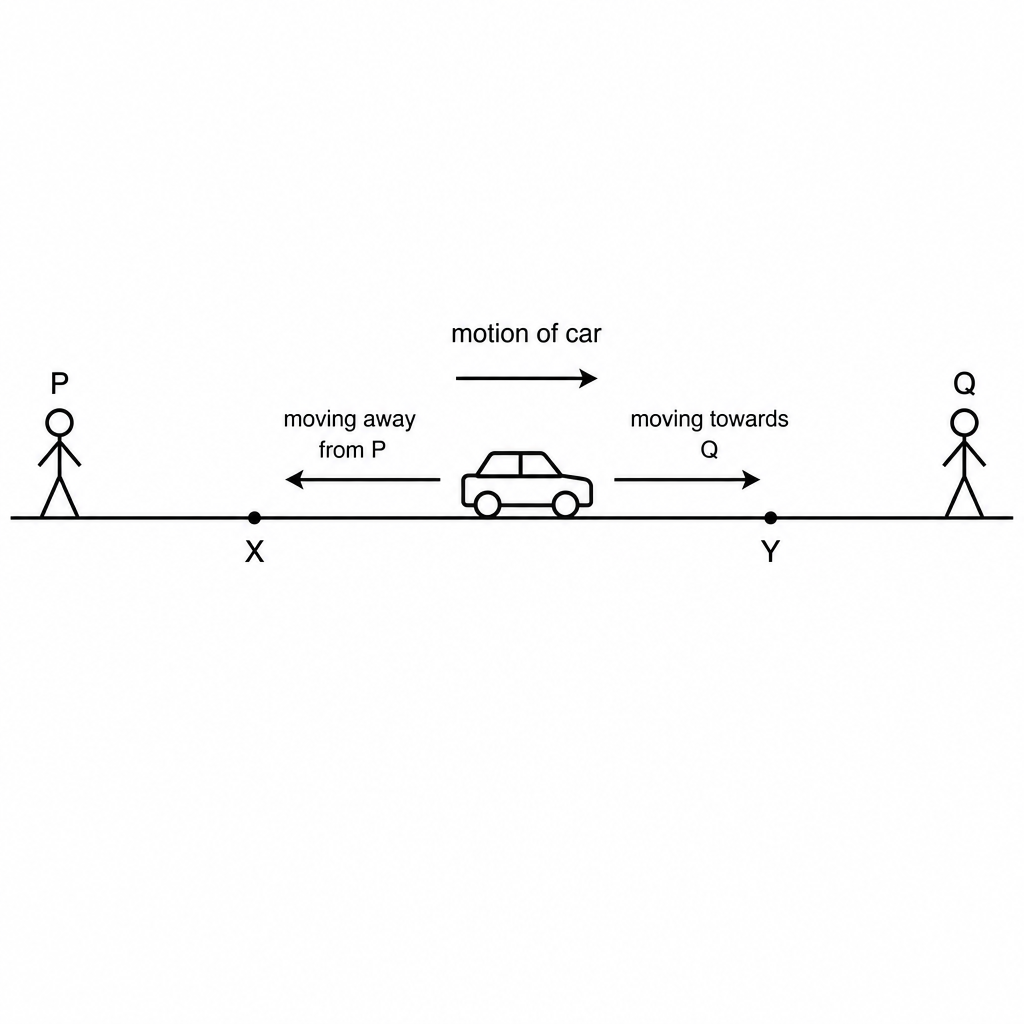
Approach
Decide for each person whether the car is moving towards them or away from them throughout the journey from X to Y.
- Moving towards (\Rightarrow) higher observed frequency.
- Moving away (\Rightarrow) lower observed frequency.
Then check each statement.
Step-by-Step Reasoning
- Relative motion seen by P:
- P is on the left.
- The car travels to the right from X to Y.
- Therefore, the car is moving away from P for the whole journey.
So P hears a frequency lower than the emitted frequency. With constant speed, that frequency does not increase during the motion.
(\Rightarrow) Statement 1 is false.
- Relative motion seen by Q:
- Q is on the right.
- The car is travelling towards the right-hand end from X to Y.
- Therefore, the car is moving towards Q for the whole journey.
So Q hears a frequency higher than the emitted frequency. With constant speed, that frequency does not decrease during the motion.
(\Rightarrow) Statement 2 is false.
- Compare what Q and P hear at any moment:
- At the same instant, the car is moving away from P (lower frequency) and towards Q (higher frequency).
Therefore Q always hears a higher frequency than P during this motion.
(\Rightarrow) Statement 3 is true.
Only statement 3 is correct, so the correct option is C.
Key Takeaways
- For stationary observers, a moving source gives higher frequency when approaching and lower when receding.
- If the car does not pass an observer (it stays on one side of them), the heard frequency stays shifted in one direction (not switching from high to low).
- Comparing two observers on opposite sides of the moving source: the one in front hears higher frequency than the one behind.
Common Mistakes
- Assuming the frequency must continuously increase as the car gets closer (distance affects loudness more than Doppler shift; Doppler shift depends on relative speed component, not distance).
- Thinking Q hears decreasing frequency because the car is moving away from P (mixing up which observer is being discussed).
- Treating this like the “passes the observer” case, where frequency changes from high to low at the passing instant (here the car travels between P and Q from X to Y and does not pass behind Q or behind P).
Things to Be Careful About
- Always decide “towards or away?” using the direction of motion relative to each observer.
- Use the wording in the stem: constant speed and straight line implies a constant Doppler shift for each observer (no trend of increasing/decreasing unless the geometry changes).
- In MCQs, test each statement independently before choosing the option combination.
A progressive wave of frequency is travelling with a speed of .
What is the phase difference between two points on the wave that are a distance of apart?
Options
A
B
C
D
Working
Answer
B
B
Background Concept
For a progressive (travelling) wave, one full cycle corresponds to:
- a spatial distance of one wavelength along the direction of travel, and
- a phase change of (or ).
So, if two points are separated by a distance along the wave, their phase difference is proportional to the fraction of a wavelength between them:
The wavelength is related to wave speed and frequency by the wave equation:
Understanding the Question
You are given:
- frequency
- wave speed
- separation of two points (along the direction of travel)
You need the phase difference between those two points.
Approach
- Use to find .
- Work out what fraction of a wavelength corresponds to.
- Convert that fraction into a phase angle by multiplying by .
Step-by-Step Reasoning
- Find wavelength:
- Express the separation as a fraction of :
So the points are a quarter of a wavelength apart.
- Convert fraction of wavelength to phase difference:
Therefore the correct option is .
Key Takeaways
- Use to connect speed and frequency to wavelength.
- Phase difference depends on separation as a fraction of .
- corresponds to , to , and to .
Common Mistakes
- Using and forgetting to multiply by (or ).
- Mixing degrees and radians (e.g. calculating and writing ).
- Using instead of .
Things to Be Careful About
- The distance must be measured along the direction of wave travel; that is what links directly to phase.
- Keep consistent units: here in and in gives in automatically.
- For MCQs, it helps to spot simple fractions: compared with is clearly of a wavelength, i.e. .
A polarised beam of light with intensity is incident normally on a polarising filter.
The transmitted light has intensity .
The filter is rotated about the normal axis through an angle .
The transmitted light has intensity .
What is the angle ?
Options
A
B
C
D
Working
For plane-polarised light through a polariser rotated by angle :
Initially .
After rotation:
Answer
A
A
Background Concept
For plane-polarised light passing through an analyser (a polarising filter), the transmitted intensity depends on the angle between the light’s plane of polarisation and the transmission axis of the analyser. This is given by Malus’s law:
where:
- is the transmitted intensity,
- is the transmitted intensity when the analyser axis is aligned with the incident polarisation direction (),
- is the rotation angle between the two directions.
Understanding the Question
A polarised beam is incident normally on a polarising filter (so angle effects from incidence are irrelevant). When the filter is in its initial position, the transmitted intensity is stated to be . This means the filter is initially aligned so transmission is maximum.
Then the filter is rotated by angle , and the transmitted intensity becomes . The question asks for and provides multiple-choice options.
Approach
Use Malus’s law with (because the initial transmitted intensity is ). Form the ratio so the unknown absolute intensity cancels, then solve for .
Step-by-Step Reasoning
Initially (aligned):
After rotating by , Malus’s law gives:
But the question states , so:
Cancel :
Take square root (angle here is between and for the given options, so use the positive root):
So:
This matches option A.
Key Takeaways
- Malus’s law: transmitted intensity through an analyser varies as .
- If the initial transmitted intensity is maximum, it is .
- Using intensity ratios quickly removes unnecessary quantities.
Common Mistakes
- Using instead of .
- Treating as meaning instead of .
- Forgetting that the initial transmitted intensity being implies alignment (i.e. ).
Things to Be Careful About
- When taking the square root of , remember could be , but the physically relevant angle here (and the provided choices) is in the first quadrant.
- Ensure your calculator is in degrees if using numerical evaluation.
Light waves are emitted from two sources.
What is a necessary condition for observable interference fringes to be produced?
Options
A The waves must be polarised.
B The waves must not be polarised.
C The waves must be coherent.
D The waves must have equal amplitudes.
Observable (stable) interference fringes require a constant phase difference between the two waves, i.e. the sources must be coherent.
Answer
C
C
Background Concept
Interference fringes are produced when two waves superpose and the intensity varies with position because the path difference changes. For the fringe pattern to be observable (i.e. steady in time), the phase difference between the two waves at any point must be constant in time.
This requires the sources to be coherent: they emit waves of the same frequency with a fixed phase relationship (constant phase difference).
Understanding the Question
You are asked for a necessary condition for observable interference fringes from two light sources. “Observable” implies a stable pattern that does not wash out when averaged over time by the eye/sensor.
Approach
Check each option against the condition for sustained interference:
- If the relative phase drifts randomly, the maxima/minima move rapidly and average out → no visible fringes.
- Other properties (polarisation, amplitude) affect contrast/visibility but are not strictly required for the existence of fringes.
Step-by-Step Reasoning
- Interference depends on a well-defined phase difference.
- If two independent sources are not coherent, their phase difference changes randomly with time.
- Then the intensity at any point fluctuates rapidly between bright and dark, and the time-averaged intensity becomes nearly uniform → fringes are not observable.
- Therefore, a necessary condition is that the sources are coherent.
So the correct option is C.
Key Takeaways
- Coherence (constant phase difference) is essential for a stable interference pattern.
- Equal amplitudes are not required; they only maximise fringe contrast.
- Polarisation is not the defining necessary condition for interference fringes.
Common Mistakes
- Choosing “equal amplitudes” (D): unequal amplitudes still give fringes, just with reduced visibility (lower contrast).
- Thinking polarisation must be present (A): interference does not require polarised light; rather, the two waves must have the same polarisation state to interfere well, but that is not the core necessary condition tested here.
- Choosing “must not be polarised” (B): false; polarised light can interfere.
Things to Be Careful About
- The word necessary: pick what must be true in all cases for observable fringes, not what makes fringes clearer.
- In many exam contexts, “coherent” implicitly includes same frequency and constant phase difference; both underpin a steady fringe pattern.
The diagram shows a water wave in a shallow tank. The wave is diffracted through a gap in a barrier and spreads. The wavelength of the wave is much smaller than the width of the gap.
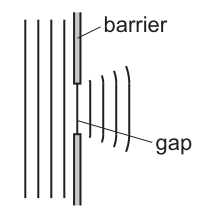
The wavelength of the wave and the width of the gap are both changed by a small amount.
Which combination of changes must increase the amount of spreading due to diffraction?
Options
| wavelength | width of gap | |
|---|---|---|
| A | decreases | decreases |
| B | decreases | increases |
| C | increases | decreases |
| D | increases | increases |
Working
Diffraction spreading increases when the gap width becomes comparable to wavelength , i.e. when increases.
To increase : increase and/or decrease .
Only option C does this (wavelength increases, gap width decreases).
Answer
C
C
Background Concept
Diffraction is the spreading of a wave as it passes through an aperture (gap) or around an obstacle. The key idea is that the amount of spreading depends on how the aperture size compares with the wavelength.
- If the gap width : very little spreading; the wavefronts remain almost straight.
- If : strong spreading; the wavefronts become strongly curved.
A useful way to express this is: diffraction increases as the ratio increases.
Understanding the Question
A water wave passes through a gap in a barrier. Initially the wavelength is much smaller than the gap width (so ), meaning diffraction is present but not maximal.
Both and are then changed by a small amount. The question asks: which pair of changes must make the diffraction spreading larger?
Approach
Use the qualitative rule “more diffraction when is larger relative to the gap”.
So check which option makes the ratio increase:
- increasing increases
- decreasing increases
The correct option must do at least one of these without doing the opposite change strongly enough to reduce the ratio.
Step-by-Step Reasoning
Let gap width be .
Consider the ratio controlling diffraction:
Check each option:
- A: decreases and decreases. One change decreases the ratio, the other increases it. Net effect is not guaranteed.
- B: decreases and increases. Both changes reduce (\Rightarrow) less diffraction.
- C: increases and decreases. Both changes increase (\Rightarrow) more diffraction.
- D: increases and increases. One change increases the ratio, the other decreases it. Net effect is not guaranteed.
Therefore, the only combination that must increase spreading is C.
Key Takeaways
- Diffraction increases when the aperture size becomes closer to the wavelength.
- Think in terms of the ratio : larger ratio (\Rightarrow) more spreading.
Common Mistakes
- Thinking “increasing gap always increases diffraction” (it generally decreases it).
- Choosing options A or D because “both change” without checking the relative effect using .
Things to Be Careful About
- The question says both quantities change by a small amount, but for options A and D the direction of net change in is still ambiguous without knowing the sizes of the changes.
- Use consistent wording: “wavelength much smaller than gap” means (weak diffraction), not strong diffraction.
Light of wavelength is incident normally on a diffraction grating. The grating has lines per mm. A number of diffraction maxima are observed on the far side of the grating.
What is the angle between the second-order maximum and the third-order maximum?
Options
A
B
C
D
Working
Lines per metre:
So grating spacing
Wavelength:
Using
Second order:
Third order:
Angle between them:
Answer
C
C
Background Concept
A diffraction grating produces principal maxima when light from many equally spaced slits interferes constructively. For normal incidence, the condition for the th order maximum is
where:
- is the grating spacing (distance between adjacent lines),
- is the angle of the maximum from the normal,
- is the order number (),
- is the wavelength.
The grating spacing is the reciprocal of the line density. If the grating has lines per unit length, then .
Understanding the Question
You are given monochromatic light with incident normally on a grating with lines per mm. You must find the angular separation between the second-order maximum () and the third-order maximum (), i.e. .
The key steps are:
- convert “lines per mm” into spacing in metres,
- use for and ,
- subtract the two angles.
Approach
- Convert line density: .
- Find .
- Compute for and .
- Use inverse sine to get and , then compute .
Step-by-Step Reasoning
- Convert the line density to SI units:
So
- Convert wavelength:
- Use the grating equation.
For the second order ():
For the third order ():
- The required angle between these maxima is the difference:
This matches option C.
Key Takeaways
- Convert line density to spacing using (in SI units).
- For normal incidence, maxima satisfy .
- The angular separation between two orders is the difference of their angles, not a ratio.
Common Mistakes
- Forgetting to convert to , giving wrong by a factor of .
- Using instead of .
- Subtracting the sine values instead of subtracting the angles.
- Mixing degrees and radians in the calculator.
Things to Be Careful About
- Check that ; otherwise that order cannot exist.
- Use sufficient precision when calculating before applying to avoid rounding errors.
- Ensure your calculator is in degree mode since the options are in degrees.
Two cylindrical conductors, X and Y, are made from the same material. The conductors have equal lengths, but Y has a smaller diameter than X.
X and Y are connected in series to a cell.
Which row compares the number of charge carriers per unit time passing through X and through Y and compares the average drift speed of the charge carriers in X and in Y?
Options
| number of charge carriers per unit time | average drift speed of charge carriers | |
|---|---|---|
| A | Y greater than X | Y greater than X |
| B | Y same as X | Y same as X |
| C | Y greater than X | Y same as X |
| D | Y same as X | Y greater than X |
Working
In series, the current is the same through X and Y, so the number of charge carriers passing per unit time is the same.
Using
for the same material and are the same, and is the same, so . Conductor Y has smaller diameter so smaller cross-sectional area , hence larger drift speed.
Answer
D
D
Background Concept
In a steady d.c. circuit, the electric current is the rate of flow of charge:
If the charge carriers each have charge and carriers pass a cross-section in time , then and so “number of charge carriers per unit time” is directly proportional to the current.
For a metal conductor, the drift-speed model relates current to carrier density and geometry:
where:
- is cross-sectional area,
- is number of free charge carriers per unit volume (depends on material),
- is average drift speed,
- is charge per carrier.
Understanding the Question
Two cylindrical conductors X and Y have the same length and are made of the same material, but Y has a smaller diameter (so smaller cross-sectional area). They are connected in series to a cell.
You must compare:
- the number of charge carriers per unit time through X and Y (i.e. compare the currents),
- the average drift speed in X and Y.
Approach
- Use the series-circuit rule: the same current flows through all components in series.
- Translate “number of charge carriers per unit time” into “current”.
- Use to see how drift speed depends on cross-sectional area when , and are fixed.
Step-by-Step Reasoning
- Number of charge carriers per unit time
In a series circuit, there is only one path, so the current is the same everywhere. Therefore the rate at which charge passes any cross-section is the same in X and Y.
So: Y same as X.
- Average drift speed
Use
Because X and Y are the same material, is the same (same carrier density) and is the same. Because they are in series, is the same.
Rearrange:
So with , , fixed,
Y has smaller diameter, so smaller , so larger .
Therefore: Y greater than X for drift speed.
Matching the row: current (carriers per unit time) same, drift speed greater in Y → Option D.
Key Takeaways
- In series, current is the same through every component.
- “Number of charge carriers per unit time” is another way of describing current.
- For the same material, drift speed increases when cross-sectional area decreases: .
Common Mistakes
- Thinking the thinner wire must have a smaller current in series; in series, current cannot differ at different points.
- Using resistance ideas alone and concluding incorrectly about carrier rate through each wire.
- Forgetting that smaller diameter means smaller cross-sectional area , not smaller length.
Things to Be Careful About
- The phrase “per unit time” is a strong cue to connect to current.
- Same material implies same (carrier density), which is essential to comparing drift speeds using .
- Drift speed is not the same as signal speed; it can differ between conductors even when the current is the same.
A copper wire is long and has a resistance of .
The resistivity of copper is .
What is the diameter of the wire?
Options
A
B
C
D
Working
For a uniform wire,
For a circular cross-section, so
Answer
C
C
Background Concept
The resistance of a uniform wire depends on:
- its length (longer wire (\rightarrow) more resistance),
- its cross-sectional area (thicker wire (\rightarrow) less resistance),
- the material property called resistivity .
These are related by
where:
- is resistance in ,
- is resistivity in ,
- is length in m,
- is cross-sectional area in .
If the wire is cylindrical, then
so once you find , you can find the diameter .
Understanding the Question
You are given a copper wire with:
The question asks for the wire’s diameter , and you must select the matching option.
Approach
- Use and rearrange to find .
- Use to solve for .
- Compare the calculated with the options (in metres).
Step-by-Step Reasoning
Start from the resistivity equation:
Rearrange for cross-sectional area :
Substitute the given values:
First multiply the numerator:
Now divide by :
Now relate area to diameter. For a circular cross-section:
So
and
Substitute :
So
This matches option C.
Key Takeaways
- Use to connect resistance to geometry and material.
- Rearranging to find is often the first step in wire questions.
- For a cylindrical wire, convert area to diameter using .
Common Mistakes
- Using instead of (gives a factor of 4 error).
- Forgetting that is in and diameter is in m.
- Mixing up rearrangement: writing (incorrect).
Things to Be Careful About
- Check units: must be in and in m to get in .
- When taking square roots in standard form, keep track of powers of ten carefully.
- In MCQ, a quick sense-check helps: a resistance near for a few metres of copper implies a fairly thin wire, so to m is plausible; m would be extremely thin.
A thermistor is connected to a cell with negligible internal resistance.
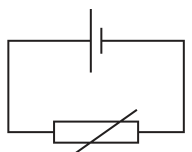
Which graph shows the variation with temperature of power, , dissipated in the thermistor?
Options
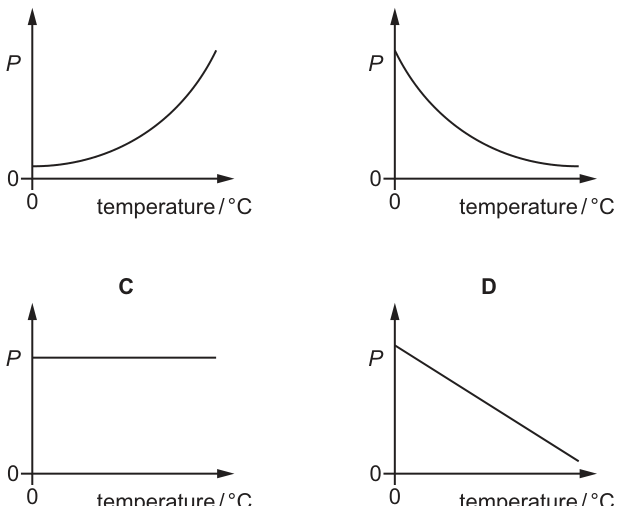
Working
Cell has negligible internal resistance so across thermistor is constant.
For an NTC thermistor, decreases as temperature increases.
So as temperature increases, decreases and increases (non-linearly).
Answer
A
A
Background Concept
A thermistor (in A-Level questions, usually an NTC thermistor) has a resistance that decreases as its temperature increases. The electrical power converted to thermal energy in a component can be written in several equivalent ways:
Which form is most useful depends on what is held constant by the circuit.
If a cell has negligible internal resistance, its terminal p.d. is essentially equal to its emf and stays (approximately) constant even when the current changes.
Understanding the Question
The circuit is just a single thermistor connected to an ideal cell. As temperature changes, the thermistor’s resistance changes, which changes the current and therefore the power dissipated in the thermistor. The question asks which of the four graphs best represents how power varies with temperature.
Key clue: “cell with negligible internal resistance” (\Rightarrow) the thermistor has (approximately) constant voltage across it.
Approach
- Use the fact that voltage across the thermistor is constant.
- Choose the power formula involving constant voltage: (P = V^2/R).
- Use the NTC thermistor behaviour: as temperature increases, (R) decreases.
- Deduce how (P) changes and match this qualitative shape to one of the graphs.
Step-by-Step Reasoning
- Negligible internal resistance means the full emf appears across the thermistor, so treat (V) as constant.
- Start from
- For an NTC thermistor, increasing temperature causes (R) to decrease.
- Since (V^2) is constant, decreasing (R) makes (P) increase.
- The resistance–temperature relationship for a thermistor is not linear (it typically falls rapidly with temperature), so (P = V^2/R) typically rises in a curved, increasingly steep way rather than a straight line.
- The only option showing power increasing with temperature in a curved upward manner is graph A.
Key Takeaways
- With an ideal cell (negligible internal resistance), the component p.d. is approximately constant.
- For constant (V): (P = V^2/R), so power increases when resistance decreases.
- For an NTC thermistor: temperature up (\Rightarrow) resistance down.
Common Mistakes
- Using (P = I^2R) without substituting (I = V/R): this can mislead because (I) is not constant here.
- Assuming thermistor resistance increases with temperature (confusing NTC with PTC).
- Choosing a straight-line decrease (like D) by wrongly thinking (P \propto R) under constant voltage.
Things to Be Careful About
- Always decide what is effectively constant in the circuit (here, (V) not (I)).
- Thermistor questions at this level almost always mean an NTC thermistor unless stated otherwise.
- Qualitative graph shape: thermistor (R(T)) is strongly non-linear, so expect a non-linear (P(T)) as well.
A metal electrical conductor has a resistance of . A potential difference (p.d.) of is applied across its ends.
How many electrons pass a point in the conductor in one minute?
Options
A
B
C
D
Working
Answer
C
C
Background Concept
Electric current is the rate of flow of charge:
so the charge that passes a point in time is:
For a conductor that obeys Ohm's law, the current is related to the applied potential difference and resistance by:
Each electron carries charge magnitude (elementary charge) . If total charge flows past a point, the number of electrons is:
Understanding the Question
You are given a resistance and an applied p.d. . The question asks for how many electrons pass a point in the conductor in one minute ().
So we need:
- current from and ,
- total charge in ,
- convert that charge into a count of electrons using .
Approach
- Convert into .
- Use .
- Use with .
- Use and compare with the options.
Step-by-Step Reasoning
Convert resistance:
Find the current using Ohm's law:
Charge passing in :
Convert charge to number of electrons:
This matches option C.
Key Takeaways
- Use to get current in a resistor.
- Use to find the total charge that flows in a given time.
- Convert charge to number of electrons with .
- Always convert prefixes (like ) to base units before calculating.
Common Mistakes
- Forgetting to convert to , giving a current times too large.
- Using instead of for one minute.
- Multiplying by instead of dividing by when finding the number of electrons.
Things to Be Careful About
- Keep track of powers of ten: .
- Use (magnitude) and ensure the final count is a pure number (no units).
- Round to match the options: rounds to .
Which circuit symbol does not represent an electric component that is designed to emit sound waves?
Options

Working
Symbols A, C and D are sound-emitting devices (buzzer/bell/loudspeaker style symbols). Symbol B is not a sound-emitting component.
Answer
B
B
Background Concept
Circuit diagrams use standard symbols to represent components. Some components are specifically designed to emit sound waves, such as:
- a buzzer/bell (often drawn as a bell-like semicircle or similar sounder symbol),
- a loudspeaker (often drawn with a cone/flared shape).
Other components (e.g. resistors, fuses, heaters, etc.) may dissipate energy or control current but are not designed to produce sound waves.
Understanding the Question
You are shown four circuit symbols (A, B, C and D) and asked which one does not represent an electrical component that is designed to emit sound.
So you must identify which symbols are clearly sounders (buzzer/bell/loudspeaker) and choose the remaining one.
Approach
- Recognise the common sound-emitter symbols (buzzer/bell/loudspeaker).
- Check each option:
- if it looks like a sounder, it is not the answer;
- the one that looks like a non-sound component is the answer.
Step-by-Step Reasoning
- A: described as a bell-like/semicircular sounder symbol → designed to emit sound.
- C: described as a loudspeaker/buzzer style symbol with a flared base → designed to emit sound.
- D: described as another bell/buzzer-like semicircular sounder symbol → designed to emit sound.
- B: described as a rectangular segmented block resembling a resistor-type symbol → not a component designed to emit sound.
Therefore the only symbol that does not represent a sound-emitting component is B.
Key Takeaways
- Learn and recognise standard circuit symbols, especially common output devices like buzzers/bells and loudspeakers.
- Use elimination: identify the three that clearly match “sound emitter”, leaving the remaining option.
Common Mistakes
- Confusing a non-sound component symbol (e.g. resistor/fuse) with a buzzer because both can look like simple blocks in some stylised drawings.
- Answering a symbol that could produce sound incidentally (e.g. a vibrating component) rather than one designed to emit sound.
Things to Be Careful About
- The question wording is specific: designed to emit sound waves. Only buzzers/bells/loudspeakers count.
- Pay attention to the distinctive “sounder” shapes (bell/semicircle or speaker cone) versus generic passive components drawn as rectangles.
The diagram shows a junction in a circuit where three wires, P, Q and R, meet. The currents in P and Q are and respectively, in the directions shown.
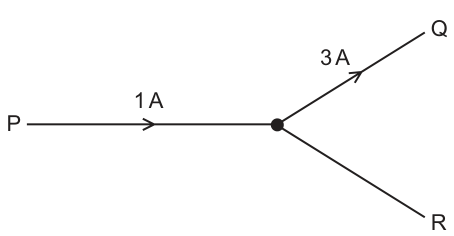
How much charge passes a given point in wire R in a time of ?
Options
A
B
C
D
Working
At the junction, total current in = total current out.
enters in wire P and leaves in wire Q, so wire R must provide an additional into the junction.
Answer
C
C
Background Concept
At any junction in a steady d.c. circuit, charge cannot build up. This leads to Kirchhoff’s first law (junction law):
Electric current is the rate of flow of charge :
Understanding the Question
We have three wires meeting at one junction. The current in wire P is towards the junction. The current in wire Q is away from the junction. We must find how much charge passes a point in wire R in .
So we need:
- the current in wire R (using the junction law),
- then the charge using .
Approach
- Decide which currents are entering and which are leaving the junction from the arrows.
- Use Kirchhoff’s first law to find the magnitude of the current in R.
- Multiply by time to get charge.
Step-by-Step Reasoning
- From the diagram: wire P carries into the junction, and wire Q carries out of the junction.
- Apply Kirchhoff’s junction law:
At the moment we only have entering but leaving. To balance, wire R must supply the missing current into the junction:
(So the current in R is and it must be directed towards the junction.)
3. Charge passing a point in wire R in time is:
So the correct option is C.
Key Takeaways
- At a junction, currents must balance: total in = total out.
- Use to convert from current and time to charge.
Common Mistakes
- Adding the currents instead of balancing in/out at the junction.
- Assuming wire R must be carrying but in the wrong direction (direction matters for in/out).
- Forgetting to multiply by time, or using instead of .
Things to Be Careful About
- Always read the arrow directions carefully before applying Kirchhoff’s first law.
- Keep units consistent: and give charge in .
- In MCQs, calculate the numerical value first (), then match to the option letter.
A cell of electromotive force (e.m.f.) and internal resistance is connected in series with a switch S and an external resistor of resistance .
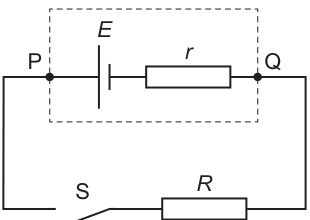
The potential difference (p.d.) between P and Q is .
Which statement is correct when S is changed from open to closed?
Options
A increases because there is a p.d. across .
B decreases because there is a p.d. across .
C remains the same because the decrease of p.d. across is balanced by the increase of p.d. across .
D remains the same because the sum of the p.d.s across and is still equal to .
Working
With open, so there is no p.d. across and the terminal p.d.
With closed, a current flows so there is a p.d. across the internal resistance :
Since , decreases.
Answer
B
B
Background Concept
A real cell can be modelled as an ideal source of e.m.f. in series with an internal resistance . When a current flows, there is a voltage drop across the internal resistance of magnitude . The potential difference measured between the external terminals of the cell (the terminal p.d.) is then
When no current flows (), there is no drop across , so the terminal p.d. equals the e.m.f.
Understanding the Question
Points P and Q are the cell terminals (the dashed box encloses the cell and its internal resistor ). The p.d. is specifically the p.d. between P and Q.
- With switch open, the circuit is broken, so no current flows.
- With switch closed, the external resistor is connected and a current flows.
The question asks what happens to the measured when we go from open switch to closed switch.
Approach
Treat the two cases separately:
- Switch open: set and find .
- Switch closed: current flows, so use to see whether increases, decreases, or stays the same.
Then match that conclusion to the option statements.
Step-by-Step Reasoning
1) Switch open
The circuit is incomplete, so
Therefore the p.d. across the internal resistance is
So the terminal p.d. (between P and Q) is
2) Switch closed
Now the circuit is complete, so current flows through and also through (series circuit). Hence
So there is a non-zero drop across the internal resistance:
Thus the terminal p.d. becomes
which is less than . Therefore, when changing from open to closed, decreases. The option that states this correctly, and gives the reason (a p.d. across ), is B.
Key Takeaways
- Terminal p.d. is the p.d. between the cell terminals and equals when current flows.
- Open circuit: .
- Closing the switch makes a drop across , so the terminal p.d. decreases.
Common Mistakes
- Thinking must equal even when current flows (forgetting internal resistance).
- Saying increases just because a resistor now has a p.d. across it (the terminal p.d. is reduced by the internal drop).
- Confusing the p.d. across with the p.d. between P and Q (they are equal only when the external circuit is the only element between P and Q; here P–Q is across the cell terminals).
Things to Be Careful About
- P and Q are the external terminals of the cell model (ideal source + internal resistance), so is the terminal voltage, not the e.m.f.
- When the switch is closed, the sum of p.d.s around the loop equals , but that does not mean the terminal p.d. stays the same; the internal drop reduces what appears at the terminals.
What is a general description of a baryon?
Options
A It consists of three quarks that must all be the same flavour.
B It consists of three quarks that do not need to be the same flavour.
C It consists of two quarks that must both be the same flavour.
D It consists of two quarks that do not need to be the same flavour.
Working
A baryon is a hadron made of three quarks (or three antiquarks), and the quarks may be different flavours (e.g. proton , neutron ).
Answer
B
B
Background Concept
In the quark model, hadrons are particles that experience the strong interaction and are made of quarks.
There are two main families:
- Baryons: composed of three quarks () or three antiquarks ().
- Mesons: composed of a quark and an antiquark ().
“Flavour” refers to the type of quark (up , down , strange , charm , bottom , top ). There is no requirement that the three quarks in a baryon all have the same flavour.
Understanding the Question
The question asks for a general description of a baryon in terms of how many quarks it contains and whether their flavours must match.
Options C and D describe particles made of two quarks, which does not match the baryon definition. Options A and B both have three quarks, but differ on whether they must all be the same flavour.
Approach
Recall the defining feature of a baryon: it is a hadron consisting of three quarks (not two). Then decide whether baryons can contain different flavours by checking standard examples like the proton and neutron.
Step-by-Step Reasoning
- A baryon is defined as a hadron made of three quarks () (or three antiquarks).
- Therefore, any option stating two quarks (C or D) must be incorrect.
- Check whether the three quarks must be the same flavour:
- Proton composition is .
- Neutron composition is .
These clearly use different flavours within the same baryon.
- Hence the correct general description is: three quarks that do not need to be the same flavour.
So the correct option is B.
Key Takeaways
- Baryons are three-quark hadrons ().
- Mesons are quark–antiquark hadrons ().
- The quarks in a baryon do not need to be the same flavour.
Common Mistakes
- Thinking a baryon is made of two quarks (confusing it with other composite ideas; in A-level, hadrons are classified as or ).
- Believing the quarks must all be the same flavour (contradicted by and ).
Things to Be Careful About
- The question asks for a general description: use the defining rule () rather than a special case.
- Remember: meson is not “two quarks” but specifically one quark and one antiquark.
A stationary nucleus has nucleon number .
The nucleus decays by emitting a proton with speed to form a new nucleus with speed . The new nucleus and the proton move away from one another in opposite directions.
Which equation gives in terms of and ?
Options
A
B
C
D
Working
Initial momentum is zero.
Let proton mass be and original nucleus mass be , so new nucleus has mass .
Conservation of momentum (opposite directions):
Answer
B
B
Background Concept
In an isolated system with no external forces, linear momentum is conserved. Momentum is
where is mass and is velocity (a vector). If the initial object is at rest, the total initial momentum is zero, so the vector sum of the momenta of the decay products must also be zero.
For nuclear problems at this level, it is standard to take the mass of a nucleus as proportional to its nucleon number (i.e. approximately times the nucleon mass), since binding-energy mass differences are neglected for momentum-ratio arguments.
Understanding the Question
A nucleus initially at rest has nucleon number . It decays by emitting a proton (mass ) with speed . The remaining daughter nucleus then has nucleon number and moves with speed . The proton and daughter nucleus move in opposite directions.
We are asked to find an equation for in terms of and , and then choose the correct option.
Approach
- Write the masses: original nucleus , daughter nucleus .
- Use conservation of momentum. Since initial momentum is zero and the two final momenta are opposite, their magnitudes must be equal.
- Solve for .
Step-by-Step Reasoning
Take the proton mass as . Then:
- parent nucleus mass
- daughter nucleus mass .
Initial momentum:
After decay, choose the proton direction as positive. Then the daughter nucleus moves in the negative direction.
Total final momentum:
Conservation of momentum gives:
Rearrange:
Cancel :
This matches option B.
Key Takeaways
- A decay from rest must produce momenta that cancel: the products recoil in opposite directions with equal and opposite momentum.
- Using nucleon number, the daughter nucleus mass is approximately times the proton (nucleon) mass.
- Be clear about vectors: opposite directions introduce a minus sign.
Common Mistakes
- Using mass for the daughter nucleus instead of .
- Treating speeds as velocities and forgetting the opposite directions (missing the sign, or incorrectly adding momenta).
- Assuming (only true if the masses were equal).
Things to Be Careful About
- The question states the particles move in opposite directions: this is the key reason you set momenta equal in magnitude.
- Mass proportional to nucleon number is an approximation used for such ratios; do not introduce binding energy corrections unless explicitly required.
- Ensure the final expression is in terms of and only, matching one of the options exactly.
What is the change to the quark composition of a nucleus that takes place during decay?
Options
A down to antiup
B down to up
C up to antidown
D up to down
Working
In (\beta^{+}) decay, a proton changes into a neutron:
Quark compositions:
So one up quark changes to a down quark: .
Answer
D
D
Background Concept
In beta decays, the nucleus changes its proton number by converting one nucleon into the other type via the weak interaction.
- A proton has quark composition .
- A neutron has quark composition .
So:
- (\beta^-) decay corresponds to , which at quark level is .
- (\beta^+) decay corresponds to , which at quark level is .
Understanding the Question
The question asks specifically what happens to the quark composition during (\beta^{+}) decay (positron emission). So we must translate the nuclear change (proton to neutron) into a change in quark flavour (up/down), then match it to an option.
Approach
- Recall what (\beta^{+}) decay does to a nucleon in the nucleus.
- Write the quark compositions of a proton and neutron.
- Compare them to identify which quark changes flavour.
- Choose the option that matches that change.
Step-by-Step Reasoning
- In (\beta^{+}) decay, the nucleus emits a positron. This happens when a proton changes into a neutron:
- Write the quark content:
- Compare to . Two quarks are the same (the two quarks in the neutron correspond to one already present in the proton plus one newly formed ), and the difference is that one of the proton’s quarks has become a quark:
- The option that states “up to down” is D.
Key Takeaways
- (\beta^{+}) decay is a proton-to-neutron conversion.
- Proton: , neutron: .
- Therefore (\beta^{+}) corresponds to .
Common Mistakes
- Mixing up (\beta^{+}) and (\beta^{-}): (\beta^{-}) is (neutron to proton), not .
- Choosing an option involving antiquarks: ordinary nuclear beta decay changes quark flavour within nucleons; it is not a quark–antiquark replacement statement.
Things to Be Careful About
- Always connect the decay type to whether proton number increases or decreases: (\beta^{+}) decreases proton number by 1 (because ).
- Remember the standard quark compositions and ; the comparison immediately reveals the required quark change.
What is the charge, in terms of the elementary charge , on a charm quark?
Options
A
B
C
D
Working
Up-type quarks (u, c, t) have charge .
So a charm quark has charge .
Answer
D
D
Background Concept
Quarks have fractional electric charges in units of the elementary charge .
There are two families (types) relevant here:
- Up-type quarks: each have charge .
- Down-type quarks: each have charge .
Antiquarks have the opposite charge to their corresponding quarks.
Understanding the Question
The question asks for the charge of a charm quark written in terms of , and then to pick the matching option.
So we just need to know whether charm () is up-type or down-type, and recall that family’s charge.
Approach
- Identify which group the charm quark belongs to.
- Use the standard quark charge values for that group.
- Choose the option that matches.
Step-by-Step Reasoning
- The charm quark symbol is .
- The quarks are the up-type quarks.
- Every up-type quark has charge:
- Therefore the charm quark has charge , which corresponds to option D.
Key Takeaways
- Memorise: have and have .
- The sign flips for antiquarks.
Common Mistakes
- Choosing by confusing quark with antiquark.
- Mixing up the families and using (down-type charge) for charm.
Things to Be Careful About
- The question is specifically about a charm quark, not an anticharm ().
- Keep the sign and fraction together: up-type is always positive .
Your score so far
Answer a question to start scoring
Your marks add up here as you work through the paper.