Physics 9702/23 — October/November 2024
Cambridge AS Level · AS Level Structured Questions · worked solutions for every part, with the mark scheme
Topics Forces, Density and Pressure · Kinematics · Dynamics · Work, Energy and Power · Deformation of Solids · Superposition · +4 more
Answer
Acceleration is the rate of change of velocity with time.
Rate of change of velocity with time.
Background Concept
Acceleration measures how quickly velocity changes. Since velocity is a vector (it has both magnitude and direction), acceleration is also a vector.
Mathematically,
where is acceleration, is the change in velocity, and is the time taken for that change.
Understanding the Question
You are asked for a definition, not a calculation. The expected statement should mention velocity (not speed) and the idea of change per unit time.
Approach
Use the standard kinematics definition: acceleration is how fast velocity changes with time.
Step-by-Step Reasoning
- Velocity is a vector quantity.
- Acceleration tells us how much the velocity changes in a given time.
- Therefore, acceleration is defined as “rate of change of velocity with time”.
Key Takeaways
- Acceleration is based on velocity, not speed.
- A correct definition uses the idea of rate of change (per unit time).
Common Mistakes
- Writing “rate of change of speed” (only correct in special cases where direction does not change).
- Forgetting “with time”.
- Saying “change in velocity” without specifying “per unit time / rate”.
Things to Be Careful About
- Because velocity is a vector, acceleration can be non-zero even if speed is constant (e.g. circular motion), so the definition must involve velocity.
A small aircraft is flying horizontally at a speed of at a height of above horizontal ground, as shown in Fig. 1.1.
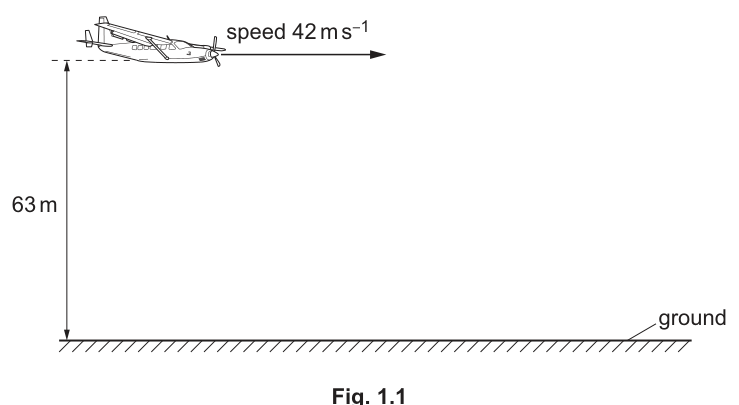
The aircraft drops a small parcel. The parcel is released from the aircraft at the instant shown in Fig. 1.1. Air resistance is negligible.
On Fig. 1.1, draw a line to show the path of the parcel as it falls from the aircraft to the ground.
Answer
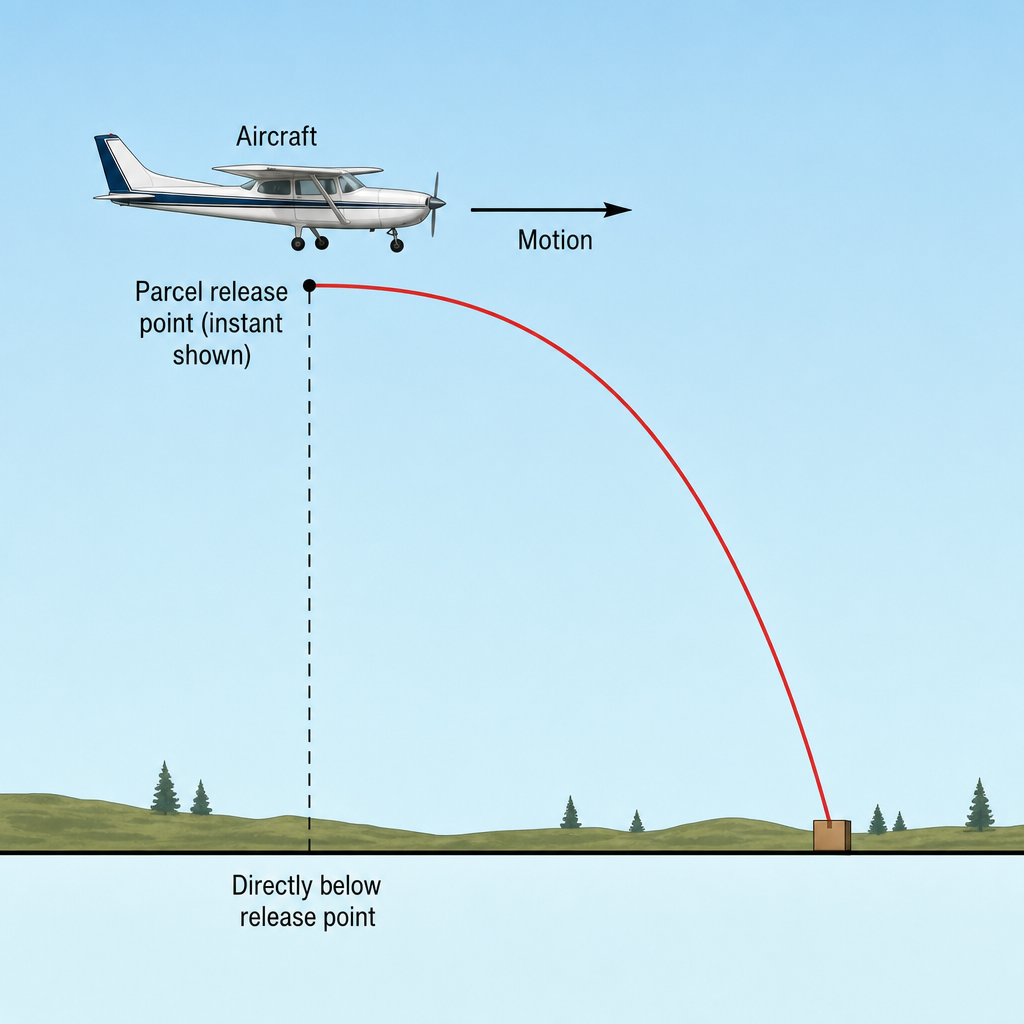
A forward-curving parabolic path to the right.
Background Concept
When air resistance is negligible, a dropped object keeps its horizontal velocity (no horizontal acceleration) while accelerating vertically downward due to gravity (). The two motions are independent:
- Horizontal: constant velocity
- Vertical: uniformly accelerated motion with acceleration
This combination produces a parabolic path (projectile motion).
Understanding the Question
The aircraft is moving horizontally at and releases the parcel. At the instant of release, the parcel has the same initial horizontal velocity as the aircraft, and zero initial vertical velocity. You must draw the path from release point to ground.
Approach
Sketch a projectile trajectory:
- Starts at the release point.
- Initially tangent is horizontal (because initial vertical velocity is zero).
- Curves downward more steeply as time increases.
- Moves to the right while falling.
Step-by-Step Reasoning
- At release: parcel has horizontal speed .
- With no air resistance, horizontal speed stays constant.
- Gravity causes increasing downward vertical speed.
- So the path curves downward (parabola), landing ahead of the point directly below the release.
Key Takeaways
- “Dropped from a moving object” does not mean it falls straight down.
- Horizontal motion continues at constant velocity while vertical motion accelerates.
Common Mistakes
- Drawing a vertical straight line down (ignores initial horizontal velocity).
- Drawing a straight diagonal line (should curve because vertical speed increases).
- Drawing it curving upward (gravity acts downward).
Things to Be Careful About
- The curve should start horizontal at the release point (since ) and become steeper downward.
- The aircraft continues forward, so the parcel’s path is not directly under the aircraft after release.
Calculate the time taken from the instant of release to the instant the parcel reaches the ground.
time = ______
Working
Vertical motion: , , .
Answer
3.6 s
Background Concept
In projectile motion with negligible air resistance, horizontal and vertical motions are independent. Time of flight is determined by the vertical motion only.
For vertical motion under gravity (constant acceleration ), the displacement equation is
where is vertical displacement, is initial vertical velocity, is vertical acceleration.
Understanding the Question
The parcel is released from height . At release, it has:
- initial vertical velocity (it is dropped, not thrown up or down),
- vertical acceleration downward,
- vertical displacement to the ground .
We want the time to reach the ground.
Approach
Use the vertical displacement equation with . The horizontal speed does not affect the time to fall.
Step-by-Step Reasoning
Take downward as positive (any consistent sign choice is fine):
Substitute into
so
Rearrange:
Key Takeaways
- Time to fall from height depends only on vertical motion.
- With , the equation simplifies to .
Common Mistakes
- Using the aircraft’s as in the vertical equation.
- Using (missing the factor ).
- Mixing sign conventions (e.g. taking but without care).
Things to Be Careful About
- Use because the parcel is dropped.
- Quote time to a sensible number of significant figures (here ).
Calculate the vertical component of the velocity of the parcel immediately before it reaches the ground.
vertical component of velocity = ______
Working
Answer
downward
35 m s⁻¹ downward
Background Concept
For motion with constant acceleration, velocity changes linearly with time:
In free fall (ignoring air resistance), the vertical acceleration is constant and equal to .
Understanding the Question
We want the vertical component of velocity just before impact. The parcel starts with no vertical component () and accelerates downward at for the time found in part (ii).
Approach
Use the vertical kinematics equation with and from (ii).
Step-by-Step Reasoning
- Initial vertical velocity: .
- Acceleration: .
- Time of flight: .
So
Direction is downward (since gravity accelerates downward), so the vertical component is about downward.
Key Takeaways
- Vertical speed increases by every second in free fall.
- The vertical component at impact depends on the time spent falling.
Common Mistakes
- Giving but not stating direction when asked for a component.
- Using (horizontal speed) instead of the vertical speed.
- Using but mixing signs incorrectly.
Things to Be Careful About
- State “downward” (or use a negative sign if you defined upward as positive).
- Keep consistent significant figures; rounds to or depending on expected precision.
Working
Horizontal component (constant).
Vertical component (downward).
Resultant speed:
Answer
55 m s⁻¹
Background Concept
In projectile motion (no air resistance):
- Horizontal velocity component is constant.
- Vertical velocity component changes due to gravity.
The speed is the magnitude of the velocity vector. If the components are perpendicular,
This is Pythagoras because and are at right angles.
Understanding the Question
At impact, the parcel has:
- horizontal component equal to its initial horizontal speed ,
- vertical component found in (iii) (downward).
You are asked for the speed (a scalar), so you need the magnitude of the combined velocity.
Approach
- Take .
- Take downward.
- Combine using .
Step-by-Step Reasoning
Horizontal component:
- No horizontal force (air resistance negligible), so horizontal acceleration is zero.
- Therefore,
Vertical component:
From (iii),
Resultant speed:
Key Takeaways
- The horizontal speed stays the same throughout (if no air resistance).
- “Speed” means magnitude of velocity: combine perpendicular components with Pythagoras.
Common Mistakes
- Adding components directly: (incorrect because they are perpendicular).
- Using only the vertical component as the speed.
- Changing due to gravity (gravity only affects vertical motion).
Things to Be Careful About
- Use magnitudes in the Pythagoras calculation; direction (“downward”) matters for describing components but speed is always positive.
- Keep consistent units ( throughout).
- Round appropriately (typically to 2 s.f. here: ).
Answer
The total momentum of a system remains constant, provided that no resultant external force acts on the system (i.e. the system is isolated).
Total momentum is constant if no resultant external force acts on the system.
Background Concept
Momentum is defined as
The principle of conservation of momentum states that for a system of interacting bodies, internal forces cannot change the total momentum of the system. Only a resultant external force can change the total momentum.
Mathematically,
So if , then and total momentum is constant.
Understanding the Question
You are asked to state the principle. That means you should give a clear sentence saying what is conserved (total momentum) and under what condition (no resultant external force / isolated system).
Approach
Write the conservation statement (total momentum before = total momentum after) and include the condition for it to be valid.
Step-by-Step Reasoning
- In any interaction (such as a collision), the forces the bodies exert on each other are internal forces.
- Internal forces occur in equal and opposite pairs and therefore cannot change the total momentum of the system.
- If there is no resultant external force on the system, then the total momentum cannot change, so it is conserved.
Key Takeaways
- Conservation of momentum is about the total momentum of a system.
- It is valid when the resultant external force is zero (or negligible).
Common Mistakes
- Forgetting to mention the condition (no external resultant force).
- Saying “momentum is always conserved” without specifying a system.
- Confusing momentum with kinetic energy (kinetic energy is not necessarily conserved).
Things to Be Careful About
- Momentum is a vector: direction matters.
- The “system” must be defined (e.g. both balls together), and external forces must be negligible (here the surface is frictionless, so horizontal external force is negligible).
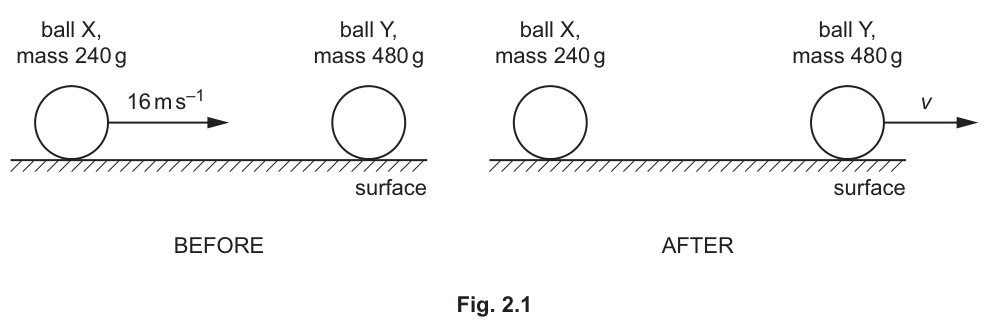
A ball X has mass and moves in a straight line on a horizontal frictionless surface with an initial speed of . The ball collides with a stationary ball Y that has mass . After the collision, ball X is stationary, as shown in Fig. 2.1.
Working
, .
Conservation of momentum:
Answer
8.0 m s^-1
Background Concept
In a collision on a frictionless horizontal surface, the resultant external horizontal force is negligible, so horizontal momentum is conserved.
For motion in a straight line, you can treat momentum as a signed scalar (choose right as positive):
Conservation means
Understanding the Question
Ball X (mass ) moves right at and hits ball Y (mass ) which is initially at rest. After collision, X is stationary and Y moves right with speed . You must show .
Approach
- Convert grams to kilograms.
- Write momentum before and after, taking right as positive.
- Use conservation of momentum and solve for .
Step-by-Step Reasoning
- Convert masses:
- Write momentum before collision:
- X is moving right at , so momentum is .
- Y is stationary, so its momentum is .
- Write momentum after collision:
- X is stationary, so its momentum is .
- Y moves right with speed , so momentum is .
- Set them equal:
- Solve:
The speed is positive, matching the diagram (Y moves to the right).
Key Takeaways
- Use momentum conservation when external forces are negligible.
- Stationary means so momentum contribution is zero.
- Always convert to SI units.
Common Mistakes
- Forgetting to convert to .
- Putting masses the wrong way round when solving for .
- Treating “speed” as always positive but then mishandling direction signs in momentum.
Things to Be Careful About
- Choose a sign convention (e.g. right positive) and stick to it.
- The question asks for speed (magnitude), but conservation of momentum is directional; here the direction is clearly to the right from the diagram.
Calculate the change in the total kinetic energy of the balls due to the collision.
= ______
Working
Initial total kinetic energy:
Final total kinetic energy ( stationary, ):
Answer
-15.4 J
Background Concept
Kinetic energy of an object of mass moving at speed is
In collisions:
- Momentum is conserved (if no resultant external force).
- Kinetic energy is only conserved in elastic collisions.
- If kinetic energy decreases, it has been transformed into other forms (internal energy, sound, deformation, etc.).
The change in total kinetic energy is defined as
Understanding the Question
You need the total kinetic energy of both balls before the collision and after the collision, then find the change due to the collision. From part (b)(i), after collision ball Y has speed and ball X is stationary.
Approach
- Compute initial total (only X is moving initially).
- Compute final total (only Y is moving finally).
- Subtract: final minus initial.
Step-by-Step Reasoning
- Initial kinetic energy:
- Ball X: , .
- Ball Y is stationary initially, so its kinetic energy is .
Thus total initial .
- Final kinetic energy:
- Ball X is stationary after, so its kinetic energy is .
- Ball Y: , .
- Change in kinetic energy:
The negative sign means the kinetic energy decreased by (energy was converted to other forms). A suitable rounded answer is .
Key Takeaways
- Always calculate total kinetic energy of the system (sum over all objects).
- Use ; a negative value indicates a loss of kinetic energy.
Common Mistakes
- Using momentum formula instead of kinetic energy formula .
- Forgetting that ball Y initially has zero kinetic energy.
- Giving without stating it is a loss (sign matters because is defined as final minus initial).
Things to Be Careful About
- Use masses in .
- Keep enough significant figures through the working; round at the end.
- The question explicitly asks for (not “energy lost”), so the negative sign is appropriate.
The collision in (b) lasts for a time of . Assume that the contact force between the balls is constant during this time.
Determine the magnitude and direction of the force exerted on ball X by ball Y during the collision.
magnitude = ______
direction ______
Working
For ball X: , (to the right), .
Collision time .
Answer
Magnitude
Direction: to the left (opposite to the initial motion of X).
1.9 × 10^3 N to the left
Background Concept
Force is related to momentum by
The quantity is the change in momentum (also called the impulse). If the force is constant during the interaction time, then
Because momentum is a vector, the direction of the force is the direction of .
Understanding the Question
The collision lasts and the contact force is assumed constant. Ball X (mass ) initially moves to the right at and ends stationary. You must find the magnitude and direction of the force on X due to Y.
Approach
- Choose right as the positive direction.
- Find the change in momentum of ball X: .
- Divide by the collision time (converted from ms to s) to get the force.
- The sign tells the direction.
Step-by-Step Reasoning
-
Set sign convention: right is positive.
-
Write initial and final velocities for X:
- Compute change in momentum:
The negative sign means X's momentum changed in the leftward direction.
- Convert the time:
- Compute the force:
So the magnitude is (often rounded to ) and the direction is to the left.
Key Takeaways
- Impulse method: .
- Always convert milliseconds to seconds.
- Use the sign of (or ) to state direction.
Common Mistakes
- Using without having (or finding) the acceleration correctly.
- Forgetting to convert to seconds.
- Giving only a magnitude with no direction.
- Using but then forgetting this changes the sign.
Things to Be Careful About
- The force asked is “on ball X by ball Y”, so you must use ball X's change in momentum.
- Significant figures: the time is given as (2 s.f.), so to 2 s.f. is reasonable.
- Direction wording: “to the left” or “opposite to the motion of X”.
Compare the magnitude and direction of the force exerted on ball Y by ball X during the collision with the answers in (c)(i). No further calculations are required.
Answer
By Newton's third law, the force exerted on ball Y by ball X has the same magnitude as in (c)(i) but is in the opposite direction.
So it is to the right.
Same magnitude, opposite direction (1.9 × 10^3 N to the right on Y).
Background Concept
Newton's third law states that when two bodies interact, they exert forces on each other that are:
- equal in magnitude,
- opposite in direction,
- of the same type,
- acting on different bodies.
Symbolically, for bodies X and Y:
Understanding the Question
In (c)(i) you found the force on ball X due to ball Y during contact. Now you must compare the force on ball Y due to ball X with that result, without doing new calculations.
Approach
Use Newton's third law for the contact interaction between the balls.
Step-by-Step Reasoning
- The contact force is an interaction pair: “force on X by Y” and “force on Y by X”.
- Newton's third law guarantees these two forces are equal in magnitude and opposite in direction at every instant (so also for their constant value in this question).
- Since in (c)(i) the force on X by Y was to the left, the force on Y by X must be to the right, with the same magnitude.
Key Takeaways
- Third-law pairs are equal and opposite and act on different bodies.
- You do not need any numbers to compare them once you know one of the forces.
Common Mistakes
- Saying the forces are equal and opposite but both acting on the same ball.
- Confusing Newton's third law with equilibrium (equal and opposite forces on the same object do not generally occur in this collision).
Things to Be Careful About
- State both the magnitude comparison and the direction comparison.
- Make sure you label the forces correctly: “on Y by X” is the opposite of “on X by Y”.
Answer
For a body in equilibrium, the sum of clockwise moments about any point equals the sum of anticlockwise moments about that point (net moment is zero).
For a body in equilibrium, the sum of clockwise moments about any point equals the sum of anticlockwise moments about that point (net moment is zero).
Background Concept
The moment of a force about a point (pivot) measures its turning effect:
where is the force and is the perpendicular distance from the pivot to the line of action of the force.
A body is in rotational equilibrium when its angular acceleration is zero. This happens when the resultant (net) moment about the pivot is zero.
Understanding the Question
You are asked to state the principle of moments. This is the standard condition used for a rigid body balanced on a pivot.
Approach
Give the equilibrium condition in words (or symbols): clockwise moments balance anticlockwise moments about the same point.
Step-by-Step Reasoning
- In equilibrium, there is no tendency to rotate.
- Therefore the total turning effect in one direction must equal the total turning effect in the opposite direction.
- So, about any chosen pivot:
(Equivalently, with a sign convention.)
Key Takeaways
- Moment is perpendicular distance.
- Rotational equilibrium requires zero net moment.
Common Mistakes
- Saying “forces are equal” instead of “moments are equal”.
- Forgetting that the distance must be perpendicular.
Things to Be Careful About
- The principle refers to moments about a point/pivot, not just any distances.
- Use consistent clockwise/anticlockwise convention if writing it as .
A rigid uniform beam rests on a pivot at its centre, as shown in Fig. 3.1.
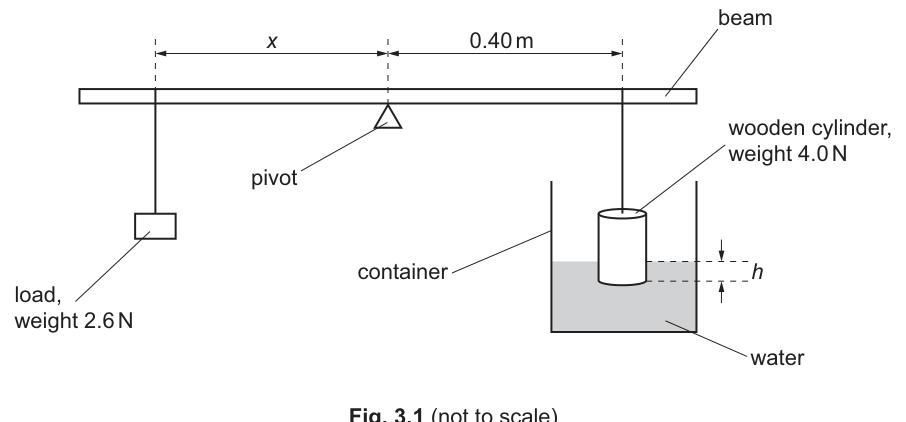
A load of weight is suspended from the beam at distance from the pivot.
A wooden cylinder of weight is suspended from the beam at a distance of from the pivot on the opposite side of the pivot to the load. The cylinder rests in a container of water. The lower part of the cylinder is immersed in the water to depth .
Initially, is equal to and is equal to . The system is in equilibrium.
Use the principle of moments to show that the upthrust exerted by the water on the cylinder is .
Working
About the pivot (beam weight has no moment):
Clockwise moment = anticlockwise moment
With :
Answer
1.4 N
Background Concept
A rigid body on a pivot is in equilibrium when the net moment about the pivot is zero:
When an object is immersed in water, an upthrust (buoyant force) acts upward. If the object is supported by a string, the force transmitted to the support is the apparent weight:
This is the downward force that produces a turning effect on the beam at the point of suspension.
Understanding the Question
The beam is pivoted at its centre and is uniform, so the beam’s own weight acts through the pivot and produces no moment.
Given initially:
- load weight at distance on one side,
- cylinder weight at distance on the other side,
- cylinder experiences upthrust .
You must use moments to show .
Approach
- Identify the force the cylinder applies to the beam: it is not but .
- Take moments about the pivot (so the pivot reaction is eliminated).
- Equate clockwise and anticlockwise moments and solve for .
Step-by-Step Reasoning
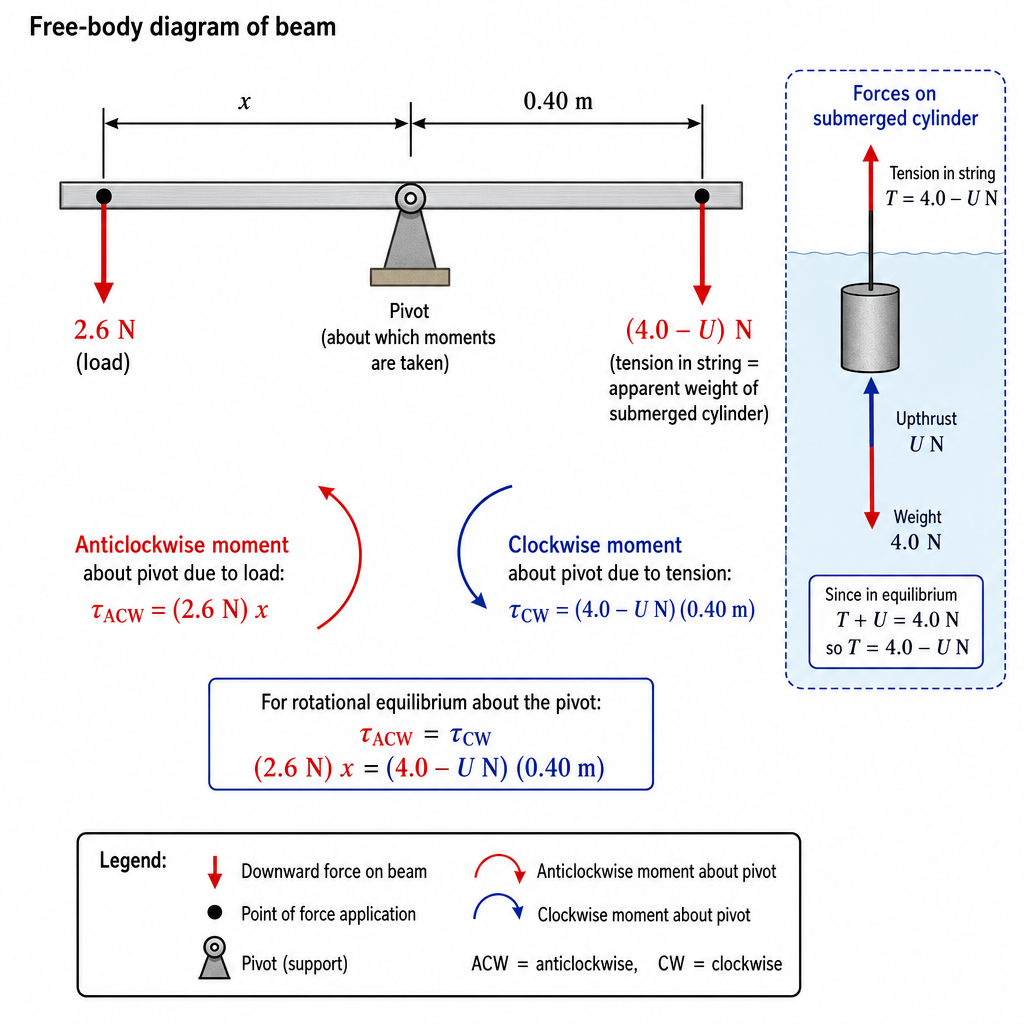
- The load produces a moment about the pivot of magnitude .
- The cylinder side produces a moment from the tension in the string. For the cylinder:
This same tension acts downward on the beam at the suspension point, so the moment from that side is .
- Set moments equal (system in equilibrium):
- Substitute :
- Cancel and solve:
Key Takeaways
- Upthrust reduces the force transmitted to the support: .
- For a uniform beam pivoted at its centre, the beam’s weight causes no moment about the pivot.
Common Mistakes
- Using as the force on the beam instead of .
- Forgetting to take moments about the pivot (and incorrectly including the pivot reaction).
- Using the immersion depth in part (i) (it is not needed here).
Things to Be Careful About
- Moments use perpendicular distances (here they are given directly along the beam).
- Keep units consistent (distances in , moments in ).
The density of the water is .
Calculate the area of the circular cross-section of the cylinder.
= ______
Working
Upthrust equals weight of displaced water:
So
Answer
1.4 × 10^-3 m^2
Background Concept
Archimedes’ principle states that the upthrust on a body immersed in a fluid equals the weight of the fluid displaced:
where is the fluid density, is gravitational field strength, and is the displaced volume.
For a uniform cylinder with cross-sectional area immersed to a depth (and not fully submerged), the displaced volume is:
So:
Understanding the Question
You are given:
- upthrust from (b)(i): ,
- water density: ,
- immersed depth initially: .
You must find the cylinder’s cross-sectional area .
Approach
Use , rearrange for , and substitute the values in SI units.
Step-by-Step Reasoning
Start with Archimedes’ principle in the useful form:
Rearrange to isolate :
Substitute the given values:
Compute the denominator:
So:
To appropriate significant figures:
Key Takeaways
- Buoyant force: .
- For a cylinder immersed to depth : .
- Always keep SI units throughout.
Common Mistakes
- Using without realising already represents cross-sectional area.
- Using as without converting to .
- Omitting (writing ).
Things to Be Careful About
- The formula assumes the cylinder is not fully submerged and has uniform cross-section.
- Quote area in and use a sensible number of significant figures.
More water is gradually added to the container in (b), so that depth in Fig. 3.1 gradually increases. The length is continuously adjusted so that the system remains in equilibrium.
On Fig. 3.2, sketch the variation of with . Use the space below for any working.
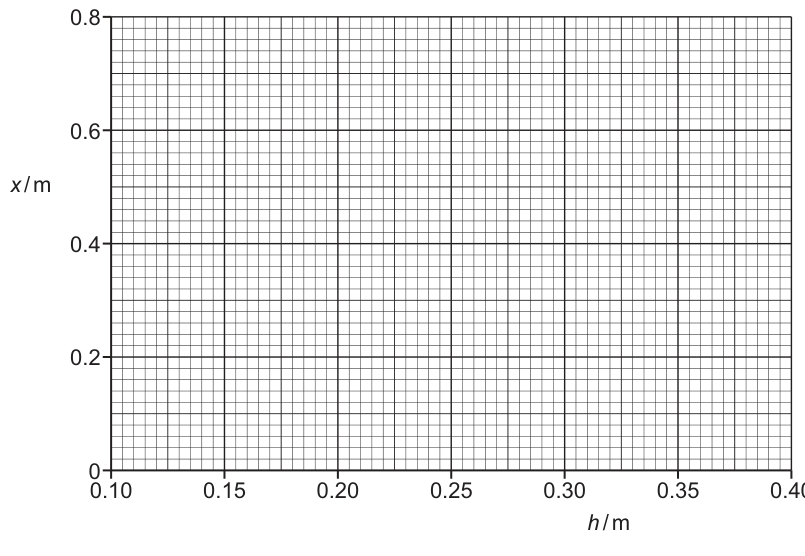
Working
For equilibrium about the pivot:
and
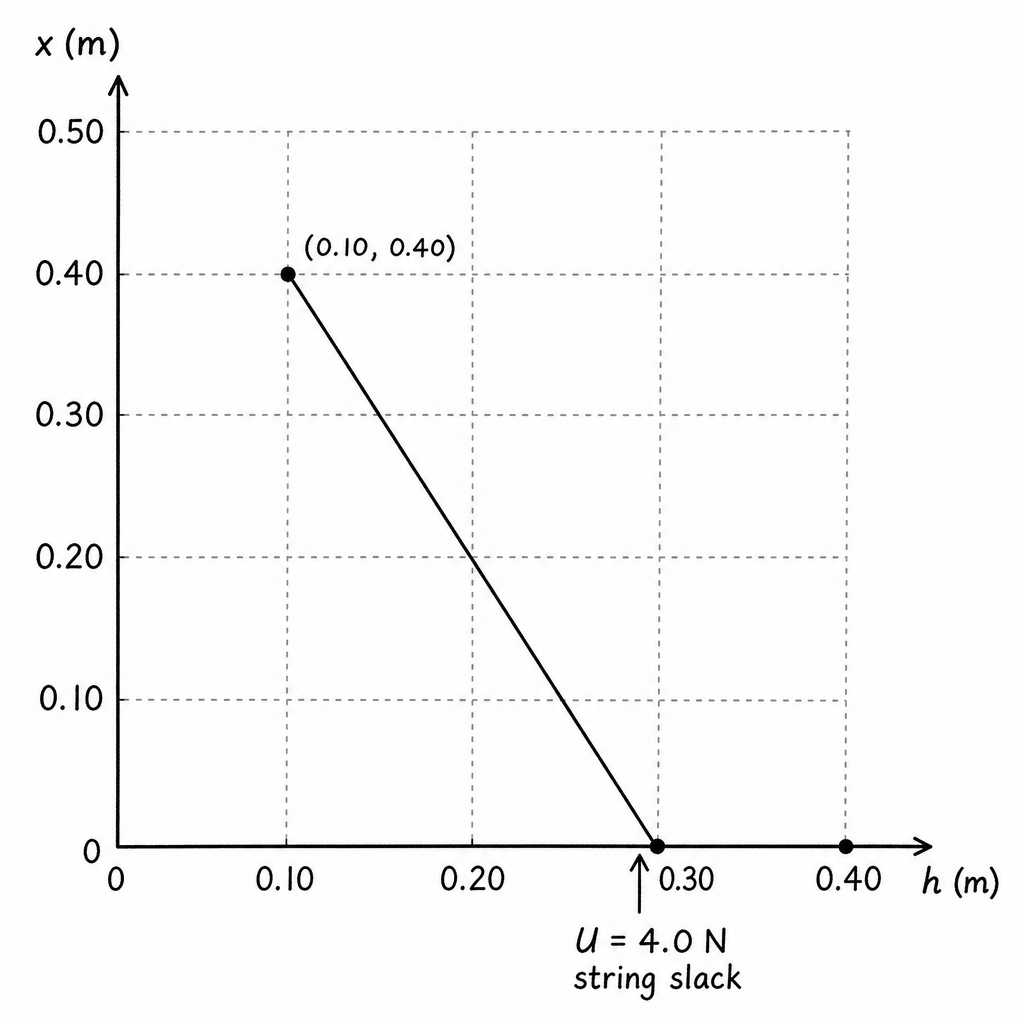
So decreases linearly with until , when and hence . For larger , the string is slack and the cylinder provides no moment, so remains .
Answer
Sketch: straight line from falling to at , then a horizontal line at up to .
A straight-line decrease of x with h to x = 0 at h ≈ 0.29 m, then x stays at 0.
Background Concept
The beam stays balanced when moments about the pivot balance:
The key physics change as water level rises is that upthrust increases with displaced volume:
So, while the cylinder is being immersed more deeply (and not yet floating freely), is directly proportional to , meaning the apparent weight decreases linearly with .
Understanding the Question
As more water is added, the immersed depth increases. You then adjust the load position so that the beam stays in equilibrium.
You must sketch how depends on on the given axes (from to ).
Approach
- Write the general moments equation relating and .
- Use so that .
- Conclude is a linear decreasing function of while the string is taut.
- Identify the limit when the cylinder no longer pulls down on the beam: this happens when reaches (apparent weight becomes zero), after which the cylinder cannot provide an upward push through a string, so the moment from that side is zero and must be zero.
Step-by-Step Reasoning
Start from the equilibrium condition about the pivot (true for all while the cylinder exerts a downward force on the beam):
Rearrange for :
Use buoyancy:
Therefore:
This has the form , so the graph is a straight line with negative gradient.
Now find where the straight line reaches (this is where the cylinder’s apparent weight becomes zero):
Using proportionality from the initial condition ( at ):
So when :
For greater than this, would exceed , meaning the tension would be negative. A string cannot provide a pushing force, so it goes slack and the cylinder provides no downward force on the beam. Hence the right-hand moment becomes zero, so the left-hand moment must also be zero, which requires:
So the sketch is:
- a straight line from down to ,
- then a horizontal line along until .
Key Takeaways
- As immersion depth increases, increases linearly.
- The cylinder’s apparent weight decreases linearly, so decreases linearly.
- Physical constraints matter: when the string cannot push, so the cylinder stops contributing to moments.
Common Mistakes
- Sketching increasing with (it must decrease because buoyancy reduces the turning effect of the cylinder side).
- Extending the straight line into negative values (not meaningful here).
- Not recognising the change after (graph should flatten at ).
Things to Be Careful About
- The given axis range up to is larger than the value where reaches , so you should show the ‘cut-off’ behaviour.
- Your sketch should pass through the known initial point
Define:
Answer
Stress is the force per unit cross-sectional area:
Stress is force per unit cross-sectional area, F/A.
Background Concept
When a force acts to stretch (or compress) a material, the internal forces within the material are described using stress. Stress is used rather than force because it takes account of how spread out the force is over the cross-section.
Stress is defined by
where:
- is stress (in pascals, ),
- is the tensile (or compressive) force (in newtons, ),
- is cross-sectional area (in ).
Understanding the Question
The question asks for the definition of stress. No numbers are needed; you just need the correct ratio and (implicitly) the correct physical meaning.
Approach
Give the standard definition: “force per unit area”, and (optionally) the formula .
Step-by-Step Reasoning
- Identify that stress relates a stretching force to the size of the cross-section carrying that force.
- Write the ratio:
- State it in words: force per unit cross-sectional area.
Key Takeaways
- Stress measures how concentrated a force is.
- and its unit is .
Common Mistakes
- Writing stress as or .
- Saying “force per unit length” (that is not stress).
Things to Be Careful About
- Use cross-sectional area (area perpendicular to the force).
- Ensure the quantity is a ratio, not just a description like “force on a wire”.
Answer
Strain is the extension per unit original length:
Strain is extension divided by original length, ΔL/L.
Background Concept
Strain describes how much a material changes length compared with its original length. Because it is a ratio of two lengths, strain has no unit.
It is defined as
where:
- is strain (dimensionless),
- is the extension (in ),
- is the original length (in ).
Understanding the Question
You are asked to define strain. This is a standard definition used with Young modulus.
Approach
State the ratio “extension/original length” and, if helpful, write .
Step-by-Step Reasoning
- Recognise strain compares a change in length to the original length.
- Write the ratio:
- Mention (or remember) it is dimensionless since metres cancel.
Key Takeaways
- Strain is a fractional change in length.
- and it has no unit.
Common Mistakes
- Using (inverted).
- Giving a unit for strain (e.g. ).
Things to Be Careful About
- Use the original (unstretched) length for .
- must be the change in length, not the final length.
Two wires X and Y, with equal unstretched lengths of , are suspended from fixed points that are at the same horizontal level. The lower ends of the wires are attached to a beam of negligible mass. The beam is horizontal and in equilibrium, as shown in Fig. 4.1.
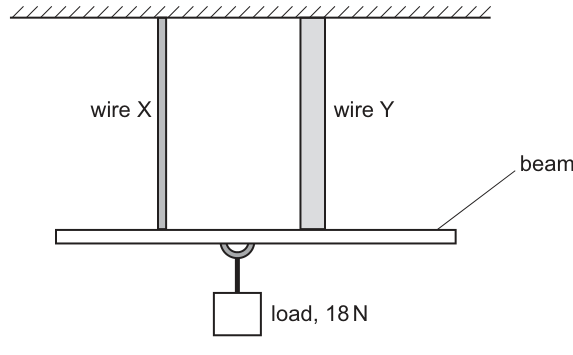
Wire X is made from a metal that has a Young modulus of .
Wire Y is made from a different metal.
A load of weight is suspended from the beam at a point that is equidistant from the two wires. This load causes both wires to extend by .
Working
Load is at the midpoint, so tensions are equal:
Young modulus:
So
With , , , :
Answer
8.5 × 10^-6 m^2
Background Concept
For a wire under tension:
- stress
- strain
- Young modulus:
Combining these gives a very useful working form:
So if you know , , and , you can find the cross-sectional area .
In addition, for a beam in equilibrium, the net force is zero and the net moment about any point is zero. Here the load is placed halfway between the two supporting wires, so the support forces must be equal by symmetry.
Understanding the Question
Two equal-length wires support a light horizontal beam. A load of weight is hung at the midpoint between the wires. Both wires extend by the same amount .
You are told wire X has Young modulus . You must determine the cross-sectional area of wire X.
Key ideas:
- Because the load is in the middle, each wire takes half the load.
- Use the Young modulus equation to relate force and extension to area.
Approach
- Use equilibrium/symmetry to find the tension in wire X.
- Convert the extension from mm to m.
- Rearrange to solve for .
- Substitute values carefully with SI units.
Step-by-Step Reasoning
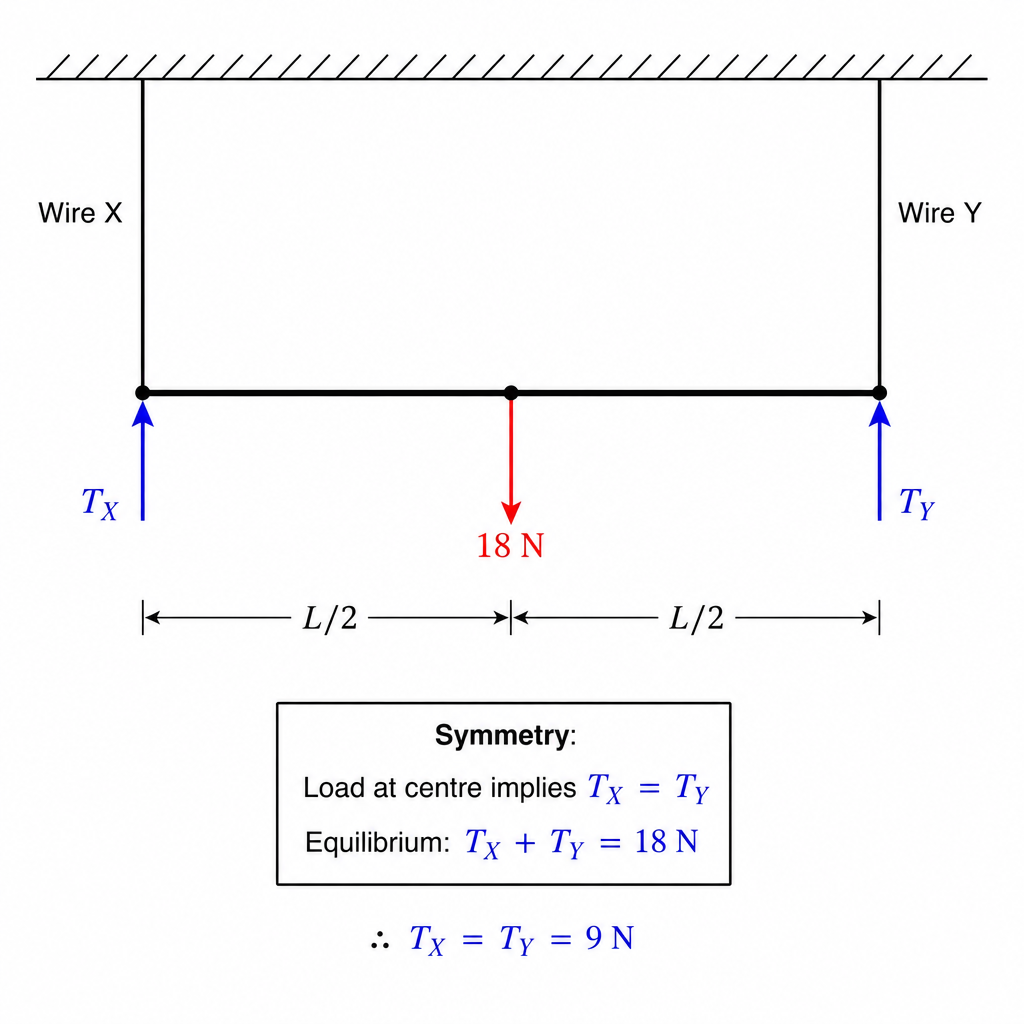
- Find the force in wire X.
The beam is symmetrical and the load acts at the midpoint. For rotational equilibrium about the midpoint, the two upward tensions must be equal. Also, for vertical force equilibrium:
With :
- Convert the extension.
- Use Young modulus.
Start from
Rearrange for :
- Substitute.
Compute numerator: .
Compute denominator: .
So
Key Takeaways
- With a central load on a symmetric support, each support force is half the load.
- For stretching:
- Always convert mm to m before substituting into SI equations.
Common Mistakes
- Using for a single wire instead of .
- Forgetting to convert to metres.
- Rearranging wrongly (e.g. putting in the numerator).
- Giving area in or missing the unit.
Things to Be Careful About
- The equality of tensions comes from symmetry and equilibrium (load exactly midway).
- Young modulus is in pascals (), so lengths must be in metres and area in .
- Quote the final answer to a sensible number of significant figures (typically 2–3).
Wire Y has a greater diameter than wire X.
Explain, without calculation, whether the Young modulus of the metal from which wire Y is made is less than, the same as or greater than .
Answer
The load is at the midpoint so wire Y has the same tension as wire X. Both wires have the same extension and original length, so they have the same strain.
Wire Y has a larger area, so for the same force its stress is smaller. Since
a smaller stress with the same strain means for wire Y is less than .
Less than 1.9 × 10^9 Pa
Background Concept
Young modulus is defined as
For a stretched wire:
- stress depends on the force and the cross-sectional area.
- strain depends on how much the wire extends compared with its original length.
So if two wires have the same strain but different stress, the one with the smaller stress must have the smaller Young modulus.
Understanding the Question
Both wires extend by the same amount and have the same original length , so they undergo the same strain.
The load is placed midway between them, so each wire supports the same force.
Wire Y has a greater diameter, so it has a larger cross-sectional area than wire X.
You must decide whether is less than, equal to, or greater than , and justify it without doing any arithmetic.
Approach
- Argue that the tensions (forces) in X and Y are equal.
- Use diameter information to compare areas.
- Use to compare stresses.
- Use with equal strain to compare Young moduli.
Step-by-Step Reasoning
- Equal force: the beam is symmetric with the load at the midpoint, so the upward forces from the two wires must be equal for rotational equilibrium. Hence .
- Equal strain: both have the same extension and the same original length , so
- Compare stresses: wire Y has larger diameter larger area . With the same force,
- Compare Young moduli: since and but , it follows that
Key Takeaways
- Same and same means same strain.
- Larger diameter means larger and therefore smaller stress for the same force.
- With equal strain, smaller stress implies smaller Young modulus.
Common Mistakes
- Thinking “thicker wire means larger Young modulus” (Young modulus is a material property, independent of dimensions).
- Assuming the forces in the two wires are different even though the load is at the midpoint.
- Mixing up stress and strain (or stating they are both smaller).
Things to Be Careful About
- The conclusion depends on same force and same strain. Here, both are true because the load is central and both extensions are stated equal.
- Young modulus compares materials; diameter changes stress for a given force but does not directly change unless you infer it from the observed extension.
A stationary wave is formed on a string XY that has a length of . Fig. 5.1 shows the string at one instant in time.
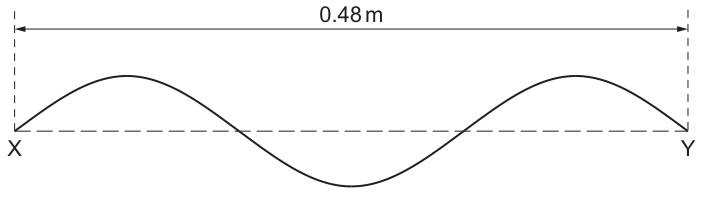
The speed of the wave on the string is .
On Fig. 5.1, draw a cross () at one position that is a node and another cross at one position that is an antinode. Label the node N and the antinode A.
Answer
Node : at a point of zero displacement (e.g. at end or ).
Antinode : at the centre of any loop (maximum displacement).
Node at a zero-displacement point (e.g. X or Y); antinode at centre of a loop.
Background Concept
In a stationary wave on a string, two waves of the same frequency and amplitude travel in opposite directions and superpose.
- A node is a point that is always at zero displacement (no oscillation).
- An antinode is a point that oscillates with maximum displacement.
For a string fixed at both ends, the ends must be nodes.
Understanding the Question
You are shown the shape of a stationary wave on a string at one instant. You must mark one node and one antinode on the diagram and label them and .
Approach
Use the defining features:
- Nodes occur where the string crosses its equilibrium position and stays there at all times (in the diagram these are the points separating adjacent loops; the fixed ends are also nodes).
- Antinodes occur at the centres of loops, where the displacement is largest.
Step-by-Step Reasoning
- Look for points that must always be stationary. Since the string is between and and fixed, and are nodes.
- Choose any loop (any “bulge”). The midpoint of that loop is an antinode because it is furthest from the equilibrium position.
- Place a cross at one node (e.g. at ) and label it .
- Place a cross at the centre of any loop and label it .
Key Takeaways
- Nodes: zero displacement, including fixed ends.
- Antinodes: maximum displacement at the centre of each loop.
Common Mistakes
- Marking a point on the string that is simply at zero displacement at that instant (a node is zero at all times, not just in the snapshot).
- Labelling the end of a loop as an antinode (loop ends are nodes).
Things to Be Careful About
- Any correct node/antinode pair earns the mark; you do not need to choose a specific one.
- Ensure labels and are next to the correct crosses.
Working
There are loops on the string, and each loop corresponds to .
So
Answer
0.32 m
Background Concept
For a stationary wave on a string fixed at both ends:
- Adjacent nodes are separated by .
- Each “loop” (one bulge between two neighbouring nodes) has length .
So if you can count the number of loops along the string, you can relate the total length to .
Understanding the Question
The string length is . From the diagram, you can count how many loops (segments between nodes) fit into this length. You must use that to show the wavelength is .
Approach
- Count the number of loops between and .
- Use:
- Rearrange to find .
Step-by-Step Reasoning
- From the snapshot in Fig. 5.1, the standing wave has three loops between and .
- Each loop is between two nodes, so its length is .
- Therefore the total length is
- Rearranging:
This matches the value you were asked to show.
Key Takeaways
- In a standing wave on a string, one loop corresponds to .
- Total length = (number of loops) .
Common Mistakes
- Using instead of .
- Counting “waves” incorrectly: the diagram shows loops, not full wavelengths.
Things to Be Careful About
- Make sure you count loops between nodes, not peaks.
- Keep units consistent; is already in metres so comes out in metres.
Working
Answer
4.38 × 10^3 Hz
Background Concept
For any wave,
where:
- is wave speed ()
- is frequency ()
- is wavelength ()
This relationship is always true for a wave with a single frequency and wavelength.
Understanding the Question
You are given the wave speed on the string, , and from part (a)(ii) the wavelength is . You must calculate the frequency.
Approach
Rearrange the wave equation to
then substitute the given values and calculate.
Step-by-Step Reasoning
- Start from:
- Rearrange for :
- Substitute:
- Calculate:
- To 3 s.f.:
Key Takeaways
- Use to connect speed, frequency, and wavelength.
- Frequency is inversely proportional to wavelength for fixed wave speed.
Common Mistakes
- Using instead of .
- Dropping units or writing without stating .
Things to Be Careful About
- Ensure is in metres (not cm).
- Quote a sensible number of significant figures (typically 2–3 s.f.).
A source of sound waves of frequency is on a rotating platform. The speed of the source is .
The sound is detected by an observer that is a large distance from the rotating platform, as shown in Fig. 5.2.
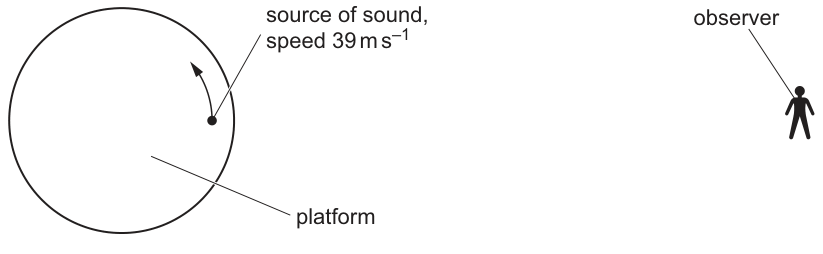
The speed of sound in air is .
Calculate the maximum frequency of the sound detected by the observer.
maximum frequency = ______
Working
Maximum detected frequency occurs when the source moves directly towards the observer.
Answer
8.88 × 10^2 Hz
Background Concept
The Doppler effect is the change in observed frequency due to relative motion between source and observer.
For a moving source and a stationary observer (sound speed ):
- When the source moves towards the observer,
- When the source moves away from the observer,
where is the component of the source velocity along the line joining source to observer.
Understanding the Question
Given:
- emitted frequency
- speed of sound
- source speed on a rotating platform
You need the maximum frequency detected by a distant observer. “Maximum” occurs when the velocity component towards the observer is greatest (i.e. the full speed is directed towards the observer).
Approach
Use the Doppler formula for a moving source towards the observer, taking for the maximum case.
Step-by-Step Reasoning
- Maximum frequency corresponds to maximum approach speed along the line of sight, so take .
- Use:
- Substitute values:
- Evaluate the denominator: .
- Compute:
so
Key Takeaways
- For a moving source, approaching motion increases observed frequency.
- Use in the denominator for approach; for recession.
Common Mistakes
- Using the wrong sign (using for approach).
- Using (forgetting you need the component along the observer line).
Things to Be Careful About
- is the component towards the observer; “maximum” means that component equals the given source speed.
- Keep and in the same units ().
At time , the observer detects the sound emitted by the source when it was in the position shown in Fig. 5.2.
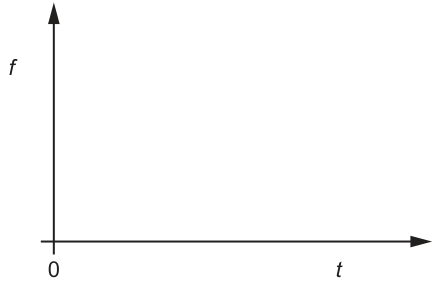
On Fig. 5.3, sketch the variation with of the frequency of the sound detected by the observer for one complete rotation of the platform. Calculations are not required.
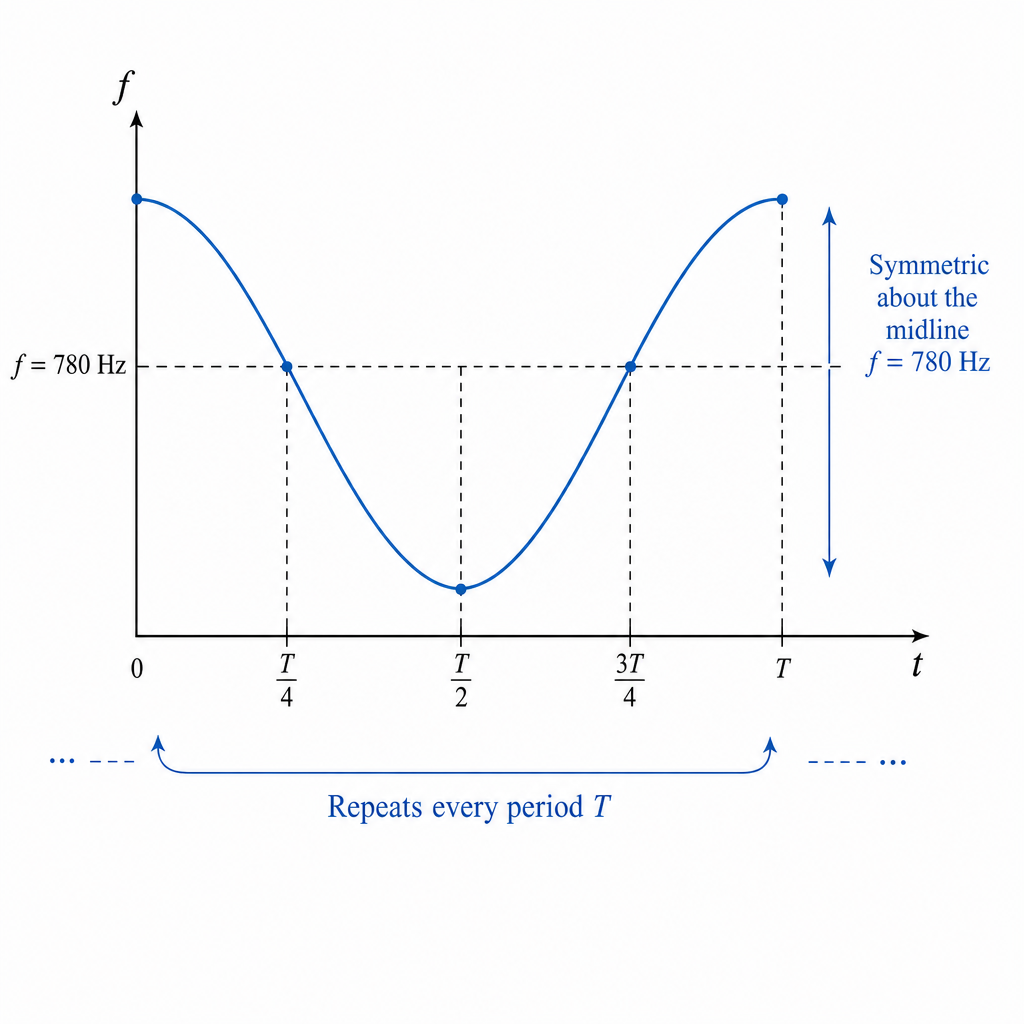
Answer
Sketch a smooth periodic curve about :
- is maximum at ,
- decreases to (when motion is perpendicular to the line to the observer),
- reaches a minimum at half a rotation,
- returns to the maximum after one complete rotation.
See working (periodic f–t sketch: max at t=0, min at half rotation, repeats).
Background Concept
For Doppler shift with a stationary observer, the detected frequency depends on the component of the source velocity along the line of sight.
If is the velocity component towards the observer at time , then for approach:
When , there is no Doppler shift so .
In uniform circular motion, the line-of-sight component of velocity varies sinusoidally with time over each rotation.
Understanding the Question
At , the observer detects sound that was emitted when the source was in the position shown. You must sketch how the detected frequency varies over one full rotation. No numbers are required, but the shape and key points (max/min/mean and where they occur) must be correct.
Approach
- Decide when the source is moving towards, away from, or perpendicular to the observer line.
- Use that to mark where the detected frequency is above , below it, or equal to it.
- Because the source repeats its motion every rotation, the frequency variation must be periodic.
Step-by-Step Reasoning
- When the source moves most directly towards the observer, is maximum and the detected frequency is maximum (as in part (b)(i)).
- When the source moves perpendicular to the observer direction, so there is no Doppler shift and the detected frequency equals the emitted frequency .
- When the source moves most directly away from the observer, is negative (receding), giving the minimum detected frequency.
- Over one full rotation, the towards/away component changes smoothly, so the detected frequency changes smoothly, producing a sinusoidal-like curve about .
- Since the question states that at the observer detects sound from the shown position, you start your sketch at the frequency corresponding to that position. For the shown position (where the source is moving towards the observer most strongly), the sketch starts at a maximum.
Key Takeaways
- Doppler shift depends on the line-of-sight velocity component.
- Circular motion gives a periodic (approximately sinusoidal) frequency variation.
- Max at strongest approach; min at strongest recession; unchanged at perpendicular motion.
Common Mistakes
- Drawing a triangular or step-like graph (the velocity component changes smoothly, so should also change smoothly).
- Starting at the wrong phase (e.g. starting at the mean when the diagram implies a maximum or minimum).
- Making the curve not repeat after one rotation.
Things to Be Careful About
- The emitted frequency is the central value: your curve should oscillate above and below it.
- Label axes correctly: on the vertical axis and on the horizontal axis, with one full period corresponding to one rotation.
Answer
Resistance is the ratio of potential difference across a component to the current through it:
Resistance is the ratio of potential difference to current, R = V/I.
Background Concept
Electrical resistance describes how strongly a component opposes the flow of electric current. For a component, if a potential difference is applied across it and a current flows through it, the resistance is defined by
The unit of resistance is the ohm, , where .
Understanding the Question
You are asked to define resistance. This means you should give the defining relationship between , , and (not a description like “opposition to current” on its own).
Approach
State the definition using the standard ratio of potential difference to current, and (optionally) give the equation.
Step-by-Step Reasoning
- Resistance is defined as potential difference per unit current.
- Therefore,
Key Takeaways
- A definition question needs the precise relationship: .
- Include the correct quantities ( and ) and their meaning.
Common Mistakes
- Writing only “resistance opposes current” without giving .
- Mixing up the ratio (e.g. ).
Things to Be Careful About
- Use the symbols correctly: is potential difference across the component, is current through it.
- If you add units, use or .
A cylindrical metal wire of length and cross-sectional area has a resistance of . There is a current in the wire of .
Determine the resistivity of the metal from which the wire is made.
resistivity = ______
Working
For a uniform wire,
Answer
1.1 × 10^-6 Ω m
Background Concept
The resistance of a uniform cylindrical conductor depends on:
- its length (longer wire bigger ),
- its cross-sectional area (thicker wire smaller ),
- and the material property called resistivity .
They are related by
where is in , in , in , so is in .
Understanding the Question
You are given , , and for a cylindrical wire. You must determine the resistivity of the metal.
Approach
Use , rearrange to , then substitute the given values carefully.
Step-by-Step Reasoning
Start with
Rearrange:
Substitute:
Calculate:
Rounded appropriately:
Key Takeaways
- Use for a uniform wire.
- Resistivity has unit .
Common Mistakes
- Using (wrong rearrangement).
- Forgetting the in the area.
- Giving units as instead of .
Things to Be Careful About
- Ensure is in metres and is in .
- Quote the final answer to 2 s.f. to match the data given.
Working
Answer
1.4 × 10^3 C
Background Concept
Current is the rate of flow of charge:
Rearranging gives the very common form:
Here is charge in coulombs (C), is current in amperes (A), and is time in seconds (s).
Understanding the Question
You are told the current is . You must find the total charge that passes in . The key detail is that the equation requires in seconds.
Approach
Convert to seconds, then use .
Step-by-Step Reasoning
Convert time:
Apply :
In standard form and to appropriate s.f.:
Key Takeaways
- Always convert minutes to seconds for SI equations.
- is a core relationship in electricity.
Common Mistakes
- Using instead of .
- Writing the unit as or instead of coulombs.
Things to Be Careful About
- Significant figures: the data (4.7 A and 5.0 min) is 2 s.f., so the final answer should be about 2 s.f.
The free electrons (charge carriers) in the wire have an average drift speed of .
Determine the number density of charge carriers in the metal.
number density = ______
Working
Answer
2.3 × 10^28 m^-3
Background Concept
In a metal, many free electrons move randomly, but when a potential difference is applied they acquire a small drift velocity along the wire. The current is related to the drift motion by
where:
- is current (A)
- is cross-sectional area ()
- is number density of charge carriers ()
- is drift speed ()
- is charge per carrier (for electrons, )
Understanding the Question
You are given , , and drift speed . You must determine , the number of charge carriers per unit volume.
The main hurdles are:
- converting to ,
- using the correct value of the electron charge.
Approach
- Convert into SI units.
- Use and rearrange to .
- Substitute values with powers of ten handled carefully.
Step-by-Step Reasoning
Convert drift speed:
Rearrange the drift current equation:
Substitute ():
Combine the denominator stepwise:
So
Rounded suitably:
Key Takeaways
- Drift current relationship: .
- Always convert drift speeds to .
- Metals typically have very large values (order ), which is a useful check.
Common Mistakes
- Using (missing the mm to m conversion) giving an answer too small.
- Forgetting .
- Using diameter instead of cross-sectional area.
Things to Be Careful About
- Powers of ten: multiplying three small numbers in the denominator easily leads to exponent slips.
- Units: must be in .
- Use as the magnitude of charge; the sign of the electron is not needed for current magnitude.
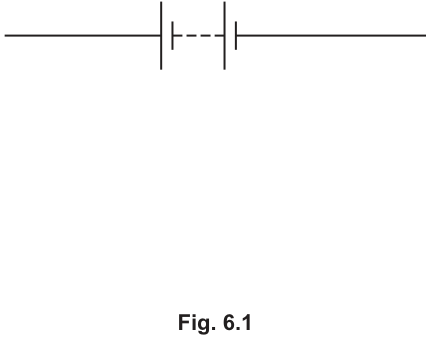
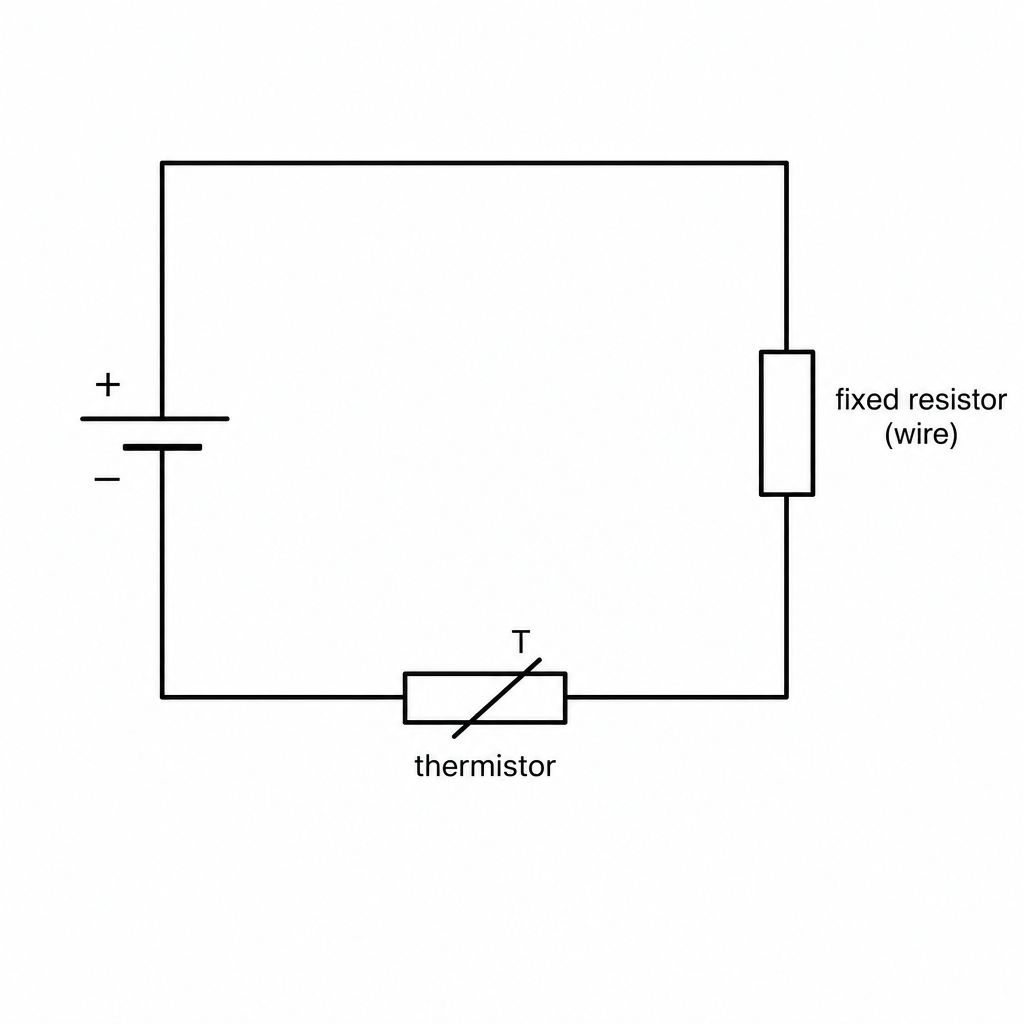
The wire in (b) may be considered to be a fixed resistor. It is connected in series with a thermistor to a battery that has negligible internal resistance.
Use circuit symbols to complete Fig. 6.1 to show the circuit diagram of this arrangement.
Answer
Thermistor and fixed resistor connected in series with the battery (single loop).
Series circuit of battery, fixed resistor (wire) and thermistor.
Background Concept
A series circuit has components connected one after another in a single closed loop. In series:
- the same current flows through every component,
- the supply p.d. is shared between components.
Circuit diagrams use standard symbols: a fixed resistor is a rectangle; a thermistor is a resistor symbol with a diagonal line and a small “” (or thermistor marking).
Understanding the Question
You are told the wire acts as a fixed resistor and it is connected in series with a thermistor to a battery (negligible internal resistance). The diagram in Fig. 6.1 is incomplete and you must add the correct symbols to show that arrangement.
Approach
Complete the single loop by placing a fixed resistor symbol and a thermistor symbol in series along the same path with the battery.
Step-by-Step Reasoning
- Keep a single closed loop.
- Add the fixed resistor (for the wire) in series.
- Add the thermistor symbol in series as well (no branching).
Key Takeaways
- “In series” means one loop, no junctions.
- Use the correct thermistor symbol, not a standard resistor alone.
Common Mistakes
- Drawing the resistor and thermistor in parallel (two branches).
- Using the wrong symbol for a thermistor (drawing a variable resistor or a plain resistor).
Things to Be Careful About
- The order of the two series components does not matter, but both must be on the same loop.
- Ensure the circuit is complete (no gaps).
Explain, without calculation, how the power dissipated in the wire changes as the temperature of the thermistor is increased.
Answer
As temperature increases, the thermistor resistance decreases, so the total series resistance decreases and the current increases.
Power in the wire is
and for the wire is constant, so the power dissipated in the wire increases.
Power in the wire increases as the thermistor temperature increases.
Background Concept
For a fixed resistor, the power dissipated can be written as
In a series circuit, the same current flows through all components, and the current is determined by the total resistance:
A typical thermistor used at this level is an NTC thermistor (negative temperature coefficient), meaning its resistance decreases as its temperature increases.
Understanding the Question
You have a battery (negligible internal resistance) connected in series with:
- the metal wire (fixed resistor with constant resistance), and
- a thermistor.
You are asked without calculation what happens to the power dissipated in the wire when the thermistor’s temperature increases.
Approach
Link the cause-and-effect chain:
- Increase temperature thermistor resistance changes (NTC: decreases).
- In series, decreasing total resistance increases the current.
- Wire power depends on (since wire is fixed), so power increases.
Step-by-Step Reasoning
- As the thermistor temperature increases, its resistance decreases (NTC behavior).
- Total series resistance is
So decreases.
- With a fixed supply voltage , the series current increases because
- The wire has constant resistance , so its power is
- Since increases and is constant, increases.
Key Takeaways
- NTC thermistor: higher temperature lower resistance.
- Series circuit: lower total resistance higher current.
- Fixed resistor power increases strongly with current because .
Common Mistakes
- Saying power decreases because “resistance decreases” (that would only apply if the component whose resistance changes is the one you are finding power for using at constant across that component).
- Treating the wire’s resistance as changing with thermistor temperature (the question says the wire is a fixed resistor).
Things to Be Careful About
- Specify that it is the thermistor resistance that changes with temperature.
- Use the correct power expression for the wire in a series circuit: is the clearest qualitative route because the wire’s is constant.
Complete Table 7.1 to show the charges, in terms of the elementary charge , on each of the flavours of quark and antiquark shown.
Table 7.1
| flavour | charge / | |
|---|---|---|
| quark | antiquark | |
| up | ||
| down | ||
| strange |
Answer
| flavour | quark charge / | antiquark charge / |
|---|---|---|
| up | ||
| down | ||
| strange |
up: +2/3, −2/3; down: −1/3, +1/3; strange: −1/3, +1/3 (in units of e)
Background Concept
Quarks are fundamental particles that carry fractional electric charge in units of the elementary charge . The common light quark flavours used at AS level are:
- up () with charge
- down () with charge
- strange () with charge
For every quark there is a corresponding antiquark (e.g. , , ). An antiquark has the same mass as the quark but opposite charge.
Understanding the Question
You are given a table with the flavours up, down and strange, and you must fill in the charge of each quark and each corresponding antiquark, expressed as a multiple of .
Approach
- Recall the standard quark charges for , , and .
- For each antiquark, change the sign of the quark charge (same magnitude, opposite sign).
Step-by-Step Reasoning
- Up quark has charge , so the up antiquark has charge .
- Down quark has charge , so the down antiquark has charge .
- Strange quark has charge , so the strange antiquark has charge .
These are entered in the table in the form “charge / ”.
Key Takeaways
- has charge (in units of ); and have charge .
- Antiquarks have opposite charge to the corresponding quarks.
Common Mistakes
- Swapping the up and down charges.
- Forgetting to change the sign for the antiquark.
- Writing charges as in the “charge/” column (the should not be included if the heading is already “/ ”).
Things to Be Careful About
- Keep the fraction format clear: and .
- Ensure the sign is correct for each antiquark (exactly opposite to the quark).
State the name of the class (group) of fundamental particles to which baryons and mesons belong.
Answer
Hadrons.
Hadrons
Background Concept
At AS level, fundamental particle “classes” typically refer to broad families such as leptons and hadrons.
- Hadrons are particles that experience the strong interaction and are made of quarks.
- Leptons (e.g. electron, neutrino) do not experience the strong interaction.
Baryons and mesons are both types of hadrons.
Understanding the Question
The question asks for the name of the class/group that includes both baryons and mesons.
Approach
Recall the family name for particles built from quarks (subject to the strong force): hadrons.
Step-by-Step Reasoning
- Baryons are quark-containing particles (e.g. proton, neutron).
- Mesons are also quark-containing particles (e.g. pion).
- The shared class for both is therefore hadrons.
Key Takeaways
- Baryons and mesons are subclasses of hadrons.
Common Mistakes
- Writing “quarks” (quarks are constituents, not the group that baryons/mesons belong to).
- Writing “nucleons” (nucleons are a subset of baryons only).
Things to Be Careful About
- The question asks for the class/group name, not what they are made from (that is asked in part (ii)).
Answer
- A baryon consists of three quarks ().
- A meson consists of a quark and an antiquark ().
Baryon: three quarks; Meson: quark–antiquark pair
Background Concept
Hadrons are made of quarks bound by the strong interaction. At this level, hadrons are split into:
- Baryons: composed of three quarks, symbolically .
- Mesons: composed of one quark and one antiquark, symbolically .
(For completeness: antibaryons are .)
Understanding the Question
You must compare baryons and mesons specifically by describing what constituent particles each is made from.
Approach
Write one clear composition statement for baryons and one for mesons, using the standard quark-counting definitions.
Step-by-Step Reasoning
- Baryons include particles like the proton and neutron; these are built from three quarks (e.g. for proton, for neutron). So: baryon .
- Mesons include particles like pions and kaons; these are built from a quark and an antiquark (e.g. for ). So: meson .
This directly provides the required comparison.
Key Takeaways
- Baryon: 3 quarks.
- Meson: quark + antiquark.
Common Mistakes
- Saying “baryons are made of protons/neutrons” (those are examples, not constituents).
- Saying “mesons are made of two quarks” without stating that one must be an antiquark.
Things to Be Careful About
- Use the word antiquark explicitly for mesons to gain full credit.
- Do not confuse “constituent particles” (quarks/antiquarks) with “fundamental interactions” (strong force).
Answer
In decay, a proton in the nucleus changes into a neutron and a positron and an electron neutrino are emitted:
p → n + e+ + νe
Background Concept
Beta decays are weak-interaction processes in which nucleons change type by converting one quark flavour into another.
In decay (positron emission):
- a proton changes into a neutron.
- a positron and an electron neutrino are produced.
This can be summarised at nucleon level by:
Key conservation ideas:
- Charge: initial (proton) equals final .
- Lepton number: initial equals final from plus from .
At quark level, one up quark changes into a down quark (since and ).
Understanding the Question
The question asks you to “describe decay in terms of the fundamental particles involved”. That means you should name the particles produced and the nucleon change (and, if you choose, the quark change).
Approach
State the standard decay transformation:
- proton changes to neutron,
- positron emitted,
- electron neutrino emitted.
Optionally relate it to the quark content change .
Step-by-Step Reasoning
- Start with a proton in the nucleus.
- In the weak interaction, the proton converts to a neutron.
- A positron is emitted (this is the “ particle”).
- An electron neutrino is also emitted so that lepton number is conserved.
So the decay is written:
(Quark view: because one turns into a .)
Key Takeaways
- decay produces a positron and an electron neutrino.
- The parent nucleon change is proton to neutron.
- Conservation of charge and lepton number guides which particles must appear.
Common Mistakes
- Writing an electron instead of a positron.
- Emitting the wrong neutrino type (often writing an antineutrino instead of ).
- Forgetting the neutrino entirely.
Things to Be Careful About
- decay is positron emission, not electron emission.
- The neutrino in decay is (electron neutrino), not .
- If you include an equation, make sure charge balances on both sides.