Physics 9702/11 — October/November 2024
Cambridge AS Level · Multiple Choice (AS Level) · answer key with instant marking and worked solutions
Topics D.C. Circuits · Dynamics · Kinematics · Deformation of Solids · Waves · Physical Quantities and Units · +5 more
Tap an option under each question to check it — your score builds as you go.
What are the SI base units for the moment of a force?
Options
A
B
C
D
Working
Moment .
has units , so
Answer
D
D
Background Concept
The moment of a force (also called torque) measures the turning effect of a force about a pivot.
Its magnitude is defined by
where:
- is the moment (torque),
- is the force,
- is the perpendicular distance from the pivot to the line of action of the force.
So the unit of moment is the unit of force multiplied by the unit of distance.
Understanding the Question
You are asked for the SI base units (i.e. expressed in , , , etc.) of the moment of a force.
The options are already written in base-unit form, so the task is to identify which one matches .
Approach
- Start from the definition: moment .
- Write the SI base units for force: .
- Multiply by and simplify powers of .
- Match with the given options.
Step-by-Step Reasoning
From the definition,
Force in SI units:
Moment has units , so
This corresponds to option D.
Key Takeaways
- Moment (torque) is .
- .
- Therefore .
Common Mistakes
- Forgetting to multiply by distance and giving units of force () instead.
- Confusing moment with pressure-like units (involving ), which would come from dividing by an area/length rather than multiplying by a length.
- Dropping a power of when simplifying.
Things to Be Careful About
- The distance in the moment definition is the perpendicular distance; it still has unit regardless.
- The question asks for SI base units, so the final form should be in , , (not just ).
Which statement about vector quantities is correct?
Options
A Acceleration of free fall is a vector quantity because it has a constant magnitude.
B Temperature in is a vector quantity because it can be positive or negative.
C Time is a vector quantity because it can only go in the forwards direction.
D Weight is a vector quantity because it has a direction.
A vector has both magnitude and direction.
Weight is a force and acts towards the centre of the Earth, so it has a direction.
Answer
D
D
Background Concept
A vector quantity is fully described only when both its magnitude and its direction are given (e.g. force, velocity, acceleration). A scalar quantity is described by magnitude alone (e.g. time, temperature, mass).
It is not enough for a quantity to be “positive or negative” to make it a vector: negative values can simply indicate a scalar measured relative to a chosen zero or reference point.
Understanding the Question
You are asked which statement about vectors is correct. Each option gives a quantity and a reason why it is (supposedly) a vector. We must choose the option whose reason matches the definition: vectors require direction.
Approach
Check each option against the definition:
- Decide whether the quantity needs direction to be specified.
- Check whether the reason given is a valid reason for being a vector.
- Select the only statement that is correct.
Step-by-Step Reasoning
- A: Acceleration of free fall, , is indeed a vector (it is an acceleration), but the reason is wrong. Being a vector is not because its magnitude is constant; it is because acceleration has a direction (downwards).
- B: Temperature (in or K) is a scalar. The fact it can be positive or negative does not make it a vector; it has no direction.
- C: Time is a scalar. The fact that time progresses forwards does not mean it has a spatial direction.
- D: Weight is a force, , and forces are vectors. Weight acts vertically downwards (towards the Earth’s centre), so it has a direction. This matches the definition.
Therefore, the correct statement is D.
Key Takeaways
- Vectors require magnitude and direction.
- Scalars can be positive/negative without being vectors.
- Forces (including weight) are vectors.
Common Mistakes
- Saying a quantity is a vector because its magnitude is constant (vectors can have changing magnitude).
- Thinking “can be negative” implies a vector (many scalars can be negative).
- Confusing “only goes forwards” (time) with having a direction in space.
Things to Be Careful About
- For quantities like acceleration and force, always associate a direction (e.g. “downwards”) when deciding if they are vectors.
- The unit or scale used (e.g. ) does not determine whether something is a vector; the definition does.
The density of the material of a rectangular block is determined by measuring the mass and linear dimensions of the block. The list shows the results obtained, together with their uncertainties.
mass
length
width
height
The density is calculated to be .
What is the uncertainty in this result?
Options
A
B
C
D
Working
Density
For a quotient/product, fractional uncertainties add:
Answer
C
C
Background Concept
When a result is calculated from several measured quantities, its uncertainty comes from the uncertainties of those measurements.
For quantities that are multiplied or divided, the fractional (or percentage) uncertainties add:
This rule matches the “worst-case” way Cambridge typically expects for uncertainty propagation at AS level.
Understanding the Question
You are given measurements (with uncertainties) of mass and the three dimensions of a rectangular block: length , width , height .
The density is
and the calculated value is . The question asks for the uncertainty in , and then to match it to one of the options.
Approach
- Write in terms of the measured quantities: .
- Add the fractional uncertainties of , , , and .
- Multiply the final fractional uncertainty by to get the absolute uncertainty in .
- Round sensibly and choose the matching option.
Step-by-Step Reasoning
Start with
So
Now calculate each fraction:
- Mass: (0.4%)
- Length: (0.2%)
- Width: (0.5%)
- Height: (1%)
Add them:
So the fractional uncertainty is .
Convert to absolute uncertainty using :
Round the uncertainty to 1 significant figure (typical convention):
This matches option C.
Key Takeaways
- For products/quotients, add fractional uncertainties.
- Convert back to an absolute uncertainty by multiplying by the calculated value.
- The largest fractional contribution often comes from the measurement with the largest relative uncertainty (here, the height).
Common Mistakes
- Adding absolute uncertainties () instead of fractional/percentage uncertainties.
- Using volume uncertainty incorrectly, e.g. finding by adding (units and method are wrong).
- Forgetting the height has a 1% uncertainty, which dominates the total.
- Rounding too early, which can shift the final option choice.
Things to Be Careful About
- Always divide uncertainty by the measured value in the same units (here all are consistent in g and cm, so no conversion is needed).
- Use the correct rule: powers would multiply fractional uncertainty by the power; here each dimension is to power 1.
- Round the uncertainty appropriately (usually 1 s.f. unless stated otherwise), then match to the option list.
What is a reasonable estimate of the volume of one page from this examination paper?
Options
A
B
C
D
Working
Take a typical exam page as about A4: .
Paper thickness .
Closest option is .
Answer
C
C
Background Concept
For a thin sheet, the volume can be estimated by
where is the area of the sheet and is its thickness. Estimation questions reward sensible typical values (order of magnitude) rather than exact measurements.
Understanding the Question
We need an approximate volume of one page of the exam paper in . A page’s volume depends mainly on:
- its surface area (page height (\times) page width), and
- the thickness of the paper.
The options span factors of 10, so we just need a reasonable estimate.
Approach
- Use a typical exam page size (about A4): roughly .
- Use a typical paper thickness: about (i.e. around ).
- Calculate and match to the nearest option.
Step-by-Step Reasoning
- Estimate the area:
-
Use a typical thickness .
-
Multiply to get volume:
- Compare with the options:
- is far too small,
- is still too small,
- matches ,
- is too large by about a factor of 10.
So the best estimate is option C.
Key Takeaways
- For thin objects, use .
- In MCQ estimation, focus on sensible typical values and order of magnitude.
- Paper thickness is about , and an A4 page area is about .
Common Mistakes
- Using thickness (ten times too thick), leading to option D.
- Forgetting to use consistent units (e.g. mixing metres and millimetres).
- Estimating area as instead of multiplying.
Things to Be Careful About
- Thickness must be in mm to obtain directly.
- The exact page size is not needed; any reasonable page dimensions and thickness should give a value around to .
An object is projected from horizontal ground at a velocity of magnitude and angle to the horizontal. It hits the ground at a time after it is projected. Assume air resistance is negligible.

Which statement does not describe the motion of this object?
Options
A The horizontal component of the object’s velocity is constant and has the value .
B The horizontal distance travelled by the object is .
C The time taken for the object to reach maximum height is .
D The vertical component of the object’s velocity is constant and has the value .
Working
For projectile motion with negligible air resistance:
- Horizontal acceleration is , so horizontal velocity is constant at .
- Vertical acceleration is , so vertical velocity changes with time (it is not constant).
Therefore the statement that does not describe the motion is D.
Answer
D
D
Background Concept
In projectile motion with negligible air resistance, the only force on the object after launch is its weight acting vertically downward. This means:
- Horizontal acceleration (no horizontal force), so horizontal velocity stays constant.
- Vertical acceleration (constant downward), so vertical velocity changes uniformly with time.
The key idea is that horizontal and vertical motions are independent (you can analyse them separately) but share the same time .
Understanding the Question
An object is projected from level ground with speed at an angle above the horizontal, and it lands back on the ground after a total time . You are asked which option is NOT a correct description of its motion.
So we check each statement against the standard results for a projectile that lands at the same vertical level as it started.
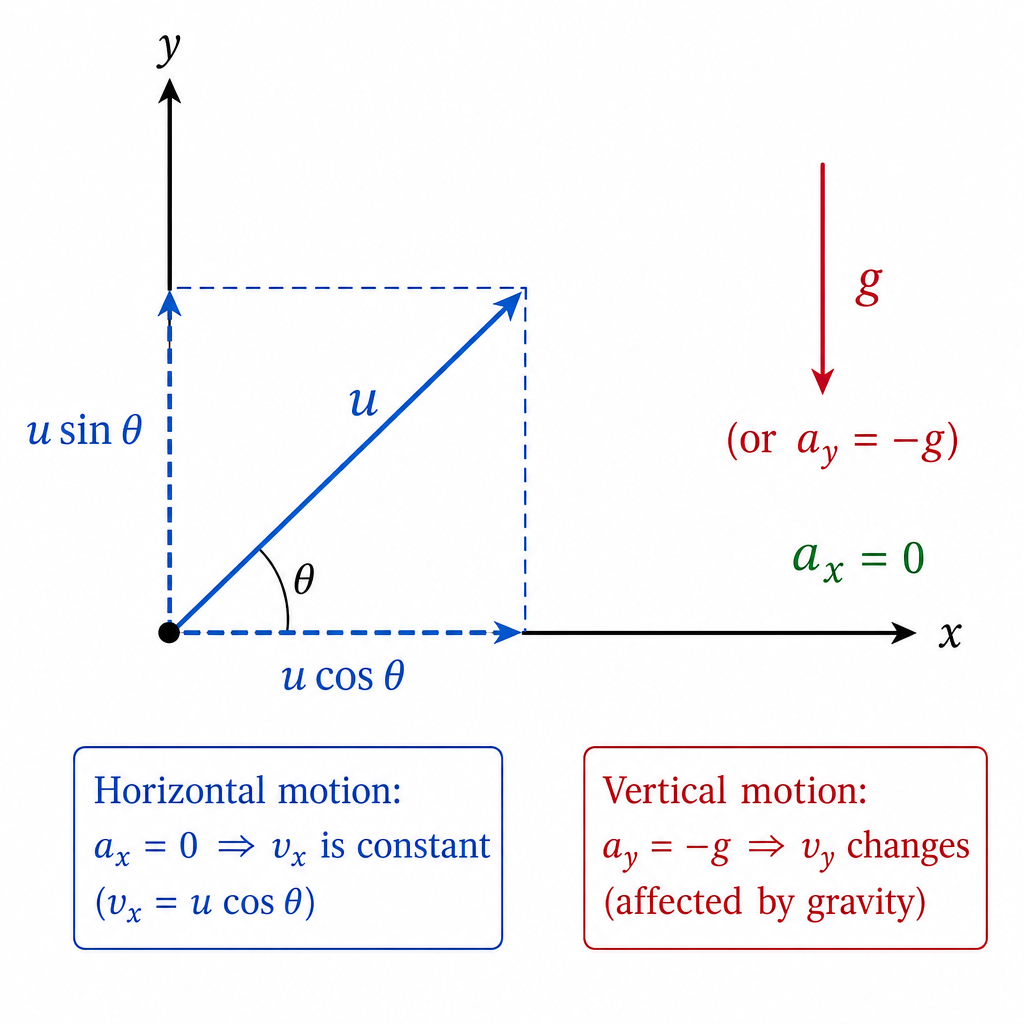
Approach
- Resolve the initial velocity into components: horizontally and vertically.
- Use the fact that gravity provides constant vertical acceleration and there is zero horizontal acceleration.
- Use symmetry for the vertical motion (launch and landing at same height): time up to maximum height equals time down from maximum height, so the time to maximum height is half the total flight time.
- Identify the statement that contradicts these facts.
Step-by-Step Reasoning
A: “The horizontal component of the object’s velocity is constant and has the value ."
- True, because , so remains equal to its initial value .
B: “The horizontal distance travelled by the object is ."
- True, because horizontal velocity is constant:
C: “The time taken for the object to reach maximum height is ."
- True for a projectile that lands at the same height it was launched from (level ground). The vertical motion is symmetric: the upward journey to takes the same time as the downward journey back to the starting height.
D: “The vertical component of the object’s velocity is constant and has the value ."
- False, because the vertical acceleration is , so vertical velocity changes: which clearly depends on time. Only at is .
Therefore, the statement that does not describe the motion is D.
Key Takeaways
- With negligible air resistance, so is constant.
- Gravity gives so changes uniformly with time.
- For launch and landing at the same height, time to maximum height is half the total time of flight.
Common Mistakes
- Thinking both components of velocity stay constant; only the horizontal component does.
- Forgetting that is the initial vertical component, not the vertical component at all times.
- Assuming using the full speed instead of the horizontal component .
Things to Be Careful About
- The symmetry result (time up = time down) relies on landing at the same vertical level as launch and constant .
- “Velocity component is constant” is a statement about acceleration: constant component implies zero acceleration in that direction (which is not true vertically).
A person, travelling on a motorway a total distance of , travels the first at an average speed of .
Which average speed must be obtained for the rest of the journey if the person is to reach the destination in a total time of hours minutes?
Options
A
B
C
D
Working
Time for first :
Total time , so remaining time:
Remaining distance:
Required average speed:
Answer
D
D
Background Concept
Average speed is defined by
For a journey made of separate sections, you can find the time for each section using . The total journey time is the sum of the section times.
Understanding the Question
The whole journey is and must take exactly . The first is already completed at an average speed of . The question asks for the average speed needed over the remaining distance so that the total time stays at .
Known:
- Total distance
- First section: at
- Total time
Unknown:
- Required average speed for the remaining distance.
Approach
- Find the time already used on the first section: .
- Subtract from the total allowed time to get the remaining time: .
- Subtract the distances to get the remaining distance: .
- Use and compare with the options.
Step-by-Step Reasoning
Time for the first :
Remaining time available out of :
Remaining distance:
Required average speed for the remaining distance in the remaining time:
This matches option D.
Key Takeaways
- Use to convert a known distance and average speed into a time.
- For fixed total time, the required speed on the remaining section depends on the remaining time, not the total time.
- Keep units consistent (here, km and h throughout).
Common Mistakes
- Dividing total distance by total time to get and assuming that is the required remaining speed.
- Subtracting speeds instead of subtracting times and distances.
- Converting hours to minutes incorrectly (e.g. treating as instead of ).
Things to Be Careful About
- When you subtract times, ensure both are in hours (or both in minutes) before subtracting.
- Rounding: rounds to , which is an exact listed option.
- “Average speed for the rest of the journey” means average over the remaining , not an instantaneous speed.
A car of mass has momentum .
What is the kinetic energy of the car?
Options
A
B
C
D
Working
Answer
C
C
Background Concept
Momentum and kinetic energy are both measures of motion but they are defined differently:
- Momentum:
where is momentum, is mass, and is speed.
- Kinetic energy:
A useful link between them comes from eliminating . Since , substituting into gives:
This is often the quickest route when and are given.
Understanding the Question
You are told:
- mass
- momentum
You are asked to find the car's kinetic energy and choose the correct option in kJ.
Approach
Use either of these equivalent methods:
- Find the speed from , then substitute into .
- Use the combined result directly.
Then convert from joules to kilojoules using .
Step-by-Step Reasoning
From momentum:
Now kinetic energy:
Compute :
Convert to kJ:
This matches option C.
(Equivalently, using :
.)
Key Takeaways
- Use to find speed when momentum and mass are known.
- When and are given, the shortcut
is very efficient.
- Always convert to when options are in kJ.
Common Mistakes
- Using (not a correct general formula).
- Forgetting to square when using .
- Converting to kJ incorrectly (dividing/multiplying by the wrong way).
- Dropping units or mixing them (here all values are already in SI).
Things to Be Careful About
- Momentum is a vector, but here only its magnitude is needed for kinetic energy.
- Keep track of powers: is large, so check the final energy is reasonable.
- Ensure the final choice corresponds to , not or .
A ladder is positioned on icy (frictionless) ground and is leant against a rough wall. At the instant of release it begins to slide.
Which diagram shows the directions of the forces , and acting on the ladder as it slides?
Options
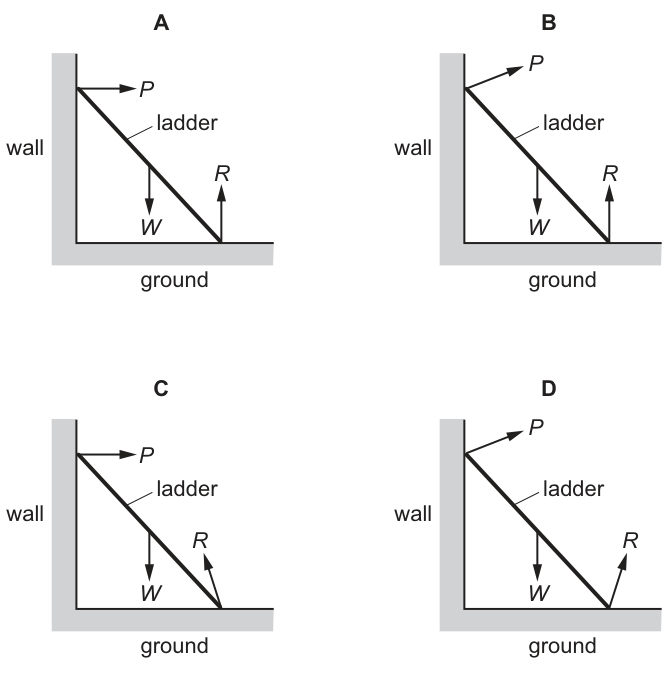
Working
Ground is frictionless (\Rightarrow) force at the ground contact is only the normal reaction, vertically upwards (R).
At the rough wall, the normal reaction on the ladder is horizontal to the right. On release, the top of the ladder slides down the wall, so friction at the wall acts upwards. Resultant force at the wall (P) is therefore up and to the right.
Weight (W) acts vertically downwards.
Answer
B
B
Background Concept
When an object is in contact with a surface, the contact force can be split into:
- a normal reaction (perpendicular to the surface), and
- a frictional force (parallel to the surface, only present if the surface is rough).
Key rules:
- If a surface is frictionless, there is no tangential (parallel) force at that contact: only the normal reaction acts.
- Friction acts to oppose the relative motion (or impending relative motion) between the two surfaces.
- Weight (W) always acts vertically downward through the centre of mass.
Understanding the Question
A ladder touches:
- The ground (icy, frictionless) at the bottom.
- A vertical wall (rough) at the top.
We must choose which option correctly shows the directions of:
- (R): force from the ground on the ladder,
- (P): force from the wall on the ladder (resultant of normal + friction),
- (W): weight of the ladder.
The statement “at the instant of release it begins to slide” tells us we should decide the friction direction from the initial sliding direction.
Approach
- Use “frictionless ground” to decide the direction of (R).
- At the wall, identify the normal reaction direction (perpendicular to the wall) and then decide the friction direction by considering how the ladder starts to move.
- Combine the wall’s normal reaction and friction to get the resultant (P), and match to the correct diagram.
Step-by-Step Reasoning
-
Force at the ground (icy / frictionless)
- Ground is horizontal, so the normal reaction is perpendicular to it: vertical upward.
- Because it is frictionless, there is no horizontal force at the ground.
Therefore (R) must be straight up.
-
Forces at the wall (rough vertical wall)
- The normal reaction from a vertical wall is perpendicular to the wall: horizontal.
- The wall is on the left of the ladder, so it pushes the ladder to the right.
-
Direction of friction at the wall
- On release, the ladder starts to slide: typically the top end moves downward along the wall (and the bottom moves outward along the ground).
- Friction opposes this relative motion, so at the wall it acts upwards on the ladder.
-
Resultant force (P) at the wall
- Combine the rightward normal reaction with the upward frictional force: resultant points up and to the right.
-
Weight (W)
- (W) acts vertically downward.
So the correct diagram must show (R) vertical up, (W) vertical down, and (P) up-right. That is option B.
Key Takeaways
- Frictionless contact (\Rightarrow) only a normal reaction (perpendicular to surface).
- Rough contact (\Rightarrow) normal reaction + friction, with friction opposing relative motion.
- A vertical wall provides a horizontal normal reaction.
Common Mistakes
- Adding a horizontal component to (R) even though the ground is frictionless.
- Making friction at the wall act downward (it should oppose the top sliding down).
- Drawing the wall’s normal reaction pointing left (it must push the ladder away from the wall, to the right).
Things to Be Careful About
- The label (P) is the resultant force at the wall (normal + friction), so it can be diagonal.
- “At the instant of release it begins to slide” indicates kinetic/impending motion, so friction direction is decided from the initial motion, not from assuming equilibrium.
- Ensure each contact force is consistent with the surface orientation: normal is always perpendicular to the surface.
A toy parachute is dropped from a bridge and falls vertically through the air.
The graph shows the distance travelled by the parachute against time.
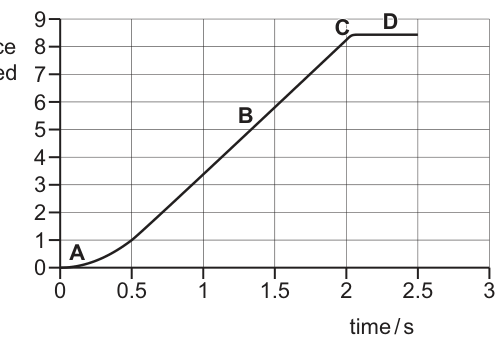
Which region of the graph shows when the parachute is at terminal velocity?
Options
A
B
C
D
Working
Terminal velocity means constant speed ().
On a distance–time graph, the gradient is the speed. Constant speed corresponds to a straight line with constant gradient.
Region is a straight line.
Answer
B
B
Background Concept
Terminal velocity occurs when the resistive (drag) force equals the weight, so the resultant force is zero.
So the object continues moving with constant velocity (constant speed for vertical motion in one direction).
For a distance–time graph:
- gradient is the speed,
- increasing gradient means speeding up,
- constant gradient means constant speed,
- zero gradient (horizontal line) means speed is zero.
Understanding the Question
A toy parachute falls vertically and a graph of distance travelled against time is shown, divided into regions , , , and .
You must choose which region corresponds to the parachute moving at terminal velocity, i.e. falling at a constant speed.
Approach
Look for the part of the distance–time graph where:
- the gradient (speed) is constant,
- so the graph is a straight line (not curved),
- and it is not horizontal (since horizontal would mean the parachute is not moving).
Step-by-Step Reasoning
- In region , the curve gets steeper: the gradient is increasing, so speed is increasing (accelerating) and it is not terminal velocity.
- In region , the graph is a straight line: gradient is constant, so speed is constant. This matches terminal velocity.
- In region , the curve flattens: gradient is decreasing, so the speed is decreasing (decelerating), not terminal velocity.
- In region , the line is horizontal: gradient is zero, meaning speed is zero (distance no longer changes), so it is not terminal velocity during a fall.
Therefore the terminal velocity region is .
Key Takeaways
- Terminal velocity means constant velocity ().
- On a distance–time graph, constant velocity corresponds to a straight line (constant gradient).
Common Mistakes
- Choosing the steepest part of the graph rather than the straight-line part: terminal velocity is about constant speed, not maximum steepness.
- Confusing a distance–time graph with a speed–time graph.
- Picking the horizontal region : a horizontal distance–time graph means the object has stopped (speed ).
Things to Be Careful About
- Always check what the axes are: here it is distance vs time, so gradient gives speed.
- Terminal velocity implies no acceleration, so the graph should not be curving (curvature indicates changing gradient and hence acceleration).
A lift (elevator) consists of a passenger car supported by a cable that runs over a light, frictionless pulley to a counterbalance. The counterbalance falls as the passenger car rises.
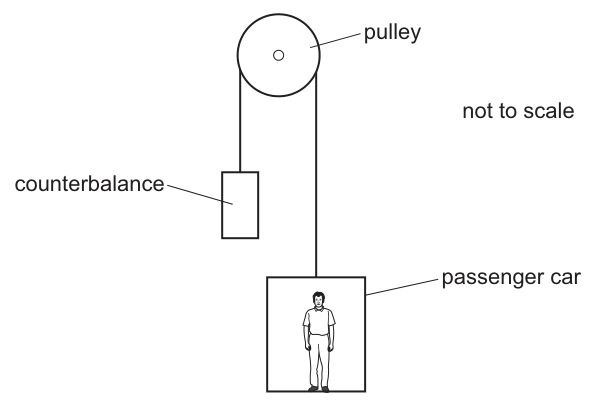
Some masses are shown in the table.
| mass | |
|---|---|
| passenger car | 520 |
| counterbalance | 640 |
| passenger | 80 |
What is the magnitude of the acceleration of the car when carrying just one passenger and when the pulley is free to rotate?
Options
A
B
C
D
Working
Total mass of car + passenger:
Counterbalance mass:
For a light, frictionless pulley (Atwood machine),
Answer
B
B
Background Concept
This is an Atwood machine: two masses connected by a light (massless), inextensible cable over a light, frictionless pulley.
Key consequences:
- The two masses have the same magnitude of acceleration (one up, one down).
- The tension is the same on both sides of the cable (light cable, frictionless/light pulley).
- Each mass obeys Newton’s second law: resultant force .
For an Atwood machine with heavier mass moving down and lighter mass moving up, the acceleration magnitude is
Understanding the Question
The counterbalance (mass ) falls while the passenger car rises. The passenger car has mass and carries one passenger of mass , so the rising side has total mass .
You are asked for the magnitude of the acceleration of the car when the pulley is free to rotate (so we treat it as ideal: no frictional torque and negligible pulley mass).
Approach
- Add the car and passenger masses to get the total rising mass .
- Identify the falling mass (the counterbalance).
- Use the Atwood machine result, or derive it quickly from Newton’s second law on each mass and eliminate the tension .
- Calculate and match it to the given options.
Step-by-Step Reasoning
Let (counterbalance, moving down) and (car + passenger, moving up).
A free-body view helps:
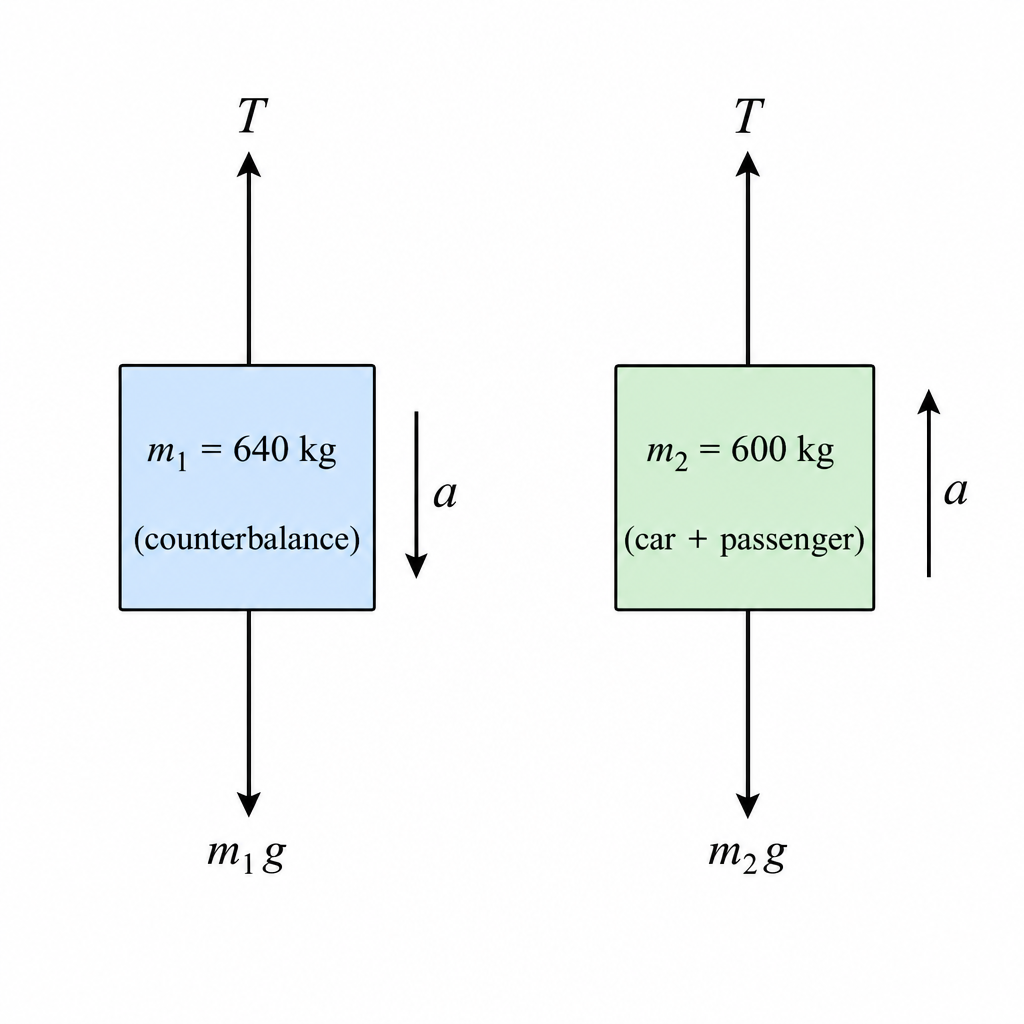
Apply Newton’s second law to each mass (take the direction of motion as positive for each mass):
For moving down:
For moving up:
Add the equations to eliminate :
So
Substitute values:
So the correct option is B.
Key Takeaways
- Combine masses on the same side of the cable before analysing.
- For an ideal Atwood machine, depends on the mass difference divided by the total mass.
- Writing Newton’s second law for each mass and eliminating tension is a reliable method.
Common Mistakes
- Forgetting to add the passenger mass to the car mass.
- Using or some other incorrect denominator (it must be ).
- Mixing signs: the forces must be consistent with your chosen positive direction for each mass.
- Using and then choosing the wrong option due to rounding; you should still land closest to .
Things to Be Careful About
- The question states a light, frictionless pulley and cable, so you assume equal tension on both sides and no energy loss.
- The acceleration is small because the mass difference () is small compared with the total mass ().
- Give the magnitude and match to the listed options; rounding to 2 s.f. is appropriate here.
A stationary ball of mass is hit by a bat. The ball leaves the bat with velocity .
The bat is in contact with the ball for a short time .
What is the average force of the bat on the ball?
Options
A
B
C
D
Working
Initial momentum (ball stationary).
Final momentum .
Change in momentum:
Average force:
Answer
B
B
Background Concept
The (average) resultant force on an object is related to how quickly its momentum changes:
where momentum (mass (m), velocity (v)). The quantity
is equal to the change in momentum (\Delta p). This is especially useful for short collisions where the force varies during contact, but we are asked for the average force.
Understanding the Question
A ball of mass starts from rest, so its initial velocity is . After being hit, it leaves the bat with velocity . The bat is in contact with the ball for time . We want the average force the bat exerts on the ball during that contact time.
Approach
- Write initial and final momentum of the ball.
- Find the change in momentum .
- Use .
- Match the resulting expression to the given options.
Step-by-Step Reasoning
Initial momentum:
Final momentum:
Change in momentum:
Average force:
This corresponds to option B.
Key Takeaways
- Use impulse: .
- For an object starting from rest and reaching speed , .
- Average force depends on how quickly the momentum changes, so divide by .
Common Mistakes
- Multiplying by instead of dividing (confusing force with impulse).
- Using (kinetic energy) instead of momentum.
- Forgetting the initial momentum is zero because the ball is stationary.
Things to Be Careful About
- Momentum is a vector; here the question only needs the magnitude of the average force in the direction the ball is hit.
- Options involving relate to energy per time (power), not force.
- Always check units: has units , which is correct for force.
A disc of mass is moving across a horizontal frictionless surface with constant velocity . It collides with a stationary disc of mass .
The diagram shows the view from above of the motion of the two discs before and after the collision.
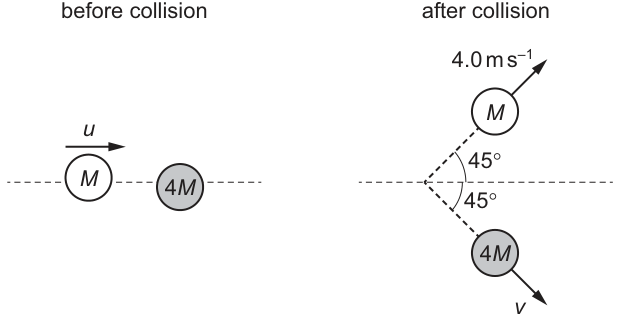
What is the initial velocity of the disc of mass ?
Options
A
B
C
D
Working
Take along the original line of motion and perpendicular.
Conservation of momentum in :
Conservation of momentum in :
Answer
D
D
Background Concept
For a collision on a frictionless horizontal surface, there is no external horizontal force on the system of two discs, so total momentum in the plane is conserved.
Momentum is a vector, so we conserve it component-wise:
- in the original direction of motion (-direction)
- perpendicular to it (-direction)
For each object, momentum is . If you know the directions of the final velocities, it is usually easiest to resolve each velocity into components using
Understanding the Question
Initially:
- disc of mass moves to the right at speed
- disc of mass is stationary
So the initial momentum is entirely in the -direction, and the initial -momentum is zero.
After collision:
- the disc moves at at above the original line
- the disc moves at speed at below the original line
You are asked to find , the initial speed.
Approach
- Choose axes with along the original direction of motion and perpendicular.
- Use conservation of momentum in the -direction to find the unknown speed (because initial -momentum is zero).
- Substitute into conservation of momentum in the -direction to find .
- Match the result to the given options.
Step-by-Step Reasoning
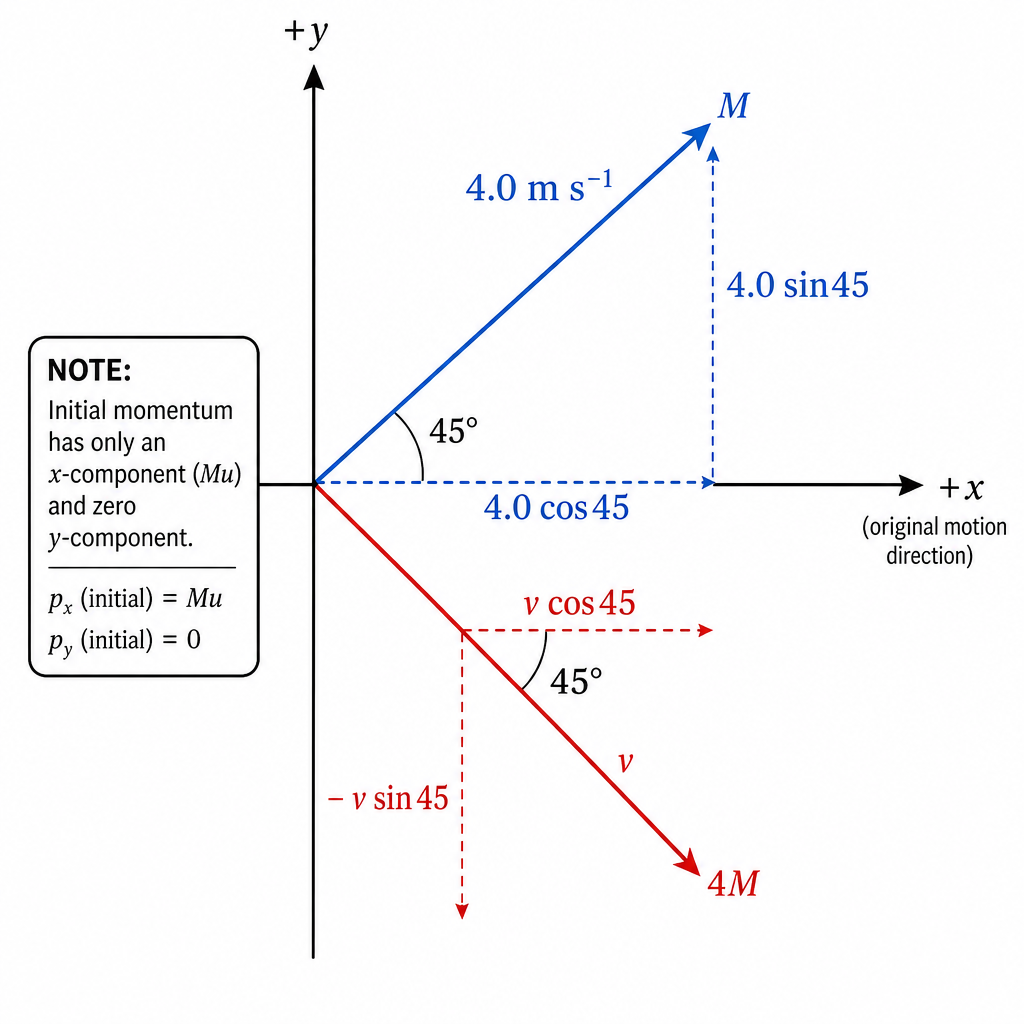
1) Resolve the final velocities into components
For the disc (speed at ):
For the disc (speed at below the line):
- its -component is positive:
- its -component is negative:
2) Conserve momentum in the -direction
Initial -momentum is zero.
Final -momentum:
Set equal to zero:
Cancel (non-zero):
3) Conserve momentum in the -direction
Initial -momentum: .
Final -momentum:
So
Cancel :
Substitute and :
This corresponds to option D.
Key Takeaways
- In 2D collisions, momentum must be conserved separately in perpendicular directions.
- Use the direction information (angles) to resolve velocities into components.
- If initial momentum in one direction is zero, that direction often lets you eliminate unknown speeds quickly.
Common Mistakes
- Treating momentum as a scalar and equating speeds instead of vector components.
- Forgetting the negative sign for the downward () component of the disc.
- Using and the wrong way round for the chosen angle.
- Forgetting that the second disc has mass when writing its momentum.
Things to Be Careful About
- Define your axes clearly; the diagram’s dashed line is a strong hint to take that as the -axis.
- Keep track of signs: above the line is , below is .
- Round only at the end to match the options: rounds to .
An object is dropped from rest on the Earth from a height of .
The same object is dropped from rest on the Moon from twice the height.
The acceleration of free fall on the Moon is approximately of the value on the Earth.
Assume that there are no resistive forces acting on the object.
What is the ratio
speed of the object just before hitting the surface on the Moon
speed of the object just before hitting the surface on the Earth
Options
A
B
C
D
Working
For a drop from rest,
Earth: ,
Moon: ,
Ratio (Earth to Moon):
Answer
A
A
Background Concept
For motion under constant acceleration (free fall with no air resistance), the kinematics (SUVAT) equation
relates speed , initial speed , acceleration , and displacement .
For an object dropped from rest, . For vertical falling:
- (or on the Moon),
- (the drop height),
so
This shows an important proportionality:
Understanding the Question
The object is dropped from rest:
- on Earth from with acceleration ,
- on the Moon from twice the height, so , with .
We want a ratio of the impact speeds. Using the no-resistance assumption means we can treat the acceleration as constant and use SUVAT.
(From the answer options provided, the intended ratio is consistent with , since that gives a value around .)
Approach
- Use for each situation (Earth and Moon).
- Form the ratio so that common factors (like and ) cancel.
- Substitute the given height ratio and .
Step-by-Step Reasoning
Earth impact speed:
Moon impact speed:
Now form the ratio (Earth to Moon):
Cancel and :
Rounding to the nearest option gives (option A).
Key Takeaways
- For free fall from rest with constant , .
- Speed depends on the square root of both height and gravitational field strength.
- Ratios are efficient because common constants cancel.
Common Mistakes
- Using without being given (or finding) the time .
- Forgetting that “twice the height” means , not .
- Not taking the square root when forming the speed ratio (treating as proportional to instead of ).
Things to Be Careful About
- The equation uses displacement (here equal to the height fallen).
- Use exactly as stated (it is not “16% less”; it is “16% of”).
- When matching to MCQ options, round appropriately (here ).
The graph shows how velocity varies with time for a bungee jumper.
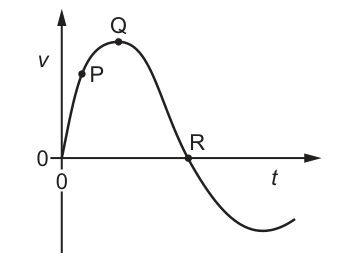
At which point is the bungee jumper momentarily at rest and at which point does she have zero acceleration?
Options
| jumper at rest | jumper with zero acceleration | |
|---|---|---|
| A | Q | P |
| B | Q | R |
| C | R | Q |
| D | R | R |
Working
Momentarily at rest means , so this is where the graph crosses the -axis: point .
Zero acceleration means , so the tangent is horizontal: at the maximum point .
Answer
C
C
Background Concept
A velocity–time graph shows how velocity changes with time .
Two key interpretations are:
- Velocity at any instant is read directly from the vertical axis.
- The object is momentarily at rest when (i.e. where the graph crosses the time axis).
- Acceleration is the rate of change of velocity:
On a – graph, is the gradient (slope) of the curve.
- Zero acceleration means the gradient is zero, i.e. the curve has a horizontal tangent (typically at a maximum or minimum of ).
Understanding the Question
You are given a curved – graph for a bungee jumper with labelled points , , and .
You must identify:
- the point where the jumper is momentarily at rest (so ), and
- the point where the jumper has zero acceleration (so gradient ).
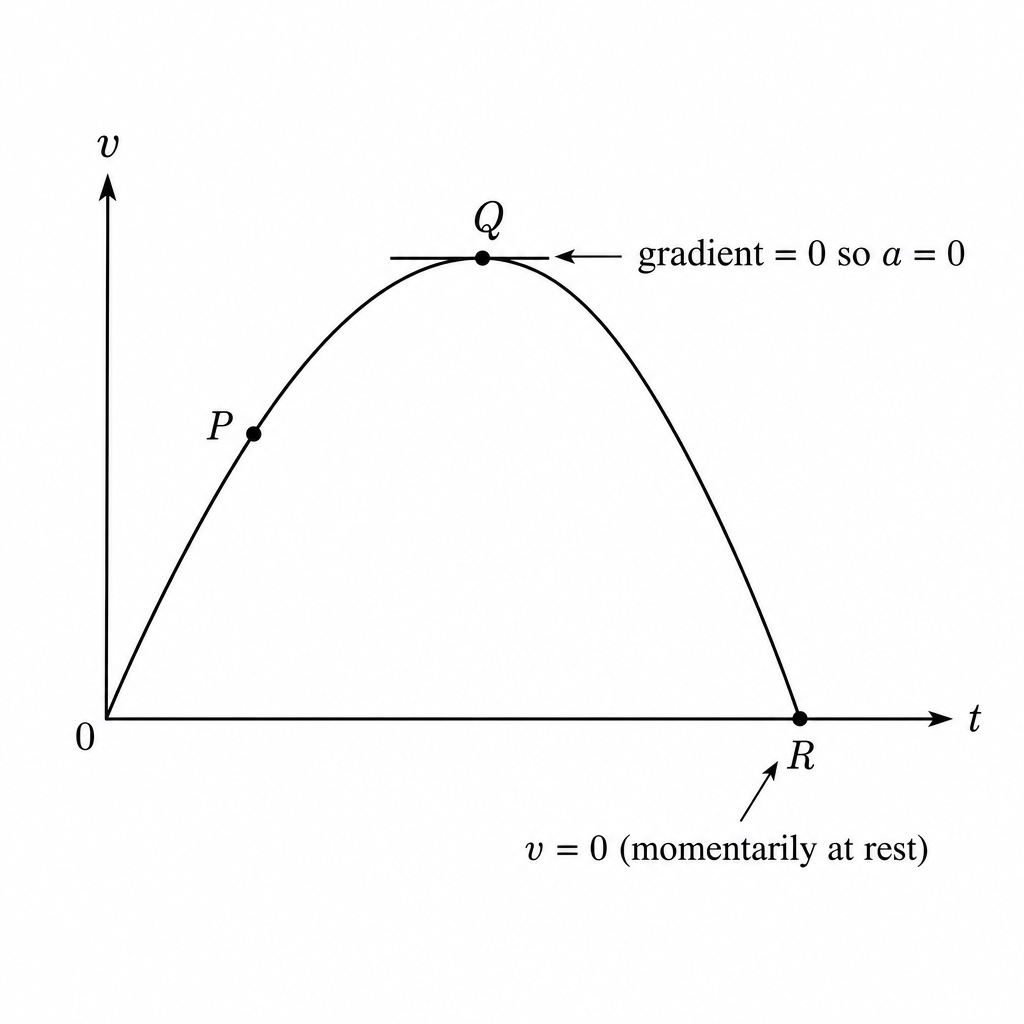
Approach
- Find where by locating the labelled point on the time axis.
- Find where by locating the labelled point where the graph has a turning point (horizontal tangent).
- Match these two points to the options table.
Step-by-Step Reasoning
-
Momentarily at rest:
- At rest means velocity is zero: .
- On the graph, occurs where the curve crosses the -axis.
- The labelled crossing point is .
-
Zero acceleration:
- Acceleration is the gradient of the – graph.
- Zero acceleration means gradient , i.e. a horizontal tangent.
- The curve has a maximum at , so the tangent there is horizontal.
- Hence acceleration is zero at .
Therefore: rest at and zero acceleration at , which corresponds to option C.
Key Takeaways
- On a – graph:
- (at rest) occurs where the graph crosses the time axis.
- is the gradient; where the tangent is horizontal.
Common Mistakes
- Choosing the point with the lowest or highest velocity for “at rest” (rest requires , not a minimum/maximum).
- Thinking acceleration is zero where ; these are independent (you can have but non-zero acceleration).
- Using the value of instead of the gradient to decide about acceleration.
Things to Be Careful About
- “Momentarily at rest” refers to an instant where (a crossing of the axis), not the starting point unless it is one of the labelled points.
- For curved graphs, acceleration at a point is the gradient of the tangent at that point, not the average slope over a wider interval.
A solid sphere, which is less dense than water, is held completely immersed in water a few metres below the surface. The density of the water is uniform.
The sphere is released. Immediately after release, the sphere rises.
Which row describes the changes in the magnitudes of the upthrust on the sphere and the resultant force on the sphere as it rises?
Options
| upthrust on the sphere | resultant force on the sphere | |
|---|---|---|
| A | constant | decreasing |
| B | constant | increasing |
| C | decreasing | decreasing |
| D | decreasing | increasing |
Working
Upthrust on a fully immersed object in uniform-density water is
so is constant (since , and are constant).
As the sphere rises it speeds up, so the drag force (downwards) increases, while weight is constant. Hence the resultant upward force decreases.
Answer
A
A
Background Concept
Upthrust (buoyant force) on an object in a fluid comes from the pressure being larger on the lower surface than on the upper surface. For a fluid of uniform density, the upthrust on a fully immersed object is given by Archimedes’ principle:
where is the fluid density, is gravitational field strength, and is the volume of fluid displaced (equal to the object’s volume if it is completely immersed).
Although the absolute pressure increases with depth (), the difference in pressure between the bottom and top of the object depends only on the vertical separation, so the net upthrust is independent of depth (provided is constant).
When an object moves through a fluid, a drag/resistive force acts opposite to its motion. As speed increases, drag generally increases, reducing the resultant (net) force in the direction of motion. This is why terminal velocity can occur when drag grows until the resultant force is zero.
Understanding the Question
A solid sphere less dense than water is held completely submerged and released. Immediately it rises, meaning initially:
The question asks, as the sphere rises, how the magnitude of:
- the upthrust on it, and
- the resultant force on it
change.
The key information is: “completely immersed” and “density of the water is uniform”.
Approach
- Decide whether changes with height/depth for a fully immersed object in uniform-density water.
- Identify forces on the rising sphere: upthrust upward, weight downward, drag downward.
- As it rises, it accelerates and its speed increases (at least initially), so infer the change in drag and hence the change in the resultant force.
- Match these trends to the table.
Step-by-Step Reasoning
Upthrust:
- Since the sphere stays fully immersed and water density is uniform, the displaced volume is constant.
- Therefore
and is constant as it rises.
Resultant force:
- Forces on the sphere while rising are:
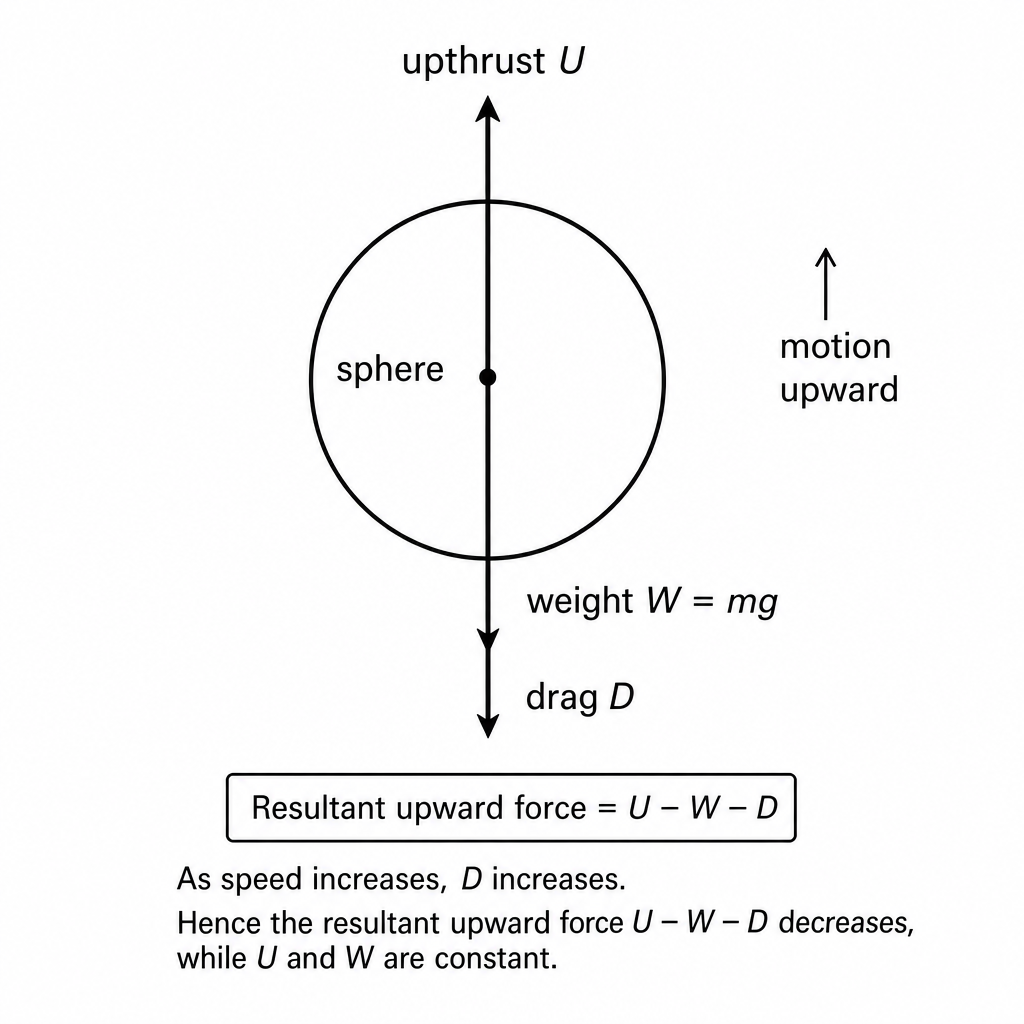
- Weight is constant.
- Upthrust is constant.
- Drag acts downward (opposes upward motion). As the sphere rises from rest, its speed increases, so increases.
Resultant upward force is
As increases, decreases.
So: upthrust constant; resultant force decreasing → row A.
Key Takeaways
- For a fully immersed object in a uniform-density fluid, upthrust is constant and does not depend on depth.
- As an object speeds up in a fluid, drag increases, so the resultant force in the direction of motion tends to decrease.
Common Mistakes
- Thinking upthrust decreases as the object rises because pressure is lower near the surface: absolute pressure decreases, but the net upthrust remains for uniform .
- Ignoring drag and concluding the resultant force stays constant (). In real fluids, drag increases as speed increases.
- Getting the drag direction wrong (it always opposes the motion).
Things to Be Careful About
- The statement “density of the water is uniform” is crucial: it allows to be treated as constant with height.
- “Immediately after release” means the sphere starts from (approximately) zero speed, but the question asks what happens as it rises, i.e. once it begins to gain speed and drag grows.
- The question asks about magnitudes of forces: the resultant force remains upward but its magnitude decreases as drag increases.
A uniform bar of weight and length is freely hinged on a wall at one end. The bar is horizontal and is held in equilibrium by a cable attached at a distance of from the other end. The cable is at an angle of to the horizontal.
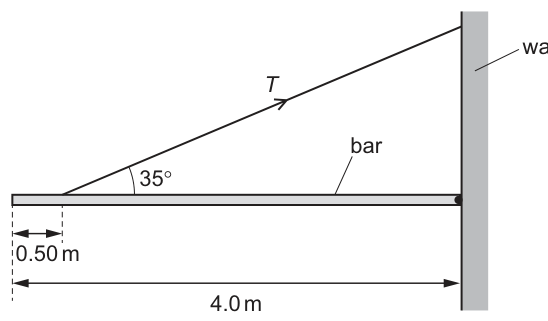
What is the tension in the cable?
Options
A
B
C
D
Working
Take moments about the hinge.
Distance of cable from hinge:
Weight acts at centre of bar, distance from hinge:
Only the vertical component of tension produces a moment about the hinge, so moment of tension:
Equilibrium:
Answer
C
C
Background Concept
For a rigid body in equilibrium:
- The resultant force is zero.
- The resultant moment (torque) about any point is zero.
Using moments is usually simplest when there is a hinge/pivot, because any unknown hinge forces produce no moment about the hinge (their lines of action pass through the pivot).
The moment of a force about a pivot is
where is the perpendicular distance from the pivot to the line of action of the force. Equivalently, if the force makes an angle to the bar, you can use the component perpendicular to the bar.
Understanding the Question
A uniform horizontal bar (length , weight ) is hinged at the wall at one end. A cable supports the bar, attached close to the free end: it is from the far end, and makes an angle of to the horizontal bar.
You are asked to find the cable tension .
Key geometry:
- Weight acts at the centre of a uniform bar, i.e. at from the hinge.
- The cable attachment point is from the hinge.
Approach
Take moments about the hinge:
- Clockwise moment is due to the bar's weight.
- Anticlockwise moment is due to the vertical component of the cable tension.
The horizontal component of tension acts along the bar, so its line of action passes through the hinge and produces no turning effect about the hinge.
Step-by-Step Reasoning
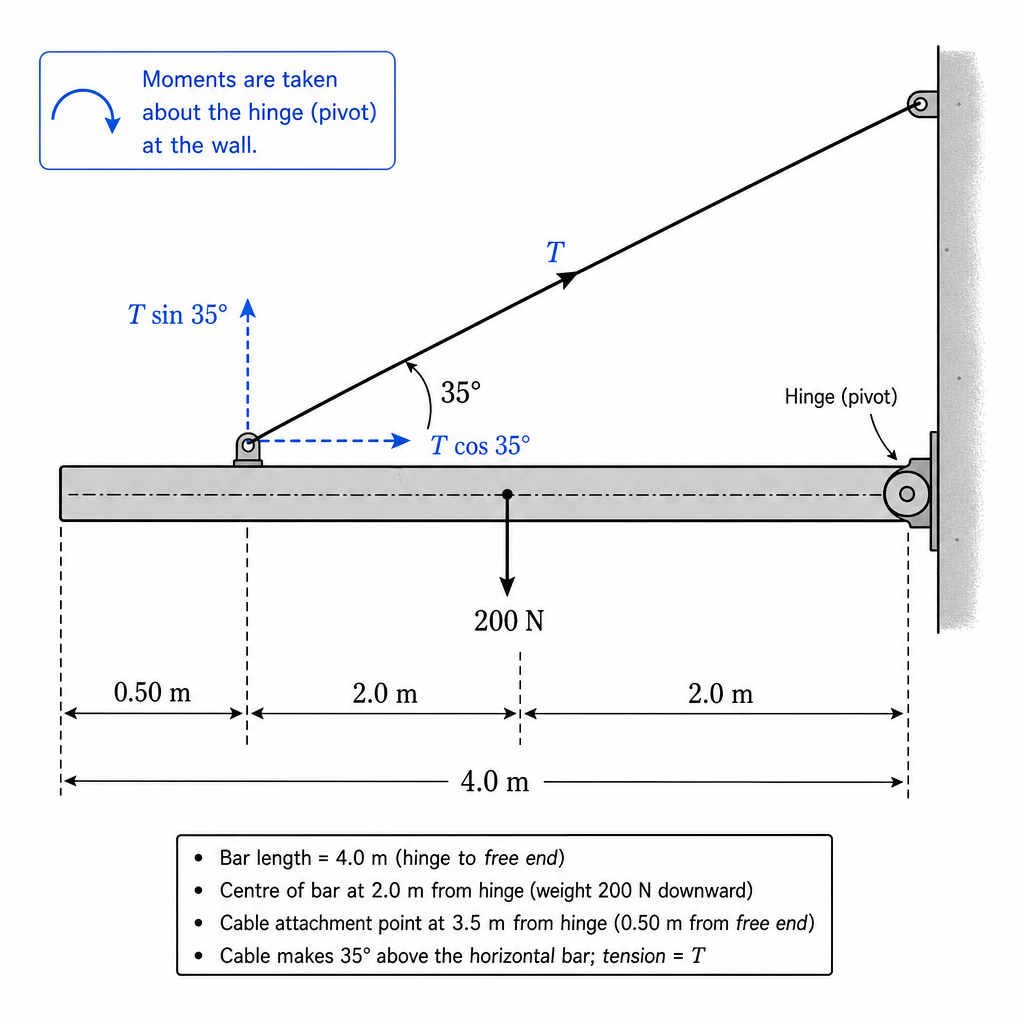
- Distances from the hinge:
- Resolve tension into components relative to the horizontal bar:
- Vertical component: (perpendicular to the bar)
- Horizontal component: (along the bar)
Only contributes to the moment about the hinge.
- Equate clockwise and anticlockwise moments about the hinge:
- Solve for :
So the correct option is C.
Key Takeaways
- For equilibrium, set the sum of moments about a pivot to zero.
- Choose the pivot to eliminate unknown forces (here, the hinge).
- Only the component of a force perpendicular to the lever arm produces a moment.
Common Mistakes
- Using the wrong distance for the cable (forgetting it is from the far end, not from the hinge).
- Using as the vertical component (swapping sine and cosine).
- Taking moments using the full instead of its perpendicular component.
Things to Be Careful About
- The bar is horizontal, so the lever arm distances are simple horizontal distances from the hinge.
- The weight acts at the centre because the bar is uniform.
- In moment calculations, always check which component actually has a perpendicular distance from the pivot; components acting through the pivot give zero moment.
The diagrams all show a pair of equal forces acting on a metre rule.
Which diagram shows forces that provide a couple and zero resultant force?
Options
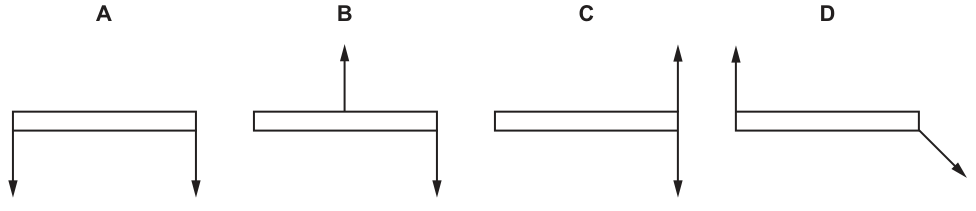
For a couple: forces must be equal, opposite, parallel and act along different lines so the resultant force is zero.
- A: forces are same direction (\Rightarrow) resultant (\neq 0).
- C: equal and opposite but same line of action (\Rightarrow) no couple.
- D: forces are not parallel (\Rightarrow) not a couple and resultant (\neq 0).
- B: equal and opposite, parallel and separated (\Rightarrow) couple and zero resultant.
Answer
B
B
Background Concept
A couple is produced by two forces that:
- have equal magnitude,
- act in opposite directions,
- are parallel,
- act along different (separated) lines of action.
For a couple:
- The resultant force is zero because the forces cancel.
- The resultant moment (torque) is not zero because the forces act at different points, producing a turning effect.
The moment of a couple is
where is the magnitude of one force and is the perpendicular distance between their lines of action.
Understanding the Question
Each option shows two equal forces on a metre rule. We need the one that:
- has zero resultant force (forces must be equal and opposite), and
- produces a couple (forces must be parallel and not act along the same line).
Approach
For each diagram, check in this order:
- Are the forces equal and opposite? If not, resultant force is not zero.
- Are they parallel? If not, they cannot form a couple.
- Do they act along different lines of action (separated)? If they are collinear, the turning effect cancels to zero.
Step-by-Step Reasoning
-
A: both forces point downward. They add to give a net downward force , so resultant force is not zero. Not correct.
-
B: one force is upward and the other is downward, with equal magnitude. So net force is .
The forces are also parallel (both vertical) and act at different points along the rule, so their lines of action are separated. This produces a non-zero turning effect (a couple). Correct. -
C: forces are equal and opposite and parallel, but they act at the same position (same line of action). With no separation , the couple moment . So there is no couple. Not correct.
-
D: one force is vertical while the other is diagonal. They are not parallel, so they do not form a couple, and their vector sum will not be zero in general. Not correct.
Therefore the correct diagram is B.
Key Takeaways
- A couple requires equal and opposite parallel forces with separation between their lines of action.
- Zero resultant force alone is not enough: if the lines of action coincide, the turning effect is zero.
Common Mistakes
- Choosing C because the forces cancel: they do cancel, but there is no separation, so no couple.
- Thinking any two opposite forces form a couple: they must also be parallel and non-collinear.
Things to Be Careful About
- “Separated” means separated perpendicularly between lines of action, not just “at different points” in a vague sense.
- If forces are not parallel (like D), you cannot classify them as a couple even if they look like they might twist the rule.
A ball of mass is thrown up to height in air with an initial velocity , as shown.
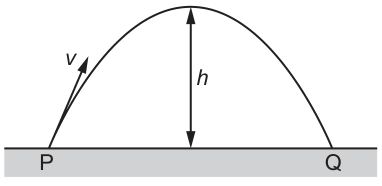
Air resistance is negligible. The acceleration of free fall is .
What is the total work done by the gravitational force on the ball during its flight from to ?
Options
A zero
B
C
D
Working
Work done by gravity:
From to the ball starts and ends at the same height, so .
Hence .
Answer
A
A
Background Concept
The gravitational force is a conservative force. For any conservative force, the work done depends only on the initial and final positions, not on the path taken.
For gravity near Earth (constant ), gravitational potential energy is
and the work done by gravity is related to the change in gravitational potential energy by
So if an object ends up at the same height it started, and the total work done by gravity over the whole journey is zero.
Understanding the Question
A ball is thrown from point on the ground, follows a curved (projectile) path, rises to a maximum height , and lands back on the ground at point .
You are asked for the total work done by the gravitational force from to (the entire flight), with air resistance negligible.
Key observation: points and are at the same vertical height.
Approach
Use the fact that gravitational work depends only on the change in height between the start and end points.
- Identify the initial height and final height.
- Find .
- Use to get the total work.
Step-by-Step Reasoning
Initial height at : take (ground level).
Final height at : (also ground level).
So the change in height is
Hence the change in gravitational potential energy is
Therefore total work done by gravity is
So the correct option is A (zero).
(Although gravity does negative work on the way up and positive work on the way down, these cancel over the full trip because the ball returns to its original height.)
Key Takeaways
- Gravity is conservative: total work depends only on initial and final heights.
- and .
- If start and finish heights are the same, the net work done by gravity is zero.
Common Mistakes
- Using the maximum height and stating the work is or without considering the return to the ground.
- Confusing the magnitude of work done during ascent () with the total work over the whole flight.
- Mixing up the sign: gravity does negative work when displacement is upward, positive work when downward.
Things to Be Careful About
- The question asks for work from to (whole journey), not just to the highest point.
- Work done by gravity is linked to vertical displacement only; horizontal motion does not change .
- Since and are at the same level, regardless of the path shape.
A spring of spring constant is suspended vertically from its top. The spring obeys Hooke’s law. Initially the spring is not compressed and not stretched. A mass of is attached to the bottom of the spring. The mass is released from rest and falls.
Frictional effects are negligible.
In the motion that follows, what is the maximum extension of the spring?
Options
A
B
C
D
Working
At maximum extension , so loss of GPE elastic energy:
Answer
D
D
Background Concept
For a vertical spring that obeys Hooke’s law, the spring force is
where is the spring constant and is the extension from the natural (unstretched) length.
When frictional effects are negligible, mechanical energy is conserved. As the mass falls, it loses gravitational potential energy (GPE) and stores energy as elastic potential energy (EPE) in the spring:
At the instant of maximum extension, the speed is momentarily zero, so there is no kinetic energy.
Understanding the Question
The spring starts at its natural length. A mass is attached and released from rest. The question asks for the maximum extension of the spring during the subsequent motion.
Key point: maximum extension occurs at the turning point where , not at the equilibrium position (where ).
Approach
Use conservation of energy between:
- initial state: mass at the natural length, released from rest;
- turning point: spring extended by , mass momentarily at rest.
The mass falls a distance , so it loses GPE . This becomes elastic energy .
Step-by-Step Reasoning
-
Let the maximum extension be .
-
GPE lost when the mass moves down by :
- Elastic potential energy stored in the spring at extension :
- At maximum extension, the mass is instantaneously at rest, so kinetic energy is zero. With negligible friction:
- Solve for (take the non-zero solution):
- Substitute values , , :
So the correct option is D.
Key Takeaways
- Maximum extension in a vertical spring drop is found using energy: .
- The maximum extension is
which is twice the equilibrium extension .
Common Mistakes
- Using the equilibrium condition and giving (this gives the extension at equilibrium, not the maximum extension).
- Including kinetic energy at the turning point (it is zero there).
- Using the wrong distance for the GPE change (the mass falls by from the release point to maximum extension).
Things to Be Careful About
- The spring starts unstretched, so the initial elastic energy is zero.
- The turning point is defined by , not by zero acceleration.
- Check units: has units of metres because .
- Rounding: rounds to , matching option D.
A wire has original length and cross-sectional area . A tensile force is applied to the wire which causes it to have extension . The wire obeys Hooke’s law.
What is an expression for the Young modulus of the material from which the wire is made?
Options
A
B
C
D
Working
Young modulus
So
Answer
B
B
Background Concept
For a wire obeying Hooke’s law (within the limit of proportionality), the extension is proportional to the applied tensile force. A material property that describes how stiff the material is in tension is the Young modulus .
Young modulus is defined as
where
and
Stress has units of (since ), and strain is dimensionless, so also has units of .
Understanding the Question
You are told a wire has original length and cross-sectional area . When a tensile force is applied, the wire extends by . The question asks for an expression for the Young modulus in terms of these quantities (or in terms of stress and strain), and provides four options.
So we need to start from and see which option matches.
Approach
- Write the definition .
- Replace stress by .
- Replace strain by (or keep it as “strain” if an option uses that word).
- Compare with the listed options.
Step-by-Step Reasoning
Start from the definition:
Substitute :
This is exactly option B.
(If you also substitute , you get , but that exact form is not one of the options; option B is the equivalent expression.)
Key Takeaways
- Young modulus is defined by
- For a wire, and .
- In MCQs, check for equivalent algebraic forms of the same definition.
Common Mistakes
- Writing as (this is the inverse, option D).
- Multiplying stress and strain instead of dividing (options A and C correspond to ).
- Forgetting that strain is dimensionless, leading to incorrect unit reasoning.
Things to Be Careful About
- The word “strain” already includes the ratio ; don’t treat it as a separate quantity with units.
- Stress must be , not .
- Check whether the option uses words (stress/strain) or symbols () and convert appropriately.
A wire is stretched by a gradually increasing force. The force–extension graph for the wire is shown.
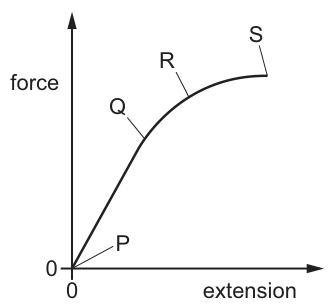
Which statement must be correct?
Options
A Point is the elastic limit.
B Point is the limit of proportionality.
C The area under the graph from to is the elastic potential energy stored in the wire.
D The area under the graph from to is the work done in stretching the wire.
Working
Work done in stretching is
so it equals the area under the –extension graph between the relevant extensions (here from to ).
Answer
D
D
Background Concept
A force–extension graph plots applied force against extension .
- Work done in stretching is the energy transferred by the force as the wire extends:
Graphically, this integral is the area under the – graph between the chosen extensions.
-
Elastic potential energy is the energy stored recoverably in the material. If the material is stretched only within its elastic range, then the work done is stored as elastic potential energy. If plastic deformation occurs, some work done is dissipated (e.g. as internal heating), so it is not all stored.
-
The limit of proportionality is the point where stops being true (end of the straight-line part).
-
The elastic limit is the point beyond which the wire does not return to its original length when the force is removed. This can be at or beyond the limit of proportionality.
Understanding the Question
You are shown a graph that is initially a straight line (Hooke’s law region) and then becomes curved with decreasing gradient. Points , , and are marked along the curve.
The question asks which statement is guaranteed true just from what a force–extension graph represents.
Approach
Check each option for whether it is a definition that must always apply:
- Statements about named points like elastic limit or limit of proportionality depend on where the straight line ends and where plasticity begins.
- Statements about the area under the graph can be tested using the definition of work done (), which is always valid.
Step-by-Step Reasoning
-
From the graph shape, the straight-line region ends at . That is the best candidate for the limit of proportionality, not . So B is not a “must”.
-
Whether is the elastic limit cannot be concluded from the loading curve alone. The elastic limit is defined by whether the wire returns to its original length on unloading; you would need an unloading curve or information about permanent extension. So A is not a “must”.
-
The area under the graph from to is:
This is, by definition, the work done by the stretching force in increasing the extension from to . Therefore D must be correct.
- Option C says the same area is the elastic potential energy stored. That would only be true if the stretching from to is entirely elastic (no plastic deformation). Since the graph is non-linear after , plasticity may have started, and we are not told unloading returns to zero extension. So C is not guaranteed.
Hence the only statement that must be correct is D.
Key Takeaways
- The area under an – graph always gives work done: .
- Elastic potential energy stored equals work done only if deformation is fully elastic.
- The limit of proportionality is where the graph stops being a straight line.
Common Mistakes
- Assuming “area under graph” always means elastic potential energy (it does not if plastic deformation occurs).
- Confusing limit of proportionality with elastic limit.
- Misidentifying the limit of proportionality as a point on the curved section (it is at the end of the straight-line part).
Things to Be Careful About
- “Must be correct” means true regardless of material behaviour after the linear region.
- The work done from to is the area under the curve between those extensions, not necessarily from the origin.
- A single loading curve cannot prove where the elastic limit is; unloading behaviour determines that.
A spring has an unstretched length of and a spring constant of . An object is suspended from the spring and the spring is deformed within its limit of proportionality. The new length of the spring is .
What is the elastic potential energy stored in the spring?
Options
A
B
C
D
Working
Extension:
Elastic potential energy:
Answer
A
A
Background Concept
For a spring that obeys Hooke's law (i.e. within the limit of proportionality), the force is proportional to the extension:
where is the spring constant and is the extension from the natural (unstretched) length.
The elastic potential energy stored in the spring is the work done to stretch it from to its final extension . Since the force increases linearly with , the energy is the area under the -against- graph (a triangle):
Understanding the Question
You are given:
- Unstretched length
- New length
- Spring constant
You must find the elastic potential energy stored when it is stretched to this new length.
Approach
- Find the extension by subtracting the unstretched length from the new length.
- Use because the spring is within its limit of proportionality (so Hooke's law applies).
- Substitute values and calculate, then match to the options.
Step-by-Step Reasoning
- Extension:
- Elastic potential energy:
Substitute and :
Calculate :
So the correct option is A.
Key Takeaways
- Extension is the change in length: .
- For a Hooke's law spring, elastic energy is .
- Energy depends on the square of the extension, so doubling would quadruple .
Common Mistakes
- Using the total length () as instead of the extension ().
- Forgetting the factor of and calculating .
- Mixing up (only true for constant force) instead of the triangular area for a linearly increasing force.
Things to Be Careful About
- The phrase “within its limit of proportionality” is the clue that Hooke's law applies, so is valid.
- Check units: in and in gives energy in .
- Square the extension before multiplying; errors often occur because is small.
A wire consists of a length of metal joined to a length of metal .
The cross-sectional area of the wire is uniform.
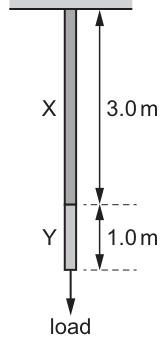
A load hung from the wire causes metal to extend by and metal to extend by .
The same load is then hung from a second wire of the same cross-sectional area, consisting of a length of metal and a length of metal .
Both wires are extended within their limit of proportionality.
What is the total extension of this second wire?
Options
A
B
C
D
Working
For a wire within the limit of proportionality,
Same load and same cross-sectional area same , so for each metal .
Metal : , so .
Metal : , so .
Total extension of second wire:
Answer
B
B
Background Concept
When a wire is stretched by a tensile force (load) and it remains within its limit of proportionality, it obeys Hooke’s law behaviour: extension is proportional to force.
A more general way to express this for a uniform wire is via Young modulus :
Rearranging gives the extension of a wire of length and cross-sectional area under force :
So for the same material (same ) under the same force and with the same area, the extension is directly proportional to length .
For two sections joined in series (one after the other), each section extends by its own amount and the total extension is the sum:
Understanding the Question
The first composite wire has:
- of metal that extends ,
- of metal that extends ,
under a certain load.
A second composite wire uses the same two metals but swaps the lengths:
- of ,
- of ,
with the same load and the same cross-sectional area.
We must find the total extension of the second wire.
The key clues are:
- “same load” and “same cross-sectional area” (so the stress is the same in every case),
- “within their limit of proportionality” (so for each metal).
Approach
- Use the first wire to find the extension per metre for metal and for metal under this load.
- Scale those extensions to the new lengths in the second wire.
- Add the two extensions to get the total.
Step-by-Step Reasoning
Because the load and area are unchanged, and are the same in both experiments. For any single metal,
so for fixed and (and fixed for that metal), .
Metal
Given of extends .
Extension per metre for :
So of extends:
Metal
Given of extends .
Extension per metre for :
So of extends:
Total extension of the second wire
Add the two series extensions:
This corresponds to option B.
Key Takeaways
- Within the limit of proportionality, a uniform wire obeys .
- For the same material under the same load and same area, extension is directly proportional to length.
- For sections joined in series, total extension is the sum of the individual extensions.
Common Mistakes
- Assuming the extension depends only on the total length and ignoring that different materials have different .
- Adding and again (that would be for the original wire, not the swapped one).
- Forgetting to scale the given extensions to the new lengths (e.g. using for of ).
Things to Be Careful About
- The reason here is that , , and are constant for each metal; changing any of these would break that simple scaling.
- The question states both wires are within the limit of proportionality; without this, extension might not be proportional to force (and the scaling could fail).
- Keep units consistent (mm with mm, m with m); here ratios make it straightforward.
The graph shows the variation of the displacement with distance for a progressive wave at one instant in time.
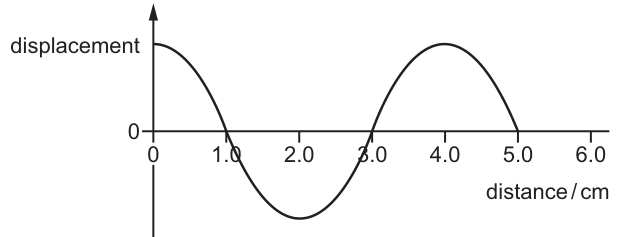
The period of the wave is .
What can be determined about the wave?
Options
A It has a velocity of and a frequency of .
B It has a velocity of and a wavelength of .
C It is longitudinal and has a frequency of .
D It is transverse and has a wavelength of .
Working
From the displacement–distance graph, one full cycle is from crest at to next crest at , so
Given period ,
Answer
A
A
Background Concept
A progressive wave transfers energy through space. Key quantities are:
- Period : time for one complete oscillation at a point.
- Frequency : number of oscillations per second, related by
- Wavelength : distance between two neighbouring points in phase (e.g. crest-to-crest or trough-to-trough) on a displacement–distance snapshot.
- Wave speed : speed the wave pattern travels, related by the wave equation
A graph of displacement against distance at one instant lets you read directly, but it does not uniquely tell you whether the wave is transverse or longitudinal without extra context.
Understanding the Question
You are given:
- A displacement–distance graph at one instant.
- The period .
You must decide which option states something that can be determined correctly about the wave. The key is to extract from the graph, then use to find and hence .
Approach
- Read the wavelength from the graph by finding the distance for one full cycle (same phase point to next same phase point).
- Convert the period into seconds and calculate frequency using .
- Compute the wave speed from .
- Compare your computed , , and with the options. Also check whether any claim about transverse/longitudinal is actually justified.
Step-by-Step Reasoning
1) Determine wavelength from the snapshot
A wavelength is the horizontal distance between two adjacent crests.
- The graph shows a crest at and the next crest at about .
So
(You could also use trough-to-trough, which would give the same result.)
2) Find frequency from the given period
Convert to seconds:
Then
3) Calculate wave speed
4) Match to the options
- Option A states and , which matches the calculations.
- Any option claiming “transverse” or “longitudinal” is not determinable from this information alone.
Therefore the correct choice is A.
Key Takeaways
- From a displacement–distance snapshot you can read wavelength.
- From the given period, you can find frequency using .
- Use the wave equation to calculate wave speed.
- The wave type (transverse/longitudinal) needs additional context; it is not reliably deduced from this graph alone.
Common Mistakes
- Using the distance between a crest and the next zero crossing as (that is ).
- Forgetting to convert to , giving a frequency times too large.
- Claiming the wave is transverse/longitudinal just because the graph is drawn with a vertical displacement axis.
Things to Be Careful About
- Ensure you identify two points that are in the same phase (crest-to-crest, trough-to-trough, or zero crossing with the same direction of slope).
- Keep units consistent: use metres in to obtain in .
- For MCQs, check that the option’s numerical values are consistent with each other and with what can actually be determined from the data given.
Which group of electromagnetic waves is arranged in order from shortest wavelength to longest wavelength?
Options
A radio waves visible light gamma rays
B visible light microwaves infrared
C visible light ultraviolet X-rays
D X-rays infrared microwaves
Working
Shortest wavelength to longest wavelength goes:
So have shorter wavelength than , which has shorter wavelength than .
Answer
D
D
Background Concept
Electromagnetic (EM) waves form a continuous spectrum. A key fact is the fixed wave speed in vacuum:
Since is constant for all EM waves in vacuum, a shorter wavelength means a higher frequency , and vice versa.
The EM spectrum in order of increasing wavelength (decreasing frequency/energy) is:
Understanding the Question
The question asks which option lists three EM wave groups arranged from shortest wavelength to longest wavelength. So we need the correct left-to-right ordering by wavelength.
Approach
- Recall the standard EM spectrum order.
- Check each option to see whether it matches the required direction (shortest longest wavelength).
Step-by-Step Reasoning
From the standard order (shortest longest):
- X-rays are very short wavelength.
- Infrared has longer wavelength than visible light.
- Microwaves have longer wavelength than infrared.
Therefore the sequence:
is correctly arranged from shortest to longest wavelength.
So the correct option is D.
Key Takeaways
- The EM spectrum order is a key recall fact.
- “Shortest wavelength” corresponds to “highest frequency” because .
Common Mistakes
- Reversing the direction: writing longest shortest wavelength.
- Mixing up infrared and microwaves (microwaves have the longer wavelength).
- Thinking visible is at the short end; gamma and X-rays are much shorter.
Things to Be Careful About
- The question is explicitly about wavelength, not frequency or energy; ensure the ordering matches wavelength.
- Remember the relative positions: lies between visible and microwaves, and X-rays lie between gamma and ultraviolet.
A wave has a frequency of .
What is the period of the wave?
Options
A
B
C
D
Working
Answer
A
A
Background Concept
Frequency is the number of complete oscillations (cycles) per second, measured in hertz (Hz). The period is the time taken for one complete oscillation, measured in seconds (s).
They are reciprocals:
This always applies for periodic waves.
Understanding the Question
You are given a wave frequency of and asked for the period. So we must convert to and then use . The multiple-choice options are in time units (ps, ns, etc.), so we should express the final time in a suitable prefix.
Approach
- Convert into using .
- Calculate .
- Convert the result in seconds into picoseconds (ps) or nanoseconds (ns) to match the options.
Step-by-Step Reasoning
Convert frequency:
Calculate period:
Convert to picoseconds. Since ,
This matches option A.
Key Takeaways
- Use for any periodic wave.
- Convert prefix units carefully: , .
Common Mistakes
- Treating as instead of .
- Inverting incorrectly (writing instead of ).
- Converting to ns incorrectly (it is , which is ).
Things to Be Careful About
- Prefixes: , , .
- Check that the order of magnitude makes sense: higher frequency should mean smaller period.
Three statements about two progressive waves are listed.
1 The waves have the same frequency.
2 The waves have the same amplitude.
3 The waves are emitted with a constant phase difference.
Which statements must be correct for the two waves to be coherent?
Options
A 1, 2 and 3
B 1 and 2 only
C 1 and 3 only
D 2 and 3 only
Working
Coherent waves have a constant phase difference, so statement 3 is required.
A constant phase difference implies the waves must have the same frequency, so statement 1 is required.
Amplitude does not affect coherence, so statement 2 is not required.
Answer
C
C
Background Concept
Two waves (or two sources) are coherent if they maintain a fixed (constant) phase relationship.
Equivalently, coherence requires:
- the waves have the same frequency (so their phase difference does not drift with time), and
- the waves have a constant phase difference.
Their amplitudes can be the same or different; amplitude affects the visibility/contrast of interference fringes, not whether the sources are coherent.
Understanding the Question
You are given three possible statements about two progressive waves:
- same frequency
- same amplitude
- emitted with a constant phase difference
You must decide which of these statements must be true for the waves to be coherent.
Approach
Use the definition of coherence: identify the required conditions (phase relationship and frequency), and then check whether amplitude is required.
Step-by-Step Reasoning
- Statement 3 (“constant phase difference”) is the key requirement for coherence.
- For the phase difference to remain constant over time, the waves must oscillate at the same rate, i.e. have the same frequency. Otherwise, even if they start with some phase difference, it will change continuously. So statement 1 is also required.
- Statement 2 (“same amplitude”) is not required: two coherent waves can have different amplitudes and still interfere; the resulting maxima/minima just won’t be equally strong.
Therefore, the statements that must be correct are 1 and 3 only, which corresponds to option C.
Key Takeaways
- Coherence is about a stable phase relationship, not about equal amplitudes.
- Same frequency is necessary to prevent the phase difference from changing with time.
Common Mistakes
- Thinking coherence requires equal amplitudes (it does not).
- Selecting only “constant phase difference” and forgetting that different frequencies make the phase difference vary with time.
Things to Be Careful About
- “Constant phase difference” and “same frequency” are tightly linked: if frequencies differ, phase difference cannot stay constant.
- Amplitude affects the intensity pattern (fringe visibility), not the coherence condition.
Waves and have the same amplitude. The waves meet in phase at point and interfere to give a resultant wave with intensity .
The amplitude of wave is doubled.
What is the new intensity of the resultant wave at , in terms of ?
Options
A
B
C
D
Working
Let the original amplitude of each wave be .
In phase at :
and , so
Now amplitude of is doubled: amplitudes are and .
Answer
(option C)
C
Background Concept
When two waves overlap, the principle of superposition says the resultant displacement is the sum of the individual displacements.
At a point where the waves are in phase (phase difference ), their displacements reach maxima and minima together, so their amplitudes add.
For waves of the same type in the same medium, the intensity is proportional to the square of the amplitude :
(This comes from intensity being proportional to energy transported per unit time, and wave energy being proportional to amplitude squared.)
Understanding the Question
Initially, waves and have the same amplitude and meet in phase at , producing a resultant intensity .
Then only wave has its amplitude doubled. We assume they still meet in phase at (only the amplitude changes, not the phase relationship). We must find the new resultant intensity at in terms of the original .
Approach
- Assign a symbol to the original amplitude of each wave.
- Use in-phase superposition to find the original resultant amplitude at .
- Use to link this amplitude to the given intensity .
- Repeat for the new amplitudes ( and ), then take a ratio to express the new intensity in terms of .
Step-by-Step Reasoning
Let each original wave have amplitude .
Original situation (in phase):
Resultant amplitude is the sum:
Intensity is proportional to amplitude squared:
So the given corresponds to something proportional to .
New situation:
Wave has doubled amplitude, so amplitudes are (from ) and (from ).
Since they still meet in phase at , the new resultant amplitude is
New intensity:
Now compare with the original using a ratio (this removes the unknown proportionality constant):
So
This matches option C.
Key Takeaways
- In-phase waves add amplitudes: .
- Intensity scales as amplitude squared: .
- Ratio methods are quick and avoid needing the constant of proportionality.
Common Mistakes
- Adding intensities instead of amplitudes: interference requires adding displacements/amplitudes first.
- Forgetting the square relationship: doubling amplitude does not double intensity; it quadruples it.
- Using as the new resultant amplitude: after doubling , the amplitudes are and , so the sum is , not .
Things to Be Careful About
- The phrase “meet in phase at ” is the key clue that amplitudes add directly (no subtraction).
- Keep the original intensity linked to the original resultant amplitude (), not to a single wave’s amplitude ().
- Rounding: corresponds to among the options.
Radio waves can be polarised, but sound waves cannot be polarised.
Which statement gives the reason for this?
Options
A Radio waves are generally of a higher frequency than sound waves.
B Radio waves are transverse waves, but sound waves are longitudinal waves.
C Radio waves can travel through a vacuum, but sound waves cannot travel through a vacuum.
D Radio waves travel at a much higher speed than sound waves.
Polarisation requires oscillations in a plane perpendicular to the direction of travel (transverse waves). Radio waves are transverse, whereas sound waves are longitudinal.
Answer
B
B
Background Concept
Polarisation is the restriction of the vibrations (oscillations) of a wave to one plane. This is only possible when the wave oscillations can occur in many directions perpendicular to the direction the wave travels.
- Transverse wave: oscillations are perpendicular to the direction of wave travel. There is a choice of perpendicular directions, so you can select one (polarise the wave).
- Longitudinal wave: oscillations are parallel to the direction of travel (compressions and rarefactions). There is no “sideways” vibration to restrict to a plane, so longitudinal waves cannot be polarised.
Radio waves are electromagnetic waves and are transverse. Sound waves in air are longitudinal.
Understanding the Question
The question asks why radio waves can be polarised but sound waves cannot. The options give different possible differences (frequency, type of wave, ability to travel in vacuum, speed). Only one of these differences is directly connected to whether polarisation is possible.
Approach
- Recall the condition for polarisation: it is only possible for transverse waves.
- Decide whether radio waves and sound waves are transverse or longitudinal.
- Choose the option that states this key reason.
Step-by-Step Reasoning
- Polarisation means selecting one direction/plane of vibration.
- That requires the wave to have vibrations perpendicular to its direction of travel, i.e. it must be transverse.
- Radio waves (electromagnetic) have electric and magnetic fields oscillating perpendicular to the direction of travel, so they are transverse and can be polarised.
- Sound waves in air consist of compressions/rarefactions along the direction of travel, so they are longitudinal and cannot be polarised.
Therefore the correct statement is: radio waves are transverse but sound waves are longitudinal → Option B.
Key Takeaways
- Only transverse waves can be polarised.
- Sound waves in air are longitudinal, so they cannot be polarised.
- Electromagnetic waves (including radio) are transverse, so they can be polarised.
Common Mistakes
- Choosing frequency (A): frequency does not determine whether polarisation is possible.
- Choosing vacuum travel (C): ability to travel in vacuum is unrelated to polarisation.
- Choosing speed (D): wave speed is not the deciding factor for polarisation.
- Thinking sound can be polarised because it can be reflected or refracted: those phenomena are not polarisation.
Things to Be Careful About
- “Polarisation” refers to the direction of oscillation, not the direction of travel.
- Sound can be transverse in some solids, but in air (the usual meaning at AS level) sound is longitudinal; the question is using that standard context.
Light of wavelength is incident normally on a diffraction grating with a total number of lines in width .
A second order maximum is observed at an angle of diffraction .
What is ?
Options
A
B
C
D
Working
For a grating,
Second order: so
With lines in width , the line spacing is
So
Answer
C
C
Background Concept
A diffraction grating has many equally spaced lines (or slits). Light from adjacent lines interferes constructively at angles where the path difference between adjacent rays is an integer multiple of the wavelength.
The condition for a principal maximum is
where:
- is the grating spacing (distance between adjacent lines),
- is the diffraction angle measured from the normal,
- is the order of the maximum (),
- is the wavelength.
If the grating has lines spread over a total width , then the line density is and the spacing is
Understanding the Question
Light of wavelength is incident normally on a grating. A second-order maximum is seen at angle . The question asks for the total number of lines across the grating width .
So we need to connect to and using the grating equation for .
Approach
- Start with the diffraction grating equation .
- Substitute (second order).
- Replace using .
- Rearrange to solve for and match it to one of the options.
Step-by-Step Reasoning
From the grating equation:
For the second order maximum, :
The grating spacing is also related to the total width and number of lines:
Equate the two expressions for :
Solve for :
This corresponds to option C.
Key Takeaways
- Use for diffraction gratings.
- Convert “ lines in width ” into spacing using .
- Second order means .
Common Mistakes
- Using instead of (that swaps density and spacing).
- Forgetting that it is second order and using .
- Writing (incorrect rearrangement of the grating condition).
Things to Be Careful About
- is measured from the normal, so the formula uses (not ).
- Ensure is a distance (spacing), while is a line density; do not confuse them.
- The result should be dimensionless: is dimensionless and is dimensionless, so is dimensionless.
Kirchhoff’s second law is a consequence of a basic principle.
What is this principle?
Options
A The charge flowing in an electric circuit is conserved.
B The energy in an electric circuit is conserved.
C The sum of the electric currents entering a point in an electric circuit is equal to the sum of the electric currents leaving that point.
D The sum of the potential differences in an electric circuit is equal to the sum of the products of the current and resistance.
Kirchhoff’s second law (sum of emfs equals sum of potential drops around a closed loop) follows from conservation of energy: a charge gains energy from sources and loses the same energy in circuit elements.
Answer
B
B
Background Concept
Kirchhoff’s second law (the “loop rule”) states that around any closed loop in a circuit, the algebraic sum of the emfs equals the algebraic sum of the potential differences (voltage drops).
Potential difference is energy transferred per unit charge:
So if a charge goes around a complete loop and returns to its starting point, the net change in its energy must be zero (it can’t come back with more or less energy than it started with, assuming no time-varying magnetic fields are inducing additional emf). That statement is simply conservation of energy applied to electric circuits.
Understanding the Question
The question asks: “Kirchhoff’s second law is a consequence of a basic principle. What is this principle?” You must choose which option describes the fundamental conservation principle behind the loop rule.
Approach
Identify what Kirchhoff’s second law says (a rule about potential differences around a loop), then match it to the relevant conservation law. Since potential difference is energy per unit charge, a closed-loop sum of potential changes being zero is a conservation of energy statement.
Step-by-Step Reasoning
- Kirchhoff’s second law concerns a closed loop and relates emfs and potential drops.
- Emf provides energy to charge; resistors/components dissipate energy from charge.
- After completing a loop, charge returns to its starting point, so total energy gained per unit charge equals total energy lost per unit charge.
- Therefore the underlying principle is conservation of energy in the circuit.
- This corresponds to option B.
Key Takeaways
- Kirchhoff’s second law (loop rule) comes from conservation of energy.
- Kirchhoff’s first law (junction rule) comes from conservation of charge.
Common Mistakes
- Choosing A (conservation of charge): that supports Kirchhoff’s first law, not the second.
- Choosing D: this is closer to a statement of the law (and not even generally correct as written for all loops/components), not the underlying principle.
- Choosing C: that is exactly Kirchhoff’s first law (junction rule), not the principle behind the second.
Things to Be Careful About
- Distinguish clearly:
- Junction/current rule (\rightarrow) conservation of charge.
- Loop/voltage rule (\rightarrow) conservation of energy.
- Kirchhoff’s second law assumes no changing magnetic flux linking the loop (otherwise an induced emf must be included).
The diagram shows a circuit with a light-dependent resistor (LDR).
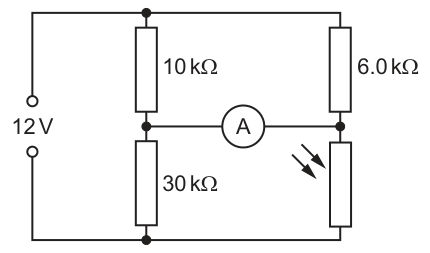
The ammeter reads zero current.
What is the resistance of the LDR?
Options
A
B
C
D
Working
Ammeter reads zero balanced bridge, so
Answer
B
B
Background Concept
In a bridge circuit (often called a Wheatstone bridge), there are two potential dividers in parallel across the same supply. An ammeter (or galvanometer) connects the midpoints.
If the ammeter reads zero, there is no current through it, so the two midpoint potentials are equal. This is the balanced bridge condition. For resistors arranged as:
- left branch: top , bottom
- right branch: top , bottom
Balance implies
This comes from the fact that each side is a potential divider: equal midpoint potentials mean the same fraction of the supply voltage is dropped across the top resistors on each side.
Understanding the Question
The circuit has:
- Left branch: (top) and (bottom)
- Right branch: (top) and an unknown (bottom)
The ammeter between the midpoints reads zero, so the bridge is balanced. The question asks for the LDR resistance.
Approach
Use the balanced-bridge ratio condition:
Then substitute the given resistances and solve for .
Step-by-Step Reasoning
Balanced bridge:
Rearrange:
Compute:
So the correct option is B.
Key Takeaways
- A zero reading in the bridge meter means the midpoint potentials are equal.
- For a balanced bridge, the ratio of the top and bottom resistors is the same in both branches.
- You can solve the unknown resistance with a simple proportion.
Common Mistakes
- Inverting one ratio (e.g. using on one side but on the other inconsistently).
- Treating the circuit as simple series/parallel and ignoring that the ammeter reading gives the special balance condition.
- Dropping the factor and mixing with .
Things to Be Careful About
- Use corresponding positions: top with top, bottom with bottom.
- Keep units consistent (here all are in , so they cancel neatly).
- The supply voltage value is irrelevant for a balance-ratio question; it cancels when comparing divider fractions.
A torch uses three lamps connected in parallel and is powered by a cell of electromotive force (e.m.f.) and negligible internal resistance. Each lamp dissipates of power.
What is the current in the cell?
Options
A
B
C
D
Working
In parallel, each lamp has .
For one lamp:
Total current from the cell:
Answer
C
C
Background Concept
Electrical power transferred in a component is
where is power (W), is potential difference across the component (V), and is current through it (A).
For components connected in parallel:
- the potential difference across each parallel branch is the same as the supply p.d.
- the total current supplied is the sum of the currents in each branch.
Understanding the Question
A cell of e.m.f. (with negligible internal resistance) supplies three identical lamps connected in parallel. Each lamp dissipates . The question asks for the current in the cell, i.e. the total current drawn by all three lamps together.
Approach
- Because the internal resistance is negligible, the terminal p.d. of the cell is .
- Because the lamps are in parallel, each lamp has across it.
- Use for one lamp to find its current.
- Multiply by 3 (or sum the three equal branch currents) to get the cell current.
Step-by-Step Reasoning
- Voltage across each lamp:
- Current in one lamp using :
- Total current in the cell is the sum of the three parallel branch currents:
So the correct option is C.
Key Takeaways
- In parallel, each component has the full supply potential difference.
- Power can be linked to current via .
- The supply current in a parallel circuit equals the sum of the branch currents.
Common Mistakes
- Using for each lamp by incorrectly sharing the voltage between parallel branches (that happens in series, not parallel).
- Forgetting to multiply by 3 after finding the current for one lamp.
- Mixing up units or rearranging incorrectly (e.g. using ).
Things to Be Careful About
- “Negligible internal resistance” means the terminal p.d. is essentially the e.m.f., so you can take across each lamp.
- Keep consistent significant figures: gives , and the total matches the options.
A cell with internal resistance is connected to a light-dependent resistor (LDR), a fixed resistor and a voltmeter, as shown.
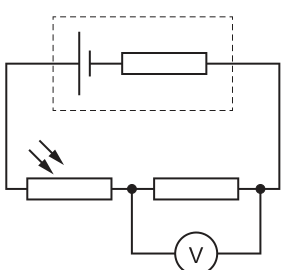
The voltmeter reading increases.
Which quantity decreases as the voltmeter reading increases?
Options
A the charge moving through the cell per unit time
B the energy transferred to the fixed resistor per unit charge
C the intensity of the light incident on the LDR
D the terminal potential difference across the cell
Working
Voltmeter is across the fixed resistor, so
As is fixed, increased voltmeter reading means increases.
For a cell with internal resistance ,
So as increases, decreases.
Answer
D
D
Background Concept
In a circuit, a voltmeter connected in parallel across a component measures the potential difference (p.d.) across that component. For a resistor that obeys Ohm’s law,
so the p.d. across the resistor is proportional to the current through it (provided its resistance is constant).
A real cell is modelled as an ideal source of emf in series with an internal resistance . When current flows, some energy is “lost” inside the cell, giving an internal p.d. drop . The terminal p.d. across the cell is therefore
So, increasing current makes the terminal p.d. smaller.
An LDR (light-dependent resistor) has a resistance that decreases when light intensity increases.
Understanding the Question
The circuit is a series loop containing: a cell with internal resistance, an LDR, and a fixed resistor. A voltmeter is connected across (in parallel with) the fixed resistor.
We are told: the voltmeter reading increases (so the p.d. across the fixed resistor increases).
We must choose which quantity decreases as that voltmeter reading increases.
Approach
- Use the fact that the voltmeter reads the p.d. across the fixed resistor.
- Because the resistor is fixed, use to decide what happens to the current.
- Use to see what decreases when current increases.
- Check the other options quickly for consistency.
Step-by-Step Reasoning
- The voltmeter is across the fixed resistor, so its reading is
-
The resistor is fixed, so is constant. Therefore an increase in implies an increase in current .
-
With internal resistance , terminal p.d. is
As increases, the term increases, so must decrease.
- Check the options:
- A: “charge per unit time” is current → increases, not decreases.
- B: “energy transferred per unit charge” is p.d. across the fixed resistor, equal to the voltmeter reading → increases, not decreases.
- C: If increases in a series circuit, total resistance must have decreased; that would happen if LDR resistance decreased, which corresponds to increased light intensity, not decreased.
- D: terminal p.d. decreases as shown.
So the correct choice is D.
Key Takeaways
- A voltmeter across a resistor measures and for a fixed resistor .
- For a cell with internal resistance, terminal p.d. falls as current increases: .
- For an LDR, higher light intensity means lower resistance.
Common Mistakes
- Assuming the terminal p.d. across the cell increases when current increases (it decreases because the internal drop increases).
- Mixing up “energy per unit charge” (which is p.d.) with power or energy per unit time.
- Thinking the LDR resistance increases with light intensity (it decreases).
Things to Be Careful About
- The voltmeter is across the fixed resistor, not across the cell, so its reading is not the terminal p.d.
- The fixed resistor’s resistance is constant, so any change in directly indicates a change in via .
- In internal resistance questions, always write (or equivalently ) to keep the sign correct.
The circuit shown contains a cell with negligible internal resistance.
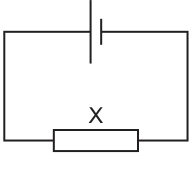
The energy transferred per unit charge in driving charge around the complete circuit is . The potential difference (p.d.) across is .
The cell is then replaced with a different cell of the same electromotive force (e.m.f.) that has significant internal resistance.
What is the effect on and of replacing the cell?
Options
| effect on | effect on | |
|---|---|---|
| A | decreases | decreases |
| B | decreases | increases |
| C | no change | decreases |
| D | no change | increases |
Working
is the energy transferred per unit charge by the cell, i.e. .
The new cell has the same e.m.f. , so has no change.
With internal resistance , the p.d. across is the terminal p.d.
Since is significant and , is significant so decreases.
Answer
C
C
Background Concept
The electromotive force (e.m.f.) of a source is defined as the energy transferred (work done) per unit charge by the source:
A real cell can be modelled as an ideal source of e.m.f. in series with an internal resistance . When current flows, some energy per unit charge is dissipated inside the cell as thermal energy in . This causes the terminal potential difference (p.d.) across the external circuit to be less than the e.m.f.
The terminal p.d. is
If increases (or becomes significant), for the same external resistance the current is reduced and there is a non-negligible "lost volts" term .
Understanding the Question
The circuit is a simple series loop: a cell in series with a component labelled .
- is stated to be “energy transferred per unit charge in driving charge around the complete circuit”. That is the definition of the e.m.f. of the cell.
- is the p.d. across .
Initially the cell has negligible internal resistance, so the p.d. across is essentially the full e.m.f.
Then the cell is replaced by a different cell with the same e.m.f. but significant internal resistance. You must decide how and change.
Approach
- Identify what represents: compare it to the definition of e.m.f.
- Decide whether changing internal resistance changes the e.m.f. (it does not, if the e.m.f. is stated to be the same).
- Use the internal-resistance relation for the p.d. across the external component: (since is the external load).
- Conclude the direction of change of when becomes significant.
Step-by-Step Reasoning
- By definition, the e.m.f. is the work done (energy transferred) per unit charge by the source. The question’s wording for matches this definition, so:
- The replacement cell is stated to have the same e.m.f. Therefore:
- Effect on : no change.
- With internal resistance , the e.m.f. is shared between the internal resistance and the external component :
Rearrange:
- Since the internal resistance is now significant and there is a current ( in a closed circuit), the term is non-zero and noticeable. Therefore is less than , i.e. compared with the negligible- case, the p.d. across decreases.
So the correct option is: no change for , decrease for (\Rightarrow) option C.
Key Takeaways
- e.m.f. is energy transferred per unit charge by the source: it is a property of the cell’s chemistry and is not reduced just because internal resistance is present.
- Internal resistance causes “lost volts” , so the terminal p.d. across the external circuit is .
- Adding internal resistance reduces the p.d. available to the external component.
Common Mistakes
- Thinking the e.m.f. decreases when internal resistance is added. Internal resistance reduces terminal p.d., not the e.m.f. (if the e.m.f. is specified unchanged).
- Confusing (p.d. across ) with (cell e.m.f.). With negligible internal resistance they are approximately equal, but not when is significant.
- Assuming must increase because current decreases. Even though may decrease, the key point is that becomes , which is less than .
Things to Be Careful About
- The phrase “energy transferred per unit charge in driving charge around the complete circuit” is a strong cue for e.m.f.
- The question states the replacement cell has the same e.m.f.: this locks the effect on as “no change”.
- is across (external component), so it is the terminal p.d., not the p.d. across the internal resistance.
In the circuits shown, the batteries are identical and all have negligible internal resistance. All of the resistors have the same resistance. The diodes have zero resistance when conducting and infinite resistance when not conducting.
In which circuit is the current in the battery greatest?
Options
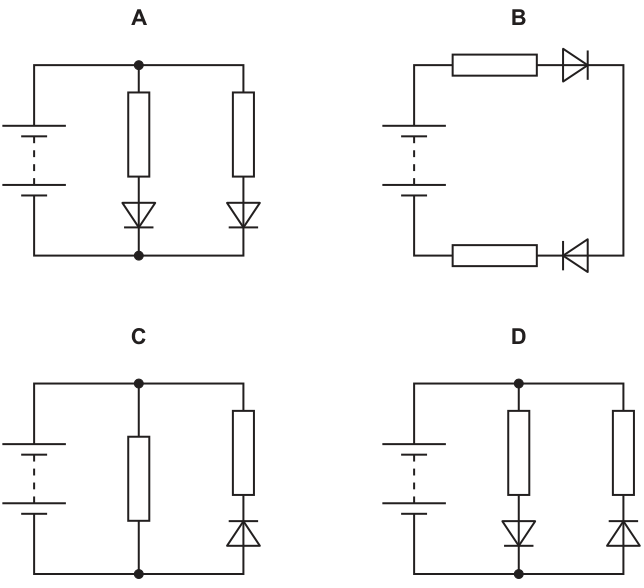
Working
Conducting diode: ; non-conducting diode: open circuit.
A: both branches conduct, so two equal resistors in parallel:
so
B: one diode is reverse-biased in the loop open circuit .
C: one branch conducts (single ), the other is blocked .
D: one branch conducts, one blocked .
Greatest current corresponds to smallest , which is circuit A.
Answer
A
A
Background Concept
An ideal diode behaves like a one-way switch:
- Forward-biased (conducting): it has zero resistance, so it can be replaced by a wire.
- Reverse-biased (not conducting): it has infinite resistance, so it can be replaced by an open circuit (a break).
For a given battery voltage , the current drawn from the battery is
So the circuit with the greatest current is the one with the smallest equivalent resistance seen by the battery.
Understanding the Question
All batteries are identical and have negligible internal resistance, so the battery voltage is the same in all options and does not change with current.
All resistors have the same resistance .
You are asked: in which circuit does the battery deliver the largest current?
So you only need to:
- Decide which diodes conduct (and which block), given the battery polarity in the diagram.
- Simplify each circuit and find .
- Compare .
Approach
For each option:
- Replace each forward-biased diode with a wire (zero resistance).
- Remove each reverse-biased branch (open circuit means no current in that branch).
- Combine the remaining resistors (series/parallel) to get .
- The smallest gives the largest battery current.
Step-by-Step Reasoning
Let the battery drive conventional current from its positive terminal through the external circuit.
Circuit A
Both diodes are oriented to allow current in the same direction through each vertical branch, so both branches conduct. Each branch then behaves like a single resistor (since the diode has when conducting). Two equal resistors in parallel give:
So
Circuit B
This is one loop, so the same current would have to pass through both diodes. Because the two diodes are oppositely oriented, for any chosen loop current direction one of them will be reverse-biased. A reverse-biased ideal diode is an open circuit, so the loop is broken and:
Circuit C
There are two parallel branches across the battery. The left branch is just a resistor , so it always provides a complete path. The right branch contains a diode oriented to block the current direction that would be driven by the battery, so that entire right branch is open and carries no current. Therefore only one resistor is effectively across the battery:
Circuit D
Again there are two parallel branches. The diodes are oppositely oriented, so only one branch is forward-biased for the given battery polarity; the other branch is open. That leaves a single conducting branch containing one resistor :
Comparing currents:
So the greatest battery current is in A.
Key Takeaways
- Ideal diode: forward-biased short circuit; reverse-biased open circuit.
- Battery current is largest when the equivalent resistance across the battery is smallest.
- Two identical resistors in parallel halve the resistance, doubling the current for the same voltage.
Common Mistakes
- Treating a reverse-biased diode as having resistance rather than being an open circuit.
- Assuming both parallel branches always conduct even if one contains a reverse-biased diode.
- Forgetting that in a single loop, a single reverse-biased diode stops all current.
Things to Be Careful About
- Use the battery polarity shown in the diagram to decide diode bias correctly.
- Once a diode is reverse-biased, that whole branch carries zero current (so do not include its resistor in the equivalent resistance).
- When comparing options, you do not need a numerical value of or ; relative is enough.
A potentiometer circuit is used to determine the electromotive force (e.m.f.) of a cell. The circuit includes a second cell of e.m.f. and internal resistance that is connected to a uniform resistance wire , as shown.
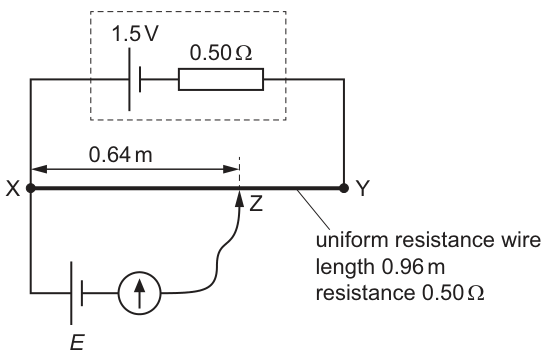
The resistance wire has a length of and a resistance of .
The movable connection is moved along wire . The galvanometer reading is zero when length is .
What is the value of e.m.f. ?
Options
A
B
C
D
Working
Total resistance in driving circuit:
Current in wire:
p.d. across whole wire :
Potential gradient:
At balance, :
Answer
A
A
Background Concept
A potentiometer measures an e.m.f. by using a null method. A steady current is passed through a uniform resistance wire, so the potential difference along the wire is proportional to length.
If the galvanometer reads zero, no current flows in the test-cell branch, so the p.d. between the contact points on the wire equals the e.m.f. of the test cell:
For a uniform wire,
where is the potential gradient (V m) and is the balance length.
Understanding the Question
A 1.5 V driving cell with internal resistance sends current through the potentiometer wire (resistance , length ). The slider is at such that and the galvanometer shows zero. We must find the unknown e.m.f. of the test cell connected between and .
So we need the potential drop along length of the wire.
Approach
- Find the current in the driving circuit using the driving e.m.f. and the total series resistance (internal resistance + wire resistance).
- Use to find the potential drop across the entire wire .
- Because the wire is uniform, scale that p.d. by the fraction of length to get .
- At null deflection, set .
Step-by-Step Reasoning
- The driving cell has internal resistance in series with the wire resistance , so
- The current through the wire is then
- The p.d. across the entire wire is
- Uniform wire means p.d. is proportional to length, so the p.d. from to is
- At balance (zero galvanometer current), the test-cell e.m.f. equals this p.d.:
So the correct option is A.
Key Takeaways
- In a potentiometer, null deflection implies the test cell is not supplying current, so its e.m.f. equals the measured p.d.
- A uniform potentiometer wire has constant potential gradient: .
- When the driving cell has internal resistance, include it when finding the current through the wire.
Common Mistakes
- Ignoring the internal resistance of the 1.5 V cell (would give the wrong current and gradient).
- Using directly as the p.d. across the wire (it is not, because some is lost across internal resistance).
- Inverting the length ratio (using instead of ).
Things to Be Careful About
- The resistance of the wire and the internal resistance are in series in the driving circuit.
- The balance condition uses potential difference along the wire, not the full driving e.m.f..
- Proportionality with length only holds because the wire is stated to be uniform (constant resistance per unit length).
Which particle is not a fundamental particle?
Options
A charm quark
B electron
C neutrino
D neutron
Working
Quarks and leptons (electron, neutrino) are fundamental particles.
A neutron is a baryon made of three quarks (e.g. ), so it is not fundamental.
Answer
D
D
Background Concept
In the AS Level model used in Cambridge 9702, fundamental particles are those not made of smaller constituents (within the syllabus model). The key fundamental families are:
- Quarks (e.g. up, down, charm, strange, etc.)
- Leptons (e.g. electron, neutrino)
Particles that are not fundamental are usually hadrons, which are composite particles made of quarks:
- Baryons: made of three quarks (e.g. proton , neutron )
- Mesons: made of a quark and an antiquark
Understanding the Question
You are given four particles and asked which one is not fundamental. So we check whether each option is a quark, a lepton, or a hadron (composite).
- charm quark → quark → fundamental
- electron → lepton → fundamental
- neutrino → lepton → fundamental
- neutron → baryon (hadron) → composite → not fundamental
Approach
- Classify each option as quark / lepton / hadron.
- Use the rule: quarks and leptons are fundamental; hadrons are made of quarks and are not fundamental.
- Select the composite particle.
Step-by-Step Reasoning
- Option A: charm quark is a quark, and quarks are fundamental → not the answer.
- Option B: electron is a lepton, and leptons are fundamental → not the answer.
- Option C: neutrino is a lepton, and leptons are fundamental → not the answer.
- Option D: neutron is a baryon (a hadron). In the quark model it is made of three quarks, typically .
Since it has constituents, it is not fundamental.
Therefore the correct choice is D.
Key Takeaways
- Fundamental (in this syllabus): quarks and leptons.
- Composite: hadrons (baryons and mesons) made of quarks.
- Neutron is a baryon with quark content .
Common Mistakes
- Thinking “neutral” means “fundamental”: neutron and neutrino are both neutral-sounding, but neutron is composite while neutrino is fundamental.
- Mixing up neutron with neutrino.
- Assuming all particles in the nucleus are fundamental: protons and neutrons are made of quarks.
Things to Be Careful About
- The question is about the quark/lepton model, not about whether something is stable or whether it has charge.
- Remember: neutrons are hadrons (baryons), not leptons.
The isotope fluorine-18, , undergoes decay to form a stable isotope.
How many neutrons are there in a nucleus of the stable isotope?
Options
A
B
C
D
Working
In (\beta^{+}) decay, the nucleon number (A) stays the same and the proton number (Z) decreases by (1).
So (^{18}{9}\text{F} \to {}^{18}{8}\text{O}) (stable).
Number of neutrons:
Answer
D
D
Background Concept
In nuclide notation (^{A}_{Z}X):
- (A) is the nucleon (mass) number = number of protons + number of neutrons.
- (Z) is the proton (atomic) number = number of protons.
- Number of neutrons is (N = A - Z).
In (\beta^{+}) decay (positron emission), a proton in the nucleus changes into a neutron:
So:
- (A) stays constant (still the same total number of nucleons).
- (Z) decreases by (1) (one fewer proton).
Understanding the Question
You are told (^{18}_{9}\text{F}) undergoes (\beta^{+}) decay to form a stable isotope. You must find how many neutrons are in the nucleus of that final (stable) isotope.
Given initially:
- (A = 18)
- (Z = 9)
After (\beta^{+}) decay:
- (A) remains (18)
- (Z) becomes (8)
Then use (N = A - Z) for the product nucleus.
Approach
- Use the rule for (\beta^{+}) decay to update (Z) (down by 1) while keeping (A) unchanged.
- Compute neutrons in the product nucleus using (N = A - Z).
- Match the result to the multiple-choice options.
Step-by-Step Reasoning
- Start with (^{18}_{9}\text{F}).
- In (\beta^{+}) decay, (Z) decreases by 1:
and (A) is unchanged:
So the daughter nucleus is (^{18}_{8}\text{O}), which is a stable isotope.
- Find the number of neutrons in (^{18}_{8}\text{O}):
- Option with 10 neutrons is D.
Key Takeaways
- (\beta^{+}) decay converts a proton into a neutron.
- (\beta^{+}) decay: (A) unchanged, (Z) decreases by 1.
- Neutron number is found from (N = A - Z).
Common Mistakes
- Changing (A) during (\beta^{+}) decay (it must stay constant).
- Increasing (Z) instead of decreasing it (confusing (\beta^{+}) with (\beta^{-})).
- Calculating neutrons using the original fluorine nucleus instead of the daughter (stable) nucleus.
Things to Be Careful About
- Always apply the decay rule first (update (Z) and (A)), then calculate (N).
- Remember: (\beta^{-}) decay makes (Z) go up by 1, but (\beta^{+}) makes (Z) go down by 1.
Which statement is correct?
Options
A A baryon is a hadron and consists of 2 quarks.
B A meson is a hadron and consists of 3 quarks.
C An electron is a fundamental particle and is a lepton.
D A neutrino is a fundamental particle and is a hadron.
Working
Baryons are hadrons made of quarks (not ). Mesons are hadrons made of a quark and an antiquark (not quarks). Neutrinos are leptons (not hadrons). An electron is a fundamental particle and is a lepton.
Answer
C
C
Background Concept
In the quark model, particles are grouped as:
- Hadrons: particles that experience the strong interaction and are made of quarks.
- Baryons: made of three quarks () (or three antiquarks for antibaryons).
- Mesons: made of a quark and an antiquark ().
- Leptons: fundamental particles that do not take part in the strong interaction (e.g. electron, muon, neutrino).
So: baryons and mesons are both hadrons, but have different quark compositions; electrons and neutrinos are leptons.
Understanding the Question
You are asked to choose the one correct statement among four options about:
- whether a particle is a hadron or a lepton, and
- how many quarks it contains (where relevant).
Only one option matches the standard definitions.
Approach
Check each option against the key facts:
- Baryon quark content ().
- Meson quark content ().
- Electron classification (fundamental lepton).
- Neutrino classification (fundamental lepton).
The option that agrees with these definitions is correct.
Step-by-Step Reasoning
-
Option A: “A baryon is a hadron and consists of 2 quarks.”
- Baryon is indeed a hadron, but baryons consist of three quarks, not two. So A is false.
-
Option B: “A meson is a hadron and consists of 3 quarks.”
- Meson is indeed a hadron, but mesons consist of a quark and an antiquark (two constituents), not three quarks. So B is false.
-
Option C: “An electron is a fundamental particle and is a lepton.”
- The electron is a fundamental particle (not made of quarks) and it is a lepton. So C is true.
-
Option D: “A neutrino is a fundamental particle and is a hadron.”
- Neutrinos are fundamental, but they are leptons, not hadrons. So D is false.
Therefore the correct statement is C.
Key Takeaways
- Baryon: hadron, .
- Meson: hadron, .
- Electron and neutrino: fundamental leptons, not hadrons.
Common Mistakes
- Swapping baryon and meson quark counts (thinking baryons are quarks or mesons are quarks).
- Thinking “fundamental particle” automatically means “hadron” (it does not; hadrons are composite).
- Forgetting neutrinos are leptons.
Things to Be Careful About
- The word hadron implies “made of quarks” (composite), so fundamental particles like electrons/neutrinos are not hadrons.
- Mesons involve an antiquark as well as a quark: , not .
Your score so far
Answer a question to start scoring
Your marks add up here as you work through the paper.