Physics 9702/23 — May/June 2024
Cambridge AS Level · AS Level Structured Questions · worked solutions for every part, with the mark scheme
Topics Physical Quantities and Units · Work, Energy and Power · Dynamics · Forces, Density and Pressure · Kinematics · Deformation of Solids · +4 more
The drag force acting on a sphere falling through a liquid is given by
where is the radius of the sphere,
is the speed of the sphere in the liquid and
is a property of the liquid called the viscosity.
Working
From
the constant is dimensionless, so
Units:
So
Answer
kg m^-1 s^-1
Background Concept
Dimensional analysis uses the fact that equations must be homogeneous: both sides must have the same units. If a formula is correct, you can deduce the SI base units of an unknown quantity by rearranging the formula and substituting base units for the other quantities.
In Stokes' law,
is a pure number (dimensionless), so it does not affect the units.
Understanding the Question
You are given an expression for the drag force on a sphere moving through a liquid. The question asks you to show, using SI base units, that viscosity has units .
Approach
- Rearrange the equation to make the subject.
- Replace each quantity with its SI units written in base units.
- Simplify carefully, cancelling powers of metres and seconds.
Step-by-Step Reasoning
Start with
Rearrange for viscosity:
Since is dimensionless,
Now write each in SI base units:
- Force: .
- Radius: .
- Speed: .
So
Multiply out the denominator: .
Then
Key Takeaways
- Physical equations must be dimensionally consistent.
- Dimensionless constants (like ) do not affect units.
- Converting to SI base units (, , ) makes cancellations clear.
Common Mistakes
- Treating as if it has units.
- Using without converting to base units.
- Incorrectly combining indices when dividing (especially with seconds).
Things to Be Careful About
- Write as before simplifying.
- When dividing by , remember it is equivalent to multiplying by .
The sphere has a radius of and is falling vertically downwards at a terminal velocity of through the liquid. The drag force acting on the sphere is .
Calculate the viscosity of the liquid.
viscosity = ______
Working
.
Answer
8.5 × 10^-2 kg m^-1 s^-1
Background Concept
Stokes' law for the viscous drag force on a sphere moving through a liquid at low Reynolds number is
where is the drag force, is the viscosity, is the sphere radius, and is the speed. If three of these are known, the fourth can be found by rearranging the equation.
Understanding the Question
You are told the sphere has radius and terminal speed , and the drag force is . You must calculate and give it in .
A key detail is that the radius is in centimetres, so it must be converted to metres for SI.
Approach
- Convert from cm to m.
- Rearrange to .
- Substitute the numerical values and calculate.
- Round to a sensible number of significant figures (typically matching the data, here 2 s.f.).
Step-by-Step Reasoning
Rearrange:
Convert radius:
Substitute:
Compute the denominator first:
So
Key Takeaways
- Always convert to SI units before substitution.
- Rearranging a formula cleanly reduces algebra errors.
- Significant figures should reflect the least precise given data.
Common Mistakes
- Forgetting to convert to (this causes a factor of error).
- Using diameter instead of radius.
- Dropping the factor .
Things to Be Careful About
- Keep track of powers of ten when converting cm to m.
- Include the unit in the final answer.
The sphere is shown in Fig. 1.1.
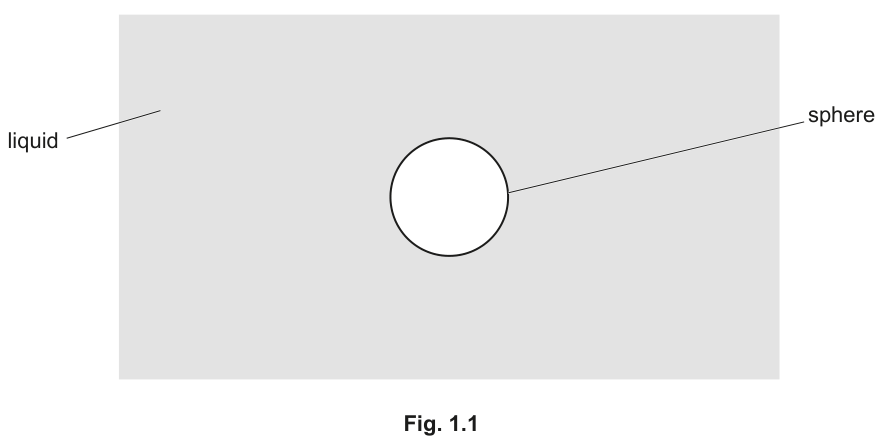
On Fig. 1.1, draw and label arrows to represent the directions of the three forces acting on the sphere as it falls at terminal velocity through the liquid.
Answer
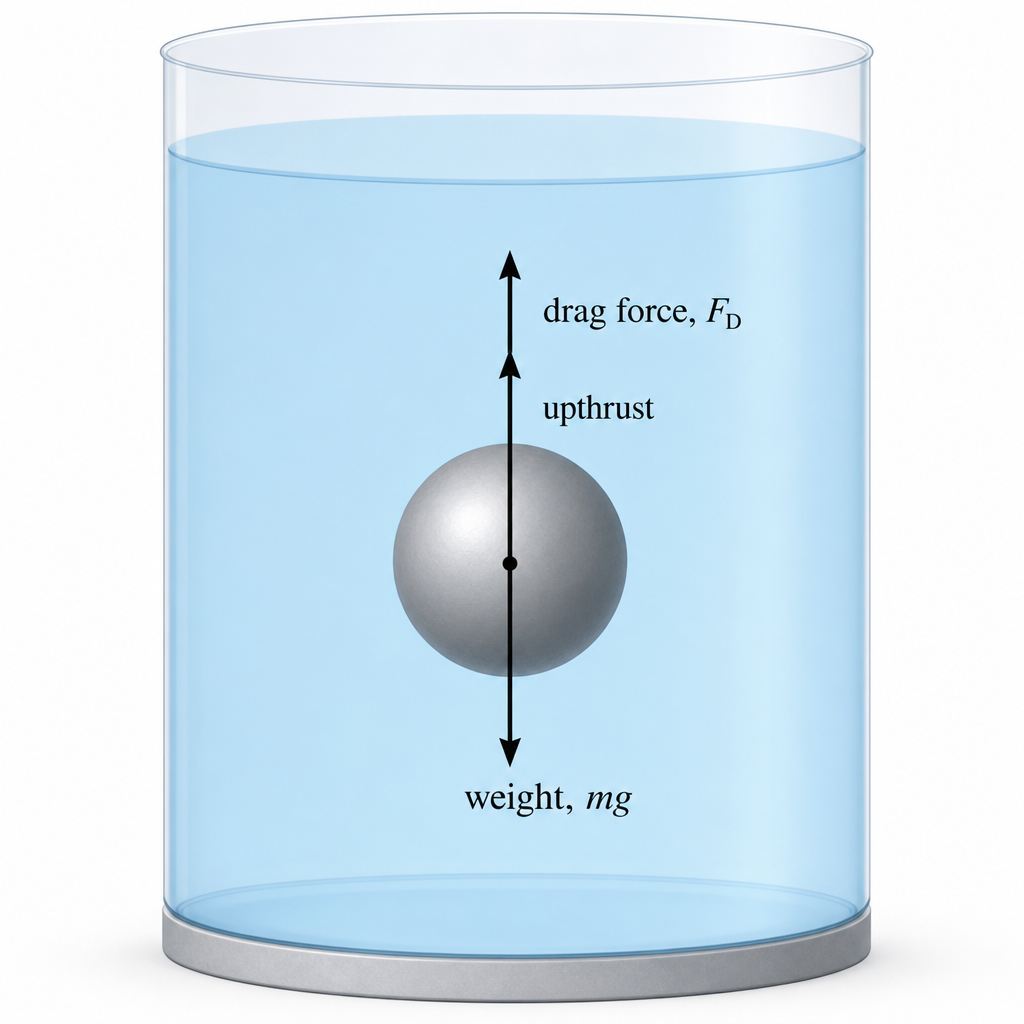
Weight acts vertically downwards.
Upthrust acts vertically upwards.
Drag force acts vertically upwards (opposes the downward motion).
Arrows: weight down; upthrust up; drag up.
Background Concept
When an object moves through a fluid, several forces can act:
- Weight acts downward due to gravity.
- Upthrust (buoyancy) acts upward due to pressure being greater at lower depth; by Archimedes' principle it equals the weight of fluid displaced.
- Drag force acts opposite to the direction of motion through the fluid.
At terminal velocity, the acceleration is zero, so the resultant force is zero (Newton’s first/second law): upward forces balance downward forces.
Understanding the Question
The sphere is falling vertically downward at terminal velocity in a liquid. The question asks you to draw and label arrows showing the directions of the three forces acting on the sphere.
So you must identify the three forces and draw them on the provided sphere diagram.
Approach
- Recognise “terminal velocity” means constant velocity, so forces balance.
- List the forces: weight, upthrust, drag.
- Decide directions: weight down; the other two oppose the motion or act upward.
- Draw three arrows on the sphere itself and label each clearly.
Step-by-Step Reasoning
- The sphere is moving downward. Drag always opposes motion, so drag must be upward.
- Upthrust is the buoyant force from the liquid; it always acts upward.
- Weight acts toward the centre of the Earth; in this vertical set-up that is downward.
At terminal velocity:
where is upthrust.
Key Takeaways
- Terminal velocity implies zero acceleration and zero resultant force.
- Drag acts opposite the motion; upthrust acts upward in a fluid.
- A correct force diagram needs correct directions and clear labels.
Common Mistakes
- Drawing drag downward (it must oppose the downward motion).
- Omitting upthrust and only drawing weight and drag.
- Drawing arrows not starting on the sphere or failing to label them.
Things to Be Careful About
- The question asks for directions, not magnitudes; however, arrows must be clearly up/down.
- Do not confuse upthrust with “reaction force”; there is no contact surface here.
Working
Upthrust equals weight of liquid displaced:
For a sphere,
Answer
1.0 N
Background Concept
Archimedes’ principle states that the upthrust (buoyant force) on an object in a fluid equals the weight of fluid displaced:
where is the fluid density, is gravitational field strength, and is the volume of fluid displaced. For a fully submerged object, the displaced volume equals the object’s volume.
Understanding the Question
The sphere (radius from earlier) is submerged in a liquid of density . You must show the upthrust is . So you calculate the sphere’s volume (in ) and then use .
Approach
- Convert radius to metres.
- Find volume of the sphere: .
- Substitute into .
- Round to as requested.
Step-by-Step Reasoning
Convert radius:
Sphere volume:
Calculate :
So
Now apply Archimedes:
To 2 significant figures this is , matching the value you were asked to show.
Key Takeaways
- Upthrust depends on fluid density and displaced volume, not the object’s mass.
- For a fully submerged object, displaced volume = object volume.
- Always use SI units: in and in .
Common Mistakes
- Using diameter instead of radius in the volume formula.
- Forgetting to convert to , leading to a error in volume.
- Using of the sphere (wrong: it is the weight of displaced liquid).
Things to Be Careful About
- The cube on the radius makes unit conversion critical.
- Rounding: you can keep extra digits (like ) but then state it is as required.
Working
At terminal velocity, resultant force is zero:
Answer
0.11 kg
Background Concept
Terminal velocity means constant velocity, so acceleration . By Newton’s second law,
so the forces balance.
For a falling sphere in a liquid:
- Weight acts downward.
- Upthrust acts upward.
- Drag force acts upward (opposes downward motion).
Therefore at terminal velocity:
Understanding the Question
You have already found the upthrust in (i) as (to 2 s.f.). You are also told earlier that the drag force at terminal velocity is . The question asks for the mass of the sphere.
Approach
- Write the equilibrium equation at terminal velocity: .
- Substitute and to find .
- Divide by to get .
- Round appropriately.
Step-by-Step Reasoning
At terminal velocity,
Substitute the known upward forces:
Now divide by :
Given that was shown as (2 s.f.), quoting as is appropriate.
Key Takeaways
- Terminal velocity implies forces balance (resultant force zero).
- For a falling object in a fluid: is balanced by upthrust plus drag.
- Mass comes from .
Common Mistakes
- Using (wrong sign; both and act upward).
- Forgetting that drag is upward when the motion is downward.
- Dividing by or is fine, but keep consistent rounding with earlier parts.
Things to Be Careful About
- Use the same rounded value of upthrust the question has guided you to () unless instructed otherwise.
- Ensure the final unit is , not newtons.
Answer
Displacement from a point is the straight-line distance and direction (a vector) from that point to the object.
Straight-line distance and direction (vector) from the point to the object.
Background Concept
Displacement is a vector measure of change in position. Unlike distance (a scalar that adds up total path length), displacement depends only on the initial and final positions.
A vector quantity must include:
- a magnitude (how far), and
- a direction (which way).
Understanding the Question
You are asked to define “displacement from a point”. That means you must describe the position change measured relative to a stated reference point, not the length of the path taken.
Approach
Give the standard definition that examiners award: straight-line separation plus direction, making clear it is a vector.
Step-by-Step Reasoning
- “From a point” indicates we measure relative to that reference point.
- Displacement is the vector from the reference point to the object’s position.
- Therefore it is the straight-line distance and direction from the point to the object.
Key Takeaways
- Displacement is a vector: magnitude + direction.
- Displacement is the straight-line separation between two positions.
Common Mistakes
- Defining it as “how far travelled” (that is distance).
- Giving only a magnitude with no direction.
- Describing the path (e.g. “along the slope”) rather than the straight-line change in position.
Things to Be Careful About
- Use the word direction or otherwise indicate vector nature.
- Include straight-line to distinguish from path length.
An object is projected horizontally at a speed of from a slope, as shown in Fig. 2.1.
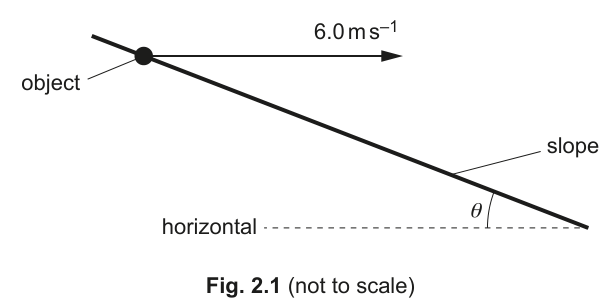
The slope is at an angle to the horizontal. Air resistance is negligible.
The object lands on the slope a time of later and stops without rolling or bouncing.
Working
Horizontal speed is constant: .
Answer
4.3 m
Background Concept
For projectile motion with negligible air resistance:
- horizontal acceleration , so horizontal velocity is constant,
- vertical acceleration downward.
So the horizontal displacement is found from constant-speed motion:
Understanding the Question
The object is projected horizontally at and lands after . Part (i) asks for the horizontal distance travelled in that time.
Approach
Use horizontal motion only:
- Take (unchanged).
- Multiply by time .
Step-by-Step Reasoning
Since air resistance is negligible, there is no horizontal force and hence .
Substitute:
Rounded to 2 s.f. (matching given data), .
Key Takeaways
- Horizontal velocity stays constant in ideal projectile motion.
- Horizontal displacement is simply .
Common Mistakes
- Using in the horizontal calculation.
- Treating the speed as the final speed (it is the initial horizontal component).
Things to Be Careful About
- Keep time in seconds and speed in so distance comes out in metres.
- Quote an appropriate number of significant figures.
Working
Vertical motion: , , .
Answer
2.5 m
Background Concept
For vertical motion in a projectile (no air resistance), acceleration is constant and equal to the gravitational field strength downward.
Using upward as positive, . Many candidates instead work with magnitudes and state “vertical distance fallen”. Either is fine if consistent.
A key kinematics equation is:
Understanding the Question
The object is projected horizontally, so its initial vertical velocity is zero (). After it lands on the slope. Part (ii) asks for the vertical distance travelled in that time (i.e. how far it falls).
Approach
Treat the vertical motion as free fall:
- Set .
- Use for the distance fallen.
Step-by-Step Reasoning
Initial vertical component is zero because the launch is horizontal:
Distance fallen in time under constant acceleration is:
Substitute and :
So the vertical distance is about (2 s.f.).
Key Takeaways
- Horizontal launch implies .
- Vertical displacement depends only on time: .
Common Mistakes
- Using as the vertical initial velocity.
- Forgetting the factor .
- Mixing sign conventions (getting a negative “distance”).
Things to Be Careful About
- Decide whether you are finding a signed displacement (could be negative) or the magnitude “distance fallen”. The question asks for distance travelled, so a positive magnitude is expected.
- Use to 2–3 s.f. consistently; rounding only at the end avoids errors.
Working
Using (i) and (ii) .
Answer
30°
Background Concept
If a line makes an angle to the horizontal, then for a right triangle formed by a horizontal run and vertical drop :
This is purely geometry; it does not depend on the object’s speed, only on the relative vertical and horizontal displacements between the two points.
Understanding the Question
The object starts at the top of the slope and lands somewhere down the slope. The straight line between start and landing lies along the slope, which is at angle to the horizontal. You already found:
- horizontal distance in (b)(i)
- vertical distance in (b)(ii)
You must use these to calculate .
Approach
- Treat and as the adjacent and opposite sides of a right triangle.
- Use .
- Take inverse tangent to get .
Step-by-Step Reasoning
From earlier parts:
Form the tangent ratio:
Now find the angle:
Rounded appropriately, .
Key Takeaways
- The slope angle comes from the ratio of vertical to horizontal displacement.
- Use when you know opposite and adjacent sides.
Common Mistakes
- Using or with the wrong sides.
- Swapping the ratio (doing gives the complement angle).
- Rounding and too early, leading to a noticeably different angle.
Things to Be Careful About
- Ensure your calculator is in degree mode, not radians.
- Use consistent values from parts (i) and (ii) (ideally unrounded) before taking the inverse tangent.
Determine the magnitude of the displacement of the object from its original position.
displacement = ______
Working
Using and .
Answer
4.9 m
Background Concept
Displacement is a vector from the starting point to the ending point. If its horizontal and vertical components are perpendicular (at right angles), the magnitude of the displacement is the resultant:
This is Pythagoras’ theorem applied to vector components.
Understanding the Question
You have already found the components of the object’s change in position after :
- horizontal distance
- vertical distance
Part (iv) asks for the magnitude of the displacement from its original position (the straight-line distance from launch point to landing point).
Approach
- Treat and as perpendicular components of the displacement vector.
- Use Pythagoras to find the resultant magnitude.
Step-by-Step Reasoning
From earlier parts:
Magnitude of displacement:
Substitute:
So .
Key Takeaways
- Displacement magnitude is the straight-line separation between initial and final positions.
- Perpendicular components combine via Pythagoras.
Common Mistakes
- Adding instead of using Pythagoras.
- Confusing displacement magnitude with distance travelled along the curved projectile path.
Things to Be Careful About
- Use the components from (i) and (ii) consistently.
- Report the answer with appropriate significant figures and unit (metres).
By considering energy, calculate the speed of the object just before it lands.
speed = ______
Working
Vertical drop .
Conservation of mechanical energy:
Answer
9.2 m s⁻1
Background Concept
When air resistance is negligible, the only significant force doing work is gravity, which is conservative. Therefore mechanical energy is conserved:
Kinetic energy:
Gravitational potential energy change for a vertical drop of height :
So the loss of GPE becomes a gain in KE.
Understanding the Question
The object is projected horizontally at . After it lands on the slope. You found in (ii) that it drops vertically by . The question asks for the speed just before it lands, using energy.
Approach
- Take initial kinetic energy from the launch speed .
- Add the gain in kinetic energy due to falling height (equal to ).
- Solve the energy equation for the final speed .
Step-by-Step Reasoning
Initial energy at launch:
During flight it falls a vertical height , so GPE decreases by and KE increases by the same amount:
So:
Cancel and multiply by 2:
Substitute , , :
This is larger than because gravity has increased the vertical component of velocity while the horizontal component remains .
Key Takeaways
- With negligible air resistance, use conservation of mechanical energy.
- Falling through height increases speed according to .
Common Mistakes
- Using displacement along the slope instead of the vertical height in .
- Forgetting to square-root at the end (leaving ).
- Adding to speed directly instead of to energy.
Things to Be Careful About
- In , must be the vertical drop (here from part (ii)).
- Keep units consistent so has units of .
- Quote the final speed to an appropriate number of significant figures (typically matching the given and ).
Answer
Hooke’s law: the extension is proportional to the applied force (load), provided the limit of proportionality is not exceeded.
Extension is proportional to force, provided the limit of proportionality is not exceeded.
Background Concept
Hooke’s law describes the behaviour of many materials and springs when they are stretched (or compressed) by a small amount. In the region where Hooke’s law holds, the relationship between force and extension is linear:
where is the spring constant.
Understanding the Question
You are asked to state Hooke’s law. This is a 1-mark “definition” style question, so you must give the linear relationship and the condition under which it applies.
Approach
Give a short sentence linking force and extension, and include the condition “up to the limit of proportionality” (or equivalent wording).
Step-by-Step Reasoning
- “Extension is proportional to applied force” means .
- The law does not apply for large extensions where the graph is no longer a straight line, so you must state the condition (limit of proportionality not exceeded).
Key Takeaways
- Hooke’s law is the linear region: .
- Always state the condition: only valid up to the limit of proportionality.
Common Mistakes
- Saying “up to the elastic limit” only: this is not as precise as “limit of proportionality” for Hooke’s law.
- Writing “force is proportional to length” instead of extension.
Things to Be Careful About
- Use the word extension (change in length), not total length.
- Include the condition of validity to secure the mark.
The variation of the applied force with the extension for a sample of a material is shown in Fig. 3.1.
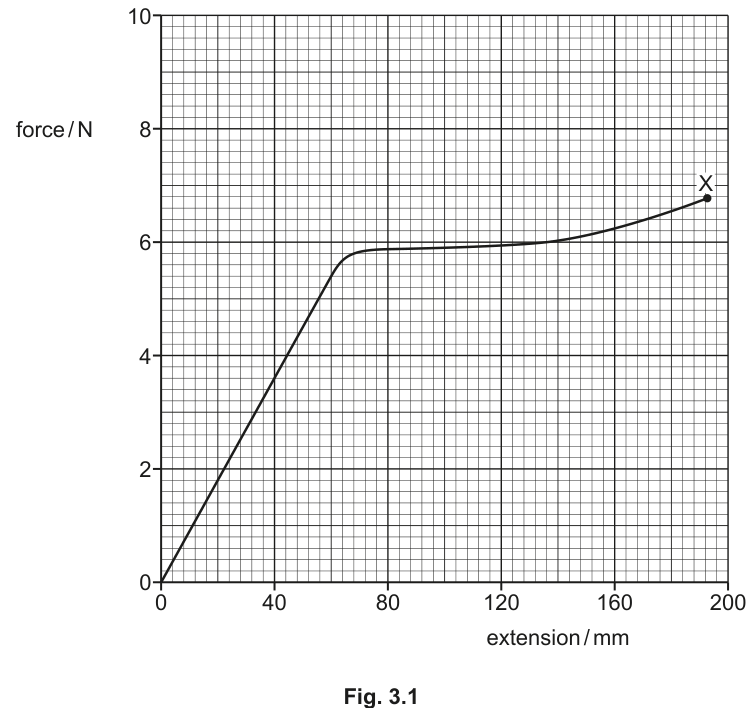
The sample behaves elastically up to an extension of and breaks at point X.
On the line in Fig. 3.1, draw a cross () to show the limit of proportionality. Label this cross with the letter P.
Answer
is at the end of the straight-line part of the graph: at extension (force ).
At 80 mm extension (≈ 6 N), i.e. the end of the straight-line region.
Background Concept
On a force–extension graph:
- The limit of proportionality is the point beyond which is no longer proportional to (the graph stops being a straight line).
- In the proportional region, the gradient is constant and equals the spring constant .
Understanding the Question
You must mark point (limit of proportionality) on the given force–extension curve. The question statement tells you the graph is linear up to an extension of .
Approach
Find where the graph stops being a straight line (end of linear region). That point is .
Step-by-Step Reasoning
- From the description/graph, the straight-line section runs from the origin to extension .
- Therefore, the limit of proportionality is at extension .
- Reading the force there gives about .
Key Takeaways
- Limit of proportionality = end of straight-line section.
Common Mistakes
- Putting at the breaking point .
- Confusing the elastic limit with the limit of proportionality without checking where the graph becomes non-linear.
Things to Be Careful About
- is defined by linearity, not by where it breaks or where the curve ends.
- If the graph is stated to be linear up to a specific extension, use that given value.
On the line in Fig. 3.1, draw a cross () to show the elastic limit. Label this cross with the letter E.
Answer
is at extension (force ) since the sample behaves elastically up to .
At 80 mm extension (≈ 6 N), since the sample is elastic up to 80 mm.
Background Concept
The elastic limit is the greatest load/extension for which the material returns to its original length when the force is removed. Beyond this point, plastic (permanent) deformation occurs.
Understanding the Question
You must mark point (elastic limit) on the force–extension curve. The question explicitly states: “The sample behaves elastically up to an extension of .”
Approach
Use the given statement: elastic limit corresponds to the extension value at which elasticity ends.
Step-by-Step Reasoning
- “Behaves elastically up to ” means that at you are at the boundary between elastic and plastic behaviour.
- So place at extension .
- From the graph, the corresponding force is about .
Key Takeaways
- Elastic limit is about recovery (returns to original length), not about straight-line behaviour.
Common Mistakes
- Placing at the breaking point .
- Assuming elastic limit must occur after the limit of proportionality: sometimes it does, but here the statement tells you exactly where it is.
Things to Be Careful About
- If the question provides “elastic up to …”, you should use that directly.
- The elastic limit and limit of proportionality can coincide (as in this graph).
The sample in (b) has a cross-sectional area of and an initial length of .
For deformations within the limit of proportionality of the sample, determine:
Working
Within the proportional region,
Using at :
Answer
75 N m⁻¹
Background Concept
In the Hooke’s law (proportional) region:
- is the applied force (N)
- is the extension (m)
- is the spring constant (N m)
On a force–extension graph, the gradient of the straight-line section is .
Understanding the Question
You are told to consider deformations within the limit of proportionality, so you must use the straight-line part of the graph. From the graph, a convenient point on the straight section is and .
Approach
Pick a point in the linear region, convert extension to metres, then use (or gradient ).
Step-by-Step Reasoning
- Choose the point at the end of the straight-line region: when .
- Convert to metres:
- Rearrange Hooke’s law:
- Substitute:
Key Takeaways
- Spring constant is the gradient of the straight-line section.
- Always use in metres to get in N m.
Common Mistakes
- Using as or .
- Using a point beyond the proportional region (where the gradient is not constant).
Things to Be Careful About
- Units: if is in mm, your would come out in N mm, not the required N m.
- Use a point clearly on the straight line to avoid reading errors.
the Young modulus of the material from which the sample is made.
Young modulus = ______
Working
Using at and :
Answer
6.0 × 10^8 Pa
Background Concept
Young modulus measures stiffness of a material and is defined (in the linear elastic region) by
where
So, combining:
This is valid only when the stress–strain graph is linear, i.e. within the limit of proportionality.
Understanding the Question
You are given:
- cross-sectional area
- original length
- from the proportional region of the force–extension graph: at ,
You must calculate in pascals.
Approach
Use
and be very careful converting to and mm to m.
Step-by-Step Reasoning
- Convert the area:
So
- Convert the extension:
- Substitute into
giving
- Evaluate the denominator:
and numerator:
So
Key Takeaways
- in the proportional (linear) region.
- Converting is essential and commonly tested.
Common Mistakes
- Converting to (wrong: that is for mm, not mm).
- Using extension in mm, giving wrong by a factor of .
- Using a point outside the proportional region where would not be constant.
Things to Be Careful About
- Units: Pa is N m, so must be in m.
- Significant figures: your final value should be consistent with the graph readings (usually 2–3 s.f.).
Determine an estimate of the work done on the sample as it is extended from zero extension to its breaking point. Explain your reasoning.
work done = ______
Working
Work done is the area under the –extension graph.
From to : triangle,
From to breaking at , take trapezium with forces and :
Answer
(area under the graph).
≈ 1.0 J
Background Concept
The work done in stretching a material by a variable force is
On a force–extension graph, this integral is the area under the graph between the two extensions.
- If increases linearly from to , the area is a triangle: .
- If changes roughly linearly between two values, the area can be estimated by a trapezium: .
Understanding the Question
You must estimate the work done stretching the sample from zero extension to the breaking point . The graph is straight up to and then curves before breaking at about with .
Approach
Split the area into simple shapes:
- A triangle for the straight-line (Hooke’s law) part from to .
- An approximate trapezium for the curved part from to using the average of the end forces.
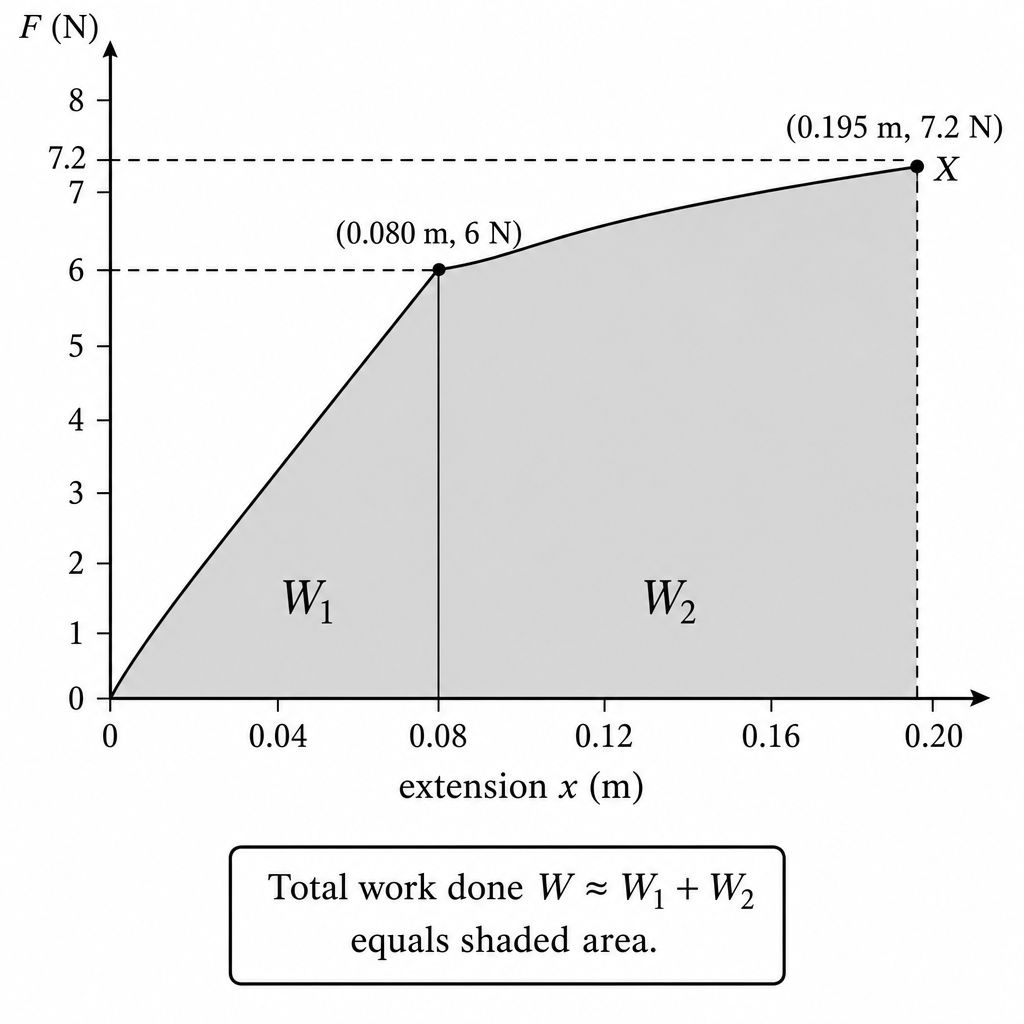
Step-by-Step Reasoning
- Linear region (0 to 80 mm):
- At , .
- Convert .
- Triangle area:
- Non-linear region (80 mm to 195 mm):
- Read breaking point approximately: , .
- Width of this section:
- Approximate area under curve using a trapezium (average force):
- Total work:
This is an estimate because the second part is curved; using a trapezium is a reasonable approximation based on the graph shape.
Key Takeaways
- Work done = area under the –extension curve.
- For curved sections, estimate using trapezia/rectangles based on the graph.
Common Mistakes
- Using with taken as the final force (overestimates when force starts from zero).
- Forgetting to convert mm to m, giving an answer too large by a factor of .
- Calculating only the triangle up to and ignoring the extra area to breaking.
Things to Be Careful About
- Always use SI units for the area: .
- Because the curve is not straight after , any single numerical answer must be presented as an estimate and justified by the “area under graph” reasoning.
A second sample of the same material has a larger cross-sectional area than the original sample but the same initial length. The two samples are each deformed with the limit of proportionality.
State and explain qualitatively how the spring constant of the second sample compares with that of the original sample.
Answer
The second sample has a larger spring constant (is stiffer).
For the same material and length,
so increasing cross-sectional area increases (and gives a smaller extension for a given force).
Larger; because for same material and length, k ∝ A (k = YA/L).
Background Concept
For a uniform wire/rod in the linear elastic region:
Comparing with Hooke’s law , we can write:
So for the same material (same ) and same length , the spring constant is proportional to cross-sectional area .
Understanding the Question
Two samples are made of the same material (so same Young modulus ) and have the same initial length , but the second has a larger cross-sectional area. Both are stretched only within the limit of proportionality, so the linear relationships apply.
You must state how the spring constant changes and explain qualitatively why.
Approach
Use the relationship (or argue from ) to deduce how changing affects stiffness.
Step-by-Step Reasoning
- Since , keeping and constant means:
- A larger area gives a larger .
- Interpreting physically: for a given force, extension
so a larger means a smaller extension; the thicker sample is harder to stretch.
Key Takeaways
- For a given material and length, increasing cross-sectional area makes the sample stiffer.
- Useful link: .
Common Mistakes
- Claiming is unchanged because it is “the same material” (geometry also matters).
- Saying extension increases with area (it decreases).
Things to Be Careful About
- The argument only applies within the limit of proportionality (linear elastic behaviour).
- State both the comparison (larger/smaller) and the reason (dependence on ).
A progressive transverse wave travelling from left to right is shown at an instant in time in Fig. 4.1.
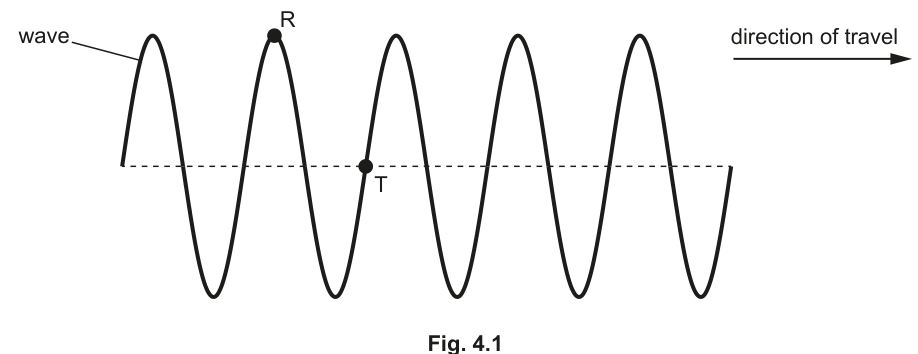
R and T are points on the wave.
Answer
Peak to equilibrium position corresponds to a quarter cycle.
Phase difference .
90°
Background Concept
For a progressive sinusoidal wave, points along the wave can be described by a phase angle. One complete cycle corresponds to (or rad).
Key phase positions on a sinusoid:
- crest (maximum positive displacement): after a chosen zero crossing,
- equilibrium (zero displacement): can be , , etc.
The phase difference between two points is the fraction of a cycle separating them, multiplied by .
Understanding the Question
The diagram shows a transverse wave at one instant. Point is at a crest. Point is at the equilibrium line (zero displacement). The question asks for the phase difference between and .
Approach
Relate each marked point to a standard position on a sine wave and count how much of a cycle separates them (in terms of fractions like , , etc.). Convert that fraction into degrees.
Step-by-Step Reasoning
- A crest is one quarter of a cycle away from the nearest equilibrium crossing.
- Therefore the separation in phase from equilibrium to crest is
So the phase difference between (crest) and (equilibrium) is .
Key Takeaways
- corresponds to one wavelength (one full cycle).
- Crest and equilibrium are separated by .
Common Mistakes
- Writing (confusing crest-to-trough with crest-to-zero).
- Giving the answer in radians when the question asks for degrees.
Things to Be Careful About
- There are two types of zero crossing (upward slope and downward slope). Both are still away from a crest; the sign/direction only affects whether you call it “leading” or “lagging”, not the magnitude here.
On Fig. 4.1, draw an arrow at point T to show the direction of movement of point T at the instant shown.
Answer
Draw the arrow at vertically downwards.
Downwards
Background Concept
In a transverse progressive wave, the wave travels horizontally but each point of the medium oscillates perpendicular to that direction (here, vertically).
For a right-travelling wave , a useful relationship is that the particle velocity is related to the local slope:
So, for a wave travelling to the right ():
- if the graph slopes upward as increases (), then so the particle is moving downward,
- if the graph slopes downward as increases (), then the particle is moving upward.
Understanding the Question
You must indicate the instantaneous direction of motion of the water at point on the snapshot of the wave, given the wave travels left to right.
Approach
Look at the local slope of the wave at on the snapshot. Use the fact that for a right-moving wave, the particle moves in the opposite direction to the slope.
Step-by-Step Reasoning
- At , the displacement is zero (on the equilibrium line).
- From the diagram, the curve at is crossing the equilibrium with a positive slope (rising as you move to the right).
- Because the wave travels to the right, particle motion is opposite to the slope:
So the point is moving downward at that instant.
Key Takeaways
- In a transverse wave, the medium moves up/down, not along the direction of travel.
- For a wave travelling right, particle velocity direction is opposite to the graph slope at that point.
Common Mistakes
- Drawing the arrow to the right (confusing wave speed with particle motion).
- Using the wrong sign rule (thinking particle motion is the same direction as the slope for a right-travelling wave).
Things to Be Careful About
- The direction is instantaneous: it depends on the slope at that exact point and the given travel direction (left-to-right here).
The horizontal distance between R and T is , as shown in Fig. 4.2.
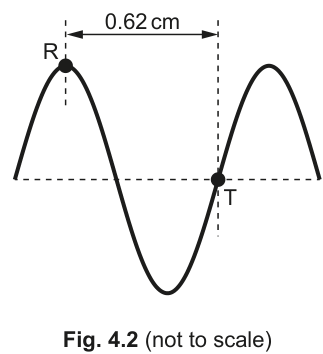
The speed of the wave is .
Calculate the frequency of the wave.
frequency = ______
Working
From (a), to is a phase difference of , so separation .
Using :
Answer
11 Hz
Background Concept
For a progressive wave:
where
- is wave speed (),
- is frequency (),
- is wavelength ().
Phase difference is linked to separation along the wave:
- corresponds to a separation of ,
- corresponds to .
Understanding the Question
You are given:
- the horizontal distance between (a crest) and (equilibrium point) is ,
- wave speed .
You must find the frequency . To do that, you need the wavelength .
Approach
- Use the phase relationship between and to decide what fraction of a wavelength represents.
- Use the measured distance to calculate .
- Convert to metres.
- Use to find .
Step-by-Step Reasoning
- From the wave shape, (crest) and (equilibrium) are separated by (a quarter cycle).
So:
- Hence:
- Convert to SI units:
- Apply the wave equation:
Rounded appropriately, .
Key Takeaways
- Use phase difference to relate a measured separation to a fraction of .
- Always convert cm to m before using .
Common Mistakes
- Taking as the full wavelength (missing the phase/fraction step).
- Forgetting to convert cm to m, giving an answer times too big.
- Using instead of .
Things to Be Careful About
- Significant figures: the inputs are typically 2 s.f., so quoting is appropriate.
- Ensure you use the horizontal separation along the direction of travel (which is what is given).
The wave is a water wave produced by a dipper attached to a vibrator in a ripple tank.
An identical dipper is attached to the same vibrator. The two dippers produce an interference pattern on the water in the tank, as shown in Fig. 4.3.
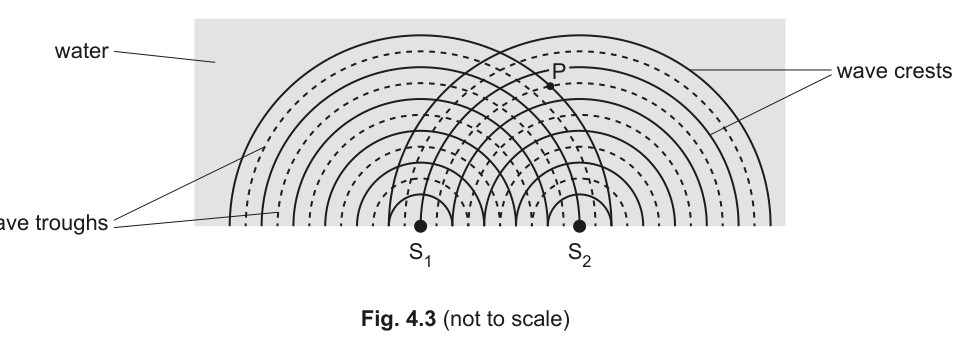
The wave crests from each source are represented by solid lines on Fig. 4.3 and the wave troughs are represented by dashed lines.
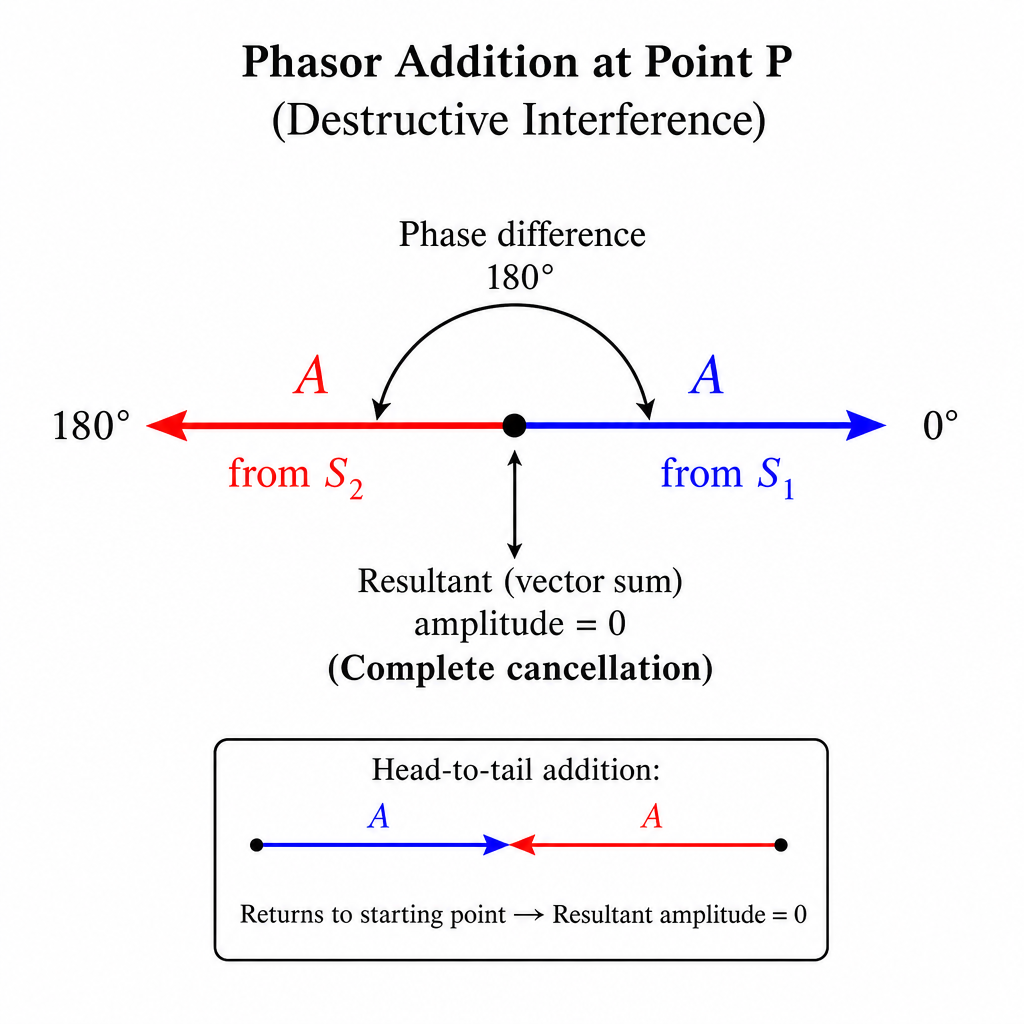
At point P in Fig. 4.3, the wave from has the same amplitude as the wave from .
Describe and explain the amplitude of the resultant wave at point P.
Answer
At , a crest from meets a trough from , so the waves arrive out of phase (path difference ).
With equal amplitudes from each source, the displacements cancel by superposition, so the resultant amplitude at is (destructive interference).
Resultant amplitude at P is 0 (destructive interference).
Background Concept
When two waves overlap, the resultant displacement is the algebraic sum of their individual displacements (principle of superposition).
For two coherent sources:
- If the waves arrive in phase (phase difference , path difference ), you get constructive interference and the amplitude is maximum.
- If the waves arrive in antiphase (phase difference , path difference ), you get destructive interference and the amplitude is minimum.
If the two waves at a point have equal amplitudes :
- in phase: resultant amplitude ,
- out of phase: resultant amplitude .
Understanding the Question
At point , the diagram shows that a crest (maximum positive displacement) from coincides with a trough (maximum negative displacement) from . Also, each wave has the same amplitude at . You are asked to describe and explain the amplitude of the resultant wave at .
Approach
- Use the crest/trough information to identify the phase relationship at .
- Use superposition to add the displacements (or add phasors) given equal amplitudes.
- State the resultant amplitude and name the type of interference.
Step-by-Step Reasoning
- A crest corresponds to displacement and a trough corresponds to displacement at the same instant.
- Crest meeting trough means the two waves at are in antiphase, i.e. phase difference (equivalently, path difference ).
- Since each has amplitude , at the instant shown the displacements are equal and opposite.
By superposition:
Thus the resultant amplitude at is zero: this point lies on a nodal line (destructive interference).
A phasor view shows the same result: two equal vectors apart add to zero.
Key Takeaways
- Interference depends on phase difference (or path difference).
- Crest + trough with equal amplitudes gives complete cancellation and zero resultant amplitude.
Common Mistakes
- Saying the resultant amplitude is (forgetting superposition is an algebraic sum).
- Confusing amplitude with displacement: amplitude is the maximum possible displacement; at destructive interference with equal amplitudes the amplitude becomes zero.
- Stating constructive interference even though the diagram shows crest meeting trough.
Things to Be Careful About
- The question states the amplitudes from each source at are the same; without that, cancellation might be partial.
- Use correct terminology: “destructive interference”, “antiphase”, “phase difference ”, “path difference ”.
Answer
In any closed loop, the algebraic sum of the e.m.f.s equals the algebraic sum of the potential drops (equivalently the sum of p.d.s around the loop is zero).
In any closed loop, the algebraic sum of the e.m.f.s equals the algebraic sum of the potential drops (sum of p.d.s around a loop is zero).
Background Concept
Kirchhoff’s second law is an expression of energy conservation for electric circuits. When a charge goes once around a complete closed loop, it can gain energy from sources (cells) and lose energy in components (resistors, internal resistance). The total energy gained per unit charge equals the total energy lost per unit charge.
Potential difference is energy transferred per unit charge, so p.d. and e.m.f. can be combined using an algebraic (signed) sum around the loop.
Understanding the Question
You are asked to state Kirchhoff’s second law: a general statement that applies to any closed loop in a circuit.
Approach
Write the standard wording: either “sum of e.m.f.s = sum of potential drops” or “algebraic sum of p.d.s around a closed loop is zero”.
Step-by-Step Reasoning
- Choose any closed loop in a circuit.
- Consider a test charge going around the loop: it gains energy across sources (e.m.f.) and loses energy across resistive components (p.d. drops).
- Since it returns to the starting point with no net change in energy, the net energy change per unit charge is zero.
- Therefore, the algebraic sum of voltages around the loop is zero (or gains = losses).
Key Takeaways
- Kirchhoff’s second law is a loop (voltage) law.
- It is fundamentally an energy conservation statement for a complete loop.
Common Mistakes
- Stating Kirchhoff’s first law (currents at a junction) instead of the second.
- Forgetting that it must be a closed loop.
Things to Be Careful About
- Use “algebraic sum” (signs matter) if you write it as a sum equals zero.
- e.m.f. is a rise in potential; resistor p.d. is a drop, depending on traversal direction.
Answer
Conservation of energy.
Conservation of energy.
Background Concept
Kirchhoff’s second law is based on conservation of energy. When a charge completes a loop and returns to its starting point, its total energy cannot have changed overall. Any energy gained from sources (cells) must be exactly balanced by energy transferred to other forms (mainly thermal energy) in components.
Understanding the Question
The question asks which conservation law leads to Kirchhoff’s second law (the loop rule).
Approach
Recall which fundamental principle enforces “total potential rises = total potential drops” around a loop.
Step-by-Step Reasoning
- e.m.f. represents energy supplied per unit charge.
- p.d. across components represents energy transferred from electrical energy per unit charge.
- Around a full loop, net energy change is zero, so the total supplied equals total transferred.
Key Takeaways
- Kirchhoff’s second law is a direct consequence of conservation of energy.
Common Mistakes
- Answering “conservation of charge” (that corresponds to Kirchhoff’s first law).
Things to Be Careful About
- Make sure you associate the correct conservation law with the correct Kirchhoff law: first law (\to) charge, second law (\to) energy.
A circuit contains a cell of internal resistance and two resistors of resistances and , as shown in Fig. 5.1.
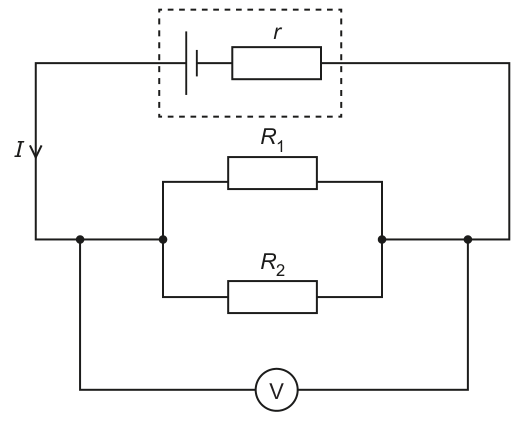
The potential difference (p.d.) across the two resistors is .
The current in the cell is .
Use Kirchhoff’s laws to show that the total resistance of the external circuit is given by
Working
Let currents in and be and .
Kirchhoff 1st law at the junction:
In parallel, p.d. across each resistor is :
So
But , hence
Answer
1/RT = 1/R1 + 1/R2
Background Concept
For resistors in parallel:
- The potential difference across each branch is the same (because both ends of each resistor connect to the same two junctions).
- The total current entering the junction equals the total current leaving (Kirchhoff’s first law: conservation of charge).
Ohm’s law relates current and p.d. for each resistor:
The equivalent (total) resistance of the parallel combination is defined by the same across the combination and the total current through it:
Understanding the Question
The external circuit is a parallel network of and , with a voltmeter measuring the p.d. across the parallel combination. You must use Kirchhoff’s laws (current at junctions and/or loop rule) to show the standard parallel-resistance formula.
Approach
- Label branch currents and .
- Use Kirchhoff’s first law: .
- Use that each branch has the same p.d. and apply Ohm’s law to write and .
- Substitute into the junction equation and use .
Step-by-Step Reasoning
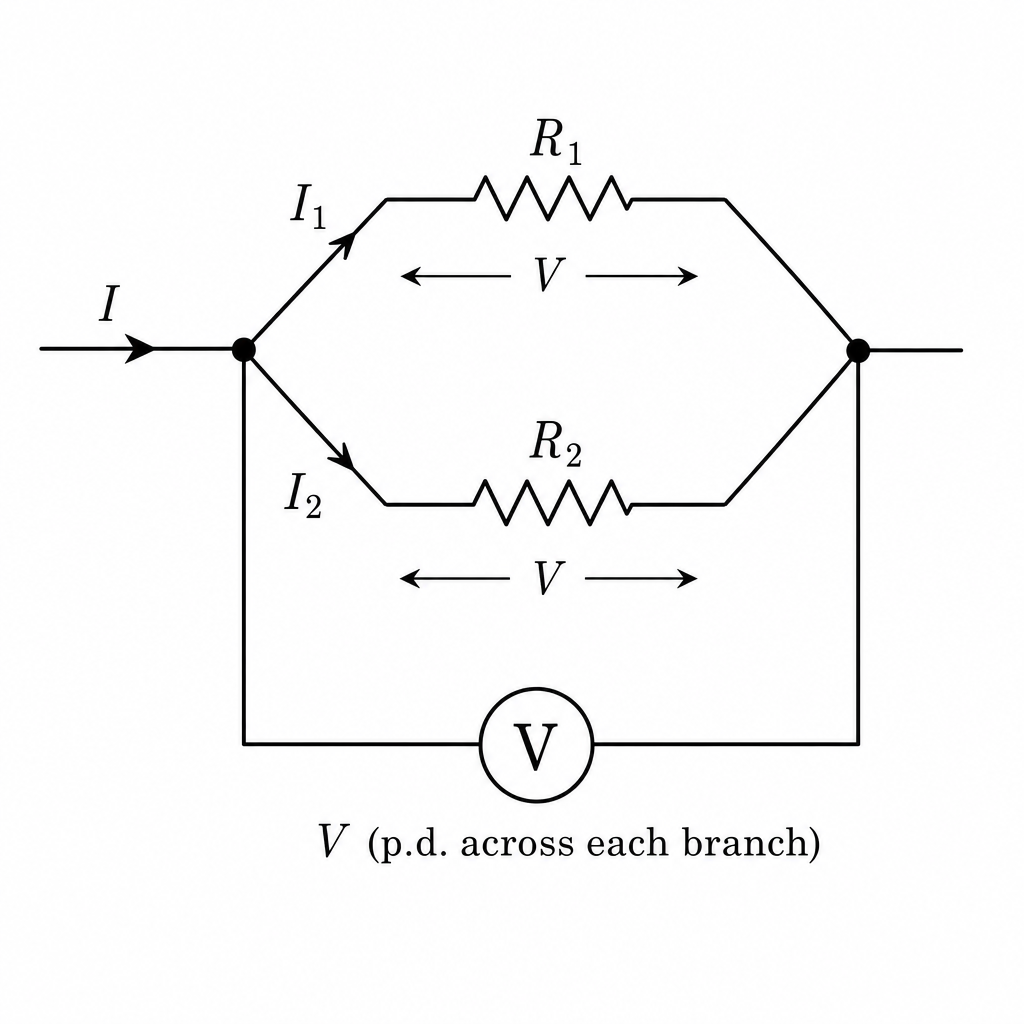
- At the junction where the current splits, Kirchhoff’s first law gives:
- Because and are connected in parallel, the p.d. across each is the same as the voltmeter reading .
- Apply Ohm’s law to each branch:
- Substitute into the junction equation:
- The equivalent resistance is defined by , so:
Cancel (non-zero), giving:
Key Takeaways
- Parallel branches share the same p.d.
- Junction currents add: .
- Combining those with leads directly to the reciprocal-resistance formula.
Common Mistakes
- Adding resistances directly for a parallel network (that is for series).
- Writing (only true for certain symmetric cases, not generally).
Things to Be Careful About
- Use the same for both branches (that is the key property of parallel).
- Remember is defined from the total current and the common p.d.: .
The electromotive force (e.m.f.) of the cell is .
When the values of and are and respectively, the p.d. measured by the voltmeter is .
Calculate the internal resistance of the cell.
= ______
Working
Equivalent external resistance:
Current in cell:
Using :
Answer
0.52 Ω
Background Concept
A real cell can be modelled as an ideal source of e.m.f. in series with an internal resistance .
- The terminal p.d. across the external circuit is
where is the current supplied by the cell.
- The external circuit here is the parallel combination of and , with equivalent resistance given by
The voltmeter reads the terminal p.d. across this external resistance.
Understanding the Question
Given:
- ,
- voltmeter reading across the external parallel network:
Find the internal resistance .
Approach
- Find the equivalent external resistance of the two parallel resistors.
- Use to find the current delivered by the cell (same current through the internal resistance, since is in series with the external network).
- Use (or ) to solve for .
Step-by-Step Reasoning
- Combine the parallel resistors:
- The voltmeter reading is the p.d. across , so the current through the external circuit is
This is also the current in the cell and through .
3. The “lost volts” across internal resistance is
So
Key Takeaways
- Terminal p.d. is smaller than e.m.f. when current flows because of the internal drop .
- In a series path, the same current flows through internal resistance and the external equivalent resistance.
- Parallel resistors reduce the external resistance.
Common Mistakes
- Using instead of (the external circuit does not have p.d. equal to when there is internal resistance).
- Forgetting to combine and in parallel.
- Using (wrong sign).
Things to Be Careful About
- Check that ; otherwise the arithmetic/signs are wrong.
- Keep sufficient significant figures during working; round at the end (here ).
A third resistor is added in parallel with and in the circuit in Fig. 5.1.
State and explain the effect, if any, of this change on:
Answer
Adding a third resistor in parallel decreases the external equivalent resistance.
Total circuit resistance decreases, so the current in the cell increases.
The current in the cell increases.
Background Concept
For resistors in parallel, adding an extra branch provides an additional path for charge, so the equivalent resistance decreases:
A cell with internal resistance supplies a current
So if decreases, the denominator decreases and increases.
Understanding the Question
A third resistor is added in parallel with and . You must state the effect on the current in the cell and explain why.
Approach
- Decide how the external equivalent resistance changes when adding a parallel resistor.
- Use the idea that the cell current depends on the total resistance (external plus internal).
Step-by-Step Reasoning
- Adding a resistor in parallel increases total conductance , so the equivalent external resistance becomes smaller.
- The internal resistance is in series with the external equivalent, so the total resistance decreases.
- Using
a smaller denominator gives a larger current.
Key Takeaways
- More parallel branches (\to) smaller equivalent resistance.
- Smaller total resistance (\to) larger supply current from the cell.
Common Mistakes
- Saying the current decreases because “resistance is added” (parallel addition actually reduces the equivalent).
- Confusing the current in one branch with the current in the cell (cell current is the sum of branch currents).
Things to Be Careful About
- Be explicit that it is the equivalent external resistance that changes, not the internal resistance .
Answer
The voltmeter reads the terminal p.d. across the external parallel network.
Adding a parallel resistor reduces external resistance, so current increases.
Since
increases, so decreases.
The voltmeter reading (terminal p.d.) decreases.
Background Concept
The voltmeter is across the external circuit, so it measures the terminal p.d. . For a cell with internal resistance :
where is the p.d. lost inside the cell.
An equivalent form (often useful for checking trends) is
This shows directly how depends on the external equivalent resistance.
Understanding the Question
A third resistor is added in parallel with and , making the external equivalent resistance smaller. You must state and explain how that affects the voltmeter reading across the external network.
Approach
- Adding a parallel resistor decreases and therefore increases the current .
- Use to see how increasing changes .
Step-by-Step Reasoning
- With an extra parallel resistor, decreases.
- The cell current becomes
so increases when decreases.
3. The internal p.d. drop is . Since is constant and increases, increases.
4. Therefore the terminal p.d.
decreases.
(Consistency check: using , decreasing makes the fraction smaller, so decreases.)
Key Takeaways
- The voltmeter measures terminal p.d., not the e.m.f.
- Increasing current increases the lost volts , reducing terminal p.d.
Common Mistakes
- Saying the voltmeter reading increases because “more current flows” (more current causes a larger internal drop, which reduces the terminal p.d.).
- Treating the voltmeter reading as fixed at .
Things to Be Careful About
- The p.d. across the external parallel combination is the same for all branches, but that common p.d. itself changes when the total current changes (because of internal resistance).
Nuclei of an isotope of samarium (Sm) each contain 62 protons and 85 neutrons.
Answer
Number of nucleons .
Background Concept
Nuclide notation is written as
where:
- is the proton number (number of protons), which identifies the element .
- is the nucleon number (total number of nucleons), so
Understanding the Question
You are told the nucleus contains protons and neutrons. You must write the isotope symbol for samarium in the form .
Approach
- Use directly from the proton count.
- Find by adding protons and neutrons.
- Put these into .
Step-by-Step Reasoning
- Proton number:
- Nucleon number:
- Therefore the nuclide notation is:
Key Takeaways
- (proton number) determines the element.
- is protons + neutrons.
- Isotopes of the same element have the same but different .
Common Mistakes
- Writing (using neutrons only).
- Swapping the positions of and .
- Using the wrong element symbol for .
Things to Be Careful About
- The notation is exactly : top left, bottom left.
- Use the given information: both protons and neutrons are needed to get .
This isotope of samarium is radioactive and decays by emitting particles. Gamma-radiation is not emitted. The energy spectrum of the emitted particles is shown in Fig. 6.1.
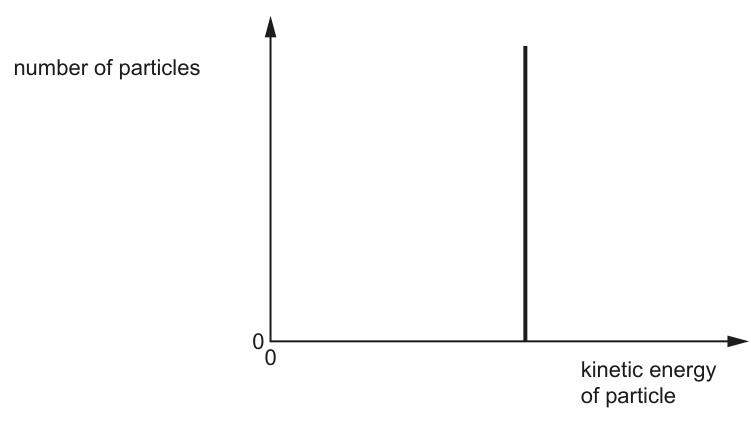
Explain how Fig. 6.1 shows that this isotope of samarium emits -particles and does not emit -particles.
Answer
Fig. 6.1 shows all emitted particles have the same kinetic energy (a single discrete line), consistent with -decay.
-decay would give a continuous range of kinetic energies (shared with a neutrino), so -particles are not emitted.
Discrete single energy line implies alpha emission; beta would give a continuous spectrum.
Background Concept
In nuclear decay, the kinetic energy distribution of emitted particles depends on how many particles share the decay energy.
- -decay (typically two-body):
If no is emitted and the daughter nucleus is left in a single energy state, the decay energy is shared in a fixed way between just the particle and the recoiling daughter nucleus. This produces (approximately) a single kinetic energy for the particle (a line spectrum).
- -decay involves three bodies because a neutrino (or antineutrino) is emitted:
The available energy is shared variably between the particle and the neutrino, so particles have a continuous spectrum of kinetic energies from near up to a maximum.
Understanding the Question
You are given an energy spectrum for the emitted particles from samarium, and told no gamma radiation is emitted. You must use the spectrum shape to decide whether the emitted particles are or .
The key visual feature is that the spectrum is a single vertical line: all particles come out with the same kinetic energy.
Approach
- Identify whether the spectrum is discrete (line) or continuous (broad distribution).
- Recall: emission gives discrete energies (line), whereas emission gives a continuous distribution due to a neutrino.
- State the conclusion with a brief justification.
Step-by-Step Reasoning
- The graph shows one sharp line at one kinetic energy value. That means every emitted particle has essentially the same kinetic energy.
- In -decay (with no ), the decay is effectively two-body ( + daughter). Conservation of energy and momentum then fixes the kinetic energies, producing a discrete line.
- In -decay, a neutrino is also produced, so the energy is shared in different proportions each time. This leads to a continuous range of kinetic energies, not a single line.
- Therefore, Fig. 6.1 is evidence for emission and evidence against emission.
Key Takeaways
- A discrete line in kinetic energy suggests a two-body decay like emission.
- A continuous spectrum occurs because a neutrino/antineutrino carries away varying energy.
Common Mistakes
- Saying has discrete energy because it is a single particle: forgetting the neutrino.
- Claiming the line means emission: is electromagnetic radiation and is not what this particle kinetic energy spectrum represents.
Things to Be Careful About
- The question states is not emitted, supporting the idea of a simple two-body decay with fixed kinetic energies.
- Don’t confuse a line spectrum in emitted particle energy (alpha) with line spectra in photon emission (gamma) from electronic transitions.
This isotope of samarium decays to an isotope of neodymium (Nd).
Give the radioactive decay equation for this decay. Include the nucleon and proton numbers of all the particles involved.
Working
-decay: , .
Answer
Background Concept
A nuclear (radioactive decay) equation must conserve:
- Nucleon number (total protons + neutrons)
- Proton number (charge number)
For -decay, the emitted particle is a helium nucleus:
So the parent nucleus changes as:
Understanding the Question
The samarium isotope has and (from part a) . It decays into an isotope of neodymium () and emits particles. From part (b)(i) we conclude the emission is .
You must write the full decay equation including and for every particle.
Approach
- Start with .
- Subtract from and from to get the daughter nucleus.
- Identify the daughter element from its new .
- Add the particle on the right.
Step-by-Step Reasoning
- Parent nuclide:
- After emission:
- Element with is neodymium (), so the daughter nucleus is:
- The decay equation is:
Check:
- Nucleon numbers:
- Proton numbers:
Key Takeaways
- In -decay, decreases by and decreases by .
- Always check conservation of both and .
Common Mistakes
- Writing the alpha particle as (that is , not ).
- Getting the daughter proton number wrong (using instead of ).
- Changing the element symbol incorrectly after changing .
Things to Be Careful About
- The question states the daughter is neodymium; that must match your calculated .
- Include nucleon and proton numbers on all nuclides, including the emitted particle.
A baryon is composed of three quarks which all have different flavours. The baryon has a charge of 0.
Two of the quarks in the baryon are an up quark and a bottom quark.
Determine, in terms of the elementary charge , the charge on the third quark in the baryon.
charge = ______
Working
Charges: up quark , bottom quark .
Total charge :
Answer
charge
Background Concept
A baryon is a hadron made from three quarks. The total electric charge of the baryon is the sum of the charges of its three quarks.
Quark charges (in units of elementary charge ):
- up ():
- down (), strange (), bottom ():
- charm (), top ():
Understanding the Question
You have a baryon consisting of three different-flavour quarks. Two are specified: an up quark and a bottom quark. The baryon’s total charge is . You must find the charge of the third quark in terms of .
Approach
- Write down the known charges of the up and bottom quarks.
- Let the third quark’s charge be .
- Use charge conservation: (sum of three quark charges) .
- Solve for .
Step-by-Step Reasoning
- Known quark charges:
-
Let the third quark have charge .
-
Total charge is zero:
Substitute:
Combine the fractions:
So:
Key Takeaways
- Baryon charge is the sum of the three quark charges.
- Remember: have ; have .
Common Mistakes
- Using the wrong sign for the bottom quark (it is ).
- Adding charges incorrectly: , not .
- Forgetting the question asks for the answer in terms of .
Things to Be Careful About
- The baryon has charge , so the quark charges must sum exactly to zero.
- Don’t assume the third quark is a particular flavour in this part; only its charge is required here.
Answer
down quark ()
down quark (d)
Background Concept
Each quark flavour has a fixed charge:
- have charge
- have charge
A baryon is made of three quarks, and the question states that all three flavours are different.
Understanding the Question
From part (c)(i), the third quark must have charge
The baryon already contains an up quark () and a bottom quark (), so the third quark must:
- Have charge .
- Not be or (different flavour).
Approach
List which flavours have charge , then choose one that is not already used.
Step-by-Step Reasoning
- Quarks with charge are , , and .
- But is already in the baryon, so it cannot be the third quark.
- Therefore a valid choice is (down) (or alternatively (strange)).
Key Takeaways
- Charge narrows down the possible flavours.
- The “different flavours” condition removes any flavour already present.
Common Mistakes
- Choosing charm (): it has charge .
- Choosing bottom (): forbidden because flavours must all be different.
Things to Be Careful About
- The question asks for a possible flavour, so giving one correct example is sufficient.
- Ensure the flavour is consistent with both the charge found in (i) and the “different flavours” statement.