Physics 9702/22 — May/June 2024
Cambridge AS Level · AS Level Structured Questions · worked solutions for every part, with the mark scheme
Topics Waves · Work, Energy and Power · Electricity · Deformation of Solids · Physical Quantities and Units · Kinematics · +5 more
The list below shows some SI quantities.
Underline the quantity that is not an SI base quantity.
charge \quad \quad current \quad \quad length \quad \quad time
Answer
charge
charge
Background Concept
SI base quantities are the fundamental quantities chosen as independent. Other quantities are derived from these (e.g. area from length, charge from current and time).
The SI base quantities are: length, mass, time, electric current, thermodynamic temperature, amount of substance, luminous intensity.
Understanding the Question
You are given four SI-related quantities and asked to pick the one that is not an SI base quantity.
Approach
Recall the SI base quantities list and compare each item.
Step-by-Step Reasoning
- Current is an SI base quantity (unit: ampere, A).
- Length is an SI base quantity (unit: metre, m).
- Time is an SI base quantity (unit: second, s).
- Charge is not a base quantity because it can be defined using current and time:
So charge is a derived quantity (unit: coulomb, C).
Key Takeaways
- SI base quantities are independent; derived quantities can be written in terms of base quantities.
- Charge is derived because .
Common Mistakes
- Thinking “charge” is fundamental because it is common in electricity questions.
- Confusing the base unit A (ampere) with C (coulomb) and assuming both must be base.
Things to Be Careful About
- The question asks for the quantity, not the unit.
- Remember: in SI, current is base, charge is derived.
A square solar panel with sides of length is shown in Fig. 1.1.
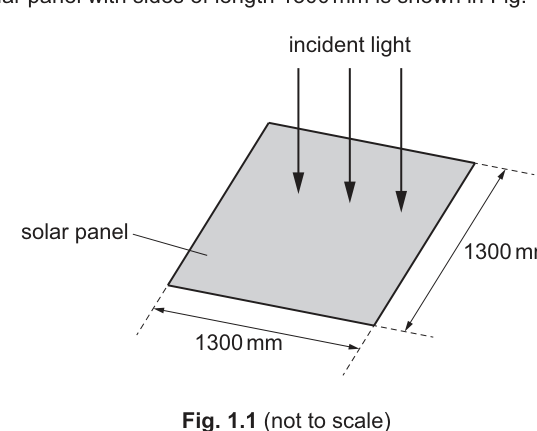
Light is incident normally on the solar panel.
The power of the light incident on the solar panel is .
Calculate the intensity of the light.
intensity = ______
Working
Side length
Answer
4.44 × 10^2 W m^-2
Background Concept
Intensity is defined as the power transferred per unit area perpendicular to the direction of energy flow:
For light incident normally (perpendicular) onto a flat surface, the relevant area is simply the surface area of the panel.
Understanding the Question
You are told:
- incident power
- square panel side length
- light is incident normally
You must find the intensity in .
Approach
- Convert the side length from mm to m.
- Calculate the area of the square: .
- Use .
Step-by-Step Reasoning
- Convert units:
- Area of the square panel:
- Intensity:
Key Takeaways
- Normal incidence means you use the full panel area.
- Always convert to SI units before substituting.
- Intensity has units .
Common Mistakes
- Using as metres instead of millimetres.
- Forgetting to square the side length when finding area.
- Giving intensity in or without units.
Things to Be Careful About
- Significant figures: inputs suggest 3 s.f. is appropriate.
- If light were not normal, you would need the projected area; the question explicitly avoids that by stating “normally.”
The percentage uncertainty in the incident power is .
The uncertainty in the length of each side is .
Calculate the percentage uncertainty in the intensity of the light.
percentage uncertainty = ______
Working
Percentage uncertainty in :
So percentage uncertainty in :
Total percentage uncertainty in :
Answer
3.8 %
Background Concept
When calculating uncertainty in a derived quantity:
- For multiplication/division, percentage uncertainties add.
- For a power, the percentage uncertainty is multiplied by the power.
If
then (percentage uncertainty in ) = (percentage uncertainty in ) + (percentage uncertainty in ).
Understanding the Question
You are given:
- percentage uncertainty in incident power :
- absolute uncertainty in each side length :
You must find the percentage uncertainty in intensity .
Approach
- Express in terms of and .
- Convert the absolute uncertainty in into a percentage uncertainty.
- Double it because the area depends on .
- Add the percentage uncertainties.
Step-by-Step Reasoning
- Since the area of a square is , and :
- Percentage uncertainty in :
Using and (same units is fine because it is a ratio):
- Because is squared, the percentage uncertainty in is doubled:
- Combine with the for (division means add):
Key Takeaways
- If , then percentage uncertainty in from is times that of .
- For , the length uncertainty contributes twice.
Common Mistakes
- Adding and without doubling for .
- Using as if it were .
- Subtracting uncertainties because one quantity is in the denominator (you still add percentage uncertainties).
Things to Be Careful About
- Use the uncertainty for each side; since it is the same used twice (as ), the factor of 2 accounts for both.
- Round appropriately; to is sensible.
The useful power output of the solar panel is .
Calculate the percentage efficiency of the solar panel.
efficiency = ______
Working
Answer
(or )
21.3 %
Background Concept
Efficiency compares useful output energy (or power) to the total input energy (or power):
For power:
To express as a percentage, multiply by .
Understanding the Question
The panel receives incident light power and produces useful electrical power . Find the percentage efficiency.
Approach
Use and multiply by .
Step-by-Step Reasoning
So the efficiency is about .
Key Takeaways
- Efficiency is a ratio of useful output to total input.
- For steady operation, using powers is equivalent to using energies.
Common Mistakes
- Flipping the fraction (using ).
- Forgetting the for percentage.
- Using the intensity value from part (i) instead of the given incident power.
Things to Be Careful About
- Quote as a percentage (include the sign).
- Reasonable rounding is fine; many mark schemes accept or depending on expected s.f.
Another square solar panel is placed so that light of the same intensity is incident normally on it. The new panel has shorter sides than the original panel. The new panel has the same power output as the original panel.
State and explain whether the efficiency of the new panel is greater than, less than or the same as the efficiency of the original panel.
Answer
Efficiency is greater.
Same intensity and smaller area means incident power is smaller.
Useful output power is the same, so
increases when decreases.
Greater than the original.
Background Concept
Two key ideas:
- Intensity-power-area relation for normal incidence:
- Efficiency of a power-converting device:
If stays the same but decreases, the ratio increases.
Understanding the Question
A second square panel is used:
- light has the same intensity and is incident normally
- the new panel has shorter sides (so smaller area)
- the new panel has the same power output as the original panel
You must decide whether its efficiency is greater/less/same, and explain.
Approach
- Use to compare input powers.
- Use to compare efficiencies.
Step-by-Step Reasoning
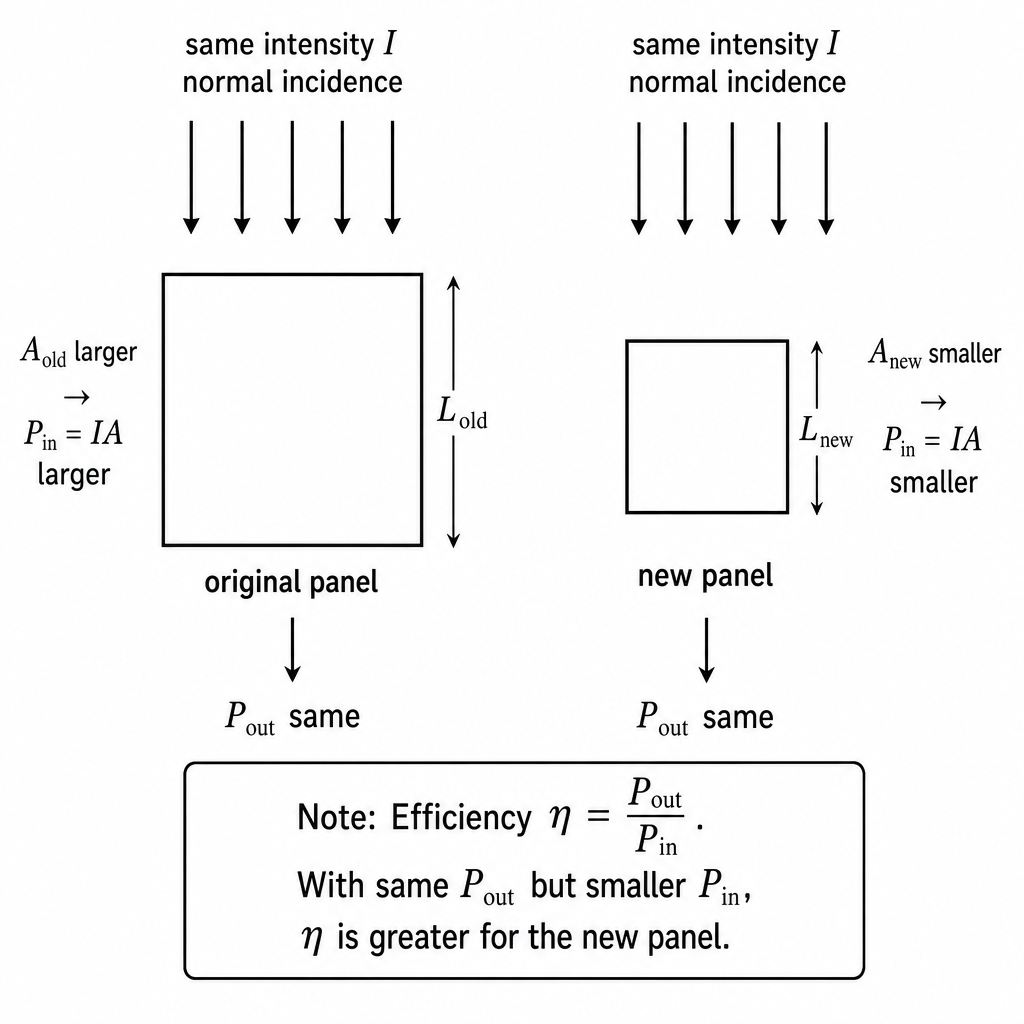
- Same intensity for both panels.
- New panel has shorter side length, so its area is smaller.
- Therefore its incident power is smaller:
- But the useful output power is stated to be the same:
- Compare efficiencies:
Since the numerators are equal but is smaller, must be larger.
So the new panel has greater efficiency.
Key Takeaways
- For normal incidence, input power depends on area: .
- Efficiency increases if the same output is achieved from a smaller input.
Common Mistakes
- Saying efficiency is the same because “intensity is the same.” (Intensity being the same does not mean input power is the same; area matters.)
- Saying efficiency is less because the panel is smaller (size alone does not decide efficiency; the ratio of output to input does).
- Forgetting to mention in the explanation.
Things to Be Careful About
- The word normally is important: it lets you use the panel area directly (no projection factor).
- The conclusion relies on comparing ratios, not on calculating any new numbers.
- In real life, it may be unrealistic for a smaller panel to have the same power output at the same intensity, but you must accept the statement and deduce the efficiency consequence.
A skydiver jumps from an aircraft at time and falls vertically downwards. The variation with of her velocity is shown in Fig. 2.1.
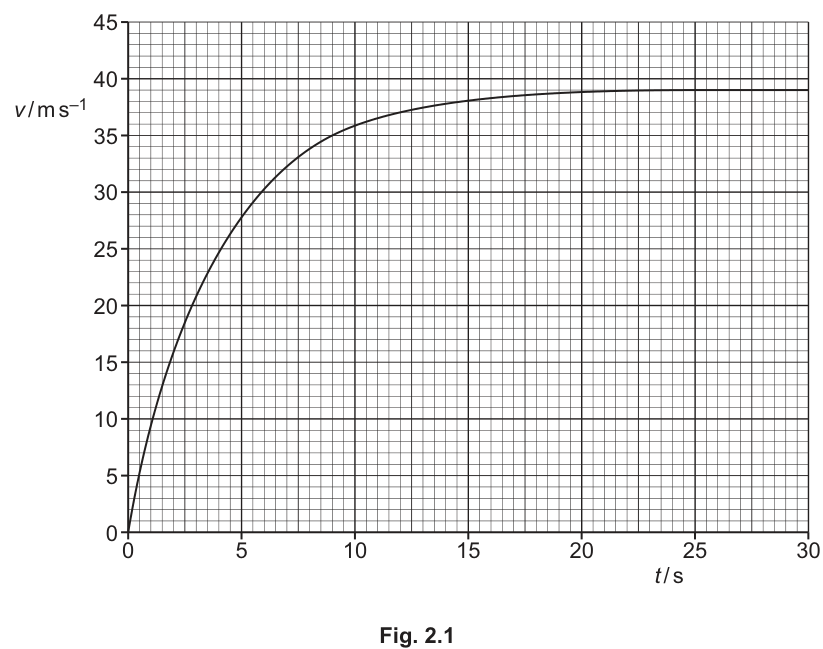
Using Fig. 2.1, state the terminal velocity of the skydiver.
terminal velocity = ______
Answer
From the horizontal section of the graph, terminal velocity .
39 m s^-1
Background Concept
Terminal velocity is the constant speed reached when the resultant force on a falling object is zero. At this point, acceleration is zero and the velocity no longer changes with time.
On a velocity–time graph, constant velocity is shown by a horizontal line (zero gradient).
Understanding the Question
You are given a velocity–time graph for a skydiver. The question asks for the terminal velocity, so you must look for where the graph becomes horizontal and read off the value of there.
Approach
- Find the part of the – curve that is horizontal.
- Read the corresponding velocity value from the vertical axis.
Step-by-Step Reasoning
- The curve rises steeply at first, then gradually levels off.
- From about onwards, the graph is essentially horizontal.
- Reading the y-value of this horizontal section gives .
Key Takeaways
- Terminal velocity corresponds to a horizontal section on a – graph.
- At terminal velocity, acceleration is zero.
Common Mistakes
- Reading the velocity at the wrong time (e.g. before the curve has become flat).
- Confusing the terminal velocity with the maximum value on the y-axis rather than the plateau value.
Things to Be Careful About
- Use the value where the graph is clearly horizontal (not where it is still slightly increasing).
- Read carefully using the axis scale and grid lines.
By drawing a suitable line on Fig. 2.1, determine the acceleration of the skydiver at time .
acceleration = ______
Working
Acceleration at is the gradient of the tangent to the – curve.
Using two points on the tangent (example readings): and ,
Answer
1.8 m s^-2
Background Concept
Acceleration is the rate of change of velocity:
On a velocity–time graph:
- The gradient (slope) gives acceleration.
- For a curved graph, the acceleration at a particular time is the gradient of the tangent at that time (instantaneous gradient).
Understanding the Question
The skydiver’s velocity changes with time, and the – graph is curved. You are asked to find the acceleration at , which means you must estimate the instantaneous gradient at that time by drawing a tangent.
Approach
- Locate on the time axis and the corresponding point on the curve.
- Draw a straight tangent line that just touches the curve at that point.
- Pick two well-separated points on the tangent (not necessarily on the curve) and read their coordinates.
- Use .
Step-by-Step Reasoning
- At early times the gradient is large (close to ) because drag is small.
- By drag has increased, so the gradient is smaller.
- After drawing the tangent at , choose two points far apart on the tangent to reduce percentage reading error.
- Example: if the tangent passes through about and then
Any reasonable pair of points from a correctly drawn tangent should give a similar value.
Key Takeaways
- Gradient of a – graph is acceleration.
- For a curve, draw a tangent to find instantaneous acceleration.
Common Mistakes
- Using two points on the curve around (a chord) instead of a tangent, giving an average acceleration rather than instantaneous.
- Choosing points too close together, making the gradient very sensitive to reading uncertainty.
- Mixing up axes and calculating .
Things to Be Careful About
- Make sure the tangent touches the curve at the correct point ().
- Read coordinates from the tangent, not from the original curve unless they lie on the tangent.
- Quote the unit and an appropriate number of significant figures.
The mass of the skydiver and her equipment is . The upthrust on the skydiver is negligible.
After reaching terminal velocity, the skydiver opens her parachute at time . A total drag force of acts on the skydiver.
Determine the magnitude and direction of the acceleration of the skydiver at time .
acceleration = ______
direction = ______
Working
Weight:
Drag after opening parachute: upwards.
Resultant force (upwards):
Acceleration:
Answer
acceleration
direction: upwards
17 m s^-2 upwards
Background Concept
For vertical motion with forces:
- Weight acts downward.
- Drag acts opposite to the direction of motion (here upward while she is moving downward).
- Upthrust is stated negligible.
Newton’s second law:
The direction of is the direction of the resultant force.
Understanding the Question
At time the skydiver has already reached terminal velocity, so she is moving downward at constant speed just before the parachute opens. At the parachute opens and a drag force of acts. You must find the acceleration immediately at that moment, including its direction.
Approach
- Draw up the forces: weight downward, drag upward.
- Calculate weight .
- Find the resultant force (taking upward or downward as positive, but be consistent).
- Use .
- State the direction based on the sign/resultant.
Step-by-Step Reasoning
- Mass .
- Weight is
- Drag is upward.
- Resultant force upward because drag is larger than weight:
- Then
- Since the resultant is upward, the acceleration is upward. (This means she is slowing down while still moving downward.)
Key Takeaways
- Terminal velocity means forces balance (before opening the parachute), but when drag changes suddenly, they no longer balance.
- Acceleration direction follows the resultant force direction.
Common Mistakes
- Adding forces () instead of subtracting because they act in opposite directions.
- Stating the acceleration is downward because she is moving downward (velocity direction is not the same as acceleration direction).
- Forgetting that upthrust is negligible (so do not include it).
Things to Be Careful About
- Keep a clear sign convention (e.g. upward positive).
- Use unless the paper specifies otherwise.
- Give both magnitude and direction as requested.
The parachute is fully open at time . At a later time the skydiver reaches a constant velocity of .
Describe and explain the variation with time of the magnitude of her acceleration between time and time .
Answer
From to , the magnitude of the acceleration decreases with time and tends to zero.
Just after the drag is greater than weight, so there is a large upward resultant force (upward acceleration). As the skydiver slows down, drag decreases, so the resultant force decreases and hence the acceleration decreases. At , drag equals weight so the resultant force is zero and the acceleration is zero (new terminal velocity).
Acceleration magnitude decreases to zero as drag falls to equal weight.
Background Concept
Drag (air resistance) increases with speed (often approximately proportional to or ). For vertical motion:
- Weight is constant.
- Drag changes as the speed changes.
Acceleration depends on the resultant force:
A constant velocity (terminal velocity) occurs when so .
Understanding the Question
At the parachute is fully open. The skydiver then slows down until at she moves at a constant speed of . You must describe what happens to the magnitude of acceleration over this time and explain it using forces.
Approach
- Consider forces just after : drag is very large because speed is still relatively high and parachute area is large.
- As she slows, drag reduces.
- Use Newton’s second law to relate changing resultant force to changing acceleration.
- At constant velocity implies zero acceleration and balanced forces.
Step-by-Step Reasoning
- Immediately after , the parachute is fully deployed, so for the current (still large) downward speed, the drag force is much larger than before.
- Drag acts upward, opposing the motion, while weight acts downward.
- Since drag initially, the resultant force is upward, so acceleration is upward (she decelerates while moving downward).
- As her speed decreases, drag decreases (because drag depends on speed). Weight stays constant.
- Therefore the upward resultant force becomes smaller in magnitude as falls.
- Hence the magnitude of acceleration decreases with time.
- At she reaches a constant speed: this is a new (lower) terminal velocity where drag equals weight, , so and .
Key Takeaways
- Changing speed changes drag; changing drag changes resultant force.
- Acceleration reduces to zero as the forces become balanced at a new terminal velocity.
Common Mistakes
- Saying acceleration is constant between and (it is not, because drag changes as speed changes).
- Saying acceleration becomes zero because “she has stopped accelerating” without linking it to forces balancing.
- Confusing the direction of velocity (down) with direction of acceleration (up during slowing down).
Things to Be Careful About
- The question asks for the magnitude of acceleration: you should still make clear the direction in the explanation (upward) to show understanding.
- Terminal velocity can occur at more than one speed (before and after the parachute opens).
Calculate the change in momentum of the skydiver between time and time .
change in momentum = ______
Working
Take downward as positive.
At , .
At , .
Answer
(i.e. a change of upwards).
-2.3 × 10^3 N s
Background Concept
Linear momentum is
Change in momentum is
Momentum is a vector: direction matters. In one-dimensional vertical motion, we handle direction with a sign convention.
Understanding the Question
You need the change in the skydiver’s momentum between:
- : just after reaching the original terminal velocity (from the graph), so is the terminal velocity from part (a).
- : later constant velocity downward.
Mass is constant at .
Approach
- Choose a positive direction (e.g. downward positive).
- Write initial and final velocities with correct sign.
- Use .
- Interpret the sign of the answer as the direction of the change in momentum.
Step-by-Step Reasoning
- Choose downward as positive.
- From the plateau on the – graph, terminal velocity is about (downward, so ).
- At , the skydiver is still moving downward at (so ).
- Compute:
- Since ,
- The negative sign (with downward taken as positive) means the change in momentum is upward: the skydiver’s downward momentum has decreased.
Key Takeaways
- Use for constant mass.
- Include direction via a sign convention; the sign tells you the direction of the change.
Common Mistakes
- Using with only one velocity (forgetting to subtract initial from final).
- Using the wrong initial velocity (not the terminal velocity at ).
- Giving only a positive number without stating direction when the sign is meaningful.
Things to Be Careful About
- Keep the same direction convention throughout.
- Quote the unit (or ).
- Use the terminal velocity value consistent with the graph reading (your final value will depend slightly on that reading).
Lightning occurs when charge builds up in the atmosphere, creating a potential difference between the ground and the atmosphere.
During a lightning strike there is an average current of for a time of .
Working
Answer
0.86 C
Background Concept
Electric current is defined as the rate of flow of charge :
If the current is approximately constant over a time interval , then the charge transferred is
Understanding the Question
You are given an average current that flows for a time during a lightning strike. The question asks for the total charge transferred.
Approach
Use because current is charge per unit time. Multiply the given current by the time duration, keeping powers of ten consistent.
Step-by-Step Reasoning
Start with
Substitute values:
Multiply the numbers and the powers of ten separately:
So
Given data are to 2 s.f., so quote to 2 s.f.:
Key Takeaways
- Use for charge transferred when current and time are known.
- Handle standard form carefully: multiply coefficients and add powers of ten.
Common Mistakes
- Using (inverting the formula).
- Losing the power of ten: , not or .
- Giving an answer with no unit (must be coulombs, C).
Things to Be Careful About
- “Average current” implies you can use directly.
- Significant figures: match the least precise given value (here 2 s.f.).
The potential difference between the ground and the atmosphere is .
Calculate the average power, in GW, transferred during the lightning strike.
power = ______
Working
Answer
990 GW
Background Concept
Electrical power is the rate at which electrical energy is transferred.
For a component (or process) with potential difference across it and current through it:
The unit conversion is
Understanding the Question
The lightning strike produces an average current and the potential difference is . You must find the average power transferred and express it in gigawatts.
Approach
Use with the given and to get power in watts, then divide by to convert to gigawatts.
Step-by-Step Reasoning
Compute the power:
Multiply coefficients and powers of ten:
So
Convert to GW:
Key Takeaways
- Use when potential difference and current are known.
- Convert between W and GW using .
Common Mistakes
- Using or (wrong relationship).
- Converting to GW by multiplying by instead of dividing.
- Dropping powers of ten when multiplying in standard form.
Things to Be Careful About
- “Average power” matches the use of “average current”.
- Quote in GW as requested, and include the unit.
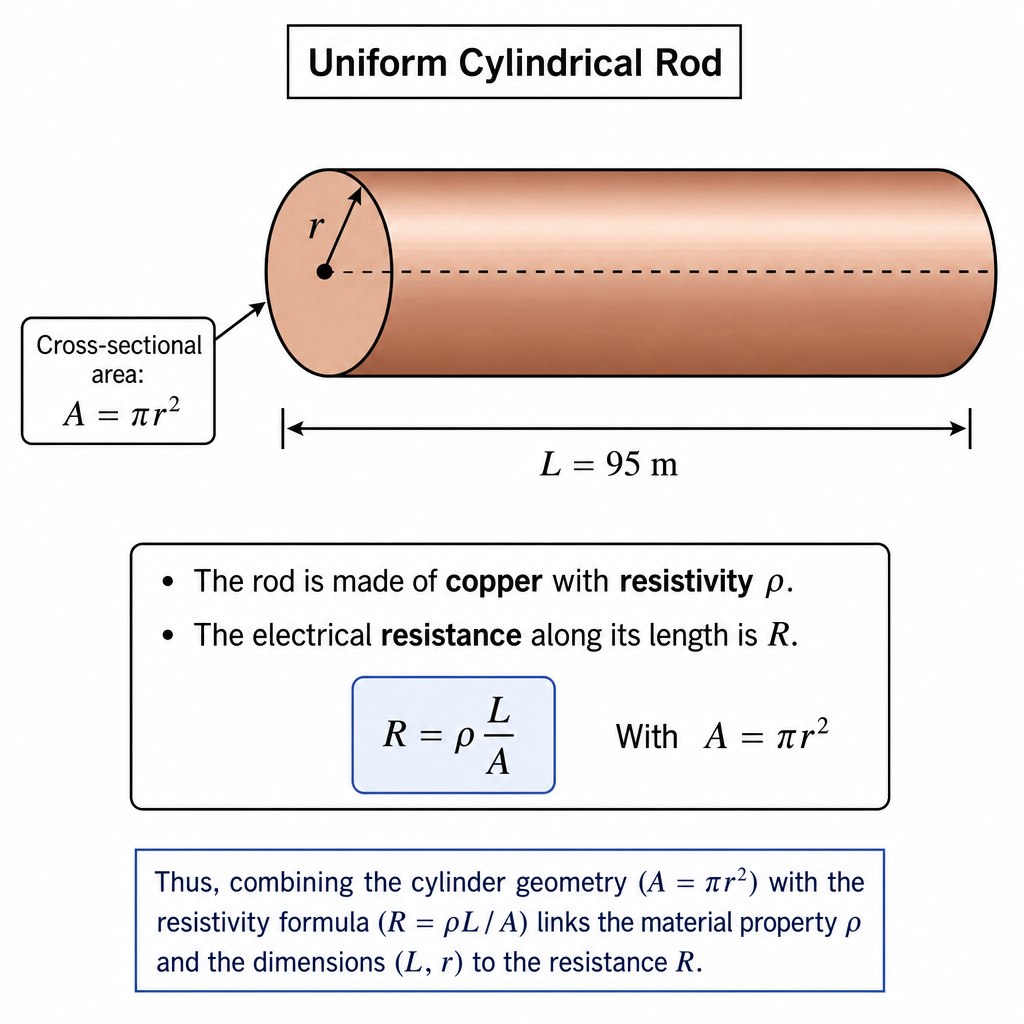
A lightning rod is attached to a tall building to conduct charge safely to the ground. The lightning rod is modelled as a uniform cylindrical copper cable of total length that runs from the ground to the top of the building, as shown in Fig. 3.1.
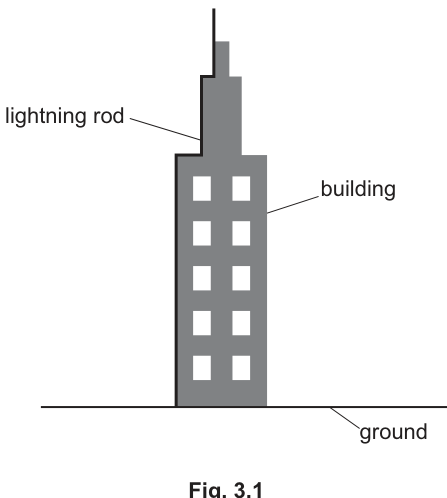
The resistance of the lightning rod is .
The resistivity of copper is .
Determine the radius of the lightning rod.
radius = ______
Working
Answer
2.3 × 10^-4 m
Background Concept
For a uniform conductor of length and cross-sectional area , its resistance is related to the material property resistivity by
For a cylindrical wire/rod of radius ,
Understanding the Question
A copper lightning rod is modelled as a uniform cylinder of length and resistance . Copper has resistivity . You must determine the radius .
Approach
- Use and rearrange to find .
- Use to find by taking a square root.
Step-by-Step Reasoning
A cylinder model is appropriate because the rod is described as uniform (constant radius).
Rearrange the resistivity equation:
Substitute:
Compute numerator:
Then
Now use :
Key Takeaways
- Resistance increases with length and resistivity, and decreases with cross-sectional area.
- For cylindrical conductors, you often need the geometry step .
Common Mistakes
- Using (inverting the formula).
- Forgetting that depends on ; radius is not proportional to area.
- Taking instead of .
Things to Be Careful About
- Units: ensure is in , in m, giving in and in m.
- Significant figures: final should reflect the given data (typically 2 s.f.).
The radius of the copper lightning rod is doubled with no change to its length.
State the effect of this change on the resistance of the lightning rod.
Answer
Since and , doubling makes four times larger, so the resistance becomes one quarter of its original value (decreases by a factor of ).
Resistance decreases to one quarter (÷4).
Background Concept
For a uniform conductor,
If material () and length () do not change, then
For a cylinder, cross-sectional area depends on radius as
Understanding the Question
Only the radius is changed: the radius is doubled, while the length stays the same. You must state what happens to the resistance.
Approach
Use proportionality: doubling increases area by , and since resistance is inversely proportional to area, resistance decreases by a factor of .
Step-by-Step Reasoning
If , then
So becomes .
Since
then
So the resistance decreases to one quarter.
Key Takeaways
- For fixed and , changing the thickness changes resistance through .
- For cylindrical wires, doubling radius quarters the resistance.
Common Mistakes
- Saying resistance halves (mixing up linear and squared dependence).
- Saying resistance doubles (forgetting is inversely proportional to ).
Things to Be Careful About
- The factor comes from , not .
- The question asks for the effect, so a factor statement ("one quarter") is enough.
A section of the lightning rod of length is removed for testing. A tensile stress of is applied, as shown in Fig. 3.2.
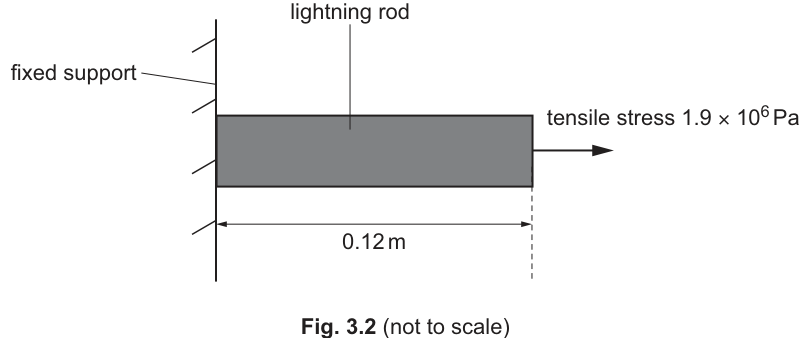
The section of the rod obeys Hooke’s law. The Young modulus of copper is .
Calculate the extension of the section.
extension = ______
Working
Answer
1.8 × 10^-6 m
Background Concept
When a material obeys Hooke's law, stress is proportional to strain.
- Stress is force per unit area:
- Strain is fractional extension:
Young modulus is defined by
This applies in the linear (elastic) region where Hooke's law holds.
Understanding the Question
A rod section of original length has a tensile stress applied. The Young modulus of copper is . You are asked to calculate the extension .
Approach
Use and rearrange to get . No area is required because stress is already given.
Step-by-Step Reasoning
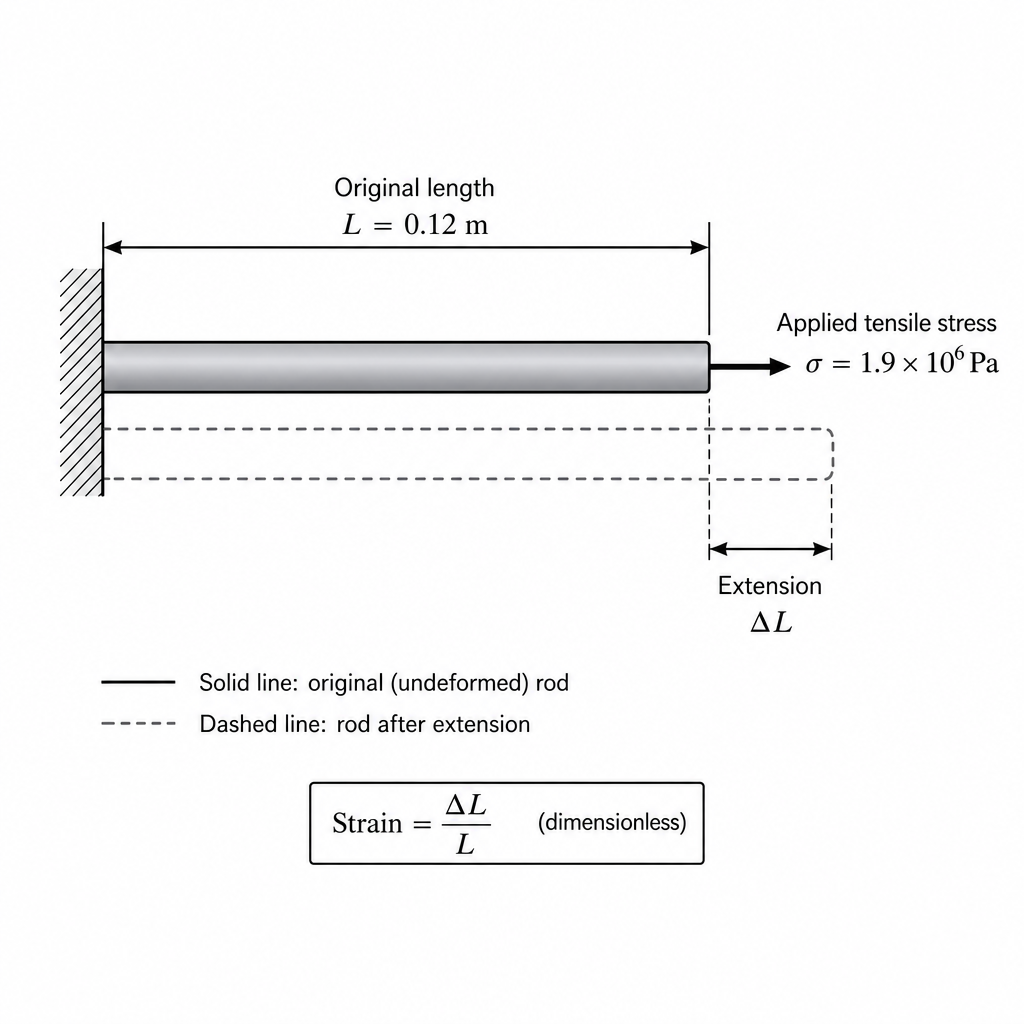
Start with
Rearrange:
Substitute the values:
Compute the numerator:
Now divide:
To appropriate s.f. (2 s.f.):
Key Takeaways
- Young modulus links stress and strain: .
- If stress is given, you do not need to find force or area.
Common Mistakes
- Using instead of .
- Forgetting strain is (some write ).
- Attempting to use without knowing .
Things to Be Careful About
- Units: Pa is ; with in m, comes out in m.
- Validity: statement “obeys Hooke’s law” is the clue that Young modulus can be used directly.
- Significant figures should reflect the data given.
A pinball machine uses a spring to launch a small metal ball of mass up a ramp. The spring is compressed by and held in equilibrium, as shown in Fig. 4.1.
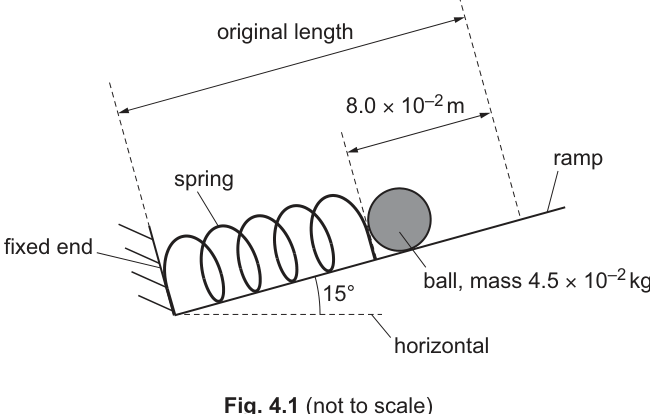
The ramp is at an angle of to the horizontal.
The spring obeys Hooke’s law and has a spring constant of .
Calculate the elastic potential energy in the compressed spring.
elastic potential energy = ______
Working
Answer
9.3 × 10^-2 J
Background Concept
A spring that obeys Hooke’s law has force proportional to extension/compression:
The elastic potential energy stored in the spring is the work done to compress/extend it from to , which equals the area under the – graph. Since increases linearly with , the graph is a triangle.
So:
Understanding the Question
You are given the spring constant and compression . The question asks for the energy stored in the spring while it is held compressed.
Approach
Use
Convert nothing (already SI), substitute, and round appropriately.
Step-by-Step Reasoning
Substitute values:
Square the compression:
Then:
To 2 s.f. (matching and ),
Key Takeaways
- For a Hooke’s-law spring, stored energy is .
- The factor comes from the triangular – graph.
Common Mistakes
- Using (missing the ).
- Using as (not converting to metres).
- Giving too many significant figures (e.g. without rounding).
Things to Be Careful About
- Ensure is in metres and in so energy comes out in joules.
- Quote the final answer with sensible significant figures.
The spring is released and expands quickly back to its original length.
Calculate the increase in gravitational potential energy of the ball when the spring returns to its original length.
increase in gravitational potential energy = ______
Working
Answer
9.1 × 10^-3 J
Background Concept
Gravitational potential energy (GPE) increases when an object rises vertically by height :
On a slope, the object may move a distance along the ramp, but only the vertical rise matters for GPE. If the ramp makes angle to the horizontal, then the vertical rise is:
Understanding the Question
When the compressed spring returns to its original length, the ball moves up the ramp by the same distance as the compression, , along a ramp at . The question asks for the increase in GPE during that motion.
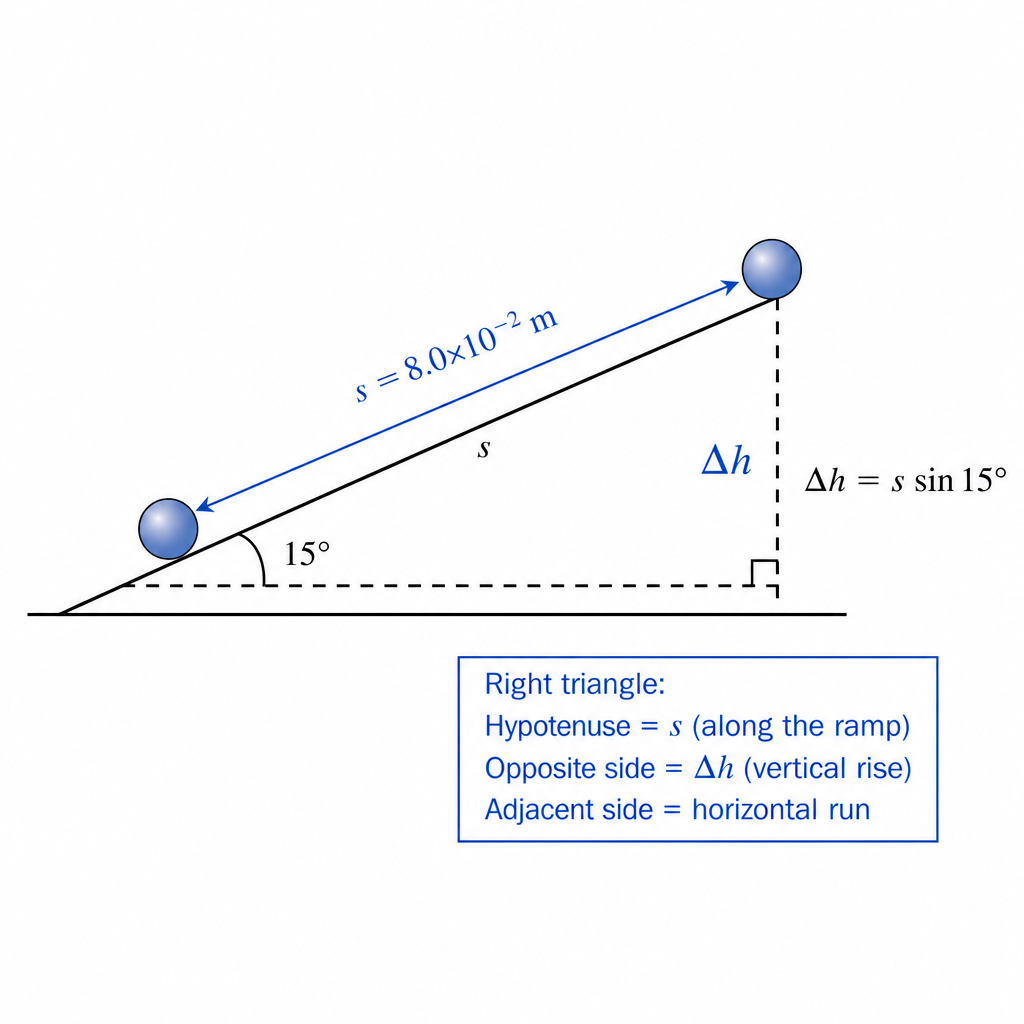
Approach
- Find the vertical height gain using .
- Use .
Step-by-Step Reasoning
Height gain:
Using :
Now calculate GPE increase:
Key Takeaways
- GPE depends only on vertical height change, not the distance along the slope.
- On an incline, height gained is .
Common Mistakes
- Using instead of .
- Using the slope distance directly in .
- Forgetting that the ball moves by along the ramp during the spring’s expansion.
Things to Be Careful About
- Keep in metres and use consistently (typically ).
- Significant figures: the data are mostly 2 s.f., so should be 2 s.f. as well.
The ball leaves the spring when the spring reaches its original length. Assume that all the elastic potential energy of the spring is transferred to the ball.
Calculate the speed of the ball as it leaves the spring.
speed = ______
Working
Answer
1.9 m s^-1
Background Concept
Energy transfers let you connect spring energy to the ball’s motion. If all the spring’s elastic potential energy becomes energy of the ball, it can appear as:
- increase in gravitational potential energy (ball rises), and
- kinetic energy (ball speeds up).
Elastic energy in the spring (Hooke’s law spring):
Kinetic energy of the ball:
Conservation of energy for this stage:
Understanding the Question
At the instant the spring reaches its natural length, the ball leaves the spring. During the spring’s expansion, the ball has moved up the ramp (so it has gained GPE). The question says assume all elastic potential energy is transferred to the ball, so you should account for both GPE gain and the remaining KE.
Given:
- from (a)
- from (b)(i)
Find: as it leaves the spring.
Approach
- Use energy conservation: .
- Use to solve for .
Step-by-Step Reasoning
Energy available as kinetic energy after lifting the ball:
Now equate to kinetic energy:
Rearrange for :
Compute the bracket:
So:
Key Takeaways
- When an object moves up a slope, spring energy splits into GPE and KE.
- Use , not unless there is no height gain.
Common Mistakes
- Setting and ignoring the GPE increase.
- Using mass as .
- Forgetting the square root when solving for .
Things to Be Careful About
- The phrase “as it leaves the spring” refers to the moment the spring reaches natural length, after the ball has risen by .
- Keep track of energy units (all in J) and quote to a sensible number of significant figures.
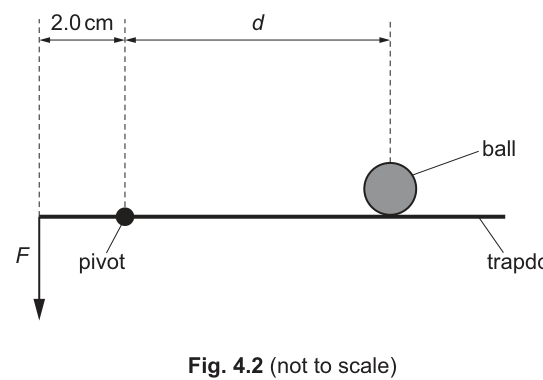
The ball comes to rest on a horizontal trapdoor of negligible mass at a distance from its pivot.
A force acts vertically downwards at a distance of from the pivot, as shown in Fig. 4.2.
Working
For equilibrium about the pivot:
Answer
7.7 × 10^-2 m
Background Concept
The moment (torque) of a force about a pivot is:
For an object in rotational equilibrium:
Understanding the Question
A ball of mass rests on a horizontal trapdoor at distance from the pivot. Its weight acts downward at that point.
A downward force acts at from the pivot on the other side.
The trapdoor is in equilibrium, so the clockwise and anticlockwise moments about the pivot balance. You must find .
Approach
- Identify the two torques about the pivot: one from , one from the ball’s weight .
- Set their moments equal.
- Rearrange for .
Step-by-Step Reasoning
Weight of the ball:
Moment balance:
So:
Rounded:
Key Takeaways
- Use perpendicular distance from the pivot when calculating a moment.
- In equilibrium, clockwise moment equals anticlockwise moment.
Common Mistakes
- Leaving as (not converting to metres).
- Using mass instead of weight (forgetting to multiply by ).
- Taking moments about the wrong point (not the pivot).
Things to Be Careful About
- The door is horizontal, so the perpendicular distance is the horizontal distance shown.
- Use consistent units (metres) for all distances when computing moments.
Force is decreased from .
State the direction of the resultant moment about the pivot on the trapdoor.
Answer
When is decreased, the clockwise moment due to the ball’s weight is greater, so the resultant moment is clockwise.
Clockwise
Background Concept
A force on one side of a pivot tends to rotate the object either clockwise or anticlockwise. The direction of the resultant moment is determined by which side produces the larger torque.
In equilibrium:
If one torque decreases while the other stays the same, the resultant moment is in the direction of the larger remaining torque.
Understanding the Question
At the trapdoor is balanced: the torque from about the pivot matches the torque from the ball’s weight.
Now is decreased. The ball’s weight (and its distance ) does not change, so the torque due to the ball stays the same, but the torque due to becomes smaller.
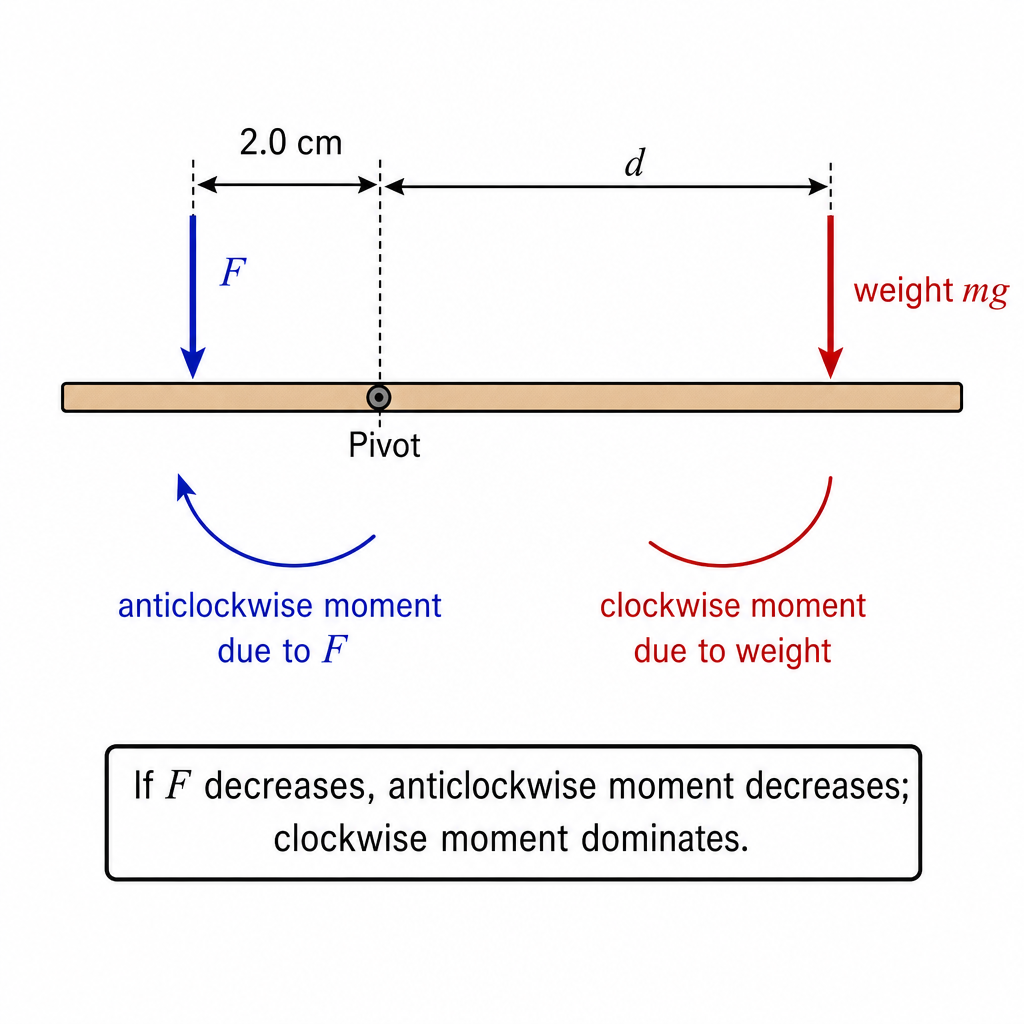
Approach
- Identify which torque is reduced (the one due to ).
- Conclude that the opposite torque (from the ball) becomes dominant.
- State the direction of rotation caused by the ball’s weight.
Step-by-Step Reasoning
- Force acts downward on the left of the pivot, producing an anticlockwise moment.
- The ball’s weight acts downward on the right of the pivot, producing a clockwise moment.
- At equilibrium these were equal.
- Reducing reduces the anticlockwise moment.
- Therefore the clockwise moment from the ball is now larger, so the resultant moment is clockwise.
Key Takeaways
- Decreasing one balancing force breaks equilibrium.
- The system rotates in the direction of the torque that is now larger.
Common Mistakes
- Stating “anticlockwise” because is still present, without comparing magnitudes.
- Mixing up which side gives clockwise vs anticlockwise rotation.
Things to Be Careful About
- Always refer to moments about the pivot.
- Keep the picture consistent: left-downward gives anticlockwise; right-downward gives clockwise for a horizontal bar (as drawn).
Answer
In any closed loop, the algebraic sum of the e.m.f.s is equal to the algebraic sum of the potential differences (sum of p.d.s around the loop is zero).
In any closed loop, the algebraic sum of the e.m.f.s equals the algebraic sum of the potential differences (sum of p.d.s around the loop is zero).
Background Concept
Kirchhoff’s second law (the loop law) is a statement of energy conservation for electric circuits. When a charge goes around a complete closed loop, the total electrical energy gained per unit charge from sources (e.m.f.s) must equal the total energy lost per unit charge in circuit elements (potential drops).
Mathematically, for a chosen loop direction:
Equivalently:
Understanding the Question
You are asked to state Kirchhoff’s second law in words (no calculation). The key ideas to include are: closed loop, algebraic sum, e.m.f.s and potential differences.
Approach
Give the standard wording: “sum of emfs equals sum of potential drops” or “algebraic sum of p.d.s around a closed loop is zero”. Mention “algebraic” to indicate sign depends on direction.
Step-by-Step Reasoning
- Consider a complete closed loop so the charge returns to its starting point.
- The net change in energy per unit charge after a complete loop must be zero.
- Therefore, energy gained per unit charge from sources (emf) equals energy lost per unit charge in components (p.d. drops).
Key Takeaways
- Kirchhoff’s second law applies to a closed loop.
- It is an energy conservation statement: gains (emf) balance losses (p.d.).
Common Mistakes
- Stating Kirchhoff’s first law (current at a junction) instead of the second.
- Forgetting the idea of a closed loop.
- Omitting that it is an algebraic sum (sign depends on chosen direction).
Things to Be Careful About
- Use “potential difference” (or “voltage drop”) and “e.m.f.” correctly.
- “Sum of p.d.s is zero” is acceptable only if it is clear you mean the algebraic sum around a loop.
A battery of electromotive force (e.m.f.) and negligible internal resistance is connected in series with a variable resistor and a thermistor as shown in Fig. 5.1.
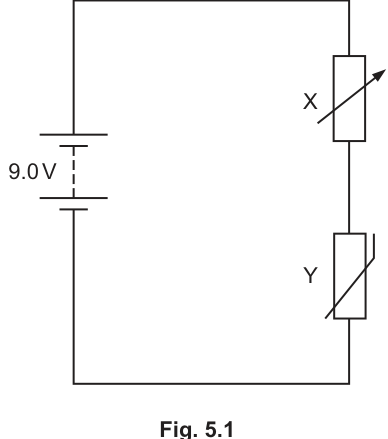
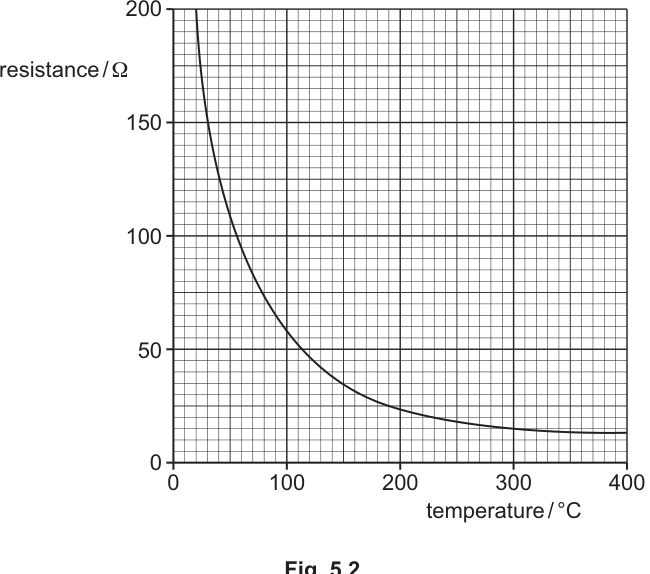
Fig. 5.2 shows the relationship between temperature and resistance for the thermistor.
The current in the circuit is . The potential difference across is .
Calculate the resistance of .
resistance = ______
Working
For thermistor :
In series:
Answer
4.5 × 10^2 Ω
Background Concept
In a series circuit, the same current flows through each component. The supply e.m.f. (here, with negligible internal resistance) is equal to the sum of the potential differences across the series components:
For any resistor-like component, the potential difference across it is related to the current through it by Ohm’s law form:
(For a thermistor, changes with temperature, but at a fixed temperature you can still use at that moment.)
Understanding the Question
You are told:
- Supply e.m.f. and internal resistance is negligible, so the full appears across and together.
- Circuit current .
- Potential difference across thermistor is .
You must find the resistance of the variable resistor .
Approach
- Use Kirchhoff’s second law to find the p.d. across : .
- Use .
(You can also find first using , but the key target is .)
Step-by-Step Reasoning
- Because the components are in series, the total potential difference splits:
So:
- Now apply to resistor :
- Calculate:
Key Takeaways
- In series: same current through each component, voltages add.
- Use Kirchhoff’s loop law to relate supply voltage to component voltages.
- Use once you know the voltage across that component.
Common Mistakes
- Using directly for (forgetting that is across ).
- Using the wrong current (in series there is only one current).
- Missing the unit .
Things to Be Careful About
- Keep in amperes: , not .
- Quote the answer to appropriate significant figures (here typically 2 s.f. to match data).
The temperature of is changed to . The resistance of remains unchanged.
Determine the new potential difference across .
potential difference = ______
Working
From Fig. 5.2 at , take .
From (i), .
Total resistance:
Current:
New p.d. across :
Answer
0.53 V
Background Concept
A thermistor has a resistance that depends strongly on temperature. For an NTC thermistor, resistance decreases as temperature increases.
In a series circuit, the supply voltage divides between the series components in proportion to their resistances. This is the potential divider idea:
Equivalently, you can find the circuit current first:
then use .
Understanding the Question
You change the thermistor temperature to , but you keep the same as in part (i). The thermistor resistance at must be read from the given graph, then you calculate the new voltage across .
Known:
- .
- unchanged from (i) (about ).
- at from graph (a small value, a few tens of ohms).
Unknown:
- New .
Approach
- Read at from Fig. 5.2.
- Use series total resistance to find the new current .
- Use (or directly the potential divider equation) to get the new p.d. across .
Step-by-Step Reasoning
- Graph reading: At , the curve is just above its value at (about ). A reasonable reading is around (your exact value may differ slightly depending on how you read the curve).
- Keep the same: From part (i), .
- Total resistance in series:
- New current:
Notice the current is larger than before because the thermistor resistance has dropped dramatically.
- Voltage across :
This is much smaller than the original because now , so most of the is dropped across .
Key Takeaways
- For an NTC thermistor, increasing temperature decreases resistance.
- In a series potential divider, the larger resistance gets the larger share of the supply voltage.
- You can compute the divided voltage using either (after finding ) or the potential divider formula.
Common Mistakes
- Not reading the thermistor resistance from the graph (or reading from the wrong axis).
- Assuming the current stays the same when the thermistor resistance changes (in series, current changes when total resistance changes).
- Using (forgetting this is only the supply, not across one component).
Things to Be Careful About
- Your final numerical value depends on the graph reading at ; small differences are expected.
- Keep consistent significant figures (typically 2 s.f. from given data and graph-reading uncertainty).
- Ensure you are using for resistance and for potential difference.
The resistance of is increased. The temperature of remains at .
By reference to the current in the circuit, state and explain the effect of this change, if any, on the potential difference across .
Answer
Increasing increases the total series resistance, so the current in the circuit decreases.
Since is constant at , the p.d. across is
so decreases.
The potential difference across Y decreases.
Background Concept
For components in series:
- The same current flows through every component.
- The total resistance is the sum: .
- The current is set by the supply voltage and total resistance:
The potential difference across a component is then .
You can also see it as a potential divider:
Understanding the Question
At the thermistor resistance is fixed (because its temperature is fixed). You then increase the variable resistor . You are asked what happens to the potential difference across , and you must explain it by referring to the current.
Approach
Link the cause-and-effect chain:
- Increasing increases total resistance.
- With fixed supply voltage, larger total resistance means smaller current.
- With fixed, smaller current means smaller .
Optionally, confirm with the potential divider fraction getting smaller.
Step-by-Step Reasoning
- Initially, at fixed temperature, is constant.
- Increase :
- With fixed:
So decreases.
- The potential difference across is:
Since is constant but has decreased, must decrease.
- Potential divider check:
Increasing increases the denominator, so the fraction (and hence ) decreases.
Key Takeaways
- In series circuits, changing one resistance changes the current everywhere.
- If a component’s resistance is fixed, its p.d. is directly proportional to the circuit current.
- Potential divider relationships give a quick qualitative check.
Common Mistakes
- Saying stays constant because is constant (but forgetting changes).
- Saying increases because increases (mixing up which component gets a larger share of the voltage; actually the larger resistance takes more of the supply).
- Not explicitly referring to current, as the question requests.
Things to Be Careful About
- Make it clear that the temperature is constant, so it is that remains constant.
- Distinguish between p.d. across and the supply voltage.
- Use a correct causal chain: .
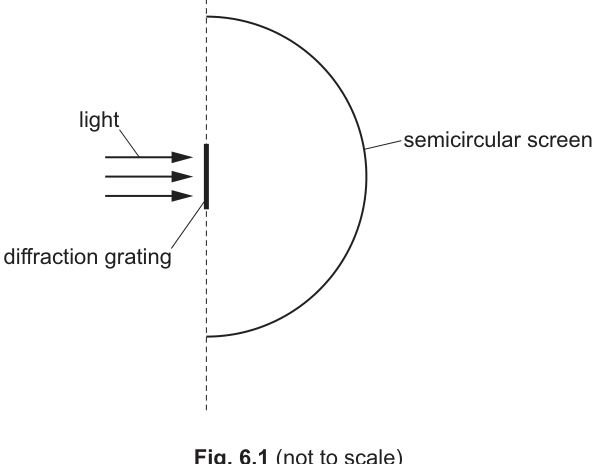
Light of a single frequency is incident normally on a diffraction grating. An interference pattern of bright and dark fringes forms on the semicircular screen shown in Fig. 6.1.
The light has wavelength .
The separation of the lines in the grating is .
Determine the total number of bright fringes formed on the screen.
number of bright fringes = ______
Working
For a grating,
Maximum order when :
Total number of bright fringes (orders to plus central):
Answer
15
Background Concept
A diffraction grating produces principal maxima (bright fringes) when waves from adjacent slits interfere constructively. The condition for a principal maximum is
where:
- is the grating spacing (distance between adjacent lines/slits),
- is the angle of the maximum from the normal to the grating,
- is the order number (),
- is the wavelength.
Not all orders exist. Because , the largest possible order satisfies
A semicircular screen allows maxima to be observed over angles from to , so the limiting case is indeed .
Understanding the Question
You are given monochromatic light of wavelength incident normally on a grating with line separation . The question asks for the total number of bright fringes (principal maxima) formed on the semicircular screen.
“Total number” means counting all orders on both sides of the central maximum, i.e. negative and positive orders, plus the central () maximum.
Approach
- Use the grating equation and the requirement to find the maximum possible order .
- Count the total maxima from to , including .
Step-by-Step Reasoning
- Convert the wavelength to metres:
- The maximum order occurs when :
Substitute values:
The order must be an integer, so the largest allowed is
- The observable bright fringes correspond to .
That is one central maximum plus 7 on each side:
Key Takeaways
- Use for a diffraction grating.
- The highest possible order comes from , giving .
- Total number of bright fringes on both sides is .
Common Mistakes
- Forgetting to include the central maximum (), leading to instead of .
- Rounding up to (not allowed because that would require ).
- Using in nm without converting to m while is in m.
Things to Be Careful About
- The “total number” includes both positive and negative orders.
- Only integer orders are physical.
- The semicircular screen implies you can consider angles up to , so the limiting condition is .
The light is replaced with red light of a single frequency.
State whether the frequency of the red light is greater than, less than or the same as the frequency of the original light.
Answer
Less than.
Less than
Background Concept
For electromagnetic waves in vacuum (and approximately in air), the speed is constant:
So frequency and wavelength are inversely proportional:
In the visible spectrum, red light has a longer wavelength than green/cyan light (such as ), so it must have a lower frequency.
Understanding the Question
The original light has wavelength . It is replaced by red light (monochromatic). You are asked to compare the frequency of red light with that of the original light.
Approach
Use the fact that red light has a longer wavelength than , and apply (with constant ).
Step-by-Step Reasoning
- Red light has a larger wavelength than .
- Since
increasing decreases .
- Therefore the red light has a smaller frequency than the original light.
Key Takeaways
- With constant wave speed, longer wavelength means lower frequency.
- Visible colour order: red corresponds to the longest wavelengths (lowest frequencies).
Common Mistakes
- Saying the frequency is greater because “red is more energetic” (it is actually less energetic per photon: ).
- Mixing up the relationships between , , and .
Things to Be Careful About
- The wave speed in the same medium is taken as constant, so the inverse relationship between and is valid here.
State and explain the effect of this change on the number of bright fringes formed on the screen. A calculation is not required.
Answer
The number of bright fringes decreases.
For maxima, and since the largest possible order satisfies . Red light has larger , so is smaller, giving fewer orders and hence fewer bright fringes.
The number of bright fringes decreases.
Background Concept
Principal maxima from a diffraction grating satisfy
Because , the order number is limited by
So the maximum observable order is approximately . The total number of bright fringes is then
Understanding the Question
You replace the original light with red light. Red light has a longer wavelength. The question asks what happens to the number of bright fringes and to explain why, without doing a numerical calculation.
Approach
- Identify how increasing affects the condition for maxima and, in particular, the maximum possible order.
- Connect a smaller to a smaller total number of maxima on the screen.
Step-by-Step Reasoning
- For any maximum of order :
- For that maximum to exist physically, we must have , so
- If you switch to red light, increases. In the inequality , a larger means that fewer integer values of can satisfy the inequality.
- Therefore becomes smaller.
- Since each order gives one bright fringe on each side (plus the central), the total number
also decreases when decreases.
So the interference pattern contains fewer bright fringes.
Key Takeaways
- Bigger wavelength larger diffraction angles for a given order, but fewer possible orders overall.
- The number of fringes is determined by how many integer orders are allowed by .
Common Mistakes
- Saying the number increases because the fringes “spread out” more. (Spacing/angles may increase, but the maximum order decreases, so the count decreases.)
- Forgetting that only integer orders are allowed.
Things to Be Careful About
- The question asks for the number of bright fringes, not their spacing or angular separation.
- No calculation is required, but you still need to refer to the grating condition and the limit to justify the change.
A particle Q and a particle R are each composed of one quark and one antiquark.
Answer
They are mesons.
Mesons
Background Concept
Hadrons are particles made of quarks.
- Baryons contain three quarks (e.g. for the proton).
- Mesons contain one quark and one antiquark (e.g. ).
Leptons (such as the electron) are not made of quarks.
Understanding the Question
The question states that each of Q and R is composed of one quark and one antiquark. You are asked to name the class (group) of particles with this composition.
Approach
Match the given quark structure (one quark + one antiquark) to the standard hadron classifications.
Step-by-Step Reasoning
- A particle made of one quark and one antiquark fits the definition of a meson.
- Therefore both Q and R are mesons.
Key Takeaways
- Meson quark + antiquark.
- Baryon three quarks.
Common Mistakes
- Saying “hadrons” (too general): baryons are also hadrons, but the question asks for the class that specifically matches quark–antiquark.
- Confusing mesons with baryons (three-quark states).
Things to Be Careful About
- The wording “class (group)” here refers to meson vs baryon vs lepton, not a specific named particle (like kaon or pion).
Q has a charge of , where is the elementary charge. R has a charge of .
Complete Table 7.1 to show a possible second quark in each of Q and R.
Table 7.1
| charge | first quark | second quark | |
|---|---|---|---|
| Q | strange | ||
| R | anti-up |
Working
For Q: strange has charge .
So second particle must have charge
So second quark is anti-up.
For R: anti-up has charge .
So second particle must have charge
So second quark is up.
Answer
- Q second quark: anti-up
- R second quark: up
Q: anti-up; R: up
Background Concept
Quarks have fractional charges (in units of the elementary charge ):
- has charge so has charge .
- has charge so has charge .
- has charge so has charge .
For a meson (quark + antiquark), the total charge is just the sum of the constituent charges.
Understanding the Question
You are told:
- Q is made from strange plus a second constituent, and has total charge .
- R is made from anti-up plus a second constituent, and has total charge .
You must choose one possible “second quark” in each case so that:
- the total charge matches, and
- the particle is still a meson (one quark and one antiquark).
Approach
For each particle:
- Write the charge of the given first constituent.
- Use: (charge of second constituent) = (total charge) − (charge of first constituent).
- Identify which quark or antiquark has that required charge, and check the quark–antiquark pairing condition.
Step-by-Step Reasoning
Particle Q
- First constituent: strange quark has charge .
- Total charge is .
- Required charge of the second constituent:
- The particle with charge is the anti-up quark .
- Check composition: is a quark and is an antiquark, so this is a valid meson.
So Q can be .
Particle R
- First constituent: anti-up has charge .
- Total charge is .
- Required charge of the second constituent:
- The particle with charge is the up quark .
- Check composition: is an antiquark and is a quark, so this is a valid meson.
So R can be .
Key Takeaways
- Quark charges are fractional; antiquarks have equal magnitude and opposite sign.
- Total charge of a composite particle is the algebraic sum of constituent charges.
- Mesons must be exactly quark + antiquark.
Common Mistakes
- Using instead of (or vice versa), giving the wrong sign for charge.
- Forgetting that Q and R must be quark–antiquark pairs: e.g. choosing two quarks.
- Arithmetic slip with negatives when subtracting a negative charge.
Things to Be Careful About
- Keep charges as fractions of until the end to avoid mistakes.
- Ensure the “second quark” you name is actually a quark or an antiquark with the required charge (e.g. only and have ).