Physics 9702/21 — May/June 2024
Cambridge AS Level · AS Level Structured Questions · worked solutions for every part, with the mark scheme
Topics Physical Quantities and Units · Dynamics · Kinematics · Deformation of Solids · Superposition · Waves · +2 more
The drag force acting on an object falling through air is given by
where is the cross-sectional area of the object,
is the velocity of the object in the air,
is the density of the air and
is a constant called the drag coefficient.
Working
.
, , .
So
Hence must equal , so has no units.
Answer
is dimensionless (no units).
C is dimensionless (no units).
Background Concept
Dimensional analysis (or checking homogeneity) uses the fact that any valid physical equation must have the same dimensions (units) on both sides. If an equation is
then the dimensions of the right-hand side must match the dimensions of force. If all other quantities on the right already have the dimensions of force, the remaining factor must be dimensionless.
Key SI base/derived units used here:
- Force:
- Density: has units
- Area: has units
- Speed: has units
Understanding the Question
You are told the drag force depends on , and (and constants). The question asks you to show, using SI base units, that the drag coefficient must have no units.
Approach
- Write the SI units for , , , and .
- Find the units of the combination .
- Compare with the units of .
- Conclude what units must have for the equation to be consistent.
Step-by-Step Reasoning
Force:
Other quantities:
Now multiply:
So the right-hand side becomes
But this must equal , therefore (no units).
Key Takeaways
- A valid physics equation must be dimensionally homogeneous.
- If the units of all other factors already match the left-hand side, the remaining constant is dimensionless.
Common Mistakes
- Using without converting it to base units when the question explicitly asks for SI base units.
- Forgetting to square the units of when handling .
- Treating as affecting units (pure numbers do not change units).
Things to Be Careful About
- Keep track of powers of metres: .
- State the conclusion clearly: “ has no units” or “ is dimensionless.”
Fig. 1.1 shows a sphere falling at terminal velocity in air.
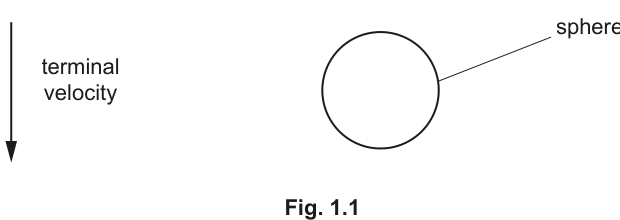
Assume that the upthrust on the sphere is negligible.
On Fig. 1.1, draw and label arrows to show the directions of the two forces acting on the sphere.
Answer
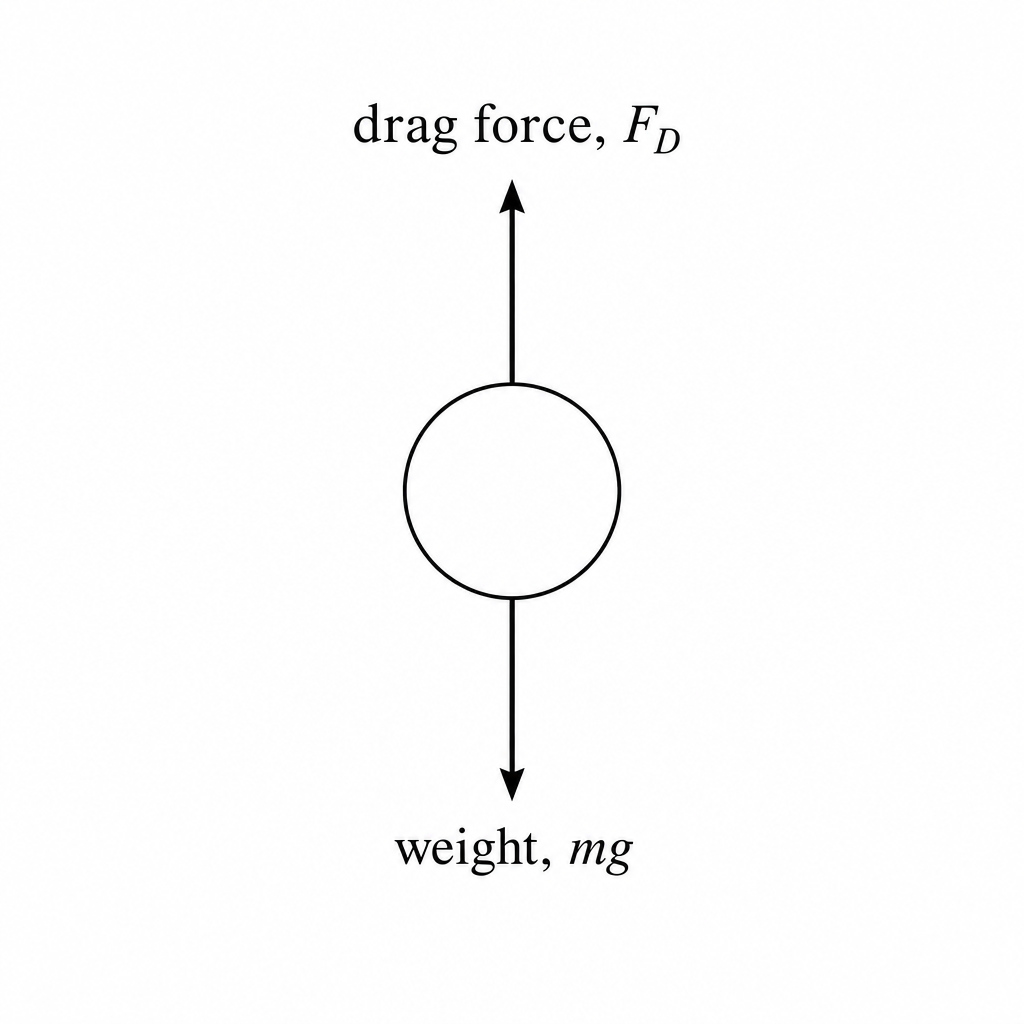
Weight acts vertically downwards.
Drag force acts vertically upwards (opposite to the motion).
Weight (mg) downwards; drag force (FD) upwards.
Background Concept
For an object moving through a fluid (air), two common vertical forces are:
- Weight acting downward due to gravity.
- Drag force acting opposite to the direction of motion through the fluid.
At terminal velocity, the object continues to move but its acceleration is zero, so the resultant force is zero. (This is used in later parts, but the force directions are the same regardless.)
Understanding the Question
A sphere is falling downward at terminal velocity. Upthrust is stated to be negligible, so you only include two forces. You must draw and label arrows for the directions of these two forces on the given diagram.
Approach
- Decide the direction of motion (downwards).
- Weight always acts downwards.
- Drag acts opposite to motion, so it acts upwards.
- Draw two arrows on the sphere, one up and one down, and label them correctly.
Step-by-Step Reasoning
The sphere is falling downwards, so:
- Draw a downward arrow from the sphere labelled (or weight ).
- Drag is resistive, so it opposes the downward motion; draw an upward arrow labelled (or drag).
Because upthrust is negligible, you do not draw an upthrust arrow.
Key Takeaways
- Weight acts toward the centre of the Earth (downward).
- Drag force always opposes the direction of motion relative to the fluid.
- If upthrust is neglected, only these two forces act vertically.
Common Mistakes
- Drawing drag in the same direction as the motion (it must oppose motion).
- Including an upthrust force despite being told it is negligible.
- Labelling drag as “friction” without making clear it is the air resistance .
Things to Be Careful About
- The question asks for directions and labels: both arrows must be shown and correctly labelled.
- Keep arrows clearly vertical (since only vertical forces are considered).
Working
At terminal velocity, resultant force .
Upthrust negligible, so .
Answer
0.48 N
Background Concept
Terminal velocity occurs when an object falls through a fluid and reaches a constant speed. Constant speed means acceleration , so by Newton’s second law the resultant force is zero:
For a falling object with negligible upthrust, the forces are weight downward and drag upward. If the resultant is zero, their magnitudes are equal.
Understanding the Question
You are given the mass of the sphere () and told it is falling at terminal velocity, with upthrust negligible. You must calculate the drag force .
Because it is at terminal velocity, you don’t need the speed or the drag formula yet; you just use force balance.
Approach
- Convert mass to kilograms.
- Use terminal velocity condition: drag balances weight (since upthrust is negligible).
- Compute using .
Step-by-Step Reasoning
Convert mass:
At terminal velocity, . With upthrust neglected:
Calculate:
Rounded appropriately:
Key Takeaways
- Terminal velocity implies zero acceleration and zero resultant force.
- If upthrust is negligible, drag equals weight: .
- Always convert grams to kilograms before using .
Common Mistakes
- Using as kilograms instead of converting from grams.
- Forgetting that at terminal velocity acceleration is zero, so forces balance.
- Giving the answer without units.
Things to Be Careful About
- State the terminal-velocity condition (resultant force zero) to justify .
- Use a sensible value of consistent with Cambridge convention ( or ).
The sphere is falling in air at a terminal velocity of in SI base units.
The density of the air is in SI base units.
The diameter of the sphere is in SI base units.
Use your answer in (c) to calculate the drag coefficient for the sphere.
= ______
Working
Rearrange
Answer
0.45
Background Concept
A common model for turbulent drag on an object moving through a fluid is
where:
- is drag force (opposes motion),
- is the drag coefficient (dimensionless),
- is the fluid density,
- is the cross-sectional area perpendicular to the motion,
- is the speed relative to the fluid.
To find , you rearrange the formula and substitute values. The cross-sectional area of a sphere (as seen from the direction of motion) is the area of a circle:
Understanding the Question
You are given:
- terminal speed ,
- air density ,
- sphere diameter ,
- and from part (c) the drag force .
You must use these to calculate the drag coefficient .
Approach
- Rearrange the drag equation to make the subject.
- Compute the cross-sectional area from the diameter.
- Substitute , , , and into the rearranged expression.
- Round to a sensible number of significant figures.
Step-by-Step Reasoning
Start with
Rearrange for :
Find . The radius is half the diameter:
So
Now substitute ( from part (c)):
Calculate and evaluate the denominator:
So
Key Takeaways
- For a sphere, use where is half the diameter.
- Rearranging to is the quickest route.
- Using consistent SI units throughout avoids unit errors.
Common Mistakes
- Using the surface area of a sphere () instead of the cross-sectional area ().
- Forgetting to square the speed ().
- Using diameter as the radius in .
- Substituting in grams-force or using mass instead of force.
Things to Be Careful About
- Check all quantities are already in SI base units (here they are).
- Keep enough significant figures during intermediate steps (e.g. keep until the end).
- Your final should be unitless; if you end up with units, a conversion or formula step is wrong.
Answer
Velocity is the rate of change of displacement with time (speed in a specified direction).
Velocity is the rate of change of displacement with time (speed in a specified direction).
Background Concept
Velocity is a vector quantity: it has both magnitude and direction. It is defined using displacement (also a vector), not distance.
Mathematically, for motion in one dimension,
and instantaneously,
Understanding the Question
You are asked to define velocity (1 mark). Examiners usually want the key idea: “rate of change of displacement” and/or “speed in a given direction”.
Approach
Give a concise definition that includes:
- displacement (not distance)
- time
- direction (since velocity is a vector)
Step-by-Step Reasoning
- “Rate of change” means “per unit time”.
- Using displacement rather than distance distinguishes velocity from speed.
- Mentioning direction confirms it is a vector.
Key Takeaways
- Velocity uses displacement, not distance.
- Velocity is a vector; speed is a scalar.
Common Mistakes
- Defining velocity as “distance travelled per unit time” (that is speed).
- Forgetting to mention direction / displacement.
Things to Be Careful About
- Use the word displacement to be unambiguous.
- Keep the definition short; do not add irrelevant equations unless asked.
A student throws a ball over a vertical wall of height , as shown in Fig. 2.1.
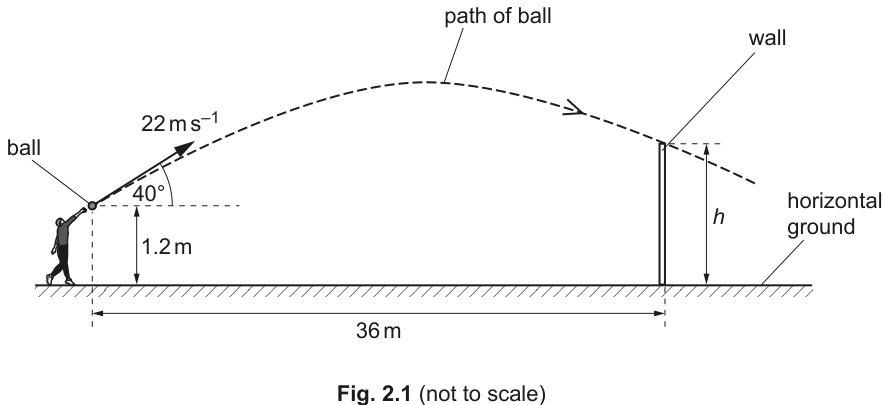
The ball leaves the hand of the student at a height of above the horizontal ground.
The ball has an initial velocity of at an angle of to the horizontal.
The wall is a horizontal distance of from where the student releases the ball.
Air resistance is negligible.
Working
Horizontal speed:
Time to reach wall:
Answer
2.14 s
Background Concept
In projectile motion with negligible air resistance:
- horizontal acceleration is zero, so horizontal velocity is constant
- vertical motion has constant acceleration
So you can treat the motion as two independent 1D motions:
Horizontal:
Vertical:
Understanding the Question
The ball is thrown with speed at above the horizontal. The wall is horizontally from the release point. You need the time when the ball reaches that horizontal position.
Given:
- horizontal distance to wall
- initial speed
- launch angle
- air resistance negligible horizontal speed constant
Unknown: to reach the wall.
Approach
- Find the horizontal component of the initial velocity: .
- Use to get .
Step-by-Step Reasoning
- Resolve horizontally:
-
Horizontal motion has zero acceleration, so stays constant.
-
Use constant-speed relation:
- Substitution gives .
Key Takeaways
- For projectiles, horizontal motion is uniform (if air resistance is negligible).
- Time to reach a horizontal position comes from .
Common Mistakes
- Using instead of for horizontal speed.
- Trying to use vertical equations to find the time (unnecessary here).
- Forgetting that is horizontal distance, not range or path length.
Things to Be Careful About
- Keep units consistent (metres and seconds).
- Calculator angle mode must be degrees.
- Use sufficient significant figures in so is not rounded too early.
Working
Answer
14.1 m s^-1
Background Concept
A velocity at an angle can be split into perpendicular components:
where is measured from the horizontal.
Understanding the Question
The initial speed is at to the horizontal. The question asks for the vertical component (so here means ).
Approach
Use trigonometry with the launch angle measured from the horizontal:
Step-by-Step Reasoning
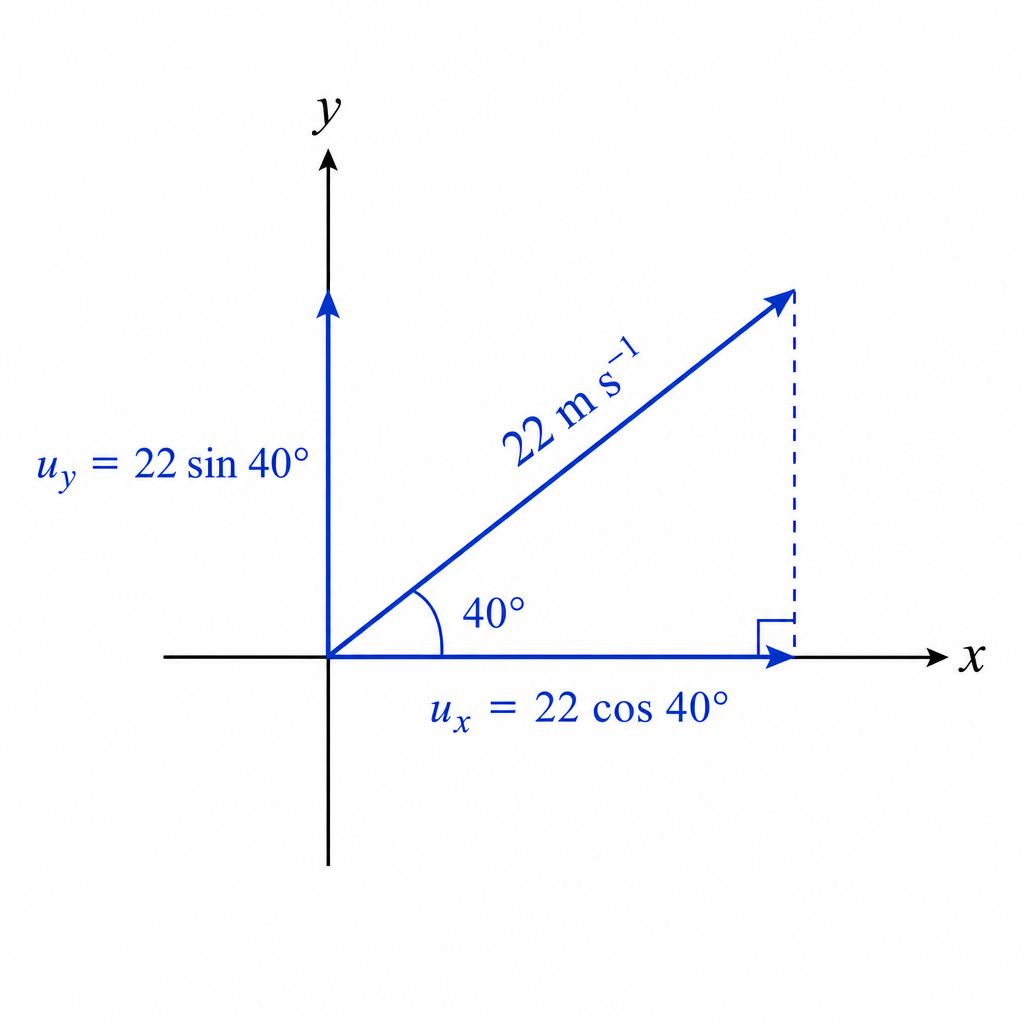
From the right-angled triangle of components, the vertical side is opposite the angle, so:
Evaluating gives .
Key Takeaways
- If the angle is to the horizontal, vertical component uses and horizontal uses .
Common Mistakes
- Swapping sine and cosine.
- Giving the component without units.
Things to Be Careful About
- Check the angle is to the horizontal (it is here).
- Ensure the component is positive initially (upwards).
Working
At the wall, and .
Vertical displacement from release point:
Height above ground at wall:
Answer
9.0 m
Background Concept
Projectile motion can be split into independent components:
- Horizontal: constant velocity (no acceleration)
- Vertical: constant acceleration downward of magnitude
For vertical motion with upward positive:
Here , so:
The height above ground at time is then:
Understanding the Question
“The ball just goes over the wall” means that when the ball is horizontally level with the wall (at ), its vertical position equals the top of the wall.
Given:
- initial height above ground
- launch speed at
- wall is away horizontally
- negligible air resistance
You already found the time to reach the wall in (i), and the initial vertical component in (ii). Use these to find the vertical position at that time.
Approach
- Use from part (i).
- Use from part (ii).
- Calculate vertical displacement from release point using
- Add the release height to get the wall height .
Step-by-Step Reasoning
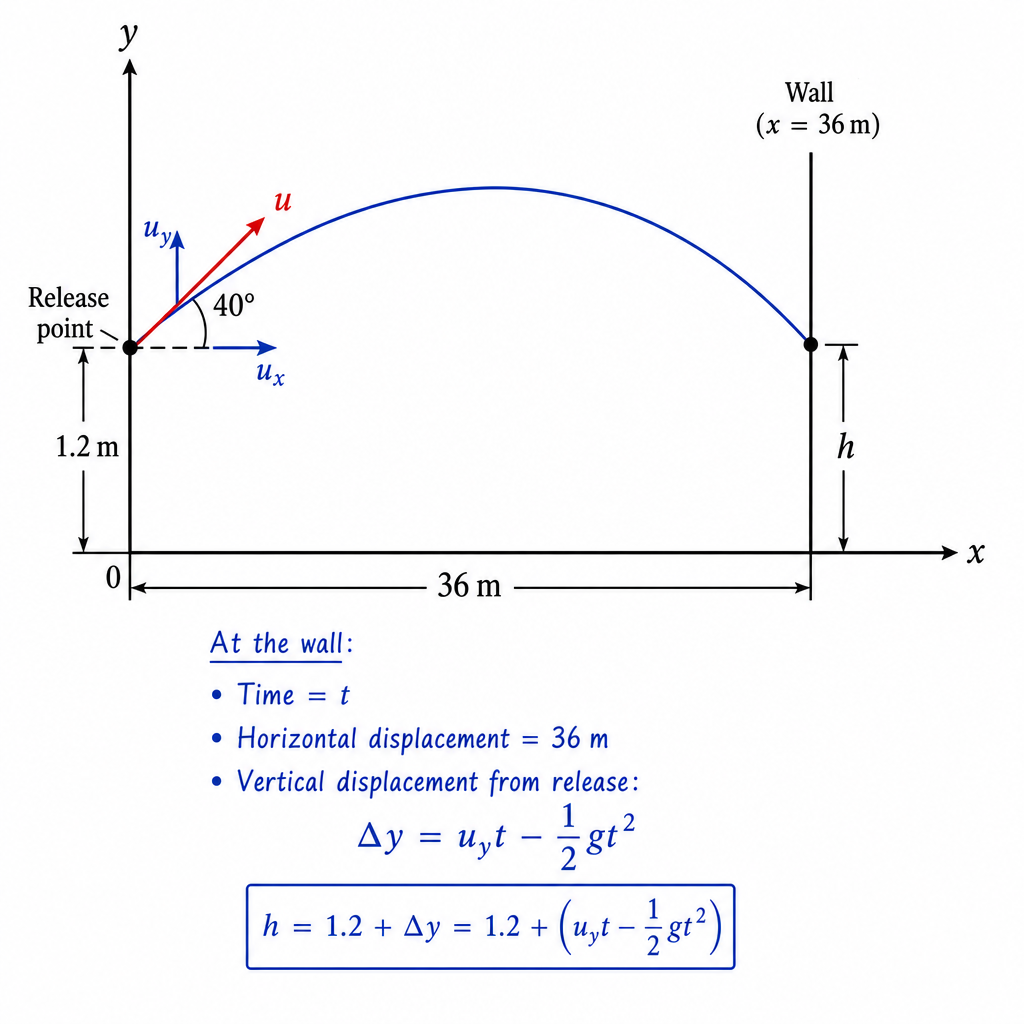
-
Time to wall from horizontal motion: .
-
Vertical component of initial velocity: .
-
Take upward as positive. Acceleration is downward, so .
-
Vertical displacement from the release point after time :
Substitute values:
This is the rise above the release point.
- The ball started above ground, so its height above ground at the wall is:
Since it “just goes over” the wall, this equals the wall height.
Key Takeaways
- Use horizontal motion to find time, then substitute that time into vertical kinematics.
- Always add the initial height if the projectile is launched above ground.
- Sign convention: upward positive gives .
Common Mistakes
- Using (wrong sign if upward is positive).
- Forgetting to add the initial height.
- Using the horizontal component instead of the vertical component in the vertical equation.
Things to Be Careful About
- Use the same time for both components (it’s the same motion).
- Do not round and too aggressively before the final step.
- Quote with sensible significant figures and include the unit .
Answer
The total momentum of a system remains constant provided that no resultant external force acts on the system (i.e. the system is isolated).
Total momentum is constant in an isolated system (no resultant external force).
Background Concept
Linear momentum is defined by
Momentum is a vector, so direction matters. The key link to forces is Newton's second law in momentum form:
If the resultant external force on a system is zero, then , so total momentum of the system does not change.
Understanding the Question
You are asked to state (not calculate) the principle. For full credit you must include both:
- what is conserved (total momentum of the system), and
- the condition (no resultant external force / isolated system).
Approach
Write one clear sentence defining conservation of momentum, and include the condition about external forces.
Step-by-Step Reasoning
- Identify the conserved quantity: total momentum (vector sum of individual momenta).
- State the condition for conservation: no resultant external force acts on the system.
- Conclude: momentum before an interaction equals momentum after.
Key Takeaways
- Momentum is conserved only for an isolated system (or when external impulses are negligible).
- Always remember momentum is a vector quantity.
Common Mistakes
- Saying only “momentum is conserved” without stating the condition about external forces.
- Referring to “momentum of an object” instead of “total momentum of the system”.
Things to Be Careful About
- Use the phrase “resultant external force” or “isolated system”. Internal forces during collision do not break conservation for the system.
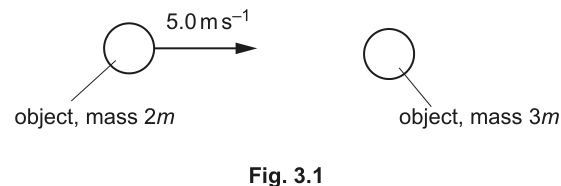
An object of mass is travelling at a speed of in a straight line. It collides with an object of mass which is initially stationary, as shown in Fig. 3.1.
After the collision, the object of mass moves with velocity at an angle of to its original direction of motion.
The object of mass moves with velocity also at an angle of , as shown in Fig. 3.2.
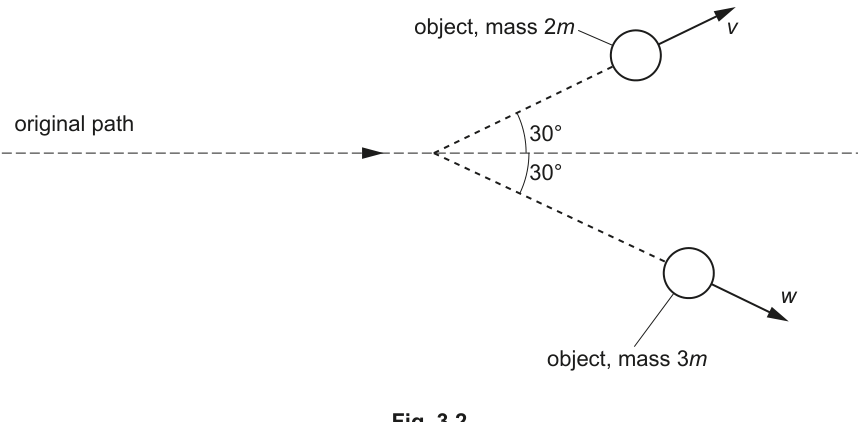
By considering the conservation of momentum in two dimensions, calculate the magnitudes of and .
= ______
= ______
Working
Take along the original direction.
Initial momentum:
After collision:
Conservation of momentum in :
Conservation of momentum in :
Cancel and substitute :
Answer
v = 2.89 m s^-1, w = 1.92 m s^-1
Background Concept
Momentum is a vector, so in two dimensions you must conserve momentum separately in perpendicular directions (usually and ):
For an object of mass moving with speed at an angle to the -axis, its momentum components are:
Understanding the Question
Before collision:
- mass moves to the right at ,
- mass is stationary.
So the initial momentum is entirely in the -direction.
After collision:
- moves at speed at above the original line,
- moves at speed at below the original line.
You must find the magnitudes and by conserving momentum in and .
Approach
- Choose axes: along the original direction, perpendicular.
- Write initial total momentum components.
- Write final total momentum components using and .
- Apply conservation in and in to get two equations.
- Solve the simultaneous equations for and .
Step-by-Step Reasoning
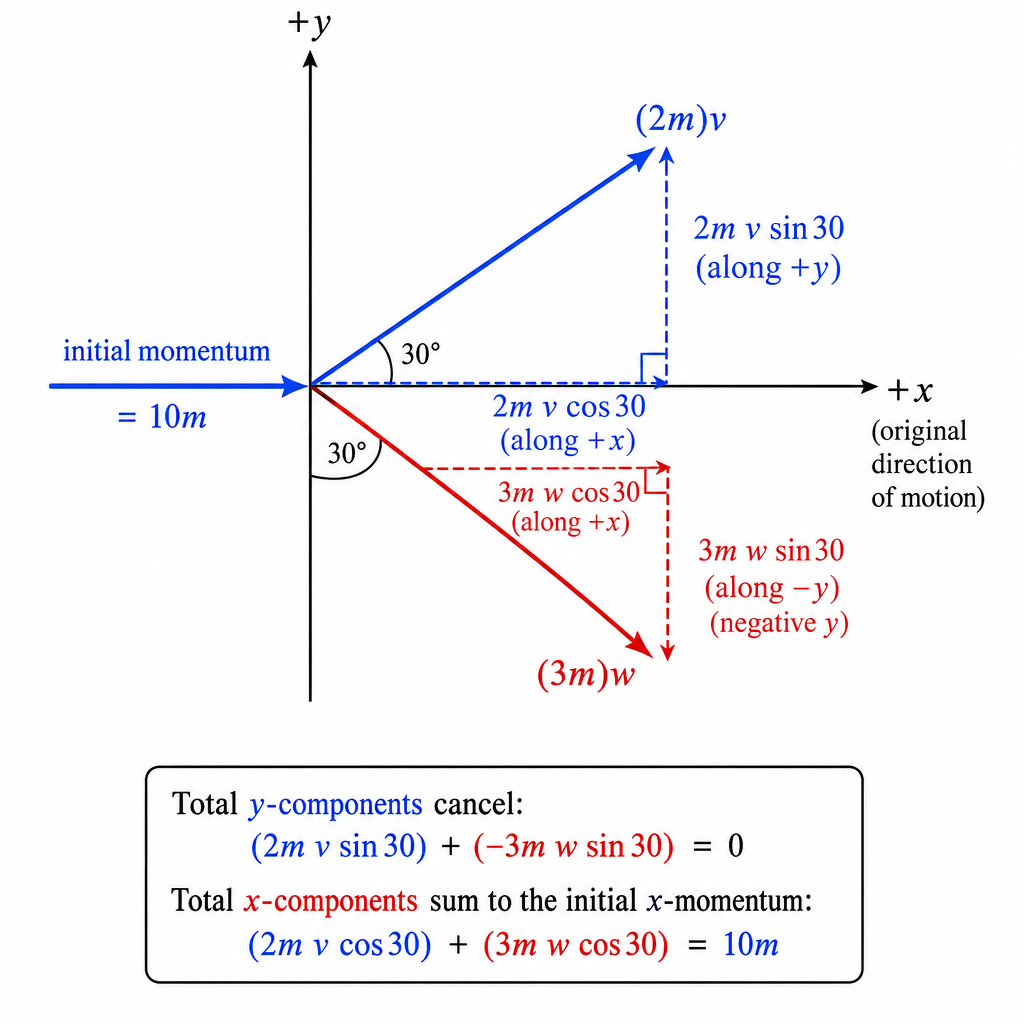
1. Initial momentum
Only the object moves initially:
2. Final momentum components
For the object at :
For the object at (downwards component is negative):
3. Conserve momentum in
Because initial momentum is zero, the final components must cancel:
Cancel :
This is a common pattern: if the scattering is symmetric in angle, the -momentum balance directly relates the speeds.
4. Conserve momentum in
Cancel and factor out :
Substitute :
So
Using gives .
Then
Key Takeaways
- In 2D collisions, conserve momentum separately in perpendicular directions.
- Assign signs carefully: upward positive, downward negative.
- Symmetry in angles often makes the -equation especially simple.
Common Mistakes
- Forgetting momentum is a vector and trying to conserve speeds instead of momentum components.
- Using and the wrong way round for components.
- Missing the negative sign for the downward -component of the object.
- Forgetting to multiply by the masses ( and ) when writing momentum.
Things to Be Careful About
- The factor cancels, but only after you have correctly included it in every term.
- Keep consistent axis choice: angles are given to the original direction, so choose along that direction.
- Quote answers with units and sensible significant figures (matching given data, typically 2 or 3 s.f.).
An object of mass is travelling in a straight line at a speed of . The object is brought to rest in a distance of by a constant force.
Calculate the magnitude of this force.
= ______
Working
Use
Magnitude of force:
Answer
1.5 × 10^3 N
Background Concept
For motion with constant acceleration, the SUVAT equation relating speeds, acceleration, and distance is:
where is initial speed, final speed, acceleration, and displacement along the line of motion.
Once is known, Newton's second law links resultant force and acceleration:
If the question asks for the magnitude of the force, you give a positive value even if the acceleration is negative (deceleration).
Understanding the Question
Given:
- mass
- initial speed
- final speed (comes to rest)
- stopping distance
- constant force (so constant acceleration)
Find: magnitude of the force producing the stopping.
Approach
- Use to find the acceleration .
- Use to find the force.
- Take magnitude (ignore the negative sign of deceleration).
Step-by-Step Reasoning
1. Find the acceleration
Substitute into
with , , :
The negative sign shows the acceleration is opposite to the motion (a deceleration).
2. Use Newton's second law
Magnitude:
Key Takeaways
- Constant force implies constant acceleration, so SUVAT applies.
- Deceleration gives a negative , but the force magnitude is positive.
- Always keep units consistent (metres, seconds, kilograms).
Common Mistakes
- Using instead of in the SUVAT equation.
- Forgetting that is already in metres and accidentally converting incorrectly.
- Giving a negative force when the question asks for magnitude.
Things to Be Careful About
- The stopping distance is small, giving a large deceleration; this is physically plausible.
- Significant figures: inputs are mostly 2 s.f., so is appropriate.
Answer
Strain is the extension divided by the original length:
Strain = extension/original length, (\Delta L/L).
Background Concept
When a force stretches a wire, its length increases by an amount called the extension . To describe how significant this change is, we compare it with the original length .
Strain is defined as the fractional change in length:
Because it is a ratio of two lengths, strain has no unit (it is dimensionless).
Understanding the Question
You are asked to define strain. No calculation is needed: just give the definition and (ideally) the defining equation.
Approach
State that strain equals extension divided by original length, and write it mathematically as .
Step-by-Step Reasoning
- Identify the quantity: strain (often symbol ).
- Use the definition: fractional extension.
Key Takeaways
- Strain measures how much something stretches relative to its original length.
- Strain is dimensionless.
Common Mistakes
- Writing strain as (inverted).
- Giving units for strain (it has none).
- Confusing strain with stress (stress is force per unit area).
Things to Be Careful About
- Use original length in the denominator (not the extended length).
- Make sure the definition is a ratio, not just “extension”.
A copper wire of length has a uniform cross-sectional area of .
A tensile force of is applied to the wire. This causes the wire to extend by up to its limit of proportionality.
Working
Answer
1.1 × 10^11 Pa
Background Concept
For a wire under tension:
- Stress is the force per unit cross-sectional area:
- Strain is the fractional extension:
- Young modulus measures stiffness and is defined (in the linear, proportional region) by:
This only applies up to the limit of proportionality (where stress is directly proportional to strain).
Understanding the Question
You are given:
- extension
You must calculate the Young modulus of copper using these values.
Approach
- Find the stress using .
- Find the strain using .
- Use .
(Equivalently, you can combine into one expression .)
Step-by-Step Reasoning
1) Stress
Convert nothing here except ensure SI units are used (they are).
2) Strain
Convert extension from mm to m:
Then:
3) Young modulus
To suitable significant figures:
Key Takeaways
- Always convert to SI units before calculating .
- comes from the linear region: .
- For a given material, is (approximately) constant and does not depend on wire dimensions.
Common Mistakes
- Forgetting to convert to .
- Using area in or mixing units.
- Calculating (inverted).
Things to Be Careful About
- Stress has unit ; strain has no unit; therefore Young modulus has unit .
- Quote the final answer to 2–3 significant figures (matching the given data).
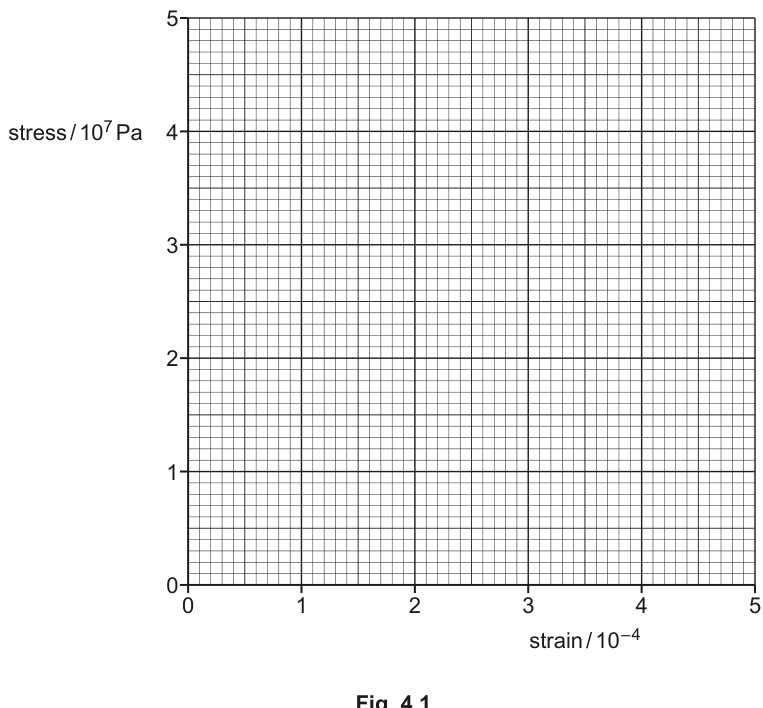
On Fig. 4.1, draw a line to show how the stress varies with the strain for the wire up to its limit of proportionality.
Working
At limit of proportionality:
Answer
Draw a straight line through the origin to the point (i.e. on the axis and on the axis).
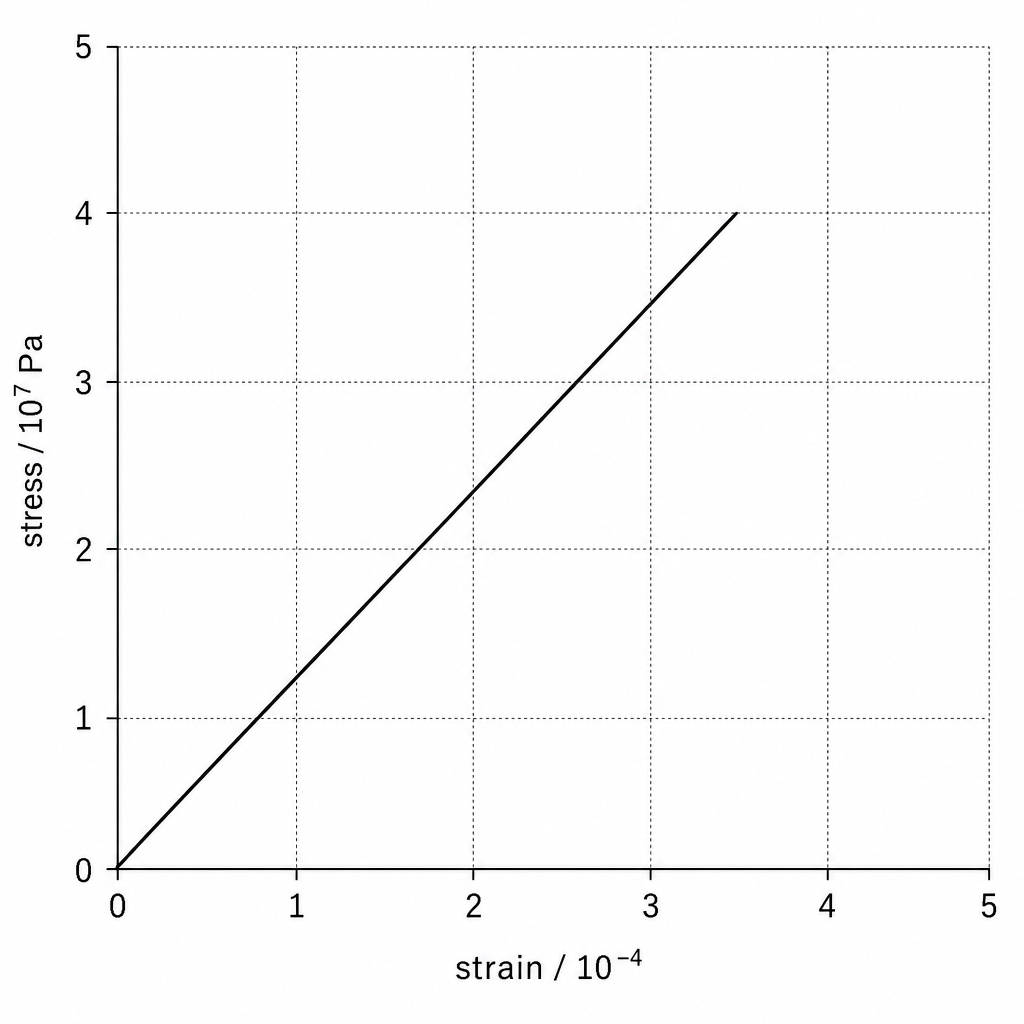
Straight line through origin to (strain 3.5×10^-4, stress 4.0×10^7 Pa).
Background Concept
In the proportional (Hooke’s law) region for a metal wire:
So a graph of stress against strain is a straight line through the origin. The gradient of the stress–strain graph is the Young modulus:
The graph is only straight up to the limit of proportionality.
Understanding the Question
You are given the force, dimensions, and extension at the limit of proportionality. Figure 4.1 has scaled axes:
- Vertical axis is stress in units of .
- Horizontal axis is strain in units of .
You must draw the correct stress–strain line up to that limit.
Approach
- Calculate the stress at the limit: .
- Calculate the strain at the limit: .
- Plot the point using the scaled axes.
- Draw a straight line from the origin to this point.
Step-by-Step Reasoning
Compute the endpoint values:
Now convert these to the axis numbers:
- On the -axis, stress is labelled as , so corresponds to .
- On the -axis, strain is labelled as , so corresponds to .
So the required graph is a straight line from to .
Key Takeaways
- In the proportional region, stress–strain is a straight line through the origin.
- You must use the axis scaling correctly to place the endpoint.
Common Mistakes
- Drawing a curve (that would represent beyond the proportional limit).
- Not passing through the origin.
- Plotting as if the axes were unscaled (forgetting the and factors).
Things to Be Careful About
- The extension is given at the limit of proportionality, so your line should stop at that point.
- Use a ruler to draw a single straight line with a clear endpoint.
- Ensure the point lies at and on the printed axes (not at or ).
A second copper wire has the same length as the wire in (b) but a larger diameter. Both wires are subjected to a tensile force of .
By placing a tick (✓) in each row, complete Table 4.1 to compare the stress and strain of the two wires.
Table 4.1
| greater in second wire | less in second wire | the same in both wires | |
|---|---|---|---|
| stress | |||
| strain |
Answer
For the second wire, is larger.
Same material so same and
So:
- stress: less in second wire
- strain: less in second wire
Stress: less in second wire. Strain: less in second wire.
Background Concept
Two key definitions link force, geometry, and stretching:
For a given material in the proportional region, Hooke’s law in stress–strain form is:
So if the material is the same, is the same, and strain is directly proportional to stress:
Understanding the Question
There are two copper wires of the same length. The second wire has a larger diameter, so it has a larger cross-sectional area . Both wires experience the same tensile force .
You must decide whether stress and strain are greater, less, or the same in the second wire compared to the first.
Approach
- Use to compare stresses when changes but is the same.
- Then use (same material means same ) to compare strains.
Step-by-Step Reasoning
- Stress comparison
Same force , but second wire has larger area .
If increases, decreases. Therefore stress is less in the second wire.
- Strain comparison
Both are copper, so Young modulus is the same. In the proportional region:
Since is less for the second wire, is also less for the second wire.
Key Takeaways
- Increasing diameter (area) reduces stress for the same applied force.
- For the same material, lower stress implies lower strain (in the linear region).
Common Mistakes
- Saying stress is the same because the force is the same (stress depends on area too).
- Saying strain is the same because the length is the same (strain depends on extension, which changes with stress).
- Confusing stress with strain.
Things to Be Careful About
- The statement “same material” is crucial: it means Young modulus is the same, linking stress and strain directly.
- The question does not ask about extension directly, but note that smaller strain would also mean smaller extension because and is the same for both wires.
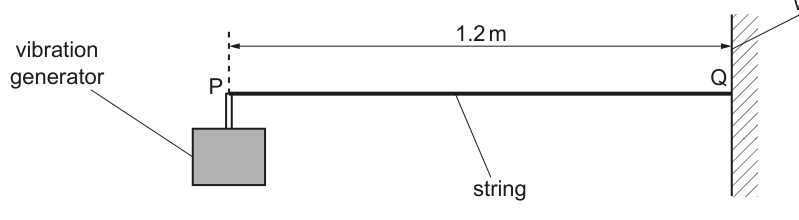
A stretched string PQ has length . One end of the string is attached to a vibration generator and the other end is attached to a wall, as shown in Fig. 5.1.
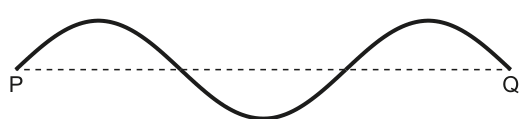
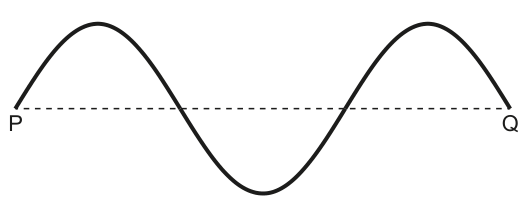
The vibration generator is switched on and a stationary wave is formed on the string. The string is shown at one instant of time in Fig. 5.2.
Answer
Waves from the generator travel along the string to the wall and are reflected back.
The incident and reflected waves (same frequency) travel in opposite directions and superpose, producing fixed nodes (zero displacement) and antinodes (maximum displacement), i.e. a stationary wave.
Incident wave reflects at the wall; incident and reflected waves superpose to form nodes and antinodes (stationary wave).
Background Concept
A stationary wave on a string forms when two progressive waves of the same frequency (and usually similar amplitude) travel in opposite directions along the same line.
By the principle of superposition, the resultant displacement at any point is the sum of the displacements due to each wave.
- At some points the two waves always cancel: nodes (zero displacement at all times).
- At other points they always add or subtract to the largest possible magnitude: antinodes (maximum amplitude).
A reflection at a fixed end (the wall) produces a reflected wave that is inverted in displacement compared with the incident wave, but it has the same frequency.
Understanding the Question
The generator at one end produces a progressive wave on the stretched string. The other end is attached to a wall (a fixed boundary), so the wave reflects. The question asks for the physical mechanism (reflection + superposition) that leads to a stationary-wave pattern between the generator and wall.
Approach
- State that the generator sends a progressive wave along the string.
- State that the wave reflects at the wall.
- Explain that the incident and reflected waves travel in opposite directions and superpose.
- Conclude that repeated constructive/destructive interference makes fixed nodes and antinodes (stationary wave).
Step-by-Step Reasoning
- The vibration generator produces a sinusoidal disturbance, so a progressive transverse wave travels from P to Q.
- When this wave reaches the wall at Q, it cannot move the wall: Q is effectively a fixed end, so the wave is reflected back toward P.
- Now there are two waves on the same string segment: one travelling right and one travelling left.
- At each position, the instantaneous displacement is the algebraic sum of the two displacements.
- Where the two displacements are always equal and opposite, the resultant displacement is always zero: a node.
- Where they are always in the same direction, the resultant has maximum magnitude: an antinode.
- Because this pattern stays at fixed positions, it is a stationary wave.
Key Takeaways
- Stationary waves come from superposition of two waves of the same frequency travelling in opposite directions.
- Reflection at a fixed end provides one of the counter-propagating waves.
- Nodes and antinodes are the hallmark of stationary waves.
Common Mistakes
- Saying “the wave stops” at the wall: it reflects; energy is not simply lost (though some may be absorbed).
- Describing only reflection but not superposition/interference.
- Confusing a stationary wave with a travelling wave (stationary pattern vs moving crests).
Things to Be Careful About
- Use the correct terms incident, reflected, superposition, nodes, antinodes.
- Make clear the waves travel in opposite directions and have the same frequency.
Working
Three loops are shown, so
Answer
0.80 m
Background Concept
For a string with nodes at both ends (fixed ends), a stationary wave consists of a number of equal “loops”. Each loop is the distance between two adjacent nodes, and that distance is half a wavelength:
If there are loops along a length , then
Understanding the Question
The string length is . The diagram shows a stationary wave pattern with three distinct loops (three bulges) between P and Q. The task is to find the wavelength of the underlying progressive waves.
Approach
- Count the number of loops between the fixed ends.
- Use .
- Rearrange for .
Step-by-Step Reasoning
- From the diagram, there are loops between P and Q.
- Each loop corresponds to a half-wavelength, so total length is
- Substitute :
- Solve for :
Key Takeaways
- In a stationary wave on a string, node-to-node distance is .
- Counting loops is often the fastest way to relate to .
Common Mistakes
- Treating one loop as one full wavelength (it is ).
- Miscounting loops or forgetting that both ends are nodes for a fixed end.
Things to Be Careful About
- Ensure you are counting complete loops between adjacent nodes.
- Quote the wavelength with unit (m).
Fig. 5.3 shows the stationary wave at time when all points on the wave are at their maximum displacements.
The period of the wave is .
On Fig. 5.3, sketch the shape of the stationary wave at time .
Working
After the wave is the same as after , so all displacements are reversed.
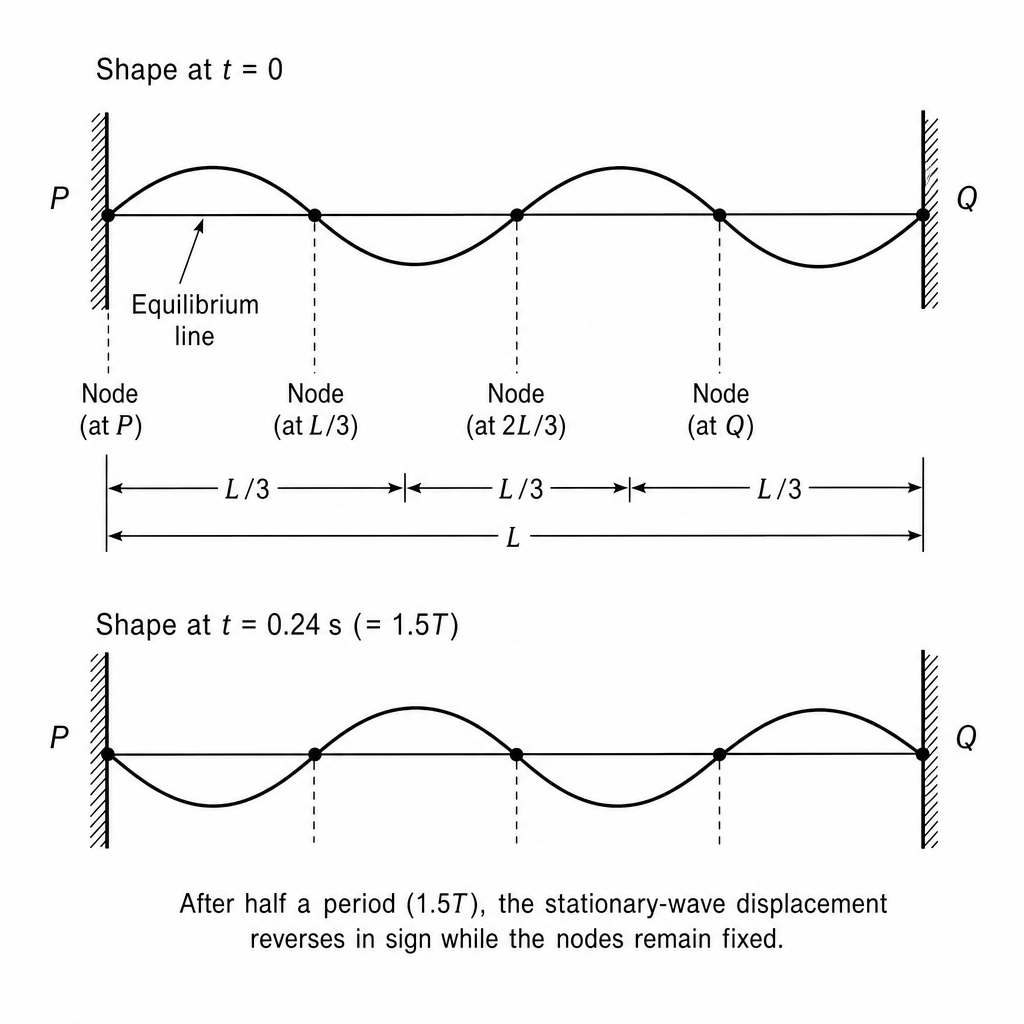
Answer
Sketch the same three-loop shape as at but inverted about the equilibrium line (crests become troughs, troughs become crests; nodes unchanged).
Inverted stationary-wave shape (same as t=0 but reflected in the equilibrium line).
Background Concept
In a stationary wave, each point on the string oscillates in simple harmonic motion (SHM) with the same frequency as the driving generator, but the amplitude depends on position:
- Nodes: amplitude (never move).
- Antinodes: maximum amplitude.
The time dependence at any fixed position is SHM. After half a period (), the displacement at every oscillating point is reversed (because SHM is sinusoidal):
So a snapshot of the string at looks like the original snapshot flipped about the equilibrium line.
Understanding the Question
At , the diagram shows the string when all points are at maximum displacement (so each loop is at its extreme). The period is . We must sketch the shape at .
Approach
- Express as a multiple of .
- Use periodicity: adding a whole number of periods returns the same shape.
- Recognise that an extra half-period inverts the displacement.
- Draw the inverted pattern; keep nodes in the same positions.
Step-by-Step Reasoning
- Calculate how many periods corresponds to:
So .
- After one full period , the wave shape repeats exactly.
- The remaining extra time is (half a period). In SHM, after half a period, every displacement changes sign:
- a crest becomes a trough of the same magnitude,
- a trough becomes a crest,
- nodes remain at zero.
- Therefore, the required sketch is the same three-loop pattern but flipped vertically about the equilibrium line.
Key Takeaways
- Convert the given time into a fraction/multiple of the period.
- A stationary-wave snapshot after is the inverted snapshot (nodes unchanged).
Common Mistakes
- Treating as instead of .
- Redrawing a travelling wave (shifted sideways). A stationary wave does not move sideways; its nodes stay fixed.
- Changing node positions: nodes must remain at the same locations.
Things to Be Careful About
- Use the identity: shape repeats every , but is inverted after .
- Ensure the number of loops is unchanged and the endpoints/nodes stay fixed.
Points R and T on the string are a horizontal distance of apart and in the positions shown in Fig. 5.4.
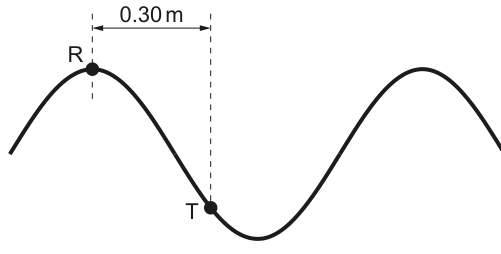
State the phase difference between the oscillations of points R and T.
= ______
Answer
R and T are in adjacent loops (separated by a node), so they oscillate in antiphase.
180°
Background Concept
In a stationary wave on a string, all points between a pair of adjacent nodes oscillate in phase (they reach maxima and cross equilibrium together). However, neighbouring segments (on opposite sides of a node) oscillate in antiphase:
- When one segment is above the equilibrium line, the neighbouring segment is below it.
- This corresponds to a phase difference of .
Understanding the Question
The diagram marks two points:
- R is at a crest in one loop.
- T is at a trough in the next loop.
They are separated by a node between those loops. The question asks for the phase difference between their oscillations.
Approach
- Decide whether R and T are in the same loop or in different loops.
- Use the stationary-wave phase rule: same loop (\to 0^\circ), adjacent loops (\to 180^\circ).
- State the phase difference in degrees.
Step-by-Step Reasoning
- In the given stationary-wave pattern, nodes separate loops.
- R lies in one loop and T lies in the neighbouring loop, with a node in between.
- Adjacent loops oscillate in antiphase, so when R has maximum positive displacement, T has maximum negative displacement.
- Therefore the phase difference is
Key Takeaways
- Same segment between nodes: phase difference .
- Adjacent segments across a node: phase difference .
Common Mistakes
- Using progressive-wave phase rules based on separation distance (e.g. (\Delta x/\lambda)) without noticing this is a stationary wave.
- Saying (which is actually in phase, not antiphase).
Things to Be Careful About
- The key clue is whether there is a node between the points.
- Phase difference is about timing of oscillations, not about the instantaneous shape alone (though the shape helps you see antiphase).
Working
With ,
Answer
5.0 m s⁻¹
Background Concept
The speed of a progressive wave is related to its frequency and wavelength by the wave equation:
Also, frequency and period are reciprocals:
On a string, the stationary wave pattern is produced by these progressive waves, so the wavelength found from the stationary wave is the wavelength of the progressive waves.
Understanding the Question
You are given the period of the wave and you can obtain the wavelength from the stationary-wave pattern (from part (b), ). The question asks for the wave speed on the string.
Approach
- Convert period to frequency using .
- Use (or directly ).
- Substitute values with correct units.
Step-by-Step Reasoning
- Find the frequency:
- Use the wave equation:
- Substitute :
(Equivalently, .)
Key Takeaways
- links wave speed to time information (period/frequency) and space information (wavelength).
- The wavelength measured from a stationary wave belongs to the underlying progressive waves.
Common Mistakes
- Using but substituting instead of without taking the reciprocal.
- Using the wrong wavelength (e.g. confusing loop length with full wavelength).
- Missing units or giving instead of .
Things to Be Careful About
- Keep everything in SI units (seconds and metres are already SI here).
- Quote the final answer to a sensible number of significant figures (here ).
Answer
At any junction, the total current entering equals the total current leaving (algebraic sum of currents at a node is zero).
At any junction, the total current entering equals the total current leaving.
Background Concept
Kirchhoff’s first law (KCL) is a statement of conservation of charge in an electrical circuit. Charge cannot accumulate at a junction in a steady-state circuit, so the rate of flow of charge (current) into a junction must equal the rate of flow out.
Understanding the Question
You are asked to state Kirchhoff’s first law. No calculation is needed; you must give the correct wording about currents at a junction (node).
Approach
Recall that KCL is the “junction rule”: currents into a node equal currents out of the node. You can also express it as “the algebraic sum of currents at a junction is zero”.
Step-by-Step Reasoning
- Current is defined as charge per unit time, .
- If no charge builds up at a junction, the net charge flow into the junction per unit time must be zero.
- Therefore, the sum of currents entering equals the sum of currents leaving.
Key Takeaways
- Kirchhoff’s first law is conservation of charge applied at a junction.
- Valid for steady currents (no charge accumulation at the node).
Common Mistakes
- Stating a voltage law (loop rule) instead of the current law.
- Forgetting “junction/node” and writing a vague statement about current being the same everywhere (only true in series sections).
Things to Be Careful About
- Use the word junction/node, and refer explicitly to currents entering and leaving.
- If using “algebraic sum”, make clear signs depend on chosen current directions.
A cell with internal resistance is connected to two resistors of resistances and as shown in Fig. 6.1.
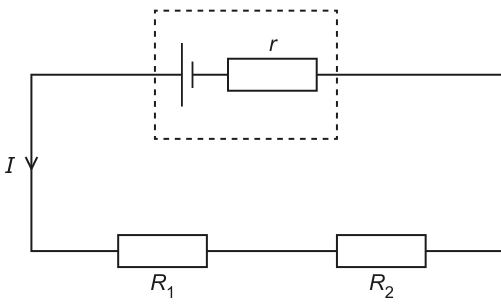
The potential differences (p.d.s) across and are and respectively.
The terminal p.d. across the cell is .
The current in the circuit is .
Use Kirchhoff’s laws to show that the total resistance of the external circuit is given by
Working
Using Kirchhoff’s second law for the external circuit,
For series resistors, the current is the same , so
Hence
But , so
Answer
RT = R1 + R2
Background Concept
Kirchhoff’s second law (KVL) states that the algebraic sum of potential differences around any closed loop is zero. In a series circuit, the same current flows through each component. Ohm’s law for a resistor is .
Understanding the Question
In Fig. 6.1, the two external resistors and are connected in series. Their p.d.s are and , and the terminal p.d. across the cell (i.e. across the external circuit) is . You must use Kirchhoff’s laws to show the external total resistance equals .
Approach
- Use KVL around the loop containing the external resistors to relate to and .
- Use the fact that series components carry the same current, then apply Ohm’s law to write and in terms of .
- Rearrange into the form and identify .
Step-by-Step Reasoning
- Around the external part of the circuit, the total drop across both resistors equals the terminal p.d.:
- Since and are in series, the same current flows through each.
- Apply Ohm’s law separately:
- Substitute into the KVL equation:
- By definition, the equivalent (total) external resistance is , so comparing with gives:
Key Takeaways
- In series: same current; p.d.s add.
- KVL gives the sum of voltage drops around a loop.
- Equivalent resistance in series is the sum of resistances.
Common Mistakes
- Using Kirchhoff’s first law at a junction (there is no junction in a simple series circuit).
- Writing for series resistors (incorrect: voltages divide).
- Forgetting that is for the external circuit, not including internal resistance .
Things to Be Careful About
- Make clear that is the terminal p.d. across the external network.
- Use consistent symbols: across , across , current through both.
The electromotive force (e.m.f.) of the cell in Fig. 6.1 is .
The values of and are and respectively. The terminal p.d. of the cell is .
Calculate the internal resistance of the cell.
= ______
Working
External resistance:
Current:
Using :
Answer
2.8 Ω
Background Concept
A real cell can be modelled as an ideal source of e.m.f. in series with an internal resistance . When a current is delivered, some energy is dissipated inside the cell, giving an internal voltage drop .
The terminal p.d. (the p.d. across the external circuit) is then
or equivalently .
Understanding the Question
You are given:
- , in series, so they form the external load
- terminal p.d.
You must find the internal resistance .
Approach
- Combine the external resistors to get the total external resistance .
- Use the terminal p.d. across the external circuit: .
- Use to solve for .
Step-by-Step Reasoning
- Series combination:
- The terminal p.d. is across the external circuit, so by Ohm’s law:
- The “lost volts” across the internal resistance are:
- Since this equals :
Key Takeaways
- Terminal p.d. is across the external load only.
- Lost volts .
- Find from the external circuit, then deduce .
Common Mistakes
- Using instead of (only true if ).
- Forgetting to add and for series.
- Writing (sign error).
Things to Be Careful About
- Quote in .
- Use a sensible rounding: inputs are mostly 2–3 s.f., so is appropriate.
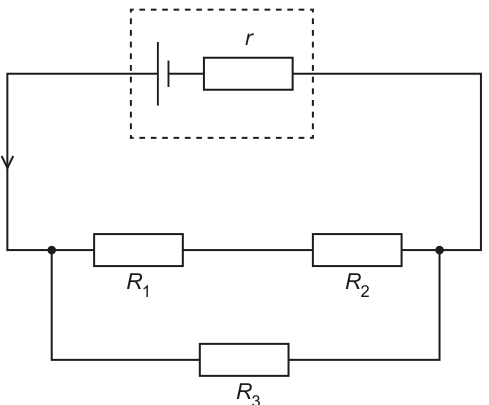
A resistor of resistance is added to the circuit in Fig. 6.1, so that the circuit is as shown in Fig. 6.2.
State and explain the effect, if any, of this change on:
Answer
The current in the cell increases.
Adding in parallel reduces the total external resistance, so the total circuit resistance decreases and hence
increases.
Increases
Background Concept
For a cell of e.m.f. and internal resistance , supplying an external equivalent resistance , the circuit current is
Adding resistors in parallel decreases the equivalent resistance because there are more paths for charge to flow.
Understanding the Question
Originally, and are in series. Then a resistor is added in parallel with the series combination of and (Fig. 6.2). You must state and explain what happens to the current drawn from the cell.
Approach
- Compare the equivalent external resistance before and after adding .
- Use the relationship between total resistance and current for a cell with internal resistance.
Step-by-Step Reasoning
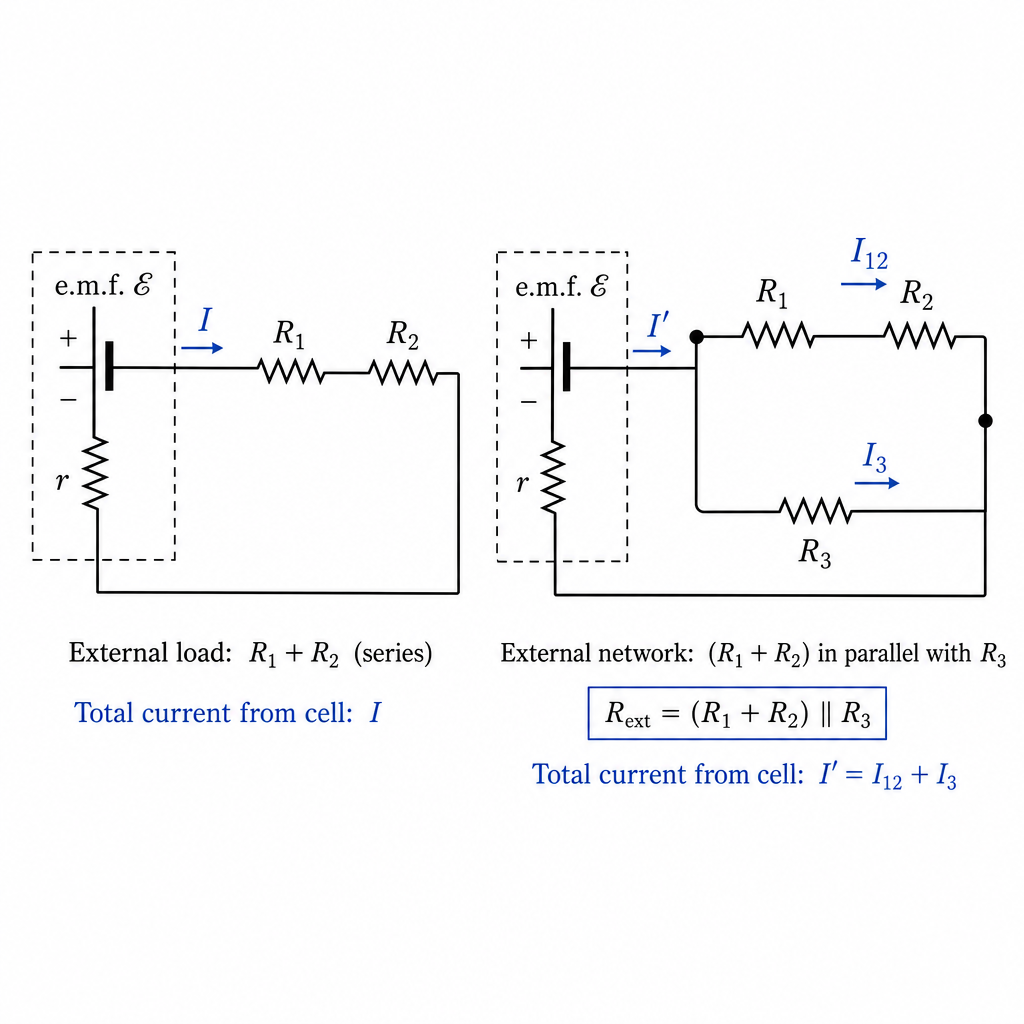
- Before adding , the external resistance is
- After adding in parallel with , the new external equivalent resistance is
A parallel combination always gives a smaller resistance than the smallest branch resistance, so
- The total resistance seen by the e.m.f. becomes . Since decreases while is unchanged, the denominator in
decreases, so the current increases.
Key Takeaways
- Adding a parallel path reduces equivalent resistance.
- With fixed and fixed , smaller total resistance means larger current.
Common Mistakes
- Saying current decreases because “more components” are added (not true for parallel additions).
- Treating as if it were in series with and .
Things to Be Careful About
- The question asks for current in the cell (total current supplied), not the current in a particular branch.
- Internal resistance does not change when you add external resistors.
Answer
The terminal p.d. decreases.
With internal resistance ,
Adding decreases external resistance so increases (part (i)), hence the drop increases and becomes smaller.
Decreases
Background Concept
For a cell with internal resistance , the terminal p.d. across the external circuit is
The term is the voltage lost inside the cell due to internal resistance (energy dissipated internally).
Understanding the Question
After adding in parallel with the existing external resistors, you must describe what happens to the terminal p.d. of the cell and explain why.
Approach
- Use the conclusion that the current drawn from the cell increases when external resistance decreases.
- Substitute this into the terminal p.d. relation to predict the effect on .
Step-by-Step Reasoning
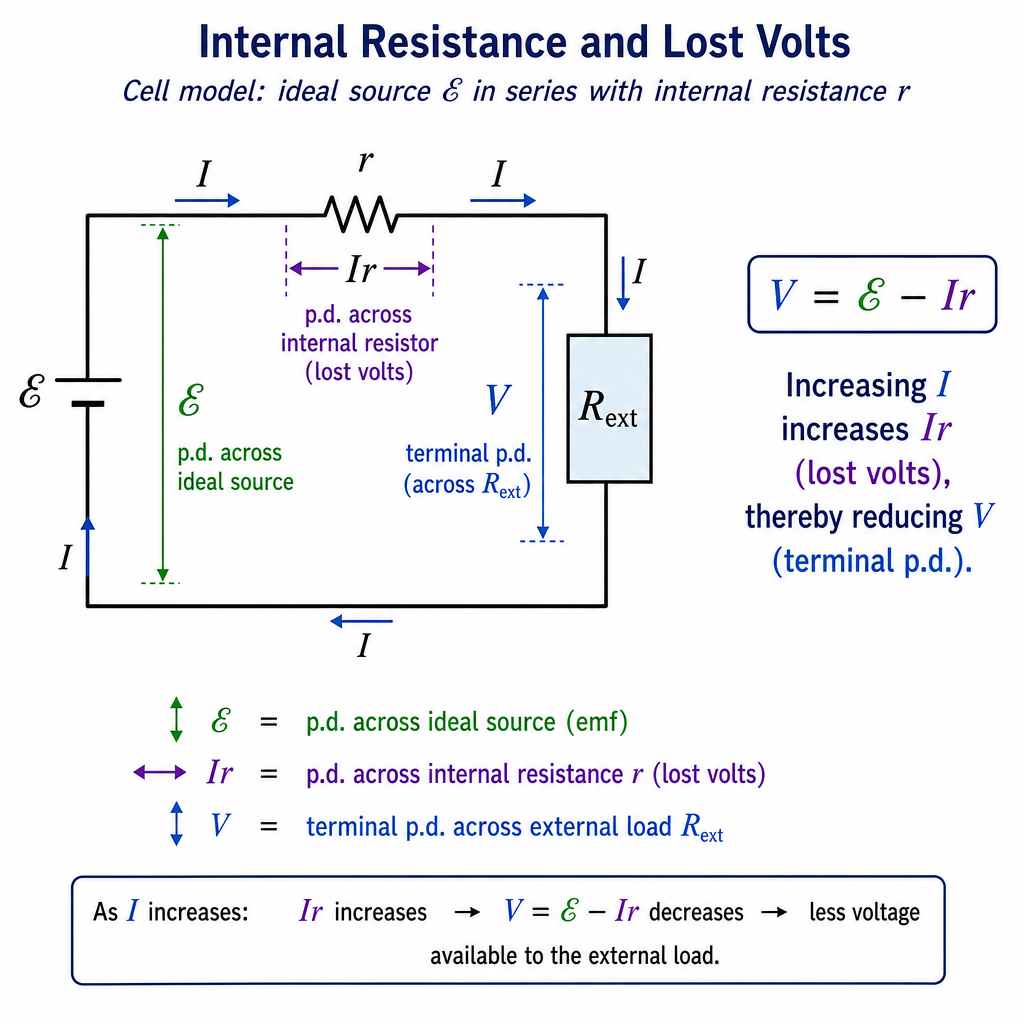
- Adding in parallel reduces the equivalent external resistance, so the current in the cell increases.
- The internal voltage drop is . If increases while is constant, then increases.
- Since
a larger means a smaller terminal p.d. .
So the terminal p.d. decreases.
Key Takeaways
- Terminal p.d. falls as current increases (for fixed internal resistance).
- Any change that reduces external resistance tends to increase current and therefore increase “lost volts”.
Common Mistakes
- Saying terminal p.d. stays equal to e.m.f. (only true when ).
- Claiming increases because “more current flows” without considering the internal voltage drop.
Things to Be Careful About
- The e.m.f. is a property of the cell and is unchanged by changing the external circuit (assuming no significant depletion).
- Be explicit that is internal and unchanged; it is the increase in that changes and hence .
Nuclei of an isotope of copper (Cu) each have 29 protons and 37 neutrons. This isotope is a emitter.
Answer
Background Concept
Nuclide notation has the form
where:
- is the proton (atomic) number,
- is the nucleon (mass) number, i.e. total number of protons + neutrons,
- is the chemical symbol.
Understanding the Question
You are told each copper nucleus has protons and neutrons. You must write the nuclide notation .
Approach
- Use .
- Use .
- Insert into .
Step-by-Step Reasoning
- Proton number:
- Nucleon number:
So the nuclide notation is
Key Takeaways
- comes from protons only.
- is total nucleons (protons + neutrons).
Common Mistakes
- Writing (using neutrons only).
- Swapping and .
- Omitting the element symbol or using by mistake.
Things to Be Careful About
- Check that and that equals the given number of neutrons (), as a quick consistency check.
The energy spectrum of the radiation emitted by a sample of this isotope is shown in Fig. 7.1.
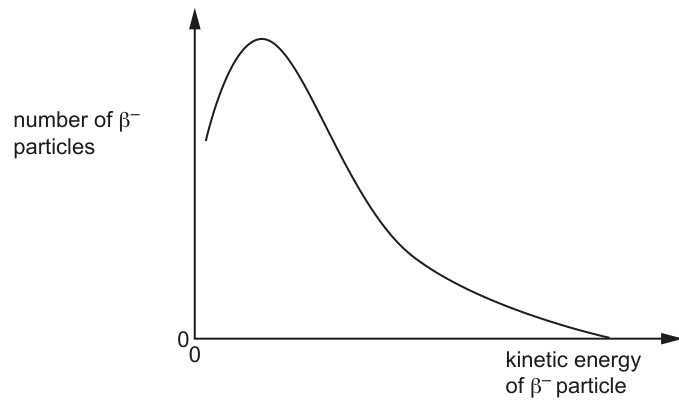
Use Fig. 7.1 to explain why other particles apart from the particles must be emitted during this decay.
Answer
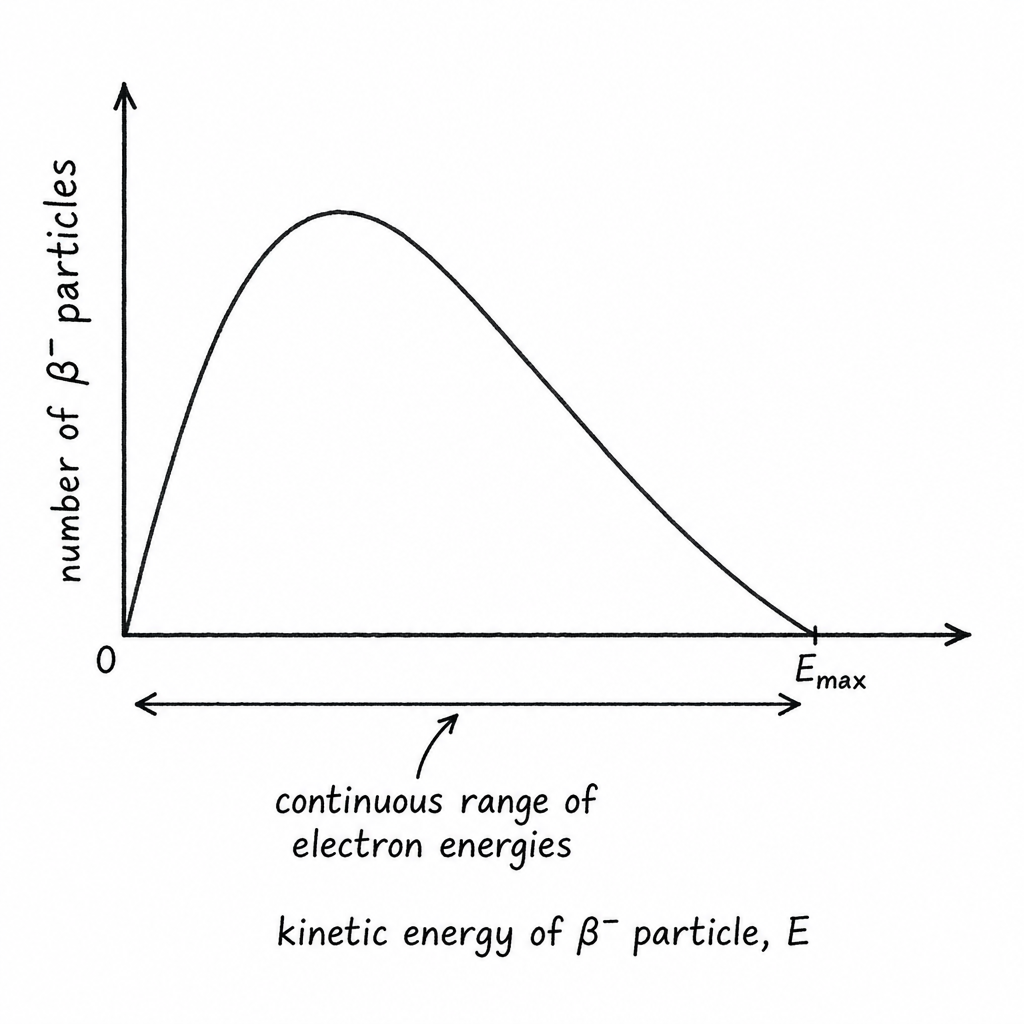
The particles have a range of kinetic energies from up to a maximum value (continuous spectrum).
If only the daughter nucleus and the particle were produced, conservation of energy and momentum would give the a single fixed kinetic energy.
Since the energy varies, some energy (and momentum) must be carried away by another emitted particle.
Continuous range of beta energies implies energy/momentum shared with another emitted particle.
Background Concept
In radioactive decay, quantities that must be conserved include:
- total energy (including kinetic energy of products and any rest-mass energy changes),
- momentum.
For a simple two-body decay (parent at rest decays into exactly two products), conservation of momentum fixes the magnitudes of the momenta of the two products, and therefore their kinetic energies are fixed (a single value, not a spread).
In decay specifically, a neutron in the nucleus changes to a proton and emits an electron (). In reality, a (anti)neutrino is also emitted, allowing energy and momentum to be shared in different proportions.
Understanding the Question
Fig. 7.1 shows the number of emitted particles against their kinetic energy. The curve is not a single line at one energy; it is spread out from near up to a maximum (endpoint) energy.
The question asks you to use that fact to argue that more than just particles must be emitted.
Approach
- Identify the key observation from the graph: the electron kinetic energy is continuous from to a maximum.
- Use the principle: two-body decay gives a fixed kinetic energy for one product.
- Conclude: at least one additional particle must be taking a variable share of the available energy and momentum.
Step-by-Step Reasoning
- From the spectrum, electrons are detected with many different kinetic energies (not one value).
- Suppose only two products were emitted: the daughter nucleus and the electron.
- If the parent nucleus is initially at rest, momentum conservation requires the electron and the daughter nucleus to have equal and opposite momenta.
- With only two bodies, that momentum magnitude is fixed, so their kinetic energies would also be fixed.
- Therefore the electron would have a single discrete kinetic energy.
- But the graph shows a continuous range, so the electron does not always take the same share of the available decay energy.
- Hence there must be at least one other emitted particle that can carry away the “missing” energy and momentum in varying amounts.
Key Takeaways
- A continuous spectrum is evidence that decay energy is shared between more than two products.
- Conservation of momentum is the key reason a two-body decay would give a single electron energy.
Common Mistakes
- Saying “energy is not conserved” (energy is conserved; it is shared among products).
- Referring only to conservation of charge/nucleon number (true but doesn’t explain the spectrum shape).
- Claiming the spread is due to measurement error; the spread is a real physical feature of decay.
Things to Be Careful About
- The maximum (endpoint) energy corresponds to the case where the other particle takes almost zero kinetic energy (and the recoil is minimal), but most decays share energy differently.
- The daughter nucleus recoil kinetic energy is usually small but not the main explanation for the wide continuous spectrum.
Answer
Electron antineutrino ().
Electron antineutrino
Background Concept
In decay, a neutron changes into a proton. To conserve:
- charge,
- lepton number,
- energy and momentum,
an electron and an electron antineutrino are emitted:
Understanding the Question
You have already inferred in (i) that another particle must be emitted besides the particle. Here you just have to name it.
Approach
Recall the standard decay products and state the additional particle.
Step-by-Step Reasoning
In decay the emitted beta particle is an electron . The accompanying particle is the electron antineutrino .
Key Takeaways
- decay emits an electron and an electron antineutrino.
Common Mistakes
- Writing “neutrino” instead of “antineutrino” for decay.
- Naming a photon () instead; may occur in some decays but is not the required particle to explain the continuous spectrum.
Things to Be Careful About
- Use the correct symbol: (electron antineutrino).
The copper isotope decays to an isotope of zinc (Zn).
Give the radioactive decay equation for this decay. Include the nucleon and proton numbers of all the particles involved.
Working
For decay, stays the same and increases by .
Initial nucleus: , .
So daughter zinc nucleus has , .
Answer
Background Concept
A nuclear decay equation must conserve:
- nucleon number (total number of protons + neutrons),
- proton number (charge number).
In decay, a neutron in the nucleus converts to a proton and emits an electron and an electron antineutrino:
This means for the nucleus:
- stays the same (one nucleon is still one nucleon),
- increases by (a neutron becomes a proton).
Understanding the Question
The copper isotope () decays by emission into an isotope of zinc. You must write the full decay equation including nucleon and proton numbers for every particle.
Approach
- Find the original and for copper.
- Use the rules: unchanged, .
- Write the balanced equation including and with their correct values.
Step-by-Step Reasoning
- Original copper nucleus has:
so it is .
-
After decay:
- Nucleon number unchanged: .
- Proton number increases by 1: .
- Element with is zinc, so the daughter is .
-
The emitted electron has:
(nucleon number 0, charge number ).
- The emitted antineutrino has:
(0 nucleons, 0 charge).
Putting this together:
Check conservation:
- :
- :
Key Takeaways
- In decay: unchanged, increases by 1.
- Always include the electron and the (anti)neutrino with correct labels.
Common Mistakes
- Decreasing (that would be decay).
- Changing (not correct for decay).
- Writing (positron) instead of .
- Omitting the antineutrino when asked for “all particles involved”.
Things to Be Careful About
- Use the correct nuclide symbols: Cu and Zn.
- Ensure both and are shown for every particle, including and .