Physics 9702/11 — May/June 2024
Cambridge AS Level · Multiple Choice (AS Level) · answer key with instant marking and worked solutions
Topics Physical Quantities and Units · Waves · Dynamics · D.C. Circuits · Particle Physics · Kinematics · +5 more
Tap an option under each question to check it — your score builds as you go.
Which unit is an SI base unit?
Options
A ampere
B coulomb
C degree Celsius
D gram
Working
The SI base unit for electric current is the ampere.
Coulomb is derived since .
Answer
A
A
Background Concept
SI base units are the fundamental units defined for base quantities (e.g. length, mass, time, electric current, temperature, amount of substance, luminous intensity). All other SI units are derived from these by multiplication/division and powers.
The SI base unit for electric current is the ampere (A). A coulomb (C) is a derived unit of charge defined by:
so:
Understanding the Question
You are given four units and asked which one is an SI base unit.
- ampere
- coulomb
- degree Celsius
- gram
You must identify the one that appears in the list of seven SI base units.
Approach
- Recall the seven SI base units and check each option.
- If a unit can be written in terms of other SI units (e.g. ), it is derived, not a base unit.
Step-by-Step Reasoning
- Ampere (A): this is the SI base unit for electric current, so it qualifies.
- Coulomb (C): charge is defined via , so , meaning it is a derived unit.
- Degree Celsius (): SI base unit for temperature is the kelvin (K). Celsius is related by an offset, so it is not a base unit.
- Gram (g): the SI base unit for mass is the kilogram (kg); gram is a submultiple of kg, not the base unit.
Therefore the only SI base unit listed is ampere.
Key Takeaways
- SI base units are a fixed set of seven units.
- Derived units can be expressed in terms of base units (e.g. ).
- Temperature base unit is K (not ) and mass base unit is kg (not g).
Common Mistakes
- Choosing coulomb because it is a common electrical unit, forgetting it is derived from A and s.
- Choosing degree Celsius instead of kelvin when asked specifically for an SI base unit.
- Thinking gram is the SI base unit for mass; SI uses kilogram as the base unit.
Things to Be Careful About
- “SI unit” and “SI base unit” are not the same: many SI units are derived.
- Prefix-related units (like gram, centimetre) may be SI-compatible but still not the defined base units.
Which of the following could have the same units as force?
Options
A
B
C momentum distance
D momentum time
Working
Force has units . Since
So force has units , i.e. energy per distance.
Answer
A
A
Background Concept
Dimensional analysis checks whether two quantities can have the same units.
A key definition linking force and energy is work done:
where is work/energy (unit ), is force (unit ) and is distance moved in the direction of the force (unit ). Rearranging gives the unit relationship
So any expression with units of could have the same units as force.
Understanding the Question
You are given four different combinations of common physical quantities (energy, distance, time, momentum) and asked which one could share the same units as force.
So we compare each option’s units with .
Approach
Use a known equation to express force in terms of other quantities (work/energy and distance), then match that to the options. Alternatively, express everything in base units, but the work definition is quickest here.
Step-by-Step Reasoning
From the work equation:
Rearrange:
So the units of are “energy per distance”, i.e.
Option A is exactly , which matches .
For completeness, the others do not match:
- B is (power), not force.
- C is momentum distance: .
- D is momentum time: .
None of these equal .
Therefore the correct option is A.
Key Takeaways
- Use defining equations (like ) to connect units quickly.
- Force has units .
- Power is , so “energy per time” is not force.
Common Mistakes
- Confusing with (force vs power).
- Treating momentum as if it were force (momentum is not force; force is rate of change of momentum).
- Forgetting that “could have the same units” is purely about dimensions, not physical meaning.
Things to Be Careful About
- Use consistent symbols: distance is (or ), time is .
- If converting to base units, remember: which immediately implies .
The velocity of an object changes from an initial velocity to a final velocity . The vectors represent these velocities.
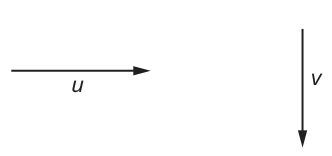
Which single vector represents the change in velocity of the object?
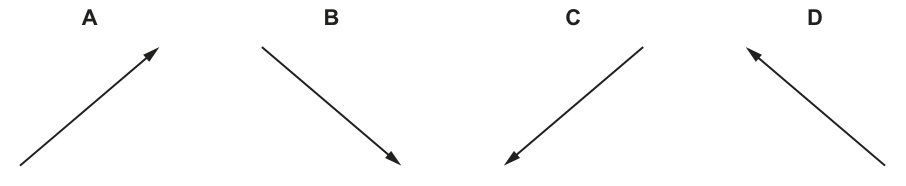
Options
Working
Change in velocity:
With tails together, is to the right and is downward, so points from the tip of to the tip of , i.e. down and left.
Answer
C
C
Background Concept
Velocity is a vector, so a change in velocity must be found by vector subtraction, not by subtracting magnitudes.
The definition is
Geometrically, subtraction of vectors can be done by adding the negative:
where has the same magnitude as but points in the opposite direction.
Understanding the Question
The diagram shows:
- initial velocity : horizontal to the right
- final velocity : vertical downward
You must choose which option arrow represents .
Approach
Use
Then use a vector diagram method:
- Draw and starting from the same point (common tail).
- The vector is the arrow from the tip (head) of to the tip of .
Step-by-Step Reasoning
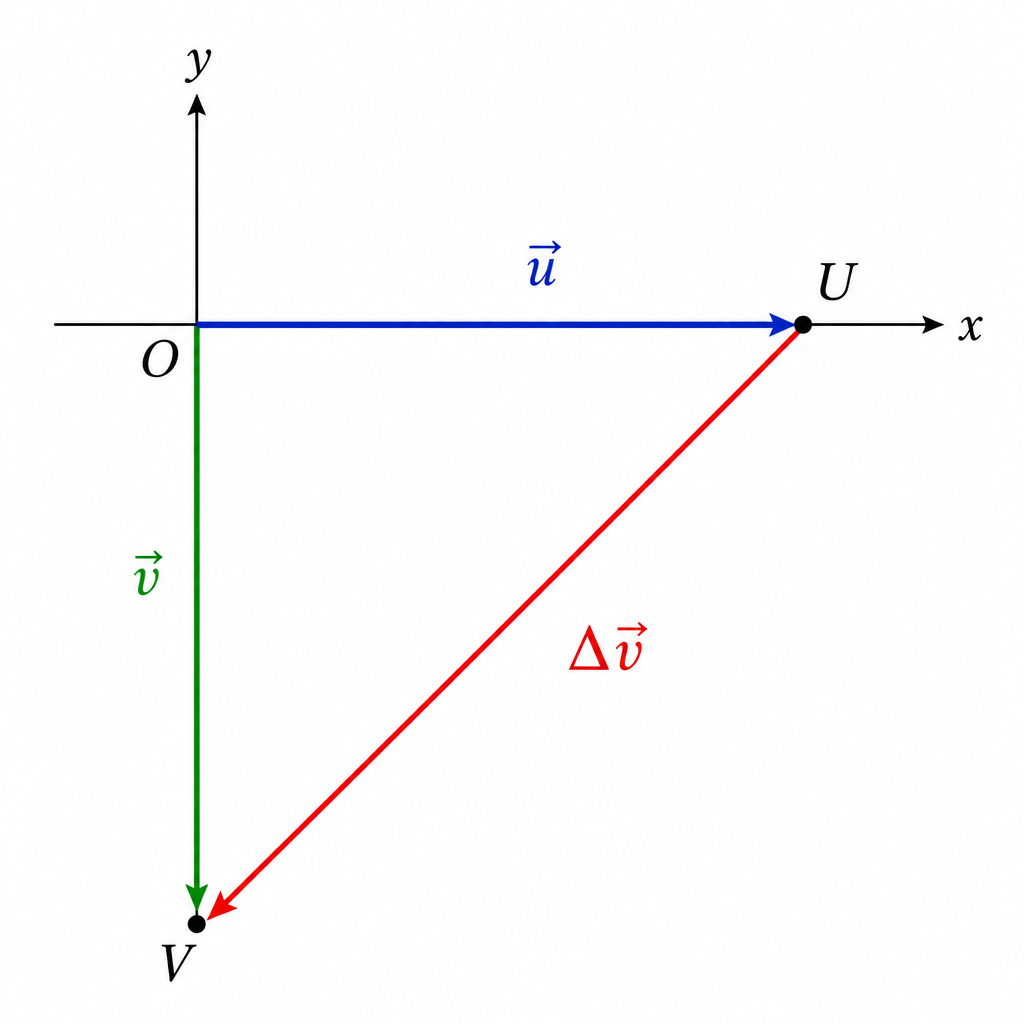
-
Place both vectors with their tails at the origin.
- goes to the right.
- goes downward.
-
We want .
- Start at the tip of .
- Go to the tip of .
-
From the tip of (right of the origin) to the tip of (below the origin) you must go left and down. Therefore points down-left.
-
Among the options, the down-left arrow is option C.
Key Takeaways
- Changes in vectors use vector subtraction: .
- With a common tail, is drawn from the head of to the head of .
Common Mistakes
- Subtracting magnitudes only (ignoring direction), which cannot identify the correct option.
- Drawing the arrow from the tip of to the tip of (this gives , the opposite direction).
- Treating as “the diagonal between them” without keeping track of the subtraction order.
Things to Be Careful About
- The order matters: ; they are equal in magnitude but opposite in direction.
- Always decide whether you are going “final minus initial” (for change) before choosing the direction.
An object is moving with initial velocity . The object then moves with uniform acceleration for time until it reaches final velocity .
Which equation describes the motion of the object?
Options
A
B
C
D
Working
For uniform acceleration,
Rearrange:
Answer
B
B
Background Concept
For motion in a straight line with uniform (constant) acceleration , the velocity changes at a constant rate. Acceleration is defined by
Rearranging gives the standard kinematics (SUVAT) equation that links initial velocity , final velocity , acceleration and time :
This equation is only valid when acceleration is constant over the time interval.
Understanding the Question
You are told:
- initial velocity is
- the object accelerates uniformly with acceleration
- for a time
- reaching final velocity
You must select which of the given options correctly describes this constant-acceleration situation.
Approach
Use the defining constant-acceleration relation (or start from ). Then compare (or rearrange) to match one of the options. A quick check is also to ensure each equation is dimensionally correct.
Step-by-Step Reasoning
Start from the constant acceleration definition:
Multiply both sides by :
Rearrange to make the subject:
This matches option B.
(You can also immediately reject options with because has units of length, not velocity.)
Key Takeaways
- With constant acceleration, the correct velocity-time relation is .
- Always check dimensions: has units of velocity, but has units of distance.
Common Mistakes
- Using in a velocity equation (confusing with displacement formulae like ).
- Forgetting that can be rearranged to without changing the physics.
- Missing the factor of in the displacement formula and incorrectly inserting a into the --- relation.
Things to Be Careful About
- Ensure the motion is explicitly stated to have uniform acceleration; otherwise SUVAT equations do not apply.
- Dimensional (unit) checking is a fast way to eliminate wrong options: so but .
Which calculation produces a vector quantity?
Options
A current time
B final displacement initial displacement
C
D mass
Working
A: (charge, scalar)
B: (displacement, vector)
C: (power, scalar)
D: (kinetic energy, scalar)
Answer
B
B
Background Concept
A vector has both magnitude and direction (e.g. displacement, velocity, acceleration, force). A scalar has magnitude only (e.g. time, mass, charge, energy, power).
A useful test is: if the result must include a direction (and obeys vector addition/subtraction rules), it is a vector.
Understanding the Question
You are given four calculations and asked which one produces a vector quantity.
So for each option, identify what physical quantity the calculation represents, then decide whether that quantity is scalar or vector.
Approach
- Translate each expression into a known physics definition/equation.
- Decide whether the resulting quantity is scalar or vector.
- Choose the option that is definitely a vector.
Step-by-Step Reasoning
Option A: current time
Current is charge per unit time:
So (charge). Charge has no direction, so it is a scalar.
Option B: final displacement initial displacement
Displacement is a vector position (often written ). The difference between two displacement vectors is the change in displacement:
That is still a vector (it has a direction from initial position to final position).
Option C:
Work done per unit time is power:
Power is a scalar.
Option D: mass
This is kinetic energy:
Energy is a scalar.
Therefore, only B produces a vector.
Key Takeaways
- Displacement (and change in displacement) is a vector.
- Charge, power, and energy are scalars.
- Multiplying/dividing scalars gives scalars; subtracting vectors gives a vector.
Common Mistakes
- Thinking “displacement” means “distance”: distance is scalar, but displacement is vector.
- Assuming anything involving subtraction must be scalar; vector subtraction is a standard vector operation.
- Confusing speed (scalar) with velocity (vector); kinetic energy uses speed squared, so it cannot carry direction.
Things to Be Careful About
- Option B uses the word “displacement” explicitly, which is a strong clue it is vector.
- Work done and energy quantities are always scalars in this syllabus context.
- gives charge, not current or a directional flow quantity; charge itself has no direction.
A thermometer can be read to an accuracy of . This thermometer is used to measure a temperature rise from to .
What is the percentage uncertainty in the measurement of the temperature rise?
Options
A
B
C
D
Working
Temperature rise:
Uncertainty in :
Percentage uncertainty:
Answer
D
D
Background Concept
When a quantity is measured with an instrument that has an accuracy (or reading uncertainty) of (\pm x), each single reading has an absolute uncertainty (\pm x).
If you derive a new quantity by combining measurements, you must propagate uncertainties:
- For a sum or difference, absolute uncertainties add:
- Percentage (or fractional) uncertainty is then found from:
This “add absolute uncertainties for a difference” rule corresponds to the worst-case situation (one reading at the high end, the other at the low end), which is what MCQs typically expect.
Understanding the Question
You measure a temperature change from (40\ ^\circ\text{C}) to (100\ ^\circ\text{C}) using a thermometer readable to (\pm 0.5\ ^\circ\text{C}).
The quantity you finally care about is the temperature rise:
The question asks for the percentage uncertainty in (\Delta T).
Approach
- Calculate the temperature rise (\Delta T).
- Find the absolute uncertainty in (\Delta T) by adding the absolute uncertainties of the two temperature readings.
- Convert that absolute uncertainty into a percentage of (\Delta T).
- Match to the closest option.
Step-by-Step Reasoning
- Temperature rise:
- Each reading has uncertainty (\pm 0.5\ ^\circ\text{C}). Since (\Delta T) is found by subtracting two measured values, add the absolute uncertainties:
- Percentage uncertainty in (\Delta T):
So the correct option is D.
Key Takeaways
- A temperature rise is a difference of two readings.
- For sums/differences, add absolute uncertainties.
- Percentage uncertainty is ((\text{absolute uncertainty}/\text{value})\times 100%).
Common Mistakes
- Using (\pm 0.5\ ^\circ\text{C}) as the uncertainty in (\Delta T) instead of (\pm 1.0\ ^\circ\text{C}).
- Dividing by (100\ ^\circ\text{C}) (or (40\ ^\circ\text{C})) instead of dividing by the temperature rise (60\ ^\circ\text{C}).
- Writing the fraction (1/60) as (0.8%) by incorrect arithmetic.
Things to Be Careful About
- The uncertainty applies to each thermometer reading, not to the rise directly.
- For this syllabus/MCQ style, use worst-case addition of absolute uncertainties for subtraction.
- Round to match the options: (1.67%) rounds to (1.7%).
The diagram shows the path of a golf ball.
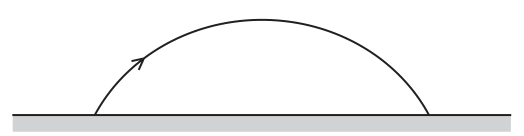
Which row describes changes in the horizontal and vertical components of the golf ball’s velocity when air resistance is ignored?
Options
| horizontal | vertical | |
|---|---|---|
| A | constant deceleration | constant acceleration downwards |
| B | constant deceleration | acceleration decreases upwards then increases downwards |
| C | constant velocity | constant acceleration downwards |
| D | constant velocity | acceleration decreases upwards then increases downwards |
Working
Ignoring air resistance, the only force is weight, so acceleration is constant vertically downward () and zero horizontally.
Hence horizontal velocity is constant, and vertical acceleration is constant downward.
Answer
C
C
Background Concept
In projectile motion with air resistance ignored, the only force acting on the projectile is its weight (downwards). By Newton's second law, this produces a constant acceleration of magnitude vertically downward.
Because there is no horizontal force, the horizontal acceleration is zero. Therefore:
- horizontal component of velocity stays constant (no change in ),
- vertical component of velocity changes at a constant rate because is constant.
Understanding the Question
You are shown a golf ball following a curved path (a projectile). The question asks how the horizontal and vertical components of the ball’s velocity change when air resistance is ignored.
So you must decide whether each component has constant velocity, constant acceleration, or varying acceleration.
Approach
- Identify forces on the ball after it leaves the club: only acts.
- Convert that into acceleration components: , .
- Convert acceleration statements into velocity behaviour:
- if then is constant,
- if constant then vertical velocity changes linearly, and acceleration is constant downward.
- Match these to the option table.
Step-by-Step Reasoning
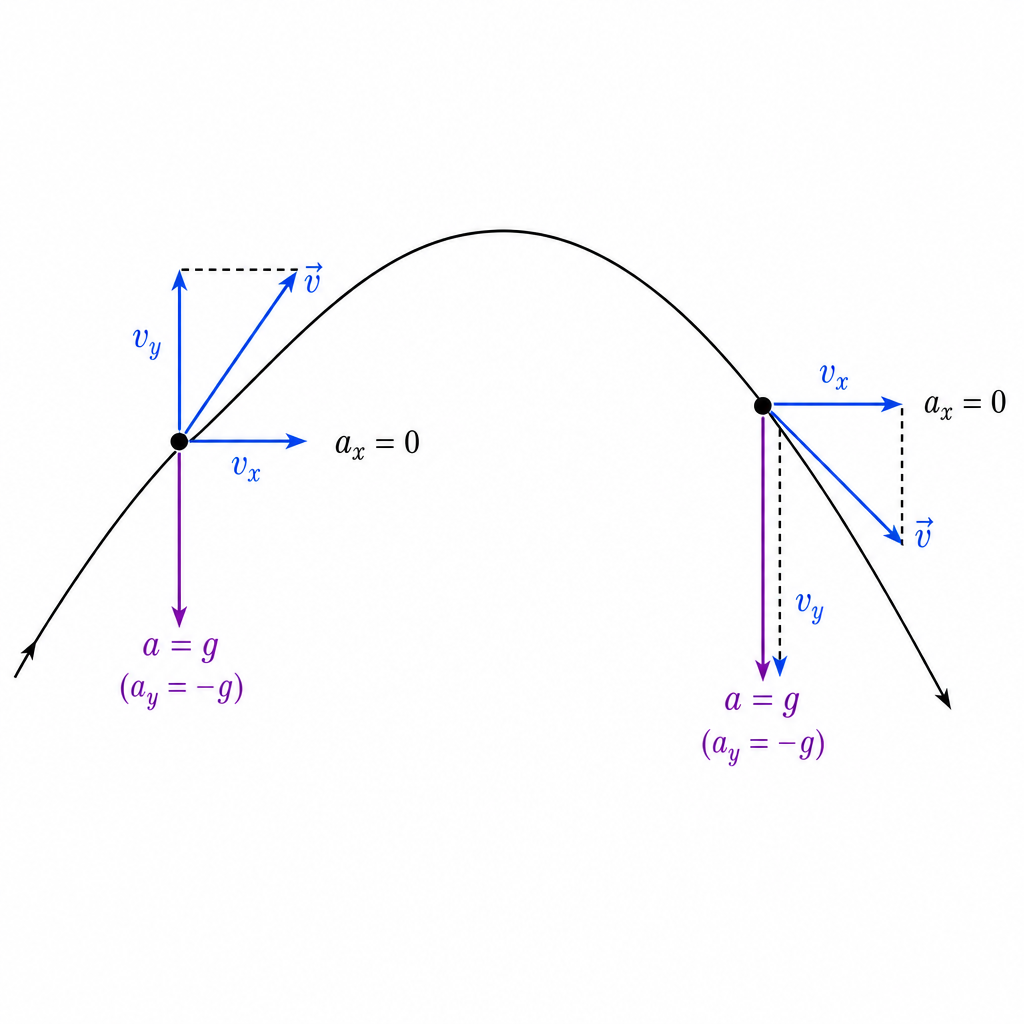
- With air resistance ignored, there is no resistive force opposing motion. The only force is weight downward.
- Therefore the acceleration is constant and vertically downward:
- There is no horizontal force, so:
- If , the horizontal velocity component does not change (constant velocity horizontally).
- If constant, the vertical acceleration is constant downward throughout the flight.
- The row that says “horizontal: constant velocity” and “vertical: constant acceleration downwards” is option C.
Key Takeaways
- Ignoring air resistance means only gravity acts.
- In projectile motion: is constant and is constant downward ().
- “Constant acceleration” refers to acceleration, not velocity: the vertical velocity changes, but the vertical acceleration does not.
Common Mistakes
- Saying the horizontal velocity decreases: that only happens if air resistance is included.
- Confusing vertical velocity with vertical acceleration (vertical velocity is zero at the top, but acceleration is still ).
- Thinking acceleration changes direction during the flight; it is always downward.
Things to Be Careful About
- The question asks about components of velocity, so you must think in and directions separately.
- “Acceleration decreases upwards then increases downwards” is incorrect here: that describes situations where the net acceleration varies (e.g. with drag), not ideal projectile motion.
- Sign convention: many mark schemes phrase it as “constant acceleration downwards” to avoid sign confusion; that corresponds to if up is positive.
An aircraft flies from London to Sydney in a time of hours minutes.
The distance travelled is .
What is the average speed of the aircraft?
Options
A
B
C
D
Working
Time:
Distance:
Average speed:
Convert to :
Answer
C
C
Background Concept
Average speed is defined as
It is a scalar quantity. In exam questions, the main skill is consistent unit conversion so that the final speed can be compared with the answer options.
Useful conversions:
Understanding the Question
You are given:
- Time of flight:
- Distance travelled:
You must find the average speed and then choose which option (A–D) matches that value. The options are expressed in different units (including , , and ), so you either convert your speed into one of those units or convert each option back into .
Approach
- Convert the given time into seconds.
- Convert the distance into metres.
- Calculate in .
- Convert the result into the unit used in one of the options (here, is convenient) and identify the matching option.
Step-by-Step Reasoning
1) Convert time to seconds
So total time is
2) Convert distance to metres
3) Average speed in
This is about , a realistic cruising speed for a jet airliner.
4) Convert to match the option units
Option C is in . Since ,
This matches Option C.
Key Takeaways
- Average speed is always .
- Convert all quantities into consistent units before substituting.
- When options use unusual units, convert your final value (or the options) carefully using powers of ten.
Common Mistakes
- Converting to (treating minutes as a decimal of an hour incorrectly).
- Forgetting to convert km to m, leading to a speed smaller by a factor of .
- Converting or in the wrong direction (mixing up and ).
Things to Be Careful About
- Always write the full time conversion: .
- Keep powers of ten explicit when converting to nano/micro/milli units.
- Round to match the options: becomes , which corresponds exactly to .
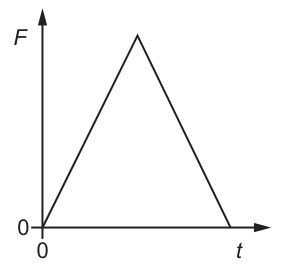
A golf club hits a golf ball. The graph shows how the force on the ball varies with time .
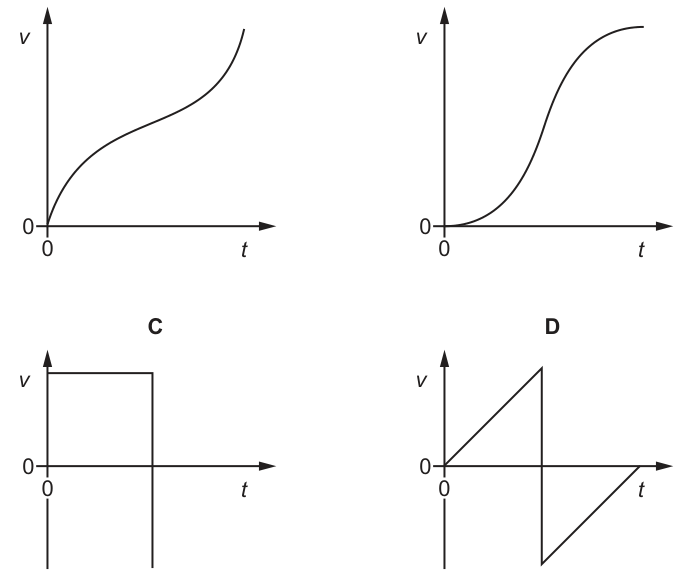
Which graph shows how the velocity of the ball varies with time ?
Options
Working
Using , the acceleration has the same time-dependence as .
Since
the gradient of the – graph starts at , increases to a maximum, then decreases back to ; after contact (when ), so is constant.
So rises with an S-shape and then levels off to a horizontal line.
Answer
B
B
Background Concept
A force causes a change in velocity because it produces an acceleration:
Also, acceleration is the rate of change of velocity:
So, the value of the force at a given time tells you the gradient (slope) of the velocity–time graph at that same time (up to a constant factor of ).
Equivalently, the change in momentum is the impulse:
which is the area under the – graph; this means velocity must increase during the time the force acts.
Understanding the Question
The golf club exerts a force on the ball for a short contact time. The given – graph is a triangle: starts at , increases linearly to a peak, then decreases linearly back to .
You must choose which candidate – graph matches this situation.
Approach
- Convert the force-time shape into an acceleration-time shape using .
- Use to infer how the gradient of the – graph changes with time.
- Check what happens after the force returns to zero: then so velocity becomes constant (horizontal line).
Step-by-Step Reasoning
-
Because , the acceleration is:
- zero at the start of contact,
- increasing (since increases linearly),
- then decreasing back to zero (since decreases linearly back to zero).
-
Since , the gradient of the – graph must:
- start at zero (initially flat),
- increase to a maximum (velocity curve gets steeper and steeper: concave up),
- then decrease back to zero (velocity curve still rises but becomes less steep: concave down).
-
Once the club is no longer in contact, , so and the velocity must be constant: the – graph becomes horizontal.
Among the options, only B shows an increasing curve whose slope grows then reduces and then levels off (becoming horizontal).
Key Takeaways
- determines via .
- is the gradient of the – graph.
- When returns to zero, velocity becomes constant (horizontal – line).
Common Mistakes
- Choosing a graph where decreases or becomes negative: the force shown is always positive, so acceleration is always positive during contact.
- Thinking velocity should have a triangular shape like the force: it is the gradient of velocity that follows the force shape, not the velocity itself.
- Forgetting that after the force stops, the ball continues moving at constant velocity (no sudden drop).
Things to Be Careful About
- The question is about shape, not exact values: focus on how the slope changes.
- A linearly increasing force means the slope of increases linearly (curving upward), and a linearly decreasing force means the slope of decreases linearly (curving downward).
- Any sudden vertical change in velocity would imply an infinite acceleration (and hence an unrealistic infinite force), so graphs with vertical jumps are not appropriate here.
What is meant by the mass and by the weight of an object on the Earth?
Options
| mass | weight | |
|---|---|---|
| A | its momentum divided by its velocity | the work done in lifting it one metre |
| B | the gravitational force on it | the property that resists its acceleration |
| C | the pull of the Earth on it | its mass divided by the acceleration of free fall |
| D | the property that resists its acceleration | the pull of the Earth on it |
Working
Mass is the property of a body that resists acceleration (inertia).
Weight is the gravitational force (pull of the Earth) on the body.
Answer
D
D
Background Concept
Mass is a measure of an object's inertia: how difficult it is to change its velocity. It appears in Newton's second law:
so for a given resultant force , a larger mass produces a smaller acceleration .
Weight is the gravitational force on the object due to the Earth. Near the Earth's surface:
where is the acceleration of free fall.
Understanding the Question
The question asks which pair of statements correctly defines mass and weight for an object on Earth. You must pick the option where the mass description matches inertia, and the weight description matches the Earth's gravitational pull.
Approach
- Identify the correct meaning of mass (inertial property, not a force).
- Identify the correct meaning of weight (a force caused by gravity).
- Compare these to the table entries and select the only option that matches both.
Step-by-Step Reasoning
- Mass is not “momentum divided by velocity” as a definition in this context (even though can be rearranged to for constant ). The intended definition is that mass is the property that resists acceleration (inertia).
- Weight is not “work done in lifting it one metre” (that is related to change in gravitational potential energy, ).
- Weight is the pull of the Earth on it, i.e. the gravitational force on the object.
- The only option that states:
- mass = “the property that resists its acceleration”, and
- weight = “the pull of the Earth on it”
is D.
Key Takeaways
- Mass measures inertia and links force to acceleration via .
- Weight is a gravitational force, given by near Earth.
- Mass is not a force; weight is a force and has units of newtons.
Common Mistakes
- Mixing up mass and weight (e.g. saying mass is the gravitational force).
- Choosing an option that uses a rearranged formula (like ) instead of the physical meaning being tested.
- Treating work done (energy) as if it were a force (weight).
Things to Be Careful About
- Weight depends on local gravitational field strength ; mass does not.
- Units: mass in , weight in .
- In MCQs, the exam often wants the conceptual definition (inertia for mass; gravitational pull for weight), not an algebraic rearrangement.
A thin horizontal plate of area is beneath the surface of a liquid of density .
The force on one side of the plate due to the pressure of the liquid is .
What is the depth of the plate beneath the surface of the liquid?
Options
A
B
C
D
Working
Answer
A
A
Background Concept
For a liquid at rest, the (gauge) pressure increases with depth because of the weight of the liquid above. The hydrostatic pressure difference between a point at depth and the surface is
where is the gauge pressure in , is the liquid density in , and is the gravitational field strength.
If a flat surface of area experiences a uniform pressure on one side, the force on that side is
Understanding the Question
A horizontal plate is under a liquid surface. You are given:
- area
- density
- force on one side due to liquid pressure
You must find the depth of the plate below the surface.
Because the plate is thin and horizontal, the pressure over that face is effectively the same everywhere and equals the hydrostatic pressure at that depth.
Approach
- Convert the given force on the plate into the pressure using .
- Use hydrostatic pressure and rearrange to .
Step-by-Step Reasoning
- Find the pressure:
- Use :
Calculate the denominator:
So
This corresponds to option A.
Key Takeaways
- Pressure is force per unit area: .
- In a static liquid, gauge pressure at depth is .
- Combine the two to link force on a submerged surface directly to depth.
Common Mistakes
- Using (missing the area ).
- Forgetting to divide the force by area before using .
- Mixing units (e.g. using or not using ).
- Using an incorrect value for or omitting it.
Things to Be Careful About
- The pressure in is the gauge pressure due to the liquid column; atmospheric pressure cancels because it acts on both the liquid surface and (if relevant) the other side.
- Keep enough significant figures during intermediate steps; rounding too early can shift the final option choice in MCQs.
Spheres X and Y form an isolated system. The mass of Y is greater than the mass of X.
Sphere Y is initially stationary.
Sphere X collides elastically with sphere Y.
The speed of sphere X before the collision is .
Which statement must be correct?
Options
A Sphere X rebounds with a speed that is greater than , and sphere Y moves off with a speed that is less than .
B Sphere X rebounds with a speed that is less than , and sphere Y moves off with a speed that is also less than .
C Sphere X rebounds with speed , and sphere Y remains stationary.
D Sphere X remains stationary, and sphere Y moves off with a speed that is less than .
Working
Let sphere X have mass and sphere Y have mass with . Initially and .
For a 1D elastic collision with the second mass initially at rest:
Since , is negative (X rebounds) and
Also,
So X rebounds with speed less than and Y moves off with speed less than .
Answer
B
B
Background Concept
In an isolated system, the total momentum is conserved because there is no resultant external force.
In a perfectly elastic collision, two things are conserved:
- Total momentum
- Total kinetic energy
For a one-dimensional elastic collision between masses and , where is initially at rest, the final velocities are standard results (derivable from the two conservation equations):
The sign of a velocity indicates direction; a negative value means rebound.
Understanding the Question
Sphere X (mass smaller) approaches with speed . Sphere Y (mass larger) is stationary. After an elastic collision, we must decide which of the four statements must be true.
Because it is isolated and elastic, we can use the elastic-collision results to see whether X rebounds or stops, and whether speeds are greater than, equal to, or less than .
Approach
Model this as a 1D elastic collision.
- Write the expressions for and after collision.
- Use the condition to determine the sign of (rebound or not).
- Compare the magnitudes of and with .
- Match to the option.
Step-by-Step Reasoning
Let X have mass and Y have mass with . Initially:
For an elastic collision with the second object initially at rest:
Because , the numerator is negative, so . That means sphere X rebounds.
Its rebound speed is the magnitude:
Since , the fraction is less than 1, so .
Now for sphere Y:
Because when , this fraction is also less than 1, so .
Therefore:
- X rebounds with speed less than .
- Y moves off with speed less than .
This matches Option B.
Key Takeaways
- In an isolated collision, momentum is conserved; if it is elastic, kinetic energy is also conserved.
- For an elastic collision with a stationary target:
- If the target is more massive (), the incident object rebounds with reduced speed.
- The target moves off forward with speed less than the incident speed.
Common Mistakes
- Thinking “elastic” means the incident object must bounce back faster than it arrived; that can only happen if the other object is moving towards it initially.
- Ignoring the mass condition ; the sign of depends on whether is positive or negative.
- Confusing speed and velocity: X rebounds means the velocity changes sign.
Things to Be Careful About
- This reasoning assumes a straight-line (1D) collision; the MCQ context implies this.
- When comparing speeds with , compare the fractions like to 1.
- Ensure you use magnitudes for “speed” and keep sign only for direction when interpreting rebound.
A ball of mass is thrown towards a stationary vertical bat. The ball hits the bat with a horizontal velocity of .
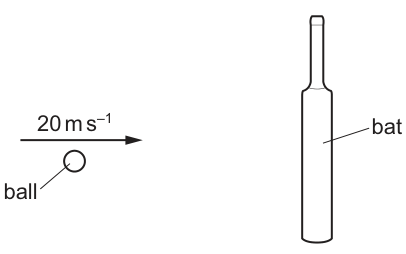
The ball rebounds and leaves the bat with a horizontal velocity of .
What is the change in momentum of the ball?
Options
A
B
C
D
Working
Take motion towards the bat as positive.
Ball rebounds, so :
Magnitude of change in momentum .
Answer
D
D
Background Concept
Momentum is a vector quantity defined by
where is mass and is velocity. Because velocity has direction, momentum also has direction. The change in momentum is
If an object rebounds, its velocity reverses direction, which must be represented by a change of sign when using a chosen positive direction.
Understanding the Question
The ball (mass ) approaches the bat horizontally at . After colliding with the bat, it rebounds and moves horizontally in the opposite direction at . We are asked for the change in the ball's momentum. The options are given in , which is equivalent to .
Approach
- Choose a positive direction (conveniently, towards the bat).
- Compute the initial momentum .
- Because the ball rebounds, take the final velocity as negative and compute .
- Compute and take the magnitude to match the multiple-choice options.
Step-by-Step Reasoning
Choose “towards the bat” as positive.
Initial momentum:
After collision, the ball rebounds, so its velocity is opposite to the original direction:
Final momentum:
Change in momentum:
The question’s answers are positive numbers (magnitudes), so
This corresponds to option D.
Key Takeaways
- Momentum is a vector: reversing direction means the sign of (and ) changes.
- Use , not .
- is the same unit as .
Common Mistakes
- Treating the rebound speed as positive, giving (option B).
- Adding speeds incorrectly without direction (e.g. instead of for a reversal).
- Using the wrong mass unit or forgetting to multiply by mass.
Things to Be Careful About
- State/keep a consistent sign convention for direction.
- When an object rebounds, its final velocity is in the opposite direction, so it must be negative relative to the initial direction.
- Ensure the unit is expressed as or ; they are equivalent.
An isolated object of negligible weight is acted on by two coplanar forces of the same magnitude.
In which diagram is the object in equilibrium?
Options
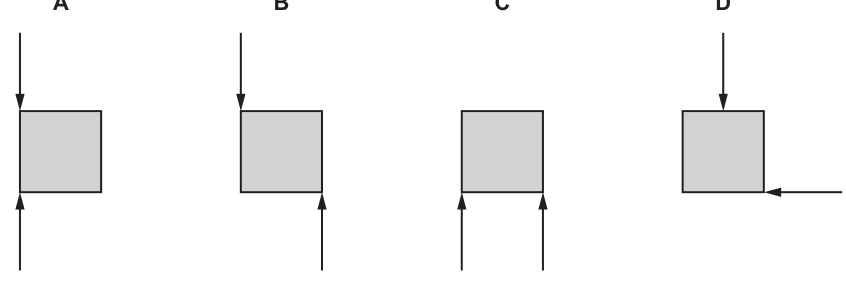
For equilibrium, resultant force and resultant moment must both be zero.
Two equal forces give zero resultant force only if they are opposite in direction, and zero moment only if their lines of action are the same (collinear).
Only diagram A shows equal and opposite forces acting along the same line.
Answer
A
A
Background Concept
An object is in equilibrium only if it has:
- No linear acceleration (translational equilibrium):
- No angular acceleration (rotational equilibrium):
where is the moment (torque) of a force about any point:
and is the perpendicular distance from the chosen pivot to the line of action of the force.
With two forces of equal magnitude, for they must be opposite directions. Even then, if they are not along the same line of action, they form a couple, producing a turning effect (non-zero net moment), so the object will rotate and is not in equilibrium.
Understanding the Question
You are shown four diagrams (A to D) where an isolated object (so no other forces like weight) has two coplanar forces of the same magnitude acting on it.
You must pick the diagram where the object is in complete equilibrium, meaning:
- the two forces cancel as vectors (no resultant force), and
- they do not cause rotation (no resultant moment).
Approach
Check each option using the two equilibrium conditions:
- Resultant force: are the forces equal and opposite as vectors?
- Resultant moment: if they are opposite, are their lines of action collinear? If not, they create a couple.
Step-by-Step Reasoning
-
Option A: One force is upward and the other is downward, equal magnitude, and they act along the same vertical line.
- Resultant force: .
- Resultant moment: since the lines of action coincide, the perpendicular separation is , so no couple and .
- Therefore equilibrium.
-
Option B: Forces are equal and opposite but act along different parallel lines.
- Resultant force is zero, but there is a separation between the lines of action, so a couple exists.
- Net moment is not zero: the couple moment is .
- Not in equilibrium.
-
Option C: Both forces act upward.
- Resultant force is upward, so .
- Not in equilibrium.
-
Option D: One force is downward and the other is horizontal.
- Resultant force is not zero because the forces are not opposite.
- Not in equilibrium.
Hence only A satisfies both conditions.
Key Takeaways
- Equilibrium requires both and .
- Two equal forces give equilibrium only when they are equal, opposite, and collinear.
- Equal and opposite but non-collinear forces form a couple and cause rotation.
Common Mistakes
- Choosing option B because the forces are equal and opposite, forgetting that non-collinear forces produce a turning effect.
- Checking only and ignoring .
- Thinking that forces must act at the centre to avoid rotation; the key is whether their lines of action are the same.
Things to Be Careful About
- “Coplanar” just means the forces lie in the same plane; it does not guarantee equilibrium.
- A couple can exist even when the net force is zero.
- For two-force equilibrium, the special condition is: same magnitude, opposite direction, same line of action.
A uniform beam PQ rests horizontally on a support at point S.
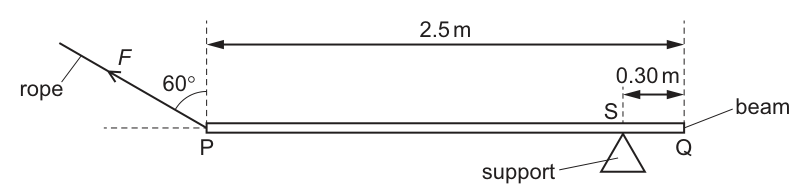
A rope is attached at one end of the beam. The rope is at an angle of to the vertical and exerts a force , in newtons, on the beam.
What is the moment, in N m, of the force about the point S?
Options
A
B
C
D
Working
Distance .
Component of perpendicular to the beam (vertical) is
Moment about :
Answer
A
Background Concept
The moment (torque) of a force about a point is a measure of its turning effect.
Two equivalent ways to calculate the magnitude of the moment about point are:
- Use the perpendicular distance from to the line of action of the force:
- Use the distance vector from to the point of application and the angle between and :
For a horizontal beam, it is often easiest to resolve the force into a component perpendicular to the beam (vertical component) because only that component produces a moment when the line from pivot to application point is along the beam.
Understanding the Question
- The beam is horizontal from to with length .
- The support (pivot for moments) is at point , which is from the right end.
- A rope pulls at with force magnitude along the rope.
- The rope makes an angle of to the vertical.
We are asked for the moment of this force about , in the form (number).
Approach
- Find the horizontal distance from to (the lever arm along the beam), using the given lengths.
- Find the component of perpendicular to the beam (vertical component), using the given angle to the vertical.
- Moment about is (perpendicular component) (distance from to point of application).
Step-by-Step Reasoning
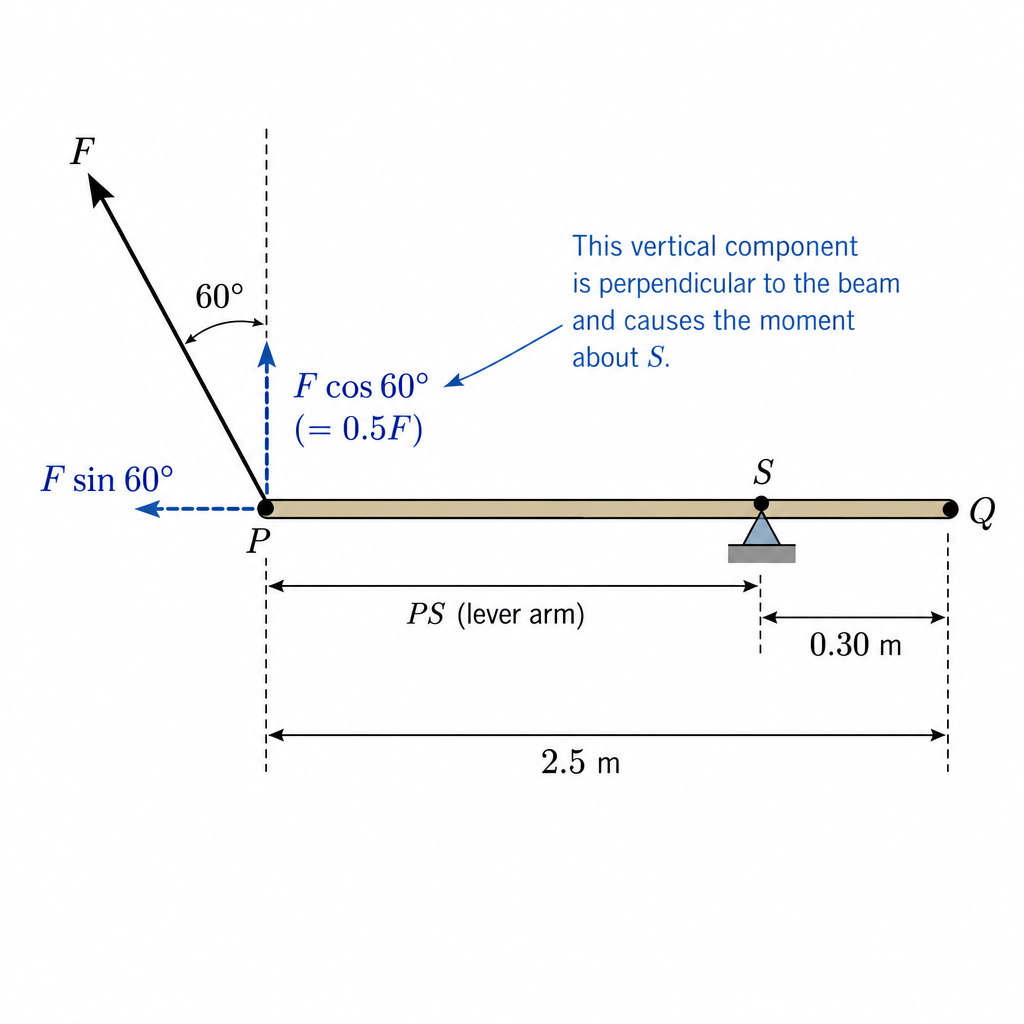
1) Find
Since is between and ,
2) Resolve perpendicular to the beam
The beam is horizontal, so the perpendicular direction is vertical.
The rope is at to the vertical, so the vertical component is adjacent to the angle:
3) Calculate the moment about
The vertical component produces the turning effect with lever arm :
So the correct option is A.
Key Takeaways
- Moment about a point can be found using where is the component perpendicular to the lever arm.
- Always compute the correct distance from the pivot to the point where the force acts.
- Interpreting angles correctly (to vertical vs to horizontal) is crucial for resolving components.
Common Mistakes
- Using as the lever arm instead of .
- Taking the perpendicular component as (this would be correct only if the angle were given to the horizontal, not to the vertical).
- Using the full force rather than the perpendicular component, which overestimates the moment.
Things to Be Careful About
- Angle given is to the vertical, so vertical component is .
- The lever arm is measured from the pivot to the point of application along the beam: .
- Moment unit is (force distance).
The diagram shows the dimensions of an elastic cord used to project a stone. The tension in the cord is when the cord is pulled into the shape shown.
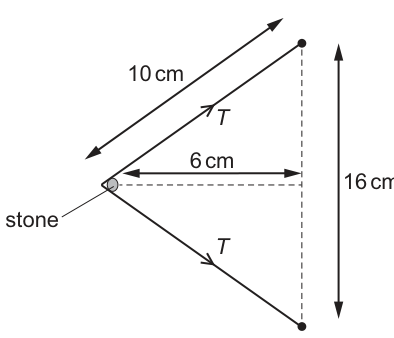
Which force does the elastic cord exert on the stone?
Options
A
B
C
D
Working
Each cord has tension along a -- triangle, so
Horizontal component of one tension:
Vertical components cancel by symmetry, so resultant force on the stone:
Answer
B
B
Background Concept
A force is a vector, so when multiple forces act at a point we add them vectorially (by components). A standard method is to resolve each force into perpendicular components (e.g. horizontal and vertical), add components in each direction, then find the resultant.
If two forces are symmetric about a line, their components perpendicular to that line are equal and opposite (so they cancel), while components along that line add.
Understanding the Question
Two equal segments of elastic cord pull on the stone. Each segment has tension directed along the cord away from the stone. The geometry shows each cord makes a right triangle with horizontal distance and vertical distance (half of ), with cord length . We must find the single force (resultant) the cord system exerts on the stone.
Approach
- Use the -- triangle to get the direction ratios of the tension.
- Resolve one tension into horizontal and vertical components.
- Use symmetry: vertical components cancel; horizontal components add.
- Express the resultant in terms of and match to the options.
Step-by-Step Reasoning
For one cord segment, the direction from the stone to an attachment point has:
- horizontal component
- vertical component
- length
So for the angle the cord makes with the horizontal,
Horizontal component of the tension in one cord:
Vertical component magnitude in one cord would be
but one cord pulls upward and the other downward with equal magnitude, so the vertical components cancel.
Therefore the resultant force on the stone is purely horizontal and equals the sum of the two horizontal components:
This corresponds to option B.
Key Takeaways
- Tension acts along the cord.
- Resolve each tension into components using triangle ratios.
- In symmetric arrangements, one set of components cancels and the other adds.
Common Mistakes
- Adding tensions as without resolving into components.
- Using the wrong ratio (e.g. taking as the horizontal component).
- Forgetting that the vertical components are equal and opposite, so they cancel.
Things to Be Careful About
- The separation means each attachment point is from the centre line.
- Use the correct component: horizontal uses .
- The answer must be in terms of (no need for numerical newtons).
A box of weight is pushed with a horizontal force of along level ground for a distance of .
The box is then lifted at constant velocity through a height of by a vertical force.
What is the total work done on the box by the two forces?
Options
A
B
C
D
Working
Horizontal push:
Lift at constant velocity, so lifting force :
Total:
Answer
B
B
Background Concept
Work done by a force is the energy transferred when the force causes a displacement.
For a constant force causing a displacement at angle to the force,
So only the component of force parallel to the displacement does work.
When lifting an object vertically at constant velocity, the acceleration is zero, so the resultant force is zero. That means the lifting force equals the weight. The work done by the lifting force over height is
which is also equal to the gain in gravitational potential energy.
Understanding the Question
There are two separate stages:
- The box is pushed horizontally along level ground by a horizontal force of through a distance of .
- The box is then lifted vertically through a height of at constant velocity by a vertical force.
We are asked for the total work done on the box by the two applied forces (the horizontal push force and the vertical lifting force). The weight and any frictional forces are not being asked for.
Approach
- Compute work in stage 1 using because the force and displacement are in the same direction.
- For stage 2, use the constant-velocity condition to set the lifting force equal to the weight (), then compute .
- Add the two work values and choose the closest option.
Step-by-Step Reasoning
Stage 1: pushing along the ground
The push is horizontal and the displacement is horizontal, so and .
Stage 2: lifting the box
The box is lifted at constant velocity, so and resultant force is zero.
Therefore lifting force .
Work done by this lifting force through height :
Total work by the two forces
This is closest to , so the correct option is B.
Key Takeaways
- Use and remember only the component parallel to displacement does work.
- “Constant velocity” implies zero acceleration and hence zero resultant force.
- Total work by specified forces is found by adding the work done by each force over its own displacement.
Common Mistakes
- Using the weight for the horizontal stage (weight does no work when displacement is horizontal).
- Forgetting that constant velocity implies lifting force equals weight.
- Adding an extra term for the work done by weight; the question asks for work done by the two applied forces only.
- Choosing option by rounding the wrong way.
Things to Be Careful About
- Check the force and displacement directions (horizontal vs vertical) before applying .
- Use the given weight directly in the lifting stage; you do not need to find mass.
- When selecting an MCQ option, compare your calculated value with the listed answers; here rounds to to 2 s.f.
Which statement about efficiency is correct?
Options
A Efficiency does not have a unit.
B The joule is a unit of efficiency.
C The metre is a unit of efficiency.
D The watt is a unit of efficiency.
Working
Efficiency is defined as
Both numerator and denominator have the same unit (J or W), so the units cancel.
Answer
A
A
Background Concept
Efficiency measures how well a device converts input energy (or power) into useful output energy (or power).
It is defined as a ratio:
The output and input must be the same type of quantity (energy with energy, or power with power). Because it is a ratio of like quantities, efficiency has no unit (it is dimensionless). It may be written as a decimal (e.g. 0.35) or as a percentage (e.g. 35%).
Understanding the Question
You are asked which statement about the unit of efficiency is correct. The options list various SI units (joule, metre, watt) and one statement claiming efficiency has no unit.
Approach
Use the definition of efficiency and check units: if the numerator and denominator are the same physical quantity, their units cancel, leaving no unit.
Step-by-Step Reasoning
Start with the definition (using energy):
Both and are energies measured in joules (J). So the unit would be
So efficiency is dimensionless (no unit).
Equivalently, using power:
Therefore the correct statement is that efficiency does not have a unit.
Key Takeaways
- Efficiency is a ratio of useful output to total input.
- A ratio of the same type of quantity has units that cancel, so efficiency is dimensionless.
- Efficiency can be expressed as a decimal or a percentage.
Common Mistakes
- Thinking efficiency has the unit of energy (J) or power (W) because energy/power appears in the definition.
- Mixing quantities (e.g. useful energy output divided by input power), which would not be a valid efficiency definition.
- Forgetting that “percent” is not an SI unit; it is just an alternative way to express a dimensionless number.
Things to Be Careful About
- Ensure numerator and denominator are the same kind of quantity (energy/energy or power/power).
- If asked for efficiency “in %”, multiply the dimensionless ratio by .
A plane wave of amplitude is incident on a surface of area placed so that it is perpendicular to the direction of travel of the wave. The energy per unit time reaching the surface is .
The amplitude of the wave is increased to and the area of the surface is reduced to .
How much energy per unit time reaches this smaller surface?
Options
A
B
C
D
Working
Intensity .
Amplitude .
Power (energy per unit time) on area is .
So .
Answer
B
B
Background Concept
For a progressive wave, the intensity is the energy transferred per unit time per unit area (i.e. power per unit area). For many waves at a fixed frequency in a given medium,
where is the wave amplitude. If a surface of area is perpendicular to the direction of travel, then the energy per unit time (power) incident on it is
Understanding the Question
Initially, a plane wave of amplitude delivers energy per unit time onto a surface of area (perpendicular to the wave direction). Then two changes happen simultaneously:
- amplitude becomes ,
- area becomes .
We must find the new energy per unit time (new power) reaching the smaller surface, in terms of .
Approach
- Use to find how intensity changes when amplitude doubles.
- Use to include the change in receiving area.
- Combine the two scaling factors and apply them to the original power .
Step-by-Step Reasoning
Let the initial intensity be .
- Doubling amplitude:
- Halving the area:
- Power on the surface:
Initial power:
New power:
So the correct option is .
Key Takeaways
- Use (not ).
- Power received by a surface is , so changing area directly scales the received power.
- Combine multiplicative factors carefully when more than one change occurs.
Common Mistakes
- Assuming intensity is proportional to amplitude () and getting instead of .
- Forgetting to include the change in area and answering .
- Mixing up “energy per unit time” with “energy”: this question is about power.
Things to Be Careful About
- The surface is perpendicular to the wave direction, so the full area intercepts the wave; no cosine factor is needed.
- Apply scaling systematically: amplitude change affects intensity (square law), while area change affects total power linearly.
A steel ball is falling at constant speed in oil.
Which graph shows the variation with time of the gravitational potential energy and the kinetic energy of the ball?
Options
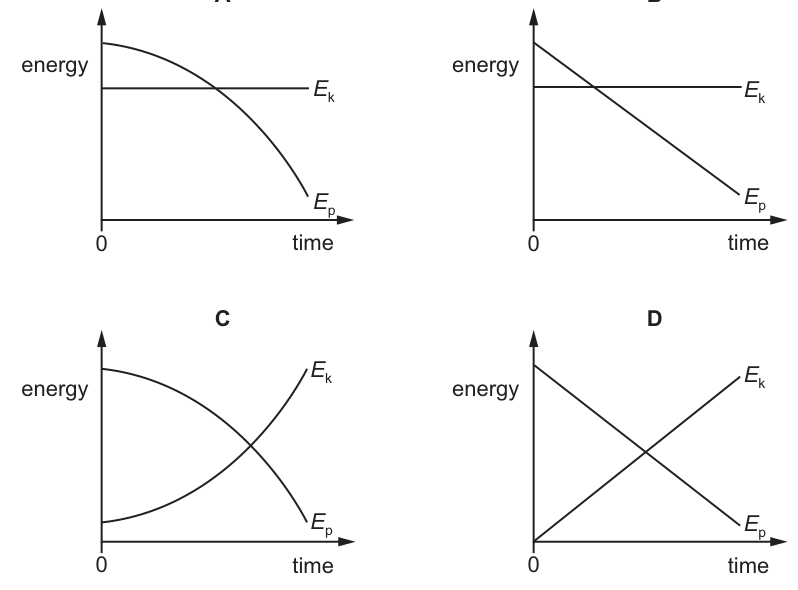
Working
Constant speed → constant, so
is constant (horizontal line).
Also constant → height decreases linearly with time, so
decreases linearly with time.
Answer
B
B
Background Concept
A falling object in a fluid can reach terminal speed: the resistive (drag) force increases until the forces balance, giving zero resultant force and hence zero acceleration.
Two relevant energy expressions are:
where is height above a chosen reference level, and
where is the speed.
Understanding the Question
The steel ball is stated to be falling at constant speed in oil. The question asks which graph correctly shows how and vary with time.
So we need to decide (i) whether changes with time and (ii) how changes with time while the ball descends at constant speed.
Approach
- Use the given condition “constant speed” to decide what happens to and hence to .
- Use constant speed to decide how height varies with time.
- Convert the behaviour of into the behaviour of using .
- Choose the option whose two curves/lines match these behaviours.
Step-by-Step Reasoning
-
Constant speed means constant kinetic energy
If the ball falls at constant speed, then does not change with time. Since
and is constant, must be constant. So the graph must be a horizontal line.
-
Constant speed means height decreases linearly with time
Constant speed implies uniform motion (no acceleration), so the displacement changes at a constant rate:
(taking downward as decreasing ). Therefore decreases linearly with time.
-
Gravitational potential energy decreases linearly with time
Since
and and are constants, is directly proportional to . If decreases linearly with time, then also decreases linearly with time.
-
Match to the options
We need: horizontal (constant) and a straight line sloping down with time. That corresponds to option B.
Key Takeaways
- At terminal speed (constant speed), acceleration is zero and speed is constant, so is constant.
- For uniform motion, displacement (and hence height) changes linearly with time.
- Because , a linear decrease in height gives a linear decrease in gravitational potential energy.
Common Mistakes
- Choosing a graph where increases: that would require the ball to speed up (non-zero acceleration).
- Choosing a curved decrease: that would correspond to changing speed (e.g. accelerating), not constant speed.
- Assuming must always decrease “more and more quickly” because the object is falling, forgetting that here the speed is constant.
Things to Be Careful About
- “Constant speed” is the key phrase: it implies uniform velocity (in magnitude) and therefore a linear change of position with time.
- Even though is constant, still decreases: the lost gravitational potential energy is transferred to internal/thermal energy of the oil and ball due to drag.
When a force of is applied to a spring, the length of the spring is .
When a force of is applied to the same spring, its length is .
The spring obeys Hooke’s law.
What is the spring constant of the spring?
Options
A
B
C
D
Working
Hooke's law: so using two points, .
Answer
D
D
Background Concept
Hooke’s law for a spring states that, provided the spring is within its limit of proportionality, the force applied to the spring is proportional to the extension :
where:
- is the applied force (in ),
- is the extension from the natural (unstretched) length (in ),
- is the spring constant (in ).
If you do not know the natural length, you can still find by using two measurements because the natural length cancels when you take differences.
Understanding the Question
You are told the spring obeys Hooke’s law and given two force–length readings for the same spring:
- At , length is
- At , length is
The question asks for the spring constant , and you must choose from options A–D.
Approach
Because the spring is Hookean, the graph of force against extension is a straight line with gradient .
We are given lengths, not extensions, and the natural length is not given. Use the fact that extension is .
Then for two readings:
So:
Step-by-Step Reasoning
- Find the change in force:
- Find the change in length:
Convert to metres:
- Calculate the spring constant:
- Match to the options: is option D.
Key Takeaways
- For a Hookean spring, is the gradient of the – graph.
- If the natural length is unknown, use differences: .
- Always convert mm to m when you want in .
Common Mistakes
- Using the lengths directly as extensions (forgetting that extension is measured from the natural length).
- Forgetting to convert to , which would make the answer times too large.
- Calculating as using one data point, which is invalid because is not the extension.
Things to Be Careful About
- The unit of must be , so the extension must be in metres.
- Using two points is essential here because the natural length is not provided.
- The linear relationship is guaranteed by “obeys Hooke’s law”, so the slope method is appropriate.
An experiment is carried out using a metal wire to investigate how it responds to a varying tensile force. The cross-sectional area of the wire is constant.
Which graph has a gradient that is equal to the Young modulus of the metal?
Options
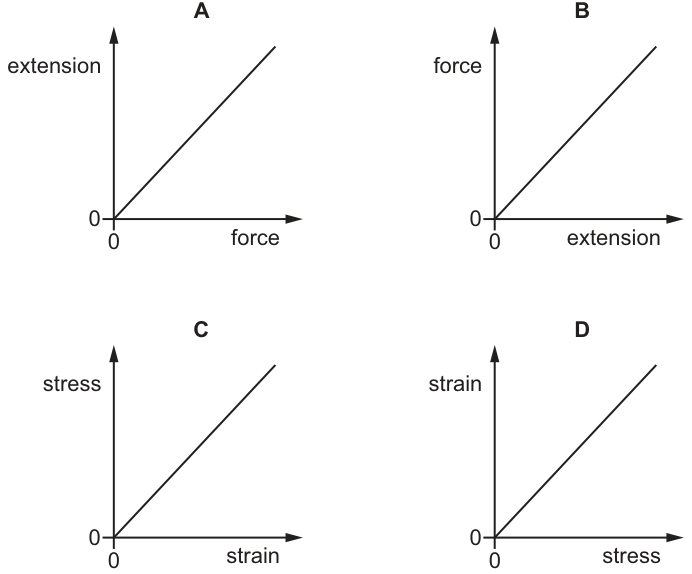
Working
Young modulus
So a graph of stress (y-axis) against strain (x-axis) has gradient
Answer
C
C
Background Concept
Young modulus is a measure of stiffness of a material in the linear (Hooke's law) region. It is defined by
where
- stress is force per unit cross-sectional area:
- strain is fractional extension:
So .
Understanding the Question
You are shown four straight-line graphs through the origin with different choices of axes involving force, extension, stress and strain. The question asks which graph has a gradient numerically equal to the Young modulus of the metal.
Approach
- Start from the definition .
- Recall that the gradient of a graph of against is .
- Match with stress and with strain so that the gradient becomes .
Step-by-Step Reasoning
- Since
a graph plotted with stress on the vertical axis and strain on the horizontal axis will have gradient
- Among the options, the only graph with vertical axis = stress and horizontal axis = strain is option C.
Key Takeaways
- Young modulus is the ratio .
- Graph gradients represent ratios of the plotted variables: .
- Therefore, gradient equals only for a stress (y) vs strain (x) graph.
Common Mistakes
- Choosing strain vs stress (option D): that gradient is .
- Choosing force vs extension (option B): gradient is , the spring constant of that particular wire length, not Young modulus.
- Choosing extension vs force (option A): gradient is .
Things to Be Careful About
- Young modulus uses stress and strain, not force and extension; stress includes division by area and strain includes division by original length.
- Make sure you interpret “gradient” correctly as (not the inverse).
For a wire, Hooke’s law is obeyed for a tension and extension . The Young modulus for the material of the wire is .
Which expression represents the elastic potential energy stored in the wire?
Options
A
B
C
D
Working
For Hooke's law, the – graph is a straight line through the origin, so elastic potential energy is the area under the graph:
Answer
C
C
Background Concept
When a material obeys Hooke’s law, the extension is proportional to the applied tension (force) :
The elastic potential energy stored is the work done in stretching it from to . Work done is the integral of force with respect to extension, which is the area under the force–extension graph:
For Hooke’s law, increases linearly from to , so the area is a triangle.
Understanding the Question
You are told the wire obeys Hooke’s law and has tension and extension . The question asks for the expression for the elastic potential energy stored.
The options include expressions involving the Young modulus , but is a material property (units of Pa) and is not directly the energy.
Approach
Use the definition:
- elastic energy = work done stretching the wire
- work done = area under the – graph
For a Hookean wire this area is a triangle with base and height .
Step-by-Step Reasoning
- Because Hooke’s law is obeyed, the – graph is a straight line through the origin.
- The work done (elastic energy stored) is the area under this line from to .
- That area is a triangle:
So the correct option is C.
(Checks: has units , so it can represent energy; expressions like have units , not energy.)
Key Takeaways
- Elastic potential energy stored = work done stretching.
- For Hooke’s law (linear –),
- Always check units to eliminate impossible options.
Common Mistakes
- Using instead of (forgetting that the force increases from to ).
- Thinking the Young modulus can directly replace the force in the energy expression.
- Not recognising elastic energy as an area under the force–extension graph.
Things to Be Careful About
- in the expression is the final tension at extension , not an average force you invent separately.
- Young modulus relates stress and strain (), and to use it you would also need the wire’s original length and cross-sectional area; none are given, so cannot be sufficient here.
A plane polarised wave has amplitude . The wave is incident normally on a polarising filter.
The transmission axis of the filter is at angle to the plane of polarisation of the incident wave.
What is the amplitude of the wave that emerges from the filter?
Options
A
B
C
D
Working
Only the component of the incident amplitude parallel to the transmission axis is transmitted.
Answer
A
A
Background Concept
For a plane polarised wave, the oscillating electric field (and hence the wave amplitude) has a fixed direction. A polarising filter only transmits the component of the electric field parallel to its transmission axis.
If the incident field amplitude is and the transmission axis makes an angle to the incident plane of polarisation, then resolving the field along the axis gives the transmitted amplitude.
Malus's law is often stated for intensity:
Since intensity is proportional to the square of amplitude (), amplitude itself varies as .
Understanding the Question
You are given a plane polarised wave of amplitude incident normally on a polariser. The polariser axis is at angle to the wave's polarisation direction. The question asks for the amplitude (not intensity) of the emergent wave.
Approach
- Treat the amplitude as the magnitude of the electric field oscillation.
- Resolve this amplitude into a component parallel to the transmission axis.
- The polariser transmits only the parallel component, so the emergent amplitude equals that component.
Step-by-Step Reasoning
Let the incident wave have amplitude along its polarisation direction.
The transmission axis is at angle to this direction, so the component of along the axis is
That is the transmitted amplitude.
Comparing with the options, this corresponds to option A.
Key Takeaways
- A polariser transmits the component of the electric field (amplitude) parallel to its transmission axis.
- Amplitude scales as .
- Intensity scales as because .
Common Mistakes
- Choosing : this is the intensity factor applied incorrectly to amplitude.
- Including : amplitude is not squared; only intensity is proportional to amplitude squared.
Things to Be Careful About
- The question asks for amplitude, not intensity or power.
- Remember the relationship , so if intensity follows , amplitude follows .
- Ensure the angle is between the incident polarisation direction and the transmission axis (as stated).
An electromagnetic wave is travelling through a vacuum.
What could be the wavelength and period of the electromagnetic wave?
Options
| wavelength | period | |
|---|---|---|
| A | ||
| B | ||
| C | ||
| D |
Working
For an electromagnetic wave in vacuum,
Check option C:
Answer
C
C
Background Concept
Electromagnetic (e.m.) waves travel through a vacuum at the speed of light, denoted by :
For any wave,
and since frequency and period are related by
you can combine these to get a very useful form when period is given:
So for an e.m. wave in vacuum, a correct pair must satisfy .
Understanding the Question
You are given four possible pairs of wavelength and period, each written using metric prefixes (pm, ns, m, etc.). The task is to decide which pair could describe an e.m. wave in a vacuum.
That means: convert each wavelength to metres, each period to seconds, and check whether
Approach
- Use (since period is given directly).
- Convert the prefix units into SI units:
- and note large prefixes too: , , .
- Compute and see which option gives .
Step-by-Step Reasoning
Option C is:
- Wavelength:
- Period:
Now calculate the wave speed:
Divide the numbers and subtract powers of ten:
This matches , so option C is consistent with an electromagnetic wave in vacuum.
(For the other options, either the wavelength is extremely large compared with the period or vice versa, giving a speed far from .)
Key Takeaways
- In vacuum, electromagnetic waves must satisfy .
- Always convert prefixes carefully to metres and seconds before substituting.
- Using is quickest when period is given.
Common Mistakes
- Mixing up the prefixes (e.g. treating as instead of ).
- Forgetting that , so a factor like is even smaller in seconds.
- Using but not converting period to frequency correctly (missing that ).
Things to Be Careful About
- Very large prefixes (T, G, M) can change magnitudes drastically:
- and .
- When dividing powers of ten, remember:
- Keep track of units: in and in gives in .
Light of frequency in a vacuum is incident normally on a diffraction grating that contains .
What is the angle between the adjacent second and third order intensity maxima?
Options
A
B
C
D
Working
Wavelength:
Grating spacing:
For order :
Second order:
Third order:
Angle between adjacent maxima:
Answer
A
A
Background Concept
A diffraction grating produces bright intensity maxima (principal maxima) when waves from adjacent slits emerge in phase.
For a grating of slit spacing , at normal incidence, the condition for the th order maximum is:
where:
- is the distance between adjacent lines (slits) on the grating,
- is the angle from the central (zero-order) direction to the maximum,
- is the order number (),
- is the wavelength of the light.
We are given frequency instead of , so we use the wave equation for light in vacuum:
Understanding the Question
The light is incident normally on a grating with .
You must find the angular positions of the second-order maximum () and the third-order maximum (), then calculate the angle between these adjacent maxima, i.e. .
Approach
- Convert the frequency to wavelength using .
- Convert the line density (lines per metre) into slit spacing using .
- Use to find and .
- Subtract to get the separation angle.
Step-by-Step Reasoning
- Wavelength from frequency:
- Grating spacing from line density:
A grating with has
- Second order maximum ():
- Third order maximum ():
- Angle between adjacent 2nd and 3rd order maxima:
So the correct option is .
Key Takeaways
- Convert line density to slit spacing using .
- Convert frequency to wavelength with .
- Use the grating equation for maxima.
- “Angle between adjacent orders” means subtract their angles, not use one angle alone.
Common Mistakes
- Using instead of .
- Forgetting to convert from frequency to wavelength.
- Treating the separation as , which is not valid because is non-linear.
- Mixing degrees and radians on the calculator.
Things to Be Careful About
- Keep (vacuum) since the question specifies vacuum.
- Ensure ; here both and satisfy this, so both orders exist.
- Round at the end; rounding and too early can slightly change the final difference, but it should still match the nearest option.
The siren of a moving police car emits a sound wave with a frequency of . A stationary observer hears sound of frequency . The speed of sound in the air is .
What could be the speed and the direction of movement of the car?
Options
A directly away from the observer
B directly towards the observer
C directly away from the observer
D directly towards the observer
Working
Observed frequency is higher (), so the source is moving towards the observer.
For a moving source and stationary observer:
Answer
B
B
Background Concept
The Doppler effect is the change in observed frequency when there is relative motion between a wave source and an observer.
For sound in air, the speed of sound is measured relative to the air. If the source moves and the observer is stationary, the spacing of the wavefronts in front of the source is reduced (shorter wavelength), so the observer detects a higher frequency.
For a source speed moving towards the observer:
For a source moving away:
where:
- is the emitted frequency,
- is the observed frequency,
- is the speed of sound,
- is the speed of the source (relative to the air).
Understanding the Question
A police car siren emits . A stationary observer hears while the speed of sound is .
You must decide (i) whether the car is moving towards or away, and (ii) which of the two given speeds ( or ) matches the Doppler calculation.
Approach
- Use the fact that to decide the direction (approaching gives higher frequency).
- Substitute into the Doppler formula for a moving source and stationary observer.
- Solve for and compare to the options.
Step-by-Step Reasoning
-
Since , the observed frequency is higher than the emitted frequency, so the source must be moving towards the observer.
-
Use the approaching-source formula:
Substitute values:
- Rearrange to find .
First invert and multiply:
Calculate the right-hand side:
So:
This rounds to and the direction is towards the observer.
Therefore the correct option is B.
Key Takeaways
- If , the source and observer are moving closer together (for sound).
- For a moving source and stationary observer, use (approaching).
- The value of comes from a simple rearrangement of a ratio.
Common Mistakes
- Using the “moving observer” Doppler formula instead of the “moving source” one.
- Choosing “away” even though (receding would give ).
- Sign error: writing in the denominator for approaching.
- Rounding too early and getting closer to .
Things to Be Careful About
- Ensure you are using the speed of sound in air () consistently.
- The formula depends on what is moving (source vs observer); here the observer is explicitly stationary.
- Keep at least 3 s.f. during the algebra before rounding to match the options.
The diagram shows the shape at one instant in time of part of a stretched string as a wave travels along it from left to right.
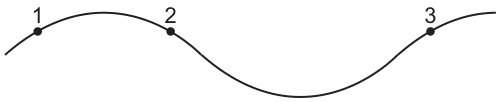
What are the directions of the velocities of the points 1, 2 and 3 on the string at this instant in time?
Options
| point 1 | point 2 | point 3 | |
|---|---|---|---|
| A | |||
| B | |||
| C | |||
| D |
Working
For a wave travelling to the right,
so
Hence the transverse velocity is opposite in sign to the local slope.
Point 1: slope up () (down).
Point 2: slope down () (up).
Point 3: slope up () (down).
Answer
D
D
Background Concept
In a transverse wave on a string, each point of the string oscillates perpendicular to the direction the wave travels. The wave moves to the right, but the string particles have (instantaneous) velocities that are up or down.
A right-travelling wave can be written as
where is the wave speed and describes the shape. Differentiating with respect to time gives the transverse particle velocity:
So for a wave moving to the right, the vertical velocity is the negative of the slope (gradient) times .
Understanding the Question
You are shown a snapshot of the string shape at one instant. Three points (1, 2, 3) are marked:
- point 1 is on an upward slope (approaching a crest),
- point 2 is on a downward slope (leaving the crest),
- point 3 is on an upward slope (after a trough).
The question asks for the directions of the velocities of the points on the string at that instant. Since the wave is transverse, these directions are vertical (up/down), not left/right.
Approach
- Use the fact the wave travels to the right: .
- At each labelled point, decide whether the slope is positive (upward to the right) or negative (downward to the right).
- Reverse the sign to get the direction of the vertical velocity.
- Match the three directions to the table of options.
Step-by-Step Reasoning
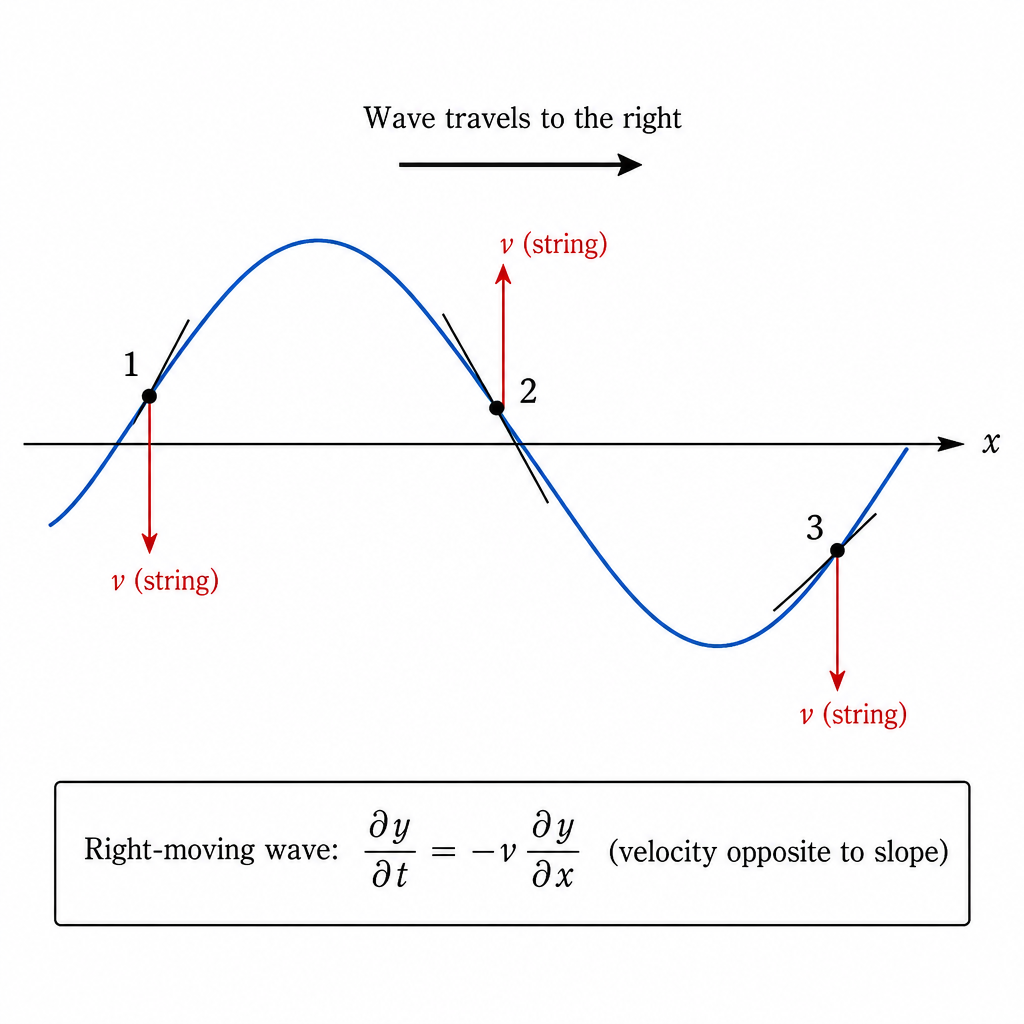
- Point 1 is on an upward slope, so .
Negative means is decreasing with time: the point is moving down.
- Point 2 is on a downward slope, so .
Positive means is increasing with time: the point is moving up.
- Point 3 is again on an upward slope, so .
So point 3 is moving down.
Thus the directions are: point 1 down, point 2 up, point 3 down, which corresponds to option D.
Key Takeaways
- In a transverse wave, particle motion is perpendicular to wave travel.
- For a wave travelling right, : the particle velocity direction is opposite to the local slope.
Common Mistakes
- Choosing left/right arrows: that would describe wave travel, not the string particle velocity.
- Thinking points always move toward equilibrium (e.g. crest always down): not true; the direction depends on whether the wave profile at that location is shifting left/right.
- Forgetting the minus sign in for a right-moving wave.
Things to Be Careful About
- Always use the stated wave direction (left-to-right here). If the wave travelled left, the sign would change:
- Judge the slope at the labelled point, not whether it is near a crest/trough.
- Remember the velocity asked is instantaneous at that time, not an average over a cycle.
Which wave cannot be a longitudinal wave?
Options
A a diffracted wave
B a polarised wave
C a reflected wave
D a stationary wave
Polarisation requires vibrations in one plane only, so it is only possible for transverse waves.
Longitudinal waves oscillate parallel to the direction of travel and cannot be polarised.
Answer
B
B
Background Concept
A longitudinal wave has oscillations parallel to the direction of wave travel (e.g. compressions and rarefactions in sound).
A transverse wave has oscillations perpendicular to the direction of travel (e.g. waves on a string, electromagnetic waves).
Polarisation means restricting the vibrations/oscillations of a wave to one plane. This only makes sense when the vibrations can point in different perpendicular directions (as for a transverse wave). For a longitudinal wave, the oscillation is fixed along the direction of travel, so there is no “plane of vibration” to select.
Understanding the Question
We must choose which of the listed descriptions (diffracted, polarised, reflected, stationary) cannot apply to a longitudinal wave.
So we ask: can longitudinal waves diffract? reflect? form stationary waves? be polarised?
Approach
Use the key fact: only transverse waves can be polarised. Then check that the other phenomena (diffraction, reflection, stationary waves) can occur for longitudinal waves as well.
Step-by-Step Reasoning
- Polarised wave (B): requires transverse oscillations so that only one plane/direction of oscillation is allowed. Longitudinal oscillations are along the propagation direction, so a longitudinal wave cannot be polarised.
- Diffracted wave (A): diffraction is spreading after passing an obstacle/gap; it happens for any wave type, including sound (longitudinal). So a longitudinal wave can be diffracted.
- Reflected wave (C): reflection occurs at boundaries for all wave types; sound reflects as echoes. So a longitudinal wave can be reflected.
- Stationary wave (D): stationary waves form by superposition of two waves of the same frequency travelling in opposite directions; this occurs for sound in tubes (longitudinal). So a longitudinal wave can be stationary.
Therefore the only one that cannot be longitudinal is B.
Key Takeaways
- Polarisation is a property of transverse waves only.
- Diffraction, reflection, and stationary wave formation are general wave phenomena that can apply to both longitudinal and transverse waves.
Common Mistakes
- Thinking “stationary waves are transverse only” (they are not; sound in air columns forms longitudinal stationary waves).
- Confusing “diffracted” with “polarised”: diffraction depends mainly on aperture size relative to wavelength, not on wave type.
Things to Be Careful About
- The question asks cannot be longitudinal, not “is transverse”. Some transverse-only properties (like polarisation) are the key discriminators.
- Remember real examples: sound can reflect, diffract, and form stationary waves, but cannot be polarised.
Microwaves are emitted from two sources at points X and Y. The two waves meet at point Z. The diagram shows the paths of the two waves.
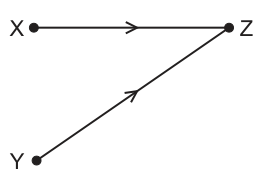
The waves emitted from points X and Y are coherent.
What is a direct consequence of the two waves being coherent?
Options
A There is a constant difference in the path lengths YZ and XZ.
B There is a constant difference in phase between the two waves at Z.
C There is a constant non-zero difference in frequency of the two waves at Z.
D There is a constant non-zero difference in amplitude of the two waves at Z.
Working
Coherent sources emit waves of the same frequency with a constant phase difference.
So, at a fixed point , the phase difference between the two waves arriving remains constant.
Answer
B
B
Background Concept
Two waves (or sources) are coherent if they maintain a constant phase difference and have the same frequency. Coherence is the key condition for producing a stable (time-independent) interference pattern.
- Same frequency means the phase difference does not drift due to one wave “running ahead” of the other.
- Constant phase difference means the relative phase relationship stays fixed.
Understanding the Question
Two microwave waves are emitted from sources at and and meet at point . The question asks for a direct consequence of and being coherent.
You are choosing which statement must be true because the sources are coherent.
Approach
Use the definition of coherence:
- Identify what coherence guarantees (constant phase difference; same frequency).
- Match that to the option statements.
- Reject options that describe things coherence does not guarantee (e.g. path difference, amplitude difference).
Step-by-Step Reasoning
- Coherent sources: waves have the same frequency and a constant phase difference.
- Consider each option:
- A: “constant difference in path lengths and ” — path difference depends on geometry, not on coherence. Coherence does not force any particular path difference.
- B: “constant difference in phase between the two waves at ” — this matches the definition: at a fixed point , the phase difference remains constant in time when sources are coherent.
- C: “constant non-zero difference in frequency” — coherent sources must have the same frequency, so any non-zero frequency difference contradicts coherence.
- D: “constant non-zero difference in amplitude” — coherence does not require amplitudes to be equal or different; amplitude is not part of the definition.
Therefore the correct option is B.
Key Takeaways
- Coherence ≡ same frequency and constant phase difference.
- Coherence enables stable interference because phase relationships do not change with time.
Common Mistakes
- Confusing path difference with phase difference: path difference can be constant due to fixed geometry, but coherence is about phase relationship and frequency.
- Thinking coherence requires equal amplitudes (it does not).
- Missing that “non-zero frequency difference” directly contradicts coherence.
Things to Be Careful About
- At a given point, phase difference can be related to path difference via
but coherence is not the same as “constant path difference”; coherence is a property of the sources, not of the geometry.
- “Constant phase difference” is the key phrase typically rewarded in MCQs on coherence.
What is the unit of resistivity?
Options
A
B
C
D
Working
Using
so
Units:
Answer
D
D
Background Concept
Resistivity (\rho) is a material property that tells you how strongly a material opposes the flow of electric current. For a uniform wire of length (L) and cross-sectional area (A), the resistance (R) is related to resistivity by
Here:
- (R) has unit (\Omega) (ohm),
- (L) has unit (\text{m}),
- (A) has unit (\text{m}^2),
- (\rho) is whatever unit makes the equation homogeneous.
Understanding the Question
You are asked for the SI unit of resistivity (\rho). The multiple-choice options are different combinations of (\Omega) with powers of metres. The quickest way is to rearrange (R = \rho L/A) to find the units of (\rho).
Approach
- Rearrange the resistivity equation to make (\rho) the subject.
- Substitute the units of (R), (A), and (L).
- Simplify the metre powers to get the final unit.
Step-by-Step Reasoning
Start with
Rearrange:
Now insert units:
- (R) in (\Omega)
- (A) in (\text{m}^2)
- (L) in (\text{m})
So
This corresponds to option D.
Key Takeaways
- Use (R = \rho L/A) to connect resistivity to measurable quantities.
- Unit checking (homogeneity) is a fast way to validate or determine units.
- Resistivity has SI unit (\Omega\text{ m}).
Common Mistakes
- Inverting (A) and (L) and getting (\Omega\text{ m}^{-1}) or (\Omega\text{ m}^{-2}).
- Forgetting that (A) is an area, so its unit is (\text{m}^2) (not (\text{m})).
- Confusing resistivity (\rho) (unit (\Omega\text{ m})) with resistance (R) (unit (\Omega)).
Things to Be Careful About
- Keep track of powers of metres: (\text{m}^2/\text{m} = \text{m}).
- The symbol (\rho) is also used for density in other topics; here (\rho) is resistivity (from the electricity syllabus statement (R = \rho L/A)).
A kettle is connected to a mains supply.
What are possible values for the power of the kettle and the current in the kettle?
Options
| power / W | current / A | |
|---|---|---|
| A | 500 | 0.5 |
| B | 500 | 5.0 |
| C | 2500 | 0.1 |
| D | 2500 | 10 |
Working
Use
For option D:
This matches the given current.
Answer
D
D
Background Concept
Electrical power is the rate at which electrical energy is transferred.
If a device has potential difference across it and current through it, then the power converted is
where is in watts (W), in volts (V), and in amperes (A).
Understanding the Question
The kettle is connected to a mains supply. The question asks which pair of values (power, current) could both be correct at the same time.
So each option must satisfy with .
Approach
For each option, check consistency using
If the calculated matches the option’s stated current, that option is possible.
Step-by-Step Reasoning
Take each power value and find the required current at .
- If :
So any correct option with must have . Options A () and B () do not match.
- If :
This matches option D exactly. Option C gives , which is far too small for at .
Therefore the only possible pair is option D.
Key Takeaways
- Use to relate power, potential difference, and current.
- For a fixed supply voltage, higher power means proportionally higher current.
- In MCQs, quickly eliminate options by checking consistency with the governing equation.
Common Mistakes
- Swapping the formula (e.g. using ).
- Forgetting to rearrange correctly: , not .
- Not checking that both numbers in the option satisfy the same equation.
Things to Be Careful About
- Units must be consistent: W, V, A work directly in .
- Mains voltage is given as , so always divide power by to get current.
- Kettles are typically high-power appliances (often a few kW), so currents of several amperes are reasonable at mains voltage.
Which circuit results in output voltage increasing with increasing temperature?
Options
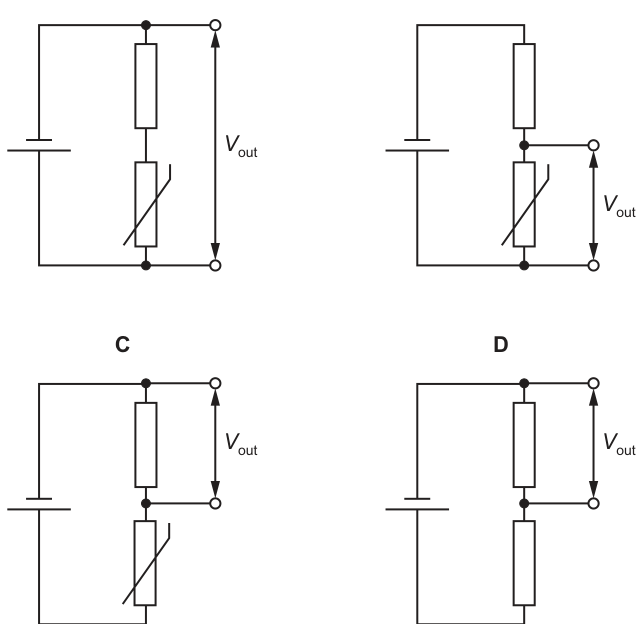
Working
Assume an NTC thermistor, so resistance decreases as temperature increases.
For a series potential divider with supply and fixed resistor :
- If is across the fixed resistor,
As temperature increases, decreases, so decreases and hence increases.
Answer
C
C
Background Concept
A thermistor used at AS level is normally an NTC thermistor (negative temperature coefficient): its resistance decreases when its temperature increases.
A pair of resistors in series across a supply forms a potential divider. If the supply voltage is and the resistors are (top) and (bottom), then the voltage across (output taken from) the bottom resistor is
and the voltage across the top resistor is
Understanding the Question
Each option shows a circuit containing a thermistor (temperature-dependent resistance) and/or fixed resistors. We must choose the circuit for which the measured output voltage increases when temperature increases.
So we need to identify where is measured (across which component(s)) and decide whether that voltage rises or falls as the thermistor resistance changes with temperature.
Approach
- Use NTC behaviour: temperature up down.
- For each circuit, write as a fraction of the supply voltage using potential-divider ideas.
- See whether that fraction increases or decreases as decreases.
Step-by-Step Reasoning
-
Option A: is across the entire series combination connected to the cell, so it is essentially the supply voltage (constant). It does not increase with temperature.
-
Option B: is across the thermistor in series with a fixed resistor .
When temperature increases, decreases, so the fraction decreases. Hence decreases.
- Option C: is across the fixed resistor in series with the thermistor.
When temperature increases, decreases, so the denominator decreases while the numerator is constant. Therefore the fraction increases, so increases. This matches the requirement.
- Option D: only fixed resistors are present, so there is no temperature dependence; is constant.
Therefore the correct circuit is C.
Key Takeaways
- An NTC thermistor has resistance that decreases with increasing temperature.
- In a potential divider, the output across a component is proportional to its resistance fraction of the total series resistance.
- If the variable resistance is in the other part of the divider (i.e. not the one you measure across), the output can increase as that variable resistance decreases.
Common Mistakes
- Assuming the thermistor resistance increases with temperature (confusing NTC with PTC).
- Forgetting that measuring across the whole series combination gives the supply voltage (so it does not change).
- Swapping the divider formula and using or similar incorrect expressions.
Things to Be Careful About
- Cambridge questions nearly always imply an NTC thermistor unless stated otherwise; if it were PTC, the trend would reverse.
- Always identify exactly which component is measured across before applying the potential divider relationship.
- Keep the supply voltage fixed when comparing outputs; only the resistance changes with temperature.
Four resistors, each of resistance , are connected as shown.
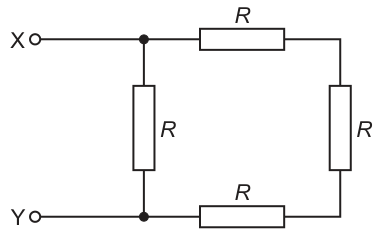
The total resistance between point X and point Y is .
What is the magnitude of the resistance ?
Options
A
B
C
D
Working
Between X and Y there are two branches in parallel:
- left branch: resistance
- right branch: three resistors in series, resistance
So
Given :
Answer
C
C
Background Concept
Resistors combine in two basic ways:
- Series: same current flows through each resistor, so resistances add:
- Parallel: same potential difference across each branch, so conductances add:
For two resistors in parallel, this is often written as
Understanding the Question
You are given a network of four identical resistors (each is ) connected between terminals X and Y. The total (equivalent) resistance between X and Y is . The task is to find the value of , then select the correct option.
The key is to spot that the circuit forms two separate paths between X and Y.
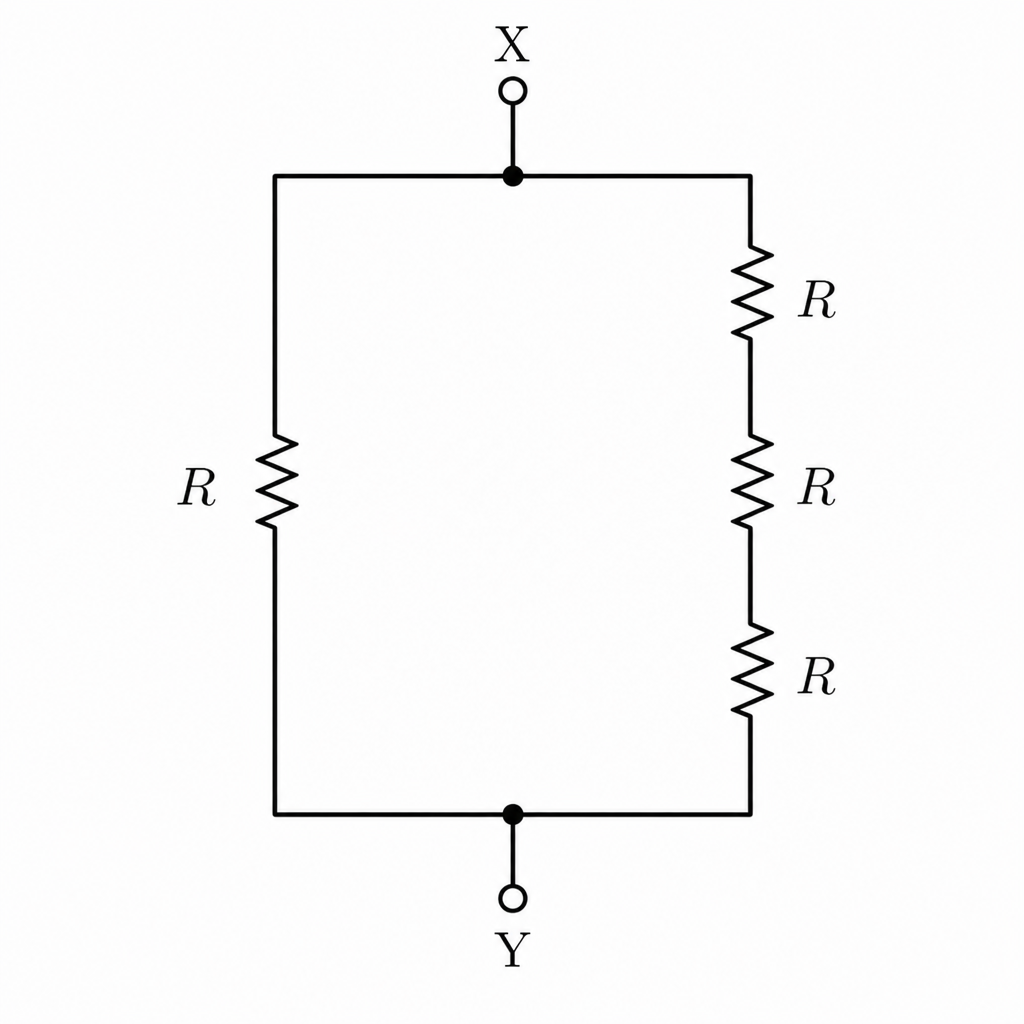
Approach
- Identify the two branches between the same pair of nodes (X and Y): this tells you they are in parallel.
- Simplify the right-hand branch by adding three resistors in series.
- Combine the two branches using the parallel formula.
- Set the equivalent resistance equal to and solve for .
Step-by-Step Reasoning
-
X is directly connected by wire to the top central node, and Y is directly connected by wire to the bottom central node. So the resistance between X and Y is the same as between those two central nodes.
-
Left branch: there is a single resistor directly between the top and bottom central nodes, so that branch has resistance .
-
Right branch: going from the top central node to the bottom central node via the right-hand side, you must pass through:
- the top resistor (top central to top-right),
- the right vertical resistor (top-right to bottom-right),
- the bottom resistor (bottom-right to bottom central).
These are end-to-end with no junctions between them that create alternative paths, so they are in series:
- The two branches ( and ) connect the same two nodes, so they are in parallel:
- Given :
Multiply both sides by :
So the correct option is C.
Key Takeaways
- Look for branches: if there are two distinct paths between the same two nodes, they are in parallel.
- Reduce each branch as far as possible (series sums are usually easiest).
- For two parallel resistances, the product-over-sum formula is quick and reliable.
Common Mistakes
- Treating all four resistors as series or all as parallel without checking the nodes.
- Forgetting that the right-hand side is three resistors in series (using instead of ).
- Making an algebra slip when solving (e.g. dividing by 4 instead of multiplying).
Things to Be Careful About
- Decide series/parallel by nodes and junctions, not by how the diagram “looks”. Two resistors are in series only if the same current must flow through both (no branching at their connection).
- Keep the equivalent resistance expression symbolic (in terms of ) until the end; it reduces errors.
- Ensure the final value matches one of the given options exactly.
A cell with internal resistance is connected to a variable resistor as shown.
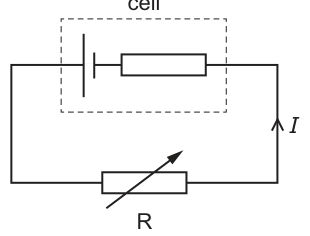
The resistance of is gradually decreased.
How do the current and the terminal potential difference (p.d.) across the cell change?
Options
| current | terminal p.d. across cell | |
|---|---|---|
| A | decreases | decreases |
| B | decreases | increases |
| C | increases | decreases |
| D | increases | increases |
Working
For a cell of e.m.f. and internal resistance in series with :
As decreases, decreases so increases.
Terminal p.d. across cell:
Since increases, increases, so decreases.
Answer
C
C
Background Concept
A real cell can be modelled as an ideal source of e.m.f. in series with an internal resistance . When a current flows, some of the energy per unit charge supplied by the cell is “lost” inside the cell as thermal energy in .
Key relationships:
- Current in a series circuit:
- Terminal potential difference (p.d.) across the cell terminals when delivering current:
(Equivalently, for the external resistor, since the same current flows through it.)
Understanding the Question
You have a single-loop series circuit containing:
- a cell with internal resistance
- a variable resistor
You gradually decrease . The question asks how:
- the circuit current changes, and
- the terminal p.d. across the cell changes.
Approach
Treat and as series resistances.
- Use to see how current depends on .
- Use (or ) to see how terminal p.d. depends on via the change in .
Step-by-Step Reasoning
- Current change
Total resistance in the loop is , so
As is decreased, the denominator decreases, so must increase.
- Terminal p.d. change
The terminal p.d. is
We just found that increases when decreases. Since is constant, the product increases, so the quantity subtracted from gets larger. Therefore decreases.
(You can also see this using : even though increases, is being reduced substantially, and in fact
which clearly gets smaller as gets smaller.)
So: current increases, terminal p.d. decreases (\Rightarrow) option C.
Key Takeaways
- Decreasing external resistance increases current in a series circuit.
- With internal resistance, higher current causes a larger “lost volts” , reducing the terminal p.d.
- Terminal p.d. when supplying current is always less than (unless ).
Common Mistakes
- Stating terminal p.d. increases because current increases (forgetting the term).
- Using (wrong sign for a discharging cell).
- Treating terminal p.d. as equal to e.m.f. even when current flows.
Things to Be Careful About
- The internal resistance is in series with , so total resistance is .
- “Terminal p.d. across the cell” means the p.d. between the external terminals, not across the internal resistance.
- If the question were about a charging cell (current forced into the cell), the sign in would change; here it is delivering current, so .
The diagram shows a circuit with a cell and three resistors with resistances , and .
The cell has negligible internal resistance.
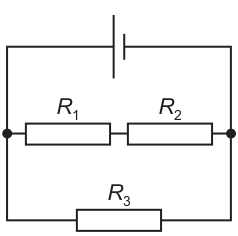
The total resistance of the circuit is .
Which equation for is correct?
Options
A
B
C
D
Working
and are in series, so their combined resistance is
This series combination is in parallel with , so
Answer
D
D
Background Concept
Resistors in series carry the same current, and the potential differences add, so the equivalent resistance is the sum:
Resistors in parallel share the same potential difference, and the currents add. It is therefore the conductances (reciprocals of resistance) that add:
Understanding the Question
The circuit has two main nodes (left and right). Between these same two nodes:
- one branch contains followed by (so these two are in series in that branch),
- another branch contains just .
So the combination is in parallel with . The question asks for the correct equation for the total resistance .
Approach
- Replace and by a single equivalent resistance using the series rule.
- Combine that equivalent resistance with using the parallel rule.
- Match the final expression to one of the options.
Step-by-Step Reasoning
- Since and are end-to-end in the same branch, they are in series:
- The branch containing and the branch containing are connected across the same two nodes, so they are in parallel. Therefore:
- Substitute :
This matches option D.
Key Takeaways
- Identify series/parallel by checking whether components share the same current path (series) or the same pair of nodes (parallel).
- Series: resistances add directly.
- Parallel: reciprocals add.
Common Mistakes
- Adding all three resistances directly (treating the whole circuit as series).
- Writing (forgetting that the reciprocal relation applies to , not ).
- Treating as parallel with just because they are on the same branch.
Things to Be Careful About
- The cell being on a separate branch does not change the resistor-combination logic; only the node connections of the resistors matter.
- In parallel combinations, keep track of the reciprocal carefully:
but instead
Hydrogen and deuterium can be represented by the nuclide symbols and respectively.
What is a difference between hydrogen and deuterium?
Options
A The deuterium atom has twice the number of electrons as the hydrogen atom.
B The deuterium nucleus has a charge, but the hydrogen nucleus has no charge.
C The deuterium nucleus has less mass than the hydrogen nucleus.
D The deuterium nucleus has half the charge per unit mass of the hydrogen nucleus.
Working
For : nucleus has so charge , mass number .
For : nucleus has so charge , mass number .
Charge per unit mass is proportional to .
Hydrogen: ; deuterium: , i.e. half.
Answer
D
D
Background Concept
In nuclide notation :
- (proton number) = number of protons in the nucleus.
- (nucleon / mass number) = total number of nucleons (protons + neutrons).
For a neutral atom, number of electrons = number of protons = .
The nuclear charge is . The nuclear mass is approximately proportional to (each nucleon has mass about ), so the charge per unit mass is proportional to
Understanding the Question
You are told hydrogen and deuterium are and . These are isotopes: same (same element, same nuclear charge) but different (different number of neutrons, different mass).
The question asks which statement correctly describes a difference between them.
Approach
- Read off and for each nuclide.
- Use to compare nuclear charge and (for neutral atoms) electron number.
- Use to compare nuclear mass.
- If needed, compare charge per unit mass via .
Step-by-Step Reasoning
-
Hydrogen (protium) :
- so nucleus has 1 proton, charge .
- so total nucleons = 1, hence 0 neutrons.
- Neutral atom has 1 electron.
-
Deuterium :
- so nucleus has 1 proton, charge .
- so total nucleons = 2, hence 1 neutron.
- Neutral atom has 1 electron.
Now test options:
- A is false: both neutral atoms have 1 electron (same ).
- B is false: both nuclei have charge (same ).
- C is false: deuterium has larger so greater mass, not less.
- D is true: same charge () but deuterium has about twice the nuclear mass, so its charge per unit mass is about half:
Therefore the correct answer is D.
Key Takeaways
- Isotopes have the same proton number (same nuclear charge, same electron number for neutral atoms).
- Different mass number means different number of neutrons and different nuclear mass.
- Charge per unit mass for nuclei scales as .
Common Mistakes
- Thinking deuterium has 2 electrons because it has mass number 2 (confusing with electron number).
- Thinking has “no charge” because it has no neutrons (nuclear charge depends only on protons).
- Assuming “heavier” means “less charge” (charge is unchanged across isotopes).
Things to Be Careful About
- Use for charge and electron count (neutral atom), not .
- “Charge per unit mass” is a ratio: if charge is the same but mass doubles, the ratio halves.
A radioactive sample decays by emitting particles.
The energy released in the decay process is the same for each nucleus that decays, but the particles emitted have a continuous range of kinetic energies.
Which statement explains why the particles are emitted with a continuous range of kinetic energies?
Options
A Some of the energy released is given to the remaining nucleons in the nucleus.
B Some of the energy released is taken by an emitted antineutrino.
C Some of the energy released is used to create the particle.
D Some of the energy released is used to create a new nucleon.
Working
In decay,
The decay releases a fixed energy , but this energy is shared between the emitted electron and the antineutrino (and a small nuclear recoil). Since the antineutrino can take a variable amount of energy, the electron ( particle) has a continuous range of kinetic energies.
Answer
B
B
Background Concept
In nuclear decays, the energy available to the products is set by the mass (rest-energy) difference between the initial and final nuclei. This fixed available energy is often called the decay energy or -value.
In decay a neutron in the nucleus changes into a proton and emits an electron and an antineutrino:
Conservation laws apply:
- Energy conservation: the fixed -value becomes kinetic energy (and any changes in rest energy).
- Momentum conservation: the products share momentum, so the daughter nucleus recoils.
If there are three particles in the final state (electron, antineutrino, recoiling nucleus), the kinetic energy can be shared in continuously many ways, so one particle’s kinetic energy need not be a single value.
Understanding the Question
The question states:
- Each decay releases the same total energy.
- Yet the emitted particles (electrons) have a continuous range of kinetic energies.
You are asked which option explains the continuous range. So we need the physical reason the electron’s kinetic energy is not fixed from decay to decay.
Approach
Identify what particles are produced in decay. Then use energy conservation: if another emitted particle can carry away a variable fraction of the available energy, the electron kinetic energy will vary continuously.
Step-by-Step Reasoning
- Write the decay process:
This shows an antineutrino is emitted along with the electron.
- The decay has a fixed energy release . That energy appears mainly as kinetic energy of:
- the electron,
- the antineutrino,
- and a small recoil kinetic energy of the daughter nucleus.
-
Because both the electron and antineutrino are emitted, the energy can be shared between them in many ways while still satisfying momentum conservation. Therefore the electron can emerge with anything from near zero kinetic energy up to a maximum (when the antineutrino takes very little energy).
-
Hence, the correct explanation is that some energy is taken by the emitted antineutrino, giving the electron a continuous kinetic-energy spectrum.
So the correct option is B.
Key Takeaways
- In decay an antineutrino is emitted: .
- A continuous spectrum occurs because the decay energy is shared variably between the electron and the antineutrino (with slight nuclear recoil).
Common Mistakes
- Choosing recoil of nucleons/nucleus (option A): recoil exists but the defining reason for the continuous spectrum is the extra emitted particle (the neutrino/antineutrino) sharing energy.
- Thinking energy is “used to create the particle” (option C): the electron is a decay product; the fixed -value already accounts for rest-mass changes.
- Thinking a “new nucleon is created” (option D): decay converts a neutron to a proton; it does not create an additional nucleon.
Things to Be Careful About
- State the correct lepton: in decay it is an antineutrino (not a neutrino).
- The question asks for the reason for a continuous range: the key is energy sharing among multiple final particles, not merely that the nucleus recoils.
Which particle is not a fundamental particle?
Options
A electron
B neutrino
C neutron
D top quark
Working
Electron and neutrino are leptons (fundamental). Top quark is a quark (fundamental). A neutron is a baryon made of three quarks.
Answer
C
C
Background Concept
In the A-Level model, fundamental (elementary) particles are those not known to have any smaller constituents. These include:
- Quarks (e.g. up, down, top, etc.)
- Leptons (e.g. electron, neutrinos)
Hadrons are composite particles made from quarks:
- Baryons: 3 quarks (e.g. proton, neutron)
- Mesons: quark + antiquark
Understanding the Question
You are given four named particles and asked which one is not fundamental. So we check whether each is an elementary quark/lepton, or a composite hadron.
Approach
- Identify whether each option is a lepton, quark, or hadron.
- Recall that hadrons are made of quarks, so they are not fundamental.
- Choose the particle that is composite.
Step-by-Step Reasoning
- Electron: a lepton → treated as fundamental.
- Neutrino: a lepton → treated as fundamental.
- Top quark: a quark → fundamental.
- Neutron: a baryon (hadron) consisting of three quarks (specifically ) → composite, so not fundamental.
Therefore the correct option is the neutron.
Key Takeaways
- Fundamental particles here are quarks and leptons.
- Neutrons and protons are baryons, made of three quarks, so they are not fundamental.
Common Mistakes
- Thinking “neutron is in the nucleus, so it must be fundamental” (it is not; it is made of quarks).
- Mixing up hadrons and leptons: leptons (electron, neutrino) are elementary; hadrons (neutron) are composite.
Things to Be Careful About
- At this syllabus level, you are expected to treat quarks and leptons as fundamental, and use the quark model (baryon = three quarks) to identify composite particles.
- Don’t confuse neutron (particle) with neutrino (lepton); the similar words often cause incorrect selection.
What is the charge of an anti-top quark?
Options
A
B
C
D
Working
Top quark has charge .
Antiquark has opposite charge, so anti-top has charge .
Answer
A
A
Background Concept
Quarks carry fractional electric charges in units of the elementary charge magnitude .
- Up-type quarks () have charge .
- Down-type quarks () have charge .
For any particle and its antiparticle, all additive quantum numbers (including electric charge) have the same magnitude but opposite sign. So an antiquark has the negative of the quark’s charge.
Understanding the Question
The question asks for the electric charge of an anti-top quark. The options are the possible fractional charges in multiples of . We need the known charge of a top quark and then reverse the sign.
Approach
- Recall the charge of the top quark ().
- Use the antiparticle rule: .
- Match to the option given.
Step-by-Step Reasoning
- The top quark is an up-type quark, so
- The anti-top quark has the opposite charge:
- This corresponds to option A.
Key Takeaways
- Up-type quarks (): .
- Down-type quarks (): .
- Antiparticles have charges with the same magnitude but opposite sign.
Common Mistakes
- Mixing up up-type and down-type quark charges.
- Forgetting to change the sign when moving from quark to antiquark.
- Confusing (the magnitude of elementary charge) with the electron’s charge (which is ).
Things to Be Careful About
- The symbol in the options is a positive magnitude; the sign is shown explicitly in front.
- Only the sign changes between quark and antiquark; the fractional value ( here) stays the same.
Your score so far
Answer a question to start scoring
Your marks add up here as you work through the paper.