Physics 9702/22 — February/March 2024
Cambridge AS Level · AS Level Structured Questions · worked solutions for every part, with the mark scheme
Topics Waves · Dynamics · Particle Physics · Physical Quantities and Units · Kinematics · Forces, Density and Pressure · +4 more
Table 1.1 lists some SI quantities. Complete the table by indicating with a tick (✓) which rows are SI base quantities.
Table 1.1
| quantity | base quantity |
|---|---|
| current | |
| energy | |
| force | |
| mass |
Answer
SI base quantities are:
- current: ✓
- mass: ✓
(energy and force are derived quantities)
current and mass
Background Concept
SI base quantities are a small set of fundamental quantities chosen by convention, each with its own base unit. All other physical quantities are derived from these base quantities using definitions (e.g. force from ).
The SI base quantities are: length, mass, time, electric current, temperature, amount of substance, luminous intensity.
Understanding the Question
You are given four quantities (current, energy, force, mass) and must indicate which ones are SI base quantities (not which ones have SI units).
Approach
Compare each listed quantity with the SI base list. If it is one of the seven base quantities, tick it; otherwise it is derived.
Step-by-Step Reasoning
- Current: electric current is one of the SI base quantities (unit: ampere, ) so it is ticked.
- Energy: energy is derived (e.g. ), so it is not ticked.
- Force: force is derived (defined by ), so it is not ticked.
- Mass: mass is an SI base quantity (unit: kilogram, ) so it is ticked.
Key Takeaways
- Base quantities are the starting point; derived quantities are built from definitions.
- Knowing the seven SI base quantities avoids confusion between “SI unit” and “SI base quantity”.
Common Mistakes
- Ticking force because newton () is an SI unit; it is SI, but derived.
- Ticking energy because joule () is an SI unit; it is SI, but derived.
Things to Be Careful About
- The question asks for SI base quantities, not quantities with SI units.
- Only the seven named base quantities count as base quantities.
Working
Using definition of power:
Work done:
and
So
Units:
Answer
kg m^2 s^-3
Background Concept
Power is the rate of doing work (or the rate of energy transfer).
where is work done (energy transferred) and is time.
To express a quantity in SI base units, we rewrite it using definitions until only base quantities remain: mass (), length (), time (), current (), etc.
Understanding the Question
You are asked to find the SI base units of power. So the final answer must be written only using , , (and others if needed). For power, it will end up using , and .
Approach
- Start from the definition .
- Replace using .
- Replace using .
- Substitute the base units for , , , and , then simplify.
Step-by-Step Reasoning
Start with
Work done is defined by
so
Force is defined by Newton's second law:
so
Now put in base units:
- mass has unit
- acceleration has unit
- distance has unit
- time has unit
Hence
Combine the factors and the factors:
Key Takeaways
- Use definition chains to reduce derived quantities to base quantities.
- Power in base units is .
Common Mistakes
- Writing just (watt). The question asks for base units, not the named derived unit.
- Missing one factor of time and getting (that is energy, joule).
Things to Be Careful About
- Keep track of the extra division by in .
- Acceleration is , not .
A light meter is used to measure the intensity of light in a classroom. Daylight is incident normally on the sensor of the meter. The sensor has an area of . The reading on the meter is .
Calculate the power of the daylight incident on the sensor.
power = ______
Working
Intensity:
Area:
So
Answer
0.21 W
Background Concept
Intensity is defined as power per unit area:
where:
- is intensity in
- is power in
- is area in
Rearranging gives .
Understanding the Question
A light meter sensor of area receives daylight normally (so the relevant area is just the sensor area). The meter reads an intensity of . You must calculate the total power incident on the sensor.
Given:
Find:
- in watts.
Approach
- Convert the area from to .
- Use .
- Round suitably (typically 2 s.f. here, matching the area given to 2 s.f.).
Step-by-Step Reasoning
Start from
Convert area:
So
Now substitute:
Rounded:
Key Takeaways
- Intensity is power per unit area: .
- Converting to requires squaring the length conversion.
Common Mistakes
- Using (forgetting to square the conversion).
- Leaving the area in while using in , causing inconsistent units.
Things to Be Careful About
- Because the light is incident normally, you do not need to use any cosine factor; the effective area is just the sensor area.
- Ensure the final unit is (since ).
- Significant figures: (2 s.f.) and (likely 2 or 3 s.f. depending on context), so is appropriate.
Answer
Acceleration is the rate of change of velocity with time (change in velocity per unit time).
Rate of change of velocity with time.
Background Concept
Acceleration describes how quickly velocity changes. Because velocity is a vector, acceleration is also a vector.
Mathematically, average acceleration is
and instantaneous acceleration is
Understanding the Question
You are asked to define acceleration, so you need a clear statement linking acceleration to the change of velocity over a time interval.
Approach
Give the standard Cambridge definition: “rate of change of velocity with respect to time” (or equivalent wording).
Step-by-Step Reasoning
- State that acceleration depends on the change in velocity (not speed) and the time taken.
- Phrase it as “change in velocity per unit time” or “rate of change of velocity with time”.
Key Takeaways
- Acceleration measures how velocity changes with time.
- Using “velocity” (vector) rather than “speed” (scalar) is the safest definition.
Common Mistakes
- Saying “rate of change of speed” (only correct for straight-line motion with no direction change).
- Omitting “per unit time” / “with time”.
Things to Be Careful About
- In many exam questions direction matters, so remember acceleration is a vector quantity.
An Olympic diver stands on a platform above a pool of water, as shown in Fig. 2.1.
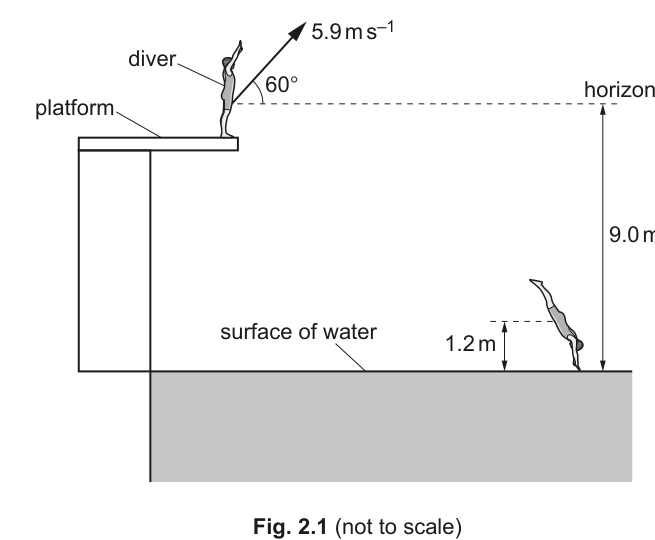
When the diver is on the platform his centre of gravity is a vertical height of above the surface of the water. The diver jumps from the platform with a velocity of at an angle of to the horizontal.
Air resistance is negligible.
When the diver hits the surface of the water, his centre of gravity is a vertical height of above the surface of the water.
Calculate the speed of the diver at the instant he hits the surface of the water.
speed = ______
Working
Vertical drop of centre of gravity:
With negligible air resistance,
Answer
14 m s^-1
Background Concept
For motion under gravity with air resistance negligible, the acceleration is constant and equal to vertically downwards. A very useful result is that the final speed depends on the change in vertical height and not on the direction of launch.
You can show this either by energy conservation or by kinematics:
- Energy: loss of gravitational potential energy becomes gain in kinetic energy.
- Kinematics: for the vertical component, , while the horizontal component stays constant; combining gives .
Understanding the Question
The diver’s centre of gravity starts above the water surface and is above the water surface at impact. So the centre of gravity has fallen by . The diver leaves the platform at speed at to the horizontal. You must find the speed (magnitude of velocity) just as he hits the water.
Approach
Use a method that avoids needing time:
- Find the vertical drop .
- Use
- Take the square root to get .
Step-by-Step Reasoning
- Vertical drop:
- Apply the constant-acceleration relation for speed change due to gravity (equivalently energy conservation):
- Substitute , , :
- Hence
Key Takeaways
- With no air resistance, final speed depends on initial speed and vertical drop only.
- The launch angle is not needed if you use energy or the combined-speed kinematics result.
Common Mistakes
- Using instead of .
- Trying to find time first (unnecessary and often leads to algebra errors).
- Using (needs time) or mixing vertical and horizontal components incorrectly.
Things to Be Careful About
- Take the drop as positive in (here ).
- Quote the final speed to sensible significant figures (typically 2 s.f. here).
The diver in (b) enters the water and decelerates.
Describe and explain the variation of the viscous drag force acting on the diver in the water as he moves downwards.
Answer
The viscous drag force acts upwards (opposite to the downward motion). It is greatest just after entering the water when the speed is largest, and it decreases as the diver slows down because drag depends on speed.
Upwards; largest at high speed on entry, then decreases as speed decreases.
Background Concept
Drag (resistive) forces oppose motion through a fluid. For viscous drag at relatively low speeds (laminar flow), a common model is
At higher speeds (turbulent flow), a common model is
In both cases, the key idea is: bigger speed (\Rightarrow) bigger drag, and drag acts opposite to the velocity.
Understanding the Question
After the diver enters the water, he is moving downward but slowing down (decelerating). You must describe how the viscous drag force changes as he moves downward and explain why.
Approach
- State the direction of drag (opposite to motion).
- Link drag magnitude to speed.
- Use the fact that the diver slows down in water to explain the variation.
Step-by-Step Reasoning
- Immediately after entry, the diver’s downward speed is large, so the upward drag force is large.
- The drag force contributes to an upward resultant force, so the diver decelerates.
- As the diver slows, his speed gets smaller.
- Since viscous drag depends on speed (typically ), the drag force decreases as he continues moving downwards.
Key Takeaways
- Drag always acts opposite to the direction of motion.
- Drag magnitude reduces as speed reduces (for both and models).
Common Mistakes
- Saying drag acts downwards (wrong: it opposes motion).
- Saying drag increases as he slows down (reverses the dependence on ).
Things to Be Careful About
- The question specifies “viscous drag”, so it is safest to mention dependence on speed (not on depth or mass).
The diver has a volume of . The density of the water is .
Show that the upthrust acting on the diver when he is entirely underwater is .
Working
For a fully submerged object,
Answer
740 N
Background Concept
Archimedes’ principle: the upthrust (buoyant force) on an object in a fluid equals the weight of the fluid displaced.
For a fully submerged object of volume in a fluid of density :
Understanding the Question
You are given the diver’s volume and water density . When the diver is entirely underwater, he displaces his full volume of water. You must show the upthrust is .
Approach
Use and substitute the given values, then round to match .
Step-by-Step Reasoning
Substitute:
Calculate:
so
Key Takeaways
- Upthrust depends on fluid density and displaced volume, not on the object’s mass.
- Fully submerged means displaced volume equals object volume.
Common Mistakes
- Using the diver’s mass instead of volume.
- Using of the diver rather than of the water.
Things to Be Careful About
- Keep units consistent: in and in gives in newtons.
At a particular instant when the diver is entirely underwater his horizontal velocity is zero. The viscous drag force acting on him at this instant is vertically upwards. The diver has mass .
Determine the magnitude and direction of the acceleration of the diver.
acceleration = ______
direction ______
Working
Upward forces:
Weight:
Resultant force upward:
Newton’s second law:
Answer
12 m s^-2 upwards
Background Concept
When an object is in a fluid, the vertical forces can include:
- weight (downwards),
- upthrust (upwards),
- drag (opposes motion, so here upwards if the diver is moving down).
Newton’s second law links resultant force to acceleration:
The direction of the acceleration is the direction of the resultant force, not necessarily the direction of motion.
Understanding the Question
At the stated instant the diver is entirely underwater. We are told:
- horizontal velocity is zero (so consider vertical forces only),
- drag force is vertically upwards,
- upthrust is upwards (from part (ii)),
- mass is so weight is downwards.
We must find the magnitude and direction of the diver’s acceleration.
Approach
- Draw a vertical free-body diagram and choose a positive direction (e.g. upwards).
- Add upward forces and subtract downward forces to get the resultant .
- Use .
- The sign tells you the direction.
Step-by-Step Reasoning
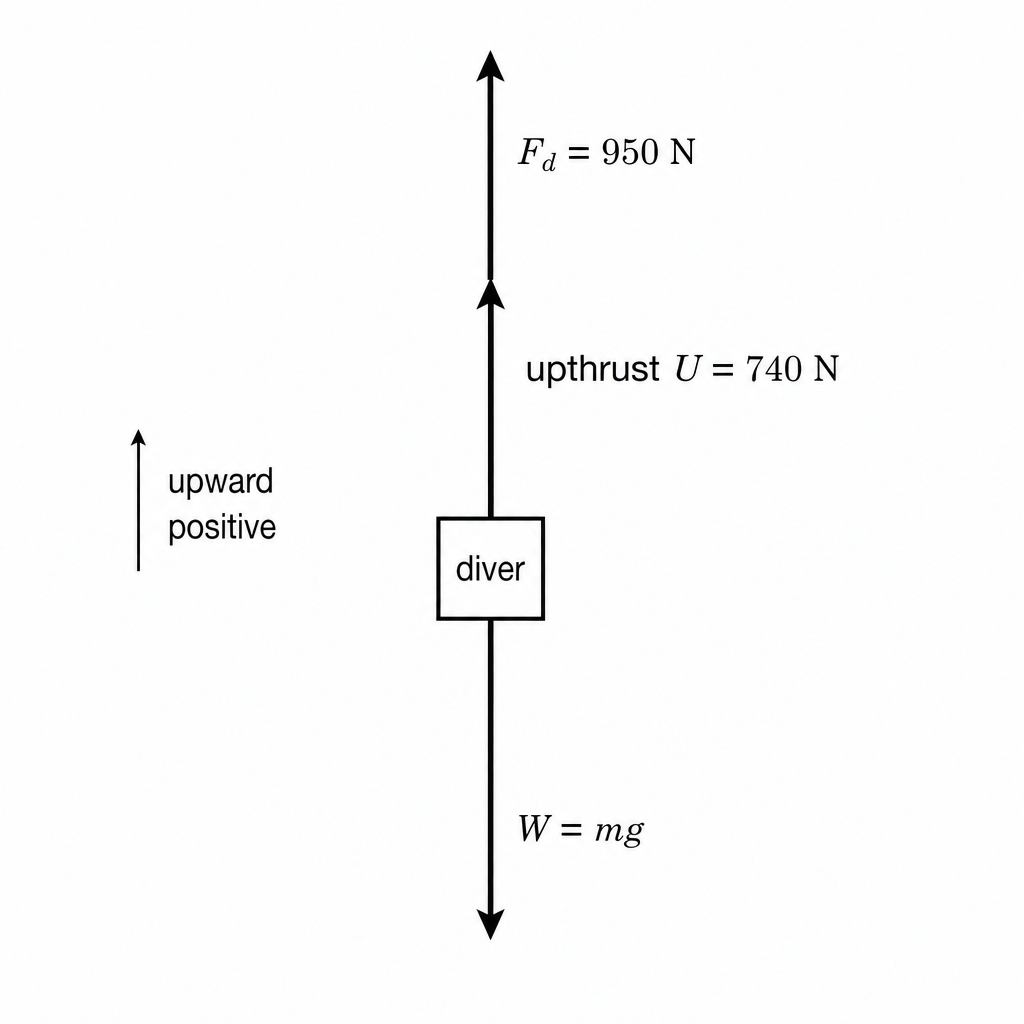
-
Take upward as positive.
-
Upward forces:
- upthrust ,
- drag .
So total upward force:
- Downward force (weight):
- Resultant force (upwards):
- Apply Newton’s second law:
Since is upwards, the acceleration is upwards.
Key Takeaways
- Always resolve forces and assign directions before using .
- An object can be moving downwards while accelerating upwards (that means it is slowing down).
Common Mistakes
- Forgetting to include upthrust.
- Taking weight as instead of .
- Adding weight to the upward forces (sign error).
- Giving only a magnitude with no direction.
Things to Be Careful About
- State the acceleration direction explicitly (upwards/downwards).
- Keep a consistent sign convention throughout; a quick free-body diagram prevents most errors.
A thin metal wire X, of diameter , is used to suspend a model planet, as shown in Fig. 3.1.
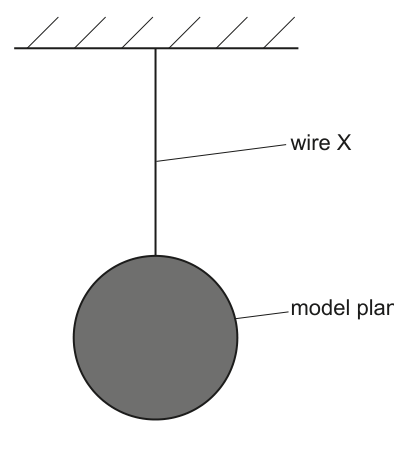
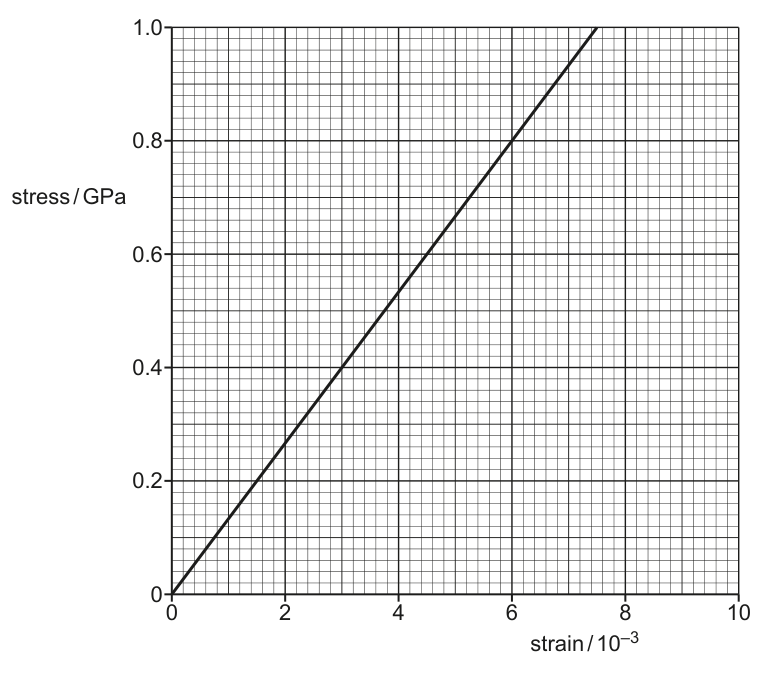
The variation with strain of the stress for wire X is shown in Fig. 3.2.
The strain in X is .
Use Fig. 3.2 to calculate the force exerted on the wire by the model planet.
force = ______
Working
From Fig. 3.2, straight line through .
For strain ,
Wire diameter , so
Answer
7.6 × 10^2 N
Background Concept
Stress and strain for a wire are defined by
and
where is the tensile force, is the cross-sectional area, is the extension and is the original length.
In the Hooke’s law (linear) region,
so a stress–strain graph is a straight line through the origin whose gradient is the Young modulus .
Understanding the Question
You are given the strain in wire X and a stress–strain graph for X. You must:
- use the graph to find the stress corresponding to this strain,
- use to find the force exerted by the model planet.
The diameter of the wire is given, so the cross-sectional area can be calculated.
Approach
- Read (or calculate by proportional scaling) the stress at strain from the straight-line graph.
- Convert the stress from to .
- Compute the wire area using .
- Rearrange to .
Step-by-Step Reasoning
- Use the straight line on the graph
The graph passes through and the origin, so stress is directly proportional to strain.
Therefore,
Convert units:
- Find cross-sectional area
With diameter , radius .
- Calculate force
Rearrange :
Key Takeaways
- In the linear region, you can scale values directly on a stress–strain graph because stress strain.
- Stress must be in (not ) when using .
- Cross-sectional area of a circular wire comes from the diameter: .
Common Mistakes
- Using the diameter as the radius when calculating area.
- Forgetting to convert to (a factor of ).
- Reading the x-axis incorrectly: it is labelled , so the value 5.4 on the axis corresponds to .
Things to Be Careful About
- Keep consistent powers of ten in the area calculation: .
- Quote the final force to sensible significant figures (limited here by the graph reading and given data).
The elastic potential energy of X is .
Calculate the original length of the wire before the model planet was attached.
original length = ______
Working
For Hooke’s law behaviour,
and
So
Answer
0.15 m
Background Concept
For a wire that obeys Hooke’s law, the force is proportional to extension, so a force–extension graph is a straight line through the origin. The elastic potential energy stored is the area under this graph:
Strain links extension to original length:
Understanding the Question
You are told the elastic potential energy stored in wire X when the planet is attached, and you already know the strain (and from part (i) you can know the force). The question asks for the original length before the load was attached.
So you need to connect energy extension, and extension original length via strain.
Approach
- Use to express extension in terms of energy and force.
- Replace by .
- Rearrange to get .
Step-by-Step Reasoning
- Start from the elastic energy formula:
- Use the definition of strain:
- Substitute into the energy expression:
- Rearrange for :
- Substitute values (, strain , and from part (i)):
Key Takeaways
- For Hooke’s law, elastic energy is triangular area: .
- Strain is a ratio: .
- Combining these gives .
Common Mistakes
- Using (rectangle area) instead of the triangular area .
- Mixing up and (original length vs extension).
- Forgetting to use the force from part (i), or using stress instead of force.
Things to Be Careful About
- The energy formula also works, but only if you first find ; here is direct.
- Use consistent significant figures: the given energy suggests an answer around 2 s.f.
Wire X is replaced by a new wire, Y, with the same original length and diameter but double the Young modulus of X. Wire Y also obeys Hooke’s law.
On Fig. 3.2, draw a line representing the variation with strain of the stress for Y.
Answer
Since and , the stress–strain line for Y is a straight line through the origin with twice the gradient of X.
E.g. it passes through (i.e. on the given axes).
Straight line through origin with twice the gradient (e.g. through (4.0, 1.0) on the axes).
Background Concept
In the Hooke’s law region, stress and strain are related by
On a graph of stress (y-axis) against strain (x-axis), the gradient is the Young modulus .
- Larger means a steeper line (more stress needed for the same strain).
- If the material obeys Hooke’s law, the line passes through the origin.
Understanding the Question
Wire Y has:
- the same diameter and original length as X (so the graph axes/definitions are unchanged),
- double the Young modulus of X,
- still obeys Hooke’s law.
You must draw what its stress–strain graph would look like on the same axes.
Approach
- Use the fact that the gradient of the stress–strain graph is .
- Doubling means doubling the gradient.
- Keep the line through the origin (Hooke’s law).
- Choose a convenient point within the displayed axes to define the new line accurately.
Step-by-Step Reasoning
For wire X, the line goes through .
If wire Y has , then for any given strain,
So when , wire Y would reach at half the strain:
Therefore, on the provided axes (labelled ), you can draw a straight line from the origin to the point .
Key Takeaways
- Young modulus is the gradient of a stress–strain graph.
- Doubling Young modulus doubles the gradient (steeper line).
- Hooke’s law implies a straight line through the origin.
Common Mistakes
- Drawing a curve (Hooke’s law requires a straight line).
- Shifting the line up/down (it must still pass through the origin).
- Keeping the same point and just “making it steeper” by eye; a correct reference point such as makes the doubling precise.
Things to Be Careful About
- The x-axis scale is , so the plotted x-coordinate for is 4.0.
- If you extend beyond the y-axis maximum, it’s still the same straight line; but using the point keeps the required drawing within the given axes.
A nucleus P undergoes -decay to form nucleus Q.
Answer
In -decay, decreases by and decreases by :
and
Background Concept
In any nuclear decay equation, two quantities are conserved:
- Nucleon number (mass number) : total number of protons + neutrons.
- Proton number (atomic number) : number of protons.
An particle is the nucleus of a helium atom:
So in -decay, the parent nucleus loses 2 protons and 2 neutrons:
Understanding the Question
You are given a parent nucleus and told it undergoes -decay to form nucleus . You must fill in the nuclide notation for:
- the daughter nucleus
- the emitted particle
so that and balance on both sides.
Approach
- Write the particle as .
- Use conservation of and to find the values for nucleus :
Step-by-Step Reasoning
Conservation of nucleon number:
Conservation of proton number:
So the completed equation is:
Key Takeaways
- In nuclear equations, always conserve and .
- -decay reduces by and by .
Common Mistakes
- Writing the particle incorrectly (e.g. mixing up and ).
- Subtracting from instead of .
- Not checking that both and balance after filling in the blanks.
Things to Be Careful About
- Ensure the nuclide notation is in the correct format .
- Both conservation conditions must be satisfied; matching only (or only ) is not enough.
Answer
The total momentum of a system remains constant provided no resultant external force acts on the system (i.e. the system is isolated).
Total momentum remains constant in an isolated system (no resultant external force).
Background Concept
Linear momentum is defined as:
Newton’s second law can be written as:
If the resultant external force on a system is zero, then , so the total momentum of the system does not change.
Understanding the Question
You are asked to state the principle (not to calculate anything). The mark is typically for:
- stating momentum is conserved (total momentum before = total momentum after)
- stating the condition: no resultant external force / isolated system
Approach
Give a precise definition:
- Mention “total momentum” of the system.
- Mention it remains constant (before = after).
- Include the condition of no external resultant force.
Step-by-Step Reasoning
A complete statement is:
- Consider a system of interacting objects.
- If no resultant external force acts on the system, the only forces are internal.
- Therefore the total momentum of the system is unchanged:
Key Takeaways
- Momentum conservation applies to a system.
- It requires no resultant external force.
Common Mistakes
- Forgetting the condition (no external force).
- Saying “momentum is conserved” without specifying “total momentum of the system”.
- Confusing momentum with energy (they are different conserved quantities under different conditions).
Things to Be Careful About
- Use the phrase “resultant external force” (or “isolated system”) to secure the condition mark.
- Don’t talk about “forces are equal” unless linking to the system idea; equal-and-opposite internal forces alone is not the full principle.
Before the decay, nucleus P has a speed of . After the decay, nucleus Q is stationary.
Calculate the speed of the alpha particle after the decay.
speed = ______
Working
Conservation of momentum:
With :
Using :
Answer
1.7 × 10^7 m s^-1
Background Concept
Momentum is conserved in a system if there is no resultant external force. For a decay event, we treat the parent nucleus and the decay products as a system; the forces involved in the decay are internal.
Momentum is a vector quantity:
So conservation means:
For nuclei, the mass is approximately proportional to nucleon number (in atomic mass units), so mass ratios can be taken as ratios of values when high precision is not required.
Understanding the Question
Given:
- Before decay: nucleus is moving at .
- After decay: nucleus is stationary, so .
- Decay is -decay, so an particle (mass number ) is emitted.
Find: speed of the particle, .
The statement “ is stationary” simplifies the momentum equation a lot because .
Approach
- Write momentum conservation for the system: parent momentum = sum of product momenta.
- Substitute .
- Use the mass ratio (from mass numbers).
- Solve for .
Step-by-Step Reasoning
Momentum conservation:
Since :
Rearrange:
Use nucleon-number ratio as a mass ratio:
So:
Compute , hence:
To 2 significant figures (matching ):
Key Takeaways
- Use .
- If one product is stationary, its momentum is zero.
- For nuclear decay questions, using mass numbers for mass ratios is usually acceptable at this level.
Common Mistakes
- Using (daughter mass number) instead of for the parent mass.
- Forgetting that makes the term zero.
- Writing conservation as only (leaving out the alpha particle).
- Giving the answer without unit or with incorrect unit.
Things to Be Careful About
- Momentum is a vector: in a full treatment, directions matter. Here, because is stated to be stationary, the must carry the system’s momentum in the same direction as the initial momentum of .
- Use an appropriate number of significant figures: the limiting value given is (2 s.f.).
By reference to the direction of propagation of energy, state what is meant by a transverse wave.
Answer
In a transverse wave, the oscillations (displacement) are perpendicular to the direction in which energy is propagated (travels).
Oscillations are perpendicular to the direction of energy propagation.
Background Concept
A progressive wave transfers energy from place to place. The direction of energy propagation is the direction the wave travels.
Waves are classified by the direction of oscillation of the medium (or field) relative to the direction the wave travels:
- Transverse: oscillations are at right angles to energy propagation.
- Longitudinal: oscillations are parallel to energy propagation.
Understanding the Question
You are asked to define a transverse wave, and you must explicitly refer to the direction of propagation of energy (i.e. the direction of travel of the wave).
Approach
Give a one-sentence definition that compares:
- direction of oscillations (displacement), and
- direction of energy propagation.
Step-by-Step Reasoning
- In a transverse wave, particles/field oscillate in a direction perpendicular to the direction the wave moves.
- Since the wave moves in the direction energy is transferred, “direction of wave travel” and “direction of energy propagation” are the same idea here.
Key Takeaways
- “Transverse” means perpendicular oscillations relative to energy propagation.
Common Mistakes
- Saying only “perpendicular to direction of travel” without mentioning energy propagation when the question specifically asks for it.
- Confusing transverse with longitudinal (parallel vs perpendicular).
Things to Be Careful About
- Use the word perpendicular (or “at right angles”).
- Make clear you are comparing with the energy propagation / wave travel direction, not something else (like amplitude).
A space telescope is designed to detect electromagnetic radiation with wavelengths in the range to .
State the region of the electromagnetic spectrum for this radiation.
Answer
Infrared.
Infrared
Background Concept
The electromagnetic (EM) spectrum is arranged by wavelength (or frequency). Typical approximate wavelength ranges:
- Visible: about to
- Infrared (IR): longer than visible, roughly up to about
- Microwaves: about to (boundary is approximate)
Also, .
Understanding the Question
The telescope detects EM radiation with wavelengths from to . You must name which part of the EM spectrum covers this range.
Approach
Convert the given wavelengths into metres (or compare directly in micrometres) and match to the standard EM spectrum regions.
Step-by-Step Reasoning
- and .
- These are far longer than visible light () but much shorter than microwaves ( and above).
- Therefore they lie in the infrared region.
Key Takeaways
- Micrometre wavelengths () are commonly infrared.
Common Mistakes
- Choosing “microwave” just because the wavelength is “long”; is still IR.
- Confusing frequency ranges with wavelength ranges without conversion.
Things to Be Careful About
- Spectrum boundaries are approximate, but – is unambiguously infrared in A-Level contexts.
A detector on another space telescope detects an electromagnetic wave. The signal from the detector is transmitted to Earth and displayed on an oscilloscope as shown in Fig. 5.1. The frequency of the signal displayed on the oscilloscope is equal to the frequency of the detected electromagnetic wave.
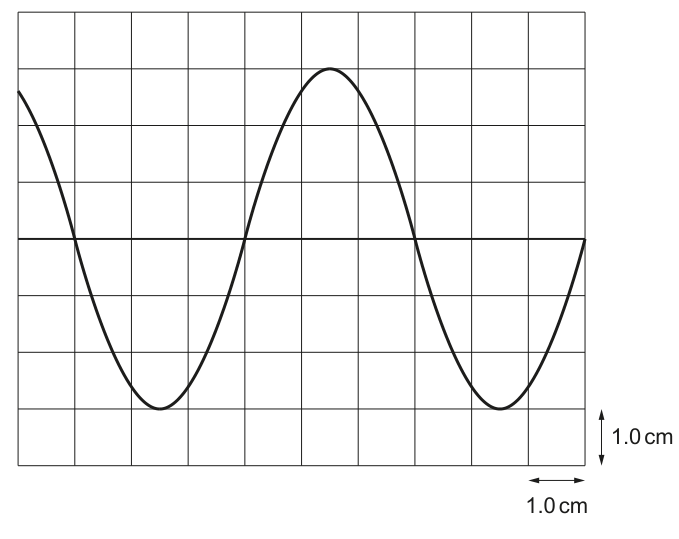
The time-base setting on the oscilloscope is .
Calculate the wavelength of the detected electromagnetic wave.
wavelength = ______
Working
From the trace, one period spans .
Time-base , so
Answer
6.0 × 10^-6 m
Background Concept
An oscilloscope displays voltage against time. The horizontal axis is time, set by the time-base (time per cm or per division). If the signal shown has the same frequency as the electromagnetic wave, then the period read from the oscilloscope is the EM wave period.
Key relations:
For an electromagnetic wave in space, the wave speed is the speed of light , and
Combining gives .
Understanding the Question
The oscilloscope trace shows a sinusoidal signal on a grid. You are told:
- time-base setting is
- the trace has a period of 4 divisions, i.e. , from one peak to the next peak.
You must calculate the electromagnetic wavelength .
Approach
- Measure the period in cm from the oscilloscope trace.
- Convert this to time using the time-base to get .
- Use .
Step-by-Step Reasoning
- Read period from trace
- One complete cycle is the horizontal distance between identical points (e.g. peak to peak).
- The diagram indicates this is divisions, so
- Convert to time period
Time per cm is , so
- Convert period to wavelength
Using :
So the wavelength is (which is ).
Key Takeaways
- Oscilloscope horizontal scale converts divisions into time using the time-base.
- For EM waves, and , so is often the quickest route.
Common Mistakes
- Using peak-to-trough distance (half a period) instead of peak-to-peak.
- Forgetting the time-base is per cm/division and not the total time.
- Using (speed of sound) instead of .
Things to Be Careful About
- Check that you used one full cycle (same phase point to same phase point).
- Keep powers of ten consistent: .
- Give the final answer in metres as requested, typically to 2 or 3 significant figures.
Coherent visible light of a single frequency is incident normally on a double slit. This produces a pattern of bright and dark interference fringes on a screen, as illustrated in Fig. 6.1.
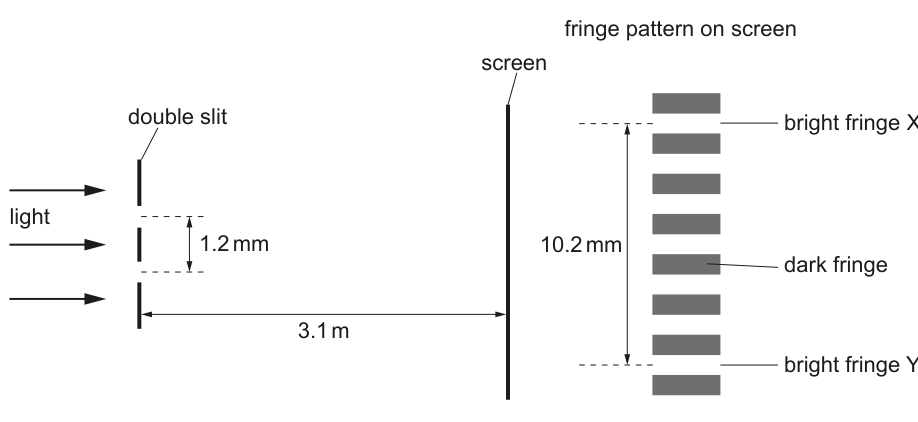
There are seven bright fringes.
Answer
- The two slits act as coherent sources so the waves have a constant phase difference.
- The waves from the two slits superpose at the screen; the path difference varies with position.
- Bright fringes occur where path difference (constructive interference).
- Dark fringes occur where path difference (destructive interference).
Bright: path difference = nλ; Dark: path difference = (n + 1/2)λ, due to superposition of coherent waves from the two slits.
Background Concept
Interference is a superposition effect: when two waves meet at a point, the resultant displacement is the algebraic sum of the individual displacements.
For a double-slit, each slit acts as a source of waves. If the sources are coherent (same frequency and a constant phase difference), a stable pattern forms because the phase relationship at each point on the screen does not drift with time.
Whether a point on the screen is bright or dark depends on the path difference between the two waves arriving there:
- Constructive interference (bright): path difference where
- Destructive interference (dark): path difference
Understanding the Question
You are asked to explain, in words, why alternating bright and dark fringes appear on the screen when coherent monochromatic light passes through a double slit.
So you must mention:
- coherent sources (the slits),
- superposition on the screen,
- the path difference conditions for maxima and minima.
Approach
Describe the physical chain:
- slits behave as coherent sources,
- waves overlap on the screen,
- different points correspond to different path differences,
- specific path differences give maxima (bright) and minima (dark).
Step-by-Step Reasoning
- When light reaches the two narrow slits, each slit diffracts the light and acts like a source of circular wavefronts.
- Because both slits are illuminated by the same incident wave, the light from the slits has the same frequency and (approximately) a fixed phase relationship: the slits are coherent.
- At any point on the screen, two waves arrive (one from each slit). The total amplitude there depends on whether the waves arrive in phase or out of phase.
- If the path difference is , the phase difference is , so the waves arrive in phase and add to give a maximum intensity (bright fringe).
- If the path difference is , the phase difference is an odd multiple of , so the waves arrive in antiphase and cancel (minimum intensity, dark fringe).
- As you move up/down the screen, the geometry changes smoothly, so the path difference alternates through these conditions, producing alternating bright and dark fringes.
Key Takeaways
- Stable interference requires coherent sources.
- Bright fringes: path difference .
- Dark fringes: path difference .
Common Mistakes
- Saying “bright where waves meet” without stating the condition on path difference.
- Confusing path difference with phase difference (they are related but not identical).
- Forgetting to mention coherence/constant phase difference, which is why the pattern is steady.
Things to Be Careful About
- Use the correct form for destructive interference: , not without explanation.
- The brightness is due to intensity, which depends on the resultant amplitude from superposition (not just on “more light”).
The distance between the centres of bright fringe X and bright fringe Y in the pattern is . The slit spacing is . The distance from the slits to the screen is .
Calculate the wavelength of the light incident on the slits.
wavelength = ______
Working
Seven bright fringes means there are fringe separations between the two outer bright fringes.
For a double slit,
Answer
6.6 × 10^-7 m
Background Concept
In double-slit interference, bright fringes are equally spaced (for small angles). The fringe spacing is related to wavelength by
where:
- is the separation of adjacent bright fringes on the screen (in m),
- is the wavelength (in m),
- is the distance from the slits to the screen (in m),
- is the slit separation (in m).
This comes from the condition for maxima and the small-angle approximation .
Understanding the Question
You are given:
- distance between the centres of bright fringes and : ,
- slit spacing: ,
- slit-to-screen distance: ,
- and the diagram states there are seven bright fringes.
The key interpretation is that and are the two outer bright fringes in the set of seven, so the distance spans multiple equal fringe spacings.
Approach
- Use the number of bright fringes to determine how many gaps (fringe spacings) lie between and .
- Divide by that number to get the fringe spacing .
- Substitute into and rearrange for .
- Convert all mm values to m.
Step-by-Step Reasoning
- If there are bright fringes in a row, the number of separations between adjacent bright fringes from the first to the seventh is .
- So the fringe spacing is
Convert to metres:
- Convert slit spacing:
- Rearrange the fringe spacing formula:
- Substitute values:
Multiply top:
Then divide:
The magnitude () is consistent with visible light.
Key Takeaways
- Adjacent bright fringes are equally spaced: use .
- If a distance spans several fringes, count the number of gaps (one fewer than the number of bright fringes involved).
- Always convert mm to m before substituting.
Common Mistakes
- Using as one fringe spacing (gives an infrared wavelength).
- Dividing by instead of .
- Forgetting to convert mm to m, causing a error.
Things to Be Careful About
- Significant figures: the limiting data ( and ) are 2 s.f., so quote to 2 s.f.
- Ensure you use (not inverted) and keep consistent symbols ( is slit separation, not amplitude).
The light is replaced by different visible light with a shorter wavelength.
State how the new fringe separation will compare to the original fringe separation.
Answer
The fringe separation decreases (smaller than before).
Smaller fringe separation.
Background Concept
For a double slit,
With the apparatus unchanged, and are constant, so
Understanding the Question
Only the wavelength is changed (it becomes shorter). The question asks how the spacing between adjacent bright fringes compares with the original.
Approach
Use the proportionality while keeping and fixed.
Step-by-Step Reasoning
- Original spacing: .
- New wavelength is shorter: .
- Therefore
So the fringes get closer together.
Key Takeaways
- For a fixed double-slit arrangement, fringe spacing is directly proportional to wavelength.
Common Mistakes
- Saying the fringe spacing increases because “shorter wavelength diffracts more” (shorter wavelengths actually diffract less).
Things to Be Careful About
- This conclusion assumes the same slit separation and screen distance (as stated). If or changed, the comparison could be different.
A stationary wave is formed on a stretched string AB, as shown in Fig. 6.2.
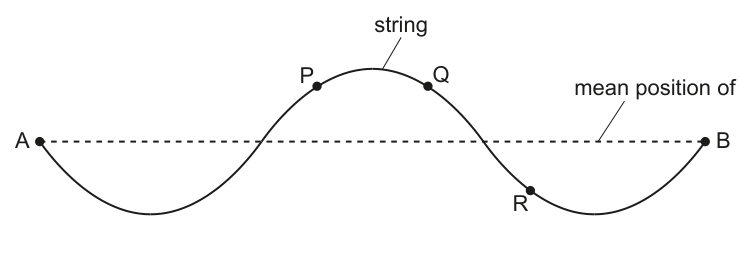
P, Q and R are points on the string.
Answer
Place the cross at a node, e.g. at the midpoint between the two loops (where the string always has zero displacement).
Cross at the central node (between the two loops).
Background Concept
A stationary (standing) wave forms when two waves of the same frequency and amplitude travel in opposite directions and superpose.
Key features:
- Nodes: points that always have zero displacement.
- Antinodes: points that oscillate with maximum amplitude.
For a string fixed at both ends, the ends are always nodes, and additional nodes can occur depending on the harmonic.
Understanding the Question
The diagram shows a stationary wave pattern with two loops. You are asked to mark the position of a node with a cross.
In a two-loop pattern on a fixed string, there is a node at each end and a node between the two loops.
Approach
Look for points where the string crosses the equilibrium position and would remain there at all times. In the drawn snapshot, the most obvious internal node is the point separating the two loops.
Step-by-Step Reasoning
- Because the string has two loops, it must have three nodes in total: at , at the middle between loops, and at .
- Any of these would be a correct node position, but commonly the intended one is the internal node (the boundary between loops).
Key Takeaways
- Nodes are points of permanent zero displacement.
- For two loops on a string fixed at both ends: nodes at both ends and at the midpoint between loops.
Common Mistakes
- Placing the cross at an antinode (maximum displacement) instead of a node.
- Choosing a point like , , or on a loop: these are generally not nodes.
Things to Be Careful About
- A node is not merely “where the string crosses the dashed line in this snapshot”; it must be a point that stays on the equilibrium line for the entire oscillation.
Answer
Points and are in the same loop (between the same two nodes), so they oscillate in phase.
0°
Background Concept
In a stationary wave on a string:
- All points between the same two adjacent nodes reach their maxima/minima together (they are in phase).
- Points in adjacent segments (separated by a node) oscillate in antiphase (phase difference ).
Understanding the Question
and are both shown on the same loop of the stationary wave. The question asks for the phase difference between their oscillations.
Approach
Decide whether the two points are in the same segment (same loop) or separated by a node.
Step-by-Step Reasoning
- and lie on the same loop, meaning there is no node between them.
- Therefore they move together: when is above equilibrium, is also above equilibrium, and they pass through equilibrium at the same instants.
- Hence phase difference is
Key Takeaways
- Same loop (same pair of adjacent nodes) (\Rightarrow) phase difference .
Common Mistakes
- Answering just because the points are at different positions.
- Thinking the phase changes continuously along the loop; in stationary waves the key comparison is whether a node lies between the points.
Things to Be Careful About
- Phase difference refers to the timing of oscillation, not the instantaneous displacement in one drawn snapshot.
Answer
and are in adjacent loops separated by a node, so they oscillate in antiphase.
180°
Background Concept
For stationary waves on a string:
- Points in the same segment between adjacent nodes are in phase.
- Crossing a node reverses the motion: adjacent segments oscillate in antiphase, i.e.
Understanding the Question
Point is on the first loop and point is on the second loop. There is a node between the two loops. You must state the phase difference between and .
Approach
Check whether a node lies between the two points. If yes, the segments are adjacent and therefore antiphase.
Step-by-Step Reasoning
- The two-loop pattern has a node at the boundary between loops.
- and lie on opposite sides of this node.
- When the first loop is above equilibrium, the second loop is below equilibrium (they move oppositely).
- Therefore the phase difference is
Key Takeaways
- Points in adjacent loops are always out of phase.
Common Mistakes
- Stating because both points are on “a wave”.
- Thinking phase depends on the distance between points rather than whether a node lies between them.
Things to Be Careful About
- The correct comparison is segment-to-segment: every time you cross a node, the phase flips by .
Answer
Electric potential difference is the work done (energy transferred) per unit charge between two points:
Work done (energy transferred) per unit charge between two points, V = W/Q.
Background Concept
Electric potential difference (p.d.) between two points is a measure of how much energy is transferred when charge moves between those points.
If an amount of charge moves and the energy transferred (work done) is , then the potential difference is defined by
Units: in joules (J), in coulombs (C), so in volts (V), where .
Understanding the Question
You are asked to give the definition of electric potential difference. There is no calculation: you just need the correct physics meaning and (ideally) the defining equation.
Approach
State that p.d. is energy transferred per coulomb (work done per unit charge), and optionally include .
Step-by-Step Reasoning
- Identify that p.d. is defined via energy/work and charge.
- State: “work done (energy transferred) per unit charge”.
- Write the equation to make the definition precise.
Key Takeaways
- Potential difference is energy per coulomb: .
- Remember the unit equivalence: .
Common Mistakes
- Defining e.m.f. instead (energy supplied per unit charge by a source around a complete circuit).
- Saying “force per unit charge” (that is electric field strength, not p.d.).
Things to Be Careful About
- Use “between two points” for p.d. (it is a property of two points, not one point).
- Use “work done/energy transferred per unit charge”, not “per unit current”.
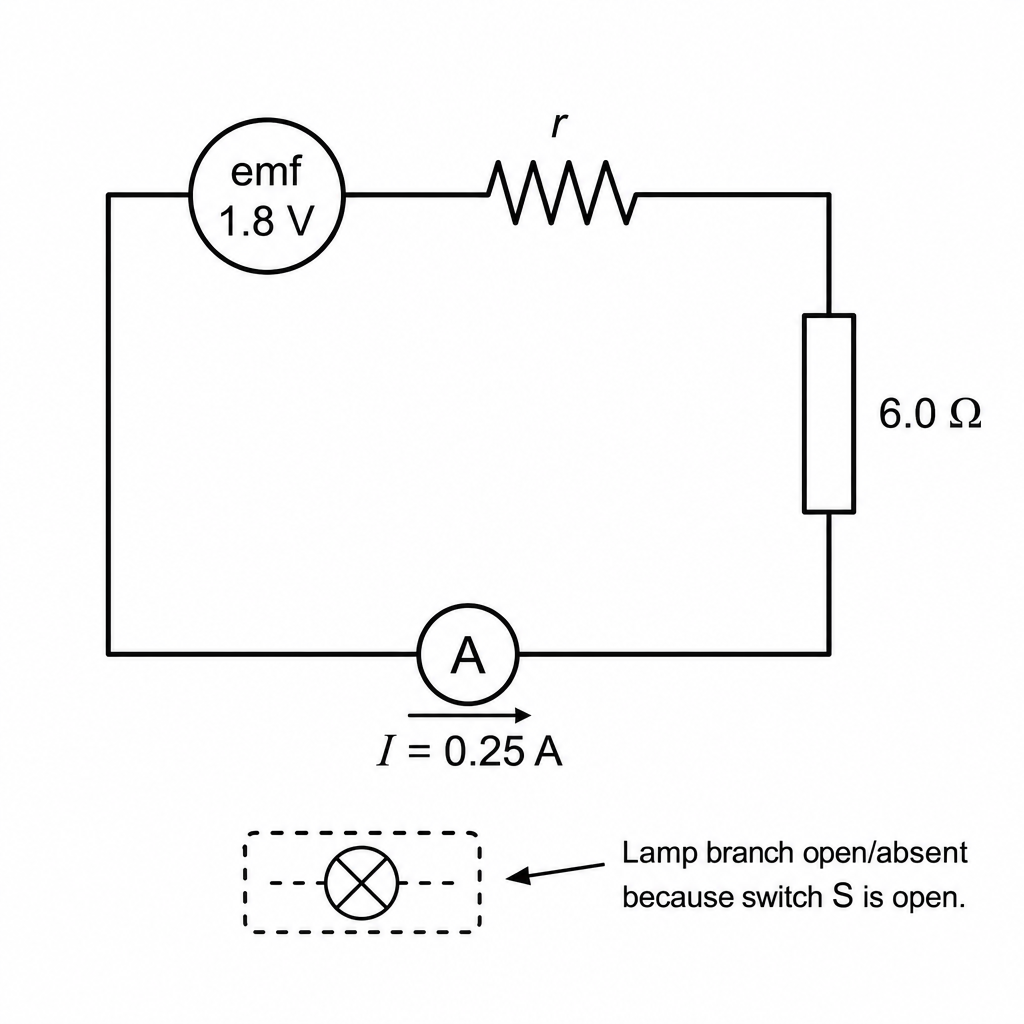
A cell of electromotive force (e.m.f.) and internal resistance is connected in parallel with a resistor of resistance and a filament lamp, as shown in Fig. 7.1.
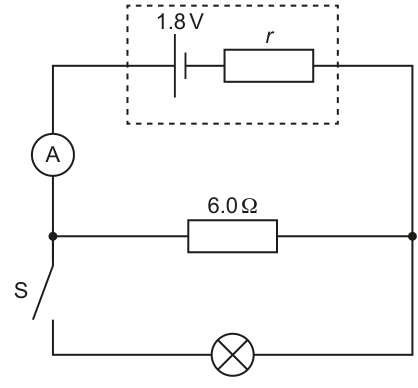
The switch S is open. The ammeter reading is .
Determine the internal resistance of the cell.
= ______
Working
Switch open lamp branch open, so external resistance only.
Lost volts:
Answer
1.2 Ω
Background Concept
A real cell can be modelled as an ideal source of e.m.f. in series with an internal resistance . When current flows, some of the e.m.f. is “lost” across :
The terminal p.d. across the external circuit is then
Also, for an external resistor ,
Understanding the Question
With switch open, the lamp branch is disconnected, so the only load connected across the cell is the resistor. The ammeter reads the current supplied by the cell, . You must find the internal resistance given .
Approach
- With the lamp branch open, treat the circuit as: cell (with ) in series with the external .
- Find the terminal p.d. across the resistor using .
- The difference is the p.d. across the internal resistance, equal to .
- Rearrange for .
Step-by-Step Reasoning
-
Switch open means no current can flow through the lamp branch, so the circuit reduces to a single loop containing , , and .
-
The terminal p.d. equals the p.d. across the resistor:
- The e.m.f. is larger than the terminal p.d. because some p.d. is across internal resistance:
- This is the p.d. across , so :
Key Takeaways
- With internal resistance, .
- “Lost volts” is and equals .
Common Mistakes
- Using with (that ignores internal resistance).
- Treating the resistor as in parallel with (it is not; is in series inside the cell model).
Things to Be Careful About
- The switch being open is crucial: it removes the lamp branch completely.
- Keep enough significant figures through the calculation; final value is appropriate.
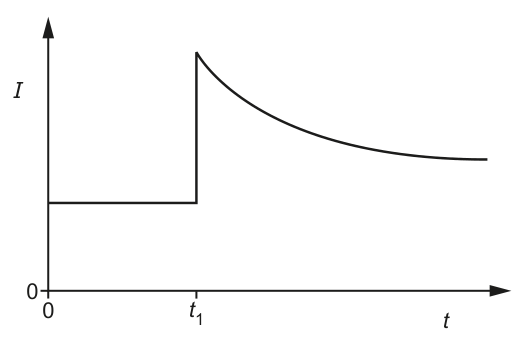
At time switch S in Fig. 7.1 is closed. Fig. 7.2 shows the variation with time of the ammeter reading .
State whether the e.m.f. of the cell after is greater than, less than or the same as it was before .
Answer
The e.m.f. is the same after .
The same.
Background Concept
The e.m.f. of a cell is the energy supplied per unit charge by the source. For an idealised cell model, is a characteristic of the cell and does not change just because you change the external circuit.
What does change when the current changes is the terminal p.d.:
So changing the load changes and therefore the lost volts , which changes the terminal p.d., even though stays (approximately) constant.
Understanding the Question
At time the switch is closed, changing the external circuit and therefore the current. You are asked whether the e.m.f. after changes compared with before .
Approach
Decide whether e.m.f. depends on the external resistance (it does not, in this model). Use the distinction between e.m.f. and terminal p.d.
Step-by-Step Reasoning
- Closing the switch changes the circuit resistance and hence the current.
- The change in current changes the terminal p.d. because .
- The e.m.f. is a property of the cell itself, so it is taken to remain the same.
Key Takeaways
- e.m.f. is energy per unit charge supplied by the source; it is not set by the external circuit.
- Terminal p.d. changes with current because of internal resistance.
Common Mistakes
- Saying e.m.f. increases because current increases (confusing e.m.f. with terminal p.d.).
- Saying e.m.f. decreases because more current is drawn (again confusing with terminal p.d. drop).
Things to Be Careful About
- In real cells, e.m.f. can vary slightly with temperature/state of charge, but exam questions usually treat it as constant for these time scales and conditions.
By considering the effect of the lamp on the total resistance of the circuit, explain the variation of the ammeter reading shown in Fig. 7.2.
Answer
- At the switch is closed so the lamp is connected in parallel with the resistor, decreasing the total external resistance, so the current increases suddenly.
- Initially the lamp filament is cool so its resistance is small, making the total resistance very small, giving the large peak current.
- As current flows the filament heats up and its resistance increases, so the total resistance increases and the current falls to a new steady value (still higher than before because there are now two parallel branches).
Current jumps up when the lamp branch is added (lower total resistance); initially lamp has low resistance (cold) giving a large peak; filament heats so its resistance rises, increasing total resistance so current falls to a new steady value still above the original.
Background Concept
When components are connected in parallel, the equivalent resistance decreases because the total conductance adds:
So adding an extra parallel branch reduces and tends to increase the current supplied by the source.
A filament lamp is non-ohmic: as current increases, the filament temperature increases, which increases its resistivity. Therefore its resistance increases as it heats up. So the lamp’s resistance is relatively small when it is cold, and larger when it is hot.
With internal resistance , a larger current also increases the lost volts , reducing the terminal p.d.:
Understanding the Question
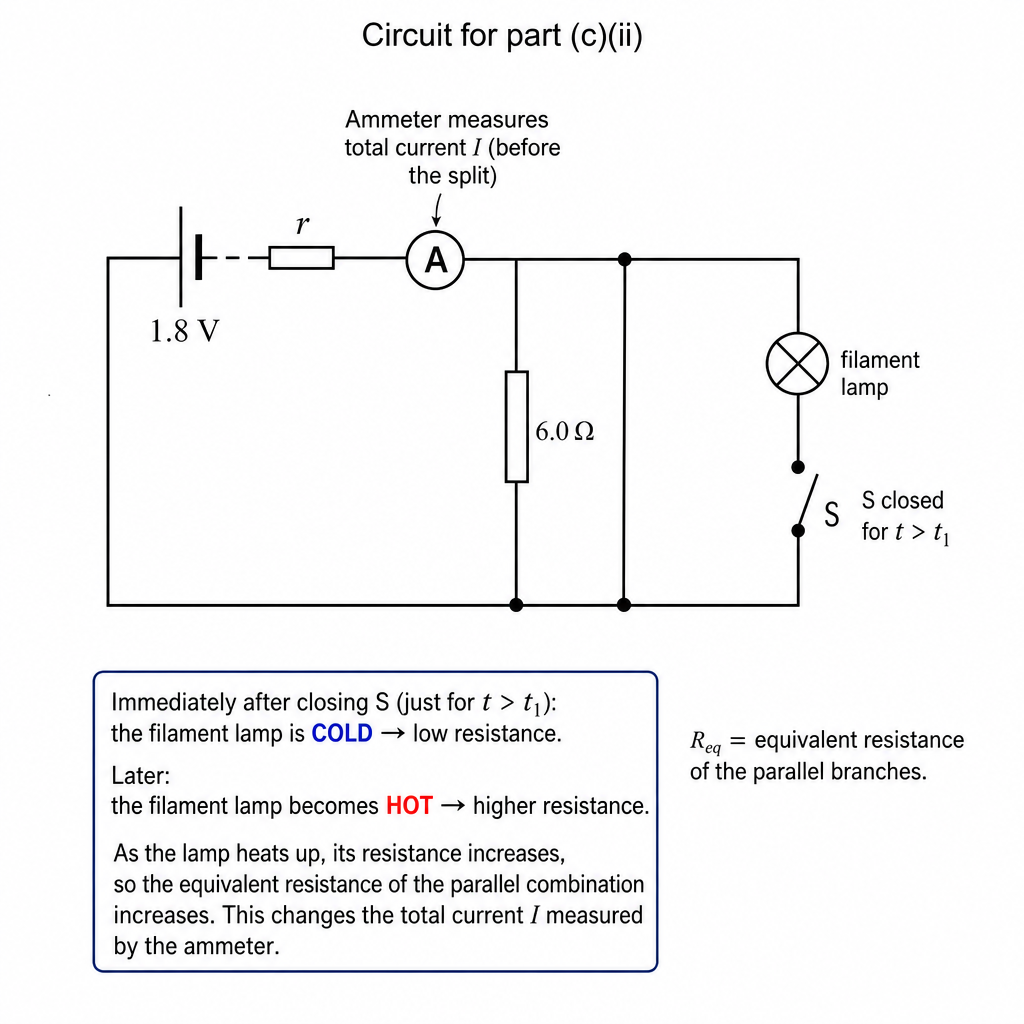
At time , switch is closed and the filament lamp becomes connected in parallel with the resistor. The graph shows the total current (ammeter reading) jumping up immediately, then decreasing gradually to a new steady value that is higher than before .
You must explain that shape by discussing how the lamp affects the total resistance of the circuit over time.
Approach
- Consider what happens to the circuit immediately when the switch is closed: you add a new parallel path.
- Use the fact that the lamp is cold initially, so it has low resistance, giving a large initial current.
- As time passes, the filament heats, the lamp resistance rises, so the equivalent resistance increases and current decreases toward a steady value.
- Note that final current is still larger than the original (because the lamp branch remains in parallel, so total external resistance is still less than alone).
Step-by-Step Reasoning
-
Before : switch open, only is connected externally, so current is constant.
-
At the instant just after :
- Closing the switch connects the lamp in parallel with the resistor.
- Adding a parallel branch reduces the external equivalent resistance .
- At that instant the filament is still cool, so the lamp’s resistance is small. This can make much smaller than .
- Hence the current drawn from the cell increases sharply, producing the sudden jump/peak.
-
After as time increases:
- The large current heats the filament.
- Heating increases the filament’s resistance.
- As the lamp resistance increases, the parallel combination’s equivalent resistance increases.
- Increased total resistance reduces the circuit current, so the ammeter reading falls.
-
Long time after (new steady state):
- The filament reaches a steady operating temperature, so its resistance becomes approximately constant.
- The current becomes constant at a new value.
- This final current is still greater than the original current because there are still two parallel paths, so the external equivalent resistance remains lower than alone.
(An additional contributing idea is that when the current is large, the lost volts is larger, which reduces the terminal p.d. and also helps limit the current; as the lamp resistance rises, current falls and the terminal p.d. recovers to a new steady value.)
Key Takeaways
- Closing the switch adds a parallel branch, so decreases and total current increases.
- Filament lamp resistance increases with temperature; this causes the current to decrease from its initial surge to a steady value.
- Internal resistance means terminal p.d. changes with current, shaping how large the current can become.
Common Mistakes
- Treating the filament lamp as having constant resistance (then you cannot explain the gradual decrease).
- Claiming the resistance decreases as it heats (true for thermistors, not for metal filaments).
- Saying the current falls below the original steady current (it should remain above, because the parallel branch still reduces the external resistance).
Things to Be Careful About
- Mention the key time-dependent physics: the filament is cold at first (low ) and heats up (higher ).
- Make sure your explanation links resistance change to current change using (with the idea that adding a parallel branch reduces total resistance).
Answer
A neutrino is a lepton.
Lepton
Background Concept
In the Standard Model classification used at AS level, fundamental particles are grouped into:
- Leptons (e.g. electron , muon, tau, and their associated neutrinos), and
- Quarks, which combine to form hadrons.
Neutrinos (and antineutrinos) are leptons.
Understanding the Question
You are asked for the class (group) of fundamental particles that includes a neutrino.
Approach
Recall the two main families of fundamental matter particles at this level and place the neutrino into the correct family.
Step-by-Step Reasoning
- Neutrinos do not consist of quarks.
- They are listed alongside the electron in the lepton family.
- Therefore the neutrino is a lepton.
Key Takeaways
- Neutrinos are leptons, not hadrons.
- Hadrons are composite particles made from quarks.
Common Mistakes
- Saying “hadron”: neutrinos are not made of quarks, so they cannot be hadrons.
- Saying “baryon” or “meson”: these are types of hadrons, so also incorrect.
Things to Be Careful About
- The question asks for the class/group, not the specific particle name (so “lepton”, not “electron neutrino”).
A hadron P has a charge of , where is the elementary charge. The hadron P is composed of a down antiquark and only one other quark.
Working
Down quark has charge , so a down antiquark has charge .
For total charge , the other quark must have charge
So the other quark can be an up quark.
Answer
Up quark ().
Up quark (u)
Background Concept
Quarks have fractional charges:
- have charge
- have charge
An antiquark has the opposite charge to the corresponding quark.
The total charge of a hadron is the sum of the charges of its constituent quarks/antiquarks.
Understanding the Question
You are told hadron has total charge and is made of:
- one down antiquark (), and
- one other quark (only one).
You must name a possible flavour of that quark.
Approach
- Write the charge of .
- Subtract it from the total charge to find the required charge of the other quark.
- Identify a quark flavour that has that charge.
Step-by-Step Reasoning
- A down quark has charge .
- Therefore the down antiquark has charge .
- Let the other quark have charge .
Then
- Solve for :
- A quark with charge could be (also or , but is the standard AS-level answer).
Key Takeaways
- Antiquarks have the opposite charge to the corresponding quark.
- Total hadron charge is the sum of constituent charges.
- To make with , you need a quark (e.g. ).
Common Mistakes
- Using for (forgetting the sign change for antiquarks).
- Choosing a or quark (charge ), which cannot produce total with .
Things to Be Careful About
- The question says “only one other quark”: do not try to build a baryon with three quarks.
- Ensure you express the charge consistently in units of when adding/subtracting.
Answer
is a meson.
Meson
Background Concept
Hadrons are particles made of quarks:
- Baryons: three quarks (e.g. for a proton)
- Mesons: one quark and one antiquark (e.g. for a )
Understanding the Question
Hadron is said to be composed of a down antiquark and only one other quark. That means it contains exactly two constituents: one quark and one antiquark.
Approach
Use the definition:
- 3 quarks baryon
- quark + antiquark meson
Step-by-Step Reasoning
- Constituents given: plus one quark.
- That is a quark–antiquark pair.
- Therefore the hadron must be a meson.
Key Takeaways
- Quark content immediately identifies hadron type.
- Meson = quark + antiquark.
Common Mistakes
- Answering “baryon”: baryons require three quarks.
- Saying “lepton”: leptons are fundamental and are not made of quarks.
Things to Be Careful About
- The question’s phrase “only one other quark” is the key clue that it is a meson.
Nucleus Q undergoes radioactive decay to form nucleus R, emitting an antineutrino and another particle X, as shown in the decay equation.
Answer
is a beta-minus particle (electron), .
Electron (beta-minus particle, e−)
Background Concept
In beta-minus decay:
- a neutron changes into a proton, emitting an electron and an antineutrino:
At nucleus level, the process increases proton number by 1 but keeps nucleon number the same.
Understanding the Question
The decay is:
An antineutrino () is explicitly shown, so you must identify what the other emitted particle is.
Approach
Recognise which radioactive decay emits an antineutrino. Then state the associated particle emitted alongside it.
Step-by-Step Reasoning
- Antineutrino emission is characteristic of beta-minus decay.
- Beta-minus decay emits an electron.
- Therefore is an electron (a particle).
Key Takeaways
- in a nuclear decay equation strongly indicates beta-minus decay.
- Beta-minus emission corresponds to an emitted electron.
Common Mistakes
- Writing “positron”: positron emission (beta-plus) is associated with a neutrino (), not an antineutrino.
- Writing “alpha particle”: alpha decay does not involve neutrinos.
Things to Be Careful About
- Cambridge often uses and interchangeably; either should be acceptable if clearly stated.
Answer
The nucleon numbers are the same: .
Same (AQ = AR)
Background Concept
The nucleon number (mass number) is the total number of protons + neutrons in the nucleus.
In beta decay (either or ), one nucleon changes type (neutron to proton or vice versa), so the total number of nucleons stays constant. Hence is conserved.
Understanding the Question
From part (i), the emission of indicates beta-minus decay. You are asked to compare nucleon numbers of the original nucleus and the daughter nucleus .
Approach
Use the fact that beta decay does not eject a nucleon from the nucleus, so is unchanged.
Step-by-Step Reasoning
- In beta-minus decay, a neutron in the nucleus becomes a proton.
- No protons or neutrons leave the nucleus as separate particles.
- Therefore the total number of nucleons is unchanged:
Key Takeaways
- Beta decay changes proton number but not nucleon number.
Common Mistakes
- Saying decreases by 1 (confusing with positron/electron emission or misremembering alpha decay).
- Treating the emitted electron as if it reduces nucleon number (electrons are not nucleons).
Things to Be Careful About
- Only alpha decay changes significantly (by 4). Beta decay keeps the same.
Answer
has charge greater than (proton number increases by 1).
R has charge +1e greater than Q
Background Concept
In beta-minus decay:
Inside a nucleus this means:
- proton number increases by 1 (one extra proton),
- nucleon number stays the same.
The nuclear charge is .
Understanding the Question
Given the decay produces an antineutrino (so it is decay), you must compare the charges of nuclei and .
Approach
Identify how changes in beta-minus decay, then translate that into nuclear charge.
Step-by-Step Reasoning
- Beta-minus decay converts a neutron to a proton.
- So the number of protons increases:
- Nuclear charge is , therefore:
So is one elementary charge more positive than .
Key Takeaways
- In decay: increases by 1, so nuclear charge increases by .
Common Mistakes
- Saying the charge decreases (that would correspond to decay).
- Saying charge is unchanged (beta decay always changes by 1).
Things to Be Careful About
- Be explicit about which nucleus has the larger charge.
- The emitted electron does not remain in the nucleus; the daughter nucleus must become more positively charged to conserve charge overall.