Physics 9702/12 — February/March 2024
Cambridge AS Level · Multiple Choice (AS Level) · answer key with instant marking and worked solutions
Topics Dynamics · Forces, Density and Pressure · Waves · Physical Quantities and Units · Kinematics · Work, Energy and Power · +5 more
Tap an option under each question to check it — your score builds as you go.
Which row shows a physical quantity and its base unit in the SI system?
Options
| quantity | unit | |
|---|---|---|
| A | current | A |
| B | force | N |
| C | mass | g |
| D | temperature | C |
Current is an SI base quantity and its SI base unit is the ampere (A).
Force (N) is a derived unit, mass has base unit kg (not g), and temperature has base unit K (not ).
Answer
A
A
Background Concept
SI base quantities are fundamental physical quantities with base units that are not defined in terms of other SI units. Examples include mass (kg), time (s), electric current (A), and thermodynamic temperature (K).
A derived unit is formed from base units (e.g. newton, N, is derived from ).
Understanding the Question
You are given four rows, each pairing a physical quantity with a unit. The task is to identify the row where:
- the quantity is an SI base quantity, and
- the unit given is the correct SI base unit for that quantity.
Approach
List/check whether each quantity is a base quantity, then check whether the unit shown is the correct SI base unit (not just a commonly used unit).
Step-by-Step Reasoning
-
A: current — A
Electric current is an SI base quantity, and the ampere (A) is its SI base unit. So this row is correct. -
B: force — N
Force is not a base quantity; it is derived from . Its unit newton is derived:So B is not a base quantity with a base unit.
-
C: mass — g
Mass is a base quantity, but its SI base unit is the kilogram (kg), not the gram (g). So C is incorrect. -
D: temperature —
Thermodynamic temperature is a base quantity, but its SI base unit is the kelvin (K). Degrees Celsius is accepted for use with SI, but it is not the SI base unit. So D is incorrect.
Therefore the correct option is A.
Key Takeaways
- Know the SI base quantities and their base units (e.g. current (\to) ampere, temperature (\to) kelvin, mass (\to) kilogram).
- Recognise derived quantities/units (e.g. force in newtons).
Common Mistakes
- Choosing D because is commonly used for temperature, forgetting the SI base unit is K.
- Choosing C because grams are commonly used, forgetting the SI base unit is kg.
- Treating force as a base quantity.
Things to Be Careful About
- The question asks for the base unit in the SI system, not merely a unit that is widely used.
- Unit symbols matter: kg is the base unit for mass, not g; K is the base unit for temperature, not .
A car of mass is travelling in a horizontal straight line. The diagram shows the two horizontal forces acting on the car in opposite directions.
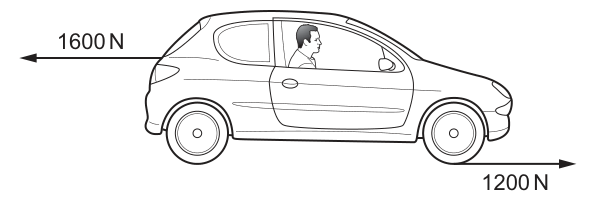
One force has magnitude , and the other force has magnitude .
What is the magnitude of the acceleration of the car?
Options
A
B
C
D
Working
Resultant horizontal force:
Newton's 2nd law:
Answer
A
A
Background Concept
When forces act on an object along a straight line, the resultant (net) force is the algebraic sum of the forces, taking one direction as positive.
Newton's second law links resultant force to acceleration:
So the acceleration magnitude is
Understanding the Question
A car of mass experiences two horizontal forces along the same straight line but in opposite directions: one way and the other way. You are asked for the magnitude of the acceleration.
Because the forces are horizontal and opposite, the resultant force is simply the difference in magnitudes.
Approach
- Choose a positive direction (e.g. the direction of the force).
- Compute the resultant force by subtracting the smaller opposing force from the larger.
- Apply .
- Round appropriately and select the matching option.
Step-by-Step Reasoning
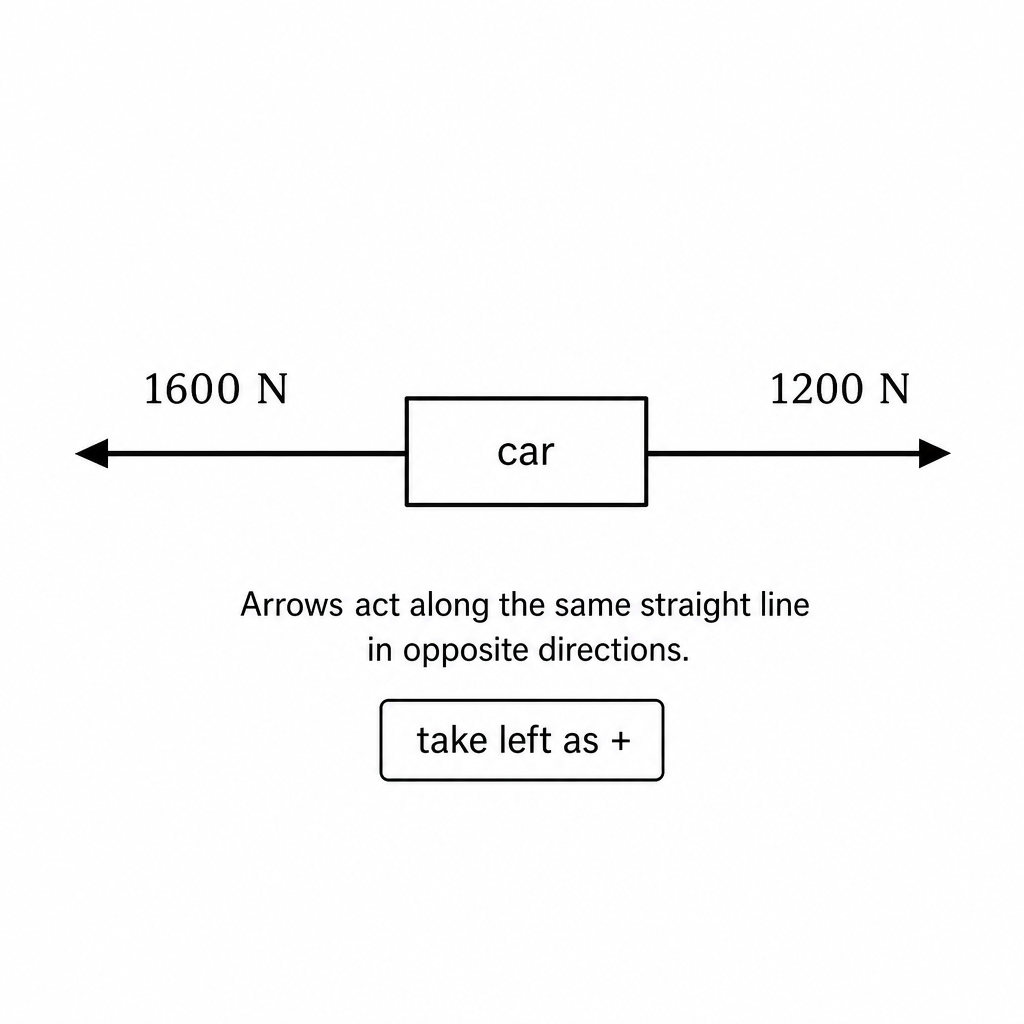
Take the direction of the force as positive. Then the opposing force is negative.
Resultant force:
Use Newton's second law:
This corresponds to option A.
Key Takeaways
- For collinear forces in opposite directions, the resultant is the difference between the larger and smaller force.
- Use with the resultant force, not an individual force.
- The magnitude of acceleration is .
Common Mistakes
- Adding the forces () instead of subtracting for opposite directions.
- Using the wrong mass unit (mass is already in , so no conversion is needed).
- Forgetting that the question asks for magnitude (so acceleration should be positive).
Things to Be Careful About
- Always decide whether forces are in the same or opposite directions before combining them.
- Keep units consistent: , , giving .
- In MCQs, round sensibly to match the given options (here ).
An object of mass is suspended by a spring from a fixed point.
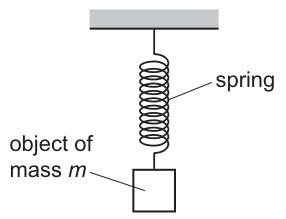
The spring has spring constant . The object is set into vertical oscillations of period .
Which equation for is homogeneous with respect to base units?
Options
A
B
C
D
Working
Spring constant:
So
Hence
So is homogeneous.
Answer
D
D
Background Concept
An equation is homogeneous if both sides have the same base units (dimensions). For an oscillation period , the base unit must be time, i.e. seconds (dimension ).
A spring constant is defined by Hooke’s law , so . This lets us find the base units of .
Understanding the Question
You are given a mass on a vertical spring of spring constant , oscillating with period . Four possible expressions are offered. You are not asked for the true formula, only which one has the correct units to be a time.
So we test each option by checking whether it has units of seconds.
Approach
- Write in base units: .
- Find from using .
- Work out the units of and .
- Decide which option gives (not , , etc.). Note that is dimensionless and does not affect homogeneity.
Step-by-Step Reasoning
From ,
Convert newtons to base units:
So
Now compare the two possible ratios:
- For :
Taking a square root would give , not .
- For :
Taking a square root gives
Therefore only
has units of time, so the homogeneous option is D.
Key Takeaways
- Homogeneity means matching base units on both sides.
- Use definitions of constants (here ) to find their units.
- is dimensionless, so it never changes the units.
- Period must come out in seconds.
Common Mistakes
- Using instead of , which gives the wrong units for .
- Forgetting to convert into base units .
- Assuming the correct physics formula without checking the dimensional requirement (the question only asks about homogeneity).
Things to Be Careful About
- Always simplify fully to base units (kg, m, s) before deciding.
- Remember that square roots halve powers: but .
- Distinguish between and ; they are reciprocals with opposite powers of time.
An object of fixed mass is initially at rest at point . The object then moves away from point with uniform acceleration.
Which statement describes the resultant force acting on the object when it is moving?
Options
A It increases uniformly with respect to time.
B It is constant but not zero.
C It is proportional to the displacement from point .
D It is zero.
Working
Uniform acceleration means is constant.
For fixed mass ,
So the resultant force is constant and, since , it is not zero.
Answer
B
B
Background Concept
Newton's second law links the resultant (net) force on an object to its acceleration:
where:
- is the vector sum of all forces acting on the object,
- is the (constant) mass,
- is the acceleration.
If is fixed, then the resultant force is directly proportional to the acceleration. Therefore:
- constant (\Rightarrow) constant ,
- zero (\Rightarrow) zero .
Understanding the Question
The object starts from rest at point and then moves away with uniform acceleration. The question asks what happens to the resultant force while it is moving.
Key information:
- mass is fixed (constant ),
- acceleration is uniform (constant ),
- it moves away from (so acceleration is not zero during the motion described).
Approach
- Translate “uniform acceleration” into “constant acceleration”.
- Use with constant to infer how behaves.
- Decide whether the force is zero or non-zero from whether is zero or non-zero.
Step-by-Step Reasoning
- “Uniform acceleration” means:
- Apply Newton's second law:
- Since is fixed and is constant, must be constant.
- The object is described as accelerating away from , so during the motion. Hence is constant but not zero.
Therefore the correct option is B.
Key Takeaways
- Uniform (constant) acceleration implies a constant resultant force only if mass is constant.
- Zero resultant force corresponds to zero acceleration (constant velocity, possibly at rest).
Common Mistakes
- Choosing D by thinking “moving at constant acceleration” might mean “moving steadily”: but steady motion is constant velocity, not uniform acceleration.
- Choosing A by confusing increasing velocity with increasing force: velocity can increase linearly in time even when force is constant.
- Choosing C: force proportional to displacement is the hallmark of simple harmonic motion (spring-like restoring force), not constant acceleration.
Things to Be Careful About
- “Uniform acceleration” means constant acceleration, not “constant speed”.
- The question asks about the resultant force (net force), not individual forces that might change while still producing a constant net force.
- Mass is stated fixed; if mass were changing (e.g. rocket), constant acceleration would not necessarily imply constant force.
A projectile is launched at an angle of to the horizontal with a horizontal component of velocity of .
What is the vertical component of the velocity of the projectile when it is launched?
Options
A
B
C
D
Working
Horizontal component:
Vertical component:
Answer
B
B
Background Concept
A projectile’s launch velocity is a vector. If it makes an angle to the horizontal, its components are
A useful relation comes from dividing these:
This is often quickest when one component (here, horizontal) and the angle are given.
Understanding the Question
You are told the projectile is launched at above the horizontal, and its horizontal component of velocity at launch is . You must find the vertical component at launch, and then choose the matching option.
Approach
Use the component relation
with and .
Step-by-Step Reasoning
Start from the standard component equations:
You are given , so .
Now express in terms of :
Substitute :
Calculate:
This corresponds to option B.
Key Takeaways
- Velocity is a vector; resolve it using for adjacent (horizontal) and for opposite (vertical).
- If and the launch angle are known, the fastest method is .
Common Mistakes
- Using or (mixing up trig ratios).
- Using instead of .
- Forgetting to round to match the given options.
Things to Be Careful About
- The given is a component, not the total speed.
- Check angle is to the horizontal (so horizontal uses , vertical uses ).
- Keep units as throughout.
A ball is released from rest at position at time zero. At , it bounces inelastically from a horizontal surface and rebounds, reaching the top of its first bounce at .
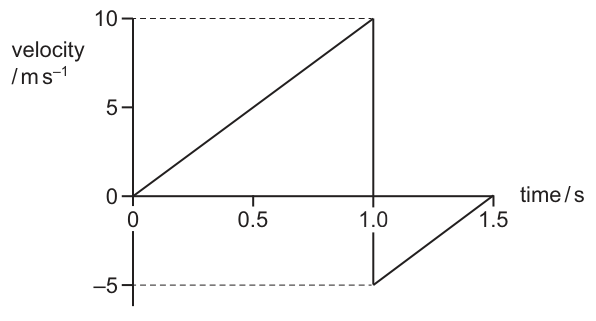
What is the total displacement of the ball from its original position at ?
Options
A
B
C
D
Working
Displacement is the (signed) area under the - graph.
From to (triangle):
From to (triangle below axis):
Total displacement:
Answer
B
B
Background Concept
A velocity–time graph contains two key pieces of information:
- The gradient gives acceleration.
- The (signed) area between the graph and the time axis gives displacement.
Mathematically, displacement is the integral of velocity:
On a graph, this becomes a geometric area calculation. Regions above the time axis (positive velocity) contribute positive displacement; regions below the axis (negative velocity) contribute negative displacement.
Understanding the Question
The ball starts from rest at at position . The given - graph shows:
- From to : velocity increases linearly from to (falling).
- At : the ball bounces and its velocity instantaneously changes to (rebound upward, hence negative on this graph).
- From to : velocity increases from to (still moving upward but slowing to rest at the top).
We are asked for the total displacement from at , i.e. net change in position, not total distance travelled.
Approach
Compute the signed area under the graph from to :
- Split the graph into simple shapes (triangles).
- Find each area using .
- Apply a negative sign to the part below the time axis.
- Add areas to get net displacement.
Step-by-Step Reasoning
1) From to
This section is a triangle above the axis with base and height .
This is positive displacement (velocity is positive).
2) From to
This section is a triangle below the axis. The speed decreases from to over .
Magnitude of area:
Because the graph is below the axis, this contributes negative displacement:
3) Net displacement at
So the ball is still in the positive displacement direction from its starting point at .
Key Takeaways
- Displacement over a time interval equals the signed area under a velocity–time graph.
- After a bounce, the velocity can change sign; the area below the axis must be subtracted.
- The question asks for displacement (net change), not distance (sum of magnitudes).
Common Mistakes
- Adding magnitudes of both triangular areas (that would give distance travelled, not displacement).
- Forgetting the negative sign for the region below the time axis.
- Using with the final velocity instead of using the triangular area (velocity is changing, so you must use the area of the shape).
Things to Be Careful About
- Check whether the graph uses the convention that downward is positive (as here) or upward is positive; either way, the area method still works as long as you keep the signs consistent.
- Use the correct base widths: to and to .
- Units: , so the area is directly a displacement in metres.
What is the definition of acceleration?
Options
A change in velocity per unit time
B rate of change of speed per unit time
C rate of change of velocity per unit time
D resultant force per unit mass
Working
Acceleration is the rate of change of velocity, i.e., change in velocity per unit time. Option A states exactly this.
Answer
A
A
Background Concept
Acceleration is defined as the rate of change of velocity. As velocity is a vector quantity (it has both magnitude and direction), acceleration is also a vector. Mathematically, for motion in a straight line, the average acceleration is given by , where is the change in velocity and is the time taken. The instantaneous acceleration is the limit of this as approaches zero.
Understanding the Question
The question asks for the correct definition of acceleration from four options. It is a multiple-choice question testing the precise wording of a fundamental concept in kinematics.
Approach
Compare each option to the standard definition of acceleration:
- Option A: "change in velocity per unit time" — this directly matches the definition.
- Option B: "rate of change of speed per unit time" — speed is a scalar; acceleration involves velocity.
- Option C: "rate of change of velocity per unit time" — this is redundant because "rate of change" already means "per unit time".
- Option D: "resultant force per unit mass" — this describes acceleration via Newton's second law, not a definition.
Step-by-Step Reasoning
- Recall the formal definition: Acceleration is the rate of change of velocity, or equivalently, the change in velocity divided by the time interval.
- Option A uses "change in velocity per unit time", which is a correct and concise statement of that definition.
- Option B incorrectly uses "speed" instead of "velocity". Since speed does not include direction, it is not the same as velocity.
- Option C is incorrect because it says "rate of change ... per unit time", which is tautological (rate of change already includes per unit time). The phrase "rate of change of velocity" alone would be correct, but adding "per unit time" makes it wrong.
- Option D is a statement of Newton's second law ( rearranged to ), which relates acceleration to force, but it is not the definition of acceleration.
Key Takeaways
- Acceleration is defined as the rate of change of velocity (vector).
- It is important to distinguish between velocity and speed.
- Definitions in physics must be precise; redundant phrases or substitution of scalar for vector quantities can change the meaning.
Common Mistakes
- Confusing acceleration with the rate of change of speed (e.g., from option B).
- Accepting option C because "rate of change of velocity" is familiar; but the extra "per unit time" makes it incorrect.
- Using Newton's second law as a definition instead of the kinematic definition.
Things to Be Careful About
- The term "rate of change" already implies division by time, so do not add "per unit time" after it.
- Acceleration is a vector; definitions must refer to velocity, not speed.
- In multiple-choice questions, read each option carefully for such subtle differences.
Two balls and , of equal mass, move along a straight line directly towards each other as shown.
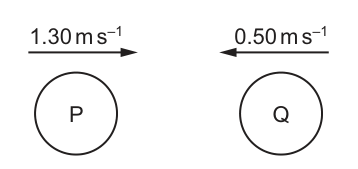
Ball has velocity to the right. Ball has velocity to the left.
and collide with one another. The collision is perfectly elastic and the total momentum is conserved.
Which diagram correctly shows the motion of and after the collision?
Options
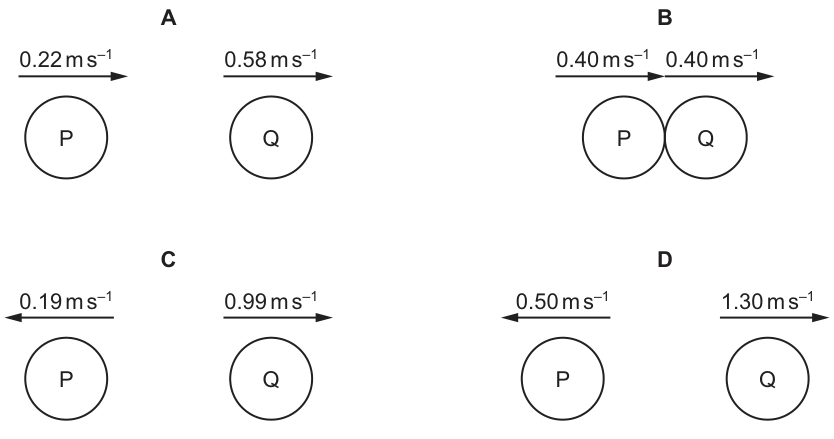
Working
Take right as positive.
For a perfectly elastic head-on collision of equal masses, the two objects exchange velocities.
So
Answer
D
D
Background Concept
In a one-dimensional collision:
- Momentum is conserved (always, if no external resultant impulse):
- If the collision is perfectly elastic, kinetic energy is also conserved:
For a head-on perfectly elastic collision between two equal masses, these two conservation laws together imply a very useful result:
- the two objects exchange velocities after the collision.
Understanding the Question
Ball and ball have equal mass and move along the same straight line towards each other.
- initially moves to the right at .
- initially moves to the left at .
The collision is perfectly elastic and momentum is conserved, so we must pick the option that matches the correct final velocities.
Approach
Use a sign convention (right positive), then apply the equal-mass perfectly elastic collision rule: swap the velocities. As a quick check, confirm that both total momentum and total kinetic energy are unchanged.
Step-by-Step Reasoning
- Choose right as positive.
- For equal masses in a perfectly elastic head-on collision, the velocities exchange:
This means rebounds left at , and moves right at .
- Check with momentum conservation (optional but reassuring):
Initial momentum:
Final momentum:
Matches.
- Check with kinetic energy conservation (also optional):
Initial:
Final uses the same two speeds, so .
So the correct diagram is the one showing moving left at and moving right at , which is Option D.
Key Takeaways
- In 1D, momentum is conserved in collisions (if external impulse is negligible).
- Perfectly elastic means both momentum and kinetic energy are conserved.
- For equal masses in a head-on perfectly elastic collision, the objects exchange velocities.
Common Mistakes
- Getting signs wrong (e.g. taking both velocities as positive even though one is to the left).
- Thinking the objects must move off together with a common speed (that corresponds to a perfectly inelastic collision, not elastic).
- Using momentum conservation alone: in an elastic collision you need the elastic condition as well (or use the known equal-mass result).
Things to Be Careful About
- Always define a positive direction before substituting into equations.
- Distinguish between speed (always positive) and velocity (can be negative in 1D).
- The “exchange of velocities” shortcut is valid only for equal masses and a head-on perfectly elastic collision.
A basketball player hits a ball vertically downwards with a speed of from a height of .
Air resistance is negligible.
What is the speed of the ball as it hits the ground?
Options
A
B
C
D
Working
Take downward as positive.
Answer
B
B
Background Concept
For vertical motion near Earth with air resistance negligible, the only significant force on the ball after it is struck is its weight. This produces a constant acceleration of magnitude downward.
For constant acceleration, the SUVAT kinematics equations apply. The most direct one here relates speeds and displacement:
where is initial speed, is final speed, is acceleration, and is displacement in the chosen positive direction.
Understanding the Question
The ball is hit downwards with speed from a height of above the ground. It then falls the to the ground with constant downward acceleration .
We are asked for the speed on impact (magnitude of velocity) when it reaches the ground.
Approach
Choose downward as the positive direction so that and the displacement to the ground is . Use
because time is not needed and not given.
Step-by-Step Reasoning
Initial speed (downwards):
Acceleration (downwards):
Displacement to the ground (downwards):
Substitute into :
Compute:
So
Matching to the options, rounds to , which is option B.
Key Takeaways
- With negligible air resistance, vertical motion is constant acceleration with downward.
- When time is not required, is often the quickest SUVAT equation.
- “Speed” means the magnitude, so take the positive square root.
Common Mistakes
- Using but taking without a consistent sign convention.
- Forgetting to square the initial speed (using instead of ).
- Choosing the wrong SUVAT equation and introducing an unnecessary unknown time.
Things to Be Careful About
- Keep directions consistent: pick up or down as positive and stick to it.
- Take the square root at the end to get from .
- Round to match the options (here ).
A ball falls through a liquid at a constant speed. It is acted upon by three forces: an upthrust, a drag force and its weight.
The liquid has a uniform density.
Which statement is correct?
Options
A The drag force increases with increasing depth.
B The drag force is equal to the sum of the upthrust and weight.
C The upthrust is constant with increasing depth.
D The weight is greater than the sum of the drag force and the upthrust.
Working
Constant speed so resultant force is zero.
Upthrust and the liquid density is uniform and the ball’s volume is constant, so is constant with depth.
Answer
C
C
Background Concept
When an object moves at constant velocity, its acceleration is zero, so by Newton’s second law the resultant force is zero.
For a body moving through a fluid, typical vertical forces are:
- weight (downwards)
- upthrust (upwards)
- drag/resistive force (opposes the motion; here upwards because the ball moves down)
Upthrust is given by Archimedes’ principle:
where is the fluid density and is the volume of fluid displaced. If the object is fully submerged and the fluid density is uniform, then neither nor changes with depth, so does not change with depth.
Understanding the Question
A ball is falling through a liquid at constant speed (so it has reached terminal speed). The liquid density is stated to be uniform. We must choose which of the given statements about how the forces compare or vary with depth is correct.
Approach
- Use “constant speed” to infer and hence the forces must balance.
- Use and the fact that is uniform (and is fixed for the ball) to decide whether upthrust changes with depth.
- Check each option against these facts.
Step-by-Step Reasoning
- Constant speed means acceleration is zero:
- Taking downward as positive, weight acts down and upthrust and drag act up:
So the weight is equal to (not greater than) the sum of drag and upthrust.
- Upthrust:
Given the liquid has uniform density and the ball’s volume is constant, is constant with depth.
- Therefore:
- A is false: drag depends mainly on speed (and fluid properties); since speed is constant, there is no reason for drag to increase with depth here.
- B is false: it incorrectly adds forces without considering direction (it would imply drag balances both weight and upthrust).
- C is true: upthrust is constant with depth in a uniform-density liquid.
- D is false: at constant speed, , not greater.
Hence the correct statement is C.
Key Takeaways
- Constant speed resultant force is zero.
- At terminal speed for a falling object in a fluid: .
- In a uniform-density fluid, upthrust is independent of depth (for a fully submerged object of fixed volume).
Common Mistakes
- Forgetting that “constant speed” implies zero resultant force.
- Treating forces as scalars and writing incorrect sums like (ignoring directions).
- Thinking upthrust must increase with depth because pressure increases with depth: although pressure does increase, the pressure difference between top and bottom of the object in a uniform-density fluid depends on and the object’s size, not on absolute depth.
Things to Be Careful About
- Drag force depends on speed (e.g. proportional to or in common models); if is constant, is constant.
- The conclusion that upthrust is constant assumes the ball is not compressing and remains fully submerged with constant displaced volume.
- Pressure increases with depth, but upthrust depends on the pressure difference across the object, not the absolute pressure.
Some small solid cubes each have mass and sides of length . These small cubes are stacked together to form a large solid cube with sides of length .
What is the weight of the large cube?
Options
A
B
C
D
Working
Small cube side .
Number along one edge:
Total number of cubes:
Total mass:
Weight:
Answer
C
C
Background Concept
Weight is the gravitational force on a mass:
where is mass (in ) and . The unit of weight is the newton (N), and prefixes are useful here: .
When identical cubes are stacked to form a larger cube, the number of small cubes is found from a scale factor. If the large cube is times longer along each edge, then the total number of small cubes is .
Understanding the Question
Each small cube has mass and side length . They are stacked to form a larger cube of side . The task is to find the weight of the entire large cube, i.e. find its total mass and multiply by .
Approach
- Convert the small cube side length to metres so the ratio with is consistent.
- Find how many small cubes fit along one edge of the large cube.
- Cube that number to get the total number of small cubes.
- Multiply by to get total mass.
- Use and express the result in kN/MN to match the options.
Step-by-Step Reasoning
Small cube side:
Number of cubes along one edge of the large cube:
Because it is a cube, the stacking happens in three dimensions, so total number of cubes is:
Total mass:
Weight:
Convert to MN:
So the closest option is C.
Key Takeaways
- Use a linear scale factor and cube it to count small cubes in a large cube.
- Find total mass by multiplying number of cubes by mass per cube.
- Weight is found from , and unit prefixes (kN, MN) must be handled carefully.
Common Mistakes
- Forgetting to convert to metres, leading to the wrong scale factor.
- Using instead of (counting layers but not the full 3D stack).
- Treating as without checking whether the rounding changes the option choice significantly.
- Incorrect conversion between N, kN, MN, and GN.
Things to Be Careful About
- Ratios must use the same unit: with .
- The final weight is about ; this is order of magnitude, so MN (not kN or GN) is the sensible prefix.
- Rounding: rounds to , matching the option precisely.
A borehole of depth contains both oil and water, as shown. The pressure due to the liquids at the bottom of the borehole is . The density of the oil is and the density of the water is .
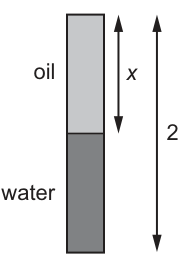
What is the depth of the oil?
Options
A
B
C
D
Working
Pressure due to liquids:
Using ,
Answer
Option D
D
Background Concept
For a liquid of density at rest, the pressure increase with depth is
where is the gravitational field strength. If there are layers of different liquids, the total pressure increase from the top to the bottom is the sum of the pressure increases across each layer:
This works because pressure is continuous at the boundary between the liquids, and each layer contributes according to its own density and thickness.
Understanding the Question
A vertical borehole is deep. The top part is oil of density with unknown depth , and the rest is water of density with depth .
The pressure at the bottom due to the liquids (so the hydrostatic/gauge pressure from the columns of oil and water) is given as . We must find and then choose the correct option.
Approach
- Write an expression for the pressure at the bottom as the sum of the hydrostatic pressures from the oil column and the water column.
- Substitute the given densities and depths ( for oil and for water).
- Solve the resulting linear equation for .
- Compare with the options.
Step-by-Step Reasoning
Pressure contribution from oil (depth ):
Pressure contribution from water (depth ):
Total pressure due to liquids at the bottom:
Expand and simplify inside the brackets:
So
Divide by (taking ):
Numerically,
Rearrange:
So the oil depth is about , which corresponds to option D.
Key Takeaways
- Hydrostatic pressure increases with depth according to .
- For multiple liquid layers, add the contributions: .
- Convert MPa to Pa correctly: .
Common Mistakes
- Using a single density for the full instead of treating oil and water separately.
- Forgetting to convert to .
- Writing the water depth as instead of .
- Using here would not match the options; this question effectively requires or .
Things to Be Careful About
- The phrase “pressure due to the liquids” indicates hydrostatic (gauge) pressure from the columns, not including atmospheric pressure.
- Keep units consistent: in , in , giving pressure in .
- When you simplify, check the sign: since water is denser than oil, increasing the oil depth should reduce the bottom pressure (because it replaces denser water), which is consistent with the term decreasing as increases.
A rod is pivoted at one end. Initially the angle of the rod to the horizontal is .
The weight of the rod causes a moment about the pivot.
The rod is then rotated in the vertical plane so that the angle of the rod increases from to .
Which graph shows the variation of with ?
Options
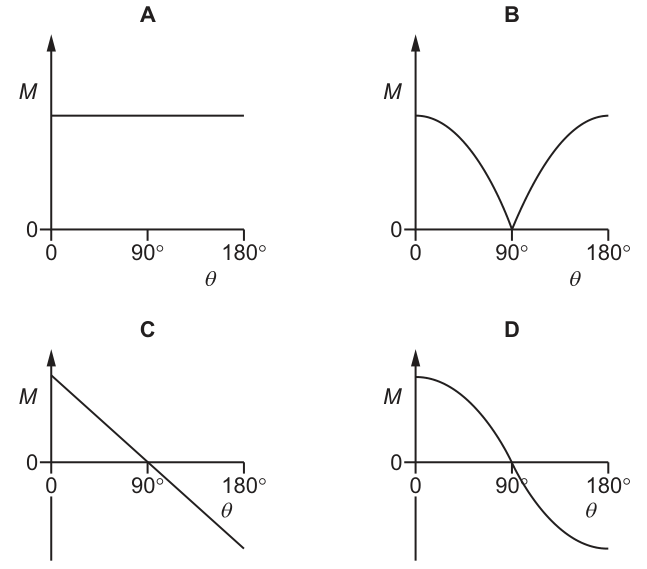
Working
Weight acts at the centre of the rod.
Perpendicular distance from pivot to the vertical line of action of is the horizontal distance of the centre:
So the moment about the pivot is
Hence decreases smoothly from a positive maximum at to at and becomes negative by .
Answer
D
D
Background Concept
The moment (torque) of a force about a pivot is
where is the perpendicular distance from the pivot to the line of action of the force. For a uniform rod pivoted at one end, its weight acts vertically downward at its centre of mass, which is at the midpoint of the rod.
A key idea: as the rod rotates, the force stays vertical, but the perpendicular distance from the pivot to the vertical line of action changes with angle.
Understanding the Question
You are told a rod is pivoted at one end and rotated in a vertical plane. The angle is measured between the rod and the horizontal, increasing from (rod horizontal) to (rod horizontal but pointing the opposite way). The question asks which graph of moment (due to the rod’s weight only) against is correct.
So we need how the lever arm of the weight changes with , including the change of sign (direction) of the turning effect.
Approach
- Take the rod length as and weight as .
- Locate the centre of mass: at distance from the pivot along the rod.
- Write the perpendicular distance from pivot to the vertical line of action of in terms of .
- Use and decide the sign of for from to .
- Match the resulting shape to the given options.
Step-by-Step Reasoning
Let the pivot be at the origin. When the rod makes angle to the horizontal, the midpoint has horizontal coordinate
The weight acts vertically downward through this point. A vertical line has constant , so the perpendicular distance from the pivot (origin) to that vertical line is simply .
So the magnitude of the moment is
But the question’s graphs include negative values, so we consider direction:
- At , the rod points to the right; the weight acts downward at , producing (say) an anticlockwise moment taken as positive. So is positive and maximum.
- At , the rod is vertical; the weight’s line of action passes through the pivot (), so the moment is zero.
- At , the rod points to the left; the midpoint is at and the moment reverses direction compared with , so is negative with the same magnitude.
This is captured by
So follows a cosine variation: smooth curve from positive at , through zero at , to negative at .
Among the options, this corresponds to the smooth curve crossing zero at (not a straight line), i.e. option D.
Key Takeaways
- Moment depends on the perpendicular distance to the line of action, not the distance along the rod.
- For a uniform rod pivoted at one end, the centre of mass is at .
- As the rod rotates, the lever arm of the vertical weight is the horizontal component: proportional to .
- Moment changes sign when the line of action moves from one side of the pivot to the other.
Common Mistakes
- Using instead of (mixing up which component is perpendicular to the vertical force).
- Assuming the moment is always positive (ignoring the reversal of turning direction after ).
- Thinking the moment is maximum at ; actually it is zero there because the line of action passes through the pivot.
- Choosing the straight-line graph (option C) rather than recognising the trigonometric dependence.
Things to Be Careful About
- Always identify the line of action of the force (here vertical) and measure the perpendicular distance to that line.
- Decide and keep a consistent sign convention for moments; the sign change is an essential clue for selecting the correct graph.
- The functional form here is smooth (cosine), so any graph with sharp corners or linear behaviour is unlikely.
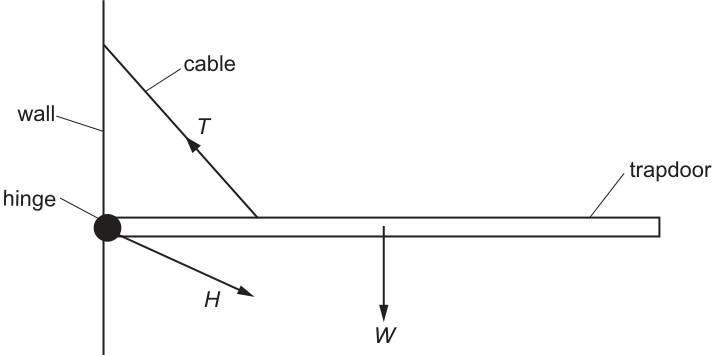
A hinged trapdoor is held closed in the horizontal position by a cable.
Three forces act on the trapdoor: the weight of the door, the tension in the cable and the force at the hinge.
Which list gives the three forces in increasing order of magnitude?
Options
A , ,
B , ,
C , ,
D , ,
Working
Take moments about the hinge. If the door has length and the cable is attached a distance from the hinge at angle to the door,
Since , it follows that .
Force equilibrium gives , so is the resultant needed to balance with an extra downward . With , this makes slightly less than but greater than , hence
Answer
C
C
Background Concept
For a rigid body in static equilibrium:
- The resultant force is zero:
- The resultant moment about any point is zero:
The moment (torque) of a force about a point is
where is the perpendicular distance from the point (pivot) to the line of action of the force.
A key idea is that a force applied very close to the hinge has a small moment arm, so it must be large to provide a given balancing moment.
Understanding the Question
A horizontal trapdoor is hinged to a wall at the left. Three forces act:
- weight acting vertically downward at the centre of the door,
- tension in a cable running up to the wall, attached to the door near the hinge,
- hinge force (the reaction at the hinge).
The question asks for the three forces in increasing order of magnitude.
Approach
- Use the principle of moments about the hinge. This removes from the torque equation because acts at the hinge so its moment about the hinge is zero.
- Compare with using the moment arms (the cable attachment is close to the hinge, while acts at the centre).
- Use force equilibrium (vector addition) to decide where sits relative to and .
Step-by-Step Reasoning
1. Compare and using moments about the hinge
Let the door length be , so the weight acts at distance from the hinge.
Let the cable be attached at distance from the hinge (near the hinge, so is much smaller than ). If the cable makes angle to the horizontal door, then the perpendicular distance from the hinge to the line of action of is .
Moment balance about hinge:
So
Because , the fraction is greater than , hence
So is not the largest force.
2. Relate to and using force equilibrium
Translational equilibrium requires
so
That means the hinge force is the resultant needed to balance the combined effect of and .
Since is already larger than , adding (downwards) changes the direction of the resultant but does not make the required balancing force smaller than .
In fact, when one force is much larger than the other (), the magnitude of the resultant is close to (it is slightly less than here because adds a downward component whereas has an upward component).
Therefore the ordering is
This corresponds to option C.
Key Takeaways
- Taking moments about the hinge is the fastest way to compare and because the hinge reaction produces no moment about the hinge.
- A force applied close to the pivot must be large to balance a torque produced farther away.
- In equilibrium, the hinge reaction is found from vector force balance: it is the resultant needed to cancel the other forces.
Common Mistakes
- Comparing vertical components only (e.g. assuming ). The cable force is not vertical and also must supply a balancing moment.
- Forgetting the perpendicular distance for moments and using instead of .
- Assuming just because both are shown roughly similar on a sketch. is a resultant vector reaction, not generally equal to any single other force.
Things to Be Careful About
- The attachment point of the cable being near the hinge is the crucial clue: small moment arm implies large .
- is a single force but it represents both horizontal and vertical hinge reactions combined; its magnitude is not found by a simple scalar addition like .
- Ordering is by magnitude (size), not by vertical component or by how long the arrows look in a sketch.
What is the definition of force?
Options
A the product of mass and acceleration
B the product of mass and velocity
C the rate of change of momentum
D the rate of transfer of energy
Working
Force is defined by Newton's second law as the rate of change of momentum:
This corresponds to option C.
Answer
C
C
Background Concept
Newton's second law gives the most general definition of force in mechanics. It states that the resultant (net) force on a body equals the rate of change of its momentum:
where momentum is
If the mass is constant, then
So is a special case of the more fundamental momentum definition.
Understanding the Question
You are asked for the definition of force. The options include expressions involving , , rate of change of momentum, and rate of transfer of energy. The correct definition must match Newton's second law.
Approach
Identify which option states Newton's second law in its defining form. Then select that letter.
Step-by-Step Reasoning
- The definition of force is:
(or ).
- Compare with options:
- A: "product of mass and acceleration" is , which is only valid when mass is constant; it is not the most general defining statement.
- B: "product of mass and velocity" is momentum , not force.
- C: "rate of change of momentum" matches Newton's second law definition.
- D: "rate of transfer of energy" is power , not force.
Therefore the correct option is C.
Key Takeaways
- The general definition of force is the rate of change of momentum: .
- is a derived special case when mass is constant.
- Momentum is and power is .
Common Mistakes
- Choosing A because is familiar, forgetting the question asks for the definition (momentum form is the defining law).
- Choosing B by confusing force with momentum.
- Choosing D by confusing force with power.
Things to Be Careful About
- In A-Level marking, "definition of force" is taken as (or ), not merely .
- Force is a vector; in full statements it is the resultant force that equals the rate of change of momentum.
A boat moves at a constant velocity through still water.
A constant drag force acts on the boat.
What is the power used by the boat to move through the water?
Options
A
B
C
D
Working
At constant velocity, the driving force equals the drag force .
Power:
Answer
B
B
Background Concept
Power is the rate of doing work:
For a constant force acting parallel to the direction of motion, the work done in moving a distance is . If the object moves with speed , then , so:
This result applies when the force considered is the force provided by the engine (the force through which the engine does work on the boat), and it is along the direction of motion.
Understanding the Question
The boat moves through still water at constant velocity . There is a constant drag force of magnitude opposing the motion. The question asks for the power used by the boat (i.e. the power output needed to maintain that constant speed against drag).
Approach
- Use the constant velocity condition: resultant force is zero, so the forward driving force must equal the drag force in magnitude.
- Use the power relation for motion at speed : .
- Match the expression to the given options.
Step-by-Step Reasoning
Since the boat’s velocity is constant, its acceleration is zero, so the net force on it is zero. Therefore, the engine’s driving force must balance the drag force:
The power required to supply this driving force at speed is:
This corresponds to option B.
Key Takeaways
- At constant speed, driving force equals resistive force (resultant force is zero).
- Power delivered by a force along the motion is .
Common Mistakes
- Choosing by confusing with kinetic energy .
- Writing or (wrong dimensions: power has units of , which matches ).
Things to Be Careful About
- The force used in must be the force through which work is done (here, the forward driving force), not the net force. At constant velocity, net force is zero but the engine still does work against drag.
- Check dimensions: gives .
The diagram shows four forces acting on a circular disc.
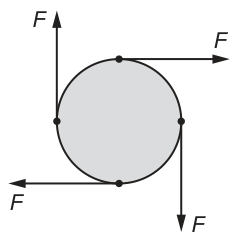
Each force has magnitude . Two of the forces act vertically and the other two forces act horizontally.
All four forces act in the same plane as the disc. No other forces act on the disc.
The disc has diameter .
Which statement is correct?
Options
A The disc is in equilibrium because the resultant force is zero.
B The disc is not in equilibrium because the resultant force is .
C The disc is in equilibrium because the resultant torque is zero.
D The disc is not in equilibrium because the resultant torque is .
Working
Vertical forces: .
Horizontal forces: .
So resultant force is .
Each force is tangential at radius , so torque from each is
All four torques act in the same (clockwise) sense, hence
Resultant torque is non-zero, so the disc is not in equilibrium.
Answer
D
D
Background Concept
For a rigid body in a plane, equilibrium requires both:
- Resultant force is zero (no linear acceleration):
- Resultant torque (moment) about any point is zero (no angular acceleration):
The torque (moment) of a force about a chosen point is
A common trap is to stop once you find the resultant force is zero; a body can still rotate if the forces form a couple or produce a non-zero net moment.
Understanding the Question
There are four forces, each of magnitude , acting at the rim of a disc of diameter (radius ). Two forces are vertical (one up, one down) and two are horizontal (one left, one right). The directions are arranged so that they tend to turn the disc in the same rotational sense.
We must decide which statement about equilibrium/resultant force/resultant torque is correct.
Approach
- Add the horizontal and vertical forces separately to find the resultant force.
- Take moments about the centre of the disc (the obvious point because distances are simple).
- Add the torques with a sign convention (e.g. clockwise positive) to find the resultant torque.
- Use the equilibrium conditions: equilibrium needs both resultant force and resultant torque to be zero.
Step-by-Step Reasoning
1) Resultant force
- Vertical forces: one upward and one downward .
- Horizontal forces: one rightward and one leftward .
So the vector sum of all forces is zero.
2) Resultant torque about the centre
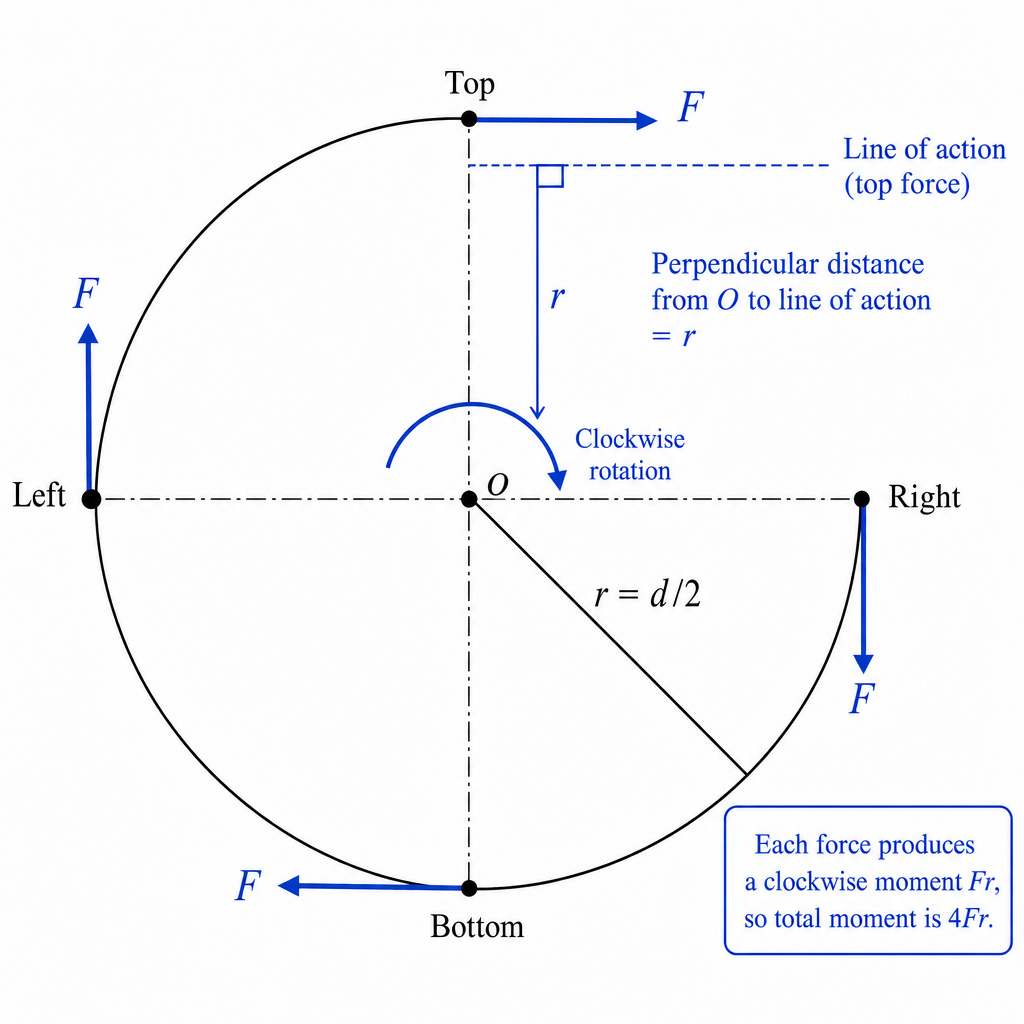
Each force acts tangentially at the rim. The perpendicular distance from the centre to each force’s line of action is the radius
So the torque magnitude from each force is
From the diagram’s directions, each force tends to rotate the disc the same way (clockwise), so the torques add:
Since , the disc has a net turning effect and is not in equilibrium.
Therefore the correct statement is: the disc is not in equilibrium because the resultant torque is .
Key Takeaways
- Equilibrium of a rigid body requires and .
- Symmetry can make the resultant force zero while leaving a non-zero couple (net torque).
- Tangential forces at radius produce torque about the centre.
Common Mistakes
- Choosing option A because the resultant force is zero, forgetting to check torque.
- Using instead of as the moment arm for a force acting at the rim.
- Incorrectly cancelling torques by assuming “forces balance” implies “moments balance”.
- Adding torques with mixed directions (not checking whether all are clockwise/anticlockwise).
Things to Be Careful About
- The perpendicular distance is to the line of action of the force, not just “distance to the point where it acts”. Here that perpendicular distance equals the radius .
- Always state the rotational sense (clockwise/anticlockwise) when discussing resultant torque.
- A zero resultant force does not guarantee equilibrium for an extended object.
A ball is projected into the air from horizontal ground and follows the path shown in the diagram.
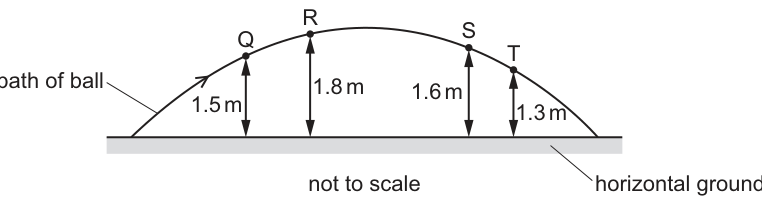
At points , , and , the ball has kinetic energies , , and respectively. The heights above the ground of these four points are shown.
Air resistance is negligible.
Which difference in kinetic energies is the smallest?
Options
A
B
C
D
Working
With negligible air resistance, mechanical energy is conserved:
So for two points 1 and 2,
Hence the kinetic-energy difference depends only on the height difference.
Heights: , , , .
Smallest is .
Answer
A
A
Background Concept
When air resistance is negligible, the only significant force doing work on the projectile is its weight. Weight is a conservative force, so the total mechanical energy stays constant:
Near Earth, gravitational potential energy is
As the ball rises, increases so increases, meaning must decrease by the same amount. As it falls, decreases so increases.
A very useful consequence is that the change in kinetic energy between two points depends only on the change in height:
Understanding the Question
Four points on the projectile path have heights:
You are asked which listed difference in kinetic energies is the smallest. Because air resistance is negligible, you do not need the speed components; you only need the heights.
Approach
- Use conservation of mechanical energy to relate kinetic energy differences to height differences.
- For each option, convert the kinetic-energy difference into .
- Compare the magnitudes; the smallest height difference gives the smallest kinetic-energy difference.
Step-by-Step Reasoning
Start with
So for points 1 and 2:
Rearrange:
Now evaluate each option using the given heights.
Option A:
Option B:
Option C:
Option D:
Comparing , , , , the smallest is , so A is correct.
Key Takeaways
- With negligible air resistance, mechanical energy is conserved for a projectile.
- Kinetic-energy differences between two points depend only on the height difference: .
- Smallest kinetic-energy change corresponds to the smallest change in height.
Common Mistakes
- Trying to use projectile equations for velocity components; they are unnecessary here.
- Thinking the shape of the path or horizontal distance matters for energy changes; only height matters (since no air resistance).
- Mixing up the sign: higher point means smaller kinetic energy.
Things to Be Careful About
- Use the height of the second term in the subtraction correctly (e.g. uses ).
- Compare magnitudes consistently; a smaller height difference always means a smaller kinetic-energy difference because is the same for all points.
The battery of a small tablet computer is initially uncharged. It is connected to a constant power supply for to charge the battery.
The efficiency of the charging process is .
What is the total energy stored in the battery?
Options
A
B
C
D
Working
Time:
Energy supplied:
Energy stored (80% efficient):
Answer
C
C
Background Concept
Power is the rate of energy transfer:
So if power is constant, the energy transferred in time is:
Efficiency describes the fraction of input energy that becomes useful output (here, energy stored in the battery):
So:
Understanding the Question
A charger supplies a constant power of for . Not all of that electrical energy ends up stored in the battery because the process is only efficient; the rest is lost (e.g. as heat). The question asks for the total energy actually stored in the battery.
Approach
- Convert into seconds because .
- Calculate the input energy using .
- Multiply by to get the stored energy.
- Compare with the options / round appropriately.
Step-by-Step Reasoning
Convert time:
Energy delivered by the supply:
Only is stored:
Rounding to match the options (2 s.f.):
This corresponds to option C.
Key Takeaways
- With constant power, energy transferred is .
- Always convert time to seconds when using watts.
- Efficiency multiplies the input energy to give the useful (stored) energy.
Common Mistakes
- Using instead of converting hours to seconds.
- Dividing by instead of multiplying (efficiency less than 1 means stored energy is smaller than input).
- Forgetting that and mixing incompatible units.
Things to Be Careful About
- The time conversion is the main place errors occur: .
- Rounding: rounds to (not ).
- Efficiency is given as , so use in calculations.
An initially stationary firework explodes and splits into two fragments that move horizontally in opposite directions.
The total kinetic energy transferred to the fragments by the explosion is .
One fragment has mass and the other one has mass .
What is the speed of the fragment of mass immediately after the explosion?
Options
A
B
C
D
Working
Initial momentum is zero, so after the explosion momenta are equal and opposite:
Total kinetic energy:
Substitute :
Answer
D
D
Background Concept
When an object explodes in free space (or when external forces are negligible during the short explosion time), the total momentum of the system is conserved.
If the object is initially stationary, the initial momentum is zero, so the vector sum of the fragment momenta after the explosion must also be zero. For two fragments moving in opposite directions along the same line, this means their momenta have equal magnitude.
Kinetic energy is not conserved in an explosion; instead, chemical/internal energy is converted into kinetic energy. Here we are told the total kinetic energy gained by the fragments is :
Understanding the Question
- A firework starts at rest and splits into two fragments moving horizontally in opposite directions.
- Masses: and .
- Total kinetic energy after explosion: .
- We want the speed of the fragment of mass immediately after the explosion.
Because it starts from rest, momentum conservation gives a relationship between the two speeds; the energy statement provides the second equation.
Approach
- Use conservation of momentum with initial momentum to relate the speeds of the two fragments.
- Write the total kinetic energy as the sum of the fragments’ kinetic energies.
- Substitute the momentum relation into the energy equation and solve for the required speed.
Step-by-Step Reasoning
Let the speed of the mass fragment be and the speed of the mass fragment be (in the opposite direction).
1) Momentum conservation
Initial momentum , so final momenta must cancel:
Cancel :
So the lighter fragment must move faster.
2) Total kinetic energy
Simplify the second term:
3) Substitute
So:
Then:
Hence the required speed is:
This matches option D.
Key Takeaways
- For an explosion from rest into two fragments in opposite directions: in magnitude.
- Momentum conservation gives a speed ratio set by inverse mass ratio.
- Total kinetic energy is the sum for each fragment; combine with the momentum relation to solve.
Common Mistakes
- Setting the speeds equal (they are not equal unless the masses are equal).
- Forgetting the factor of in the kinetic energy term for the heavier fragment.
- Using and then mishandling the negative sign; using magnitudes avoids this in a speed question.
- Assuming kinetic energy is conserved (it is not; is given as energy transferred by the explosion).
Things to Be Careful About
- Momentum is a vector: the two fragments move in opposite directions, so their momenta cancel.
- The question asks for speed (magnitude), not velocity direction.
- Ensure algebraic substitutions are squared correctly: if , then .
A spring is fixed at one end and extended by applying force to the other end. The spring has extension and elastic potential energy . The spring constant is .
The spring obeys Hooke’s law.
Which relationship is correct for this spring?
Options
A
B
C
D
Working
For a Hooke's law spring,
Elastic potential energy stored:
So .
Answer
D
D
Background Concept
A spring that obeys Hooke’s law has force proportional to extension:
where is the spring constant and is the extension.
The elastic potential energy stored in the spring is the work done in stretching it from to .
For a Hooke’s law spring, the force increases linearly from to , so the work done is the area under the straight-line – graph (a triangle).
Hence:
Understanding the Question
You are told the spring obeys Hooke’s law and you are asked which proportionality statement about is correct.
The options relate to , , , or .
Approach
- Use Hooke’s law .
- Use the expression for elastic potential energy (or derive it from ).
- Identify which option matches the dependence of .
Step-by-Step Reasoning
From Hooke’s law:
The elastic potential energy stored is the work done stretching the spring. Because rises linearly with , average force during the stretch is , so:
Substitute :
Therefore, as changes,
So the correct option is D.
Key Takeaways
- Hooke’s law: (linear force–extension relationship).
- Elastic potential energy is the area under the – graph.
- For a Hooke’s law spring: , so .
Common Mistakes
- Assuming because (energy depends on work done, not just force).
- Choosing without noticing that is not constant during the stretching.
- Forgetting the factor from the triangular area under the – graph.
Things to Be Careful About
- Proportionalities usually mean “while other relevant quantities are not fixed unless stated”; the safest is to use the full expression and compare directly.
- is quadratic in : doubling makes four times bigger (not double).
A force–extension graph is produced for a metal wire.
What must describe the limit of proportionality of the wire?
Options
A the point at which the wire breaks
B the point beyond which Hooke’s law is not obeyed
C the point beyond which the wire cannot return to its original length
D the point beyond which the wire starts to deform plastically
Hooke’s law states that force is proportional to extension () in the linear region of a force–extension graph.
The limit of proportionality is the point beyond which this proportionality no longer holds.
Answer
B
B
Background Concept
For a wire (or spring) that obeys Hooke’s law, the extension is proportional to the applied force :
where is a constant (spring constant / stiffness). On a force–extension graph, this corresponds to a straight line through the origin.
The limit of proportionality is defined as the point up to which and remain directly proportional (i.e. the graph is linear). Beyond this point, the graph starts to curve, meaning is no longer constant and Hooke’s law is no longer obeyed.
It is important not to confuse this with:
- elastic limit: the greatest load after which the material still returns to its original length when unloaded,
- yield point / plastic deformation: when permanent deformation begins,
- breaking point: when the wire snaps.
Understanding the Question
You are given that a force–extension graph has been produced and asked what must describe the limit of proportionality. The options describe different characteristic points on a typical force–extension graph (linear limit, elastic limit, yield/plastic region, and fracture).
So you must pick the option that matches the definition: “end of proportional (linear) behaviour”.
Approach
- Recall what “proportional” means on a graph: a straight line relationship .
- Identify which option says that beyond this point Hooke’s law (the proportional law) is not obeyed.
Step-by-Step Reasoning
- Hooke’s law corresponds to the proportional relationship .
- The limit of proportionality is therefore the point where the graph stops being a straight line.
- Option B states: “the point beyond which Hooke’s law is not obeyed”, which is exactly this definition.
Why the others are not “must” descriptions of the limit of proportionality:
- A (breaks): fracture occurs later than the proportional limit.
- C (cannot return to original length): that describes exceeding the elastic limit (permanent set), not necessarily the proportional limit.
- D (starts to deform plastically): plastic deformation typically begins at/after the yield point, which is not necessarily the same as the limit of proportionality.
Key Takeaways
- Limit of proportionality = end of straight-line (Hooke’s law) region on a force–extension graph.
- It is a different concept from elastic limit, yield (plastic deformation), and breaking point.
Common Mistakes
- Choosing D because students mix up “no longer proportional” with “plastic deformation begins” (these can be close on some materials but are not the same definition).
- Choosing C because students confuse “proportional limit” with “elastic limit”. A material can become non-linear yet still be elastic.
Things to Be Careful About
- “Hooke’s law not obeyed” means not proportional, i.e. graph not linear; it does not automatically mean permanent deformation.
- Exam wording: “limit of proportionality” is always about proportionality/linearity, not about breaking or plastic flow.
A spring has a spring constant of . It is joined to another spring whose spring constant is . A load of is suspended from this composite spring.
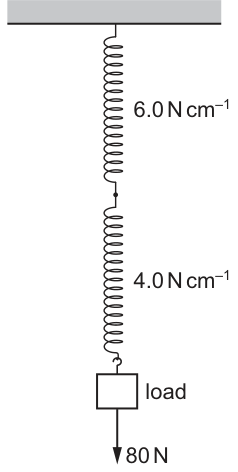
What is the extension of this composite spring?
Options
A
B
C
D
Working
For springs in series, the force in each spring is and extensions add.
Answer
D
D
Background Concept
For a spring obeying Hooke's law,
where is the tensile force (load), is the spring constant, and is the extension.
For two springs in series:
- the same force acts through both springs (they are in a single chain),
- the total extension is the sum of the individual extensions:
Understanding the Question
You have two vertical springs connected end-to-end (series): the upper has and the lower has . A load of hangs from the bottom.
The question asks for the overall extension of the two-spring combination.
Approach
- Because the springs are in series, take the force in each spring as .
- Use to find each extension in cm (since is given in ).
- Add the two extensions to get the composite extension, then match to the nearest option.
Step-by-Step Reasoning
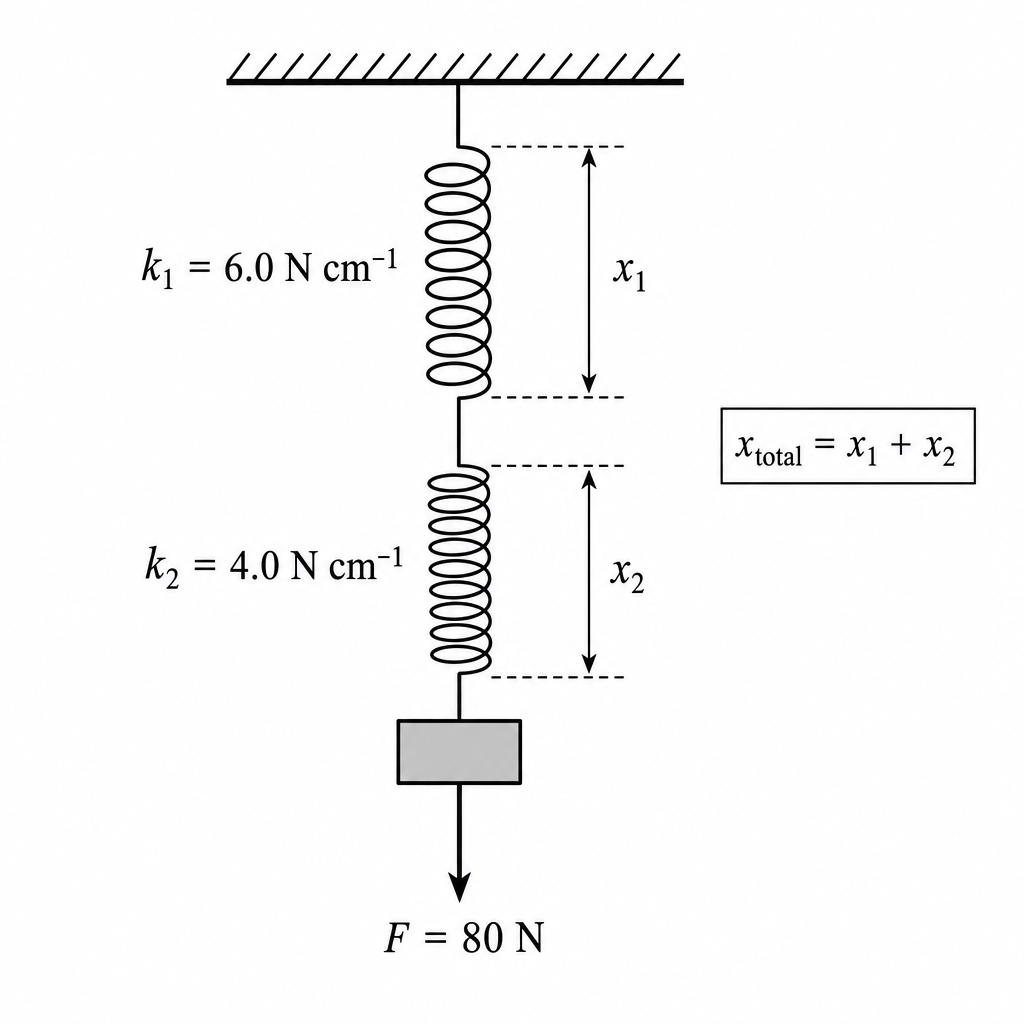
For the top spring:
For the bottom spring:
Total extension (series):
Rounded to match the options: , which is D.
Key Takeaways
- Hooke's law: .
- Springs in series: same force in each spring, and extensions add.
- Keep units consistent with (here gives extension directly in cm).
Common Mistakes
- Treating the springs as parallel (adding spring constants) instead of series.
- Dividing the force between springs; in series the force is not shared.
- Converting to but then forgetting to convert the final extension to cm.
Things to Be Careful About
- Recognise the connection is series from the diagram (end-to-end).
- If you do convert: and ; either unit route is fine if consistent.
- Options are given to 2 s.f. / whole cm, so rounding to is appropriate.
The range of frequencies of sound waves emitted by blue whales is to .
The speed of sound in seawater is approximately .
What is the approximate range of wavelengths of the sound waves emitted by blue whales?
Options
A to
B to
C to
D to
Working
Use
Speed of sound:
At :
At :
Range to .
Answer
D
D
Background Concept
For a progressive wave, the wave speed is related to frequency and wavelength by
- is in
- is in (=)
- is in
Rearranging gives
So, for a fixed wave speed, higher frequency means shorter wavelength.
Understanding the Question
We are told blue whales emit sound between and , and sound travels in seawater at about . The question asks for the corresponding range of wavelengths.
That means:
- find the longest wavelength (this occurs at the lowest frequency, )
- find the shortest wavelength (this occurs at the highest frequency, )
- then match that range to an option.
Approach
- Convert to .
- Use at and at .
- Round to a sensible level (this is an approximate multiple-choice question) and compare with the given options.
Step-by-Step Reasoning
Convert the speed:
Longest wavelength at :
Shortest wavelength at :
So the wavelength range is about to , which matches option D.
Key Takeaways
- Use to connect frequency and wavelength.
- For constant , wavelength is inversely proportional to frequency: .
- Always convert speeds like into before calculating.
Common Mistakes
- Using instead of .
- Forgetting to convert to , leading to answers smaller by a factor of .
- Swapping the ends of the range (thinking higher frequency gives longer wavelength).
Things to Be Careful About
- The question asks for an approximate range, so rounding to is appropriate.
- Make sure the units stay consistent: in and in gives in metres.
A sound wave is detected by a microphone and displayed on the screen of a cathode-ray oscilloscope (CRO).
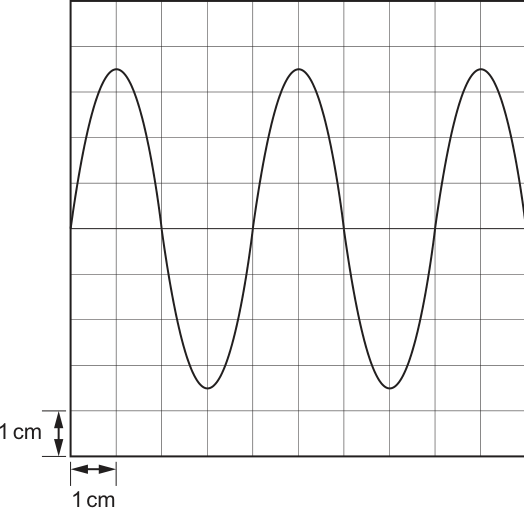
The frequency of the wave is .
What is the setting on the time-base of the CRO?
Options
A
B
C
D
Working
Frequency .
From the trace, cycles occupy the full screen width of .
Answer
A
A
Background Concept
A CRO time-base sets how much time corresponds to each horizontal centimetre (or division) on the screen. The horizontal axis is time, so one complete wave cycle (one period ) takes a time
where is the frequency.
Understanding the Question
You are given the frequency of the sound wave, and you are shown a CRO trace. The CRO grid indicates that the screen width is (10 horizontal divisions of each). The trace shows about complete cycles across the whole width.
The question asks for the time-base setting in or .
Approach
- Convert the given frequency to a period .
- Use the number of cycles across the screen to find the total time represented across the full width.
- Divide by the screen width in cm to get time per cm.
- Match to the closest option.
Step-by-Step Reasoning
- Convert frequency:
- Find the period:
- Interpret the CRO trace: cycles fit across the full width of . So the time across the whole screen is
- Convert to time per cm (the time-base setting):
This corresponds to option A.
Key Takeaways
- The horizontal axis on a CRO is time; the time-base is the time represented per unit horizontal distance.
- Use to convert frequency to period.
- Counting cycles on the trace lets you relate screen width to total elapsed time.
Common Mistakes
- Using instead of .
- Forgetting that .
- Taking the number of cycles across the screen as or similar, instead of multiplying by the period.
- Dividing by the wrong screen width (e.g. using instead of the full ).
Things to Be Careful About
- Make sure you use the full horizontal span shown by the grid (typically ).
- Ensure the counted “cycles” are complete periods (peak-to-peak or trough-to-trough consistently).
- Check units at the end: the options mix and , so the size of your answer should be sensible (a wave has a sub-millisecond period, so the time-base must be in ms, not seconds).
A source of sound waves with constant frequency moves towards a stationary observer.
The observer compares the sound waves arriving at the observer’s position with the waves emitted by the source of sound.
What is detected by the observer?
Options
A a decreased frequency of the sound waves
B no change in frequency of the sound waves
C a decreased wavelength of the sound waves
D no change in wavelength of the sound waves
Working
For sound in a stationary medium, the wave speed is (approximately) constant.
The source moves towards the observer, so wavefronts in front of the source are closer together (\Rightarrow) wavelength at the observer decreases.
Using
with constant, a smaller implies a larger detected (so frequency is not decreased).
Answer
C
C
Background Concept
The Doppler effect is the change in the observed frequency (and corresponding wavelength) of a wave due to relative motion between source and observer.
For sound in air, the wave speed in the medium (air) is approximately constant for a given set of conditions. The relationship between wave speed , frequency and wavelength is
For a moving source with constant emitted frequency :
- the source emits successive crests a time apart,
- but because the source moves forward between emissions, the spacing between crests in front of the source becomes smaller than it would be if the source were stationary.
Understanding the Question
- The source has constant emitted frequency.
- The observer is stationary.
- The source moves towards the observer.
- The observer compares the waves arriving with the waves emitted.
So we must decide what changes at the observer: frequency and/or wavelength.
Approach
Use the qualitative Doppler idea:
- Moving source towards observer (\Rightarrow) wavefronts ahead are compressed (\Rightarrow) wavelength in front decreases.
- Since in the air is (approximately) unchanged, apply to infer how the detected frequency changes.
- Match to the given options.
Step-by-Step Reasoning
- The source emits crests with constant period (constant emitted frequency ).
- Between emitting one crest and the next, the source moves closer to the observer. Therefore, the second crest is emitted from a position nearer the observer.
- This makes the distance between successive crests in front of the source smaller than normal, so the wavelength arriving at the observer is decreased.
- In the air (stationary medium), is approximately constant, so from
if decreases then must increase.
5. The options do not include “increased frequency”, but they do include “decreased wavelength”, which is consistent with the situation.
Therefore the correct choice is C.
Key Takeaways
- For a source moving towards an observer: observed wavelength decreases ahead of the source and observed frequency increases.
- For sound in air, treat as constant and use to link changes in and .
Common Mistakes
- Saying the frequency decreases when the source approaches (it increases).
- Thinking the wave speed increases because the source moves: the speed depends on the medium, not on the source speed (for this syllabus treatment).
- Confusing “emitted frequency” (constant here) with “detected frequency” (changes).
Things to Be Careful About
- The observer is stationary; it is the moving source case.
- When the source approaches, the front wavelength is reduced (compressed); behind the source it is increased.
- Options may not mention the frequency increase directly, so choose the option that correctly states what does happen (here: decreased wavelength).
Which type of waves cannot be polarised?
Options
A radio waves
B sound waves
C ultraviolet waves
D X-rays
Working
Polarisation is only possible for transverse waves.
Sound waves (in air) are longitudinal, so they cannot be polarised.
Answer
B
B
Background Concept
Polarisation means restricting the vibrations/oscillations of a wave to one plane (one direction) perpendicular to the direction of travel.
This only makes sense for transverse waves, where the oscillations are perpendicular to the direction the wave travels. For longitudinal waves, the oscillations are parallel to the direction of travel, so there is no “plane of vibration” to restrict, and therefore they cannot be polarised.
Understanding the Question
We are asked which listed wave type cannot be polarised. The options include several electromagnetic waves (radio, ultraviolet, X-rays) and sound.
We need to identify which option is not transverse.
Approach
- Recall: electromagnetic (e.m.) waves are transverse.
- Recall: sound waves in air are longitudinal.
- Conclude: the longitudinal one cannot be polarised.
Step-by-Step Reasoning
- Radio waves, ultraviolet waves, and X-rays are all electromagnetic waves.
- Electromagnetic waves are transverse, so they can be polarised.
- Sound waves in air are produced by compressions and rarefactions, so particle vibrations are parallel to the direction of propagation.
- Therefore sound waves in air are longitudinal.
- Longitudinal waves cannot be polarised.
Hence the correct option is sound waves.
Key Takeaways
- Only transverse waves can be polarised.
- Electromagnetic waves are transverse and can be polarised.
- Sound in air is longitudinal and cannot be polarised.
Common Mistakes
- Thinking “all waves can be polarised” (false: only transverse waves).
- Forgetting that sound in air is longitudinal (and confusing it with transverse waves on a string).
Things to Be Careful About
- The question is about the type of wave: polarisation depends on whether the oscillations are transverse or longitudinal, not on frequency or wavelength.
- Sound can be transverse only in certain solids (shear waves), but the standard A-Level assumption is sound in air is longitudinal.
A beam of light with power has an area of cross-section .
The amplitude of the light waves in the beam is .
The beam of light is then changed to one with the same frequency but with an increased amplitude of and an area of cross-section reduced to .
What is the power of the new beam?
Options
A
B
C
D
Working
Intensity .
Amplitude changes from to :
Power , so
Answer
so B.
B
Background Concept
For a wave, the intensity is the power transmitted per unit area:
For electromagnetic waves (light), the intensity is proportional to the square of the wave amplitude (e.g. electric field amplitude):
So, if the amplitude is multiplied by a factor , the intensity is multiplied by .
Understanding the Question
We start with a light beam of power and cross-sectional area .
- Initial amplitude:
- New beam: same frequency (so no change needed there), amplitude becomes , and area becomes .
We are asked for the new power in terms of the original power .
Approach
- Use to find how the intensity changes when amplitude changes from to .
- Use to include the effect of changing the beam cross-sectional area from to .
- Multiply the scaling factors to get .
Step-by-Step Reasoning
- Intensity scaling from amplitude:
So the new beam is times as intense.
- Power depends on both intensity and area:
Hence the ratio of powers is
Substitute and :
Therefore,
This matches option B.
Key Takeaways
- For light waves, .
- Beam power is related to intensity by .
- When multiple changes occur, compare ratios (scale factors) and multiply them.
Common Mistakes
- Using instead of (would give a factor of not ).
- Forgetting that changing area changes total power even if intensity is known.
- Applying the area factor upside down (using instead of ).
Things to Be Careful About
- Frequency being “the same” is a distraction here; the key relationship needed is intensity vs amplitude.
- Keep the ratio method clear: always write to avoid sign/inversion errors.
- Rounding: so the closest option is .
Two loudspeakers are connected to the same signal generator. The signal generator produces a single frequency. The loudspeakers face each other so that a stationary sound wave is set up in the region between the loudspeakers.
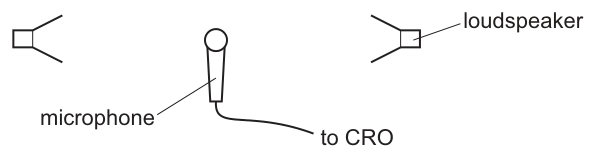
A microphone is connected to a cathode-ray oscilloscope (CRO) and positioned between the two loudspeakers.
The microphone is moved along a line joining the two loudspeakers.
The signal on the CRO shows maximum amplitudes as the microphone moves. The microphone moves a distance of from the position that gives the first maximum to the position that gives the fifth maximum.
What is the wavelength of the sound wave?
Options
A
B
C
D
Working
Successive maxima correspond to adjacent antinodes, separated by
From 1st to 5th maximum there are intervals, so
Answer
D
D
Background Concept
A stationary (standing) wave is formed by superposition of two waves of the same frequency and amplitude travelling in opposite directions. Along a stationary wave:
- Nodes are positions of zero displacement (minimum amplitude).
- Antinodes are positions of maximum displacement (maximum amplitude).
A key spacing result is:
- distance between adjacent antinodes (or adjacent nodes) is
because the pattern repeats every half-wavelength.
Understanding the Question
Two loudspeakers driven by the same signal generator face each other, creating a stationary sound wave between them. A microphone connected to a CRO is moved along the line between the speakers.
As it moves, the CRO shows 5 maximum amplitudes. That means the microphone passes through 5 antinodes (points where the sound amplitude is largest). The microphone travels 2.0 m from the position of the 1st maximum to the position of the 5th maximum.
We must find the wavelength (\lambda).
Approach
- Interpret each “maximum amplitude” as an antinode.
- Use the fact that the separation of adjacent antinodes is (\lambda/2).
- From the 1st to the 5th antinode there are 4 equal gaps, so relate the total distance to (4 \times \lambda/2), then solve for (\lambda).
Step-by-Step Reasoning
- 1st maximum = 1st antinode.
- 5th maximum = 5th antinode.
- Number of intervals between them:
- Each interval (between successive maxima/antinodes) is
- Total distance moved is therefore
- Solve:
So the correct option is D.
Key Takeaways
- In a stationary wave, adjacent nodes (or adjacent antinodes) are separated by (\lambda/2).
- If you are told the microphone meets several maxima, count the gaps between maxima, not the number of maxima.
Common Mistakes
- Using (\lambda) instead of (\lambda/2) for the spacing between adjacent maxima.
- Dividing by 5 instead of by 4 (forgetting that 5 maxima create 4 intervals between the first and fifth).
Things to Be Careful About
- “From first maximum to fifth maximum” means the distance covers four equal separations.
- Maxima in amplitude correspond to antinodes, not nodes, but both node-to-node and antinode-to-antinode spacing is (\lambda/2).
Two wave sources emit coherent waves.
Which condition must be correct for the coherent waves?
Options
A The waves are emitted in phase.
B The waves are emitted and move in opposite directions.
C The waves are emitted with a constant phase difference.
D The waves are emitted with the same amplitude.
For two sources to be coherent, their phase relationship must be fixed (constant phase difference).
Answer
C
C
Background Concept
Coherent sources are sources that produce waves with a stable (time-independent) phase relationship. In practice, for sustained interference fringes, the sources must have:
- the same frequency, and
- a constant phase difference.
The key idea is that the phase difference between the waves arriving at a point must not drift randomly with time; otherwise the interference pattern washes out.
Understanding the Question
You are told there are two wave sources emitting coherent waves. The question asks which condition must be correct (i.e. a defining requirement) for coherence, from the given options.
Approach
Use the definition of coherence: a constant phase difference (and same frequency). Then compare each option with this requirement.
Step-by-Step Reasoning
- Option C says the waves are emitted with a constant phase difference. This is exactly the definition of coherence, so it must be correct.
- Option A (“in phase”) describes one special case of constant phase difference where the phase difference is . This is sufficient but not necessary, so it is not the required condition.
- Option B (opposite directions) is irrelevant to coherence; coherence is about phase relationship and frequency, not propagation direction.
- Option D (same amplitude) is not required. Different amplitudes still produce interference; they just change the contrast/visibility of fringes.
Therefore the correct choice is C.
Key Takeaways
- Coherence means the phase difference between two sources (or two waves) remains constant.
- Being exactly in phase is only one possible constant phase difference.
- Amplitude and direction of travel are not defining conditions for coherence.
Common Mistakes
- Choosing “in phase” (A) instead of “constant phase difference” (C).
- Thinking equal amplitudes are necessary for interference.
- Confusing coherence with waves travelling in certain directions.
Things to Be Careful About
- In many syllabuses, coherence is stated as “same frequency and constant phase difference”; if only one condition is offered, the constant phase difference is the defining one.
- Remember that a constant phase difference can be any fixed value, not just .
A student sets up an experiment to investigate double-slit interference.
The student uses light of a single wavelength from a laser to illuminate a double slit so that a pattern of interference fringes is observed on the screen.
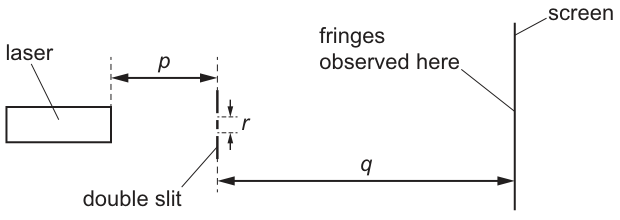
The student finds that the fringes are very close together.
What could the student decrease in order to increase the separation of the fringes on the screen?
Options
A the distance from the laser to the double slit
B the distance from the double slit to the screen
C the separation of the slits
D the wavelength of the light from the laser
Working
For double-slit interference, fringe separation is
To increase by decreasing a quantity, we must decrease .
Answer
C
C
Background Concept
In a double-slit experiment, waves from two slits interfere and form alternating bright and dark fringes on a screen. The separation of adjacent bright fringes (fringe spacing) depends on the geometry.
For slit separation and slit-to-screen distance , the fringe spacing is
where is the wavelength of the light. This result assumes small angles (screen far compared with slit separation), which is the usual double-slit arrangement.
Understanding the Question
The student observes that the fringes are very close together (small ). The question asks: which quantity could be decreased to make the fringes more widely separated (increase )? The options offer decreasing one of , , , or .
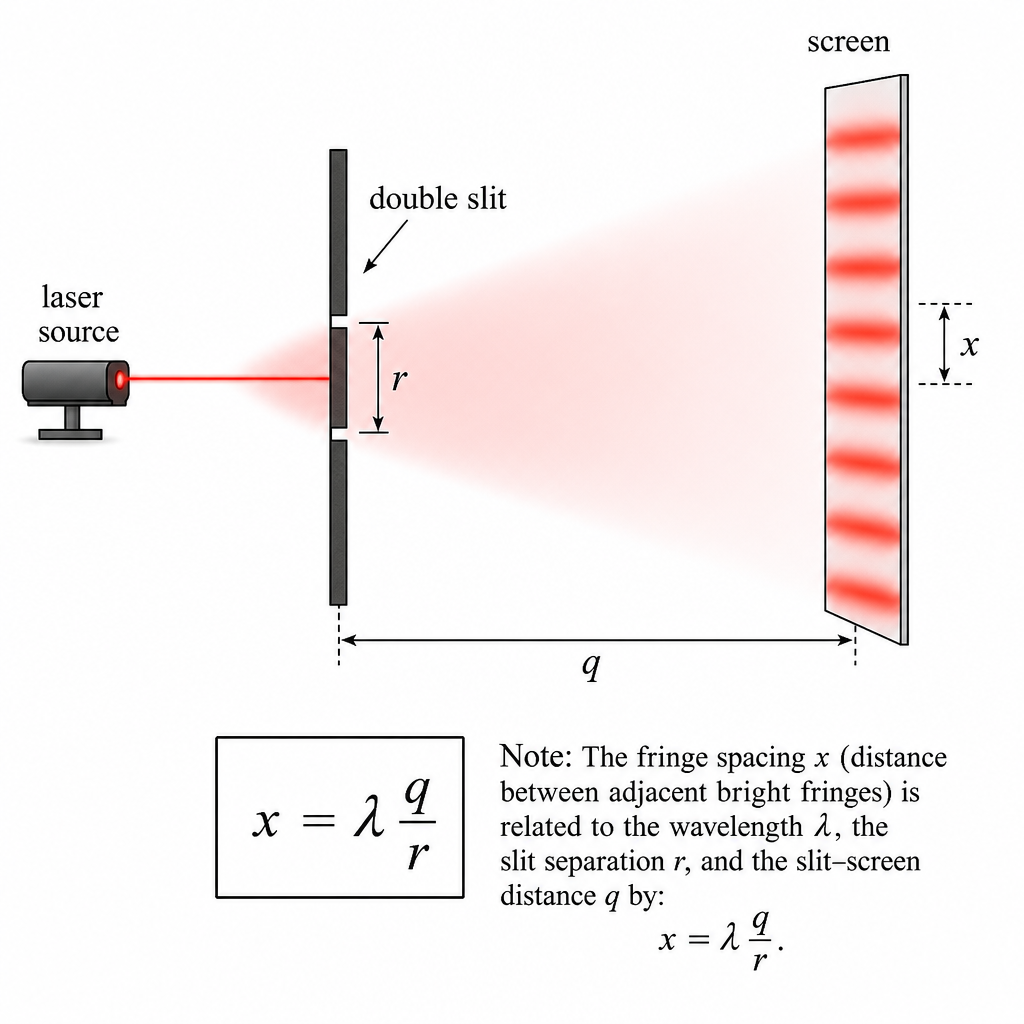
Approach
Use the fringe spacing formula and check how changes with each variable:
Then decide which decrease makes larger.
Step-by-Step Reasoning
Starting from
- Decreasing would decrease (wrong direction).
- Decreasing would decrease (wrong direction).
- Decreasing would increase because is in the denominator (correct).
- The distance (laser to double slit) does not appear in the fringe spacing expression, so changing does not directly increase .
Therefore the student should decrease the slit separation .
Key Takeaways
- Double-slit fringe spacing is
- To make fringes further apart: increase or , or decrease .
Common Mistakes
- Choosing because it is a distance, but forgetting that the question asks what to decrease.
- Thinking decreasing wavelength increases spacing (it does the opposite).
- Believing the laser-to-slit distance affects the fringe spacing; in standard double-slit geometry it mainly affects illumination/coherence rather than the spacing formula.
Things to Be Careful About
- Use the correct symbols from the diagram: here is slit-to-screen distance and is slit separation.
- Remember the inverse dependence: a smaller slit separation produces a larger fringe spacing.
- The formula is often written as ; here and .
What are the definitions of potential difference (p.d.) and electromotive force (e.m.f.), in terms of energy transfer and charge ?
Options
| p.d. | e.m.f. | |
|---|---|---|
| A | ||
| B | ||
| C | ||
| D |
Working
Potential difference:
Electromotive force:
Answer
A
A
Background Concept
Both potential difference (p.d.) and electromotive force (e.m.f.) describe energy transfer per unit charge.
- Charge moved: (in )
- Energy transferred: (in )
The common mathematical form is:
So both p.d. and e.m.f. have unit , which is the volt (V).
Understanding the Question
The question asks you to choose which option correctly states the definitions of:
- potential difference (p.d.) in terms of and
- electromotive force (e.m.f.) in terms of and
The options offer either or for each.
Approach
- Recall the definition of potential difference: work done (energy transferred) per unit charge between two points.
- Recall the definition of e.m.f.: energy supplied per unit charge by a source (e.g. a battery) to the circuit.
- Both are “per unit charge”, so both must be .
Step-by-Step Reasoning
- Potential difference is defined as:
- Electromotive force is defined as:
Therefore the option with p.d. and e.m.f. is correct, which is option A.
Key Takeaways
- Both p.d. and e.m.f. are measured in volts and have the form .
- Conceptually:
- e.m.f. is energy supplied per coulomb by the source.
- p.d. is energy transferred per coulomb in a component (or between two points).
Common Mistakes
- Choosing : this has units , not volts, so it cannot be correct.
- Thinking e.m.f. and p.d. must have different formulas: they share the same form but refer to different parts of the circuit (source vs component).
Things to Be Careful About
- Always check units: .
- The symbol here means energy transferred (work done), not weight (also sometimes written as in mechanics).
The diagram shows a network consisting of three resistors.
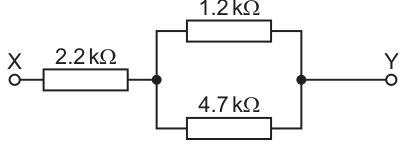
What is the combined resistance of the network between terminal and terminal ?
Options
A
B
C
D
Working
For the parallel section:
Total resistance:
Answer
C
C
Background Concept
Resistors combine in two common ways:
- Series: the same current flows through each resistor, so the potential differences add. The equivalent resistance is
- Parallel: the same potential difference is across each branch, and currents add. The equivalent resistance is found from
A quick check: a parallel combination must be less than the smallest resistor in that parallel set.
Understanding the Question
Between terminals and there is a resistor first, then the circuit splits into two branches containing (top) and (bottom), which rejoin before .
So the network is:
- in series with
- a parallel pair: and .
We want the total (equivalent) resistance between and .
Approach
- Replace the two resistors in parallel with a single equivalent resistance using the reciprocal formula.
- Add that equivalent resistance to the series resistor.
- Round to match the nearest option.
Step-by-Step Reasoning
1) Parallel part ( in parallel with ):
(using throughout is fine as long as we are consistent)
Sanity check: is less than , which is correct for a parallel combination.
2) Add the series resistor ():
This corresponds to option C.
Key Takeaways
- Identify clearly which resistors are in parallel (same two junctions) and which are in series (end-to-end with no branching between).
- Use reciprocals for parallel combinations and direct addition for series.
- Check plausibility: parallel resistance is always less than the smallest branch resistance.
Common Mistakes
- Adding the parallel resistors directly: would be series, not parallel.
- Adding reciprocals for the whole circuit: only the parallel section uses the reciprocal rule.
- Forgetting the series resistor: stopping after finding .
- Unit confusion: mixing and mid-calculation.
Things to Be Careful About
- Keep consistent units: either convert all to or keep all in .
- Rounding: calculate accurately first, then round to match the given options (here ).
- Topology clue: two components are parallel only if they connect across the same pair of junctions.
A resistor dissipates of power when there is a potential difference (p.d.) of across it.
What is the resistance of the resistor?
Options
A
B
C
D
Working
Using
Answer
B
B
Background Concept
Electrical power is the rate at which electrical energy is transferred in a component.
Key relationships:
Combine with Ohm's law to get alternative useful forms:
The form is most convenient when you are given a potential difference across a resistor and the power it dissipates.
Understanding the Question
You are told:
- power dissipated by the resistor:
- potential difference across it:
You must find the resistance and choose the matching option.
Approach
Use
because and are given directly. Rearrange to make the subject, then substitute the numbers.
Step-by-Step Reasoning
Start with
Rearrange for :
Substitute and :
So the correct option is B.
(Why the other options are not right: if were or , then at only the power would be tiny, not . If , then , too large.)
Key Takeaways
- For a resistor with known p.d. across it, use .
- Rearranging gives .
- Sanity-check: larger at fixed means smaller power.
Common Mistakes
- Using without finding correctly first.
- Rearranging incorrectly (e.g. writing ).
- Squaring incorrectly: , not .
Things to Be Careful About
- Ensure is the p.d. across the resistor (as stated), so applies directly.
- Units here are already SI, so no conversion is needed.
- Choose the option that matches the calculated value with appropriate significant figures (here ).
The diagram shows a cell with internal resistance connected in parallel with a fixed resistor and a variable resistor.
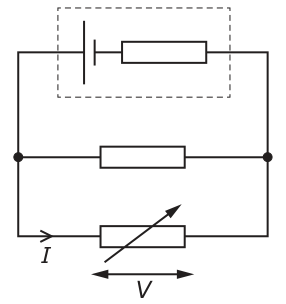
The resistance of the variable resistor is decreased.
What happens to the potential difference across the variable resistor and the current in the variable resistor?
Options
| A | decreases | decreases |
| B | decreases | increases |
| C | increases | decreases |
| D | increases | increases |
Working
Decreasing the variable resistance decreases the external (load) resistance, so the total current from the cell increases.
Voltage across the parallel network (and hence across the variable resistor) is the terminal p.d.
As increases, the drop increases, so decreases.
Current in the variable resistor is
With decreased, increases.
Answer
B
B
Background Concept
A real cell is modelled as an emf in series with an internal resistance . When the cell supplies current to an external circuit, some voltage is “lost” inside the cell across .
The terminal potential difference (the p.d. available to the external circuit) is
So, if the current drawn from the cell increases, the lost volts increases and the terminal p.d. decreases.
In a parallel circuit, all branches share the same p.d. across the supply terminals, but each branch current depends on its own resistance via Ohm’s law .
Understanding the Question
The fixed resistor and the variable resistor are connected in parallel across the cell’s terminals. The p.d. labelled is across the variable resistor (so it is also the terminal p.d. across the whole parallel network). The current is the current through the variable resistor branch.
You decrease the resistance of the variable resistor and must decide what happens to:
- the p.d. across it (), and
- the current through it ().
Approach
- Replace the circuit by the standard equivalent: emf in series with internal resistance , supplying an external load equal to the parallel combination of the two resistors.
- Decreasing the variable resistor decreases the external equivalent resistance, so the total current from the cell increases.
- Use to see how the terminal p.d. changes.
- Use to decide how the variable-branch current changes when both and change.
Step-by-Step Reasoning
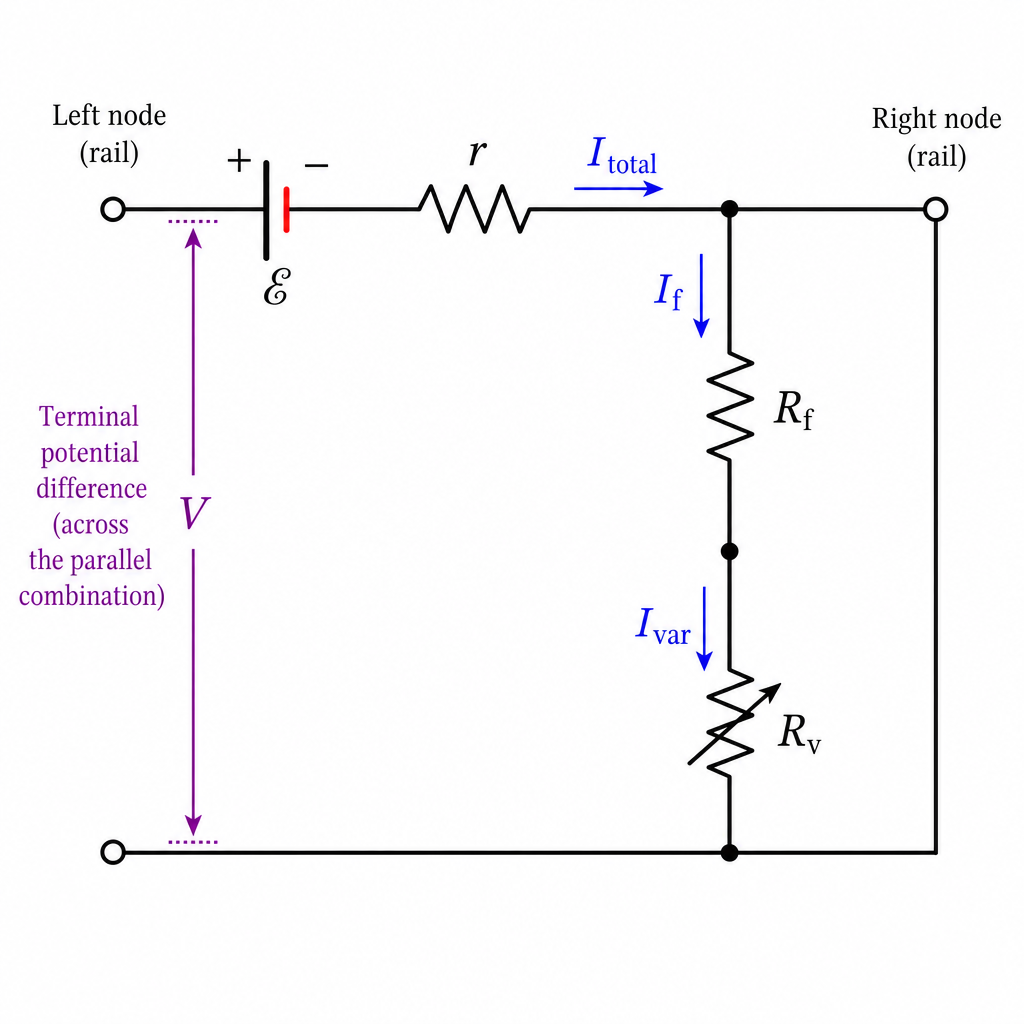
- External equivalent resistance
The two external resistors are in parallel, so the external resistance is
If is decreased, then increases, so the bracket increases and therefore decreases.
- Total current from the cell increases
The cell sees a series combination of and , so the total current is
As decreases, the denominator decreases, hence increases.
- Terminal p.d. (and hence across the variable resistor) decreases
Terminal p.d. across the external network is
Since increases, the internal drop increases, so must decrease.
So the p.d. across the variable resistor decreases.
- Current in the variable resistor increases
The variable-branch current is
Here, decreases but also decreases. The decrease in causes the branch to take a larger share of the current and, overall, increases.
You can confirm with a compact expression. With fixed resistor and variable resistor in parallel, one finds
The denominator increases with , so when is decreased, the denominator decreases and increases.
Therefore: decreases and increases, which is option B.
Key Takeaways
- Internal resistance makes the terminal p.d. fall when more current is drawn: .
- Decreasing a resistance in a parallel network decreases the external equivalent resistance and increases the total current drawn.
- In a branch, : even if falls, a sufficiently large decrease in can still make the branch current rise.
Common Mistakes
- Assuming the p.d. across the parallel resistors stays equal to the emf (only true if ).
- Thinking “lower resistance means lower current” without applying properly.
- Treating the current labelled as the total current from the cell rather than the current in the variable branch.
Things to Be Careful About
- Distinguish clearly between total current from the cell () and the branch current in the variable resistor ().
- In parallel: p.d. is common; in series: current is common.
- Internal resistance effects depend on total current, not on one branch current alone.
A radioactive source produces a beam of -particles in a vacuum. The average current caused by the -particles in the beam is .
The beam is incident on a metal target.
What is the average number of -particles hitting the metal target in a time of ?
Options
A
B
C
D
Working
Total charge in :
Charge on one -particle:
Number of -particles:
Answer
C
C
Background Concept
Electric current is defined as the rate of flow of charge:
so the total charge that passes in time is:
For a beam of charged particles, the charge delivered to a target is the number of particles multiplied by the charge per particle :
An -particle is a helium nucleus, so it has charge , where .
Understanding the Question
You are told the average current in a vacuum beam of -particles is . The beam hits a metal target for .
The question asks for the average number of -particles that hit the target in that time.
So we need:
- the total charge arriving at the target in , and
- the charge carried by one -particle.
Approach
- Use to find the total charge transferred in .
- Use for the charge of one -particle.
- Divide: .
- Match the calculated value to the closest option.
Step-by-Step Reasoning
1. Total charge in
(An ampere is a coulomb per second, so the units are consistent.)
2. Charge of one -particle
An -particle has charge :
3. Number of particles
This corresponds to option C.
Key Takeaways
- Use to convert a current over a time into a total charge.
- For particle beams, .
- Remember -particles carry charge (not ).
Common Mistakes
- Using instead of , giving an answer twice as large.
- Forgetting to multiply by time (treating current as charge).
- Incorrect handling of powers of ten when dividing numbers in standard form.
Things to Be Careful About
- The current given is an average current, so using directly is appropriate.
- Keep track of significant figures: inputs are typically 2 s.f., so is suitable.
- Charge magnitude is needed; sign does not affect the count of particles.
The charge carriers in a metal wire are free electrons.
Which statement about the charge of each free electron is correct?
Options
A The magnitude of the charge increases with the potential difference across the wire.
B The magnitude of the charge is zero unless there is a potential difference across the wire.
C The sign and magnitude of the charge do not depend on the potential difference across the wire.
D The sign of the charge depends on the potential difference across the wire.
Working
Each free electron has charge where .
The sign and magnitude of this charge are intrinsic properties of the electron and do not change with the potential difference across the wire.
Answer
C
C
Background Concept
Electric current in a metal is due to the motion (drift) of free electrons. Each electron carries a fixed, fundamental amount of charge called the elementary charge.
The charge of one electron is
where
This value is a property of the particle itself; it does not change depending on what circuit you place the electron in.
Understanding the Question
The question asks whether the charge on each free electron (both its sign and magnitude) changes when a potential difference is applied across a wire.
A potential difference affects the electric field in the wire and hence the drift velocity of the electrons and the current, but it does not alter what an electron is.
Approach
- Recall that the charge on an electron is fixed at .
- Check which option states that neither the sign nor magnitude depends on potential difference.
Step-by-Step Reasoning
- In a metal, the charge carriers are electrons.
- Each electron has charge .
- Applying a potential difference produces an electric field that causes electrons to drift, which changes the current (rate of flow of charge), but the charge per electron remains .
- Therefore, the correct statement is: the sign and magnitude of the charge do not depend on the potential difference across the wire.
So the correct option is C.
Key Takeaways
- The charge of an electron is a constant: .
- Potential difference changes electron motion (drift speed/current), not the charge on each electron.
Common Mistakes
- Thinking that increasing potential difference “gives electrons more charge” (it gives them more energy per unit charge, not more charge).
- Confusing current (charge flow per second) with the charge carried by each carrier.
Things to Be Careful About
- Potential difference is energy transferred per unit charge:
It is not something that changes the value of for a single electron.
- The sign of the electron charge is always negative; changing the direction of potential difference changes the direction of drift, not the sign of the carriers.
Which flavours of quark have charge ?
Options
| charm | strange | top | bottom | |
|---|---|---|---|---|
| A | ✓ | ✗ | ✓ | ✗ |
| B | ✓ | ✗ | ✗ | ✗ |
| C | ✗ | ✓ | ✓ | ✓ |
| D | ✗ | ✓ | ✗ | ✓ |
Up-type quarks have charge .
Charm and top are up-type, while strange and bottom are down-type (charge ).
Answer
A
A
Background Concept
Quarks come in six flavours: up (), down (), charm (), strange (), top (), bottom (). They fall into two charge groups:
- Up-type quarks () have charge .
- Down-type quarks () have charge .
(Their corresponding antiquarks have the opposite charges.)
Understanding the Question
The table lists four flavours: charm, strange, top, bottom. The question asks which of these have charge , and then which option has ticks in exactly those columns.
Approach
- Identify which of the listed flavours are up-type and which are down-type.
- Tick only the up-type flavours, since those have .
- Choose the option that matches those ticks.
Step-by-Step Reasoning
- Charm () is an up-type quark charge .
- Strange () is a down-type quark charge .
- Top () is an up-type quark charge .
- Bottom () is a down-type quark charge .
So only charm and top should be ticked. In the options, that pattern corresponds to Option A.
Key Takeaways
- Memorise the grouping: are up-type () and are down-type ().
- Multiple-choice tables often test recognising the correct subset quickly.
Common Mistakes
- Swapping strange and charm (confusing which is up-type vs down-type).
- Thinking “top/bottom” implies “positive/negative” charge; the names do not determine charge.
- Forgetting that only three flavours have (and they are always ).
Things to Be Careful About
- The question asks for flavours with ; do not bring in antiquarks (which would have the opposite charge).
- Ensure you match the ticks to exactly the correct two flavours among the four listed.
An unstable nucleus of an element decays by emitting an -particle or a particle to become a nucleus of a different element. This nucleus is also unstable and emits an -particle or a particle. The process continues until an isotope of the original element is produced.
What is the minimum possible number of these particles emitted?
Options
A
B
C
D
Working
For (\alpha) emission: (\Delta Z = -2), (\Delta A = -4).
For (\beta^-) emission: (\Delta Z = +1), (\Delta A = 0).
To end with an isotope of the original element, net (\Delta Z = 0):
Minimum with (n_{\alpha} \ge 1) is (n_{\alpha}=1), (n_{\beta}=2), total
Answer
B
B
Background Concept
In nuclear decay, two numbers track what nucleus you have:
- Proton (atomic) number (Z): sets the element.
- Nucleon (mass) number (A): total protons + neutrons.
For the two decay types here:
- (\alpha)-decay emits a helium nucleus (,^{4}_{2}\text{He}). The parent loses 2 protons and 2 neutrons, so
- (\Delta Z = -2)
- (\Delta A = -4)
- (\beta^-)-decay converts a neutron into a proton (plus an electron and antineutrino). So
- (\Delta Z = +1)
- (\Delta A = 0)
An isotope of the original element means the final nucleus has the same (Z) as the original (same element) but a different (A) is allowed.
Understanding the Question
We start with an unstable nucleus of some element ((Z_0, A_0)). It decays repeatedly, each step being either (\alpha) or (\beta^-). The chain stops at the first point where the nucleus becomes an isotope of the original element, i.e. when its proton number returns to (Z_0).
We are asked for the minimum possible number of emitted particles in such a chain.
Approach
Treat the whole chain as a net change in (Z) and (A). Let (n_{\alpha}) be the number of (\alpha)-decays and (n_{\beta}) the number of (\beta^-)-decays.
- Write net (\Delta Z) in terms of (n_{\alpha}) and (n_{\beta}).
- Impose the condition “final element is the same”: net (\Delta Z = 0).
- Find the smallest integers that satisfy it, noting that the first decay must change the element (always true here) and we must actually be able to return to (Z_0) (which requires at least one (\alpha), because with only (\beta^-) you never decrease (Z)).
Step-by-Step Reasoning
Let the initial nucleus be ((Z_0, A_0)).
Each (\alpha)-decay contributes (-2) to (Z), each (\beta^-)-decay contributes (+1) to (Z). Therefore the net change in (Z) after the whole chain is
To finish as an isotope of the original element, we require
So
The total number of emitted particles is
We need at least one (\alpha)-decay (otherwise (n_{\alpha}=0) gives (\Delta Z = n_{\beta} > 0), so you can never return to the original (Z_0)). Hence the minimum is with (n_{\alpha}=1):
This is achievable, for example: (\alpha) then (\beta^-) then (\beta^-). After these, (Z) changes by (-2+1+1=0) (back to the original element) and (A) changes by (-4), so it is indeed an isotope of the original element.
Key Takeaways
- Track nuclear changes using (Z) and (A).
- (\alpha): (\Delta Z=-2), (\Delta A=-4). (\beta^-): (\Delta Z=+1), (\Delta A=0).
- Returning to the same element means net (\Delta Z=0), which becomes an integer equation.
Common Mistakes
- Thinking (\beta^-) changes (A) (it does not).
- Forgetting that to return to the original element you must both increase and decrease (Z); with only (\beta^-) you cannot reduce (Z).
- Trying (N=2) without checking net (\Delta Z): no 2-step combination can give (\Delta Z=0).
Things to Be Careful About
- “Isotope of the original element” means same (Z), not same (A).
- The minimum number is found by minimising integer counts (n_{\alpha}, n_{\beta}) subject to the net-change constraint.
- Order of decays does not affect the net (\Delta Z) and (\Delta A), but you should reassure yourself the sequence is physically possible (e.g. one (\alpha) and two (\beta^-) can indeed be arranged so the final nucleus has (Z_0)).
A nucleus of carbon-10, , decays by beta-emission to form a nucleus of boron-10, .
For this decay process, what is the change to a nucleon and what is the change in the quark composition of the nucleon?
Options
| change to nucleon | change in quark composition | |
|---|---|---|
| A | proton to neutron | down becomes up |
| B | proton to neutron | up becomes down |
| C | neutron to proton | down becomes up |
| D | neutron to proton | up becomes down |
Working
In , the proton number decreases from to , so a proton changes to a neutron ((\beta^+) decay).
Proton quarks: ; neutron quarks: (\Rightarrow) an up quark becomes a down quark.
Answer
B
B
Background Concept
In nuclear decay, the mass number is the total number of nucleons (protons + neutrons) and the proton (atomic) number is the number of protons.
In beta processes, stays the same because a nucleon changes type, but the nucleus does not lose or gain nucleons.
There are two relevant beta decays:
- decay: a neutron changes into a proton (so increases by 1). At quark level, , meaning a down quark becomes an up quark.
- decay (positron emission): a proton changes into a neutron (so decreases by 1). At quark level, , meaning an up quark becomes a down quark.
(Associated leptons are emitted too, but for this MCQ we only need the nucleon change and quark change.)
Understanding the Question
You are told that decays to by beta-emission. You must decide:
- Whether a proton became a neutron or a neutron became a proton.
- Which quark flavour change inside that nucleon produced the new nucleon.
Then you match both to the correct row in the options table.
Approach
- Compare the proton numbers before and after the decay.
- If decreases by 1, a proton must have turned into a neutron (this corresponds to emission).
- If increases by 1, a neutron must have turned into a proton (this corresponds to emission).
- Use the quark compositions:
- proton:
- neutron:
and see which quark must change to convert one into the other.
Step-by-Step Reasoning
-
For carbon-10: .
For boron-10: .
So has decreased by 1. -
Decreasing means the nucleus has one fewer proton and one more neutron (since is unchanged). Therefore:
- Quark compositions:
- Proton:
- Neutron:
To go from to , one of the up quarks must change into a down quark:
- The option stating “proton to neutron” and “up becomes down” is B.
Key Takeaways
- Beta decay changes by but leaves unchanged.
- decreases: proton neutron (associated with emission).
- Quark compositions: proton , neutron .
- Proton neutron implies .
Common Mistakes
- Assuming all “beta-emission” means without checking .
- Mixing up the sign: remembering wrongly that proton-to-neutron increases (it actually decreases it).
- Reversing quark compositions (writing proton as and neutron as ).
Things to Be Careful About
- Always use the proton number change to decide the nucleon change; do not rely on memory of wording.
- Make sure you compare the subscripts (the values) in nuclide notation.
- The quark change must be consistent with the nucleon change: requires , not .
Your score so far
Answer a question to start scoring
Your marks add up here as you work through the paper.