Physics 9702/31 — October/November 2022
Cambridge AS Level · Advanced Practical Skills · worked solutions for every part, with the mark scheme
Topics Manipulation, Measurement and Observation · Presentation of Data and Observations · Analysis, Conclusions and Evaluation
In this experiment, you will investigate oscillations of card shapes.
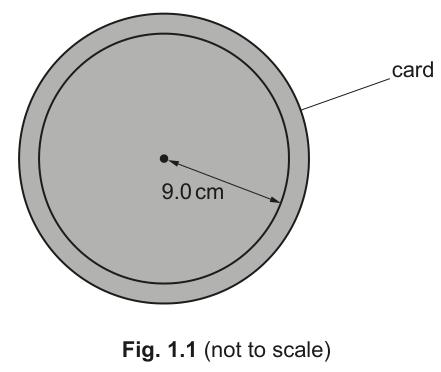
You have been provided with a circular card of radius .
● Draw a circle on the card of radius , as shown in Fig. 1.1.
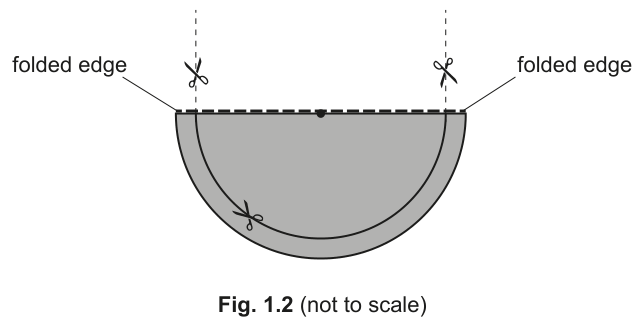
● Fold the card in half. Cut carefully along the line, as shown in Fig. 1.2, and keep both parts of the card.
● The distance between the centre of one side of the card shape and the centre of the other side is , as shown in Fig. 1.3.
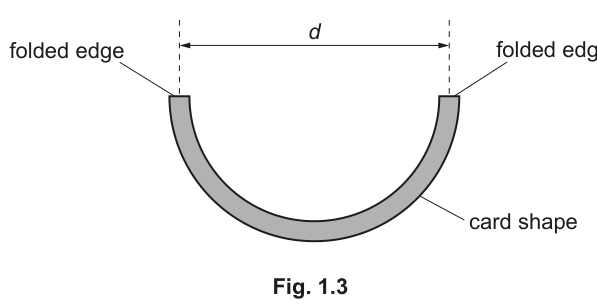
Measure and record .
= ______
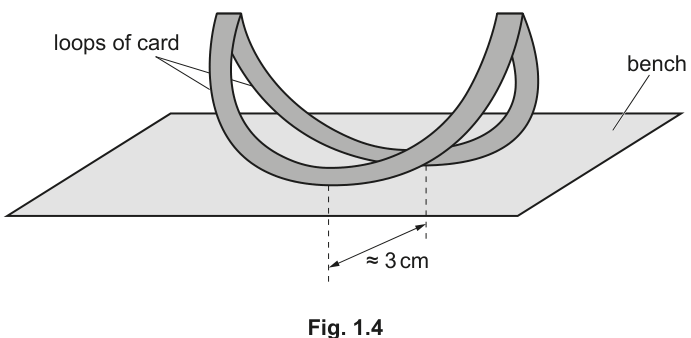
● Stand the card shape on the bench.
● Adjust the loops of card until the distance between the points where the loops touch the bench is approximately , as shown in Fig. 1.4.
● Gently press down one side of the card shape through a short distance. Release the card shape so that it oscillates.
● Determine the period of these oscillations.
= ______
Use the remaining card to cut out shapes of smaller radius, each with the same width of .
For each card shape, measure and repeat (b). Repeat until you have five sets of values of and .
Record your results in a table. Include values of in your table.
Plot a graph of on the -axis against on the -axis.
Draw the straight line of best fit.
Determine the gradient and -intercept of this line.
gradient = ______
-intercept = ______
It is suggested that the quantities and are related by the equation
where and are constants.
Using your answers in (d)(iii), determine the values of and . Give appropriate units.
= ______
= ______
Theory suggests that
where is the acceleration of free fall.
Use your value of in (e) to determine a value for . Give an appropriate unit.
= ______
The rest of this paper
1 more questions- Q2Manipulation, Measurement and Observation · Presentation of Data and Observations · Analysis, Conclusions and Evaluation20M