Physics 9702/22 — May/June 2022
Cambridge AS Level · AS Level Structured Questions · worked solutions for every part, with the mark scheme
Topics Physical Quantities and Units · Work, Energy and Power · Forces, Density and Pressure · Deformation of Solids · Kinematics · Dynamics · +5 more
In the following list, underline all units that are SI base units.
ampere degree Celsius kilogram newton
Answer
SI base units: ampere, kilogram.
ampere, kilogram
Background Concept
The SI base units are the fundamental units from which all other (derived) units are built. The seven SI base units are:
- metre (m), kilogram (kg), second (s), ampere (A), kelvin (K), mole (mol), candela (cd).
A derived unit is formed from base units using multiplication/division and powers, for example
Understanding the Question
You are given a list of units:
- ampere, degree Celsius, kilogram, newton
and asked to select (underline) only those that are SI base units.
Approach
Compare each unit in the list with the memorised set of SI base units. If a unit can be written in terms of base units (like N), it is derived and should not be underlined.
Step-by-Step Reasoning
- ampere: this is the SI base unit of electric current → underline.
- degree Celsius: the SI base unit of temperature is kelvin (K). Degree Celsius is not a base unit (it is related to kelvin by an offset) → do not underline.
- kilogram: this is the SI base unit of mass → underline.
- newton: unit of force and is derived:
so it is not a base unit → do not underline.
Key Takeaways
- Know the seven SI base units.
- Units like the newton are derived from base units.
- Temperature’s SI base unit is kelvin, not degree Celsius.
Common Mistakes
- Underlining newton because it is commonly used (common usage does not mean base unit).
- Choosing degree Celsius instead of kelvin as the SI base unit for temperature.
Things to Be Careful About
- The question asks specifically for SI base units (not just “SI units”). Some units are SI-derived and still not base.
- If unsure, try expressing the unit in base units: if it breaks down, it is not a base unit.
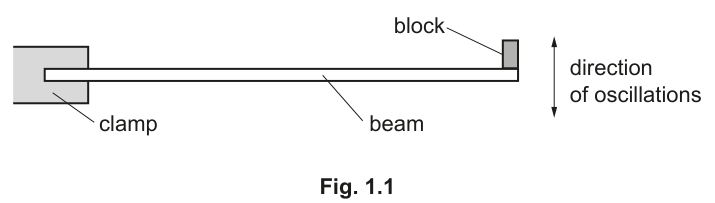
Fig. 1.1 shows a horizontal beam clamped at one end with a block attached to the other end.
The block is made to oscillate vertically.
The Young modulus of the material of the beam is given by
where is the mass of the block,
is the period of the oscillations
and is a constant.
A student determines the values and percentage uncertainties of , and .
Table 1.1 lists the percentage uncertainties.
Table 1.1
| quantity | percentage uncertainty |
|---|---|
The student uses the values of , and to calculate the value of as .
Calculate the percentage uncertainty in the value of .
percentage uncertainty = ______
Working
Given
So
Answer
5.7%
Background Concept
When quantities are multiplied/divided, their fractional (or percentage) uncertainties add. If a quantity is raised to a power, its fractional uncertainty is multiplied by that power.
For
the percentage uncertainty is
(The sign from division does not matter because uncertainties are added in magnitude.)
Understanding the Question
You are told
and given percentage uncertainties:
- :
- :
- :
You must find the percentage uncertainty in .
Approach
Treat as a product of and divided by .
- Add the percentage uncertainties of and .
- Add twice the percentage uncertainty of (because of the square).
Step-by-Step Reasoning
Start from
Apply the propagation rule:
Substitute:
Calculate:
so
Key Takeaways
- For multiplication/division: add percentage uncertainties.
- For a power : multiply that term’s percentage uncertainty by .
- Division does not mean “subtract uncertainties”; you still add magnitudes.
Common Mistakes
- Subtracting the uncertainty because is in the denominator.
- Forgetting to multiply the percentage uncertainty by .
- Using absolute uncertainties without first converting to fractional/percentage uncertainties.
Things to Be Careful About
- Make sure the power applies to the uncertainty: means .
- Keep everything consistently in percent since the table is in percent.
Use your answer in (b)(i) to determine the value of , with its absolute uncertainty, to an appropriate number of significant figures.
= ( ______ ______ )
Working
Percentage uncertainty in is .
Absolute uncertainty:
So
Answer
(8.2 ± 0.5) × 10^9 Pa
Background Concept
A percentage uncertainty tells you the size of the uncertainty compared to the value:
So the absolute uncertainty is
When quoting a final result with uncertainty, the usual convention is:
- quote the uncertainty to 1 significant figure (sometimes 2 if it begins with 1 or 2),
- quote the value to the same decimal place as the uncertainty.
Understanding the Question
From part (i) you have the percentage uncertainty in .
The calculated value is
You must write in the form
with sensible significant figures.
Approach
- Convert into a decimal fraction ().
- Multiply by to get .
- Round appropriately, then round to match.
Step-by-Step Reasoning
Given percentage uncertainty :
Compute absolute uncertainty:
First multiply :
So
Now round the uncertainty to a sensible number of significant figures (typically 1 s.f.):
Because the uncertainty is , the value of should be rounded to the same decimal place in the bracket (one decimal place):
Therefore,
Key Takeaways
- Convert percentage uncertainty to absolute uncertainty using .
- Quote uncertainty to 1 s.f. (usually), and match the value’s rounding to it.
- Keep the power of ten consistent with the requested answer format.
Common Mistakes
- Using instead of when finding .
- Rounding the value but not rounding the uncertainty (or rounding them inconsistently).
- Writing (value has too many digits compared with the uncertainty).
- Forgetting the unit .
Things to Be Careful About
- The answer line already includes , so the numbers you write in brackets must be in billions.
- Make sure the uncertainty and the value are rounded to the same decimal place within the brackets.
The rest of this paper
6 more questions- Q2Forces, Density and Pressure · Work, Energy and Power · Deformation of Solids11M
- Q3Kinematics10M
- Q4Dynamics · Physical Quantities and Units · Work, Energy and Power7M
- Q5Superposition · Waves11M
- Q6D.C. Circuits · Electricity9M
- Q7Particle Physics7M