Physics 9702/21 — May/June 2022
Cambridge AS Level · AS Level Structured Questions · worked solutions for every part, with the mark scheme
Topics Dynamics · Kinematics · Forces, Density and Pressure · Work, Energy and Power · Physical Quantities and Units · Deformation of Solids · +5 more
Define velocity.
Answer
Velocity is the rate of change of displacement with time.
Rate of change of displacement with time.
Background Concept
Velocity is a vector quantity that tells you how quickly and in what direction the position of an object is changing. It is defined in terms of displacement (also a vector).
Instantaneous velocity is defined by
and average velocity is
Understanding the Question
You are asked to define velocity (1 mark). This requires a clear definition linking velocity to displacement and time, and (ideally) indicating it is a vector.
Approach
Use the standard definition: velocity is the rate of change of displacement with time.
Step-by-Step Reasoning
- “Rate of change” means “change per unit time”.
- For velocity we must use displacement (not distance), because velocity has direction.
- So velocity is change in displacement divided by time taken.
Key Takeaways
- Velocity uses displacement, not distance.
- Velocity is a vector (direction matters).
Common Mistakes
- Defining velocity as “rate of change of distance” (that is speed).
- Writing only “displacement divided by time” without making clear it is a rate (usually still accepted, but less precise).
Things to Be Careful About
- If asked for a definition, do not substitute numbers or talk about graphs.
- If you add extra detail, ensure it is correct (e.g. do not say velocity is scalar).
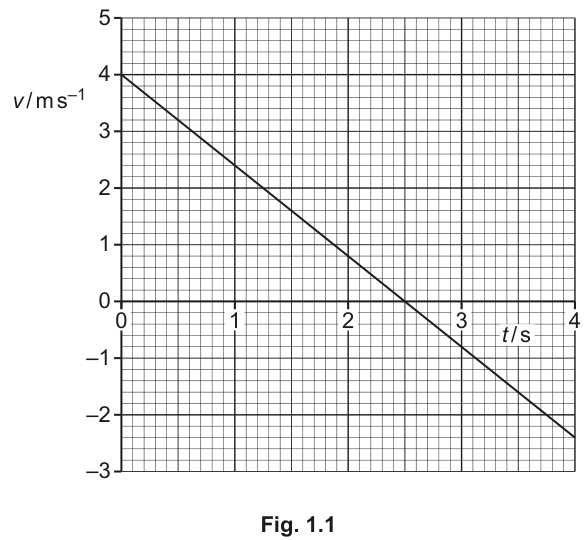
A rock of mass is projected vertically upwards from the surface of a planet. The rock leaves the surface of the planet with a speed of at time . The variation with time of the velocity of the rock is shown in Fig. 1.1.
Assume that the planet does not have an atmosphere and that the viscous force acting on the rock is always zero.
Determine the height of the rock above the surface of the planet at time .
height = ______
Working
Displacement from to :
Displacement from to (negative):
Net height above surface at :
Answer
3.2 m
Background Concept
For a velocity–time graph, the displacement over a time interval is the area under the graph:
Key sign idea:
- If is positive, the area contributes a positive displacement (upwards here).
- If is negative, the area contributes a negative displacement (downwards here).
Understanding the Question
The rock is thrown upwards with initial velocity . From the graph, decreases linearly, crosses at (top of the motion), and becomes negative by (rock is moving downward). You must find its height above the surface at , i.e. the net vertical displacement from to .
Approach
Find the area under the – graph from to . Because the graph crosses the axis, split it into:
- a positive triangle from to ,
- a negative triangle/trapezium from to ,
then add them (including the negative sign).
Step-by-Step Reasoning
- From to , velocity goes from to , making a triangle.
This is the upward displacement to the highest point.
- From to , velocity goes from to . The area is below the axis, so it is negative. Treat it as a trapezium (or a triangle here):
Time interval:
Average velocity over that interval (since the graph is a straight line):
So displacement:
- Net displacement (height above the surface at ):
So at the rock is still above the launch point, but is on its way back down.
Key Takeaways
- Area under a – graph gives displacement.
- Areas below the time axis count as negative displacement.
- When the graph is linear, using average velocity over an interval is quick and accurate.
Common Mistakes
- Adding the magnitudes of areas and forgetting the negative sign after becomes negative.
- Using the gradient instead of the area (gradient gives acceleration, not displacement).
- Using as the base for the first triangle (should be where ).
Things to Be Careful About
- Read the correct intercepts from the graph: at and at .
- Keep consistent units: area units are .
Determine the change in the momentum of the rock from time to time .
change in momentum = ______
Working
Initial momentum:
Final momentum at :
Change in momentum:
Answer
-48 N s
Background Concept
Linear momentum is
and is a vector (it has direction because has direction). The change in momentum is
The unit is equivalent to .
Understanding the Question
You are asked for the change in momentum from to .
- Mass .
- From the graph: and .
The negative final velocity indicates the rock is moving downward at .
Approach
Use
and keep the sign of velocities to show direction.
Step-by-Step Reasoning
- Find momentum at :
- Find momentum at :
- Subtract to get change in momentum:
The negative sign means the momentum has changed in the negative (downward) direction.
Key Takeaways
- Use with correct signs.
- Negative velocity gives negative momentum (direction matters).
Common Mistakes
- Using instead of .
- Ignoring the negative sign on .
- Writing the unit as (momentum change is , not ).
Things to Be Careful About
- State or imply direction through the sign; if you choose to give a magnitude instead, you should state “downwards”.
- Do not round intermediate momenta too aggressively; here values are simple so it is fine.
Determine the weight of the rock on this planet.
= ______
Working
Acceleration is the gradient of the - graph:
So and
Answer
12 N
Background Concept
On a planet with no air resistance (as stated), the only significant force on the rock in flight is its weight acting downward.
The rock’s acceleration is then constant and equal to the gravitational field strength (taking upward as positive):
From a velocity–time graph:
- the gradient is acceleration:
Understanding the Question
You are given a straight-line -– graph, so acceleration is constant. You must determine the weight of the rock on this planet.
Because there is no atmosphere in this part, the only force is weight, so the acceleration found from the graph is the gravitational acceleration (in magnitude).
Approach
- Calculate the gradient of the -– graph to find .
- Use (upwards taken as positive) to get .
- Calculate weight using .
Step-by-Step Reasoning
- Choose two clear points on the straight line. From the graph:
- at , ,
- at , .
Gradient:
So the magnitude of gravitational acceleration is
- Weight:
(Weight acts downward.)
Key Takeaways
- Gradient of a -– graph gives acceleration.
- With no air resistance, acceleration is constant and equals .
- Weight is .
Common Mistakes
- Using area under the graph (displacement) instead of gradient (acceleration).
- Forgetting that the gradient is negative; is the magnitude of acceleration due to gravity.
- Writing with negative and giving a negative weight (weight is a force magnitude; direction is downward).
Things to Be Careful About
- Use two well-separated points for the gradient to reduce reading error.
- Quote weight in newtons, , and use consistent significant figures (here 2 s.f. is appropriate).
In practice, the planet in (b) does have an atmosphere that causes a viscous force to act on the moving rock.
State and explain the variation, if any, in the resultant force acting on the rock as it moves vertically upwards.
Answer
As the rock rises, both weight and viscous (drag) force act downward, so the resultant force is downward.
The viscous force decreases as the speed decreases, so the resultant downward force decreases in magnitude (tending to just as ).
Resultant force is downward and decreases in magnitude as the rock slows (drag decreases), tending to W at the top.
Background Concept
When an object moves through an atmosphere, it experiences a viscous/drag force that acts opposite to its direction of motion.
- Weight acts downward and is (approximately) constant near the surface.
- Drag depends on speed: it increases with speed (often proportional to at low speeds and to at higher speeds).
Resultant force is the vector sum of all forces:
Understanding the Question
The rock is moving vertically upwards. You are asked to state and explain how the resultant force changes as it goes up, when there is an atmosphere.
Key point: while moving upward, both weight and drag are downward; but drag changes because the rock’s speed changes.
Approach
- Draw a free-body diagram for the upward motion.
- Write the resultant (taking upward as positive).
- Use the fact that as the rock rises it slows down, so its speed decreases, hence drag decreases.
- Deduce how this changes the resultant force.
Step-by-Step Reasoning
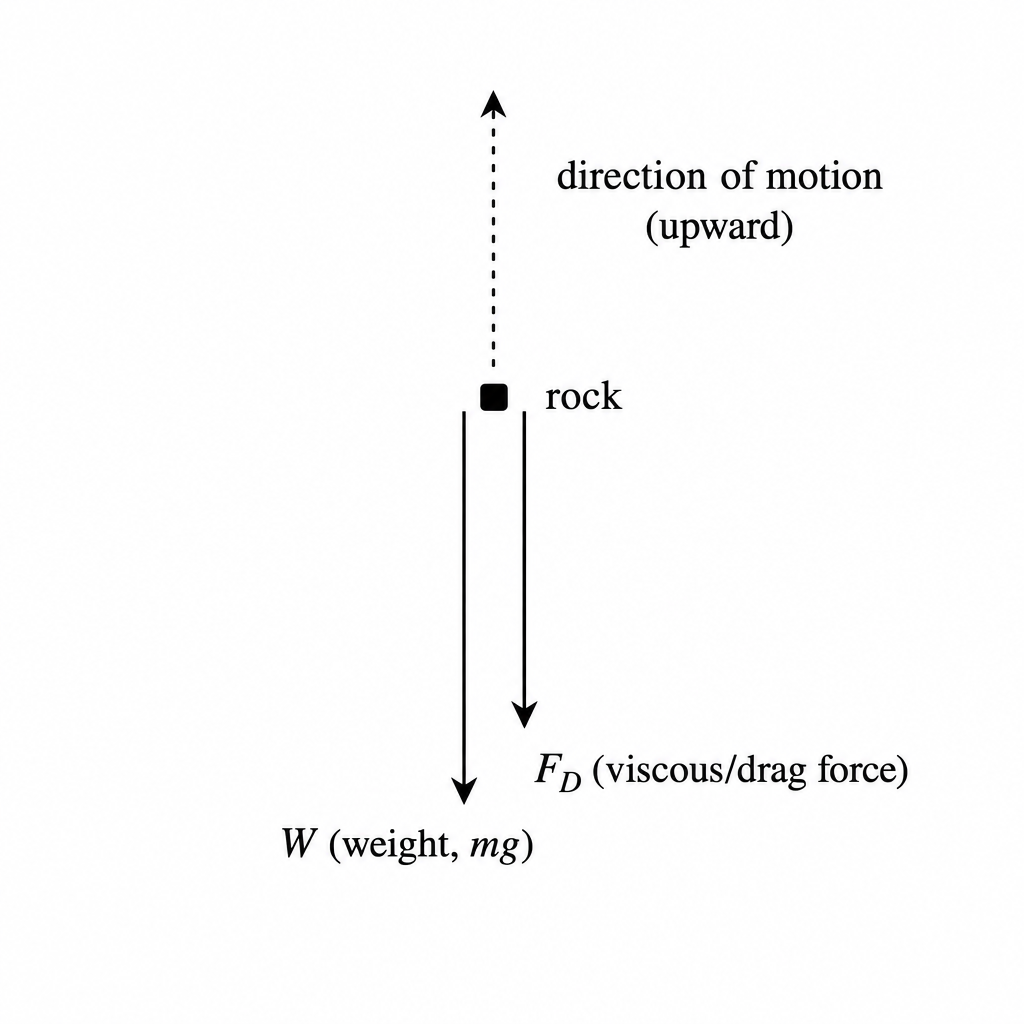
- Forces while moving upward:
- Weight downward (constant).
- Drag downward (because motion is upward).
- Taking upward as positive, the resultant force is
So the resultant is downward.
-
As the rock rises, it slows: its speed decreases. Since depends on speed, decreases as decreases.
-
Therefore decreases, so the magnitude of the resultant downward force decreases as the rock rises.
At the highest point, so drag is zero, leaving resultant force just the weight downward.
Key Takeaways
- Drag always opposes motion.
- During upward motion: drag and weight act in the same (downward) direction.
- As speed decreases, drag decreases, so the resultant force becomes less downward (approaches ).
Common Mistakes
- Saying the resultant force is constant (it is not, because drag changes with speed).
- Saying drag acts upward during upward motion (it acts downward then; it would act upward on the way down).
- Saying the resultant becomes zero at the top (only drag becomes zero; weight remains).
Things to Be Careful About
- Distinguish between direction of force and direction of motion.
- “Resultant force decreases” must be interpreted as “magnitude decreases”; direction remains downward throughout the upward part of the motion.
The rest of this paper
6 more questions- Q2Forces, Density and Pressure10M
- Q3Work, Energy and Power · Dynamics · Physical Quantities and Units9M
- Q4Deformation of Solids5M
- Q5Superposition · Waves8M
- Q6D.C. Circuits · Electricity11M
- Q7Particle Physics7M