Physics 9702/23 — May/June 2021
Cambridge AS Level · AS Level Structured Questions · worked solutions for every part, with the mark scheme
Topics Physical Quantities and Units · Kinematics · Dynamics · Forces, Density and Pressure · Deformation of Solids · Superposition · +4 more
Answer all the questions in the spaces provided.
A property of a vector quantity, that is not a property of a scalar quantity, is direction.
For example, velocity has direction but speed does not.
State two other scalar quantities and two other vector quantities.
scalar quantities: ______ and ______
vector quantities: ______ and ______
State two properties that are possessed by both scalar and vector physical quantities.
- ______
- ______
A ship at sea is travelling with a velocity of in a direction east of north in still water, as shown in Fig. 1.1.
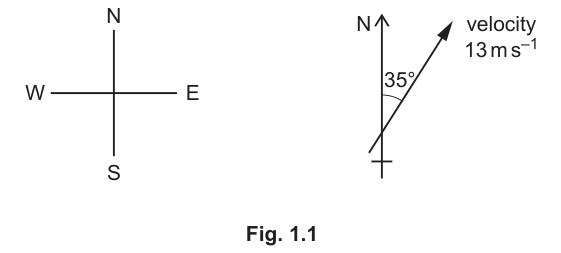
Determine the magnitudes of the components of the velocity of the ship in the north and the east directions.
north component of velocity = ______
east component of velocity = ______
The ship now experiences a tidal current. The water in the sea moves with a velocity of to the west.
Calculate the resultant velocity component of the ship in the east direction.
resultant east component of velocity = ______
Use your answers in (b)(i) and (b)(ii) to determine the magnitude of the resultant velocity of the ship.
magnitude of resultant velocity = ______
Use your answers in (b)(i) and (b)(ii) to determine the angle between north and the resultant velocity of the ship.
angle = ______
The rest of this paper
5 more questions- Q2Kinematics · Dynamics11M
- Q3Forces, Density and Pressure · Deformation of Solids10M
- Q4Superposition · Waves8M
- Q5D.C. Circuits11M
- Q6Particle Physics · Electric Fields9M