Physics 9702/33 — October/November 2020
Cambridge AS Level · Advanced Practical Skills · worked solutions for every part, with the mark scheme
Topics Manipulation, Measurement and Observation · Presentation of Data and Observations · Analysis, Conclusions and Evaluation
In this experiment, you will investigate the equilibrium of a metre rule.
Using the calipers, determine the diameter of one of the masses.
diameter = ______
Set up the apparatus as shown in Fig. 1.1, with the scale on the metre rule facing upwards.
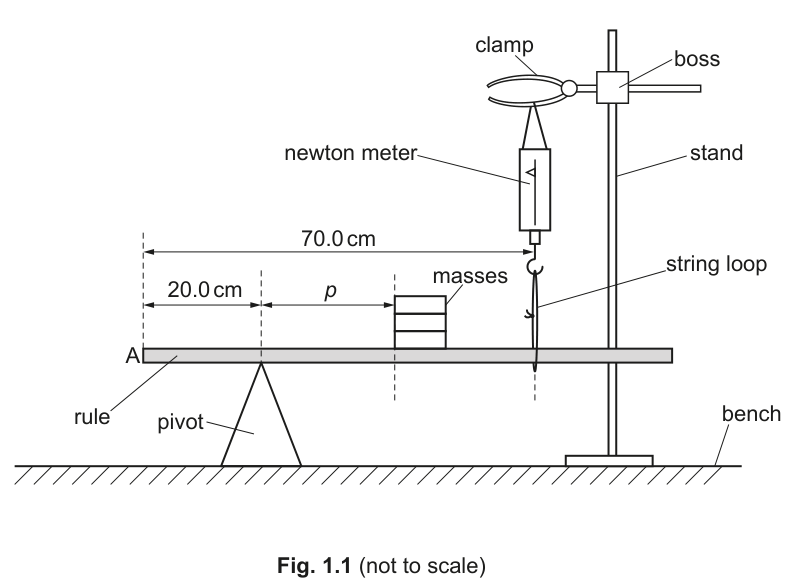
● Adjust the apparatus until the pivot is from end A of the rule and the string loop is from end A of the rule.
The pivot and string loop should remain at these positions throughout the experiment.
● Place the three masses with the edge of the bottom mass approximately from end A of the rule.
● Adjust the stand until the newton meter and string are perpendicular to the bench.
● Adjust the boss and the clamp until the rule is parallel to the bench.
● The distance from the pivot to the edge of the mass is , as shown in Fig. 1.1.
Measure and record .
= ______
● Measure and record the newton meter reading .
= ______
● Using your value of diameter from (a), calculate the radius of a mass.
= ______
● Vary in the range and determine six sets of readings of and . For each value of , adjust the boss and clamp until the rule is parallel to the bench.
Record your values in a table. Include values of in your table.
Plot a graph of on the -axis against on the -axis.
Draw the straight line of best fit.
Determine the gradient and -intercept of this line.
gradient = ______
-intercept = ______
It is suggested that the quantities and are related by the equation
where and and are constants.
Using your answers to (d)(iii), determine values for and . Give appropriate units.
= ______
= ______
The rest of this paper
1 more questions- Q2Manipulation, Measurement and Observation · Analysis, Conclusions and Evaluation · Presentation of Data and Observations20M