Physics 9702/35 — May/June 2020
Cambridge AS Level · Advanced Practical Skills · worked solutions for every part, with the mark scheme
Topics Manipulation, Measurement and Observation · Presentation of Data and Observations · Analysis, Conclusions and Evaluation
In this experiment, you will investigate the motion of a spring and a mass.
● Set up the apparatus as shown in Fig. 1.1.
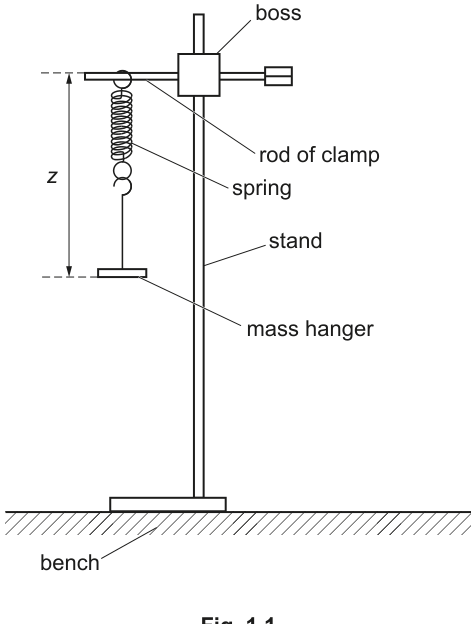
● The distance between the top of the rod of the clamp and the bottom of the mass hanger is , as shown in Fig. 1.1.
Measure and record .
= ______
● Add mass to the mass hanger where . Gently lower the mass to stretch the spring.
● Record the total added mass (do not include the mass of the hanger).
= ______
● Pull the bottom of the mass hanger horizontally through a short distance.
● Release the mass hanger. The mass hanger and masses will oscillate as shown in Fig. 1.2.
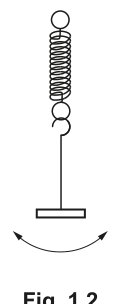
● Determine the period of these oscillations.
= ______
By changing the total mass added to the mass hanger, vary . Measure and repeat until you have six sets of values of and . Include your values from (a). Do not use .
Record your results in a table. Include values of and in your table.
Plot a graph of on the -axis against on the -axis.
Draw the straight line of best fit.
Determine the gradient and -intercept of this line.
gradient = ______
-intercept = ______
It is suggested that the quantities and are related by the equation
where and are constants.
Using your answers in (c)(iii), determine the values of and . Give appropriate units.
= ______
= ______
A student repeats the experiment using two springs in series, as shown in Fig. 1.3.
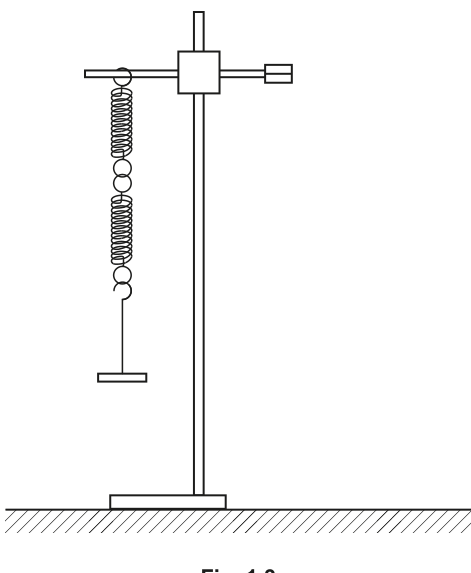
Using two springs connected in series halves the value of the spring constant of the system.
Theory suggests that is proportional to and that is inversely proportional to the spring constant of the system.
For this experiment, draw a second line on the graph to show the expected results. Label this line W.
The rest of this paper
1 more questions- Q2Manipulation, Measurement and Observation · Presentation of Data and Observations · Analysis, Conclusions and Evaluation20M