Physics 9702/33 — May/June 2019
Cambridge AS Level · Advanced Practical Skills · worked solutions for every part, with the mark scheme
Topics Manipulation, Measurement and Observation · Presentation of Data and Observations · Analysis, Conclusions and Evaluation
In this experiment, you will investigate the oscillations of a metre rule.
You may not need to use all of the materials provided.
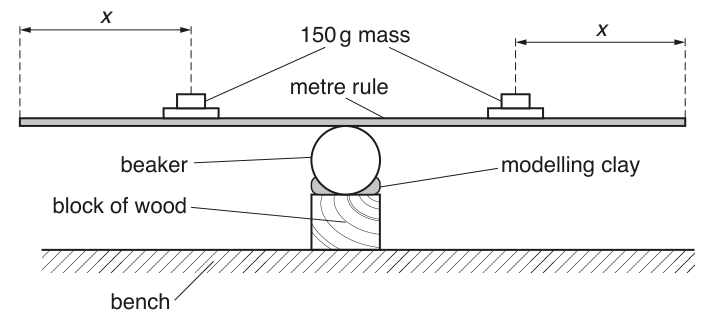
• Set up the apparatus as shown in Fig. 1.1.
• Attach the beaker to the block of wood using modelling clay.
• The distance between the centre of each mass and the nearest end of the rule is .
Adjust the apparatus so that the value of is approximately and the rule is balanced on the beaker, as shown in Fig. 1.1.
• Record .
= ______
• Pull one end of the rule down through a short distance.
• Release the end of the rule so that it oscillates.
• Determine the period of these oscillations.
= ______
Reduce by changing the positions of the masses on the rule. Measure and record and . Repeat until you have five sets of values.
Record your results in a table.
Plot a graph of on the -axis against on the -axis.
Draw the straight line of best fit.
Determine the gradient and -intercept of this line.
gradient = ______
-intercept = ______
It is suggested that the quantities and are related by the equation
where and are constants.
Using your answers in (d)(iii), determine the values of and . Give appropriate units.
= ______
= ______
For one particular value of , the value of is the same as when there are no masses on the rule.
• Remove the masses from the rule.
• Balance the rule on the beaker and repeat (b).
= ______
• Use your value of and answers in (e) to calculate this value of . Give your answer to three significant figures.
= ______
The rest of this paper
1 more questions- Q2Manipulation, Measurement and Observation · Presentation of Data and Observations · Analysis, Conclusions and Evaluation20M