Physics 9702/21 — May/June 2019
Cambridge AS Level · AS Level Structured Questions · worked solutions for every part, with the mark scheme
Topics Kinematics · Waves · Dynamics · Work, Energy and Power · Electricity · Physical Quantities and Units · +6 more
Answer all the questions in the spaces provided.
Define velocity.
Answer
Velocity is the rate of change of displacement (displacement per unit time), in a given direction.
Rate of change of displacement (displacement per unit time), in a given direction.
Background Concept
Speed and velocity both describe how fast something is moving, but they are different types of quantities:
- Speed is a scalar: it has magnitude only.
- Velocity is a vector: it has magnitude and direction.
Mathematically, average velocity is defined by
where is the change in displacement (a signed quantity that includes direction) and is the time taken.
Understanding the Question
The question asks for a definition of velocity (not speed). So you must mention displacement (not distance) and/or the idea of direction.
Approach
Give a standard definition that exam mark schemes accept:
- “rate of change of displacement”
or - “displacement per unit time”, and make clear that it is in a direction.
Step-by-Step Reasoning
- Identify that velocity is a vector quantity.
- Use displacement (vector) rather than distance (scalar).
- Express it as “per unit time” or “rate of change”.
- Include direction explicitly (or equivalently imply vector nature clearly).
Key Takeaways
- Velocity is based on displacement, not distance.
- Velocity is a vector, so direction matters.
Common Mistakes
- Defining velocity as “distance per unit time” (that is speed).
- Forgetting to mention direction / vector nature.
Things to Be Careful About
- Wording: “rate of change of displacement” is the safest phrasing.
- If you use “displacement per unit time”, ensure it is clear this includes direction.
The speed of a sound wave through a gas of pressure and density is given by the equation
where is a constant that has no units.
An experiment is performed to determine the value of . The data from the experiment are shown in Fig. 1.1.
| quantity | value | uncertainty |
|---|---|---|
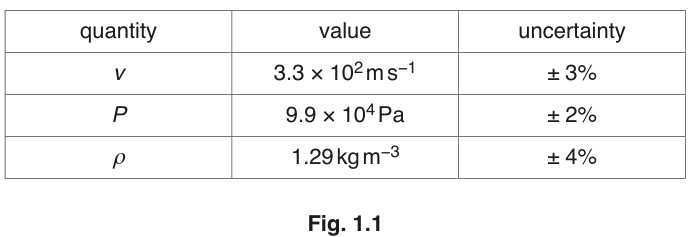
Use data from Fig. 1.1 to calculate .
= ______
Working
From
Answer
1.4
Background Concept
The given relationship is
Squaring both sides removes the square root:
This is then rearranged to make the subject:
Here is stated to be dimensionless (no units), which is consistent because has units of and its square root has units .
Understanding the Question
You are given measured values of:
and asked to calculate the constant using the equation.
Approach
- Rearrange the equation to get in terms of , , and .
- Substitute the numerical values.
- Calculate carefully, keeping track of powers of ten.
- Round sensibly (typically to 2 s.f. from the given data).
Step-by-Step Reasoning
Start with
Square both sides:
Rearrange for by multiplying by and dividing by :
Now substitute values:
- Square :
- Multiply by :
- Divide by :
So , which rounds to (2 s.f.).
Key Takeaways
- To remove a square root, square both sides before rearranging.
- When squaring standard form, square the number and double the power of ten.
- Check that the final value is reasonable and matches the expected unit statement (here: no units).
Common Mistakes
- Forgetting to square .
- Rearranging incorrectly (e.g. using ).
- Power-of-ten errors when squaring .
Things to Be Careful About
- Significant figures: inputs are mostly 2 s.f., so quoting to 2 s.f. is appropriate.
- Don’t attach units to because the question states it has none.
Use your answer in (b)(i) and data from Fig. 1.1 to determine the value of , with its absolute uncertainty, to an appropriate number of significant figures.
= ______ ______
Working
Percentage uncertainty in :
Absolute uncertainty:
Answer
1.4 ± 0.2
Background Concept
When quantities are multiplied or divided, percentage (fractional) uncertainties add.
If
then
Also, if a quantity is raised to a power, the percentage uncertainty is multiplied by that power. For
then
Finally, to convert from percentage uncertainty to absolute uncertainty:
Understanding the Question
You already found in part (i). Now you must use the percentage uncertainties in , , and to find:
- the absolute uncertainty in , and
- quote to a sensible number of significant figures.
Given uncertainties:
- :
- :
- :
Approach
- Write in terms of the measured variables: .
- Add percentage uncertainties, remembering the factor of 2 because of .
- Convert the final percentage uncertainty into an absolute uncertainty using your value of .
- Round the uncertainty (usually to 1 s.f.), then round to the same decimal place.
Step-by-Step Reasoning
From the rearranged equation:
1) Percentage uncertainty in
Since has uncertainty and is squared,
2) Combine uncertainties for multiplication/division
is proportional to and and inversely proportional to , so we add all their percentage uncertainties:
3) Convert to absolute uncertainty
Using from part (i):
4) Quote to appropriate significant figures
Uncertainty rounds to (1 s.f.). Then quote to the same decimal place (tenths):
Key Takeaways
- For products/quotients: add percentage uncertainties.
- For powers: multiply percentage uncertainty by the power.
- Round uncertainty to 1 s.f. (or 2 s.f. if it begins with 1 or 2 is sometimes accepted), then round the value to match.
Common Mistakes
- Forgetting the factor of 2 for .
- Subtracting the percentage uncertainty for the denominator (you still add it).
- Quoting too many significant figures in the uncertainty (e.g. ) or not matching decimal places (e.g. ).
Things to Be Careful About
- Use the value of from (i) (or your own calculated value) when finding the absolute uncertainty.
- Final presentation: value and absolute uncertainty should have consistent decimal places.
- Ensure you are using percentage as a fraction correctly: .
The rest of this paper
6 more questions- Q2Dynamics · Kinematics7M
- Q3Deformation of Solids · Work, Energy and Power7M
- Q4Forces, Density and Pressure · Electricity · Electric Fields · Dynamics14M
- Q5Waves · Superposition7M
- Q6D.C. Circuits · Electricity · Work, Energy and Power10M
- Q7Particle Physics5M