Physics 9702/22 — October/November 2018
Cambridge AS Level · AS Level Structured Questions · worked solutions for every part, with the mark scheme
Topics Physical Quantities and Units · Dynamics · Forces, Density and Pressure · Superposition · Electricity · Kinematics · +4 more
A golfer strikes a ball so that it leaves horizontal ground with a velocity of at an angle to the horizontal, as illustrated in Fig. 1.1.
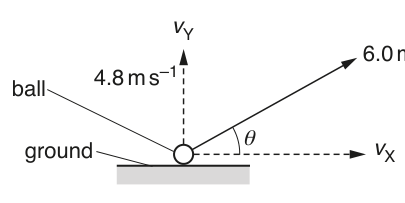
The magnitude of the initial vertical component of the velocity is .
Assume that air resistance is negligible.
Show that the magnitude of the initial horizontal component of the velocity is .
The ball leaves the ground at time and reaches its maximum height at .
On Fig. 1.2, sketch separate lines to show the variation with time , until the ball returns to the ground, of
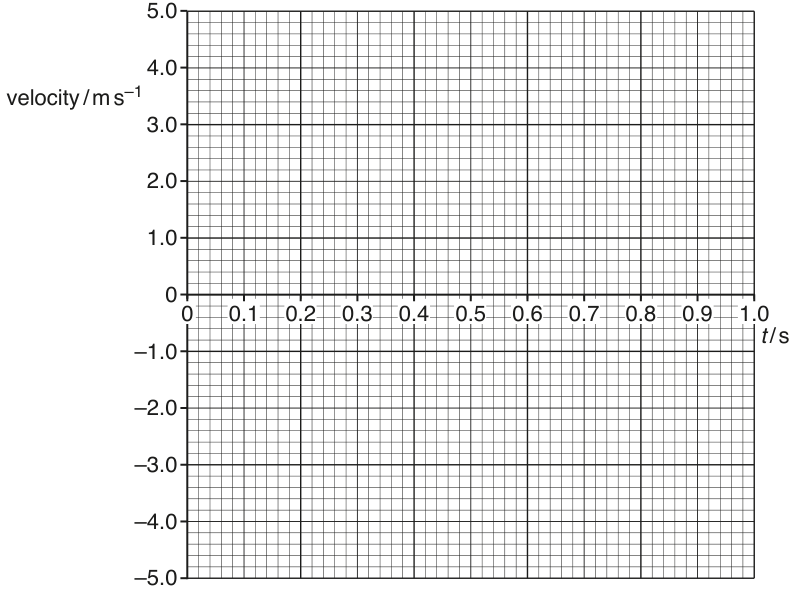
the vertical component of the velocity (label this line Y),
the horizontal component of the velocity (label this line X).
Calculate the maximum height reached by the ball.
maximum height = ______
For the movement of the ball from the ground to its maximum height, determine the ratio
ratio = ______
In practice, significant air resistance acts on the ball. Explain why the actual time taken for the ball to reach maximum height is less than the time calculated when air resistance is assumed to be negligible.
The rest of this paper
7 more questions- Q2Physical Quantities and Units · Forces, Density and Pressure6M
- Q3Dynamics · Forces, Density and Pressure11M
- Q4Waves · Superposition7M
- Q5Superposition5M
- Q6Electricity · D.C. Circuits9M
- Q7Electricity4M
- Q8Particle Physics6M