Physics 9702/21 — May/June 2018
Cambridge AS Level · AS Level Structured Questions · worked solutions for every part, with the mark scheme
Topics Physical Quantities and Units · Kinematics · Dynamics · Work, Energy and Power · Superposition · Deformation of Solids · +5 more
Answer all the questions in the spaces provided.
State what is meant by a scalar quantity and by a vector quantity.
scalar: ______
vector: ______
Answer
Scalar: a quantity with magnitude only.
Vector: a quantity with magnitude and direction.
Scalar: magnitude only. Vector: magnitude and direction.
Background Concept
A physical quantity is something that can be measured and expressed with a number and a unit.
- A scalar quantity is fully described by its magnitude (size) only.
- A vector quantity requires both magnitude and direction to be fully described.
This distinction matters because vectors must be added using vector rules (e.g. triangle/parallelogram methods or components), while scalars add by ordinary arithmetic.
Understanding the Question
You are asked to state what is meant by:
- a scalar quantity
- a vector quantity
So you need short, precise definitions (no examples are required for full credit here).
Approach
Give the defining feature of each:
- scalar → magnitude only
- vector → magnitude + direction
Step-by-Step Reasoning
- Identify what information is needed to specify the quantity.
- If only a size is needed, it is a scalar.
- If you must also specify which way it acts/points, it is a vector.
Key Takeaways
- Scalars: magnitude only.
- Vectors: magnitude and direction.
- Vector operations (addition/resolution) depend on direction.
Common Mistakes
- Saying a vector is “something that moves” (not a definition).
- Giving only examples (e.g. “speed is scalar”) without defining the terms.
- Forgetting to mention direction for a vector.
Things to Be Careful About
- Use the word magnitude explicitly.
- For vectors, include direction (or “has direction”).
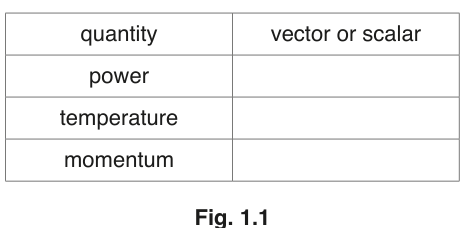
Complete Fig. 1.1 to indicate whether each of the quantities is a vector or a scalar.
| quantity | vector or scalar |
|---|---|
| power | |
| temperature | |
| momentum |
Answer
- power: scalar
- temperature: scalar
- momentum: vector
power: scalar; temperature: scalar; momentum: vector
Background Concept
A scalar has magnitude only; a vector has magnitude and direction.
Some common classifications:
- Temperature has no direction → scalar.
- Power is the rate of energy transfer; energy transfer rate has no direction → scalar.
- Momentum is defined by , and velocity is a vector → momentum is a vector.
Understanding the Question
You must complete the table by stating whether each listed quantity is a vector or a scalar:
- power
- temperature
- momentum
Approach
For each quantity, ask: “Do I need a direction to describe it fully?”
- If no → scalar
- If yes → vector
Step-by-Step Reasoning
- Power: measured in , describes how fast work is done/energy is transferred; no direction is needed → scalar.
- Temperature: measured in or ; no direction → scalar.
- Momentum: , so it points in the same direction as velocity → vector.
Key Takeaways
- Link momentum to velocity: vectors multiplied by scalars remain vectors.
- Rates like power are generally scalars unless explicitly defined with direction (not the case here).
Common Mistakes
- Thinking “power involves motion so it must be a vector” (it does not have a direction).
- Confusing momentum with speed (speed is scalar, velocity is vector).
Things to Be Careful About
- Momentum must be treated as a vector in later questions (e.g. collisions), so always attach direction when required.
An aircraft is travelling in wind. Fig. 1.2 shows the velocities for the aircraft in still air and for the wind.
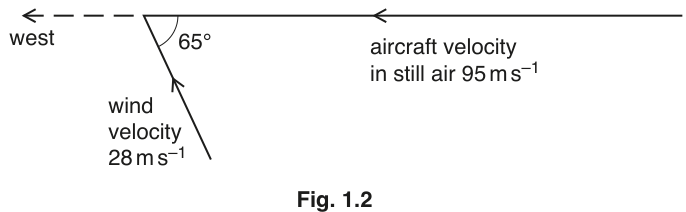
The velocity of the aircraft in still air is to the west.
The velocity of the wind is from south of east.
On Fig. 1.2, draw an arrow, labelled R, in the direction of the resultant velocity of the aircraft.
Answer
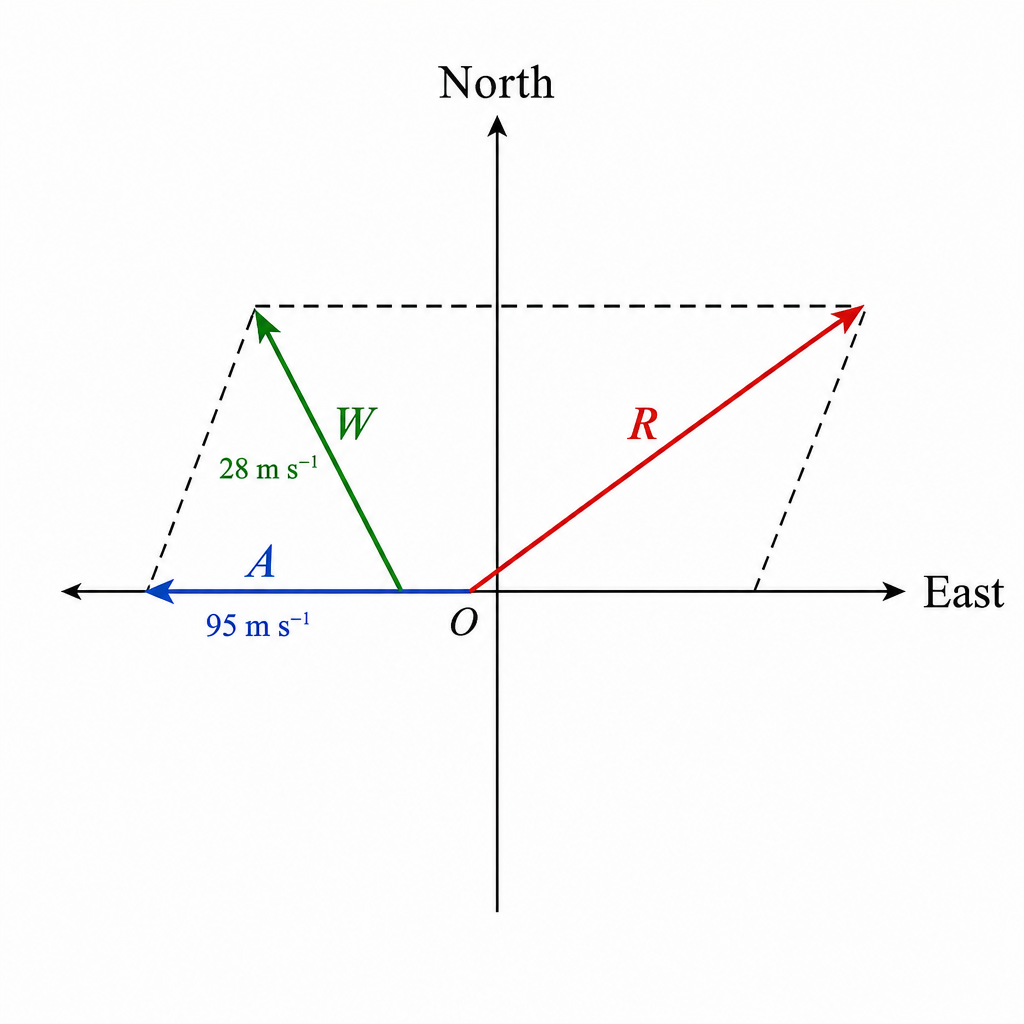
is drawn from the common origin in a direction between the two given velocity vectors (towards the north of west).
Resultant velocity direction is between the two given vectors (north of west).
Background Concept
Velocities are vectors, so the resultant (ground) velocity of the aircraft is found by vector addition:
Graphically, vector addition is done by the head-to-tail method (or parallelogram method). The resultant points from the start of the first vector to the end of the second (when placed head-to-tail).
Understanding the Question
The diagram shows:
- aircraft velocity in still air: to the west
- wind velocity: in the direction shown
You must draw an arrow labelled showing the direction of the resultant aircraft velocity (relative to the ground).
Approach
On the diagram, the resultant must be:
- the vector sum of the two given vectors
- drawn from the same origin (if using the parallelogram method), or from the origin to the final point after a head-to-tail construction
Its direction will lie between the directions of the two vectors being added.
Step-by-Step Reasoning
- Treat both velocities as vectors starting at the same point.
- Construct the parallelogram (or imagine placing one vector at the head of the other).
- The diagonal from the common origin gives the resultant direction.
- Since the aircraft velocity is due west and the wind has a component towards the north of west (as stated/drawn), the resultant points slightly north of west.
Key Takeaways
- Velocities add as vectors, not scalars.
- The resultant direction is found by a vector diagram (triangle/parallelogram).
Common Mistakes
- Adding magnitudes and using that as the resultant direction/magnitude.
- Drawing the resultant along one of the given vectors rather than between them.
- Drawing the resultant from the wrong point (not from the common origin).
Things to Be Careful About
- The arrow must be clearly labelled .
- The direction must correspond to the correct vector sum (diagonal of the parallelogram / start-to-end of head-to-tail addition).
Determine the magnitude of the resultant velocity of the aircraft.
magnitude of velocity = ______
Working
Resolve wind velocity () into components:
Resultant components:
Magnitude:
Answer
1.10 × 10^2 m s^-1
Background Concept
To find the magnitude of the sum of two vectors, a reliable method is to resolve each vector into perpendicular components (often East–West and North–South).
If a vector makes an angle to the horizontal, then:
- horizontal component:
- vertical component:
After adding components in each perpendicular direction, the magnitude of the resultant is found using Pythagoras:
Understanding the Question
Given (from the stem):
- aircraft velocity in still air: to the west
- wind velocity: from south of east (so the wind velocity has components towards west and north, as represented in the vector diagram)
You must determine the magnitude of the aircraft’s resultant velocity (relative to the ground).
Approach
- Choose axes: West–East and North–South.
- Resolve the wind velocity into west/east and north/south components using and .
- Add the wind components to the aircraft’s westward component.
- Use Pythagoras to find the magnitude of the resultant velocity.
Step-by-Step Reasoning
Take west as positive in the horizontal direction and north as positive vertically.
- Aircraft velocity components:
- West component:
- North component:
- Wind velocity components (magnitude , angle ):
Numerically:
- Resultant components:
- Resultant magnitude:
Rounded to 3 s.f.:
Key Takeaways
- Use components to add vectors cleanly.
- Add components in each perpendicular direction separately.
- Use Pythagoras to find the magnitude of the resultant.
Common Mistakes
- Using and the wrong way round for the chosen angle.
- Adding and directly (treating vectors as scalars).
- Forgetting that the resultant magnitude needs Pythagoras after finding components.
Things to Be Careful About
- Check that your angle is measured from the axis you are using (horizontal vs vertical).
- Keep units throughout and give the final answer in .
- Round appropriately (typically 2–3 significant figures).
The rest of this paper
6 more questions- Q2Dynamics · Kinematics · Work, Energy and Power · Deformation of Solids15M
- Q3Dynamics9M
- Q4Waves · Superposition8M
- Q5Superposition5M
- Q6Electricity · D.C. Circuits10M
- Q7Electric Fields · Work, Energy and Power · Physical Quantities and Units · Particle Physics6M