Physics 9702/35 — May/June 2017
Cambridge AS Level · Advanced Practical Skills · worked solutions for every part, with the mark scheme
Topics Manipulation, Measurement and Observation · Presentation of Data and Observations · Analysis, Conclusions and Evaluation
In this experiment, you will investigate the motion of a supported copper wire.
You have been provided with a copper wire and two spheres of modelling clay.
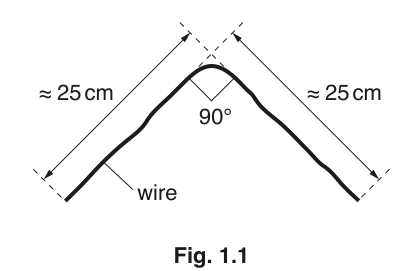
Bend the wire about its midpoint so that the two lengths are perpendicular to each other, as shown in Fig. 1.1.
Push each end of the wire through the centre of a sphere of modelling clay. Place the spheres approximately half-way along each length of the wire as shown in Fig. 1.2.
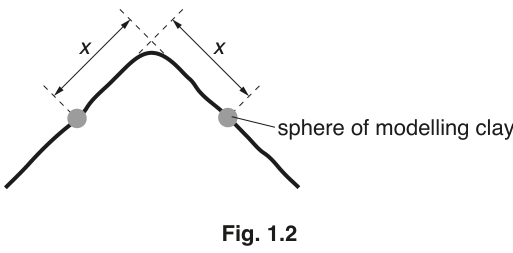
The centres of the spheres should each be the same distance from the midpoint of the wire. Gently press the modelling clay onto the wire to ensure the spheres stay in position.
Measure and record the distance from the midpoint of the wire to the centre of a sphere.
= ______
Set up the apparatus as shown in Fig. 1.3.
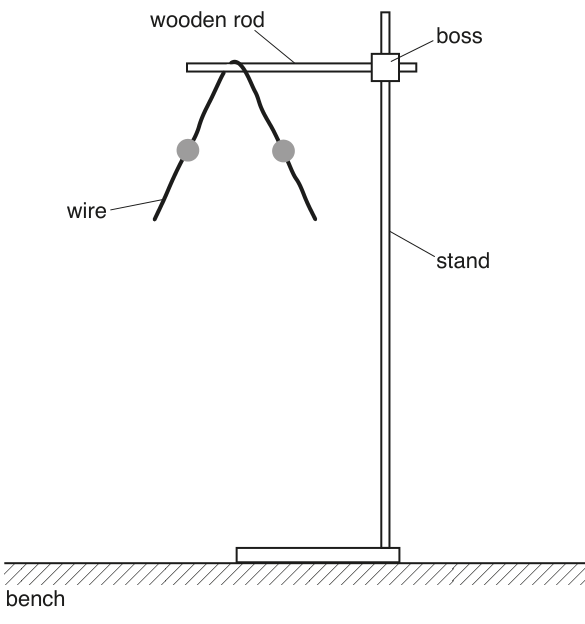
Move one end of the wire down through a short distance. Release the wire. The wire will oscillate. Determine the period of these oscillations.
= ______
Vary and repeat (a)(iii) and (b) until you have six sets of values of and . Record your results in a table. Include values of in your table.
Plot a graph of on the -axis against on the -axis.
Draw the straight line of best fit.
Determine the gradient and -intercept of this line.
gradient = ______
-intercept = ______
It is suggested that the quantities and are related by the equation
where and are constants.
Using your answers in (d)(iii), determine the values of and . Give appropriate units.
= ______
= ______
Remove the spheres from the wire.
Repeat (b)(ii).
= ______
Calculate the value of that corresponds to the value of in (f)(ii).
= ______
The rest of this paper
1 more questions- Q2Manipulation, Measurement and Observation · Analysis, Conclusions and Evaluation · Presentation of Data and Observations20M