Physics 9702/35 — October/November 2016
Cambridge AS Level · Advanced Practical Skills · worked solutions for every part, with the mark scheme
Topics Manipulation, Measurement and Observation · Analysis, Conclusions and Evaluation · Presentation of Data and Observations
In this experiment, you will investigate the motion of a bottle in water.
You have been provided with a bottle with a mass attached, a measuring cylinder, a jug of water and a large cylindrical container of water.
Use water from the jug and the measuring cylinder to determine the maximum volume of water held by the bottle.
Record .
()
= ______
Return any water to the jug.
Do not change the volume of water in the large cylindrical cylinder.
Add volume of water to the bottle where is approximately .
Record .
= ______
Screw the cap on the bottle so that no water leaks out of the bottle when the bottle is inverted.
Place both rubber bands around the top of the large cylindrical container.
Gently push the bottle into the water in the large cylindrical container until the top is just on the water surface as shown in Fig. 1.1.
Keep the bottle in this position using one hand.
Use your other hand to slide one of the rubber bands down so that it is level with the bottom of the mass.
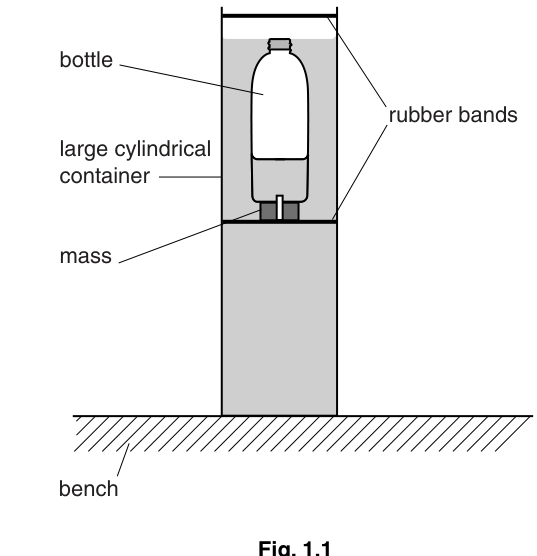
Release the bottle. The bottle will move upwards and then move downwards.
Place the other rubber band so that it is level with the highest position of the bottom of the mass as shown in Fig. 1.2. You should repeat this several times before you decide on the position of this rubber band.
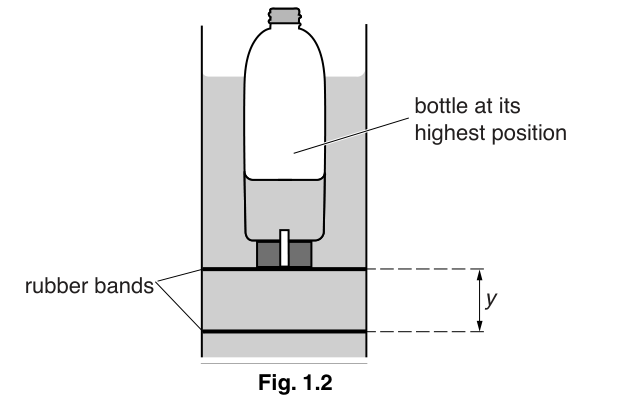
The maximum distance moved upwards by the bottle is as shown in Fig. 1.2.
Measure and record .
= ______
Calculate .
= ______
Increase and repeat (b)(ii), (b)(iii), (c)(ii), (c)(iv) and (c)(v) until you have six sets of values of and .
Do not use a value of greater than .
Plot a graph of on the -axis against on the -axis.
Draw the straight line of best fit.
Determine the gradient and -intercept of this line.
gradient = ______
-intercept = ______
The quantities and are related by the equation
where and are constants.
Using your answers in (e)(iii), determine the values of and .
Give appropriate units.
= ______
= ______
Use your values from (f) to calculate the value of when .
= ______
Explain why it is impossible to repeat the experiment using the value of calculated in (g)(i).
The rest of this paper
1 more questions- Q2Manipulation, Measurement and Observation · Analysis, Conclusions and Evaluation · Presentation of Data and Observations20M