Physics 9702/23 — October/November 2016
Cambridge AS Level · AS Level Structured Questions · worked solutions for every part, with the mark scheme
Topics Forces, Density and Pressure · Physical Quantities and Units · Electric Fields · Kinematics · Deformation of Solids · Work, Energy and Power · +6 more
Answer all the questions in the spaces provided.
Define density.
Answer
Density is mass per unit volume:
Density is mass per unit volume, (\rho = m/V).
Background Concept
Density describes how much mass is contained in a given volume.
It is defined by
where is mass (in ) and is volume (in ). The SI unit of density is .
Understanding the Question
You are asked to define density, so you should give the meaning in words or the defining equation (or both). No calculation is needed.
Approach
Use the standard definition: density equals mass divided by volume.
Step-by-Step Reasoning
- Identify the physical quantities involved: mass and volume .
- Write the defining relationship: .
- (Optional but helpful) State in words: “mass per unit volume”.
Key Takeaways
- Density is a ratio of mass to volume.
- SI unit: .
Common Mistakes
- Writing (inverting the definition).
- Giving only a unit without a definition.
Things to Be Careful About
- Use correct symbols: density is .
- If giving the equation, ensure it is clearly a definition (not a rearranged or unrelated formula).
The mass of a metal sphere is given by the expression
where is the density of the metal and is the diameter of the sphere.
Data for the density and the mass are given in Fig. 1.1.
| quantity | value | uncertainty |
|---|---|---|
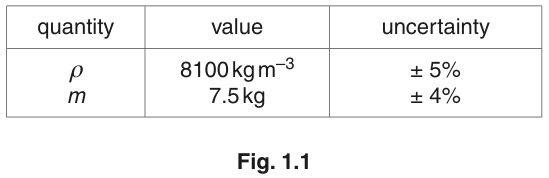
Calculate the diameter .
= ______
Working
Answer
0.121 m
Background Concept
For a sphere of diameter , the volume is
Mass is related to density by
Combining these gives the provided formula:
Understanding the Question
You are given and and asked to calculate the diameter using
This part (i) is just the numerical value of (no uncertainty yet).
Approach
Rearrange the equation to make the subject:
- Isolate .
- Take the cube root to obtain .
- Substitute the given values (already in SI units).
Step-by-Step Reasoning
Start with
Multiply both sides by and divide by :
Now take the cube root:
Substitute and :
Evaluating gives
The unit is metres because the density is in and mass in , so the volume comes out in and hence in .
Key Takeaways
- For relationships like , you must take a cube root at the end.
- Keep units consistent (SI) to avoid hidden conversion errors.
Common Mistakes
- Forgetting the cube root and leaving the answer as .
- Using radius instead of diameter (the formula already uses diameter).
- Calculator error with brackets (e.g. not dividing by correctly).
Things to Be Careful About
- Ensure is in the denominator together.
- Quote the final with a sensible number of significant figures (typically 2–3 here).
Use your answer in (i) and the data in Fig. 1.1 to determine the value of , with its absolute uncertainty, to an appropriate number of significant figures.
= ______ ______
Working
Percentage uncertainty in :
So percentage uncertainty in :
Absolute uncertainty:
Answer
0.121 ± 0.004 m
Background Concept
When a quantity is calculated from measured values, its uncertainty must be propagated.
Key rules (worst-case addition of fractional/percentage uncertainties, as used in A Level):
- For multiplication or division, percentage uncertainties add.
- For a power , the percentage uncertainty multiplies by .
Here,
The constants and are treated as exact, so only uncertainties in and contribute.
Understanding the Question
You already found in (i). Now you must:
- Use the given uncertainties in () and ().
- Find the absolute uncertainty in .
- Quote to an appropriate number of significant figures.
Approach
- Simplify the dependence: .
- Combine percentage uncertainties for by addition.
- Apply the power rule for the cube root (power ).
- Convert percentage uncertainty in into absolute uncertainty using .
- Round the uncertainty (usually 1 s.f.), then round to the same decimal place.
Step-by-Step Reasoning
From
we note
1) Uncertainty in the ratio
For division, percentage uncertainties add:
2) Uncertainty in
For a power, multiply the percentage uncertainty by the power:
This makes sense physically: taking a cube root reduces the relative uncertainty.
3) Convert to absolute uncertainty
Using from part (i):
Round the uncertainty to 1 significant figure:
Then quote to the same decimal place (thousandths of a metre):
So
Key Takeaways
- For , add uncertainties for , then divide by 3 for the cube root.
- Convert percentage uncertainty to absolute using .
- Round uncertainty first, then round the value to match its decimal place.
Common Mistakes
- Subtracting percentage uncertainties for a division (they should be added for worst-case).
- Forgetting to multiply by for the cube root.
- Giving a percentage uncertainty when the question asks for absolute uncertainty.
- Rounding and to inconsistent decimal places (e.g. ).
Things to Be Careful About
- Do not include uncertainty contributions from constants like and 6.
- Ensure the final value and its uncertainty are quoted in metres.
- Keep rounding sensible: typically to 1 s.f. and to the same decimal place as .
The rest of this paper
6 more questions- Q2Electric Fields · Kinematics12M
- Q3Deformation of Solids · Work, Energy and Power12M
- Q4Waves · Measurement Techniques8M
- Q5Superposition7M
- Q6Electricity · D.C. Circuits9M
- Q7Particle Physics7M