Physics 9702/22 — May/June 2016
Cambridge AS Level · AS Level Structured Questions · worked solutions for every part, with the mark scheme
Topics Electricity · Kinematics · Work, Energy and Power · Dynamics · Forces, Density and Pressure · Deformation of Solids · +6 more
Define acceleration.
Answer
Acceleration is the rate of change of velocity with time (change in velocity per unit time).
Rate of change of velocity with time.
Background Concept
Acceleration describes how quickly velocity changes. Velocity is a vector (it has direction), so acceleration is also a vector.
Mathematically, the (average) acceleration is
where is the change in velocity in time interval .
Understanding the Question
The question asks for the definition of acceleration (1 mark). This means you must state what acceleration measures, not calculate anything.
Approach
Write the standard definition used in kinematics: “change in velocity per unit time” or “rate of change of velocity”.
Step-by-Step Reasoning
- Identify the quantity: acceleration.
- Recall that acceleration links velocity and time.
- State it clearly in words: rate of change of velocity with time.
Key Takeaways
- Acceleration is about how velocity changes, not how position changes.
- A correct definition usually includes “change in velocity” and “per unit time / with time”.
Common Mistakes
- Saying “rate of change of speed” (speed is scalar; acceleration is defined via velocity).
- Defining it as “increase in velocity” (velocity may decrease or change direction).
Things to Be Careful About
- Use “velocity” not “speed” to be fully correct at A Level.
- Do not include units in a definition unless asked; words are sufficient here.
A man travels on a toboggan down a slope covered with snow from point A to point B and then to point C. The path is illustrated in Fig. 1.1.
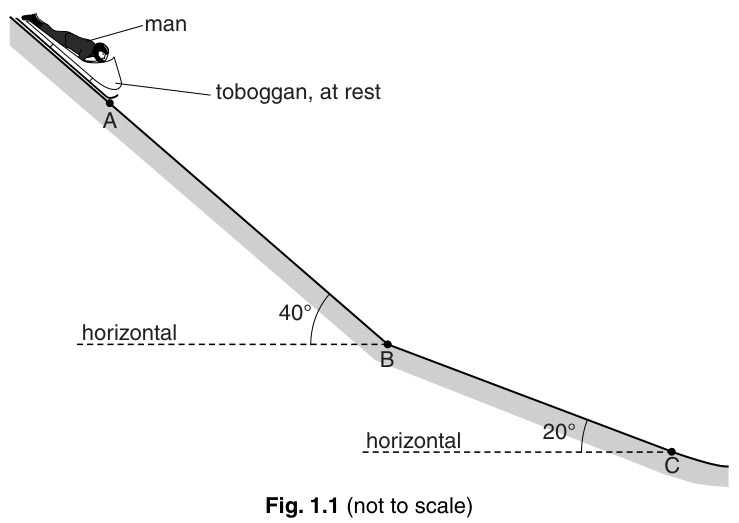
The slope AB makes an angle of with the horizontal and the slope BC makes an angle of with the horizontal. Friction is not negligible.
The man and toboggan have a combined mass of .
The man starts from rest at A and has constant acceleration between A and B. The man takes to reach B. His speed is at B.
Calculate the acceleration from A to B.
acceleration = ______
Working
From rest, , , .
Answer
1.9 m s^-2
Background Concept
For motion with constant acceleration, acceleration is defined by
where is initial velocity, is final velocity, and is the time taken.
Understanding the Question
Between A and B, the toboggan starts from rest and reaches a speed of in , with constant acceleration. The question asks for that acceleration.
Approach
Use the definition of acceleration for constant acceleration:
- Identify , , and .
- Substitute into .
Step-by-Step Reasoning
- Starts from rest, so .
- Final speed at B is .
- Time to reach B is .
To 2 significant figures (matching the data),
Key Takeaways
- Constant acceleration lets you use simple kinematics relations.
- Always check you have consistent units (here, SI already).
Common Mistakes
- Using without stating (works here but can be unsafe in general).
- Rounding too early (keep extra digits until the end).
Things to Be Careful About
- “Speed” is the magnitude of velocity; since motion is along the slope, treating it as 1D is fine.
- Give the unit for acceleration.
Show that the distance moved from A to B is .
Working
Constant acceleration:
Answer
340 m
Background Concept
For constant acceleration, the displacement can be found from the mean velocity:
and
This works because with uniform acceleration, velocity increases linearly with time.
Understanding the Question
You are asked to show that the distance from A to B is , using the information already given for motion from rest to in .
Approach
Use
with , , , then round to the stated value .
Step-by-Step Reasoning
- Since the acceleration is constant, the average speed over the interval is the average of initial and final speeds.
- Distance is average speed times time:
- The question says “show that” it is , so we round appropriately:
Key Takeaways
- For uniform acceleration, is often the quickest route.
- “Show that” questions usually expect an approximate match after rounding.
Common Mistakes
- Using with (that would assume constant velocity, not acceleration).
- Rounding too much in part (i) and then using to get a poor value.
Things to Be Careful About
- Keep at least 3 significant figures in intermediate steps if you use .
- Ensure you are calculating distance along the slope, not vertical height (height is needed later).
For the man and toboggan moving from A to B, calculate
- the change in kinetic energy,
change in kinetic energy = ______
- the change in potential energy.
change in potential energy = ______
Working
- Change in kinetic energy:
- Change in potential energy (vertical drop , with ):
Answer
ΔEk = 6.2×10^4 J; ΔEp = −2.0×10^5 J
Background Concept
Two key energy expressions are used here:
- Kinetic energy:
- Gravitational potential energy (near Earth’s surface):
A change in gravitational potential energy depends on the vertical height change , not the distance travelled along the slope.
Understanding the Question
From A to B:
- Mass of man + toboggan: .
- Starts from rest: .
- Speed at B: .
- Slope angle: to the horizontal.
- Distance along the slope A to B (from part (ii)): .
You must calculate:
- the increase in kinetic energy from A to B,
- the change in gravitational potential energy from A to B.
Approach
- Use .
- Find the vertical drop using the slope geometry: .
- Then use (negative because the toboggan loses height).
Step-by-Step Reasoning
1) Change in kinetic energy
At A, so initial kinetic energy is zero.
Compute :
2) Change in potential energy
The distance is along the slope; convert to vertical drop using trigonometry:
Now compute the loss of gravitational potential energy:
Negative sign indicates a decrease in potential energy.
Key Takeaways
- depends on speed change.
- depends only on vertical height change, not slope length.
- A downhill motion gives a negative .
Common Mistakes
- Using instead of .
- Giving as positive when the object moves downwards.
- Using in one step and in another without consistency (either is fine if rounded consistently).
Things to Be Careful About
- Keep enough significant figures during intermediate calculations to avoid rounding errors.
- State energies in joules and use (or consistent value).
Use your answers in (iii) to determine the average frictional force that acts on the toboggan between A and B.
frictional force = ______
Working
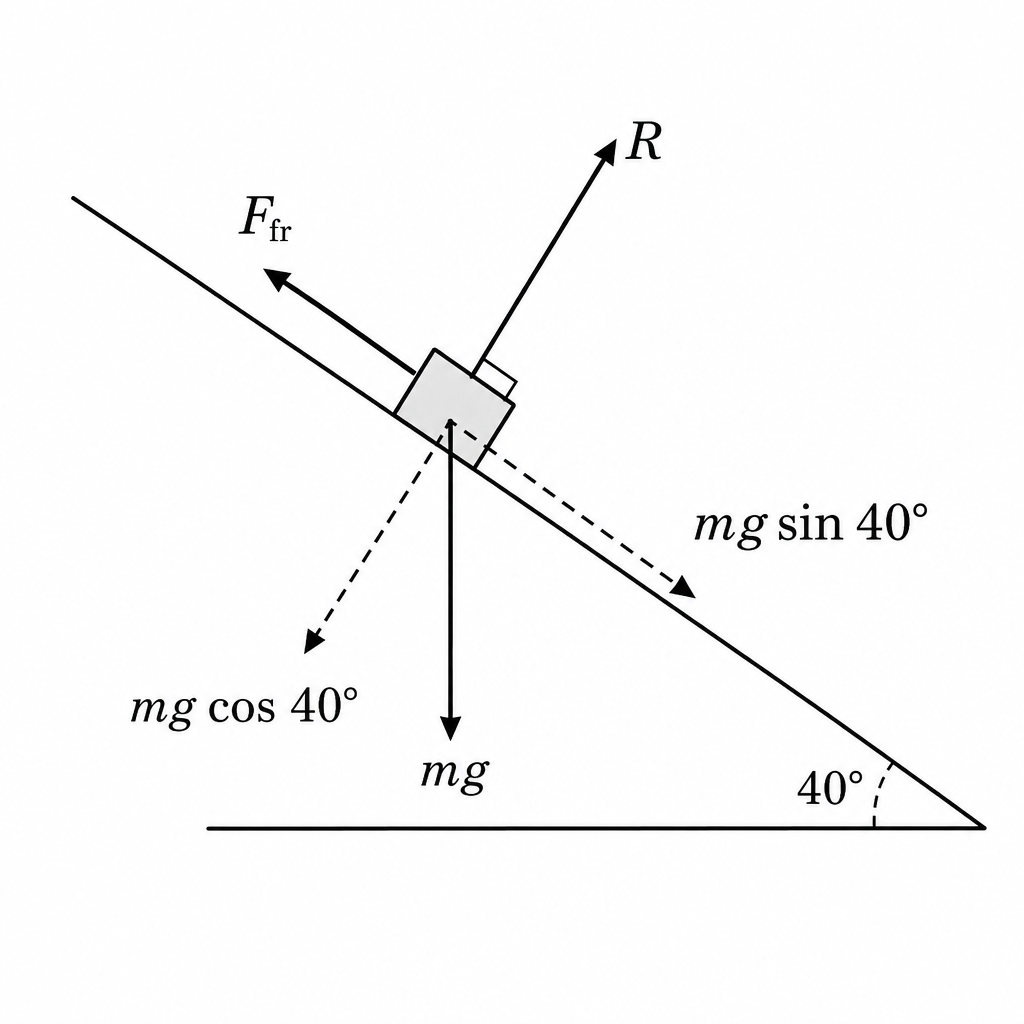
Loss of GPE provides gain in KE and work done against friction:
Using (iii):
Answer
4.2×10^2 N
Background Concept
When friction is present, mechanical energy is not conserved, but total energy is. The loss of gravitational potential energy becomes:
- an increase in kinetic energy, and
- energy dissipated as thermal energy / sound due to friction.
Work done against friction is
where is the distance moved along the surface.
Understanding the Question
From A to B, you have already found:
- increase in kinetic energy ,
- decrease in potential energy (negative),
- distance along slope .
You are asked for the average frictional force between A and B.
Approach
- Find the energy dissipated by friction:
- Convert this work to an average friction force using .
Step-by-Step Reasoning
Because the toboggan goes down the slope, it loses gravitational potential energy. If there were no friction, all of that loss would become kinetic energy.
But friction is present, so the kinetic energy gained is smaller than the potential energy lost.
- Magnitude of potential energy loss: .
- Kinetic energy gain: .
So the “missing” energy is what friction has removed:
Substitute values from (iii):
Then use :
Key Takeaways
- With friction, .
- Average friction force can be found from dissipated energy divided by distance.
Common Mistakes
- Adding energies instead of subtracting: using .
- Forgetting that is negative and mishandling signs.
- Using vertical height instead of slope distance in (friction acts along the slope).
Things to Be Careful About
- The question asks for an average frictional force: you assume friction is approximately constant or use average work/average force.
- Make sure used in is the distance along AB (here ).
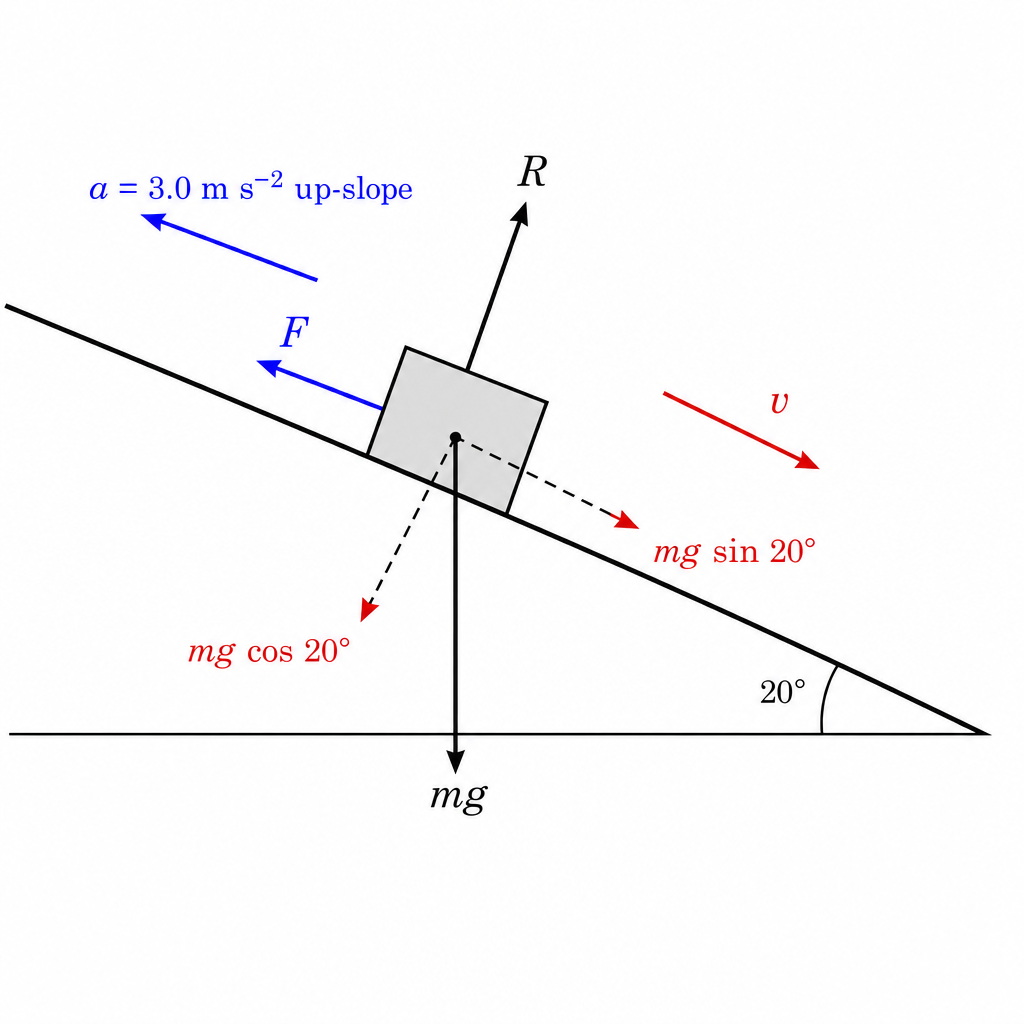
A parachute opens on the toboggan as it passes point B. There is a constant deceleration of from B to C.
Calculate the frictional force that produces this deceleration between B and C.
frictional force = ______
Working
Take down the slope as positive. Along BC:
with .
Answer
6.0×10^2 N
Background Concept
For motion on an inclined plane, the component of weight down the slope is
Resistive forces (friction + air resistance from a parachute) act opposite the direction of motion.
Newton’s second law along the slope is
where the sign of depends on your chosen positive direction.
Understanding the Question
From B to C:
- The slope angle is to the horizontal.
- Mass .
- The toboggan is still moving down the slope but is decelerating at a constant rate of .
You must find the frictional (resistive) force causing this deceleration.
Approach
- Choose a positive direction (most naturally: down the slope).
- Write the force balance along the slope: weight component minus resistive force equals .
- Use because acceleration is up the slope when the motion is down the slope.
- Solve for the resistive force.
Step-by-Step Reasoning
Let down-slope be positive.
Forces along the slope:
- Down slope: .
- Up slope: resistive force .
Newton’s second law:
The toboggan is slowing down while moving down the slope, so acceleration is up the slope, hence .
Rearrange:
Now substitute values:
So
Key Takeaways
- Deceleration means acceleration is opposite to velocity.
- On a slope, always resolve weight into components parallel and perpendicular to the plane.
- Use a consistent sign convention when applying .
Common Mistakes
- Taking while also choosing down-slope as positive (sign error).
- Using instead of for the downslope component.
- Forgetting that the resistive force must be larger than to produce an up-slope acceleration.
Things to Be Careful About
- The frictional force here effectively includes parachute drag (a resistive force). The question still calls it “frictional force”, but it is the total resistive force along the slope.
- Quote the answer with a sensible number of significant figures (typically 2 s.f. to match and angles).
The rest of this paper
7 more questions- Q2Forces, Density and Pressure6M
- Q3Deformation of Solids5M
- Q4Waves · Physical Quantities and Units10M
- Q5Superposition6M
- Q6Electric Fields · Electricity5M
- Q7Electricity · D.C. Circuits10M
- Q8Particle Physics6M