Physics 9702/31 — October/November 2015
Cambridge AS Level · Advanced Practical Skills · worked solutions for every part, with the mark scheme
Topics Manipulation, Measurement and Observation · Presentation of Data and Observations · Analysis, Conclusions and Evaluation
In this experiment, you will investigate the effect of air resistance on the motion of a circular card.
Use the compasses to draw a circle of approximate diameter on the card.
Use the scissors to cut out the circle.
Make a hole in the centre of the circle with the compasses. The hole should be big enough for the hook of the mass hanger to pass through.
Measure and record the diameter of the card as shown in Fig. 1.1.
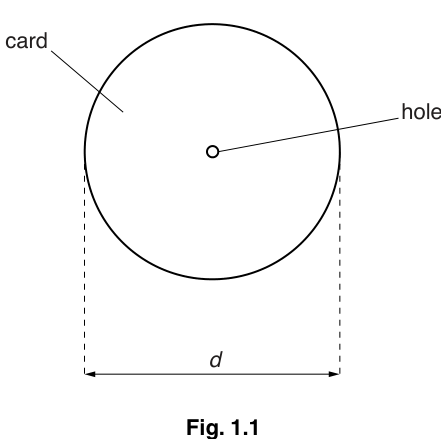
= ______
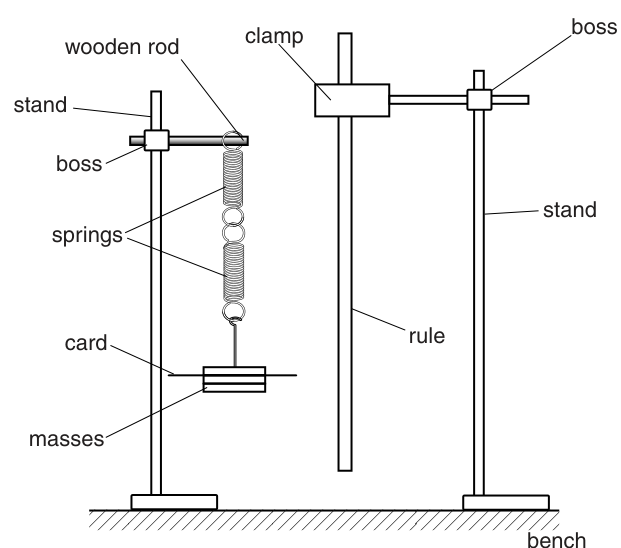
Set up the apparatus as shown in Fig. 1.2.
The rule should have a mark at the bottom and a mark at the top.
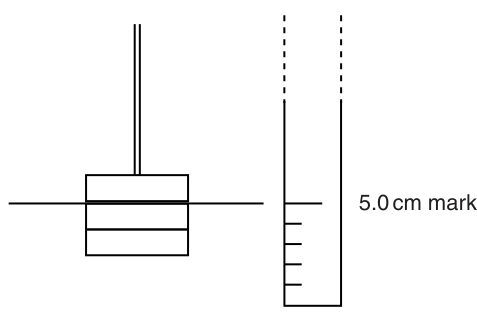
Adjust the rule until the mark is level with the card as shown in Fig. 1.3.
Pull the masses down so that the card is level with the mark as shown in Fig. 1.4.
Release the masses and watch the movement of the masses and card. They will move up and down.
When the card returns to its lowest point for the first time, it has completed one cycle as shown in Fig. 1.4.
Gradually the card moves less and less and does not move down as far as the mark.
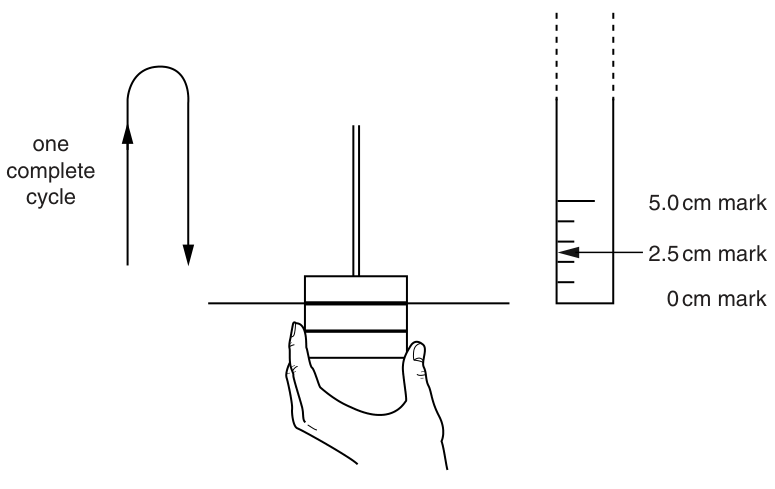
Pull the masses down so that the card is again level with the mark. Release the masses and count the number of cycles for the card to reach the mark at its lowest point.
= ______
Remove the card from the mass hanger.
Use the compasses to draw a circle of approximate diameter on the card.
Use the scissors to cut out the circle.
Measure and record the diameter of the card.
= ______
Repeat (b) and (c).
= ______
Cut smaller circles and repeat (b) and (c) until you have six sets of values of and .
Include in your table the two sets of values already taken.
Also include values of and in your table.
Plot a graph of on the -axis against on the -axis.
Draw the straight line of best fit.
Determine the gradient and -intercept of this line.
gradient = ______
-intercept = ______
It is suggested that the quantities and are related by the equation
where and are constants.
Using your answers in (f)(iii), determine the values of and .
Give appropriate units.
= ______
= ______
The rest of this paper
1 more questions- Q2Manipulation, Measurement and Observation · Presentation of Data and Observations · Analysis, Conclusions and Evaluation20M